
Anticholinesterases
&
Anticholinergics
Mr. Harshad Khade
MSc. Medical Technology (OTA)
Symbiosis International University, Pune.
Anticholinesterases
• Anticholinsterases are chemicals that prevent the breakdown of the
neurotransmitter acetylcholine or butyrylcholine.
• This increases the amount of the acetylcholine or butyrylcholine in the
synaptic cleft that can bind to muscarinic receptors, nicotinic receptors
and others.
• Anticholinesterases inhibit all types of cholinesterase and are
classified as Prosthetic (e.g. edrophenium) and Acid Transfering (E.g.
neostigmine).
• To Countract the muscarinic effects, anticholinesterases are given in
combination with muscarinic antagonists such as Atropine,
Glycopyronium or hyoscine.
Neostigmine
Class
• Anticholinesterase.
Uses
• For the reversal of non-depolarizing neuromuscular blockade and in the
treatment of
• Myasthenia gravis
• Paralytic ileus and
• Urinary retention.
Main actions Cholinergic.
Presentation
• As 15 mg tablets of neostigmine bromide and as a clear, colourless
solution for injection containing 2.5 mg/ml of neostigmine metilsulfate.
• A fixed-dose combination containing 0.5 mg of glycopyrronium bromide
and 2.5 mg of neostigmine metilsulfate per ml is also available.
Mode of action
• Neostigmine is a reversible, acid-transferring cholinesterase inhibitor
which binds to the esteratic site of acetylcholinesterase and is hydrolysed
by the latter, but at a much slower rate than is acetylcholine.
• The accumulation of acetylcholine at the neuromuscular junction allows
the competitive antagonism of any non-depolarizing relaxant that may be
present.
Routes of administration/doses
• The adult oral dose is 15–50 mg 2- to 4-hourly.
• The intravenous dose for the reversal of non-depolarizing neuromuscular blockade is
0.05–0.07 mg/kg, administered slowly and in combination with an appropriate dose of
an anticholinergic agent.
• The peak effect of the drug when administered intravenously occurs at 7–11 minutes;
a single dose of neostigmine has a duration of action of 40–60 minutes.
• Dose
• For reversal of neuromuscular blockade: 0.05 mg/kg
• Dose should not exceed 5 mg
• Must be administered with with atropine 0.015 mg/kg or glycopyrrolate 0.01 mg/kg
• Onset 5 minutes
• Duration 55-75 minutes
• Elimination Hepatic, plasma esterases
Effects
• Most of neostigmine’s effects are related to its cholinergic action.
• It must be given with an anticholinergic (atropine or more commonly
glycopyrrolate) in order to minimize these effects.
• CNS Seizures
• CVS Bradycardia, AV block, nodal rhythm, hypotension
• Respiratory Increased oral and bronchial secretions, bronchospasm
• GI/GU Increased peristalsis, urinary frequency
• Misc.
• Overdose may produce cholinergic crisis. Neostigmine does not
antagonize succinylcholine and may prolong phase 1 block of
succinylcholine.
Anticholinergics
• Anticholinergics are drugs that blocks the actions of acetylcholine.
• Acetylcholin is a neurotransmitter, or a chemical messanger.
• This agents inhibits the parasympathetic nervous system by selectively
blocking the binding of ach to its receptors in nerve cells.
• In broad terms, anticholinergics are divided in to two categories
accordance with there specific targets in the central and peripheral
nervous system and at the neuromuscular junctions
• Antimuscarinic agents
• Antinicotenic agents
Glycopyrrolate
(Glycopyrronium Bromide)
Class
• Anticholinergic
Uses
1. In premedication where an antisialogogue action is desired
2.To protect against the peripheral muscarinic effects of anticholinesterases
3. For the treatment of bradycardias in anaesthetized patients
4. For the treatment of hyperhydrosis (via topical administration) and
5. For symptom control in palliative care.
Main action
Anticholinergic; Glycopyrronium bromide has a particularly profound anti-
secretory action.
Presentation
• As a clear solution for injection containing 0.2 mg/ml of glycopyrronium
bromide and as a powder for topical application.
• It is also supplied in a fixed-dose combination containing 0.5 mg of
glycopyrronium bromide and 2.5 mg of neostigmine per ml.
Mode of action
• Glycopyrronium bromide acts by competitive antagonism of
acetylcholine at peripheral muscarinic receptors.
Routes of administration/doses
• The adult intravenous and intramuscular dose is 0.2–0.4 mg; the
paediatric dose is 4–10 micrograms/kg.
• The peak effect occurs 3 minutes after intravenous injection.
Dose
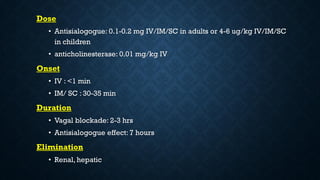
• Antisialogogue: 0.1-0.2 mg IV/IM/SC in adults or 4-6 ug/kg IV/IM/SC
in children
• anticholinesterase: 0.01 mg/kg IV
Onset
• IV : <1 min
• IM/ SC : 30-35 min
Duration
• Vagal blockade: 2-3 hrs
• Antisialogogue effect: 7 hours
Elimination
• Renal, hepatic
Effects
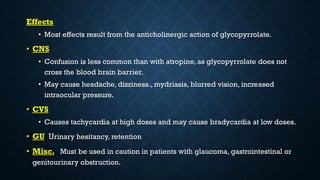
• Most effects result from the anticholinergic action of glycopyrrolate.
• CNS
• Confusion is less common than with atropine, as glycopyrrolate does not
cross the blood brain barrier.
• May cause headache, dizziness., mydriasis, blurred vision, increased
intraocular pressure.
• CVS
• Causes tachycardia at high doses and may cause bradycardia at low doses.
• GU Urinary hesitancy, retention
• Misc. Must be used in caution in patients with glaucoma, gastrointestinal or
genitourinary obstruction.
Atropine
(Atropine Sulfate)
Class
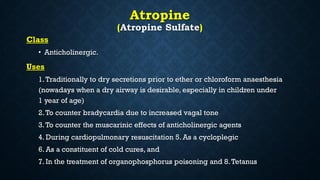
• Anticholinergic.
Uses
1.Traditionally to dry secretions prior to ether or chloroform anaesthesia
(nowadays when a dry airway is desirable, especially in children under
1 year of age)
2.To counter bradycardia due to increased vagal tone
3.To counter the muscarinic effects of anticholinergic agents
4. During cardiopulmonary resuscitation 5. As a cycloplegic
6. As a constituent of cold cures, and
7. In the treatment of organophosphorus poisoning and 8.Tetanus
Presentation
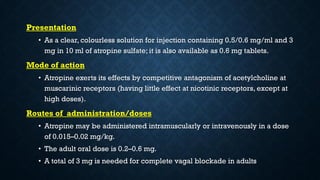
• As a clear, colourless solution for injection containing 0.5/0.6 mg/ml and 3
mg in 10 ml of atropine sulfate; it is also available as 0.6 mg tablets.
Mode of action
• Atropine exerts its effects by competitive antagonism of acetylcholine at
muscarinic receptors (having little effect at nicotinic receptors, except at
high doses).
Routes of administration/doses
• Atropine may be administered intramuscularly or intravenously in a dose
of 0.015–0.02 mg/kg.
• The adult oral dose is 0.2–0.6 mg.
• A total of 3 mg is needed for complete vagal blockade in adults
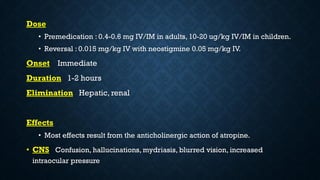
Dose
• Premedication : 0.4-0.6 mg IV/IM in adults, 10-20 ug/kg IV/IM in children.
• Reversal : 0.015 mg/kg IV with neostigmine 0.05 mg/kg IV.
Onset Immediate
Duration 1-2 hours
Elimination Hepatic, renal
Effects
• Most effects result from the anticholinergic action of atropine.
• CNS Confusion, hallucinations, mydriasis, blurred vision, increased
intraocular pressure
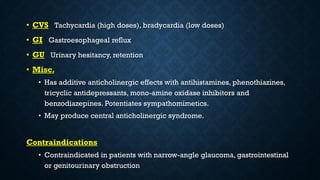
• CVS Tachycardia (high doses), bradycardia (low doses)
• GI Gastroesophageal reflux
• GU Urinary hesitancy, retention
• Misc.
• Has additive anticholinergic effects with antihistamines, phenothiazines,
tricyclic antidepressants, mono-amine oxidase inhibitors and
benzodiazepines. Potentiates sympathomimetics.
• May produce central anticholinergic syndrome.
Contraindications
• Contraindicated in patients with narrow-angle glaucoma, gastrointestinal
or genitourinary obstruction
“
”
Thank You
(+91) 8087788417

Anticholinesterases & Anticholinergics

  • 1.
    Anticholinesterases & Anticholinergics Mr. Harshad Khade MSc.Medical Technology (OTA) Symbiosis International University, Pune.
  • 2.
    Anticholinesterases • Anticholinsterases arechemicals that prevent the breakdown of the neurotransmitter acetylcholine or butyrylcholine. • This increases the amount of the acetylcholine or butyrylcholine in the synaptic cleft that can bind to muscarinic receptors, nicotinic receptors and others. • Anticholinesterases inhibit all types of cholinesterase and are classified as Prosthetic (e.g. edrophenium) and Acid Transfering (E.g. neostigmine). • To Countract the muscarinic effects, anticholinesterases are given in combination with muscarinic antagonists such as Atropine, Glycopyronium or hyoscine.
  • 3.
    Neostigmine Class • Anticholinesterase. Uses • Forthe reversal of non-depolarizing neuromuscular blockade and in the treatment of • Myasthenia gravis • Paralytic ileus and • Urinary retention. Main actions Cholinergic.
  • 4.
    Presentation • As 15mg tablets of neostigmine bromide and as a clear, colourless solution for injection containing 2.5 mg/ml of neostigmine metilsulfate. • A fixed-dose combination containing 0.5 mg of glycopyrronium bromide and 2.5 mg of neostigmine metilsulfate per ml is also available. Mode of action • Neostigmine is a reversible, acid-transferring cholinesterase inhibitor which binds to the esteratic site of acetylcholinesterase and is hydrolysed by the latter, but at a much slower rate than is acetylcholine. • The accumulation of acetylcholine at the neuromuscular junction allows the competitive antagonism of any non-depolarizing relaxant that may be present.
  • 5.
    Routes of administration/doses •The adult oral dose is 15–50 mg 2- to 4-hourly. • The intravenous dose for the reversal of non-depolarizing neuromuscular blockade is 0.05–0.07 mg/kg, administered slowly and in combination with an appropriate dose of an anticholinergic agent. • The peak effect of the drug when administered intravenously occurs at 7–11 minutes; a single dose of neostigmine has a duration of action of 40–60 minutes. • Dose • For reversal of neuromuscular blockade: 0.05 mg/kg • Dose should not exceed 5 mg • Must be administered with with atropine 0.015 mg/kg or glycopyrrolate 0.01 mg/kg • Onset 5 minutes • Duration 55-75 minutes • Elimination Hepatic, plasma esterases
  • 6.
    Effects • Most ofneostigmine’s effects are related to its cholinergic action. • It must be given with an anticholinergic (atropine or more commonly glycopyrrolate) in order to minimize these effects. • CNS Seizures • CVS Bradycardia, AV block, nodal rhythm, hypotension • Respiratory Increased oral and bronchial secretions, bronchospasm • GI/GU Increased peristalsis, urinary frequency • Misc. • Overdose may produce cholinergic crisis. Neostigmine does not antagonize succinylcholine and may prolong phase 1 block of succinylcholine.
  • 7.
    Anticholinergics • Anticholinergics aredrugs that blocks the actions of acetylcholine. • Acetylcholin is a neurotransmitter, or a chemical messanger. • This agents inhibits the parasympathetic nervous system by selectively blocking the binding of ach to its receptors in nerve cells. • In broad terms, anticholinergics are divided in to two categories accordance with there specific targets in the central and peripheral nervous system and at the neuromuscular junctions • Antimuscarinic agents • Antinicotenic agents
  • 8.
    Glycopyrrolate (Glycopyrronium Bromide) Class • Anticholinergic Uses 1.In premedication where an antisialogogue action is desired 2.To protect against the peripheral muscarinic effects of anticholinesterases 3. For the treatment of bradycardias in anaesthetized patients 4. For the treatment of hyperhydrosis (via topical administration) and 5. For symptom control in palliative care. Main action Anticholinergic; Glycopyrronium bromide has a particularly profound anti- secretory action.
  • 9.
    Presentation • As aclear solution for injection containing 0.2 mg/ml of glycopyrronium bromide and as a powder for topical application. • It is also supplied in a fixed-dose combination containing 0.5 mg of glycopyrronium bromide and 2.5 mg of neostigmine per ml. Mode of action • Glycopyrronium bromide acts by competitive antagonism of acetylcholine at peripheral muscarinic receptors. Routes of administration/doses • The adult intravenous and intramuscular dose is 0.2–0.4 mg; the paediatric dose is 4–10 micrograms/kg. • The peak effect occurs 3 minutes after intravenous injection.
  • 10.
    Dose • Antisialogogue: 0.1-0.2mg IV/IM/SC in adults or 4-6 ug/kg IV/IM/SC in children • anticholinesterase: 0.01 mg/kg IV Onset • IV : <1 min • IM/ SC : 30-35 min Duration • Vagal blockade: 2-3 hrs • Antisialogogue effect: 7 hours Elimination • Renal, hepatic
  • 11.
    Effects • Most effectsresult from the anticholinergic action of glycopyrrolate. • CNS • Confusion is less common than with atropine, as glycopyrrolate does not cross the blood brain barrier. • May cause headache, dizziness., mydriasis, blurred vision, increased intraocular pressure. • CVS • Causes tachycardia at high doses and may cause bradycardia at low doses. • GU Urinary hesitancy, retention • Misc. Must be used in caution in patients with glaucoma, gastrointestinal or genitourinary obstruction.
  • 12.
    Atropine (Atropine Sulfate) Class • Anticholinergic. Uses 1.Traditionallyto dry secretions prior to ether or chloroform anaesthesia (nowadays when a dry airway is desirable, especially in children under 1 year of age) 2.To counter bradycardia due to increased vagal tone 3.To counter the muscarinic effects of anticholinergic agents 4. During cardiopulmonary resuscitation 5. As a cycloplegic 6. As a constituent of cold cures, and 7. In the treatment of organophosphorus poisoning and 8.Tetanus
  • 13.
    Presentation • As aclear, colourless solution for injection containing 0.5/0.6 mg/ml and 3 mg in 10 ml of atropine sulfate; it is also available as 0.6 mg tablets. Mode of action • Atropine exerts its effects by competitive antagonism of acetylcholine at muscarinic receptors (having little effect at nicotinic receptors, except at high doses). Routes of administration/doses • Atropine may be administered intramuscularly or intravenously in a dose of 0.015–0.02 mg/kg. • The adult oral dose is 0.2–0.6 mg. • A total of 3 mg is needed for complete vagal blockade in adults
  • 14.
    Dose • Premedication :0.4-0.6 mg IV/IM in adults, 10-20 ug/kg IV/IM in children. • Reversal : 0.015 mg/kg IV with neostigmine 0.05 mg/kg IV. Onset Immediate Duration 1-2 hours Elimination Hepatic, renal Effects • Most effects result from the anticholinergic action of atropine. • CNS Confusion, hallucinations, mydriasis, blurred vision, increased intraocular pressure
  • 15.
    • CVS Tachycardia(high doses), bradycardia (low doses) • GI Gastroesophageal reflux • GU Urinary hesitancy, retention • Misc. • Has additive anticholinergic effects with antihistamines, phenothiazines, tricyclic antidepressants, mono-amine oxidase inhibitors and benzodiazepines. Potentiates sympathomimetics. • May produce central anticholinergic syndrome. Contraindications • Contraindicated in patients with narrow-angle glaucoma, gastrointestinal or genitourinary obstruction
  • 16.