• Definition-
• General anesthesia is a combination of
medications that put you in a sleep-like
state before a surgery or other medical
procedure.
• Under general anesthesia, you don't feel
pain because you're completely
unconscious.
• General anesthesia usually uses a
combination of intravenous drugs and
inhaled gasses (anesthetics).
Features of general anaesthesia are:
• Loss of all sensation, especially pain
• Sleep (unconsciousness) and amnesia(memory
loss)
• Immobility(fixed) and muscle relaxation
• Abolition(close) of somatic and autonomic
reflexes.
Stages of general Anaesthesia
• 1. stage of analgesia- loss of consciousness.,
• Pain is progressively abolished,
• Patient remain conscious ,
• Can hear and see,
• feel a dream like stage,
• Amnesia (loss of memory) develops by the end of stage
• Reflex and respiration remain normal,
• Through some minor operation can be carried out during this stage.
• 2. stage of delirium-This stage is inconspicuous
• Excitement is seen
• Patient may shout
• Muscle tone increase
• Jaws are tightly close
• Heart rate and BP can rise
• Pupil dilate
Stages of general Anaesthesia
• 3. Surgical anaesthesia-
• In this stage onset of regular breathing to
cessation (stop breath) of suddenly breathing
• This stage has been divided into 4 planes-
• Phase 1- Roving eyeball. When end this phase eye
become fixed.
• Phase 2- loss of cornial and laryngeal reflexes.
• Phase 3- Pupil start dilating and light reflex is lost.
• Phase 4- intercostal paralysis,
Dilated pupil.
Stages of general Anaesthesia
4. Medullary Paralysis-
. Cessation (stop breathing) of breathing to failure
of circulation and death.
. Pupil is widely dilated.
. Muscle are totally soft(flabby).
. BP is very low and fall.
. Cardiac and respiration depression.
. Amnesia ( loss of memory)
. CNS depress
INHALATIONAL
ANAESTHETICS
• Inhalational anaesthetics are gases or vapours that
diffuse rapidly across pulmonary alveoli and tissue
barriers.
• The depth of anaesthesia depends on the potency of
the agent,
• minimum alveolar concentration [MAC] is an index of
potency and its partial pressure (PP) in the brain,
• while induction and recovery depend on the rate of
change of PP in the brain.
• Transfer of the anaesthetic between lung and brain
• Alveoli Blood Brain
Factors affecting the PP of anaesthetic
• 1. PP of anaesthetic in the inspired gas: This is
proportional to its concentration in the inspired
gas mixture. Higher the inspired tension more
anaesthetic will be transferred to the blood.
• 2. Pulmonary ventilation
• 3. Alveolar exchange
• 4. Solubility of anaesthetic in blood
• 5. Solubility of anaesthetic in tissues
• 6. Cerebral blood flow: Brain is a highly perfused
organ
ELIMINATION OF INHALATIONAL
ANAESTHETICS
• When anaesthetic inhalation is discontinued,
gradients are reversed and the channel of
absorption (pulmonary epithelium) becomes
the channel of elimination.
• All inhaled anaesthetics are eliminated mainly
through lungs.
TECHNIQUES OF INHALATION OF
ANAESTHETICS
.
• Different techniques are used according to
facility available, agent used, condition of the
patient, type and duration of operation.
• 1. Open drop method
• Liquid anaesthetic is poured over a mask with
gauze and its vapour is inhaled with air.
• 2. Through anaesthetic machines
• Use is made of gas cylinders
Properties of an ideal anaesthetic
• A. For the patient: It should be pleasant,
nonirritating, should not cause nausea or
vomiting. Induction and recovery should be fast
with no after effects.
• B. For the surgeon: It should provide adequate
analgesia, immobility and muscle relaxation. It
should be noninflammable and nonexplosive so
that cautery (deaden) may be used.
• C. For the anaesthetist: Its administration should
be easy, controllable and versatile(multilateral).
• Margin of safety should be wide—no fall in BP.
INHALATION
DRUGS
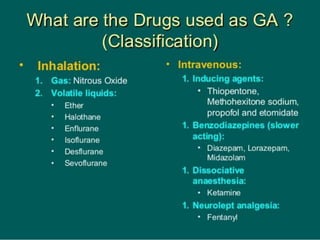
1. Nitrous oxide (N2O) It is a
colourless,
• odourless, heavier than air, noninflammable
gas supplied under pressure in steel cylinders.
It is nonirritating, but low potency
anaesthetic.
• Patients maintained on 70% N2O + 30% O2
2. Ether (Diethyl ether)
• It is a highly volatile liquid, produces irritating
vapours which are inflammable and explosive.
• Ether is a potent anaesthetic, produces good
analgesia and marked muscle relaxation by
reducing ACh output from motor nerve
endings.
(C2H5 — O — C2H5)
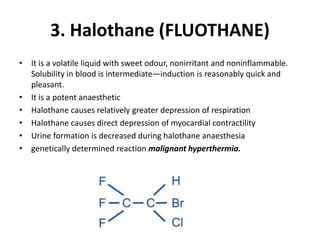
3. Halothane (FLUOTHANE)
• It is a volatile liquid with sweet odour, nonirritant and noninflammable.
Solubility in blood is intermediate—induction is reasonably quick and
pleasant.
• It is a potent anaesthetic
• Halothane causes relatively greater depression of respiration
• Halothane causes direct depression of myocardial contractility
• Urine formation is decreased during halothane anaesthesia
• genetically determined reaction malignant hyperthermia.
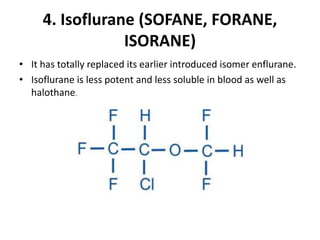
4. Isoflurane (SOFANE, FORANE,
ISORANE)
• It has totally replaced its earlier introduced isomer enflurane.
• Isoflurane is less potent and less soluble in blood as well as
halothane.
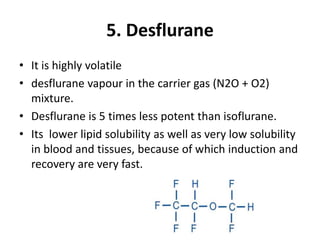
5. Desflurane
• It is highly volatile
• desflurane vapour in the carrier gas (N2O + O2)
mixture.
• Desflurane is 5 times less potent than isoflurane.
• Its lower lipid solubility as well as very low solubility
in blood and tissues, because of which induction and
recovery are very fast.
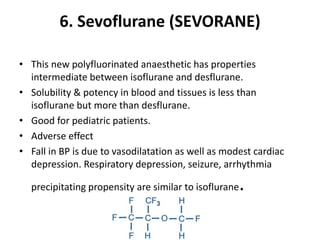
6. Sevoflurane (SEVORANE)
• This new polyfluorinated anaesthetic has properties
intermediate between isoflurane and desflurane.
• Solubility & potency in blood and tissues is less than
isoflurane but more than desflurane.
• Good for pediatric patients.
• Adverse effect
• Fall in BP is due to vasodilatation as well as modest cardiac
depression. Respiratory depression, seizure, arrhythmia
precipitating propensity are similar to isoflurane.
INTRAVENOUS
DRUGS
FAST ACTING DRUGS
• 1. Thiopentone sod. (PENTOTHAL, INTRAVAL SODIUM 0.5, 1 g powder for
making fresh injectable solution)
• It is an ultrashort acting thiobarbiturate, highly soluble in water, must be prepared
freshly before injection.
• Thiopentone is a commonly used inducing agent.
• Thipentone show most commonly re-distribution
• Intra-arterial injection produces pain.
• Thiopentone is a poor analgesic.
• It is a weak muscle relaxant,does not irritate.
• Cause- Respiratory depression
• BP falls immediately after injection
• Vasodilatation
• Adverse effects: Laryngospasm occurs generally, Shivering and delirium
• Other uses: Occasionally used for rapid control of convulsions.
‘narcoanalysis’ of criminals.
.
2. Methohexitone sodium
• It is similar to thiopentone, 3 times more
potent, has a quicker and briefer (5–8 min)
action.
• Excitement during induction and recovery is
more common.
• It is more rapidly metabolized than
thiopentone.
• (t½ 4 hr)
SLOWER ACTING DRUGS
• 1. Benzodiazepines (BZDs)
• In addition to preanaesthetic medication,
BZDs are now frequently used for inducing,
maintaining and supplementing anaesthesia
as well as for ‘conscious sedation’.
Diazepam (VALIUM, CALMPOSE 10 mg/2 ml inj)
• Diazepam 0.2–0.5 mg/kg by slow undiluted
injection in a running i.v. drip.
• this technique reduces the burning sensation
in the vein and incidence of thrombophlebitis.
Lorazepam Dose: 2–4 mg (0.04 mg/kg) i.v. CALMESE 4 mg/2 ml
inj.
• Lorazepam Three times more potent, slower
• acting and less irritating than diazepam
Midazolam (FULSED, MEZOLAM, SHORTAL 1 mg/ml, 5 mg/ml inj )
• This BZD is water soluble, nonirritating to
veins, faster and shorter acting and 3 times
more potent than diazepam.
• (t½ 2 hours)
• Fall in BP is greater than diazepam.
2. Ketamine (KETMIN, KETAMAX, ANEKET 50 mg/ml in 2 ml amp, 10 ml vial.)
• This unique anaesthetic is pharmacologically
related to the hallucinogen phencyclidine.
• It show ‘dissociative anaesthesia’
characterized by profound analgesia,
immobility, amnesia with light sleep.
• Ketamine has been used for operations on the
head and neck.
3. Fentanyl (TROFENTYL, FENDOP, FENT 50 μg/ml in 2 ml amp, 10 ml vial)
• This highly lipophilic, short acting (30–50 min)
potent opioid analgesic related to pethidine is
generally given i.v.
• The opioid antagonist naloxone can be used.
4. Dexmedetomidine
• Activation of central α2 adrenergic receptors has
been known to cause sedation and analgesia.
• Clonidine (a selective α2 agonist
antihypertensive) given before surgery reduces
anaesthetic requirement.
• Dexmedetomidine is a centrally active selective
α2A agonist.
• It is also being used as an adjunct to anaesthesia.
• Analgesia and sedation are produced with little
respiratory depression, amnesia or anaesthesia.
CONSCIOUS
SEDATION
• supplemented with local/regional
anaesthesia), to carryout diagnostic/short
therapeutic/dental procedures in
apprehensive subjects or medically
compromised patients, in place of general
anaesthesia.
1. Diazepam
• It is injected i.v. in small (1–2 mg) repeated doses
or by slow infusion until the desired level of
sedation is produced indicated by relaxation,
indifference, slurring of speech, etc.
• Flumazenil can be used to reverse the sedation,
but repeated doses are needed.
• Midazolam (i.v.) is a shorter acting alternative to
diazepam.
• Oral diazepam administered 1 hr before is also
used with the limitation that level of sedation
cannot be titrated.
2. Propofol
• Brief action,
• it has to be administered as continuous i.v.
infusion throughout the procedure by using a
regulated infusion pump.
• Advantage: is that level of sedation can be
change during the procedure and recovery is
relatively quick.
3. Nitrous oxide
• The patient is made to breathe 100% oxygen
through a nose piece or hood and N2O is added
in 10% increments (to a maximum of 50%, rarely
70%) till the desired level of sedation assessed by
constant verbal contact is obtained. This is
maintained till the procedure is performed.
• Thereafter, N2O is switched off, but 100% O2 is
continued for next 5 min. The patient is generally
roadworthy in 30–60 min.
4. Fentanyl Injected i.v. (1–2 μg/kg every 15–30 min)
• It can be used alone or in combination with
midazolam/propofol.
COMPLICATIONS OF
GENERAL
ANAESTHESIA
A. During anaesthesia
• 1. Respiratory depression.
• 2. Salivation, respiratory secretions. This is less problematic now as
nonirritant anaesthetics are mostly used.
• 3. Cardiac arrhythmias.
• 4. Fall in BP.
• 5. Aspiration(desire) of gastric contents: acid pneumonitis
(mendelson syndrome)- bacteria from oral and pharyngeal area and
cause acute lungs injury.
• 6. Laryngospasm and asphyxia (difficulty in breathing)
• 7. Delirium (serious disturbance in mental abilities that results in
confused thinking ), convulsions and other excitatory effects are
generally seen with i.v. anaesthetics; especially if phenothiazines or
hyoscine have been given in premedication. These are suppressed
by opioids.
B. After anaesthesia
• 1. Nausea and vomiting.
• 2. Persisting (continue) sedation: impaired
psychomotor function.
• 3. Pneumonia.
• 4. Organ toxicities: liver, kidney damage.
• 5. Nerve palsies—due to faulty positioning.
• 6. Emergence delirium.
• 7. Cognitive (understanding) defects: prolonged excess
cognitive decline has been observed in some patients,
especially the elderly, who have undergone general
anaesthesia, particularly of long duration.
DRUG INTERACTIONS
• 1. Patients on antihypertensives given general
anaesthetics—BP may fall markedly.
• 2. Neuroleptics, opioids, clonidine and
monoamine oxidase inhibitors potentiate
anaesthetics.
• 3. Insulin need of a diabetic is increased
during GA: switch over to plain insulin even if
the patient is on oral hypoglycaemics.
PREANAESTHETC
MEDICATION
• Preanaesthetic medication refers to the use of
drugs before anaesthesia to make it more pleasant and
safe.
The aims are:
• 1. Relief of anxiety.
• 2. Amnesia for pre- and postoperative events.
• 3. Supplement analgesic action of anaesthetics and
potentiate them so that less anaesthetic is needed.
• 4. Decrease secretions and vagal stimulation that may be
caused by the anaesthetic.
• 5. Antiemetic effect extending to the postoperative period.
• 6. Decrease acidity and volume of gastric juice.
1. Sedative-antianxiety drugs
• Benzodiazepines like diazepam (5–10 mg oral) or
lorazepam (2 mg oral or 0.05 mg/kg i.m. 1 hour
before) have become popular drugs for
preanaesthetic medication
• Midazolam is a good amnesic with potent and
shorter lasting action; it is also better suited for
i.v. injection, due to water solubility.
• Promethazine (50 mg i.m.) is an antihistaminic
with sedative, antiemetic and anticholinergic
properties. It causes little respiratory depression.
2. Opioids
• Morphine (10 mg) or pethidine (50–100 mg), i.m. allay anxiety
and apprehension of the operation, produce pre- and
postoperative analgesia, smoothen induction, reduce the
dose of anaesthetic required and supplement poor analgesics
(thiopentone, halothane) or weak anaesthetics (N2O).
Postoperative restlessness is also reduced.
• Disadvantages They depress respiration, may cause fall in BP
during anaesthesia, can precipitate asthma and tend to delay
recovery.
• Other disadvantages are lack of amnesia, flushing (redness of
face), delayed gastric emptying and biliary spasm.
3. Anticholinergics
• Atropine or hyoscine (0.6 mg or 10–20 μg/kg i.m./i.v.) or
glycopyrrolate (0.2–0.3 mg or 5–10 μg/kg i.m./i.v.) have been
used, primarily to reduce salivary and bronchial secretions.
This need is infrequent now due to use of non-irritant
anaesthetics.
• The main aim of their use now is to prevent vagal bradycardia
and hypotension (which occur reflexly due to certain surgical
procedures), and prophylaxis of laryngospasm
• which is precipitated by respiratory secretions.
• Hyoscine: in addition, produces amnesia and antiemetic
effect, but tends to delay recovery.
• Glycopyrrolate: is twice as potent and longer acting
quaternary antimuscarinic which does not produce central
effects.
4. Neuroleptics
• Chlorpromazine (25 mg), triflupromazine (10 mg)
or haloperidol (2–4 mg) i.m. are infrequently
used in premedication.
• They allay anxiety, smoothen induction and have
antiemetic action. However, they potentiate
respiratory depression and hypotension caused
by the anaesthetics and delay recovery.
• Involuntary movements and muscle dystonias can
occur, especially in children.
5. H2 blockers/proton pump
inhibitors
• Patients undergoing prolonged operations, obese
patients are at increased risk of gastric
regurgitation and aspiration pneumonia.
• Ranitidine (150 mg)/famotidine (20 mg) or
omeprazole (20 mg)/pantoprazole (40 mg) given
night before and in the morning benefit by raising
pH of gastric juice and may also reduce its volume
and thus chances of regurgitation.
6. Antiemetics
• Metoclopramide 10–20 mg i.m. preoperatively is
effective in reducing postoperative vomiting. By enhancing
gastric emptying, it reduces the chances of reflux and its
aspiration. Extrapyramidal effects and motor restlessness
can occur. Combined use of metoclopramide and H2
blockers is more effective.
• Domperidone: is nearly as effective and does not produce
extrapyramidal side effects.
• Ondansetron: (4–8 mg i.v.) the selective 5-HT3 blocker has
been found highly effective in reducing the incidence of
post-anaesthetic nausea and vomiting.
• It is practically devoid of side effects and has become the
antiemetic of choice in anaesthetic practice.

General anasthesia

  • 2.
    • Definition- • Generalanesthesia is a combination of medications that put you in a sleep-like state before a surgery or other medical procedure. • Under general anesthesia, you don't feel pain because you're completely unconscious. • General anesthesia usually uses a combination of intravenous drugs and inhaled gasses (anesthetics).
  • 4.
    Features of generalanaesthesia are: • Loss of all sensation, especially pain • Sleep (unconsciousness) and amnesia(memory loss) • Immobility(fixed) and muscle relaxation • Abolition(close) of somatic and autonomic reflexes.
  • 5.
    Stages of generalAnaesthesia • 1. stage of analgesia- loss of consciousness., • Pain is progressively abolished, • Patient remain conscious , • Can hear and see, • feel a dream like stage, • Amnesia (loss of memory) develops by the end of stage • Reflex and respiration remain normal, • Through some minor operation can be carried out during this stage. • 2. stage of delirium-This stage is inconspicuous • Excitement is seen • Patient may shout • Muscle tone increase • Jaws are tightly close • Heart rate and BP can rise • Pupil dilate
  • 6.
    Stages of generalAnaesthesia • 3. Surgical anaesthesia- • In this stage onset of regular breathing to cessation (stop breath) of suddenly breathing • This stage has been divided into 4 planes- • Phase 1- Roving eyeball. When end this phase eye become fixed. • Phase 2- loss of cornial and laryngeal reflexes. • Phase 3- Pupil start dilating and light reflex is lost. • Phase 4- intercostal paralysis, Dilated pupil.
  • 7.
    Stages of generalAnaesthesia 4. Medullary Paralysis- . Cessation (stop breathing) of breathing to failure of circulation and death. . Pupil is widely dilated. . Muscle are totally soft(flabby). . BP is very low and fall. . Cardiac and respiration depression. . Amnesia ( loss of memory) . CNS depress
  • 8.
  • 9.
    • Inhalational anaestheticsare gases or vapours that diffuse rapidly across pulmonary alveoli and tissue barriers. • The depth of anaesthesia depends on the potency of the agent, • minimum alveolar concentration [MAC] is an index of potency and its partial pressure (PP) in the brain, • while induction and recovery depend on the rate of change of PP in the brain. • Transfer of the anaesthetic between lung and brain • Alveoli Blood Brain
  • 10.
    Factors affecting thePP of anaesthetic • 1. PP of anaesthetic in the inspired gas: This is proportional to its concentration in the inspired gas mixture. Higher the inspired tension more anaesthetic will be transferred to the blood. • 2. Pulmonary ventilation • 3. Alveolar exchange • 4. Solubility of anaesthetic in blood • 5. Solubility of anaesthetic in tissues • 6. Cerebral blood flow: Brain is a highly perfused organ
  • 11.
    ELIMINATION OF INHALATIONAL ANAESTHETICS •When anaesthetic inhalation is discontinued, gradients are reversed and the channel of absorption (pulmonary epithelium) becomes the channel of elimination. • All inhaled anaesthetics are eliminated mainly through lungs.
  • 12.
    TECHNIQUES OF INHALATIONOF ANAESTHETICS . • Different techniques are used according to facility available, agent used, condition of the patient, type and duration of operation. • 1. Open drop method • Liquid anaesthetic is poured over a mask with gauze and its vapour is inhaled with air. • 2. Through anaesthetic machines • Use is made of gas cylinders
  • 13.
    Properties of anideal anaesthetic • A. For the patient: It should be pleasant, nonirritating, should not cause nausea or vomiting. Induction and recovery should be fast with no after effects. • B. For the surgeon: It should provide adequate analgesia, immobility and muscle relaxation. It should be noninflammable and nonexplosive so that cautery (deaden) may be used. • C. For the anaesthetist: Its administration should be easy, controllable and versatile(multilateral). • Margin of safety should be wide—no fall in BP.
  • 15.
  • 16.
    1. Nitrous oxide(N2O) It is a colourless, • odourless, heavier than air, noninflammable gas supplied under pressure in steel cylinders. It is nonirritating, but low potency anaesthetic. • Patients maintained on 70% N2O + 30% O2
  • 17.
    2. Ether (Diethylether) • It is a highly volatile liquid, produces irritating vapours which are inflammable and explosive. • Ether is a potent anaesthetic, produces good analgesia and marked muscle relaxation by reducing ACh output from motor nerve endings. (C2H5 — O — C2H5)
  • 18.
    3. Halothane (FLUOTHANE) •It is a volatile liquid with sweet odour, nonirritant and noninflammable. Solubility in blood is intermediate—induction is reasonably quick and pleasant. • It is a potent anaesthetic • Halothane causes relatively greater depression of respiration • Halothane causes direct depression of myocardial contractility • Urine formation is decreased during halothane anaesthesia • genetically determined reaction malignant hyperthermia.
  • 19.
    4. Isoflurane (SOFANE,FORANE, ISORANE) • It has totally replaced its earlier introduced isomer enflurane. • Isoflurane is less potent and less soluble in blood as well as halothane.
  • 20.
    5. Desflurane • Itis highly volatile • desflurane vapour in the carrier gas (N2O + O2) mixture. • Desflurane is 5 times less potent than isoflurane. • Its lower lipid solubility as well as very low solubility in blood and tissues, because of which induction and recovery are very fast.
  • 21.
    6. Sevoflurane (SEVORANE) •This new polyfluorinated anaesthetic has properties intermediate between isoflurane and desflurane. • Solubility & potency in blood and tissues is less than isoflurane but more than desflurane. • Good for pediatric patients. • Adverse effect • Fall in BP is due to vasodilatation as well as modest cardiac depression. Respiratory depression, seizure, arrhythmia precipitating propensity are similar to isoflurane.
  • 22.
  • 23.
    FAST ACTING DRUGS •1. Thiopentone sod. (PENTOTHAL, INTRAVAL SODIUM 0.5, 1 g powder for making fresh injectable solution) • It is an ultrashort acting thiobarbiturate, highly soluble in water, must be prepared freshly before injection. • Thiopentone is a commonly used inducing agent. • Thipentone show most commonly re-distribution • Intra-arterial injection produces pain. • Thiopentone is a poor analgesic. • It is a weak muscle relaxant,does not irritate. • Cause- Respiratory depression • BP falls immediately after injection • Vasodilatation • Adverse effects: Laryngospasm occurs generally, Shivering and delirium • Other uses: Occasionally used for rapid control of convulsions. ‘narcoanalysis’ of criminals. .
  • 24.
    2. Methohexitone sodium •It is similar to thiopentone, 3 times more potent, has a quicker and briefer (5–8 min) action. • Excitement during induction and recovery is more common. • It is more rapidly metabolized than thiopentone. • (t½ 4 hr)
  • 25.
    SLOWER ACTING DRUGS •1. Benzodiazepines (BZDs) • In addition to preanaesthetic medication, BZDs are now frequently used for inducing, maintaining and supplementing anaesthesia as well as for ‘conscious sedation’.
  • 26.
    Diazepam (VALIUM, CALMPOSE10 mg/2 ml inj) • Diazepam 0.2–0.5 mg/kg by slow undiluted injection in a running i.v. drip. • this technique reduces the burning sensation in the vein and incidence of thrombophlebitis.
  • 27.
    Lorazepam Dose: 2–4mg (0.04 mg/kg) i.v. CALMESE 4 mg/2 ml inj. • Lorazepam Three times more potent, slower • acting and less irritating than diazepam
  • 28.
    Midazolam (FULSED, MEZOLAM,SHORTAL 1 mg/ml, 5 mg/ml inj ) • This BZD is water soluble, nonirritating to veins, faster and shorter acting and 3 times more potent than diazepam. • (t½ 2 hours) • Fall in BP is greater than diazepam.
  • 29.
    2. Ketamine (KETMIN,KETAMAX, ANEKET 50 mg/ml in 2 ml amp, 10 ml vial.) • This unique anaesthetic is pharmacologically related to the hallucinogen phencyclidine. • It show ‘dissociative anaesthesia’ characterized by profound analgesia, immobility, amnesia with light sleep. • Ketamine has been used for operations on the head and neck.
  • 30.
    3. Fentanyl (TROFENTYL,FENDOP, FENT 50 μg/ml in 2 ml amp, 10 ml vial) • This highly lipophilic, short acting (30–50 min) potent opioid analgesic related to pethidine is generally given i.v. • The opioid antagonist naloxone can be used.
  • 31.
    4. Dexmedetomidine • Activationof central α2 adrenergic receptors has been known to cause sedation and analgesia. • Clonidine (a selective α2 agonist antihypertensive) given before surgery reduces anaesthetic requirement. • Dexmedetomidine is a centrally active selective α2A agonist. • It is also being used as an adjunct to anaesthesia. • Analgesia and sedation are produced with little respiratory depression, amnesia or anaesthesia.
  • 32.
  • 33.
    • supplemented withlocal/regional anaesthesia), to carryout diagnostic/short therapeutic/dental procedures in apprehensive subjects or medically compromised patients, in place of general anaesthesia.
  • 34.
    1. Diazepam • Itis injected i.v. in small (1–2 mg) repeated doses or by slow infusion until the desired level of sedation is produced indicated by relaxation, indifference, slurring of speech, etc. • Flumazenil can be used to reverse the sedation, but repeated doses are needed. • Midazolam (i.v.) is a shorter acting alternative to diazepam. • Oral diazepam administered 1 hr before is also used with the limitation that level of sedation cannot be titrated.
  • 35.
    2. Propofol • Briefaction, • it has to be administered as continuous i.v. infusion throughout the procedure by using a regulated infusion pump. • Advantage: is that level of sedation can be change during the procedure and recovery is relatively quick.
  • 36.
    3. Nitrous oxide •The patient is made to breathe 100% oxygen through a nose piece or hood and N2O is added in 10% increments (to a maximum of 50%, rarely 70%) till the desired level of sedation assessed by constant verbal contact is obtained. This is maintained till the procedure is performed. • Thereafter, N2O is switched off, but 100% O2 is continued for next 5 min. The patient is generally roadworthy in 30–60 min.
  • 37.
    4. Fentanyl Injectedi.v. (1–2 μg/kg every 15–30 min) • It can be used alone or in combination with midazolam/propofol.
  • 38.
  • 39.
    A. During anaesthesia •1. Respiratory depression. • 2. Salivation, respiratory secretions. This is less problematic now as nonirritant anaesthetics are mostly used. • 3. Cardiac arrhythmias. • 4. Fall in BP. • 5. Aspiration(desire) of gastric contents: acid pneumonitis (mendelson syndrome)- bacteria from oral and pharyngeal area and cause acute lungs injury. • 6. Laryngospasm and asphyxia (difficulty in breathing) • 7. Delirium (serious disturbance in mental abilities that results in confused thinking ), convulsions and other excitatory effects are generally seen with i.v. anaesthetics; especially if phenothiazines or hyoscine have been given in premedication. These are suppressed by opioids.
  • 40.
    B. After anaesthesia •1. Nausea and vomiting. • 2. Persisting (continue) sedation: impaired psychomotor function. • 3. Pneumonia. • 4. Organ toxicities: liver, kidney damage. • 5. Nerve palsies—due to faulty positioning. • 6. Emergence delirium. • 7. Cognitive (understanding) defects: prolonged excess cognitive decline has been observed in some patients, especially the elderly, who have undergone general anaesthesia, particularly of long duration.
  • 41.
    DRUG INTERACTIONS • 1.Patients on antihypertensives given general anaesthetics—BP may fall markedly. • 2. Neuroleptics, opioids, clonidine and monoamine oxidase inhibitors potentiate anaesthetics. • 3. Insulin need of a diabetic is increased during GA: switch over to plain insulin even if the patient is on oral hypoglycaemics.
  • 42.
  • 43.
    • Preanaesthetic medicationrefers to the use of drugs before anaesthesia to make it more pleasant and safe. The aims are: • 1. Relief of anxiety. • 2. Amnesia for pre- and postoperative events. • 3. Supplement analgesic action of anaesthetics and potentiate them so that less anaesthetic is needed. • 4. Decrease secretions and vagal stimulation that may be caused by the anaesthetic. • 5. Antiemetic effect extending to the postoperative period. • 6. Decrease acidity and volume of gastric juice.
  • 44.
    1. Sedative-antianxiety drugs •Benzodiazepines like diazepam (5–10 mg oral) or lorazepam (2 mg oral or 0.05 mg/kg i.m. 1 hour before) have become popular drugs for preanaesthetic medication • Midazolam is a good amnesic with potent and shorter lasting action; it is also better suited for i.v. injection, due to water solubility. • Promethazine (50 mg i.m.) is an antihistaminic with sedative, antiemetic and anticholinergic properties. It causes little respiratory depression.
  • 45.
    2. Opioids • Morphine(10 mg) or pethidine (50–100 mg), i.m. allay anxiety and apprehension of the operation, produce pre- and postoperative analgesia, smoothen induction, reduce the dose of anaesthetic required and supplement poor analgesics (thiopentone, halothane) or weak anaesthetics (N2O). Postoperative restlessness is also reduced. • Disadvantages They depress respiration, may cause fall in BP during anaesthesia, can precipitate asthma and tend to delay recovery. • Other disadvantages are lack of amnesia, flushing (redness of face), delayed gastric emptying and biliary spasm.
  • 46.
    3. Anticholinergics • Atropineor hyoscine (0.6 mg or 10–20 μg/kg i.m./i.v.) or glycopyrrolate (0.2–0.3 mg or 5–10 μg/kg i.m./i.v.) have been used, primarily to reduce salivary and bronchial secretions. This need is infrequent now due to use of non-irritant anaesthetics. • The main aim of their use now is to prevent vagal bradycardia and hypotension (which occur reflexly due to certain surgical procedures), and prophylaxis of laryngospasm • which is precipitated by respiratory secretions. • Hyoscine: in addition, produces amnesia and antiemetic effect, but tends to delay recovery. • Glycopyrrolate: is twice as potent and longer acting quaternary antimuscarinic which does not produce central effects.
  • 47.
    4. Neuroleptics • Chlorpromazine(25 mg), triflupromazine (10 mg) or haloperidol (2–4 mg) i.m. are infrequently used in premedication. • They allay anxiety, smoothen induction and have antiemetic action. However, they potentiate respiratory depression and hypotension caused by the anaesthetics and delay recovery. • Involuntary movements and muscle dystonias can occur, especially in children.
  • 48.
    5. H2 blockers/protonpump inhibitors • Patients undergoing prolonged operations, obese patients are at increased risk of gastric regurgitation and aspiration pneumonia. • Ranitidine (150 mg)/famotidine (20 mg) or omeprazole (20 mg)/pantoprazole (40 mg) given night before and in the morning benefit by raising pH of gastric juice and may also reduce its volume and thus chances of regurgitation.
  • 49.
    6. Antiemetics • Metoclopramide10–20 mg i.m. preoperatively is effective in reducing postoperative vomiting. By enhancing gastric emptying, it reduces the chances of reflux and its aspiration. Extrapyramidal effects and motor restlessness can occur. Combined use of metoclopramide and H2 blockers is more effective. • Domperidone: is nearly as effective and does not produce extrapyramidal side effects. • Ondansetron: (4–8 mg i.v.) the selective 5-HT3 blocker has been found highly effective in reducing the incidence of post-anaesthetic nausea and vomiting. • It is practically devoid of side effects and has become the antiemetic of choice in anaesthetic practice.