General Anesthetics
By
Dr. Faraza Javaid
General Anesthesia
2
General anesthesia (GA) is the state
produced when a patient receives
medications for amnesia, analgesia,
muscle relaxation, and sedation.
An anesthetized patient can be
thought of as being in a controlled,
reversible state of unconsciousness.
Types of Anesthesia
▶General
▶Regional
▶Local
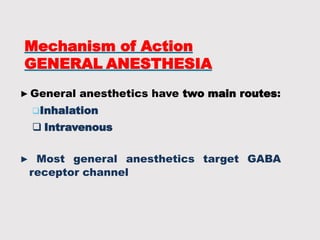
Mechanism of Action
GENERAL ANESTHESIA
▶ General anesthetics have two main routes:
Inhalation
 Intravenous
▶ Most general anesthetics target GABA
receptor channel
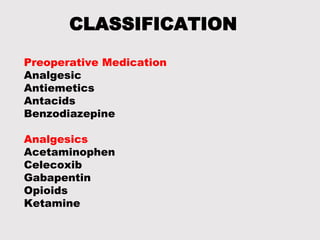
CLASSIFICATION
Preoperative Medication
Analgesic
Antiemetics
Antacids
Benzodiazepine
Analgesics
Acetaminophen
Celecoxib
Gabapentin
Opioids
Ketamine
General Anesthetics
Inhalational
Intravenous
Local Anesthetics
Neuromuscular Blocker
Succinyl choline
Atracurium
Rucoronium
Mivacurium
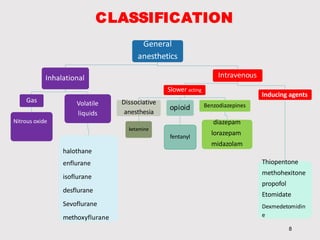
CLASSIFICATION
General
anesthetics
Inhalational
Gas
Nitrous oxide
Volatile
liquids
halothane
enflurane
isoflurane
desflurane
Sevoflurane
methoxyflurane
Intravenous
Slower acting
Dissociative
anesthesia
ketamine
opioid
fentanyl
Benzodiazepines
diazepam
lorazepam
midazolam
Inducing agents
Thiopentone
methohexitone
propofol
Etomidate
Dexmedetomidin
e
8
General Anesthesia
9
medical procedures,
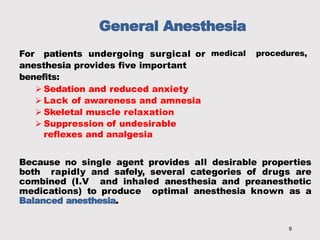
For patients undergoing surgical or
anesthesia provides five important
benefits:
 Sedation and reduced anxiety
 Lack of awareness and amnesia
 Skeletal muscle relaxation
 Suppression of undesirable
reflexes and analgesia
Because no single agent provides all desirable properties
both rapidly and safely, several categories of drugs are
combined (I.V and inhaled anesthesia and preanesthetic
medications) to produce optimal anesthesia known as a
Balanced anesthesia.
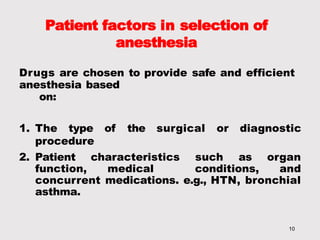
Patient factors in selection of
anesthesia
10
Drugs are chosen to provide safe and efficient
anesthesia based
on:
1. The type of the surgical or diagnostic
procedure
2. Patient characteristics such as organ
function, medical conditions, and
concurrent medications. e.g., HTN, bronchial
asthma.
Stages and depth of anesthesia
Use preanesthetic medication
↓
Induce by I.V anesthetic (ketamine) or suitable alternative
↓
Use muscle relaxant → Intubate
↓
11
Use, usually a mixture of N2O and a halogenated hydrocarbon→
maintain and monitor.
↓
Withdraw the drugs → recover
Stages and depth of anesthesia/ Induction
12
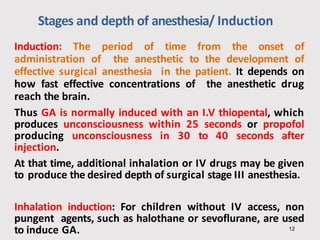
Induction: The period of time from the onset of
administration of the anesthetic to the development of
effective surgical anesthesia in the patient. It depends on
how fast effective concentrations of the anesthetic drug
reach the brain.
Thus GA is normally induced with an I.V thiopental, which
produces unconsciousness within 25 seconds or propofol
producing unconsciousness in 30 to 40 seconds after
injection.
At that time, additional inhalation or IV drugs may be given
to produce the desired depth of surgical stage III anesthesia.
Inhalation induction: For children without IV access, non
pungent agents, such as halothane or sevoflurane, are used
to induce GA.
Stages and depth of anesthesia/ Maintenance
13
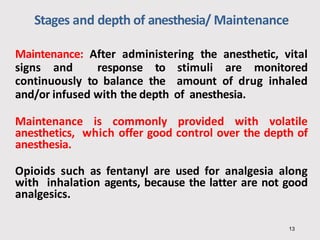
Maintenance: After administering the anesthetic, vital
signs and response to stimuli are monitored
continuously to balance the amount of drug inhaled
and/or infused with the depth of anesthesia.
Maintenance is commonly provided with volatile
anesthetics, which offer good control over the depth of
anesthesia.
Opioids such as fentanyl are used for analgesia along
with inhalation agents, because the latter are not good
analgesics.
Stages and depth of anesthesia/ Recovery
14
Recovery: The time from discontinuation of
administration of the anesthesia until consciousness
and protective physiologic reflexes are regained. It
depends on how fast the anesthetic drug diffuses from
the brain.
For most anesthetic agents, recovery is the reverse of
induction.
The patient is monitored to assure full recovery, with
normal physiologic functions (spontaneous respiration,
acceptable blood pressure and heart rate, intact
reflexes, and no delayed reactions such as respiratory
depression).
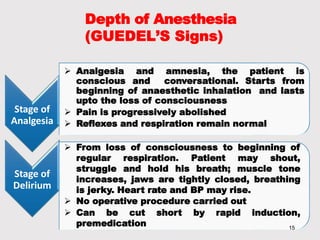
Depth of Anesthesia
(GUEDEL’S Signs)
Stage of
Analgesia
 Analgesia and amnesia, the patient is
conscious and conversational. Starts from
beginning of anaesthetic inhalation and lasts
upto the loss of consciousness
 Pain is progressively abolished
 Reflexes and respiration remain normal
Stage of
Delirium
 From loss of consciousness to beginning of
regular respiration. Patient may shout,
struggle and hold his breath; muscle tone
increases, jaws are tightly closed, breathing
is jerky. Heart rate and BP may rise.
 No operative procedure carried out
 Can be cut short by rapid induction,
premedication 15
Surgical
anaesthesia
Extends from onset of regular respiration to
cessation of spontaneous breathing. This has
been divided into 4 planes:
 Plane 1, moving eye balls. This plane ends
when eyes become fixed.
 Plane 2, loss of corneal and laryngeal reflexes.
 Plane 3, pupil starts dilating and light reflex is
lost.
 Plane 4, Intercostal paralysis, shallow
abdominal respiration, dilated pupil.
Medullary
paralysis  Cessation of breathing to failure of circulation
and death.
16
MAC(minimal alveolar anesthetic
concentration)
▶ is defined as the concentration of inhaled
anesthetic as a % of inspired air, at which
50% of patients will be anesthetized.
▶ MAC is a measure of potency: ED50.
MAC (potency)
Numerically,
MAC is small for
potent
anesthetics such
as sevoflurane
and large for
less potent
agents such as
nitrous oxide.
19
Uptake and distribution of inhalation
anesthetics
19
The principal objective of inhalation
anesthesia is a constant and optimal brain
partial pressure of inhaled anesthetic
(partial pressure equilibrium between
alveoli and brain).
Thus, the alveoli are the “windows to the
brain” for inhaled anesthetics.
The partial pressure of an anesthetic gas at
the origin of the respiratory pathway is the
driving force moving the anesthetic into
the alveolar space, which delivers the drug
to the brain and other body compartments.
The solubility in blood is ranked in
the following order:
halothane>enflurane>isoflurane>sevofl
urane>desflurane>N2O
An inhalational anesthetic agent with low
solubility in blood shows fast induction and
also recovery time, and an agent with
relatively high solubility in blood shows
slower induction and recovery time.
20
Four major tissue compartments determine the time
course of anesthetic uptake:
a. Brain, heart, liver, kidney, and endocrine glands:
These highly perfused tissues rapidly attain a
steady-state with the PP of anesthetic in the blood.
b. Skeletal muscles: poorly perfused, and have a large
volume, prolong the time required to achieve
steady-state.
c. Fat: poorly perfused. However, potent GA are very
lipid soluble. Therefore, fat has a large capacity to
store anesthetic. This combination of slow delivery
to a high capacity compartment prolongs the time
required to achieve steady-state.
d. Bone, ligaments, and cartilage: these are poorly
perfused and have a relatively low capacity to
store anesthetic.
21
Wash out: When the administration of
anesthetics discontinued, the body now
becomes the “source” that derives the
anesthetic into the alveolar space. The same
factors that influence attainment of steady-
state with an inspired anesthetic determine
the time course of clearance of the drug
from the body.
22
MECHANISM OF ACTION
23
No specific receptor has been identified. The
fact that chemically unrelated compounds
produce anesthesia argues against the
existence of a single receptor.
The focus is NOW on proteins comprising ion
channels:
GABAA receptors, Glycine receptors,
NMDA glutamate receptors
Nicotinic receptors: Blocks the excitatory
postsynaptic current of the nicotinic
receptors.
Currently, there are 5 inhalational and 5
intravenous anesthetics used to induce or
maintain general anesthesia:
Inhalational:
Nitrous Oxide, Isoflurane, Sevoflurane, Desflurane
and Xenon.
Intravenous:
Propofol, Etomidate, Ketamine, Methohexital and
Thiopental.
These 10 general anesthetic drugs are often
accompanied by sedative benzodiazepines:
midazolam, diazepam and lorazepam.
24
Of these 10 general anesthetics:
Ketamine, nitrous oxide and xenon inhibit
ionotropic glutamate receptors, with the
strongest effects being seen on the NMDA
receptor subtype.
These anesthetics also have modest effects
on many other receptors, including
GABAARs, but their primary action is the
blockade of NMDA receptors.
25
 The other 7 general anesthetics and 3
sedatives share a common target and
mechanism of action, they all enhance the
function of GABAA Rs, the most abundant
fast inhibitory neurotransmitter receptor in
the CNS.
 These 7 general anesthetics also have a
spectrum of modest to strong effects on
other ion channels including glycine,
nicotinic, serotonin, glutamate receptors
and potassium channels.
Halothane (Prototype)
27
Advantages:
Potent anesthetic, rapid induction &
recovery
Neither flammable nor explosive, sweet
smell, non irritant
Low incidence of post operative nausea
and vomiting.
Relaxes both skeletal and uterine muscle,
and can be used in obstetrics when
uterine relaxation is indicated.
Combined with its pleasant odour,
this makes it suitable in
children for inhalation induction.
Halothane
28
Disadvantages:
 Weak analgesic (thus is usuallycoadministerd withN2O,
And opioids)
 Is a strong respiratory depressant
 Is a strong cardiovascular depressant
 Hepatotoxic: is oxidatively metabolized in the liver to
tissue - toxic hydrocarbons (e.g., trifluroethanol and
bromide ion).
Enflurane
29
Less potent than halothane, but
produces rapid induction and recovery
~2% metabolized to fluoride ion,
which is excreted by the kidney
Has some analgesic activity
Nitrous oxide (N2O)
31
It is a potent analgesic but a weak general
anesthetic.
Rapid onset and recovery
Does not depress respiration, and no muscle
relaxation.
Clinical use: dental surgery, obstetrics,
postoperative physiotherapy, refractory pain
in terminal illness, and maintenance of
anesthesia.
The least hepatotoxic, Teratogenic, bone
marrow depression.
Intravenous Anesthetics
32
Barbiturates (thiopental, methohexital)
Potent anesthetic but a weak analgesic
High lipid solubility; quickly enter the CNS
and depress function, often in less than one
minute, and redistribution occur very
rapidly as well to other body tissues,
including skeletal muscle and ultimately
adipose tissue (serve as a reservoir).
All barbiturates can cause apnea, coughing,
chest wall spasm, laryngospasm, and
bronchospasm
Intravenous Anesthetics/ Propofol
33
Propofol, Phenol derivative, It is an IV sedative-
hypnotic used in the induction and or maintenance of
anesthesia.
Onset is smooth and rapid (40 seconds)
Decrease BP without depressing the myocardium, it also
reduce intracranial pressure.
It is widely used and has replaced thiopental as the first
choice for anesthesia induction and sedation, because it
produces a euphoric feeling in the patient and does not
cause post anesthetic nausea and vomiting.
Poor analgesia.
Ketamine
35
Ketamine (phencyclidine derivative) a short-acting,
anesthetic, induces a dissociated state in which the patient is
unconscious (but may appear to be awake) and does not feel
pain.
This dissociative anesthesia provides sedation, amnesia, and
immobility.
Ketamine is also a potent bronchodilator.
Therefore, it is beneficial in patients in asthmatics. Conversely,
it is contraindicated in hypertensive or stroke patients.
Ketamine is used mainly in children and elderly adults for
short procedures.
It should not widely used, because it increases cerebral
blood flow and may induce hallucinations, particularly in
young adults.
Adjuvants/ BDZs & Opioids (fentanyl,
sufentanil)
Benzodiazepine (midazolam, lorazepam and
diazepam)
Are used in conjunction with anesthetics to
sedate the patient.
Opioids:
Analgesic, not good amnesic, used together
with anesthetics.
They are administered either I.V, epidurally, or
intrathecally
38
Anesthetic Toxicity
38
Exposure of rodentstoanesthetic agents during the period of
birth results in widespread neurodegeneration in the
developing brain.
This neuronal injury, which is apoptotic in nature, results in
disturbed electrophysiologic function and cognitive
dysfunction in adolescent and adult rodents that were
exposed to anesthetics during the neonatal period.
A variety of agents, including isoflurane, propofol,
midazolam, nitrous oxide, and thiopental, manifest this
toxicity.
Although the etiology is not clear, GABA A agonism
and NMDA receptor antagonism play a role. In
particular, the combination of a GABA A agonist
39
greatest toxicity. Until the occurrence of
and NMDA receptor antagonist produce the
this
neurotoxicity during brain development has been
established in pre-clinical studies, its relevance to
the use of anesthetics in humans will not be
clear.
Thankyou
40

General Anestheics.pptx

  • 1.
  • 2.
    General Anesthesia 2 General anesthesia(GA) is the state produced when a patient receives medications for amnesia, analgesia, muscle relaxation, and sedation. An anesthetized patient can be thought of as being in a controlled, reversible state of unconsciousness.
  • 3.
  • 4.
    Mechanism of Action GENERALANESTHESIA ▶ General anesthetics have two main routes: Inhalation  Intravenous ▶ Most general anesthetics target GABA receptor channel
  • 5.
  • 6.
    General Anesthetics Inhalational Intravenous Local Anesthetics NeuromuscularBlocker Succinyl choline Atracurium Rucoronium Mivacurium
  • 8.
  • 9.
    General Anesthesia 9 medical procedures, Forpatients undergoing surgical or anesthesia provides five important benefits:  Sedation and reduced anxiety  Lack of awareness and amnesia  Skeletal muscle relaxation  Suppression of undesirable reflexes and analgesia Because no single agent provides all desirable properties both rapidly and safely, several categories of drugs are combined (I.V and inhaled anesthesia and preanesthetic medications) to produce optimal anesthesia known as a Balanced anesthesia.
  • 10.
    Patient factors inselection of anesthesia 10 Drugs are chosen to provide safe and efficient anesthesia based on: 1. The type of the surgical or diagnostic procedure 2. Patient characteristics such as organ function, medical conditions, and concurrent medications. e.g., HTN, bronchial asthma.
  • 11.
    Stages and depthof anesthesia Use preanesthetic medication ↓ Induce by I.V anesthetic (ketamine) or suitable alternative ↓ Use muscle relaxant → Intubate ↓ 11 Use, usually a mixture of N2O and a halogenated hydrocarbon→ maintain and monitor. ↓ Withdraw the drugs → recover
  • 12.
    Stages and depthof anesthesia/ Induction 12 Induction: The period of time from the onset of administration of the anesthetic to the development of effective surgical anesthesia in the patient. It depends on how fast effective concentrations of the anesthetic drug reach the brain. Thus GA is normally induced with an I.V thiopental, which produces unconsciousness within 25 seconds or propofol producing unconsciousness in 30 to 40 seconds after injection. At that time, additional inhalation or IV drugs may be given to produce the desired depth of surgical stage III anesthesia. Inhalation induction: For children without IV access, non pungent agents, such as halothane or sevoflurane, are used to induce GA.
  • 13.
    Stages and depthof anesthesia/ Maintenance 13 Maintenance: After administering the anesthetic, vital signs and response to stimuli are monitored continuously to balance the amount of drug inhaled and/or infused with the depth of anesthesia. Maintenance is commonly provided with volatile anesthetics, which offer good control over the depth of anesthesia. Opioids such as fentanyl are used for analgesia along with inhalation agents, because the latter are not good analgesics.
  • 14.
    Stages and depthof anesthesia/ Recovery 14 Recovery: The time from discontinuation of administration of the anesthesia until consciousness and protective physiologic reflexes are regained. It depends on how fast the anesthetic drug diffuses from the brain. For most anesthetic agents, recovery is the reverse of induction. The patient is monitored to assure full recovery, with normal physiologic functions (spontaneous respiration, acceptable blood pressure and heart rate, intact reflexes, and no delayed reactions such as respiratory depression).
  • 15.
    Depth of Anesthesia (GUEDEL’SSigns) Stage of Analgesia  Analgesia and amnesia, the patient is conscious and conversational. Starts from beginning of anaesthetic inhalation and lasts upto the loss of consciousness  Pain is progressively abolished  Reflexes and respiration remain normal Stage of Delirium  From loss of consciousness to beginning of regular respiration. Patient may shout, struggle and hold his breath; muscle tone increases, jaws are tightly closed, breathing is jerky. Heart rate and BP may rise.  No operative procedure carried out  Can be cut short by rapid induction, premedication 15
  • 16.
    Surgical anaesthesia Extends from onsetof regular respiration to cessation of spontaneous breathing. This has been divided into 4 planes:  Plane 1, moving eye balls. This plane ends when eyes become fixed.  Plane 2, loss of corneal and laryngeal reflexes.  Plane 3, pupil starts dilating and light reflex is lost.  Plane 4, Intercostal paralysis, shallow abdominal respiration, dilated pupil. Medullary paralysis  Cessation of breathing to failure of circulation and death. 16
  • 17.
    MAC(minimal alveolar anesthetic concentration) ▶is defined as the concentration of inhaled anesthetic as a % of inspired air, at which 50% of patients will be anesthetized. ▶ MAC is a measure of potency: ED50.
  • 18.
    MAC (potency) Numerically, MAC issmall for potent anesthetics such as sevoflurane and large for less potent agents such as nitrous oxide. 19
  • 19.
    Uptake and distributionof inhalation anesthetics 19 The principal objective of inhalation anesthesia is a constant and optimal brain partial pressure of inhaled anesthetic (partial pressure equilibrium between alveoli and brain). Thus, the alveoli are the “windows to the brain” for inhaled anesthetics. The partial pressure of an anesthetic gas at the origin of the respiratory pathway is the driving force moving the anesthetic into the alveolar space, which delivers the drug to the brain and other body compartments.
  • 20.
    The solubility inblood is ranked in the following order: halothane>enflurane>isoflurane>sevofl urane>desflurane>N2O An inhalational anesthetic agent with low solubility in blood shows fast induction and also recovery time, and an agent with relatively high solubility in blood shows slower induction and recovery time. 20
  • 21.
    Four major tissuecompartments determine the time course of anesthetic uptake: a. Brain, heart, liver, kidney, and endocrine glands: These highly perfused tissues rapidly attain a steady-state with the PP of anesthetic in the blood. b. Skeletal muscles: poorly perfused, and have a large volume, prolong the time required to achieve steady-state. c. Fat: poorly perfused. However, potent GA are very lipid soluble. Therefore, fat has a large capacity to store anesthetic. This combination of slow delivery to a high capacity compartment prolongs the time required to achieve steady-state. d. Bone, ligaments, and cartilage: these are poorly perfused and have a relatively low capacity to store anesthetic. 21
  • 22.
    Wash out: Whenthe administration of anesthetics discontinued, the body now becomes the “source” that derives the anesthetic into the alveolar space. The same factors that influence attainment of steady- state with an inspired anesthetic determine the time course of clearance of the drug from the body. 22
  • 23.
    MECHANISM OF ACTION 23 Nospecific receptor has been identified. The fact that chemically unrelated compounds produce anesthesia argues against the existence of a single receptor. The focus is NOW on proteins comprising ion channels: GABAA receptors, Glycine receptors, NMDA glutamate receptors Nicotinic receptors: Blocks the excitatory postsynaptic current of the nicotinic receptors.
  • 24.
    Currently, there are5 inhalational and 5 intravenous anesthetics used to induce or maintain general anesthesia: Inhalational: Nitrous Oxide, Isoflurane, Sevoflurane, Desflurane and Xenon. Intravenous: Propofol, Etomidate, Ketamine, Methohexital and Thiopental. These 10 general anesthetic drugs are often accompanied by sedative benzodiazepines: midazolam, diazepam and lorazepam. 24
  • 25.
    Of these 10general anesthetics: Ketamine, nitrous oxide and xenon inhibit ionotropic glutamate receptors, with the strongest effects being seen on the NMDA receptor subtype. These anesthetics also have modest effects on many other receptors, including GABAARs, but their primary action is the blockade of NMDA receptors. 25
  • 26.
     The other7 general anesthetics and 3 sedatives share a common target and mechanism of action, they all enhance the function of GABAA Rs, the most abundant fast inhibitory neurotransmitter receptor in the CNS.  These 7 general anesthetics also have a spectrum of modest to strong effects on other ion channels including glycine, nicotinic, serotonin, glutamate receptors and potassium channels.
  • 27.
    Halothane (Prototype) 27 Advantages: Potent anesthetic,rapid induction & recovery Neither flammable nor explosive, sweet smell, non irritant Low incidence of post operative nausea and vomiting. Relaxes both skeletal and uterine muscle, and can be used in obstetrics when uterine relaxation is indicated. Combined with its pleasant odour, this makes it suitable in children for inhalation induction.
  • 28.
    Halothane 28 Disadvantages:  Weak analgesic(thus is usuallycoadministerd withN2O, And opioids)  Is a strong respiratory depressant  Is a strong cardiovascular depressant  Hepatotoxic: is oxidatively metabolized in the liver to tissue - toxic hydrocarbons (e.g., trifluroethanol and bromide ion).
  • 29.
    Enflurane 29 Less potent thanhalothane, but produces rapid induction and recovery ~2% metabolized to fluoride ion, which is excreted by the kidney Has some analgesic activity
  • 31.
    Nitrous oxide (N2O) 31 Itis a potent analgesic but a weak general anesthetic. Rapid onset and recovery Does not depress respiration, and no muscle relaxation. Clinical use: dental surgery, obstetrics, postoperative physiotherapy, refractory pain in terminal illness, and maintenance of anesthesia. The least hepatotoxic, Teratogenic, bone marrow depression.
  • 32.
    Intravenous Anesthetics 32 Barbiturates (thiopental,methohexital) Potent anesthetic but a weak analgesic High lipid solubility; quickly enter the CNS and depress function, often in less than one minute, and redistribution occur very rapidly as well to other body tissues, including skeletal muscle and ultimately adipose tissue (serve as a reservoir). All barbiturates can cause apnea, coughing, chest wall spasm, laryngospasm, and bronchospasm
  • 33.
    Intravenous Anesthetics/ Propofol 33 Propofol,Phenol derivative, It is an IV sedative- hypnotic used in the induction and or maintenance of anesthesia. Onset is smooth and rapid (40 seconds) Decrease BP without depressing the myocardium, it also reduce intracranial pressure. It is widely used and has replaced thiopental as the first choice for anesthesia induction and sedation, because it produces a euphoric feeling in the patient and does not cause post anesthetic nausea and vomiting. Poor analgesia.
  • 35.
    Ketamine 35 Ketamine (phencyclidine derivative)a short-acting, anesthetic, induces a dissociated state in which the patient is unconscious (but may appear to be awake) and does not feel pain. This dissociative anesthesia provides sedation, amnesia, and immobility. Ketamine is also a potent bronchodilator. Therefore, it is beneficial in patients in asthmatics. Conversely, it is contraindicated in hypertensive or stroke patients. Ketamine is used mainly in children and elderly adults for short procedures. It should not widely used, because it increases cerebral blood flow and may induce hallucinations, particularly in young adults.
  • 37.
    Adjuvants/ BDZs &Opioids (fentanyl, sufentanil) Benzodiazepine (midazolam, lorazepam and diazepam) Are used in conjunction with anesthetics to sedate the patient. Opioids: Analgesic, not good amnesic, used together with anesthetics. They are administered either I.V, epidurally, or intrathecally 38
  • 38.
    Anesthetic Toxicity 38 Exposure ofrodentstoanesthetic agents during the period of birth results in widespread neurodegeneration in the developing brain. This neuronal injury, which is apoptotic in nature, results in disturbed electrophysiologic function and cognitive dysfunction in adolescent and adult rodents that were exposed to anesthetics during the neonatal period. A variety of agents, including isoflurane, propofol, midazolam, nitrous oxide, and thiopental, manifest this toxicity.
  • 39.
    Although the etiologyis not clear, GABA A agonism and NMDA receptor antagonism play a role. In particular, the combination of a GABA A agonist 39 greatest toxicity. Until the occurrence of and NMDA receptor antagonist produce the this neurotoxicity during brain development has been established in pre-clinical studies, its relevance to the use of anesthetics in humans will not be clear.
  • 40.