1.How does gene work?
2.Gene-protein relationship.
3.Genetic fine structure.
1.How does gene work?
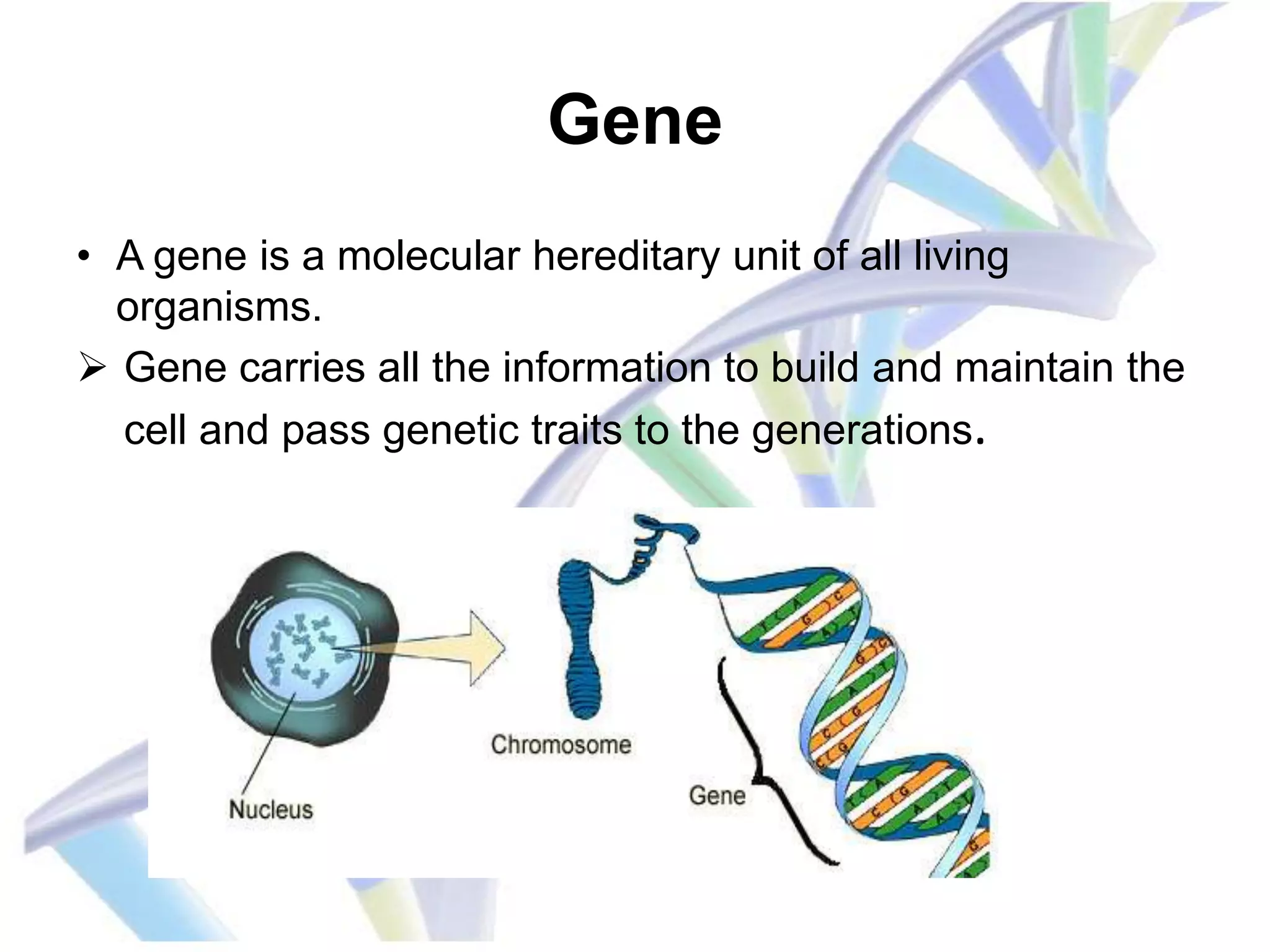
Gene
• A gene is a molecular hereditary unit of all living
organisms.
 Gene carries all the information to build and maintain the
cell and pass genetic traits to the generations.
One-gene-One-Enzyme Hypothesis
• 1940s, George Beadle and Edward Tatum
• Gene act by the production of the enzymes
and each gene is responsible for production of
the single enzyme that in turn effect a single
step in metabolic pathway.
One-gene-One-Enzyme Hypothesis

• Diagrammatic representation of production
of arginine
One-gene-One-Enzyme Hypothesis
RESULT
• This model, which is known as one-gene-oneenzyme hypothesis, provides the first
evidence of function of the gene.
• some genes were responsible for the
functions of the enzymes and each gene
apparently control one specific enzyme.
2.GENE-PROTEIN RELATIONSHIP
Relationship between genotype and
phenotype.
Genes
Linear sequence of amino acid
Enzymes

Structural proteins
Phenotyope of the cell

Characteristics features of the organism
STRUCTURE OF PROTEIN
PROTEIN MOTIFS
• Several elements of secondary structure
combine to produce a pattern, or motif, that is
found in numerous other proteins.
RELATIONSHIP BETWEEN GENE MUTATION AND
ALTERED PROTEINS

• To alter the protein function only the change of
one
amino
acid
is
enough.
Vernon
Ingram, showed this 1st time in 1957 when he
study the globular protein called hemoglobin
molecule which transport oxygen in cells.
Hemoglobin consists of 4 polypeptide chains :
• Two identical alpha chains each containing 141
amino acids.
• Two identical beta chains each containing 146
amino acids.
RELATIONSHIP BETWEEN GENE
MUTATION AND ALTERED PROTEINS
Genes and cellular metabolism:
GENETIC FINE STRUCTURE
BEAD THEORY
• Structure: gene is indivisible by crossing over.
Crossing over always occurs between the genes
but never within them.
• Function: gene is the fundamental unit of
function. Parts of gene cannot function.
• Change: gene is also treated as a fundamental
unit of change or mutation. It changes from one
allelic form to another. There are no smaller
components within it that can be changed.
BEAD THEORY
• Seymour Benzer in 1950s showed that bead
theory was not correct.
• Benzer was able to use genetic system in
which extremely small level of recombination
could be detected.
• The smallest units of mutation and
recombination are now known to be
correlated with single nucleotide pairs.
Fine structure analysis of gene
• Life cycle of bacteriophage
• Plaque morphology and rII system of phageT4.
• The concept of selection in genetic crosses
with bacteriophage
• Deletion mapping
• Destruction of bead theory
Phage T4
• T4 are viruses that infect the bacterium E. coli. The
infection ends with destruction (lysis) of the bacterial cell.
• They have been enormously useful in genetic studies
because
a. Viruses of two (or more) different genotypes can
simultaneously infect a single bacterium.
b. The DNA molecules of one of the infecting viruses can
recombine with that of another forming recombinant
molecules.
c. The huge number of viruses released from a huge number
of bacterial hosts enables even rare recombination events
to be detected.
T4 phage
• T4 can be used to
a. detect mutations within a single gene
b. speed up the process of mapping these point
mutations by the use of deletion mutants.
Selection in genetic cross
• The procedure was to infect strain B in liquid
culture with two mutants to be tested
Benzer findings
• Benzer eventually found some 2000 different
mutations in the rII gene. The recombination frequency
between some pairs of these was as low as 0.02.The T4
genome has 160,000 base pairs of DNA extending over
~1,600 centimorgans (cM).
• So 1 cM ≅ 100 base pairs
• So 0.02 cM represents a pair of adjacent nucleotides.
• From these data, Benzer concluded that the
– smallest unit of mutation and
– the smallest unit of recombination

• was a single base pair of DNA.
Mapping Point Mutations Within A
Gene
• Benzer was able to speed up the mapping
process by taking advantage of the discovery that
some of his mutants did not have point mutations
but deletions instead. In contrast to the
properties of T4 viruses with point mutations, T4
viruses with deletions in rII showed
a. no recombination with other rII mutants or any
other genes for that matter;
b. never back-mutated.
Deletion Mapping
• Deletions can be mapped by the same procedure used for
point mutations. Simply cross pairs of deletion mutants and
see if they produce progeny that can grow on E. coli strain K.
• Here is a hypothetical example. Each of 6 strains of deletion
mutants are crossed with each of the others.
Strains 1
1
0
2
3
4

5
6

2
0
0

3
+
+
0

4
0
+
+

5
0
0
+

6
0
0
0

0

+

+

0

+
0

1 and 3 do not overlap
must shift 4 away from 2
6 must extend under 3
right-hand end of 4 must be
removed from over 6
left-hand end of 6 must not
overlap 5 but must continue
to overlap 2.
∴ shorten right-hand end of 5
Deletion Mapping
• From the results, one can draw a map showing
the order and relative size of the deletions.

• With such a deletion map, one can now
quickly map the location of point mutations
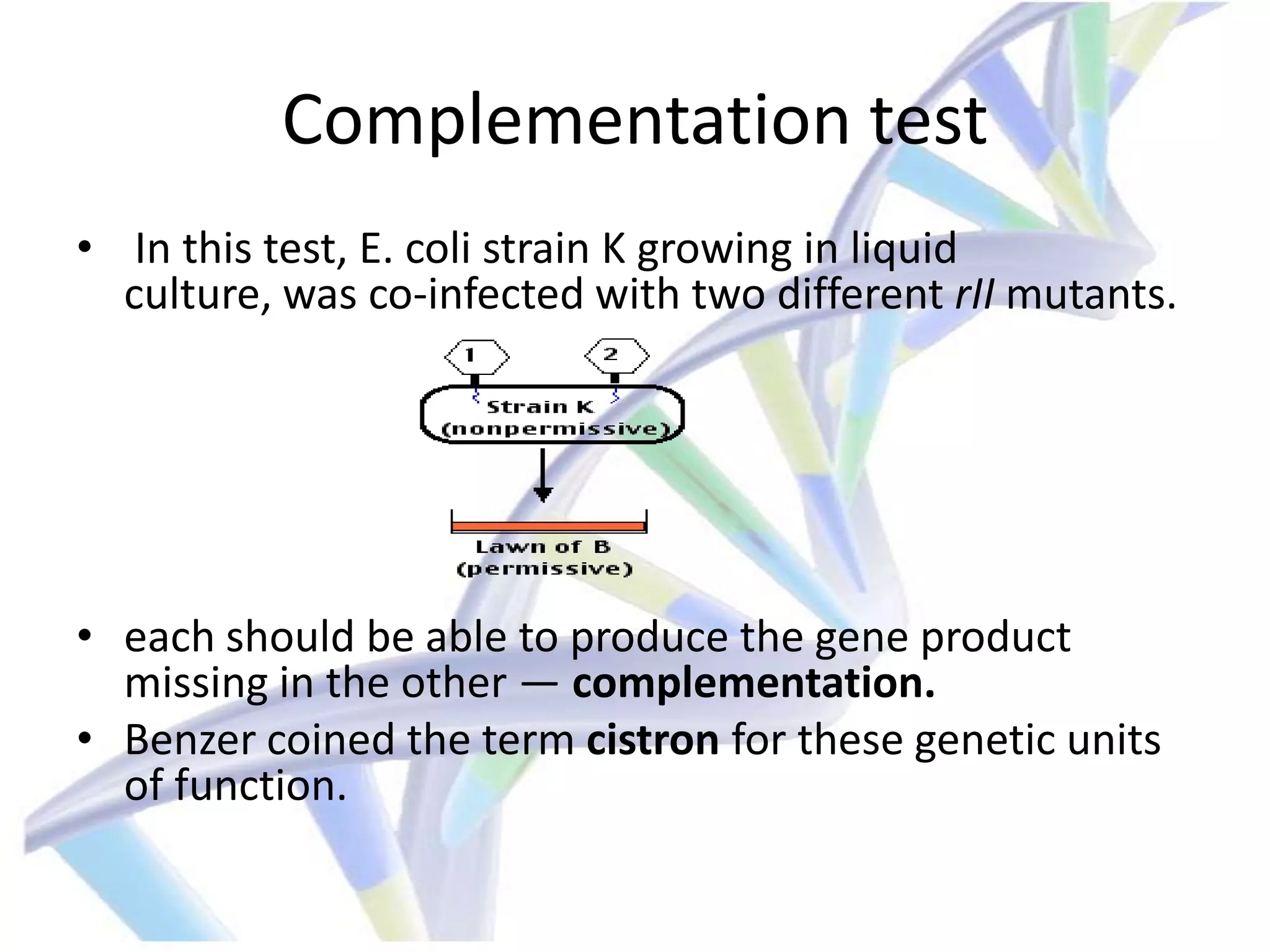
Complementation test
• In this test, E. coli strain K growing in liquid
culture, was co-infected with two different rII mutants.

• each should be able to produce the gene product
missing in the other — complementation.
• Benzer coined the term cistron for these genetic units
of function.
REVISED BEAD THEORY
The nucleotide pair is the fundamental unit of
1. Structure
2. Change
3. Benzer coined the term cistron for genetic
units of function
Gene protein relattionship. genetic fine structure

Gene protein relattionship. genetic fine structure

  • 1.
    1.How does genework? 2.Gene-protein relationship. 3.Genetic fine structure.
  • 2.
  • 3.
    Gene • A geneis a molecular hereditary unit of all living organisms.  Gene carries all the information to build and maintain the cell and pass genetic traits to the generations.
  • 4.
    One-gene-One-Enzyme Hypothesis • 1940s,George Beadle and Edward Tatum • Gene act by the production of the enzymes and each gene is responsible for production of the single enzyme that in turn effect a single step in metabolic pathway.
  • 5.
    One-gene-One-Enzyme Hypothesis • Diagrammaticrepresentation of production of arginine
  • 7.
  • 8.
    RESULT • This model,which is known as one-gene-oneenzyme hypothesis, provides the first evidence of function of the gene. • some genes were responsible for the functions of the enzymes and each gene apparently control one specific enzyme.
  • 9.
  • 10.
    Relationship between genotypeand phenotype. Genes Linear sequence of amino acid Enzymes Structural proteins Phenotyope of the cell Characteristics features of the organism
  • 12.
  • 13.
    PROTEIN MOTIFS • Severalelements of secondary structure combine to produce a pattern, or motif, that is found in numerous other proteins.
  • 14.
    RELATIONSHIP BETWEEN GENEMUTATION AND ALTERED PROTEINS • To alter the protein function only the change of one amino acid is enough. Vernon Ingram, showed this 1st time in 1957 when he study the globular protein called hemoglobin molecule which transport oxygen in cells. Hemoglobin consists of 4 polypeptide chains : • Two identical alpha chains each containing 141 amino acids. • Two identical beta chains each containing 146 amino acids.
  • 15.
  • 16.
    Genes and cellularmetabolism:
  • 17.
  • 18.
    BEAD THEORY • Structure:gene is indivisible by crossing over. Crossing over always occurs between the genes but never within them. • Function: gene is the fundamental unit of function. Parts of gene cannot function. • Change: gene is also treated as a fundamental unit of change or mutation. It changes from one allelic form to another. There are no smaller components within it that can be changed.
  • 19.
    BEAD THEORY • SeymourBenzer in 1950s showed that bead theory was not correct. • Benzer was able to use genetic system in which extremely small level of recombination could be detected. • The smallest units of mutation and recombination are now known to be correlated with single nucleotide pairs.
  • 20.
    Fine structure analysisof gene • Life cycle of bacteriophage • Plaque morphology and rII system of phageT4. • The concept of selection in genetic crosses with bacteriophage • Deletion mapping • Destruction of bead theory
  • 21.
    Phage T4 • T4are viruses that infect the bacterium E. coli. The infection ends with destruction (lysis) of the bacterial cell. • They have been enormously useful in genetic studies because a. Viruses of two (or more) different genotypes can simultaneously infect a single bacterium. b. The DNA molecules of one of the infecting viruses can recombine with that of another forming recombinant molecules. c. The huge number of viruses released from a huge number of bacterial hosts enables even rare recombination events to be detected.
  • 22.
    T4 phage • T4can be used to a. detect mutations within a single gene b. speed up the process of mapping these point mutations by the use of deletion mutants.
  • 23.
    Selection in geneticcross • The procedure was to infect strain B in liquid culture with two mutants to be tested
  • 24.
    Benzer findings • Benzereventually found some 2000 different mutations in the rII gene. The recombination frequency between some pairs of these was as low as 0.02.The T4 genome has 160,000 base pairs of DNA extending over ~1,600 centimorgans (cM). • So 1 cM ≅ 100 base pairs • So 0.02 cM represents a pair of adjacent nucleotides. • From these data, Benzer concluded that the – smallest unit of mutation and – the smallest unit of recombination • was a single base pair of DNA.
  • 25.
    Mapping Point MutationsWithin A Gene • Benzer was able to speed up the mapping process by taking advantage of the discovery that some of his mutants did not have point mutations but deletions instead. In contrast to the properties of T4 viruses with point mutations, T4 viruses with deletions in rII showed a. no recombination with other rII mutants or any other genes for that matter; b. never back-mutated.
  • 26.
    Deletion Mapping • Deletionscan be mapped by the same procedure used for point mutations. Simply cross pairs of deletion mutants and see if they produce progeny that can grow on E. coli strain K. • Here is a hypothetical example. Each of 6 strains of deletion mutants are crossed with each of the others. Strains 1 1 0 2 3 4 5 6 2 0 0 3 + + 0 4 0 + + 5 0 0 + 6 0 0 0 0 + + 0 + 0 1 and 3 do not overlap must shift 4 away from 2 6 must extend under 3 right-hand end of 4 must be removed from over 6 left-hand end of 6 must not overlap 5 but must continue to overlap 2. ∴ shorten right-hand end of 5
  • 27.
    Deletion Mapping • Fromthe results, one can draw a map showing the order and relative size of the deletions. • With such a deletion map, one can now quickly map the location of point mutations
  • 28.
    Complementation test • Inthis test, E. coli strain K growing in liquid culture, was co-infected with two different rII mutants. • each should be able to produce the gene product missing in the other — complementation. • Benzer coined the term cistron for these genetic units of function.
  • 29.
    REVISED BEAD THEORY Thenucleotide pair is the fundamental unit of 1. Structure 2. Change 3. Benzer coined the term cistron for genetic units of function