PHYTOCHROME
Presented by…
Patel Hasti G.
M.Sc. Sem 3
Botany CBO 501
Department of Life Sciences,
H.N.G.U
Patan
CONTENT
 Introduction
 History and Discovery
 Distribution
 Characteristics of phytochrome
 Chemical nature of phytochrome
 Mode of action of phytochrome
 Mechanism of phytochrome action
 Phytochrome mediated physiological responses
 Phytochrome is a pigment system : some evidences
 Role of phytochrome
INTRODUCTION
 Phytochrome is a photoreceptor , a pigment that
plants and some algae and fungi use to detect
light.
 It is a sensitive to light in the red and far-red region
of the visible spectrum.
 Biochemically phytochrome is a protein whit a
billion chromophore.
 The pigment that controls growth and flowering in
many plant.
HISTORY AND DISCOVERY
 The first important work in this field was
conducted in 1930s by L.H. Flint and E.D. Mc
Alister. In 1935 they reported that the seeds of
lettuce ( Lactuca sativa ) did not germinate in dark
but showed very good germination when exposed
to wavelengths from 525 to 700 nm in the red
region.
 H.A. Borthwick and S.B. Hendricks and other
(1952) of the U.S. Department of Agriculture plant
Industry Station in Beltsville, Maryland using large
spectrograph confirmed the finding of Flint and Mc
Alister.
DISTRIBUTION OF PHYTOCHROME
 Presence of phytochrome has been known in
angiosperms , gymnosperms, liverworts, mosses,
ferns and some green algae.
 Distribution of phytochrome in grass shoot is variable,
but oat, rye and barley seedling all have high
concentration in apical rigions of the coleoptile near
the shoot apex and in the growing leaf bases.
 Phytochrome is present in most organs of all plants
investigating, including roots.
 In green lower plants phytochrome is permanently
localized in conformation in or near the plasma
membrane.
CHARACTERISTICS OF PHYTOCHROME
 The action spectrum of the light needed for these
responses shows a peak in the red at about
660nm.
 These responses can be reversed by an be
application of far-red light soon after the red
treatment.
 Sensitive spectrometers can measure a decrease in
absorbance at 730nm when sensitive plant tissues
are exposed to red light.
CONT…
 The change in absorbance is caused by the conversion
of photoreceptor from one structural form to another.
 The red absorbing form changes to the far red
absorbing from when it absorb red light and back
again when it absorb far red light.
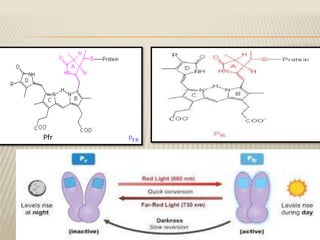
 Phytochrome has two different chemical structure
that are inter-convertible the form are named by the
color of light that they absorb maximally.
1] The Pr form and 2] The Pfr form
CONT…
1] The Pr form:
 Absorbs at a peak of 660nm
 Is the form synthesized in dark grown seedling.
 When Pr absorb red light, it is converted to the Pfr
form.
2] The Pfr form:
 Absorb at a peak of 730nm.
 The Pfr is a active form that initiates biological
response.
 When Pfr is absorb far red light it converted to the Pr
form.
Pfr
CONT…
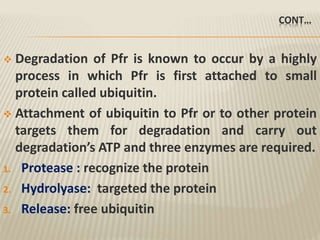
 Degradation of Pfr is known to occur by a highly
process in which Pfr is first attached to small
protein called ubiquitin.
 Attachment of ubiquitin to Pfr or to other protein
targets them for degradation and carry out
degradation’s ATP and three enzymes are required.
1. Protease : recognize the protein
2. Hydrolyase: targeted the protein
3. Release: free ubiquitin
CHEMICAL NATURE
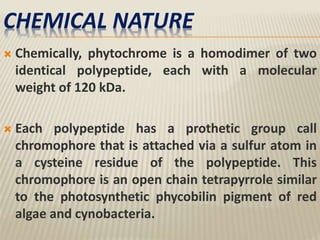
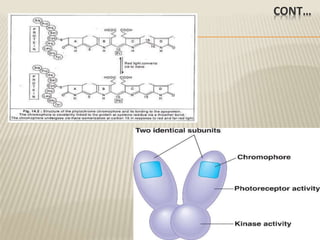
 Chemically, phytochrome is a homodimer of two
identical polypeptide, each with a molecular
weight of 120 kDa.
 Each polypeptide has a prothetic group call
chromophore that is attached via a sulfur atom in
a cysteine residue of the polypeptide. This
chromophore is an open chain tetrapyrrole similar
to the photosynthetic phycobilin pigment of red
algae and cynobacteria.
CONT...
 The chromophore, Not the protein , That absorbs
the light and causes phytochrome responses.
 When Pr is converted to Pfr by red light there is
apparently a cis-trans isomerization in the
chromophore . Alternation of the chromophore in
phytochrome then cause several unidentified
subtle changes in the structure of phytochrome
portion.
CONT…
MODE OF ACTION OF PHYTOCHROME
1] Hartman, the German physiologist has proposed a
scheme of phytochrome action
red light inactive form
Pr Pfr Pfr –X biological form
far red light
dark decay X
2] According to Borthwick and Hendricks Pr and Pfr
follow several alternative reaction paths since only
that could explain the apparently contradictory
observations made from time to time.
Note X = ATP, NAD+ etc…
CONT…
3] H. Smith ( 1970) assumes the phytochrome to be
present in the membrane.
Inner membrane outer
Compartment compartment
Pr*X
red light
precursor X Pr Pfr* X biological action
far red
light
Pfr*X
Smith hypothesis for phytocrome action
CONT…
4] Jaffe’s hypothesis is also entirely speculative. He
assumes that phytochrome perhaps causes
changes in permeability of the membrane and acts
through acetylcholine(Ach).
5] Evans (1975 ) says that Pfr (or PfrX) “control the
flow of reactive substances into several linked and
compecting synthetic pathways.”
MECHANISM OF PHYTOCHROME ACTION
 Phytochrome is believed to act in following ways :
1]According to Galston and coworkers hydroxylation
of flavonoid compound is affected by
phytochromes. Mohr, however suggests that
radiation infuences some ‘basic metabolic change
in the cell’ responsible for many different effects
and influences on flavenoid hydroxylation pattern
presumably represent only one such change.
CONT…
2] works of K.V. Thimann and coworkers suggest that
phytochrome action involves the synthesis of
nucleic acids and enzymes which may be
responsible for the physiological changes. Mohr
and others have found evidence to suggest that
phytochrome effects are medicated by activation
of genes that code for specific messenger RNA
molecules which in their turn code for specific
enzymes.
3] their are certain responses due to red or far – red
light which are too fast to be explain by the gene
activation or repression hypothesis.
PHYTOCHROME MEDIATED PHYSIOLOGICALE
RESPONSES:
• Phytochrome has been found to control a number
of physiological responses of the plant. e.g. spore
germination, chloroplast movement, elongation,
bud dormancy, root development,..etc.
• Numerous plant responses are mediated by
phytochrome hence, for convenience of study ,
they have been divided in to positive, negative and
complex responses or as developmental and
repaid responses.
CONT…
1] Positive responses:
characterized by initiation or increase of
biosynthetic or growth processes e.g. phytocrome
mediated anthocynin synthesis.
2] Negative responses:
those involving inhibition of growth processes or
other physiological processes like translocation of
substance e.g. inhibition of hypocotyls elongation
by light.
CONT…
3] complex responses;
Those which are characterized by initially an
inhibition and later promotion of the responses
as compared to corresponding dark control e.g.
light controlled regulation of oxygen uptake by
cotyledons.
DEVELOPMENTAL AND RAPID RESPONSES
A] Developmental responses: those responses which
are mediated by phytochrome but also involve
other physiological processes like growth,
differentiation certain periodic phenomenon and
longer time for production of the responses e.g.
photoperiodism and germination
B] Rapid responses : those which are detectable
within a very short period after germination
irradiation and do not apparently interact with
complex physiological processes e.g. closing of
mimosa leaflets.
CONT…
PHYTOCHROME IS A PIGMENT SYSTEM: SOME
EVIDENCES
 There are similarities in the absorption spectra of
phytochrome and the action spectra of plant
responses is one important evidence suggesting
that phytochrome is the pigment causing such
responses.
 The response caused by red light are, always
nullified by an immediate subsequent exposure to
red light.
 Only low irradiance levels of either red or far red
light that are capable of inter converting
phytochrome from one form to another cause
these responses.
CONT…
 In leaves and stem , light absorbed by chlorophyll
alters both the action spectra for phytochrome
response caused by Pfr and the amount of light
required for the response.
 Both Pr and Pfr absorb violate and blue light, but
low irradiance levels of these wevelengths are
much less effective then red or far red light for the
physiological processes.
ROLE OF PHYTOCHROME
 Many flowering plants use it to regulate the time
of flowering based on the length of day and night
(photoperiodism) and to set circadian rhythms.
 It also regulates other responses including the
germination of seeds, elongation of seedling, the
size, shape and number of leaves the synthesis of
chlorophyll and the straightening of the epicotyl
or hypocotyl hook of dicot seedlings.
REFERENCES
 Plant Physiology : Fundamentals and
Applications
By Arvind Kumar and S.S. Purohit
 Textbook of Plant Physiology
By V. Verma
 www.slidesher.in
 www.images of phytochrome.in
Pytochrome

Pytochrome

  • 1.
    PHYTOCHROME Presented by… Patel HastiG. M.Sc. Sem 3 Botany CBO 501 Department of Life Sciences, H.N.G.U Patan
  • 2.
    CONTENT  Introduction  Historyand Discovery  Distribution  Characteristics of phytochrome  Chemical nature of phytochrome  Mode of action of phytochrome  Mechanism of phytochrome action  Phytochrome mediated physiological responses  Phytochrome is a pigment system : some evidences  Role of phytochrome
  • 3.
    INTRODUCTION  Phytochrome isa photoreceptor , a pigment that plants and some algae and fungi use to detect light.  It is a sensitive to light in the red and far-red region of the visible spectrum.  Biochemically phytochrome is a protein whit a billion chromophore.  The pigment that controls growth and flowering in many plant.
  • 4.
    HISTORY AND DISCOVERY The first important work in this field was conducted in 1930s by L.H. Flint and E.D. Mc Alister. In 1935 they reported that the seeds of lettuce ( Lactuca sativa ) did not germinate in dark but showed very good germination when exposed to wavelengths from 525 to 700 nm in the red region.  H.A. Borthwick and S.B. Hendricks and other (1952) of the U.S. Department of Agriculture plant Industry Station in Beltsville, Maryland using large spectrograph confirmed the finding of Flint and Mc Alister.
  • 5.
    DISTRIBUTION OF PHYTOCHROME Presence of phytochrome has been known in angiosperms , gymnosperms, liverworts, mosses, ferns and some green algae.  Distribution of phytochrome in grass shoot is variable, but oat, rye and barley seedling all have high concentration in apical rigions of the coleoptile near the shoot apex and in the growing leaf bases.  Phytochrome is present in most organs of all plants investigating, including roots.  In green lower plants phytochrome is permanently localized in conformation in or near the plasma membrane.
  • 6.
    CHARACTERISTICS OF PHYTOCHROME The action spectrum of the light needed for these responses shows a peak in the red at about 660nm.  These responses can be reversed by an be application of far-red light soon after the red treatment.  Sensitive spectrometers can measure a decrease in absorbance at 730nm when sensitive plant tissues are exposed to red light.
  • 7.
    CONT…  The changein absorbance is caused by the conversion of photoreceptor from one structural form to another.  The red absorbing form changes to the far red absorbing from when it absorb red light and back again when it absorb far red light.  Phytochrome has two different chemical structure that are inter-convertible the form are named by the color of light that they absorb maximally. 1] The Pr form and 2] The Pfr form
  • 8.
    CONT… 1] The Prform:  Absorbs at a peak of 660nm  Is the form synthesized in dark grown seedling.  When Pr absorb red light, it is converted to the Pfr form. 2] The Pfr form:  Absorb at a peak of 730nm.  The Pfr is a active form that initiates biological response.  When Pfr is absorb far red light it converted to the Pr form.
  • 9.
  • 10.
    CONT…  Degradation ofPfr is known to occur by a highly process in which Pfr is first attached to small protein called ubiquitin.  Attachment of ubiquitin to Pfr or to other protein targets them for degradation and carry out degradation’s ATP and three enzymes are required. 1. Protease : recognize the protein 2. Hydrolyase: targeted the protein 3. Release: free ubiquitin
  • 11.
    CHEMICAL NATURE  Chemically,phytochrome is a homodimer of two identical polypeptide, each with a molecular weight of 120 kDa.  Each polypeptide has a prothetic group call chromophore that is attached via a sulfur atom in a cysteine residue of the polypeptide. This chromophore is an open chain tetrapyrrole similar to the photosynthetic phycobilin pigment of red algae and cynobacteria.
  • 12.
    CONT...  The chromophore,Not the protein , That absorbs the light and causes phytochrome responses.  When Pr is converted to Pfr by red light there is apparently a cis-trans isomerization in the chromophore . Alternation of the chromophore in phytochrome then cause several unidentified subtle changes in the structure of phytochrome portion.
  • 13.
  • 14.
    MODE OF ACTIONOF PHYTOCHROME 1] Hartman, the German physiologist has proposed a scheme of phytochrome action red light inactive form Pr Pfr Pfr –X biological form far red light dark decay X 2] According to Borthwick and Hendricks Pr and Pfr follow several alternative reaction paths since only that could explain the apparently contradictory observations made from time to time. Note X = ATP, NAD+ etc…
  • 15.
    CONT… 3] H. Smith( 1970) assumes the phytochrome to be present in the membrane. Inner membrane outer Compartment compartment Pr*X red light precursor X Pr Pfr* X biological action far red light Pfr*X Smith hypothesis for phytocrome action
  • 16.
    CONT… 4] Jaffe’s hypothesisis also entirely speculative. He assumes that phytochrome perhaps causes changes in permeability of the membrane and acts through acetylcholine(Ach). 5] Evans (1975 ) says that Pfr (or PfrX) “control the flow of reactive substances into several linked and compecting synthetic pathways.”
  • 17.
    MECHANISM OF PHYTOCHROMEACTION  Phytochrome is believed to act in following ways : 1]According to Galston and coworkers hydroxylation of flavonoid compound is affected by phytochromes. Mohr, however suggests that radiation infuences some ‘basic metabolic change in the cell’ responsible for many different effects and influences on flavenoid hydroxylation pattern presumably represent only one such change.
  • 18.
    CONT… 2] works ofK.V. Thimann and coworkers suggest that phytochrome action involves the synthesis of nucleic acids and enzymes which may be responsible for the physiological changes. Mohr and others have found evidence to suggest that phytochrome effects are medicated by activation of genes that code for specific messenger RNA molecules which in their turn code for specific enzymes. 3] their are certain responses due to red or far – red light which are too fast to be explain by the gene activation or repression hypothesis.
  • 19.
    PHYTOCHROME MEDIATED PHYSIOLOGICALE RESPONSES: •Phytochrome has been found to control a number of physiological responses of the plant. e.g. spore germination, chloroplast movement, elongation, bud dormancy, root development,..etc. • Numerous plant responses are mediated by phytochrome hence, for convenience of study , they have been divided in to positive, negative and complex responses or as developmental and repaid responses.
  • 20.
    CONT… 1] Positive responses: characterizedby initiation or increase of biosynthetic or growth processes e.g. phytocrome mediated anthocynin synthesis. 2] Negative responses: those involving inhibition of growth processes or other physiological processes like translocation of substance e.g. inhibition of hypocotyls elongation by light.
  • 21.
    CONT… 3] complex responses; Thosewhich are characterized by initially an inhibition and later promotion of the responses as compared to corresponding dark control e.g. light controlled regulation of oxygen uptake by cotyledons.
  • 22.
    DEVELOPMENTAL AND RAPIDRESPONSES A] Developmental responses: those responses which are mediated by phytochrome but also involve other physiological processes like growth, differentiation certain periodic phenomenon and longer time for production of the responses e.g. photoperiodism and germination B] Rapid responses : those which are detectable within a very short period after germination irradiation and do not apparently interact with complex physiological processes e.g. closing of mimosa leaflets. CONT…
  • 23.
    PHYTOCHROME IS APIGMENT SYSTEM: SOME EVIDENCES  There are similarities in the absorption spectra of phytochrome and the action spectra of plant responses is one important evidence suggesting that phytochrome is the pigment causing such responses.  The response caused by red light are, always nullified by an immediate subsequent exposure to red light.  Only low irradiance levels of either red or far red light that are capable of inter converting phytochrome from one form to another cause these responses.
  • 24.
    CONT…  In leavesand stem , light absorbed by chlorophyll alters both the action spectra for phytochrome response caused by Pfr and the amount of light required for the response.  Both Pr and Pfr absorb violate and blue light, but low irradiance levels of these wevelengths are much less effective then red or far red light for the physiological processes.
  • 25.
    ROLE OF PHYTOCHROME Many flowering plants use it to regulate the time of flowering based on the length of day and night (photoperiodism) and to set circadian rhythms.  It also regulates other responses including the germination of seeds, elongation of seedling, the size, shape and number of leaves the synthesis of chlorophyll and the straightening of the epicotyl or hypocotyl hook of dicot seedlings.
  • 26.
    REFERENCES  Plant Physiology: Fundamentals and Applications By Arvind Kumar and S.S. Purohit  Textbook of Plant Physiology By V. Verma  www.slidesher.in  www.images of phytochrome.in