C3 CYCLE
Presented by : - Salvi Pinky P.
M.sc sem : - 3
Paper : - Botany 503
Department of Life sciences,
H. N. G. U., Patan
CONTENTS
 Introduction
 Stages : —
1) Fixation
2) Reduction
3) Regeneration
 Significance of C3 cycle
 Difference between C3 and C4 cycle
Introduction
• It is a cyclic reaction occuring in the dark phase of
photosynthesis.
• In this reaction CO2 is converted in to sugar and hence it is a
process of carbon fixation.
• The Calvin cycle was first observed by Melvin Calvin in
chlorella, unicellular green algae.
• Calvin was awarded Nobel prize for this work in 1961.
Other names for Calvin Cycle : —
1) Dark reactions
2) C3 Cycle
3) Reductive Pentose phosphate Cycle
4) Calvin Cycle
5) Photosynthetic Carbon Reduction Cycle [ PCR ]
• Calvin and other workers are working at the University of
Berkeley, he used a carbon – 14 isotopes to understand the
Photosynthesis process in plants.
• This radioactive isotope helped him determine how the light
independent reaction works in Singal – celled algae.
• Calvin and co - workers found that after three second,
radioactivity appeared in phosphoglyceric acid or PGA.
• Phosphoglyceric acid is, therefore, the first stable product of
Photosynthesis as known as C3 Cycle.
Stages of C3 cycle
• These energy carrying molecules are made in the stroma of
the chloroplast where the Calvin takes place.
• The Calvin cycle is not totally independent of light since it
relies on ATP and NADPH, which are products of the light
dependent reactions.
• The light reactions of the Calvin cycle can be organised in to
three basic stages : - 1) Fixation
2) Reduction
3) Regeneration
FIXATION
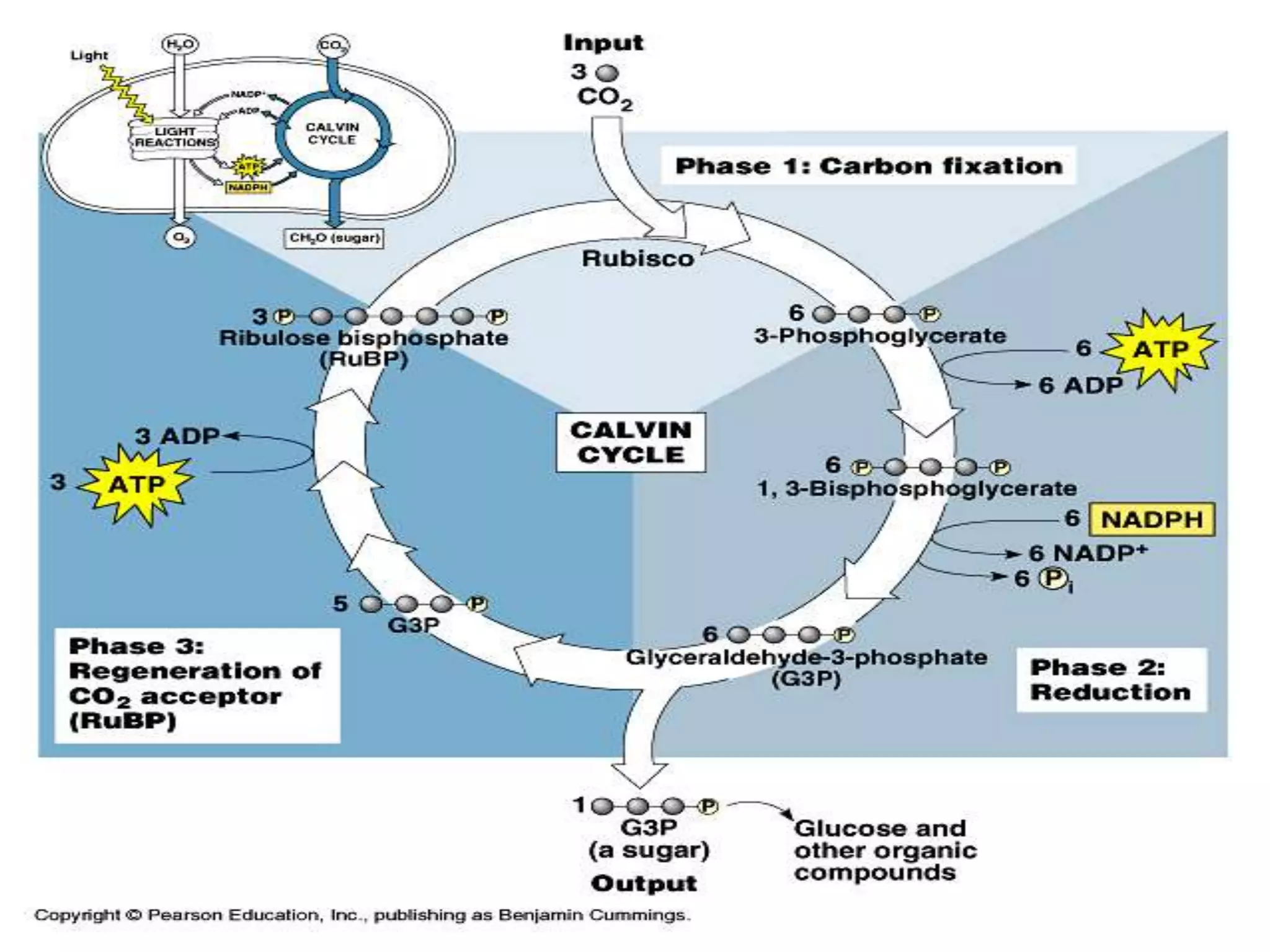
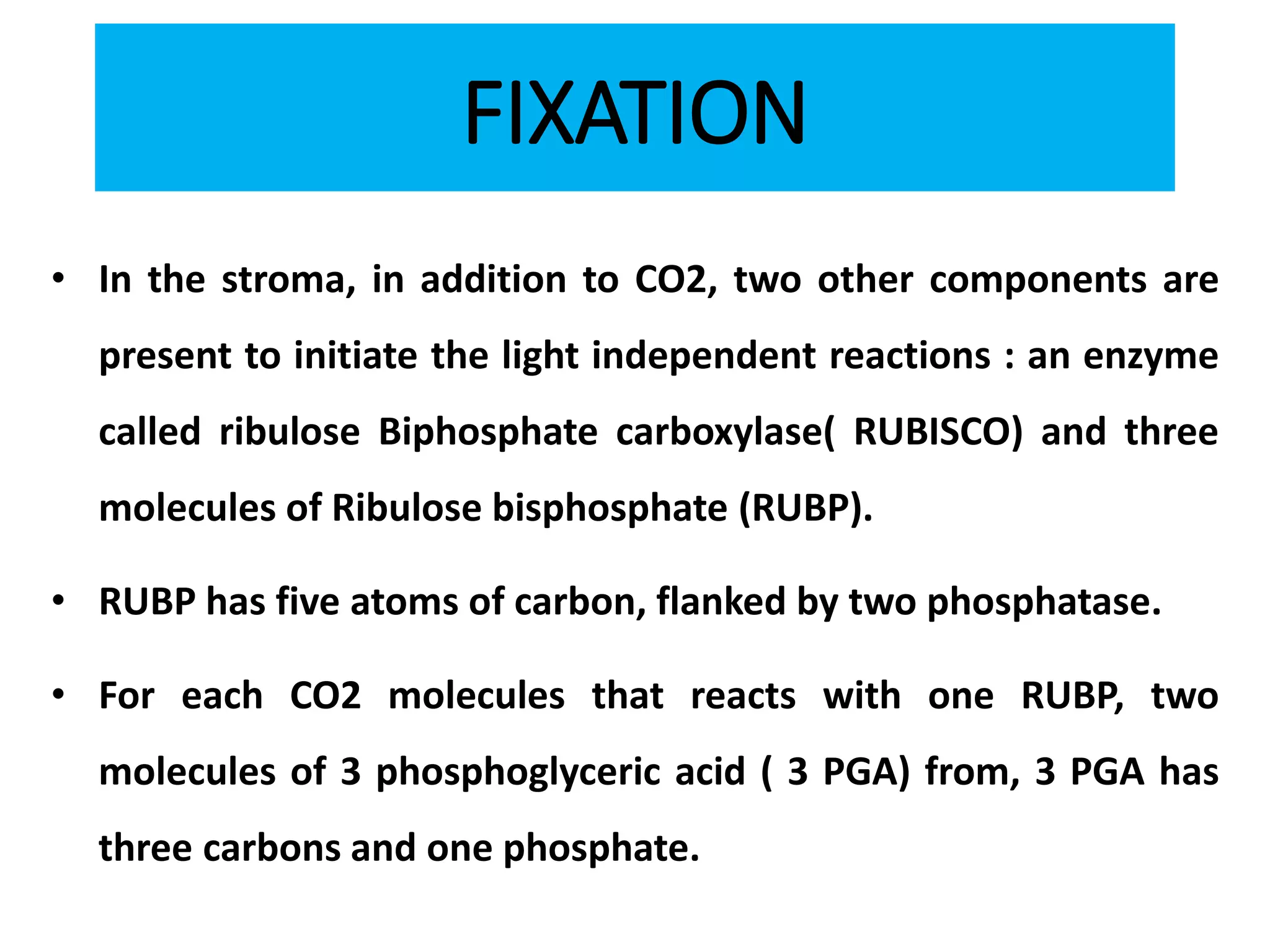
• In the stroma, in addition to CO2, two other components are
present to initiate the light independent reactions : an enzyme
called ribulose Biphosphate carboxylase( RUBISCO) and three
molecules of Ribulose bisphosphate (RUBP).
• RUBP has five atoms of carbon, flanked by two phosphatase.
• For each CO2 molecules that reacts with one RUBP, two
molecules of 3 phosphoglyceric acid ( 3 PGA) from, 3 PGA has
three carbons and one phosphate.
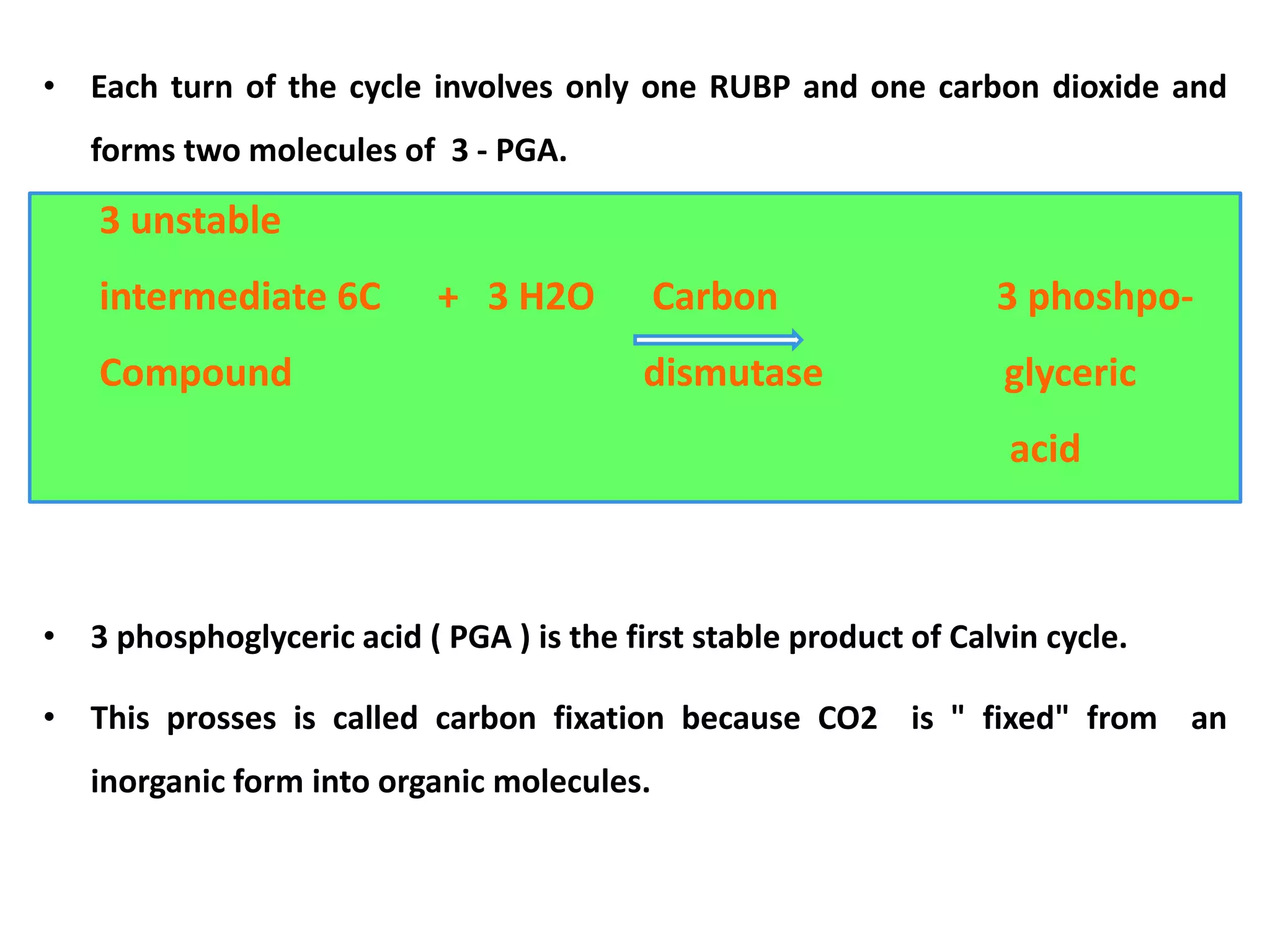
• Each turn of the cycle involves only one RUBP and one carbon dioxide and
forms two molecules of 3 - PGA.
• 3 phosphoglyceric acid ( PGA ) is the first stable product of Calvin cycle.
• This prosses is called carbon fixation because CO2 is " fixed" from an
inorganic form into organic molecules.
3 unstable
intermediate 6C + 3 H2O Carbon 3 phoshpo-
Compound dismutase glyceric
acid
REDUCTION
• 6 molecules of 3 PGA are phosphorylated by 6 molecules of 1, 3
diphosphoglyceric acid and 6 molecules of ADP.
• Six molecules of 1,3 diphosphoglyceric glyceric acid are
• 6 molecules of 1, 3 diphosphoglyceric acid are reducedhe use of
molecules of NADPH2 to from 6 Molecules of 3 phosphoglyceric.
3 Phospho Kinase 1,3 diphosphate
glyceric acid + ATP glyceric acid + ADP
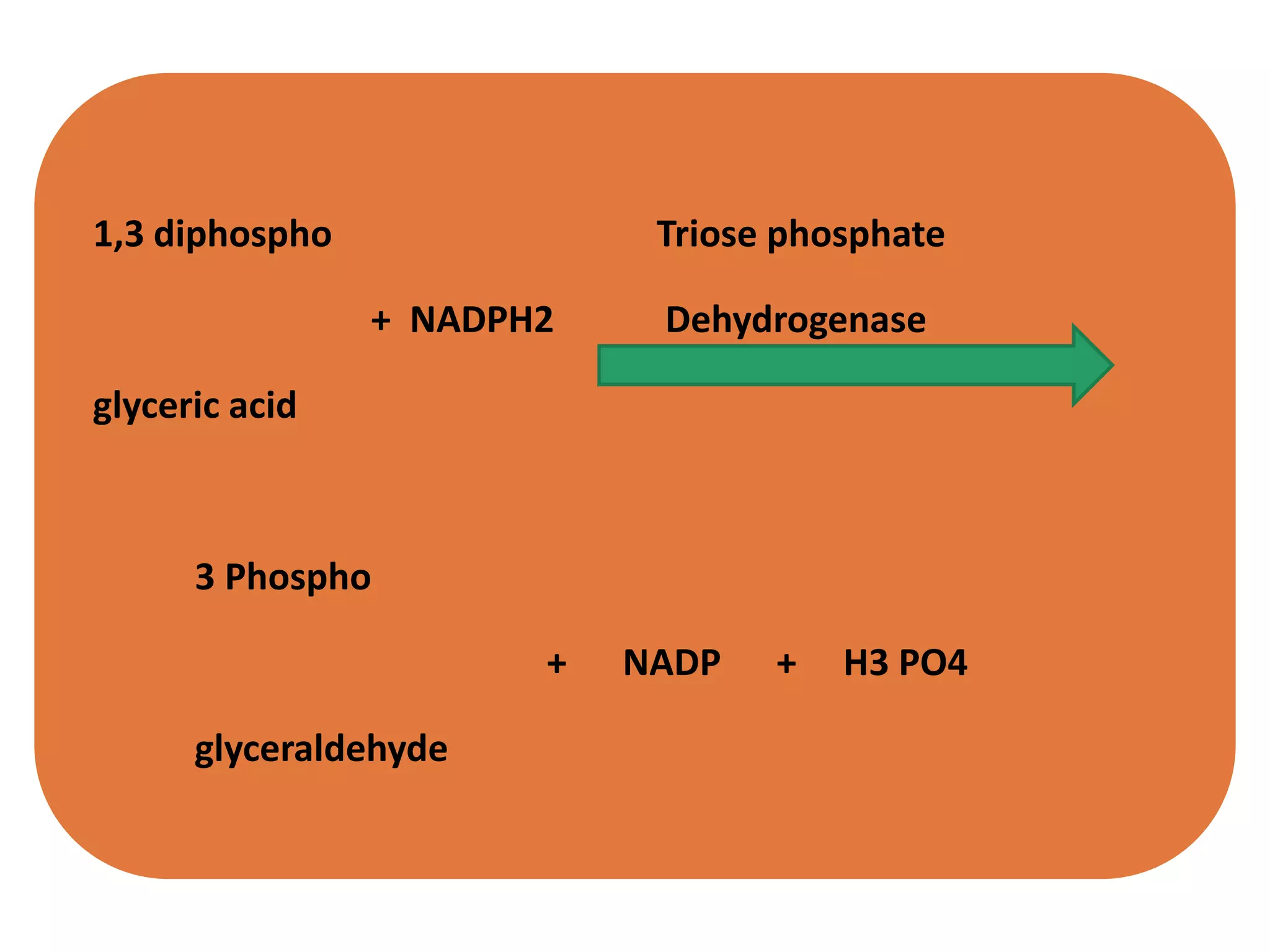
1,3 diphospho Triose phosphate
+ NADPH2 Dehydrogenase
glyceric acid
3 Phospho
+ NADP + H3 PO4
glyceraldehyde
REGENERATION
I. In the regeneration phase, the ribose diphosphate is
regenerated it involves the following steps.
1. Some of the molecules of 3 phosphoglyceraldyde convert
into dihydroxy acetone phosphate ( DHAP ).
3 Phospho Triose phosphate Dihydroxy acetone
isomerase Phosphate
glyceraldehyde ( DHAP )
2. Both 3 PGAL and DHAP then unite in the presence of enzyme,
aldolase to from fructose 1,6 diphosphate.
3. Fructose 1,6 disphosphate is converted into Fructose 6
phosphate in the presence of phosphorylase.
4. Some of the 4 phosphate combines with DHAP in the presence
of the enzyme aldolase to form sedoheptose 1,7 diphosphate.
3 Phospho Aldolase Fructose 1,6
glyceraldehyde + DHAP diphosphate
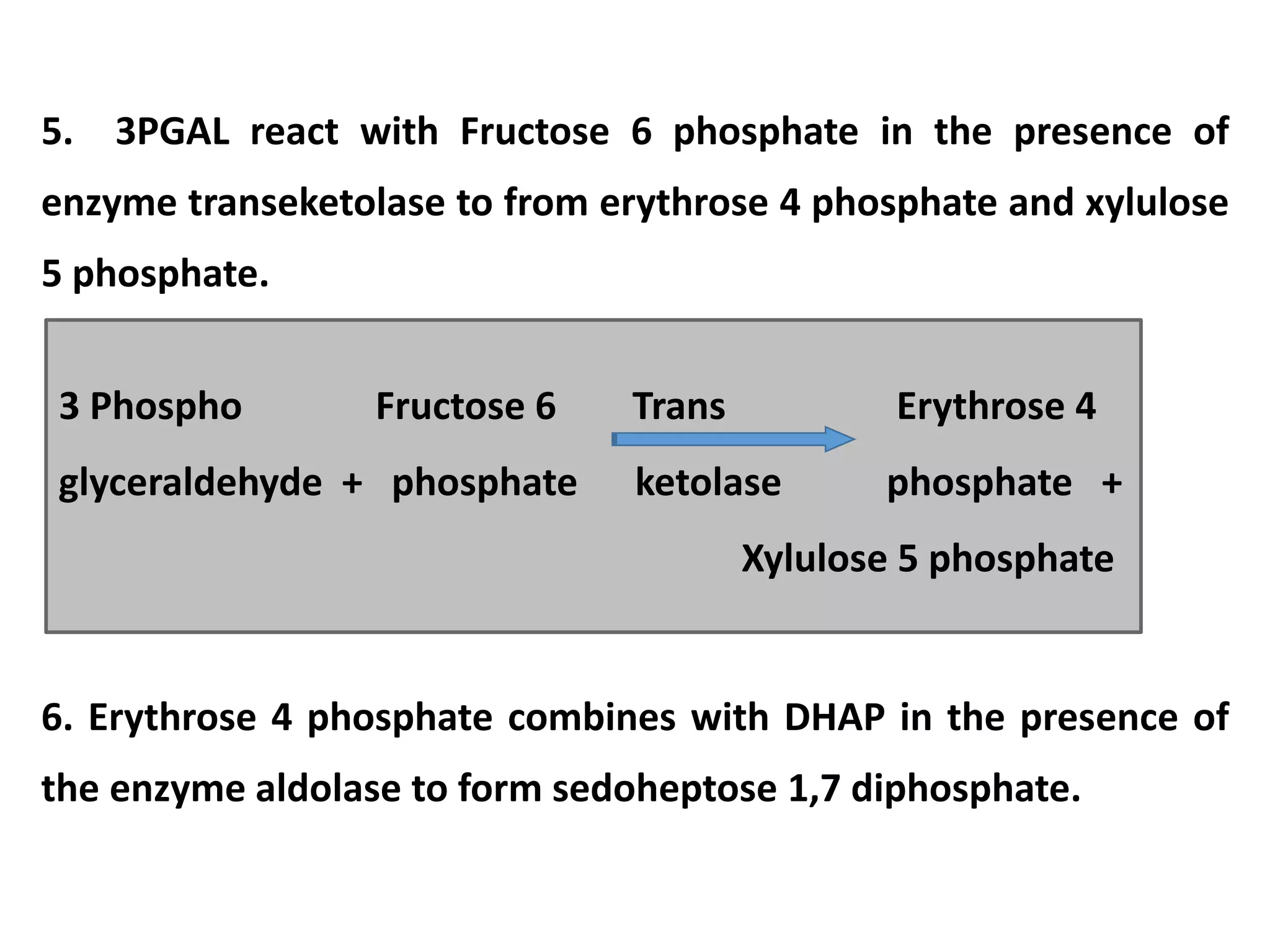
5. 3PGAL react with Fructose 6 phosphate in the presence of
enzyme transeketolase to from erythrose 4 phosphate and xylulose
5 phosphate.
6. Erythrose 4 phosphate combines with DHAP in the presence of
the enzyme aldolase to form sedoheptose 1,7 diphosphate.
3 Phospho Fructose 6 Trans Erythrose 4
glyceraldehyde + phosphate ketolase phosphate +
Xylulose 5 phosphate
7. Sedoheptulose 1,7 diphosphate loses one phosphate group in
the presence of the enzyme phosphatase to from sedoheptulose 7
phosphate.
8. Sedoheptulose 7 phosphate react with 3 PGAL in the presence
of transeketolase to form xylulose 5 phosphate and ribose 5
phosphate.
Erythrose 4 Aldolase Sedoheptulose 1,7
phosphate + DHAP diphosphate
9. Ribose 5 phosphate is converted into Ribulose 1,5 bisphosphate
in the presence of enzyme phosphopentose kinese and ATP.
Sedoheptulose + 3 Phospho Trans Xylulose
7 phosphate Glyceraldehyde Ketolase 5 phosphate +
Ribose 5 phosphate
Ribose + ATP Phospho Ribulose
5 phosphate pento 1,5 di- + ADP
kinese Phosphate
10. Two Molecules of xylulose 5 phosphate are also converted
into one molecule of Ribulose 5 phosphate.
• Ribulose 5 phosphate is phosphorylated by ATP to form
Ribulose 1,5 bisphosphate and ADP.
2 moles Phosphopento 2 moles
Xylulose + ATP Kinese Ribulose + ADP
5 phosphate 1,5 diphosphate
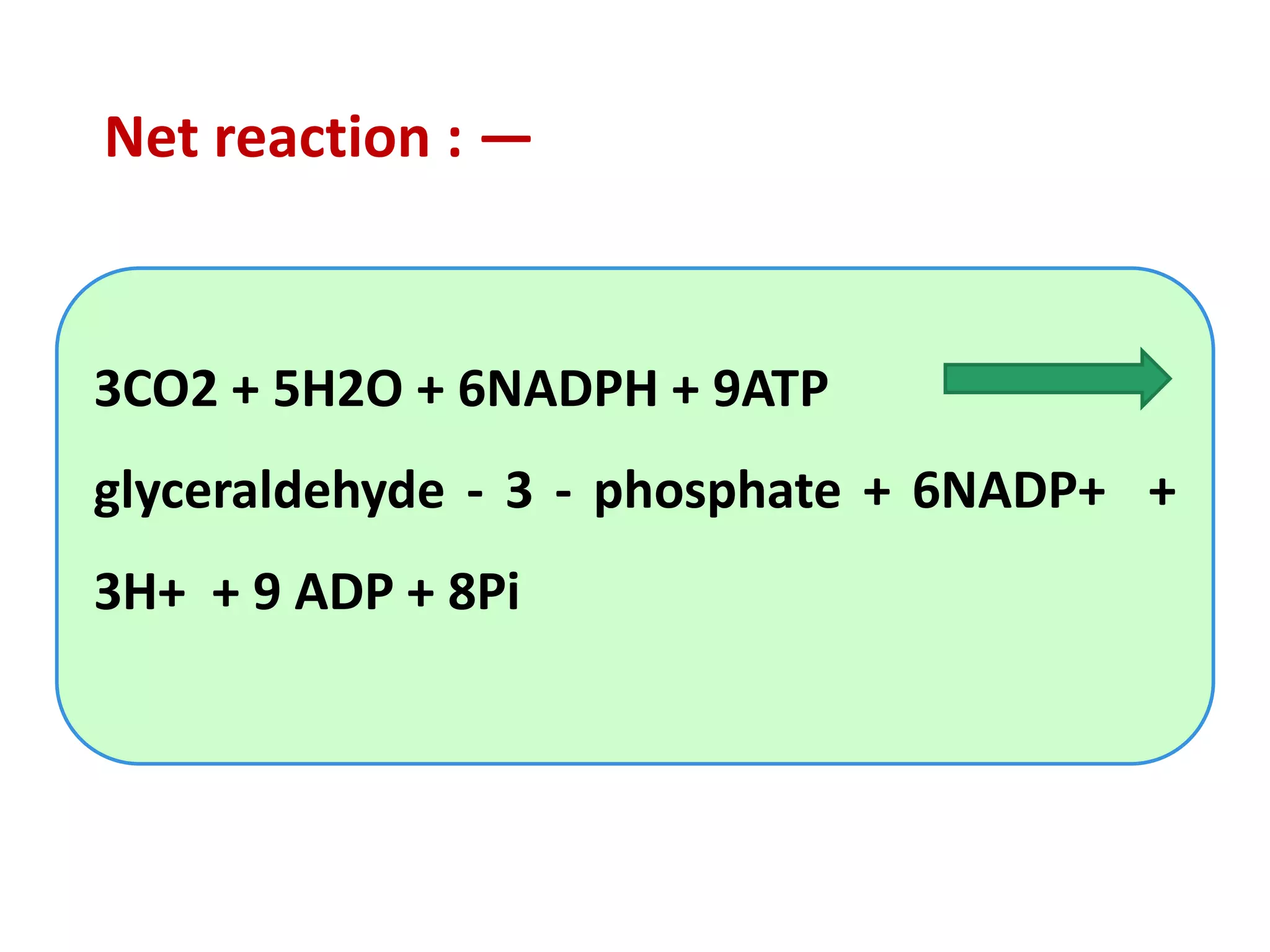
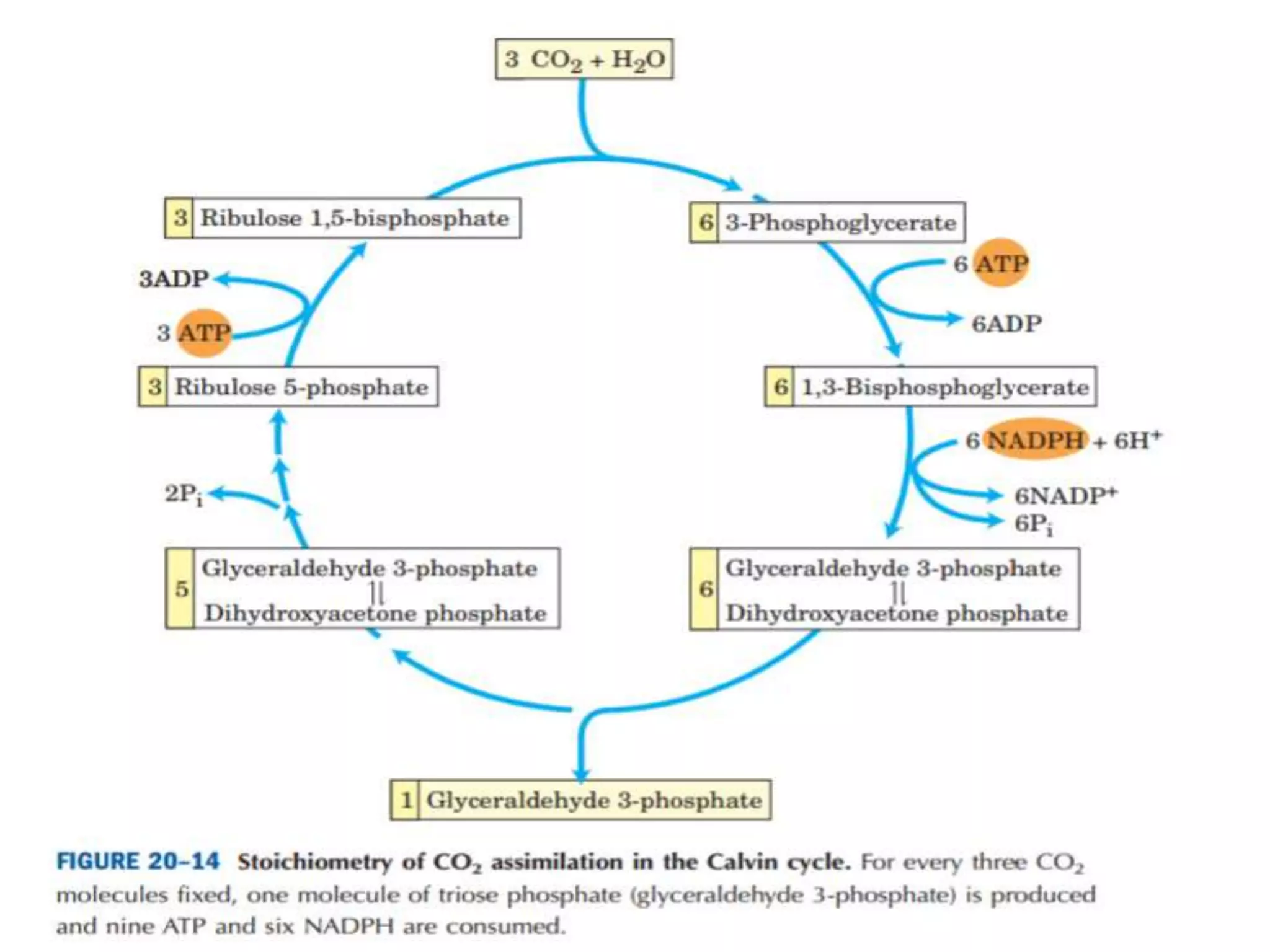
Net reaction : —
3CO2 + 5H2O + 6NADPH + 9ATP
glyceraldehyde - 3 - phosphate + 6NADP+ +
3H+ + 9 ADP + 8Pi
SIGNIFICANCE OF C3 CYCLE
• It is the main biochemical pathway during the dark reaction
(phase – II) of Photosynthesis.
• It result in the synthesis of carbohydrates from CO2 [ assimilation
of carbon ].
• It depends on the light reaction ( phase I ) for the supply of the
assimiatory power ( ATP and NADPH2 ) required for carbon
assimilation.
• It stores the ATP energy formed during light reaction in the
carbohydrate molecules as the food energy.
• It is the primary source of organic food and food energy for all
the organisms.
• Calvin cycle [ C3 cycle ] reaction occur in all photosynthetic
plants ; i.e. C3, C4 and CAM plants, during the dark phase of
Photosynthesis.
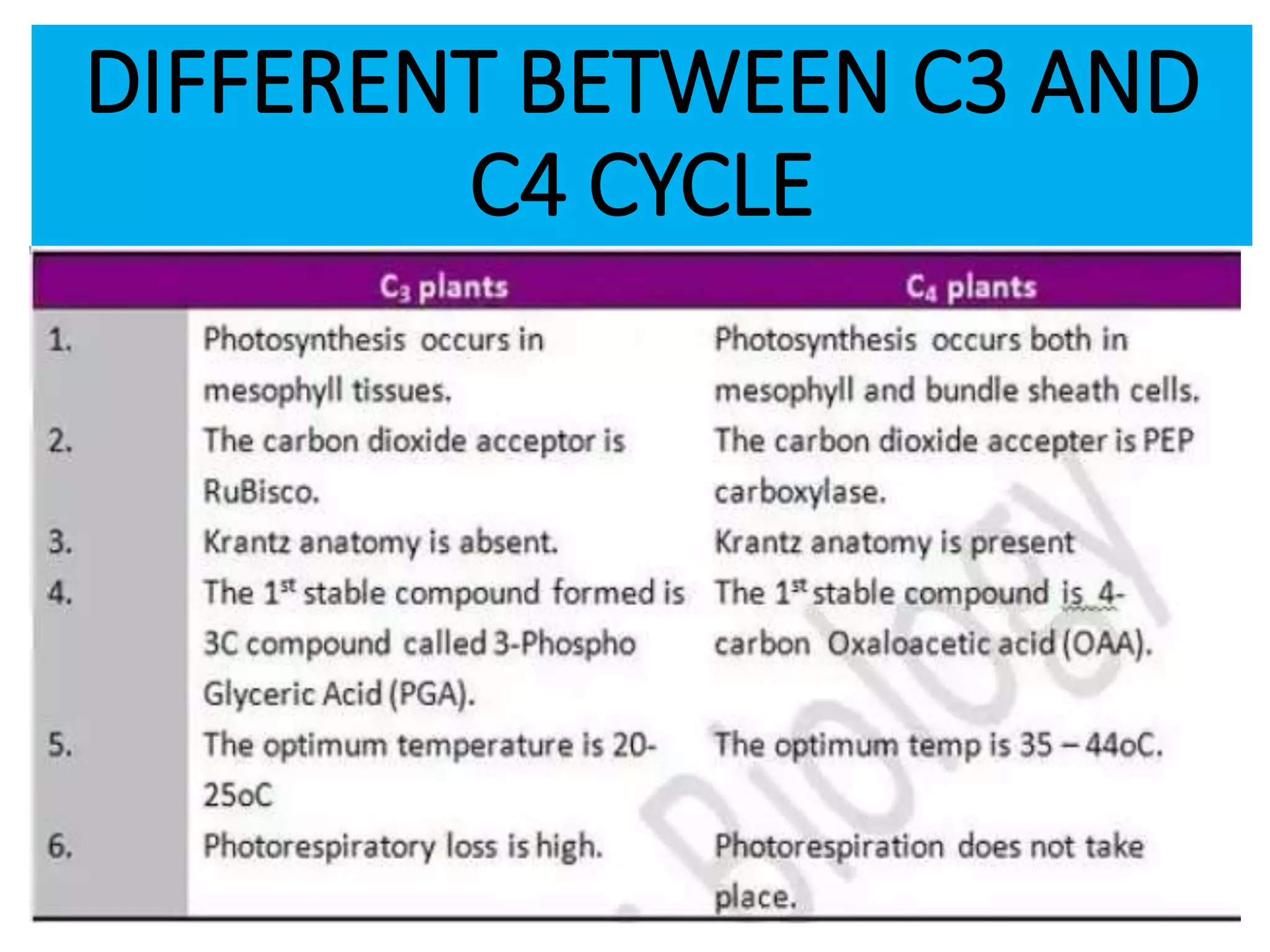
DIFFERENT BETWEEN C3 AND
C4 CYCLE
REFERENCES
• Plant physiology By : - Taize & Zeiger
• Plant physiology By : - Verma P. S. and P. K. Agarwal
• Principles of biochemistry By : – Albert lehninger
 https:// biologydictionary.net
 https:// eagri.org
 www.losal.org
Thank you

C3 cycle

  • 1.
    C3 CYCLE Presented by: - Salvi Pinky P. M.sc sem : - 3 Paper : - Botany 503 Department of Life sciences, H. N. G. U., Patan
  • 2.
    CONTENTS  Introduction  Stages: — 1) Fixation 2) Reduction 3) Regeneration  Significance of C3 cycle  Difference between C3 and C4 cycle
  • 3.
    Introduction • It isa cyclic reaction occuring in the dark phase of photosynthesis. • In this reaction CO2 is converted in to sugar and hence it is a process of carbon fixation. • The Calvin cycle was first observed by Melvin Calvin in chlorella, unicellular green algae. • Calvin was awarded Nobel prize for this work in 1961.
  • 4.
    Other names forCalvin Cycle : — 1) Dark reactions 2) C3 Cycle 3) Reductive Pentose phosphate Cycle 4) Calvin Cycle 5) Photosynthetic Carbon Reduction Cycle [ PCR ]
  • 5.
    • Calvin andother workers are working at the University of Berkeley, he used a carbon – 14 isotopes to understand the Photosynthesis process in plants. • This radioactive isotope helped him determine how the light independent reaction works in Singal – celled algae. • Calvin and co - workers found that after three second, radioactivity appeared in phosphoglyceric acid or PGA. • Phosphoglyceric acid is, therefore, the first stable product of Photosynthesis as known as C3 Cycle.
  • 7.
    Stages of C3cycle • These energy carrying molecules are made in the stroma of the chloroplast where the Calvin takes place. • The Calvin cycle is not totally independent of light since it relies on ATP and NADPH, which are products of the light dependent reactions. • The light reactions of the Calvin cycle can be organised in to three basic stages : - 1) Fixation 2) Reduction 3) Regeneration
  • 8.
    FIXATION • In thestroma, in addition to CO2, two other components are present to initiate the light independent reactions : an enzyme called ribulose Biphosphate carboxylase( RUBISCO) and three molecules of Ribulose bisphosphate (RUBP). • RUBP has five atoms of carbon, flanked by two phosphatase. • For each CO2 molecules that reacts with one RUBP, two molecules of 3 phosphoglyceric acid ( 3 PGA) from, 3 PGA has three carbons and one phosphate.
  • 9.
    • Each turnof the cycle involves only one RUBP and one carbon dioxide and forms two molecules of 3 - PGA. • 3 phosphoglyceric acid ( PGA ) is the first stable product of Calvin cycle. • This prosses is called carbon fixation because CO2 is " fixed" from an inorganic form into organic molecules. 3 unstable intermediate 6C + 3 H2O Carbon 3 phoshpo- Compound dismutase glyceric acid
  • 10.
    REDUCTION • 6 moleculesof 3 PGA are phosphorylated by 6 molecules of 1, 3 diphosphoglyceric acid and 6 molecules of ADP. • Six molecules of 1,3 diphosphoglyceric glyceric acid are • 6 molecules of 1, 3 diphosphoglyceric acid are reducedhe use of molecules of NADPH2 to from 6 Molecules of 3 phosphoglyceric. 3 Phospho Kinase 1,3 diphosphate glyceric acid + ATP glyceric acid + ADP
  • 11.
    1,3 diphospho Triosephosphate + NADPH2 Dehydrogenase glyceric acid 3 Phospho + NADP + H3 PO4 glyceraldehyde
  • 12.
    REGENERATION I. In theregeneration phase, the ribose diphosphate is regenerated it involves the following steps. 1. Some of the molecules of 3 phosphoglyceraldyde convert into dihydroxy acetone phosphate ( DHAP ). 3 Phospho Triose phosphate Dihydroxy acetone isomerase Phosphate glyceraldehyde ( DHAP )
  • 13.
    2. Both 3PGAL and DHAP then unite in the presence of enzyme, aldolase to from fructose 1,6 diphosphate. 3. Fructose 1,6 disphosphate is converted into Fructose 6 phosphate in the presence of phosphorylase. 4. Some of the 4 phosphate combines with DHAP in the presence of the enzyme aldolase to form sedoheptose 1,7 diphosphate. 3 Phospho Aldolase Fructose 1,6 glyceraldehyde + DHAP diphosphate
  • 14.
    5. 3PGAL reactwith Fructose 6 phosphate in the presence of enzyme transeketolase to from erythrose 4 phosphate and xylulose 5 phosphate. 6. Erythrose 4 phosphate combines with DHAP in the presence of the enzyme aldolase to form sedoheptose 1,7 diphosphate. 3 Phospho Fructose 6 Trans Erythrose 4 glyceraldehyde + phosphate ketolase phosphate + Xylulose 5 phosphate
  • 15.
    7. Sedoheptulose 1,7diphosphate loses one phosphate group in the presence of the enzyme phosphatase to from sedoheptulose 7 phosphate. 8. Sedoheptulose 7 phosphate react with 3 PGAL in the presence of transeketolase to form xylulose 5 phosphate and ribose 5 phosphate. Erythrose 4 Aldolase Sedoheptulose 1,7 phosphate + DHAP diphosphate
  • 16.
    9. Ribose 5phosphate is converted into Ribulose 1,5 bisphosphate in the presence of enzyme phosphopentose kinese and ATP. Sedoheptulose + 3 Phospho Trans Xylulose 7 phosphate Glyceraldehyde Ketolase 5 phosphate + Ribose 5 phosphate Ribose + ATP Phospho Ribulose 5 phosphate pento 1,5 di- + ADP kinese Phosphate
  • 17.
    10. Two Moleculesof xylulose 5 phosphate are also converted into one molecule of Ribulose 5 phosphate. • Ribulose 5 phosphate is phosphorylated by ATP to form Ribulose 1,5 bisphosphate and ADP. 2 moles Phosphopento 2 moles Xylulose + ATP Kinese Ribulose + ADP 5 phosphate 1,5 diphosphate
  • 18.
    Net reaction :— 3CO2 + 5H2O + 6NADPH + 9ATP glyceraldehyde - 3 - phosphate + 6NADP+ + 3H+ + 9 ADP + 8Pi
  • 20.
    SIGNIFICANCE OF C3CYCLE • It is the main biochemical pathway during the dark reaction (phase – II) of Photosynthesis. • It result in the synthesis of carbohydrates from CO2 [ assimilation of carbon ]. • It depends on the light reaction ( phase I ) for the supply of the assimiatory power ( ATP and NADPH2 ) required for carbon assimilation.
  • 21.
    • It storesthe ATP energy formed during light reaction in the carbohydrate molecules as the food energy. • It is the primary source of organic food and food energy for all the organisms. • Calvin cycle [ C3 cycle ] reaction occur in all photosynthetic plants ; i.e. C3, C4 and CAM plants, during the dark phase of Photosynthesis.
  • 22.
  • 23.
    REFERENCES • Plant physiologyBy : - Taize & Zeiger • Plant physiology By : - Verma P. S. and P. K. Agarwal • Principles of biochemistry By : – Albert lehninger  https:// biologydictionary.net  https:// eagri.org  www.losal.org
  • 24.