C3, C4 & CAM pathways of carbon
fixation
Calvin Cycle (C3 Plants)
The dark reaction process of photosynthesis
has been named variously such as – Calvin
cycle, Bassham and calvin cycle, Blackman
reaction, Carbon assimilation , path of carbon in
photosynthesis, Reduction pentose phosphate
cycle etc. Calvin cycle consists of two important
parts :
a) Synthesis of carbohyrates
b) Regeneration of ribulose diphosphate.
a) Synthesis of carbohydrates.
1. Carbon dioxide is first accepted by ribulose
diphosphate and forms an unstable 6-
carbon compound from which two
molecules of phosphoglyceric acid are
formed. The reaction is regulated by an
enzyme called carboxydismulase or RuDP
carboxylase (or Rubisco).
2. Phosphoglyceric acid is reduced to
phosphoglyceraldehyde by NADPH. This reaction
if supported by the ATP and triose phosphate
dehydrogenase.
3. The phosphoglyceraldehyde molecule is
converted into dihydroxyacetone phosphate in
presence of enzyme triose phosphate isomerase.
4. Phosphoglyceraldehyde and dihydroxyacetone
phosphate (one molecule each) unite to form
fructose – 1,6- diphosphate. The enzyme aldolase
regulates this reaction.
5. From fructose -1,6- diphosphates different types of
compounds are synthesized and may be converted
into glucose or starch.
b) Regeneration of ribose diphosphate .
It is true that carbohydrates are formed in a
way described earlier, but the process utilises one
ribulose diphosphate molecule. Therefore, its
generation is essential in order to say that
carbohydrates are synthesized by utilising CO2
and H2O.
1. The so formed fructose – 6-phosphate and
phosphoglyceraldehyde combine and break into 4-
carbon compound and 5-carbon compound in
presence of the enzyme transketolase.
2. Erythrose-4-phosphate combines with a molecule
of dihydroxyacetone phosphate to form
sedoheptulose- 1, 7- diphosphate in the presence of
enzyme aldose.
3. From sedoheptulose- 1,7- disphosphate one
phosphate is removed in presence of the enzyme
phosphatase and thus sedoheptulose – 7 phophate is
formed.
4. Sedoheptulose -7- phophate and
phosphoglyceraldehyde combine in presence of
transketolase and produce one molecule each of
xylulose -5, phosphate and ribose 5- phosphate.
Hatch and slack cycle (C4
Plants)
Kortschak and his coworkers (1954) reported
the formation of dicarboxylic acids (C4) as
primary products of photosynthesis in
sugarcane. The C4 cycle may also reffered as
the dicarboxylic acid cycle or hatch & slack
cycle.
 Reaction of Hatch & Slack cycle:
Hatch & Slack cycle is completed in the
chloroplasts of mesophyll cells and bundle sheath
cells following reactions occur during this cycle.
1. Formation of oxalo-acetic acid:-
The primary accepter of co2 in this cycle is
a 3C-compund – phosphoenol pyruvic acid.
In mesophyll cells, the atmospheric CO2
first combines with water to form
bicarbonate ion (HCO3¯) in presence of
enzyme carbonic anhydrase.
CO2 + H2O HCO3¯
Reaction occurring in the chloroplst of
mesophyll cell.
2) Formation of malic acid and aspartic acid :-
• oxaloacetic acid is quite unstable and is
converted either into malic acid or aspartic
acid.
• The oxaloacetic acid is reduced to malic acid by
using light-generated NADPH + H⁺. This
reaction is catalysed by enzyme malic
dehydrogenase.
• The oxaloacetic acid can also be converted into
aspartic acid in presence of enzyme aspartic
transminase.
• The C4 acids i.e , malic acid and aspartic acid
are then transported to the chloroplasts of
the bundle sheath.
 Reaction occurring in bundle sheath
chloroplast:-
3) Formation of pyruvic acid-
In bundle sheath
chloroplast, the mallic acid undergoes
oxidative decarboxylation to yield pyruvic
acid and CO2 in presence of malic enzyme.
4) The CO2 and NADP + H⁺ , produced by
oxidative decarboxylation of malic enter into
calvin cycle. The co2 combines with ribulose
diphosphates (RuDP) to yield 2 molecules of
phosphoglyceric acid (PGA)
CO2 + RuDP 2 Mols. PGA.
5) In a few C4 plants the aspartic acid undergoes
transmination to form oxaloacetic acid which is
then decarboxylated to pyruvic acid. This
reaction
is catalysed by aspartate transminase.
L-Aspartic acid oxaloacetic acid pyruvic acid
6) Formation of phosphoenol pyruvic acid
(PEP):-
The pyruvic acid produced by oxidative
decarboxylation is transported back to the
Mesophyll cells where it is phosphorylated to
phosphoenol pyruvic acid in presence of
enzyme pyruvate phosphate dikinase. This
enzyme is unusual because it splits one
molecule of ATP, (synthesized in photosynthetic
light reaction), into AMP and Ppi.
SIGNIFICATION OF C4 CYCLE
• In C4 plants , it increase the
photosynthetic yield two to three times
more than c3 plants.
• In C4 plants , it performs a high rate of
photosynthesis even when the stomata
are nearly closed.
• It increase the adaptability of C4 plants to
high temprature and light intensities.
• They can very well grow in saline soils
because of presence of C4 organic acid.
DEFFERENCE BETWEEN C3 & C4 CYCLE
• C3 Cycle :
 The primary CO2 accepter is a 5c compund
Ribulose diphosphate (RuDP).
 The first stable compund formed
iphosphoglyceric acid (PGA) which contain 3 C
atoms.
 C3 cycle is completed in only one type of
chloroplast present in mesophyll.
 It takes place at comparatively low temperature.
 Photorespiration occurs in C3 plants.
 The rate of photosynthesis is comparatively
lower.
 It occurs in C3 plants which show normal
anatomy.
• C4 cycle :
 The primary CO2 accepter is a 3 C compund –
phosphoenol pyruvic acid (PEP).
 The first stable compound is a 4C oxaloacetic
acid.
 C4 cycle is copmleted in two types of
chloroplasts,one occuring in mesophyll cells
and other in bundle sheath cells.
 It takes place at high temperature and more
light intensities.
 Photorespiration does not occur in C4 plants.
 The rate of photosynthesis is comparatively
higher.
 It occurs in C4 plant which show kranz anatomy.
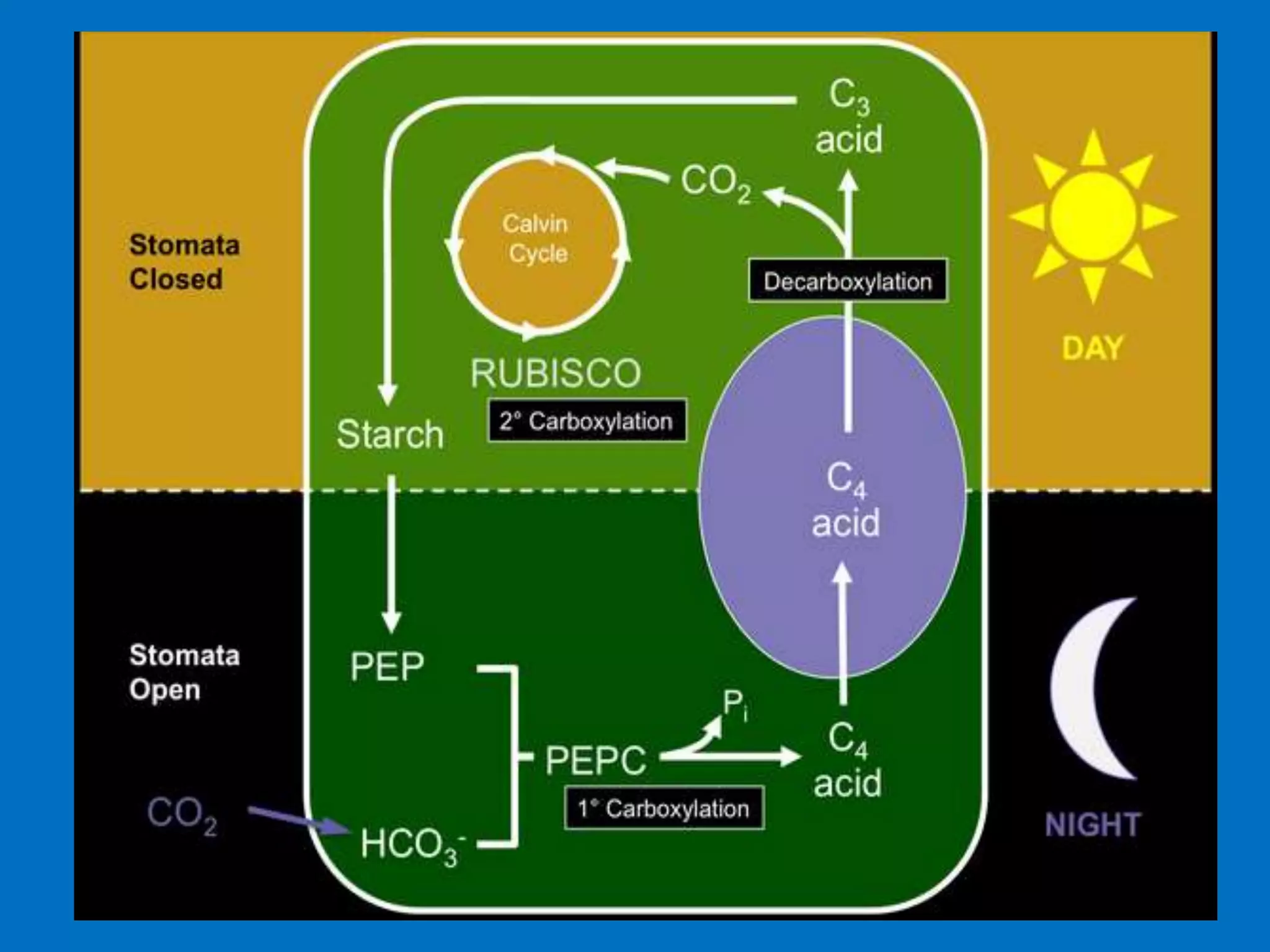
INTRODUCTION of CAM
• Occures Mostly in succulent plants which grow
under semi-arid conditions. Since the cycle was
first discovered in the plants belonging to family
crassulaceae e.g , Bryophyllum, Sedium
calycinum etc., it was named as crassulacean Acid ,
orchid and pine apple families.
• CAM cycle is completed in two parts
(A)Acidification
(B) Deacidification.
• Acidification takes place in dark while
deacidification occurs during day time.
SIGNIFICANCE of CAM
1. As CAM plants are able to fix CO2 in dark, they can
survive for longer periods in light withous CO2 uptake.
2. The stomata of leaves remain closed during the day
and open at night.this is an adaptation to conserve
water , since succulents exhibiting CAM are found in dry
habitat.
3. During the night CO2 is taken into the leaves through
open stomata. This limits the photosynthesis. It is also
limited by stored organic acid and carbohydrates
causing slow growth of the plants. Thus CAM plants are
generally slow growing
4. They are drought resistant and possess xerophytic
adaptations like thick fleshy leaves .
C3,C4 & CAM pathway
C3,C4 & CAM pathway

C3,C4 & CAM pathway

  • 1.
    C3, C4 &CAM pathways of carbon fixation
  • 2.
    Calvin Cycle (C3Plants) The dark reaction process of photosynthesis has been named variously such as – Calvin cycle, Bassham and calvin cycle, Blackman reaction, Carbon assimilation , path of carbon in photosynthesis, Reduction pentose phosphate cycle etc. Calvin cycle consists of two important parts : a) Synthesis of carbohyrates b) Regeneration of ribulose diphosphate.
  • 3.
    a) Synthesis ofcarbohydrates. 1. Carbon dioxide is first accepted by ribulose diphosphate and forms an unstable 6- carbon compound from which two molecules of phosphoglyceric acid are formed. The reaction is regulated by an enzyme called carboxydismulase or RuDP carboxylase (or Rubisco).
  • 4.
    2. Phosphoglyceric acidis reduced to phosphoglyceraldehyde by NADPH. This reaction if supported by the ATP and triose phosphate dehydrogenase. 3. The phosphoglyceraldehyde molecule is converted into dihydroxyacetone phosphate in presence of enzyme triose phosphate isomerase. 4. Phosphoglyceraldehyde and dihydroxyacetone phosphate (one molecule each) unite to form fructose – 1,6- diphosphate. The enzyme aldolase regulates this reaction.
  • 5.
    5. From fructose-1,6- diphosphates different types of compounds are synthesized and may be converted into glucose or starch. b) Regeneration of ribose diphosphate . It is true that carbohydrates are formed in a way described earlier, but the process utilises one ribulose diphosphate molecule. Therefore, its generation is essential in order to say that carbohydrates are synthesized by utilising CO2 and H2O. 1. The so formed fructose – 6-phosphate and phosphoglyceraldehyde combine and break into 4- carbon compound and 5-carbon compound in presence of the enzyme transketolase.
  • 6.
    2. Erythrose-4-phosphate combineswith a molecule of dihydroxyacetone phosphate to form sedoheptulose- 1, 7- diphosphate in the presence of enzyme aldose. 3. From sedoheptulose- 1,7- disphosphate one phosphate is removed in presence of the enzyme phosphatase and thus sedoheptulose – 7 phophate is formed. 4. Sedoheptulose -7- phophate and phosphoglyceraldehyde combine in presence of transketolase and produce one molecule each of xylulose -5, phosphate and ribose 5- phosphate.
  • 8.
    Hatch and slackcycle (C4 Plants) Kortschak and his coworkers (1954) reported the formation of dicarboxylic acids (C4) as primary products of photosynthesis in sugarcane. The C4 cycle may also reffered as the dicarboxylic acid cycle or hatch & slack cycle.  Reaction of Hatch & Slack cycle: Hatch & Slack cycle is completed in the chloroplasts of mesophyll cells and bundle sheath cells following reactions occur during this cycle.
  • 9.
    1. Formation ofoxalo-acetic acid:- The primary accepter of co2 in this cycle is a 3C-compund – phosphoenol pyruvic acid. In mesophyll cells, the atmospheric CO2 first combines with water to form bicarbonate ion (HCO3¯) in presence of enzyme carbonic anhydrase. CO2 + H2O HCO3¯ Reaction occurring in the chloroplst of mesophyll cell.
  • 10.
    2) Formation ofmalic acid and aspartic acid :- • oxaloacetic acid is quite unstable and is converted either into malic acid or aspartic acid. • The oxaloacetic acid is reduced to malic acid by using light-generated NADPH + H⁺. This reaction is catalysed by enzyme malic dehydrogenase. • The oxaloacetic acid can also be converted into aspartic acid in presence of enzyme aspartic transminase.
  • 11.
    • The C4acids i.e , malic acid and aspartic acid are then transported to the chloroplasts of the bundle sheath.  Reaction occurring in bundle sheath chloroplast:- 3) Formation of pyruvic acid- In bundle sheath chloroplast, the mallic acid undergoes oxidative decarboxylation to yield pyruvic acid and CO2 in presence of malic enzyme.
  • 12.
    4) The CO2and NADP + H⁺ , produced by oxidative decarboxylation of malic enter into calvin cycle. The co2 combines with ribulose diphosphates (RuDP) to yield 2 molecules of phosphoglyceric acid (PGA) CO2 + RuDP 2 Mols. PGA. 5) In a few C4 plants the aspartic acid undergoes transmination to form oxaloacetic acid which is then decarboxylated to pyruvic acid. This reaction is catalysed by aspartate transminase. L-Aspartic acid oxaloacetic acid pyruvic acid
  • 13.
    6) Formation ofphosphoenol pyruvic acid (PEP):- The pyruvic acid produced by oxidative decarboxylation is transported back to the Mesophyll cells where it is phosphorylated to phosphoenol pyruvic acid in presence of enzyme pyruvate phosphate dikinase. This enzyme is unusual because it splits one molecule of ATP, (synthesized in photosynthetic light reaction), into AMP and Ppi.
  • 14.
    SIGNIFICATION OF C4CYCLE • In C4 plants , it increase the photosynthetic yield two to three times more than c3 plants. • In C4 plants , it performs a high rate of photosynthesis even when the stomata are nearly closed. • It increase the adaptability of C4 plants to high temprature and light intensities. • They can very well grow in saline soils because of presence of C4 organic acid.
  • 16.
    DEFFERENCE BETWEEN C3& C4 CYCLE • C3 Cycle :  The primary CO2 accepter is a 5c compund Ribulose diphosphate (RuDP).  The first stable compund formed iphosphoglyceric acid (PGA) which contain 3 C atoms.  C3 cycle is completed in only one type of chloroplast present in mesophyll.  It takes place at comparatively low temperature.  Photorespiration occurs in C3 plants.  The rate of photosynthesis is comparatively lower.  It occurs in C3 plants which show normal anatomy.
  • 17.
    • C4 cycle:  The primary CO2 accepter is a 3 C compund – phosphoenol pyruvic acid (PEP).  The first stable compound is a 4C oxaloacetic acid.  C4 cycle is copmleted in two types of chloroplasts,one occuring in mesophyll cells and other in bundle sheath cells.  It takes place at high temperature and more light intensities.  Photorespiration does not occur in C4 plants.  The rate of photosynthesis is comparatively higher.  It occurs in C4 plant which show kranz anatomy.
  • 18.
    INTRODUCTION of CAM •Occures Mostly in succulent plants which grow under semi-arid conditions. Since the cycle was first discovered in the plants belonging to family crassulaceae e.g , Bryophyllum, Sedium calycinum etc., it was named as crassulacean Acid , orchid and pine apple families. • CAM cycle is completed in two parts (A)Acidification (B) Deacidification. • Acidification takes place in dark while deacidification occurs during day time.
  • 20.
    SIGNIFICANCE of CAM 1.As CAM plants are able to fix CO2 in dark, they can survive for longer periods in light withous CO2 uptake. 2. The stomata of leaves remain closed during the day and open at night.this is an adaptation to conserve water , since succulents exhibiting CAM are found in dry habitat. 3. During the night CO2 is taken into the leaves through open stomata. This limits the photosynthesis. It is also limited by stored organic acid and carbohydrates causing slow growth of the plants. Thus CAM plants are generally slow growing 4. They are drought resistant and possess xerophytic adaptations like thick fleshy leaves .