LINKAGE AND CROSSING OVER
Course: Advances in breeding of fruit crops
By:
Sanjay Chetry
Ph.D. Scholar
ID: 2020632001
Dept. of Fruit Science
TNAU, Coimbatore
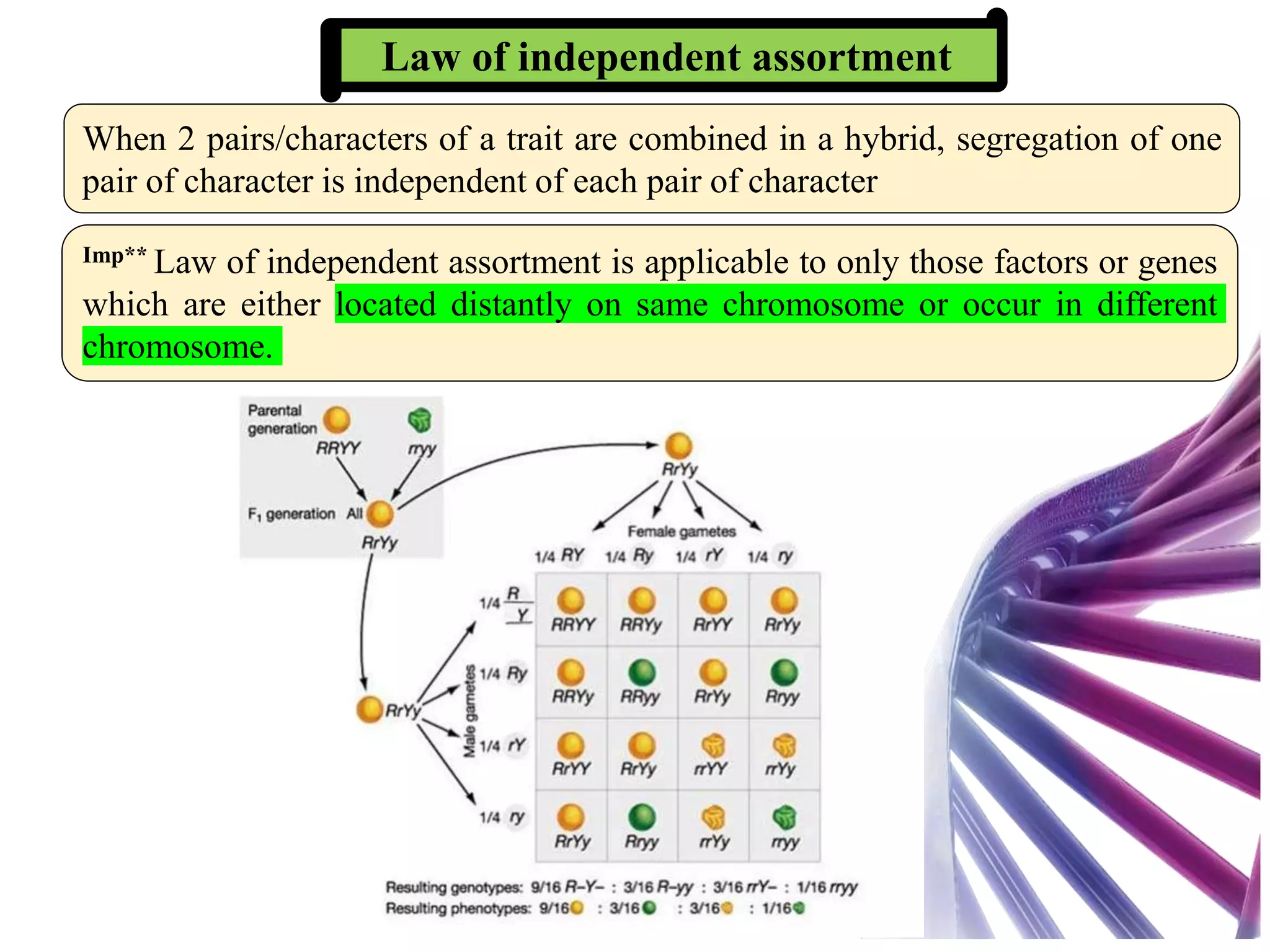
Law of independent assortment
Imp** Law of independent assortment is applicable to only those factors or genes
which are either located distantly on same chromosome or occur in different
chromosome.
When 2 pairs/characters of a trait are combined in a hybrid, segregation of one
pair of character is independent of each pair of character
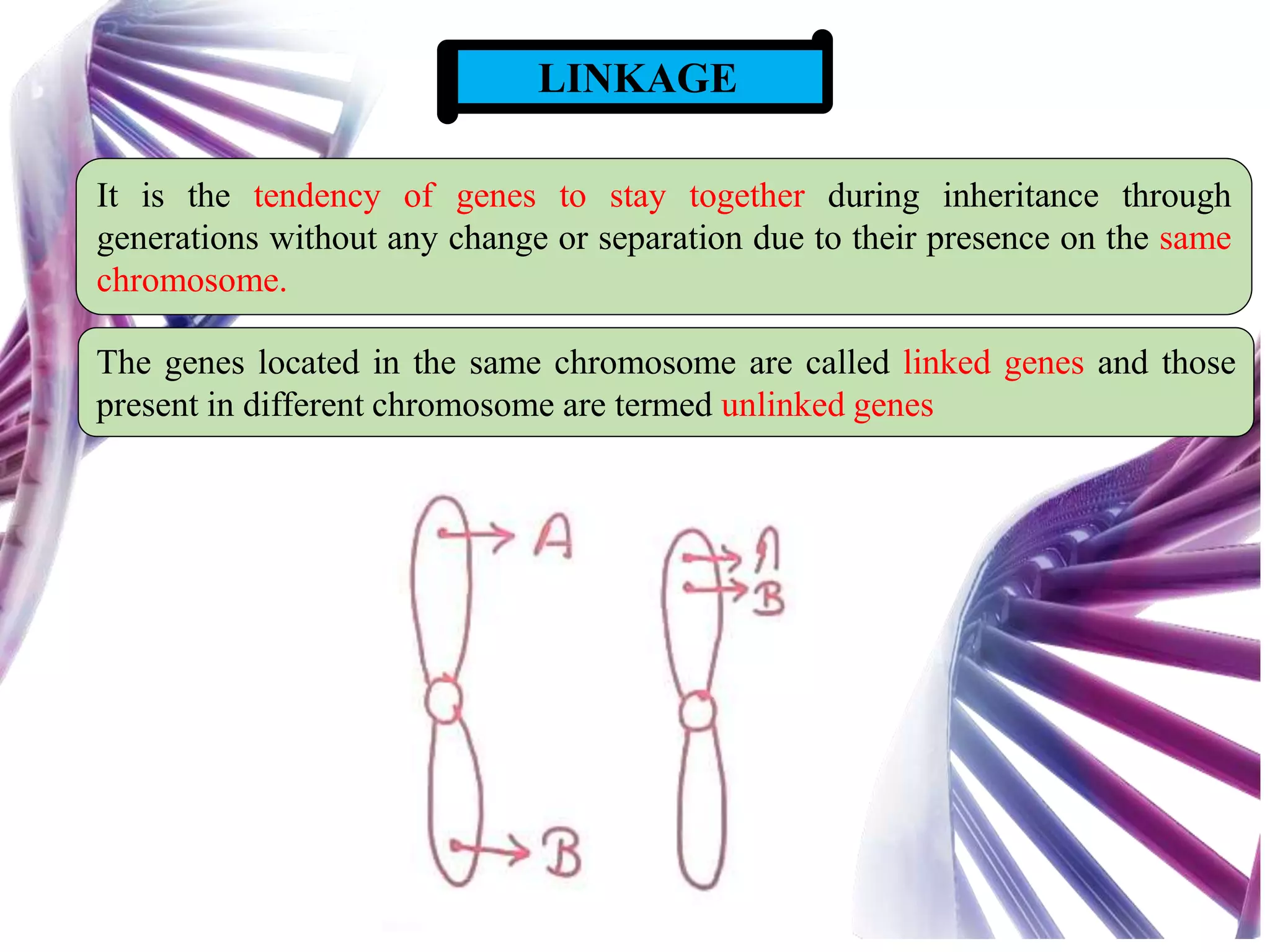
LINKAGE
The genes located in the same chromosome are called linked genes and those
present in different chromosome are termed unlinked genes
It is the tendency of genes to stay together during inheritance through
generations without any change or separation due to their presence on the same
chromosome.
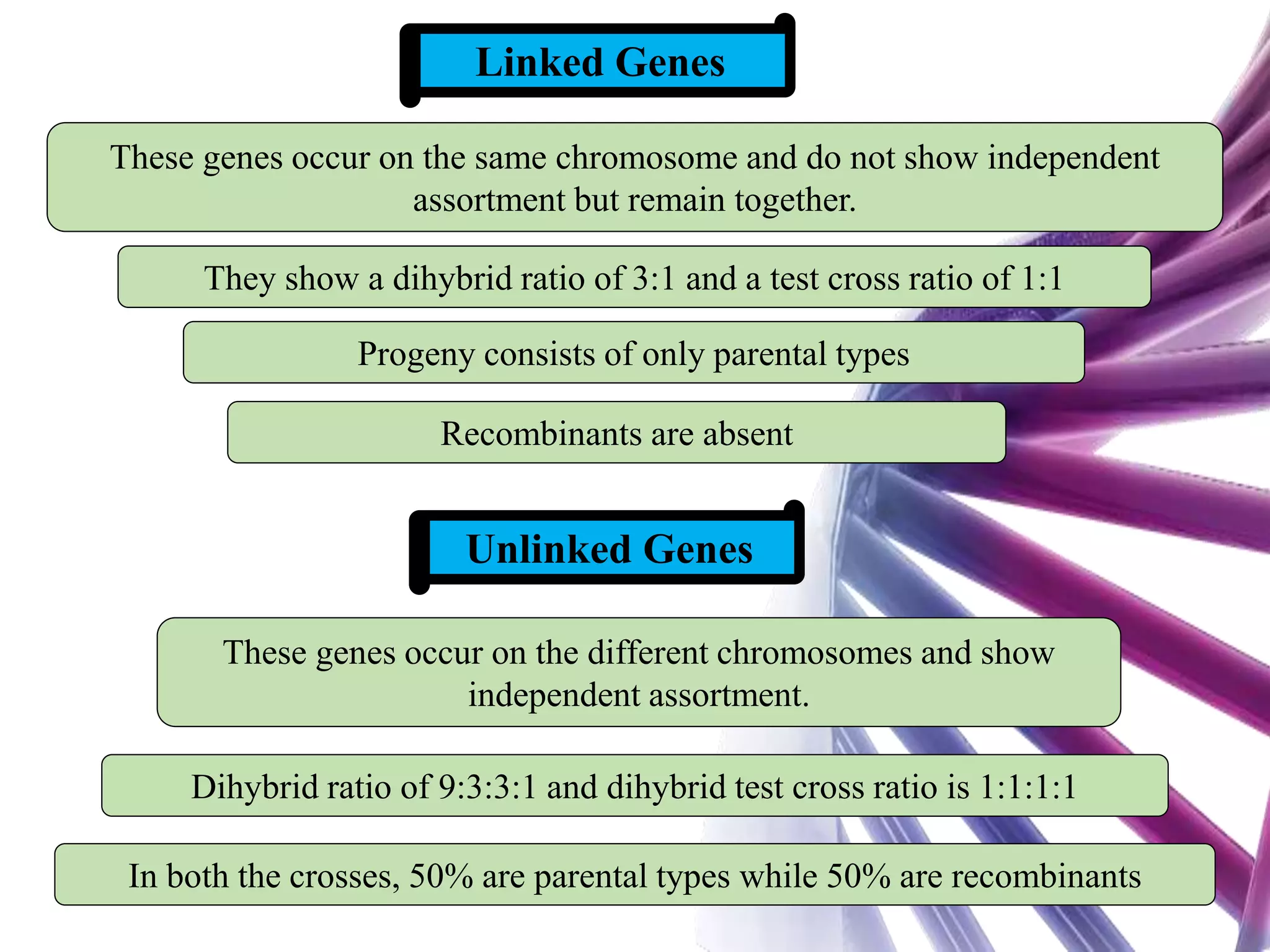
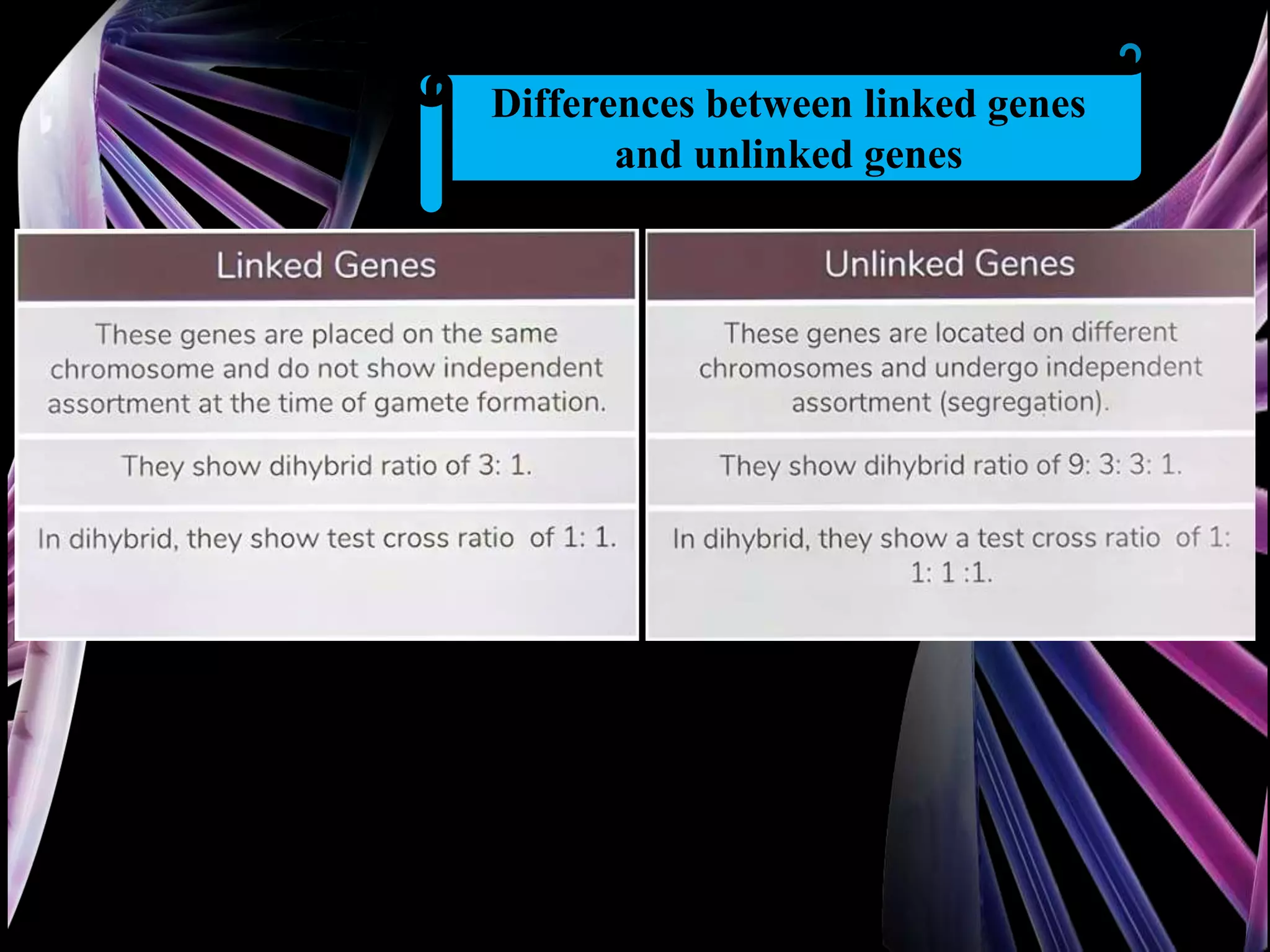
These genes occur on the same chromosome and do not show independent
assortment but remain together.
They show a dihybrid ratio of 3:1 and a test cross ratio of 1:1
Progeny consists of only parental types
Recombinants are absent
Linked Genes
These genes occur on the different chromosomes and show
independent assortment.
Dihybrid ratio of 9:3:3:1 and dihybrid test cross ratio is 1:1:1:1
In both the crosses, 50% are parental types while 50% are recombinants
Unlinked Genes
Differences between linked genes
and unlinked genes
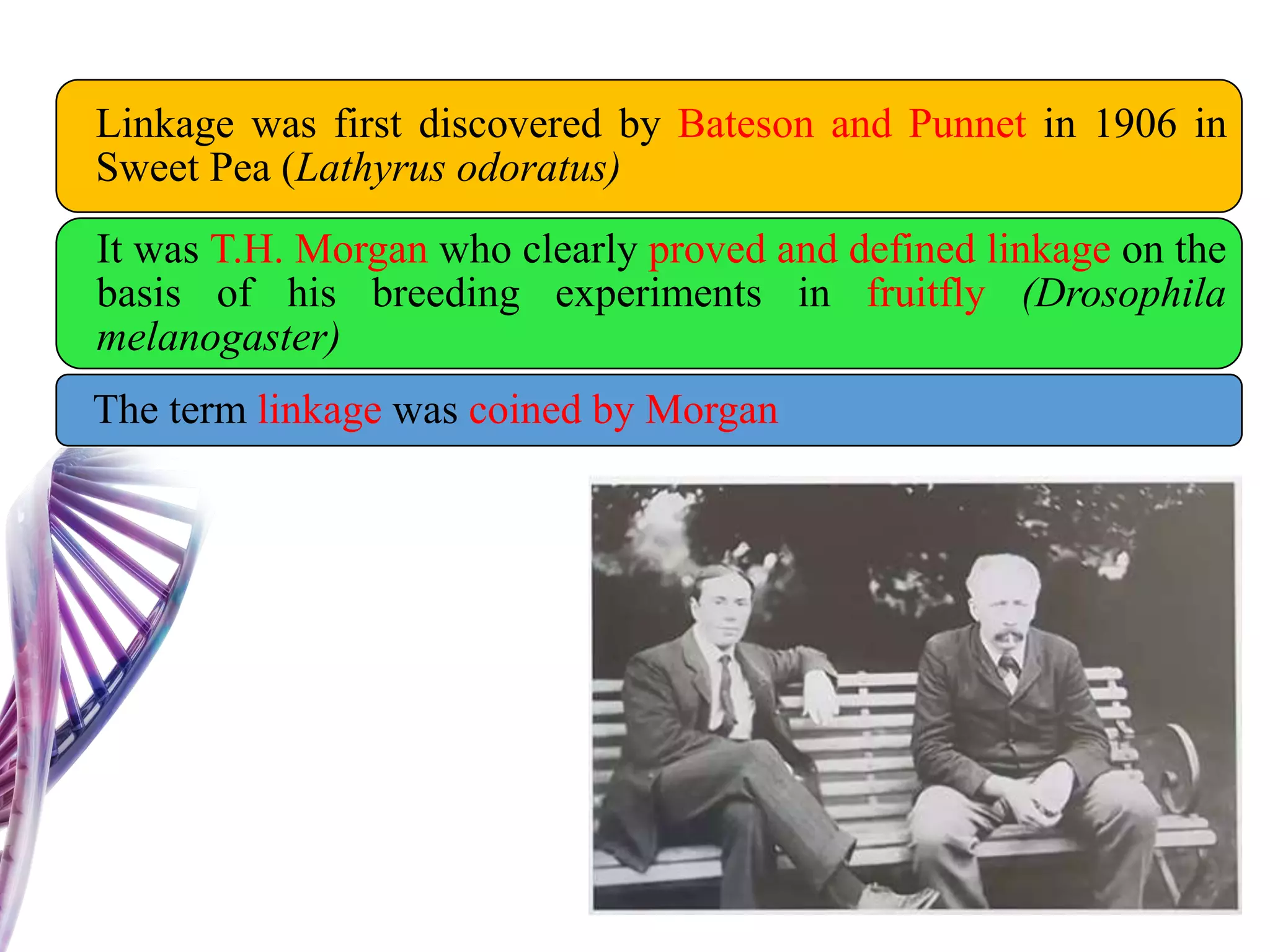
Linkage was first discovered by Bateson and Punnet in 1906 in
Sweet Pea (Lathyrus odoratus)
It was T.H. Morgan who clearly proved and defined linkage on the
basis of his breeding experiments in fruitfly (Drosophila
melanogaster)
The term linkage was coined by Morgan
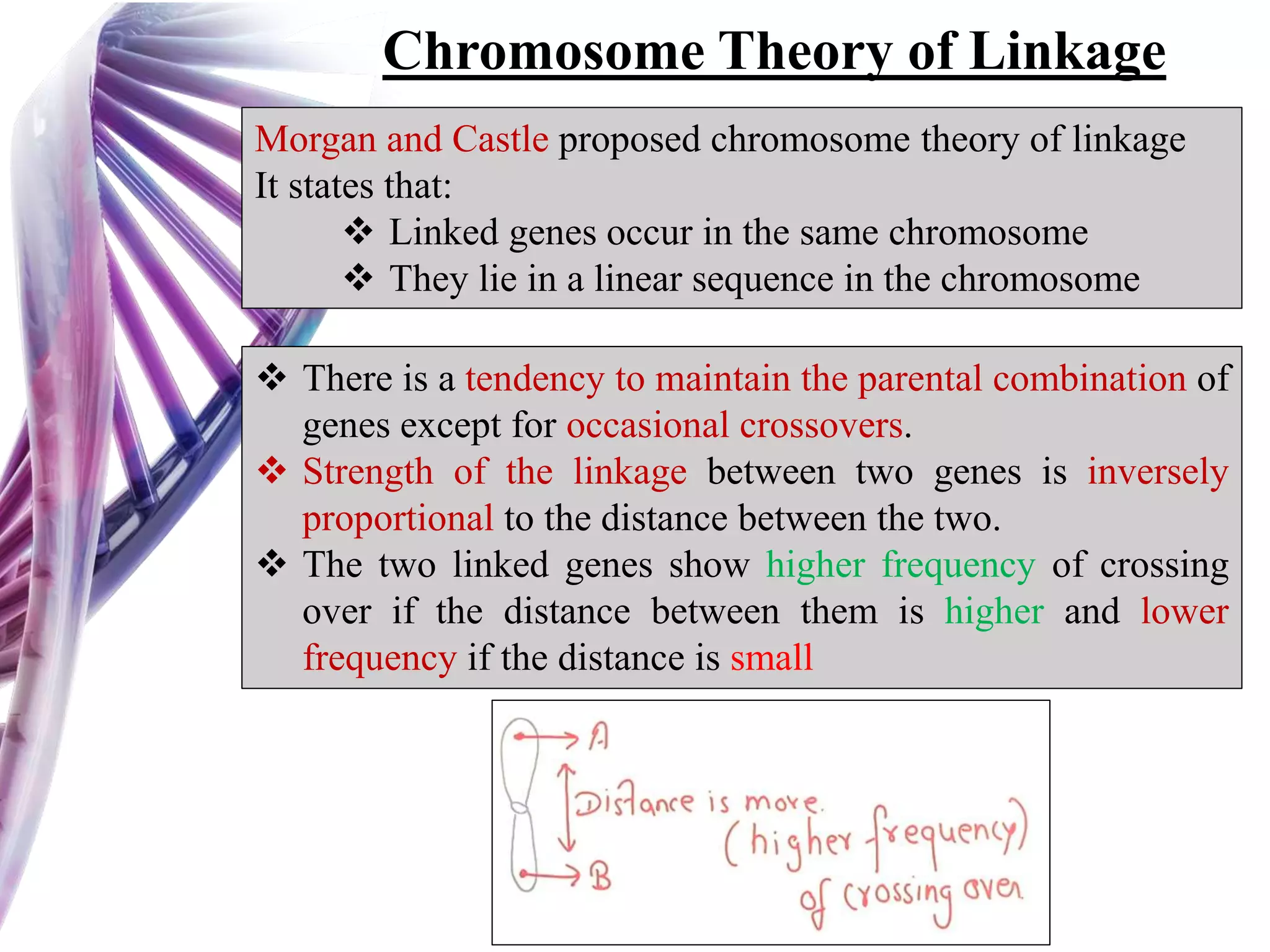
Chromosome Theory of Linkage
Morgan and Castle proposed chromosome theory of linkage
It states that:
 Linked genes occur in the same chromosome
 They lie in a linear sequence in the chromosome
 There is a tendency to maintain the parental combination of
genes except for occasional crossovers.
 Strength of the linkage between two genes is inversely
proportional to the distance between the two.
 The two linked genes show higher frequency of crossing
over if the distance between them is higher and lower
frequency if the distance is small
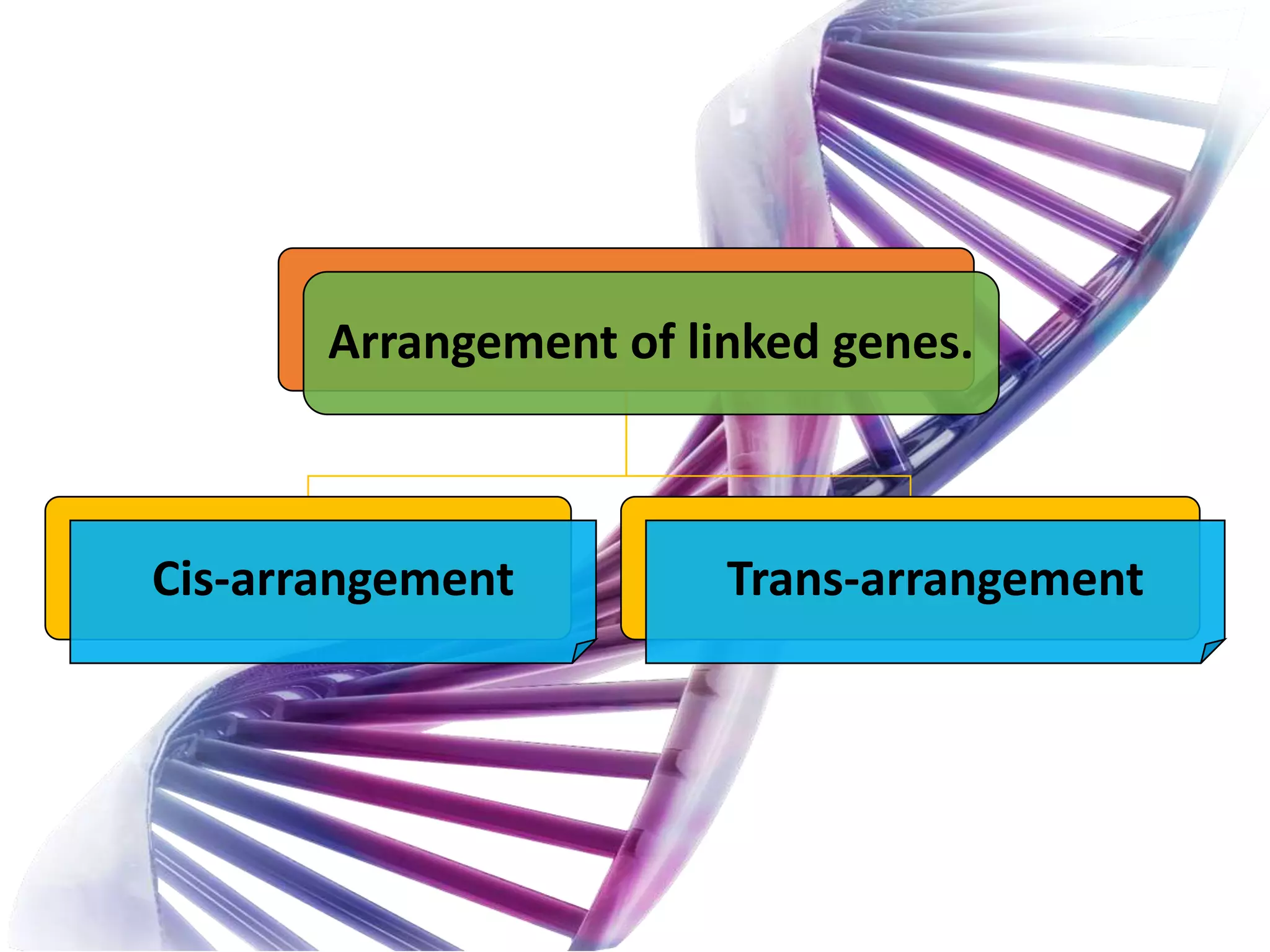
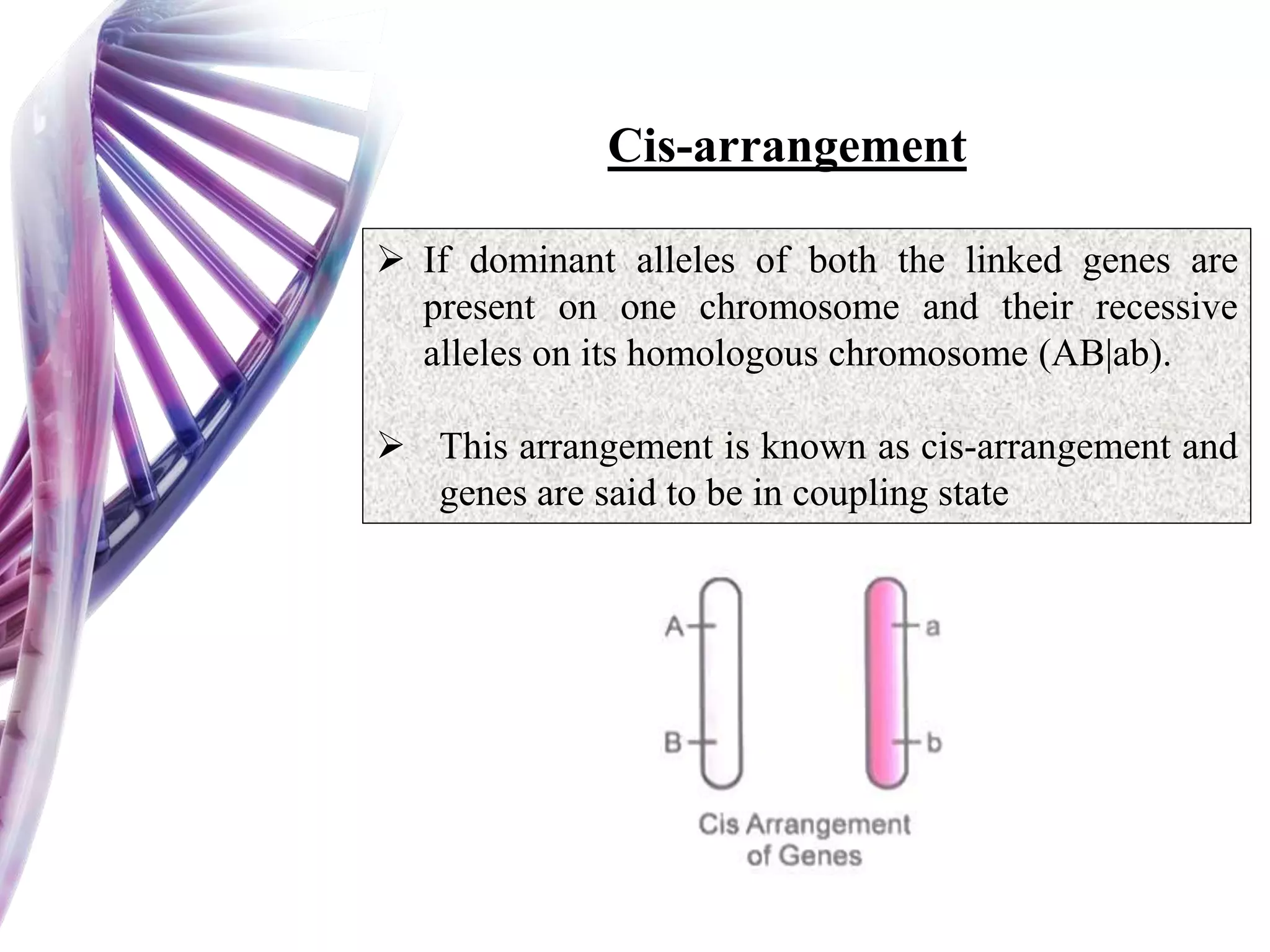
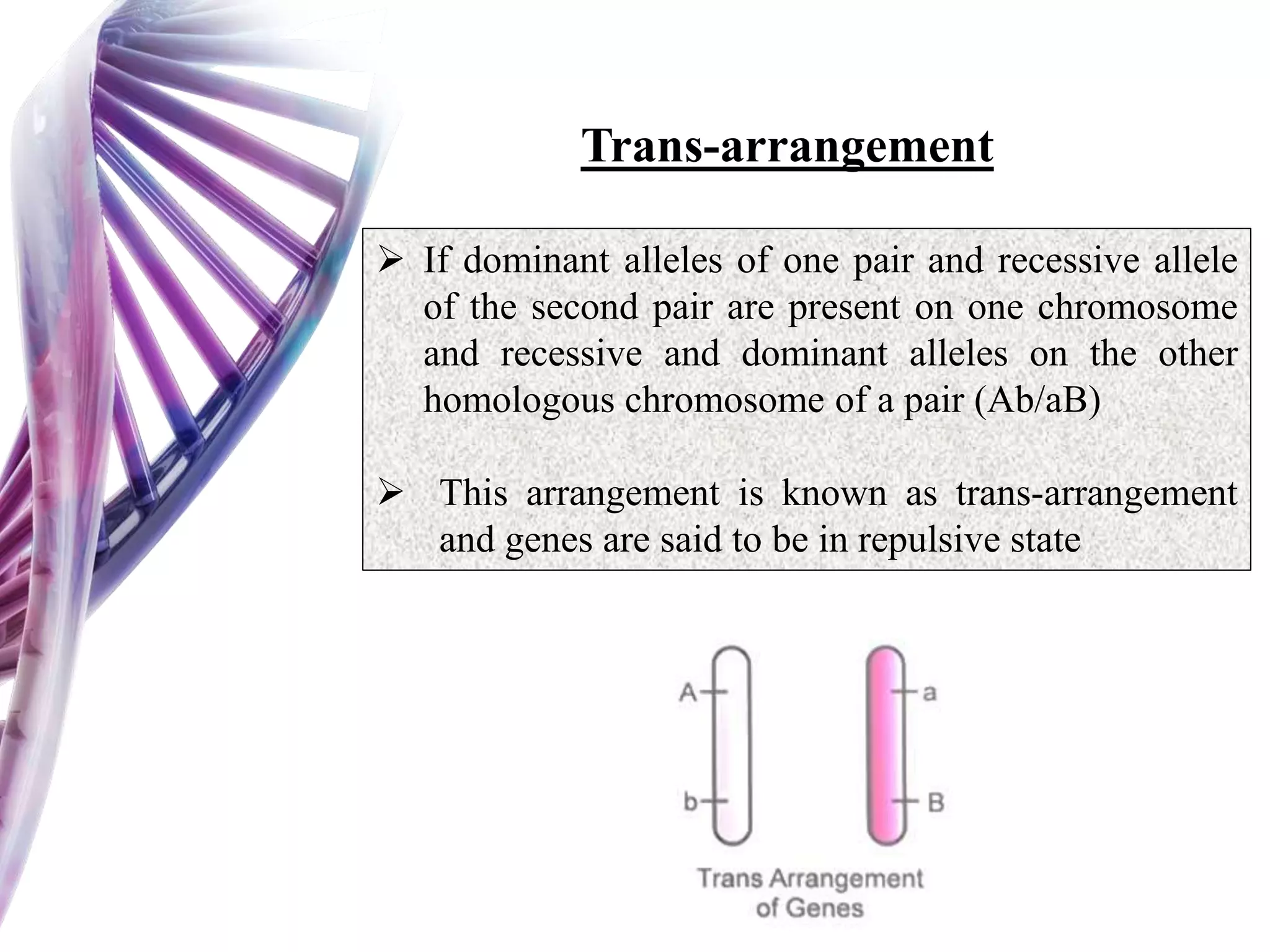
Arrangement of linked genes.
Cis-arrangement Trans-arrangement
 If dominant alleles of both the linked genes are
present on one chromosome and their recessive
alleles on its homologous chromosome (AB|ab).
 This arrangement is known as cis-arrangement and
genes are said to be in coupling state
Cis-arrangement
 If dominant alleles of one pair and recessive allele
of the second pair are present on one chromosome
and recessive and dominant alleles on the other
homologous chromosome of a pair (Ab/aB)
 This arrangement is known as trans-arrangement
and genes are said to be in repulsive state
Trans-arrangement
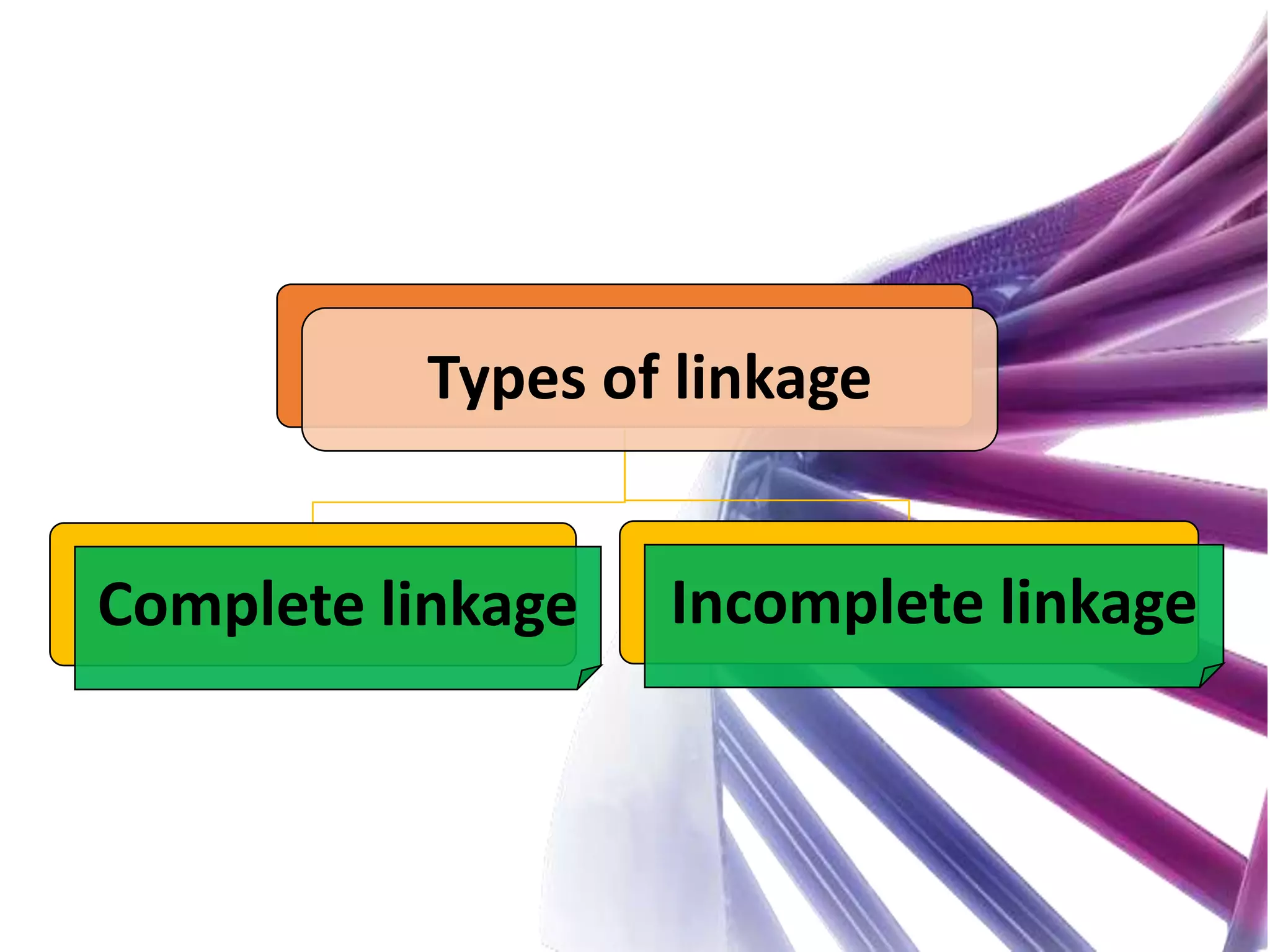
Types of linkage
Complete linkage Incomplete linkage
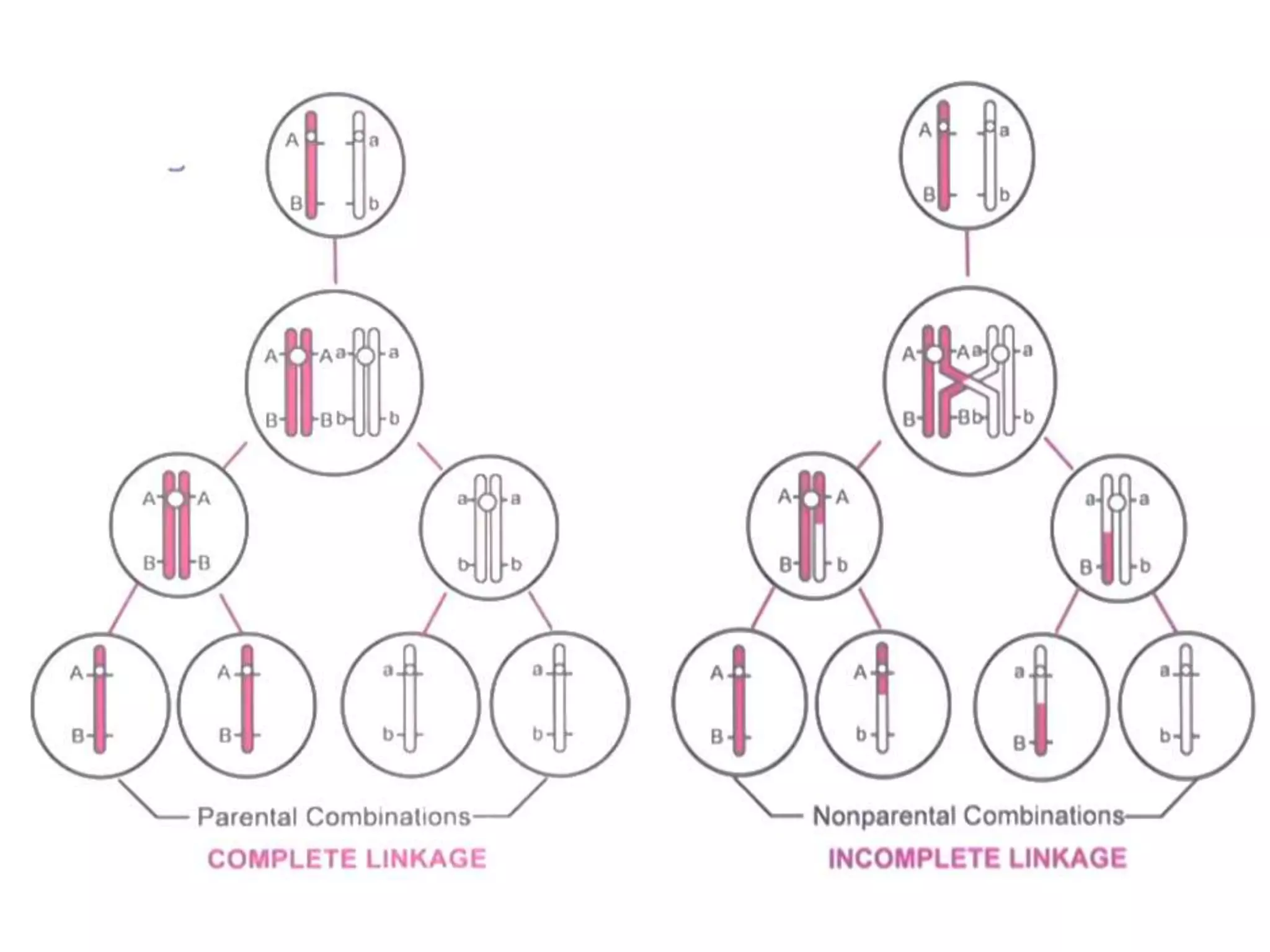
Complete Linkage
 The genes located in same chromosome do not separate and are
inherited together over the generations due to the absence of
crossing over
 Complete linkage allows the combination of parental traits to be
inherited as such.
 Linkage is incomplete when new or non parental combinations
of linked genes are formed.
 It is due to crossing over and hence produce recombinant
progeny besides the parental type.
 Incomplete linkage is very common and has been studied in
various organisms.
Incomplete Linkage
Complete linkage in Male Drosophila
Complete linkage is rare but has been
reported in male Drosophila.
A red eyed and normal winged (wild type) homozygous female Drosophila
(PV/PV) is crossed to homozygous recessive purple eyed and vestigial
winged male (pv/pv)
The progeny or F1 generation individuals are heterozygous red eyed and
normal winged.
When F1 males are test crossed to homozygous recessive female (purple
eyed and vestigial winged), only two types of individuals are produced i.e.,
red eyed normal winged and purple eye vestigial winged in the ratio of 1:1
(parental phenotypes only)
Similarly during inbreeding of F1 individuals, recombinant types are absent.
There was no crossing over which indicated that the linkage in male
Drosophila was complete
(Parental Types)
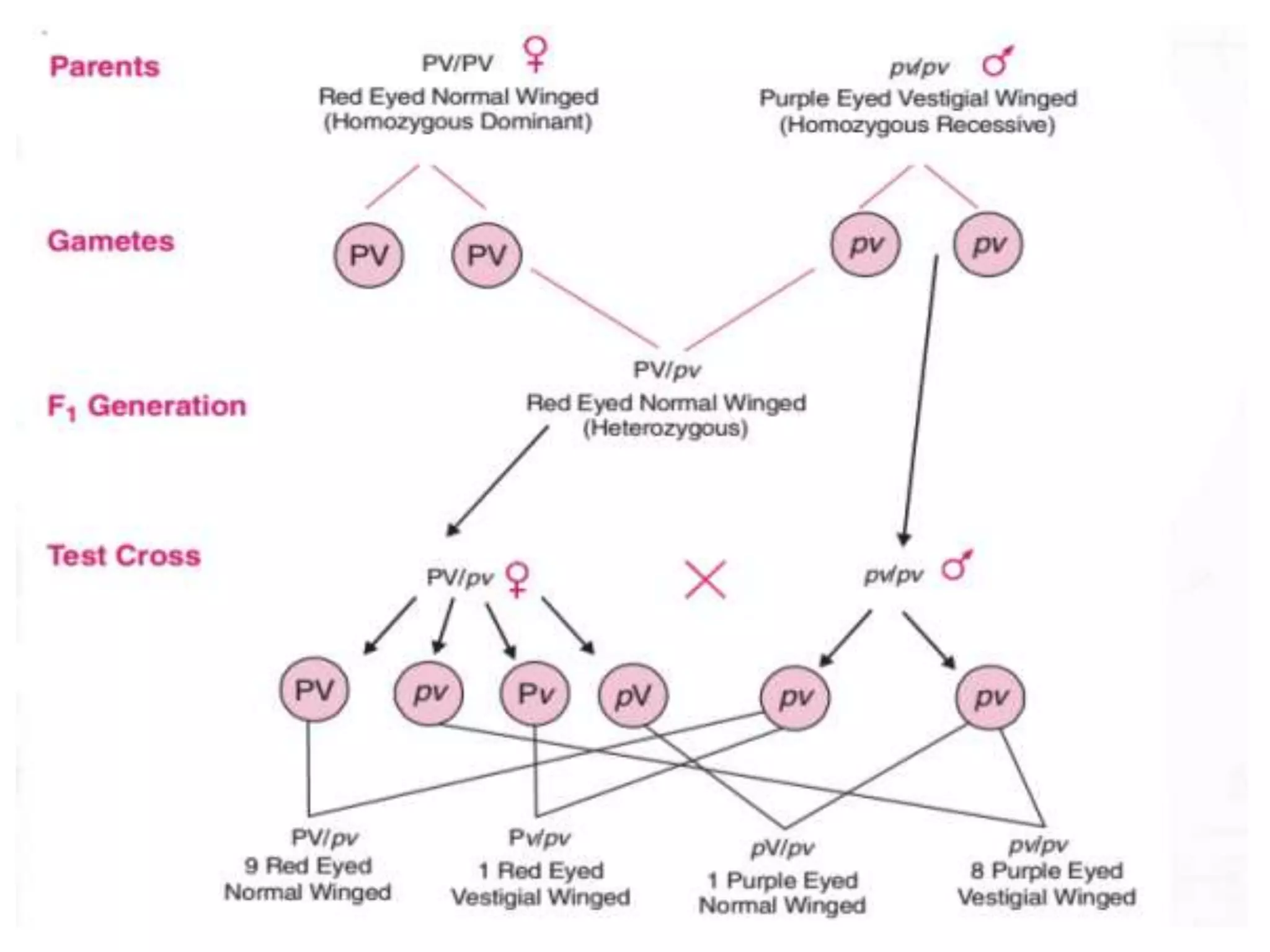
Incomplete linkage in Female Drosophila
A red eyed and normal winged (wild type) dominant homozygous female
Drosophila (PV/PV) is crossed to homozygous recessive purple eyed and
vestigial winged male (pv/pv)
The progeny or F1 generation individuals are heterozygous red eyed and
normal winged.
F1 females flies are test crossed with homozygous recessive males
It does not yield the ratio of 1:1:1:1
Instead the ratio comes out to be 9:1:1:8. This shows that the two genes did
not segregate independently of each other
Differences complete linkage and incomplete linkage
Significance of Linkage
Linkage reduces the chances of the formation of new combinations
of genes in the gametes. Thus it helps to keep the parental racial
and important traits together.
It helps to maintain the important traits of a newly developed
variety
Linkage disallows the plants breeders to combine all valuable traits
in a single variety
Linkage groups give important information about the location of
genes in the chromosomes.
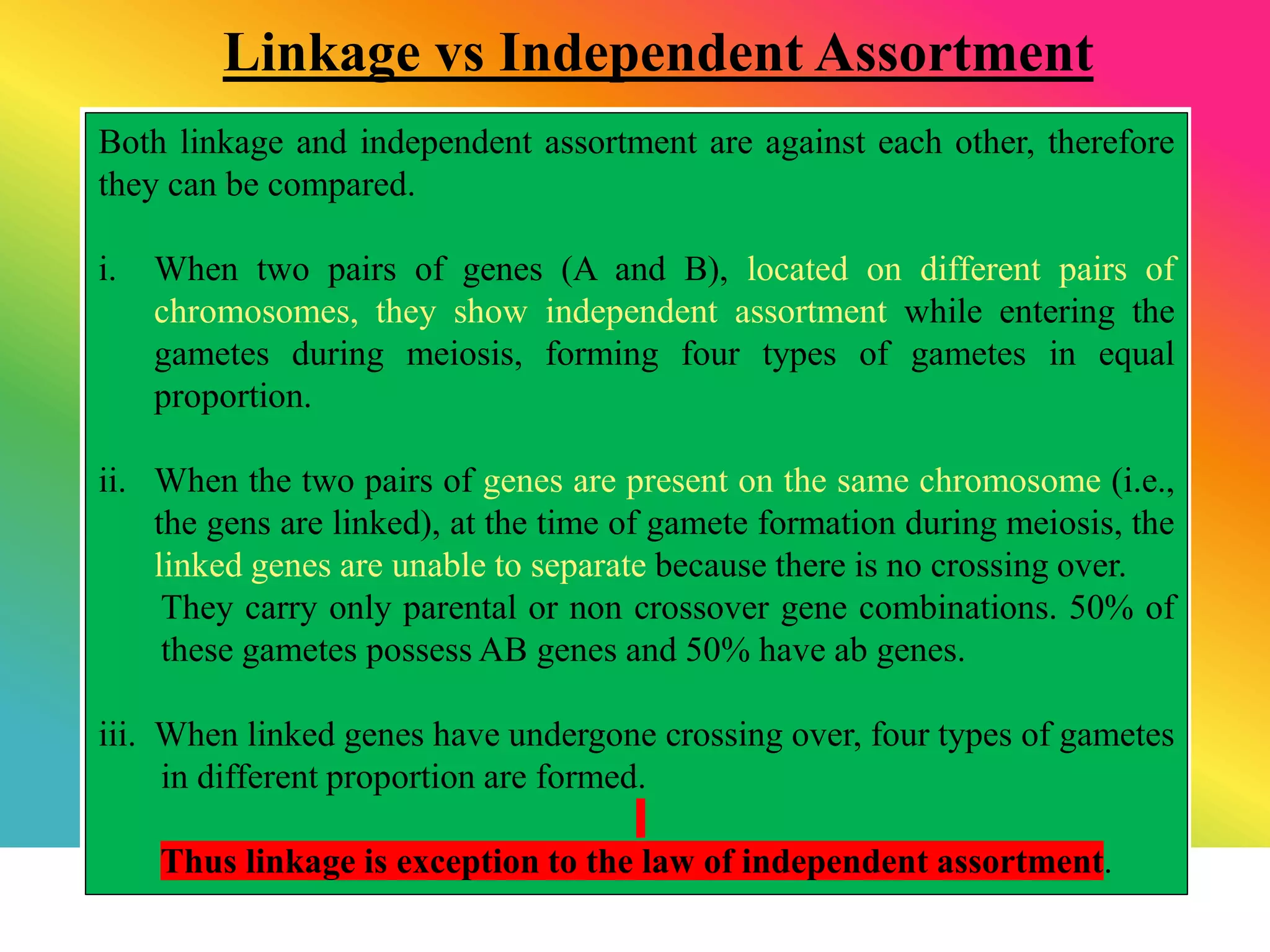
Linkage vs Independent Assortment
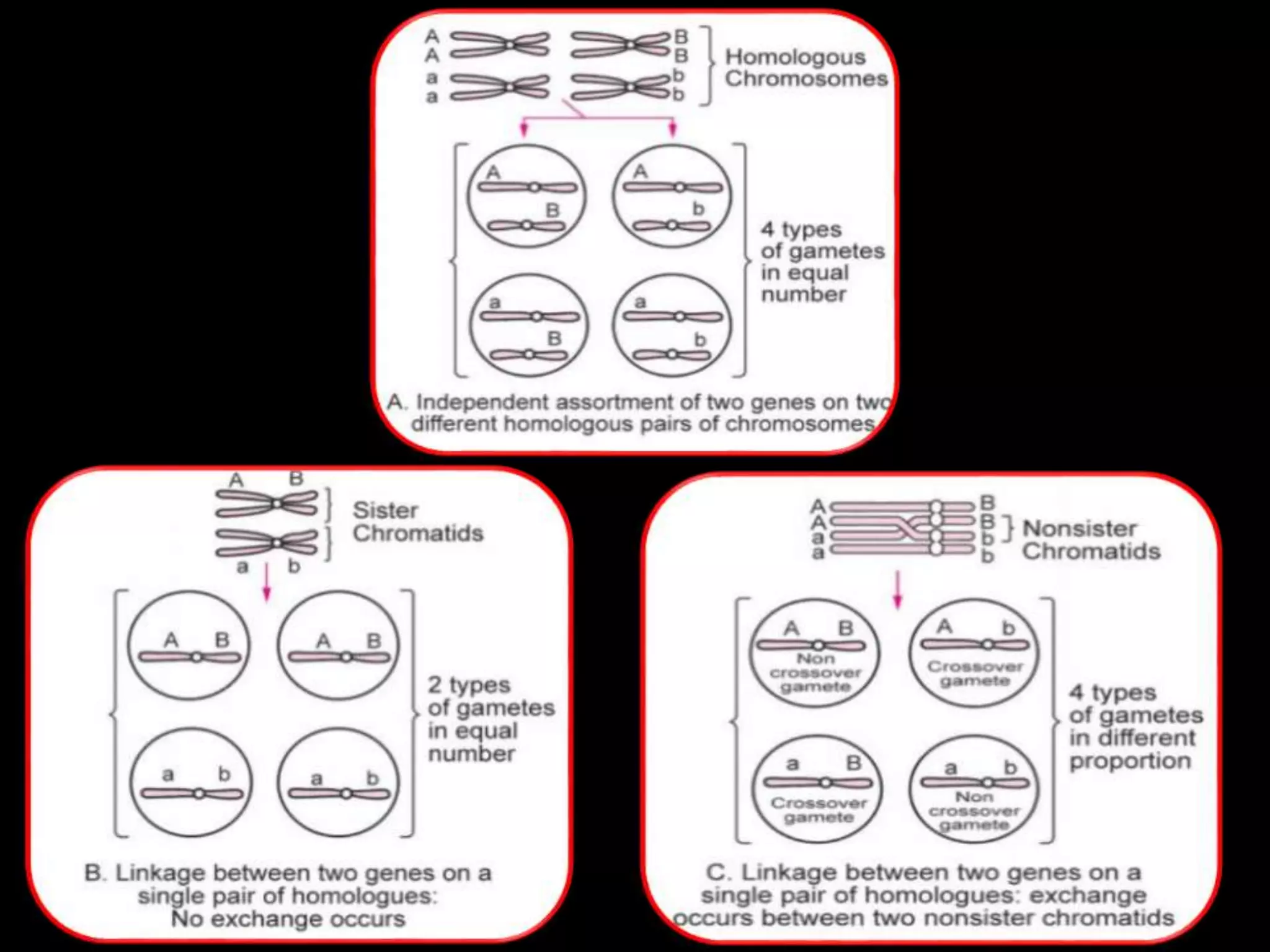
Both linkage and independent assortment are against each other, therefore
they can be compared.
i. When two pairs of genes (A and B), located on different pairs of
chromosomes, they show independent assortment while entering the
gametes during meiosis, forming four types of gametes in equal
proportion.
ii. When the two pairs of genes are present on the same chromosome (i.e.,
the gens are linked), at the time of gamete formation during meiosis, the
linked genes are unable to separate because there is no crossing over.
They carry only parental or non crossover gene combinations. 50% of
these gametes possess AB genes and 50% have ab genes.
iii. When linked genes have undergone crossing over, four types of gametes
in different proportion are formed.
Thus linkage is exception to the law of independent assortment.
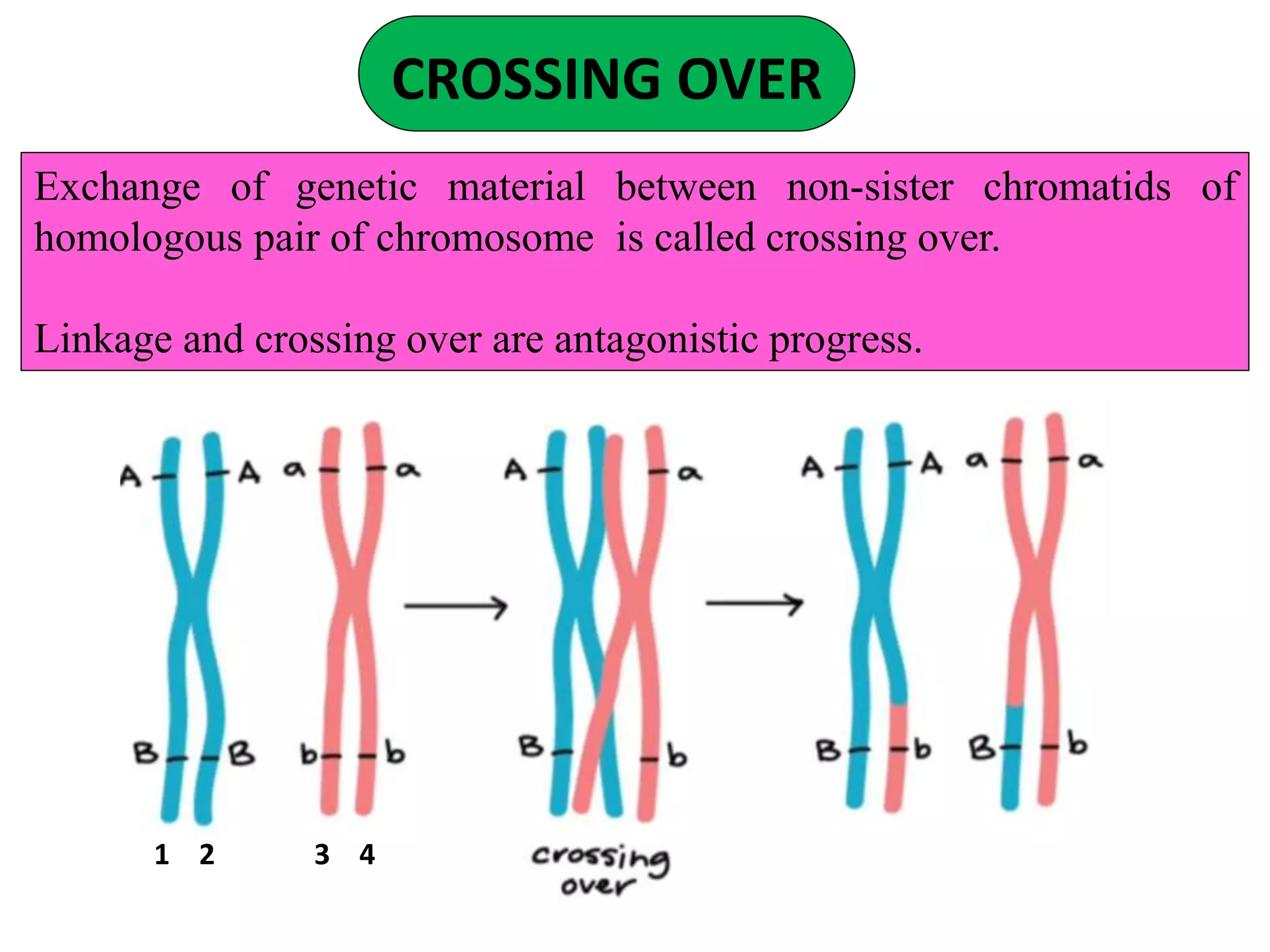
CROSSING OVER
Exchange of genetic material between non-sister chromatids of
homologous pair of chromosome is called crossing over.
Linkage and crossing over are antagonistic progress.
1 2 3 4
Characters of Crossing Over
 Takes place only at 4 stranded stage i.e., tetrad stage
 Only two chromatid are involved in a single chromosome
Mechanism of Crossing Over
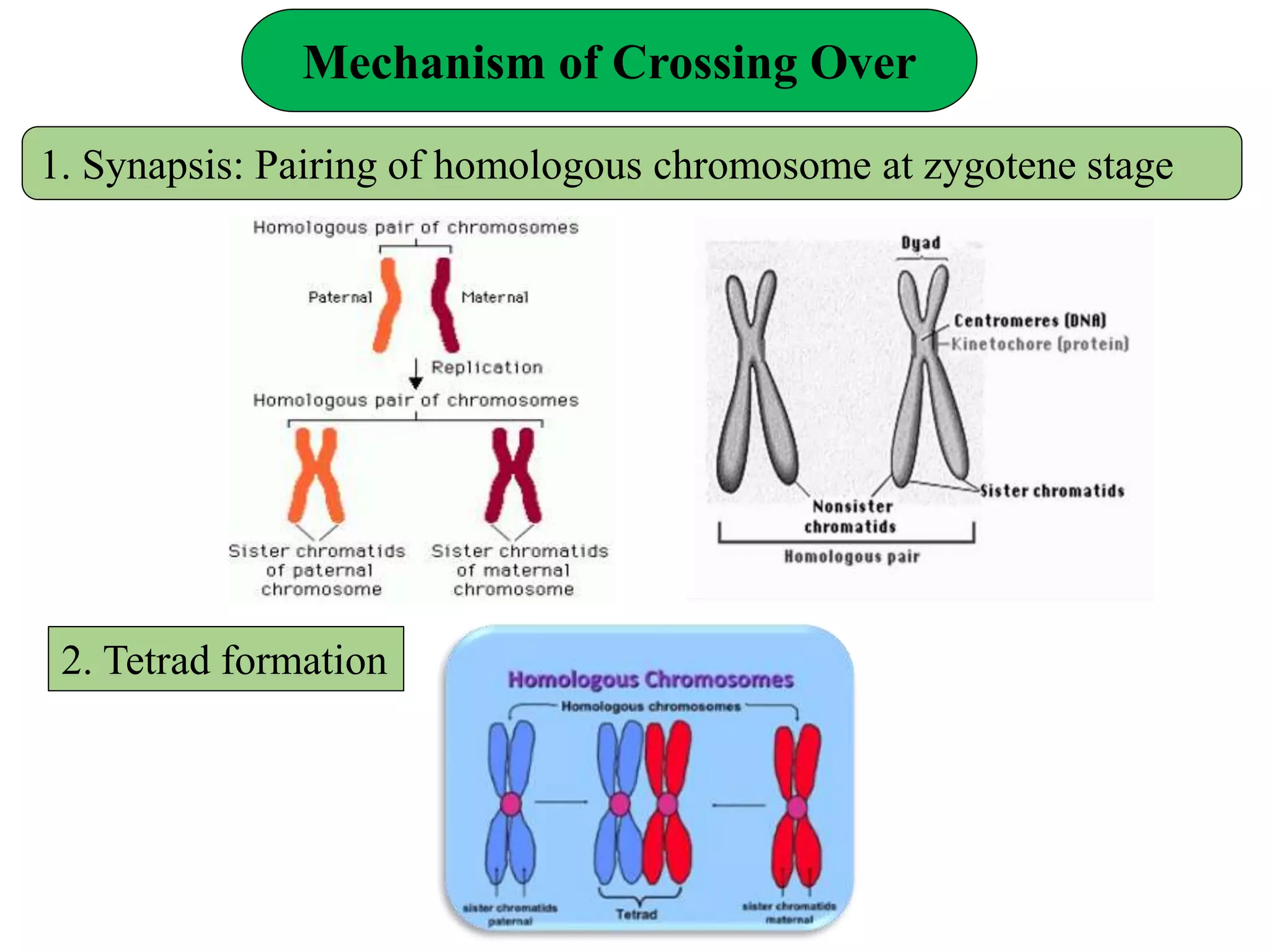
1. Synapsis: Pairing of homologous chromosome at zygotene stage
2. Tetrad formation
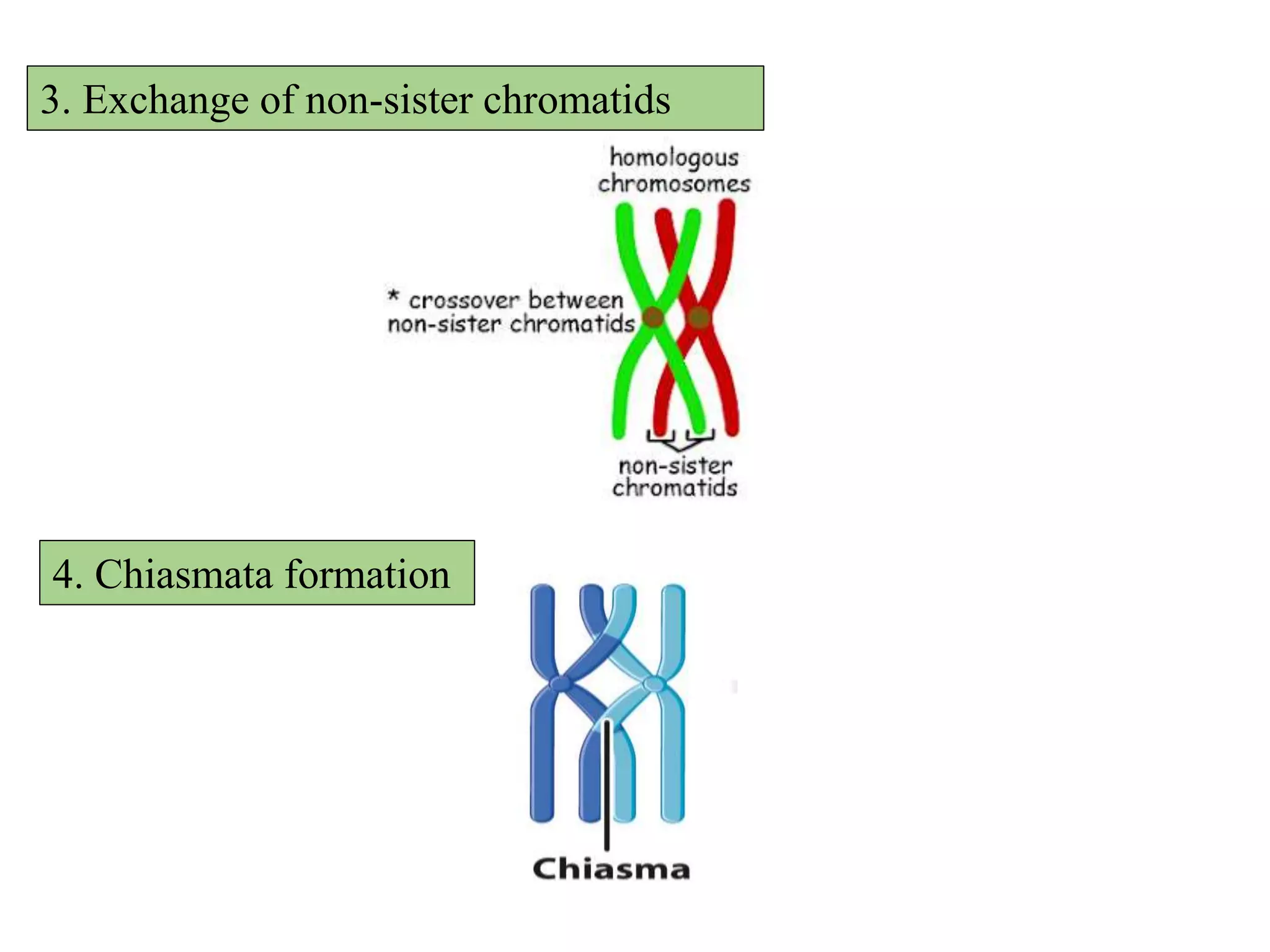
3. Exchange of non-sister chromatids
4. Chiasmata formation
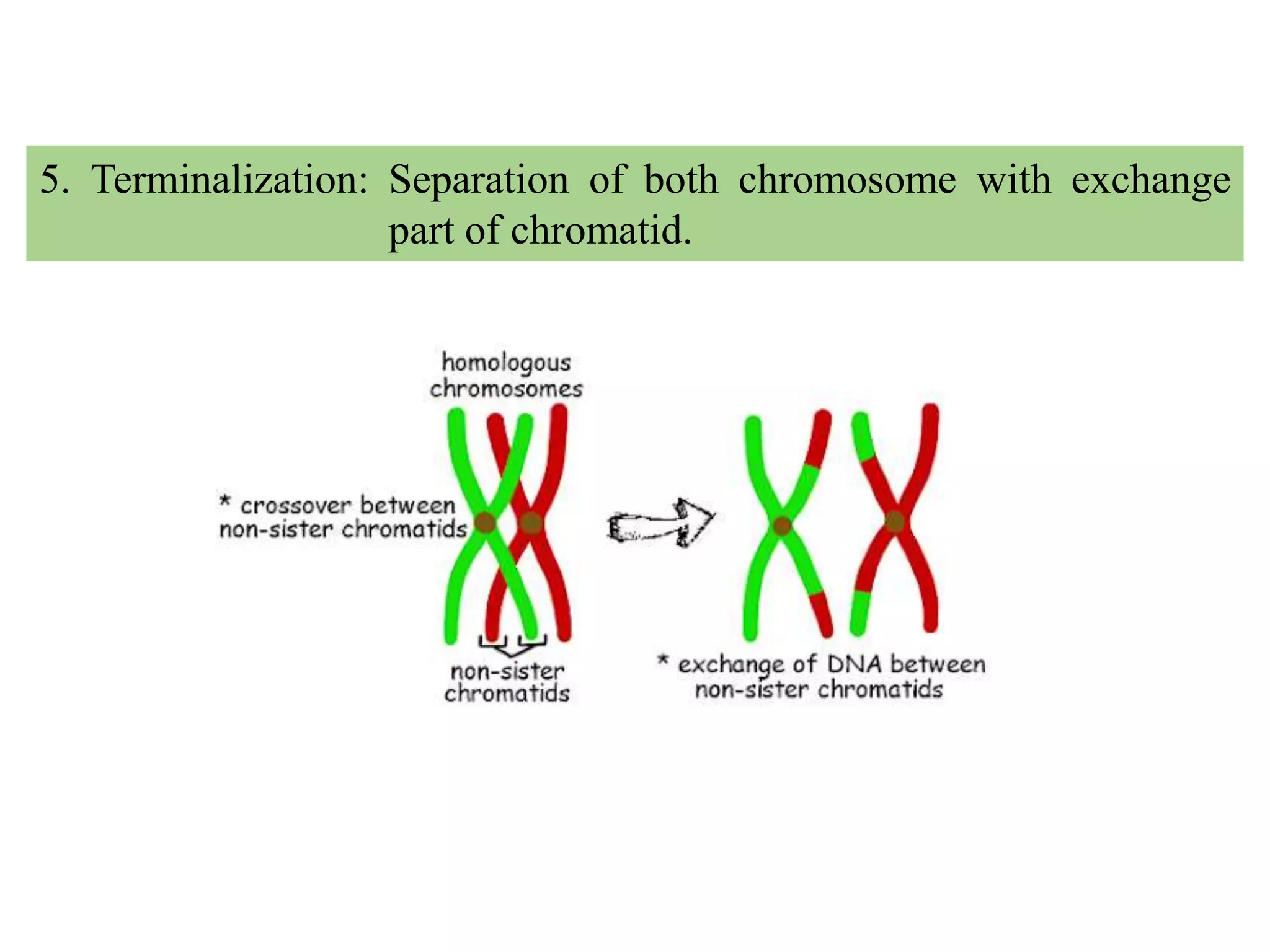
5. Terminalization: Separation of both chromosome with exchange
part of chromatid.
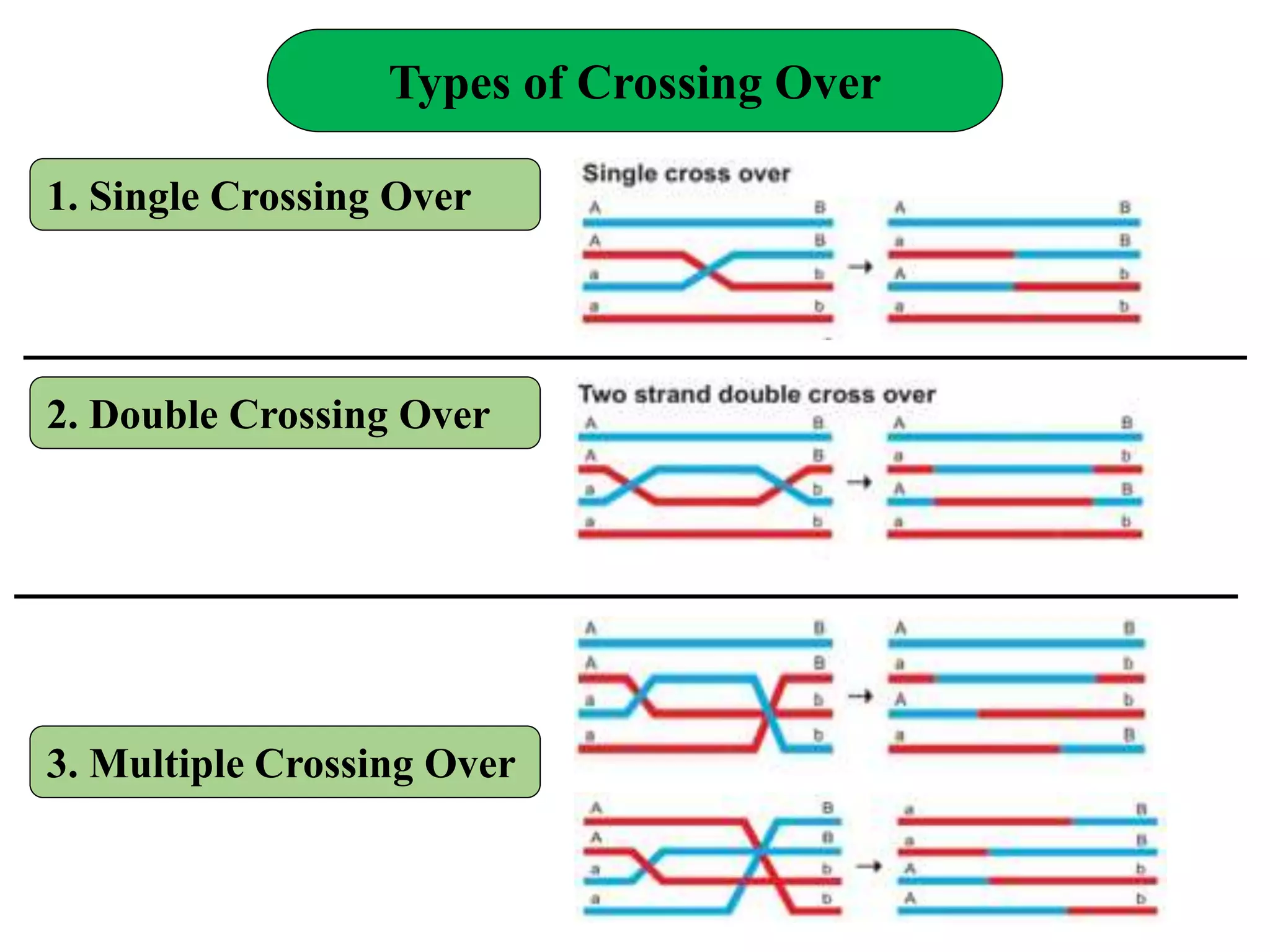
Types of Crossing Over
1. Single Crossing Over
2. Double Crossing Over
3. Multiple Crossing Over
Sl. No. Linkage Crossing Over
1. Linkage ensures to keep the genes in a
chromosome to inherit together.
Crossing over facilitates the separation of
genes present chromosome and segregate
into different gametes.
2. The strength of linkage between two
genes is inversely proportional to the
distance between them in the
chromosome
The chance of crossing over between two
genes is directly proportional to the distance
between them in the chromosome
3. The strength of linkage between two
genes increases with the decrease in
distance between them.
The chance of crossing over between two
genes decreases with the decrease in the
distance between them.
4. The strength of linkage decrease with
increase in distance between the genes.
The chance of crossing increases with
increase in distance between the genes.
5. Linkage ensures the maintenance of
parental trait in the offspring.
The crossing over causes alterations in the
parental traits in the offspring.
6. Linkage reduces the chance of creation
of variability with sexual reproduction.
Crossing over increases the chance of
variability with sexual reproduction.
Differences between linkage and crossing over
Linkage and Crossing over (Sanjay Chetry).pptx

Linkage and Crossing over (Sanjay Chetry).pptx

  • 1.
    LINKAGE AND CROSSINGOVER Course: Advances in breeding of fruit crops By: Sanjay Chetry Ph.D. Scholar ID: 2020632001 Dept. of Fruit Science TNAU, Coimbatore
  • 2.
    Law of independentassortment Imp** Law of independent assortment is applicable to only those factors or genes which are either located distantly on same chromosome or occur in different chromosome. When 2 pairs/characters of a trait are combined in a hybrid, segregation of one pair of character is independent of each pair of character
  • 3.
    LINKAGE The genes locatedin the same chromosome are called linked genes and those present in different chromosome are termed unlinked genes It is the tendency of genes to stay together during inheritance through generations without any change or separation due to their presence on the same chromosome.
  • 4.
    These genes occuron the same chromosome and do not show independent assortment but remain together. They show a dihybrid ratio of 3:1 and a test cross ratio of 1:1 Progeny consists of only parental types Recombinants are absent Linked Genes These genes occur on the different chromosomes and show independent assortment. Dihybrid ratio of 9:3:3:1 and dihybrid test cross ratio is 1:1:1:1 In both the crosses, 50% are parental types while 50% are recombinants Unlinked Genes
  • 5.
    Differences between linkedgenes and unlinked genes
  • 6.
    Linkage was firstdiscovered by Bateson and Punnet in 1906 in Sweet Pea (Lathyrus odoratus) It was T.H. Morgan who clearly proved and defined linkage on the basis of his breeding experiments in fruitfly (Drosophila melanogaster) The term linkage was coined by Morgan
  • 7.
    Chromosome Theory ofLinkage Morgan and Castle proposed chromosome theory of linkage It states that:  Linked genes occur in the same chromosome  They lie in a linear sequence in the chromosome  There is a tendency to maintain the parental combination of genes except for occasional crossovers.  Strength of the linkage between two genes is inversely proportional to the distance between the two.  The two linked genes show higher frequency of crossing over if the distance between them is higher and lower frequency if the distance is small
  • 8.
    Arrangement of linkedgenes. Cis-arrangement Trans-arrangement
  • 9.
     If dominantalleles of both the linked genes are present on one chromosome and their recessive alleles on its homologous chromosome (AB|ab).  This arrangement is known as cis-arrangement and genes are said to be in coupling state Cis-arrangement
  • 10.
     If dominantalleles of one pair and recessive allele of the second pair are present on one chromosome and recessive and dominant alleles on the other homologous chromosome of a pair (Ab/aB)  This arrangement is known as trans-arrangement and genes are said to be in repulsive state Trans-arrangement
  • 11.
    Types of linkage Completelinkage Incomplete linkage
  • 12.
    Complete Linkage  Thegenes located in same chromosome do not separate and are inherited together over the generations due to the absence of crossing over  Complete linkage allows the combination of parental traits to be inherited as such.  Linkage is incomplete when new or non parental combinations of linked genes are formed.  It is due to crossing over and hence produce recombinant progeny besides the parental type.  Incomplete linkage is very common and has been studied in various organisms. Incomplete Linkage
  • 14.
    Complete linkage inMale Drosophila Complete linkage is rare but has been reported in male Drosophila. A red eyed and normal winged (wild type) homozygous female Drosophila (PV/PV) is crossed to homozygous recessive purple eyed and vestigial winged male (pv/pv) The progeny or F1 generation individuals are heterozygous red eyed and normal winged. When F1 males are test crossed to homozygous recessive female (purple eyed and vestigial winged), only two types of individuals are produced i.e., red eyed normal winged and purple eye vestigial winged in the ratio of 1:1 (parental phenotypes only) Similarly during inbreeding of F1 individuals, recombinant types are absent. There was no crossing over which indicated that the linkage in male Drosophila was complete
  • 15.
  • 16.
    Incomplete linkage inFemale Drosophila A red eyed and normal winged (wild type) dominant homozygous female Drosophila (PV/PV) is crossed to homozygous recessive purple eyed and vestigial winged male (pv/pv) The progeny or F1 generation individuals are heterozygous red eyed and normal winged. F1 females flies are test crossed with homozygous recessive males It does not yield the ratio of 1:1:1:1 Instead the ratio comes out to be 9:1:1:8. This shows that the two genes did not segregate independently of each other
  • 18.
    Differences complete linkageand incomplete linkage
  • 19.
    Significance of Linkage Linkagereduces the chances of the formation of new combinations of genes in the gametes. Thus it helps to keep the parental racial and important traits together. It helps to maintain the important traits of a newly developed variety Linkage disallows the plants breeders to combine all valuable traits in a single variety Linkage groups give important information about the location of genes in the chromosomes.
  • 20.
    Linkage vs IndependentAssortment Both linkage and independent assortment are against each other, therefore they can be compared. i. When two pairs of genes (A and B), located on different pairs of chromosomes, they show independent assortment while entering the gametes during meiosis, forming four types of gametes in equal proportion. ii. When the two pairs of genes are present on the same chromosome (i.e., the gens are linked), at the time of gamete formation during meiosis, the linked genes are unable to separate because there is no crossing over. They carry only parental or non crossover gene combinations. 50% of these gametes possess AB genes and 50% have ab genes. iii. When linked genes have undergone crossing over, four types of gametes in different proportion are formed. Thus linkage is exception to the law of independent assortment.
  • 22.
    CROSSING OVER Exchange ofgenetic material between non-sister chromatids of homologous pair of chromosome is called crossing over. Linkage and crossing over are antagonistic progress. 1 2 3 4
  • 23.
    Characters of CrossingOver  Takes place only at 4 stranded stage i.e., tetrad stage  Only two chromatid are involved in a single chromosome
  • 24.
    Mechanism of CrossingOver 1. Synapsis: Pairing of homologous chromosome at zygotene stage 2. Tetrad formation
  • 25.
    3. Exchange ofnon-sister chromatids 4. Chiasmata formation
  • 26.
    5. Terminalization: Separationof both chromosome with exchange part of chromatid.
  • 27.
    Types of CrossingOver 1. Single Crossing Over 2. Double Crossing Over 3. Multiple Crossing Over
  • 28.
    Sl. No. LinkageCrossing Over 1. Linkage ensures to keep the genes in a chromosome to inherit together. Crossing over facilitates the separation of genes present chromosome and segregate into different gametes. 2. The strength of linkage between two genes is inversely proportional to the distance between them in the chromosome The chance of crossing over between two genes is directly proportional to the distance between them in the chromosome 3. The strength of linkage between two genes increases with the decrease in distance between them. The chance of crossing over between two genes decreases with the decrease in the distance between them. 4. The strength of linkage decrease with increase in distance between the genes. The chance of crossing increases with increase in distance between the genes. 5. Linkage ensures the maintenance of parental trait in the offspring. The crossing over causes alterations in the parental traits in the offspring. 6. Linkage reduces the chance of creation of variability with sexual reproduction. Crossing over increases the chance of variability with sexual reproduction. Differences between linkage and crossing over