Biomass Gasification
BY
ER. T. AYISHA NAZIBA, DR. D. RAMESH, DR. S. PUGALENDHI
 Biomass gasification is a thermo-chemical process by which, biomass containing
carbon, hydrogen and oxygen is reacted with restricted amount of air/ oxygen
and/or steam to yield a mixture of combustible gases consisting of carbon
monoxide, hydrogen and traces of methane. This mixture is called producer gas
 Gasification accomplished in air sealed chamber - slight suction or pressure
relative to ambient pressure
Heat + biomass = gas + pyrolytic oils + char + ash + steam
BIOMASS GASIFICATION
GASIFICATION
• Gasification is a partial oxidation process whereby a carbon source such as coal,
natural gas or biomass, is broken down into carbon monoxide (CO) and
Hydrogen (H2) plus carbon dioxide (CO2) and possibly hydrocarbon molecules
such as methane (CH4)
• This mix of gas is known as producer gas and the precise characteristics of the
gas will depend on the gasification parameters such as temperature and also the
oxidizer used
• The oxidizer may be air, in which case the producer gas will also contain Nitrogen
(N2), or steam or oxygen
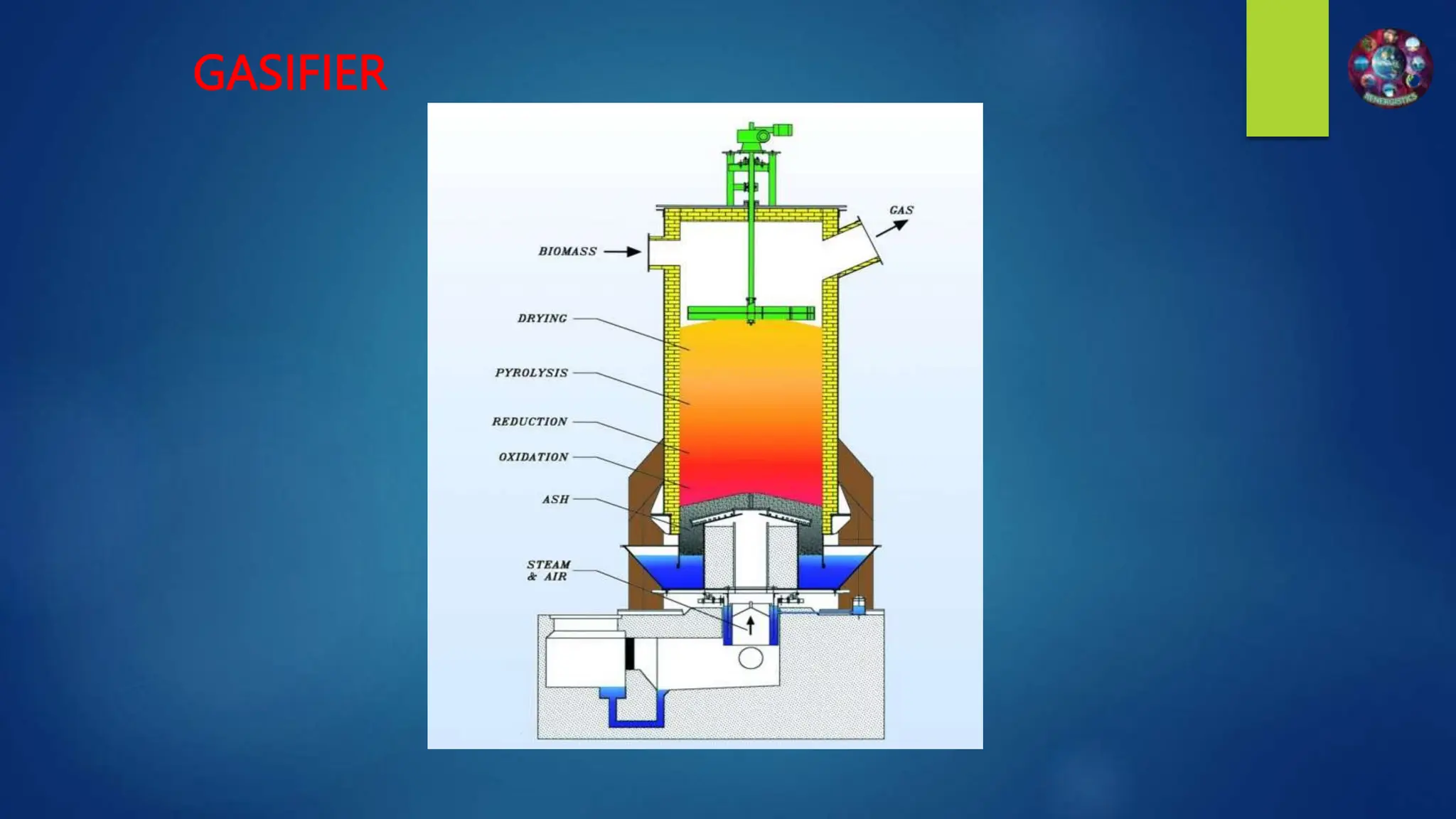
GASIFIER
• Gasifier is an equipment which can gasify a variety of biomass such as wood
waste, agricultural wastes like stalks and roots of various crops, maize cobs, etc.
• The gasifier is essentially a chemical processes take place. Biomass gets dried,
heated, pyrolyzed, partially oxidized and reduced, as it flows through it.
• The gas produced in the gasifier is a clean burning fuel having calorific value of
about 950 to 1200 Kcal/m3.
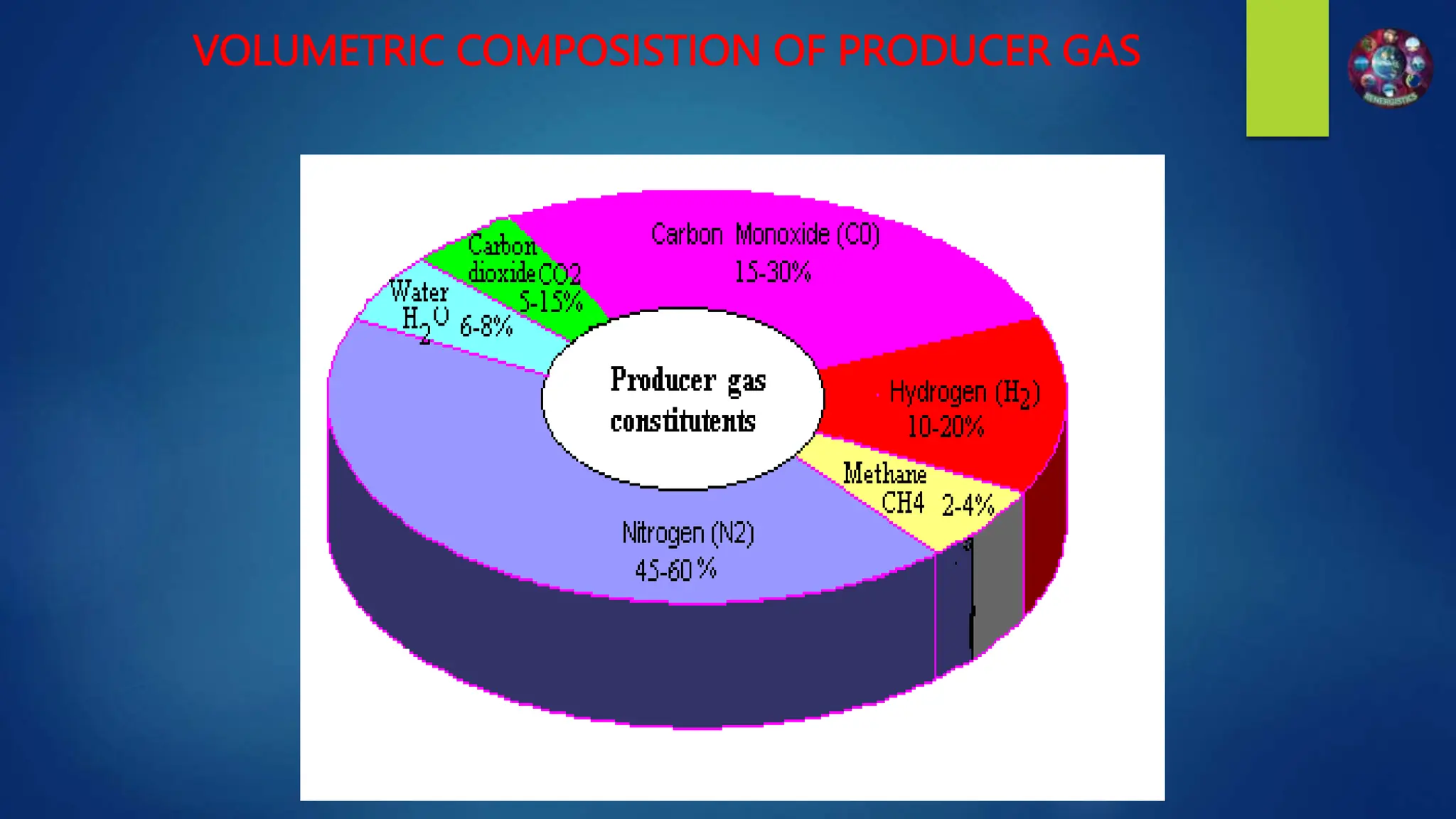
• Hydrogen(18 - 20 %)and carbon - monoxide (18 - 24%) are the main constituents
of the gas.
• The advantages of a gasifier are very easy to operate, maintain, sturdy in
construction and reliable in operation
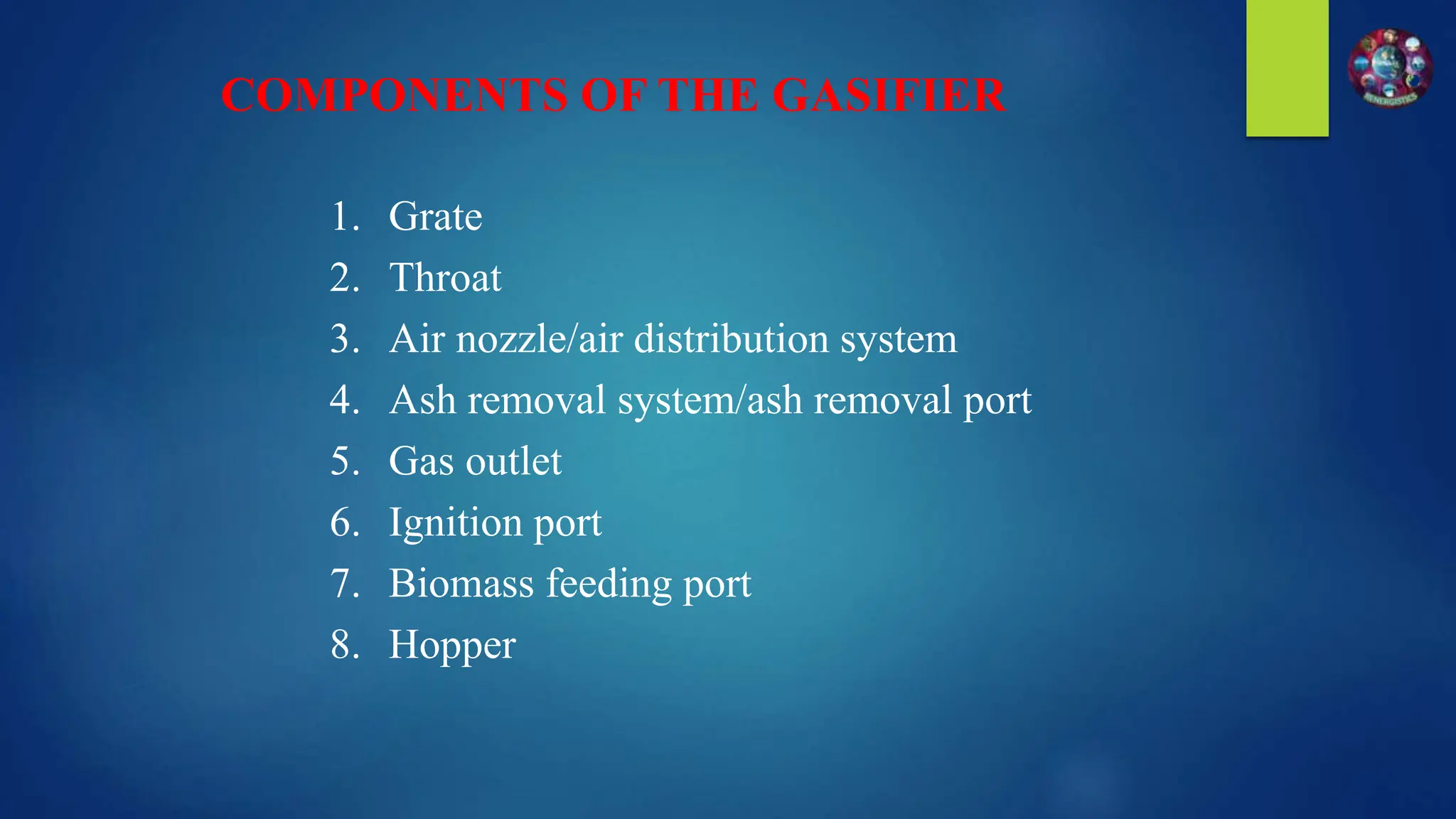
1. Grate
2. Throat
3. Air nozzle/air distribution system
4. Ash removal system/ash removal port
5. Gas outlet
6. Ignition port
7. Biomass feeding port
8. Hopper
COMPONENTS OF THE GASIFIER
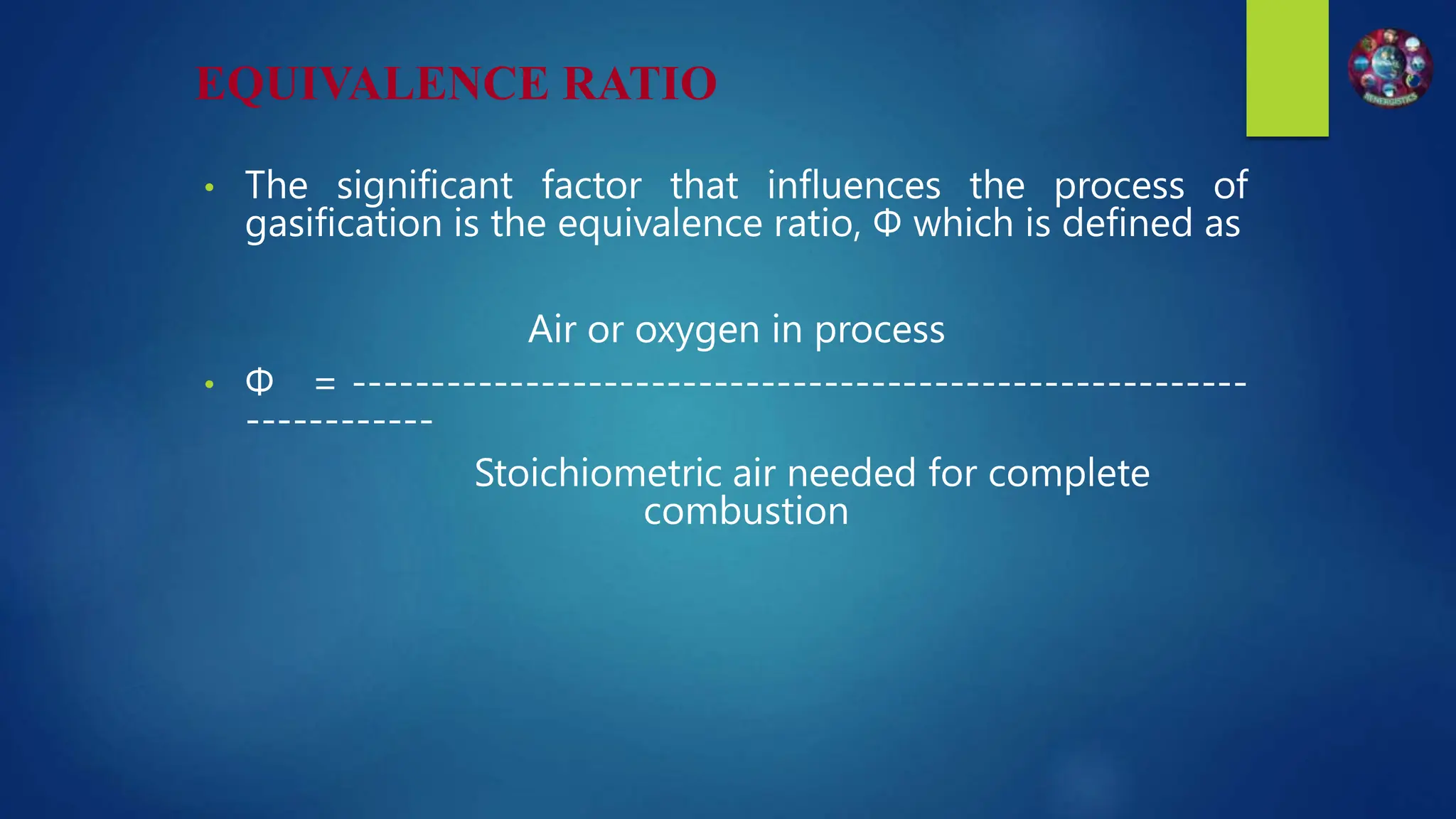
• The significant factor that influences the process of
gasification is the equivalence ratio, Φ which is defined as
Air or oxygen in process
• Φ = ---------------------------------------------------------
------------
Stoichiometric air needed for complete
combustion
EQUIVALENCE RATIO
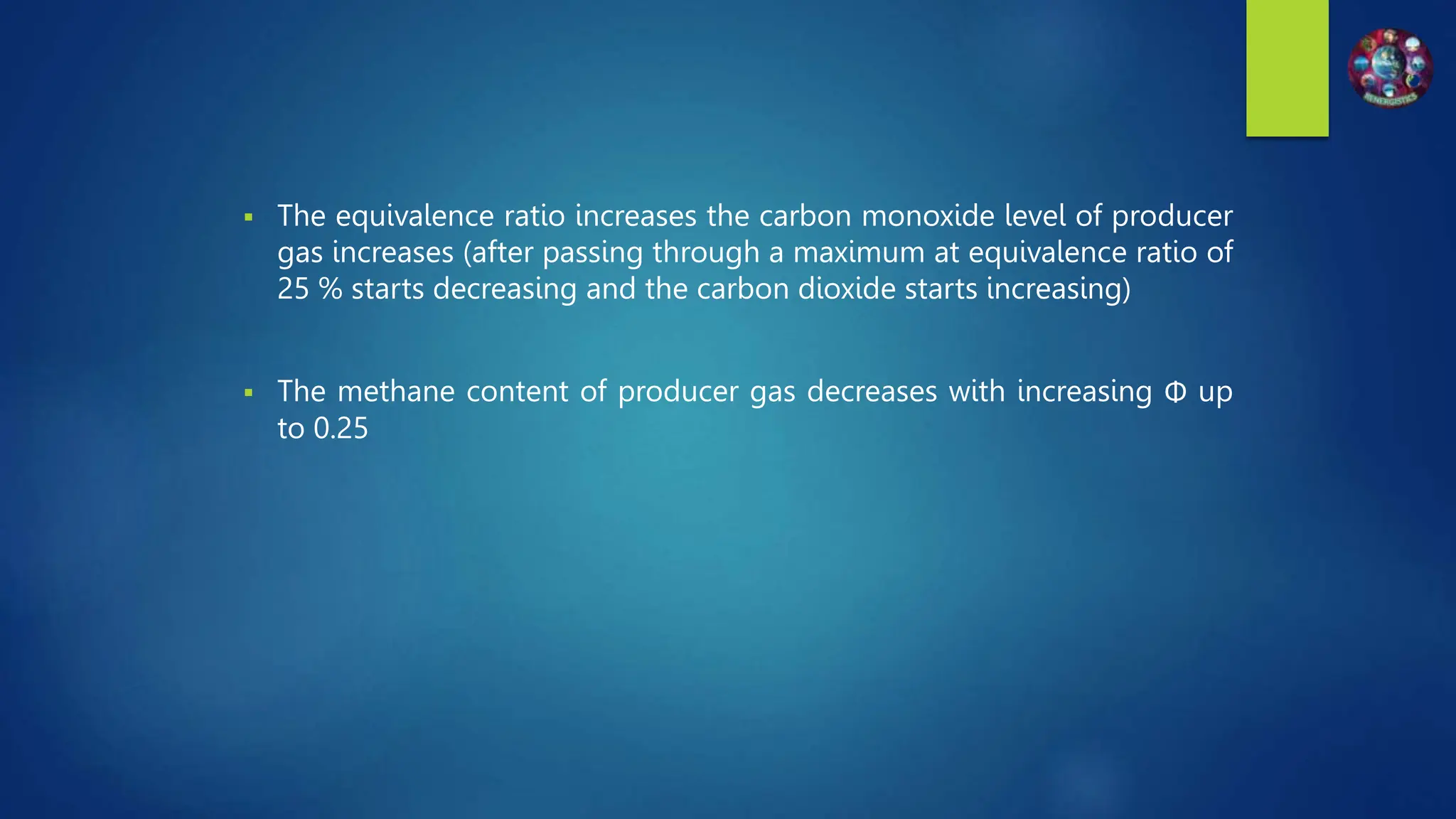
 The equivalence ratio increases the carbon monoxide level of producer
gas increases (after passing through a maximum at equivalence ratio of
25 % starts decreasing and the carbon dioxide starts increasing)
 The methane content of producer gas decreases with increasing Φ up
to 0.25
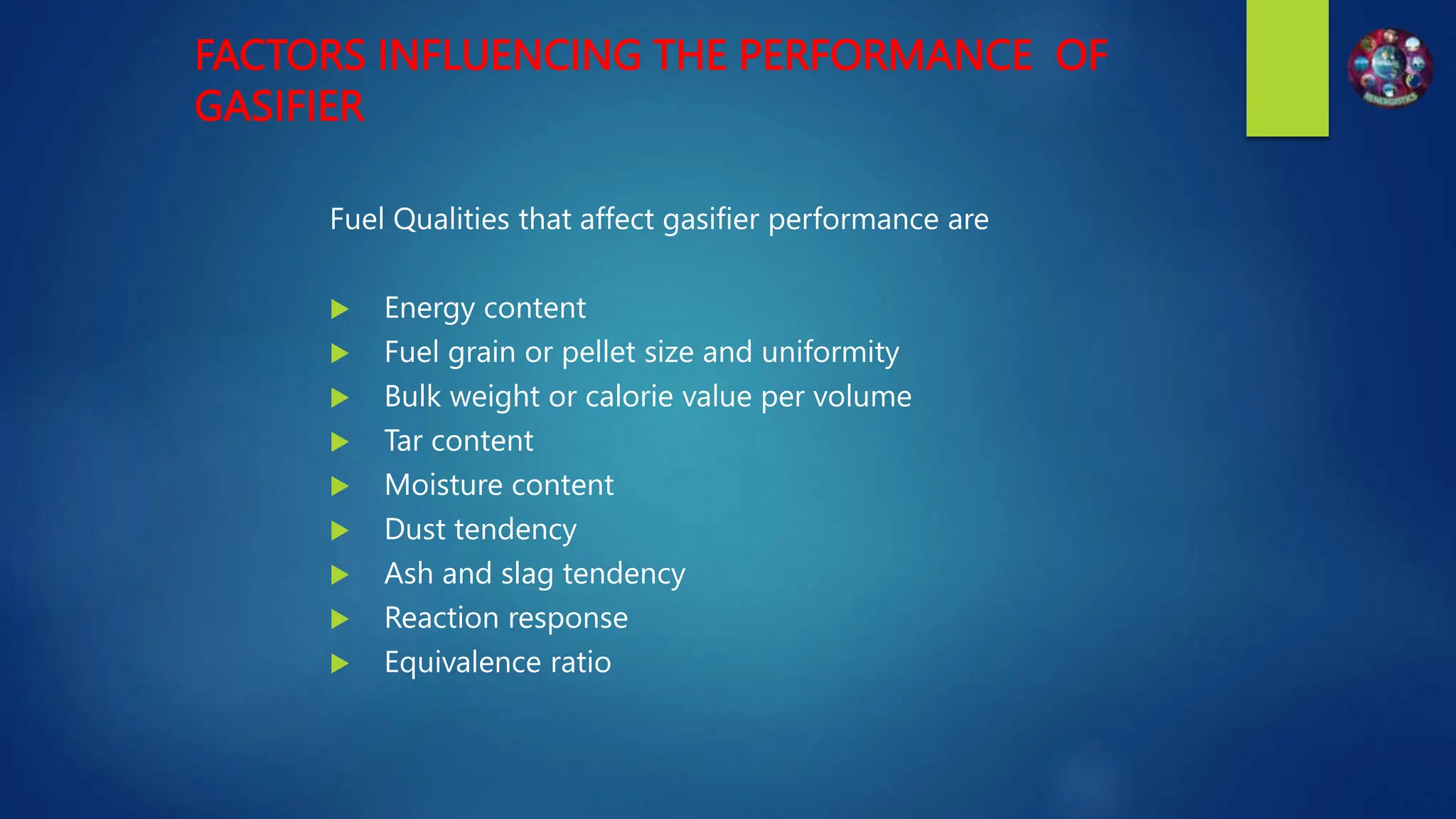
FACTORS INFLUENCING THE PERFORMANCE OF
GASIFIER
Fuel Qualities that affect gasifier performance are
 Energy content
 Fuel grain or pellet size and uniformity
 Bulk weight or calorie value per volume
 Tar content
 Moisture content
 Dust tendency
 Ash and slag tendency
 Reaction response
 Equivalence ratio
THERMO-CHEMICAL REACTIONS OCCURRING IN
GASIFICATION
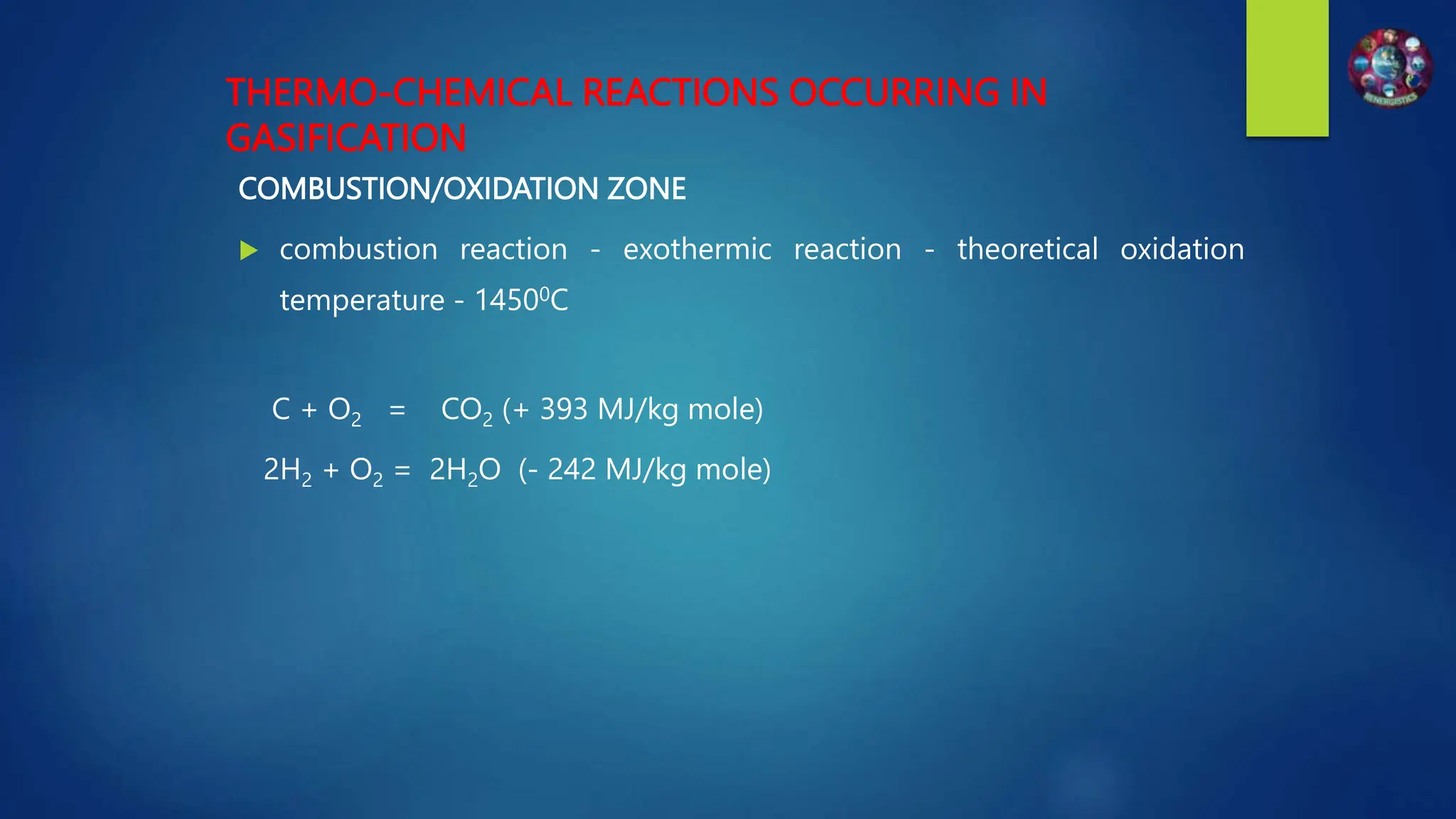
COMBUSTION/OXIDATION ZONE
 combustion reaction - exothermic reaction - theoretical oxidation
temperature - 14500C
C + O2 = CO2 (+ 393 MJ/kg mole)
2H2 + O2 = 2H2O (- 242 MJ/kg mole)
SEQUENCE OF REACTIONS IN A DOWNDRAFT
GASIFIER
Air +
Water
Fuel
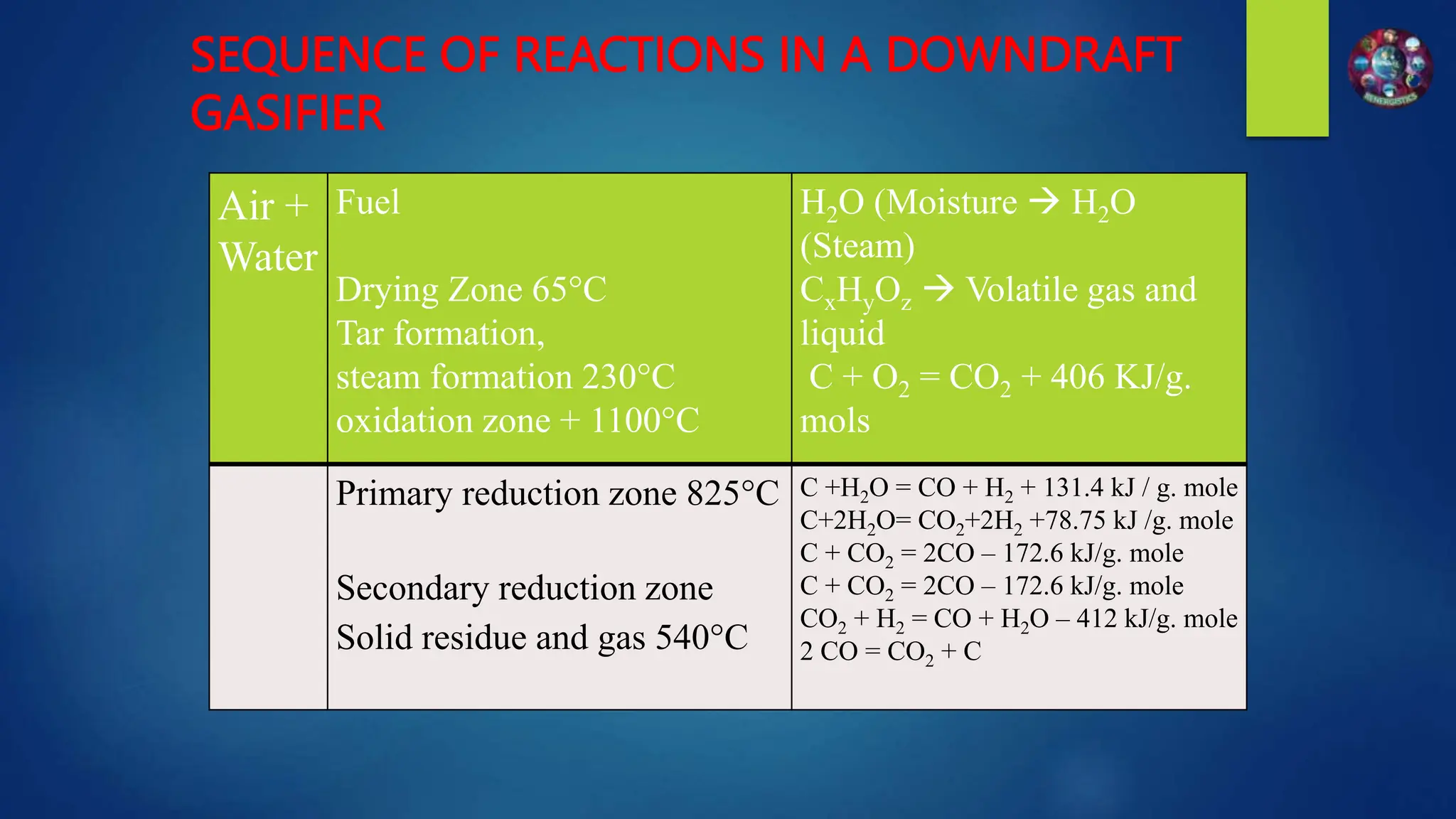
Drying Zone 65°C
Tar formation,
steam formation 230°C
oxidation zone + 1100°C
H2O (Moisture  H2O
(Steam)
CxHyOz  Volatile gas and
liquid
C + O2 = CO2 + 406 KJ/g.
mols
Primary reduction zone 825°C
Secondary reduction zone
Solid residue and gas 540°C
C +H2O = CO + H2 + 131.4 kJ / g. mole
C+2H2O= CO2+2H2 +78.75 kJ /g. mole
C + CO2 = 2CO – 172.6 kJ/g. mole
CO2 + H2 = CO + H2O – 412 kJ/g. mole
2 CO = CO2 + C
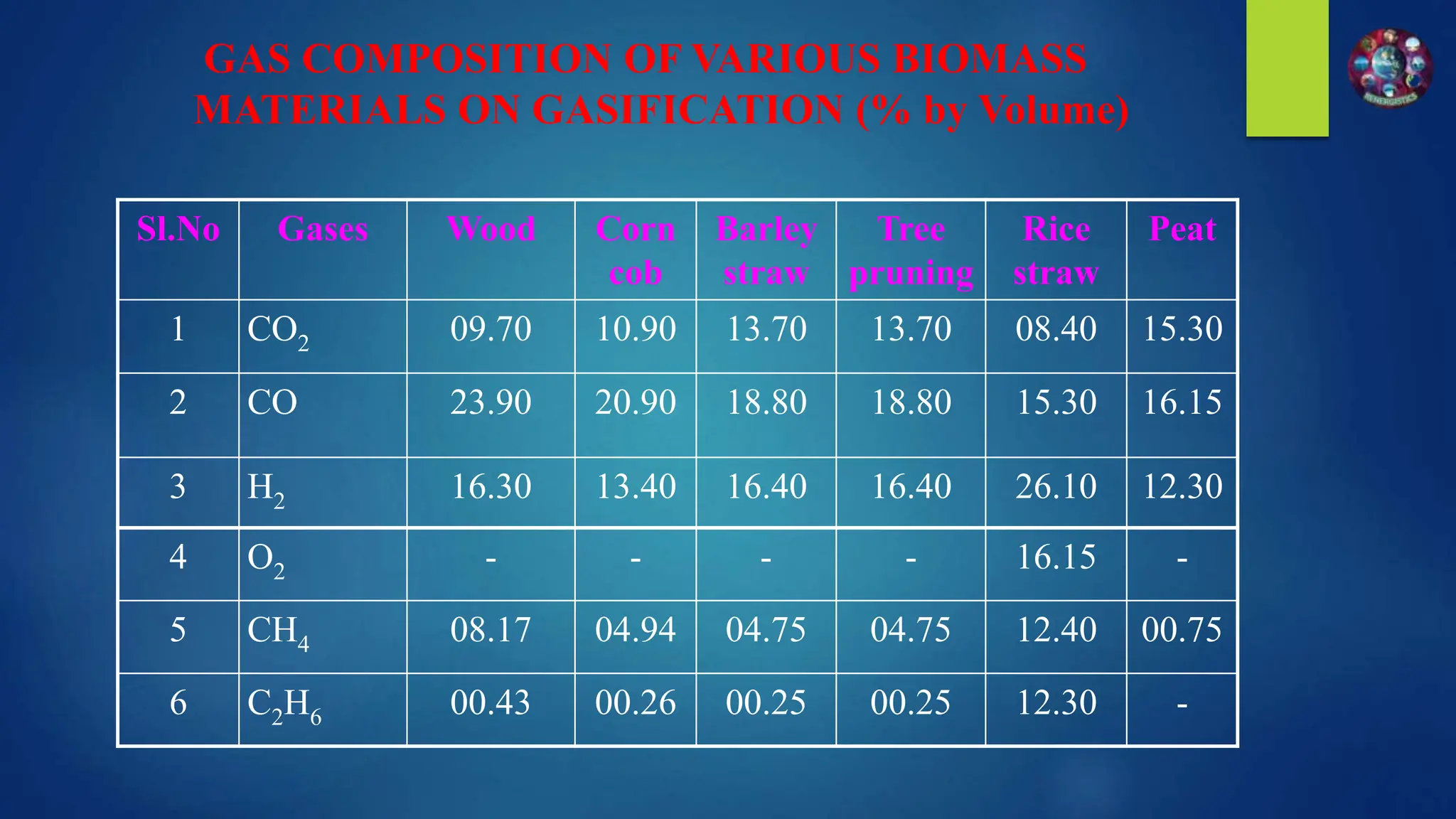
4 O2 - - - - 16.15 -
5 CH4 08.17 04.94 04.75 04.75 12.40 00.75
6 C2H6 00.43 00.26 00.25 00.25 12.30 -
Sl.No Gases Wood Corn
cob
Barley
straw
Tree
pruning
Rice
straw
Peat
1 CO2 09.70 10.90 13.70 13.70 08.40 15.30
2 CO 23.90 20.90 18.80 18.80 15.30 16.15
3 H2 16.30 13.40 16.40 16.40 26.10 12.30
GAS COMPOSITION OF VARIOUS BIOMASS
MATERIALS ON GASIFICATION (% by Volume)
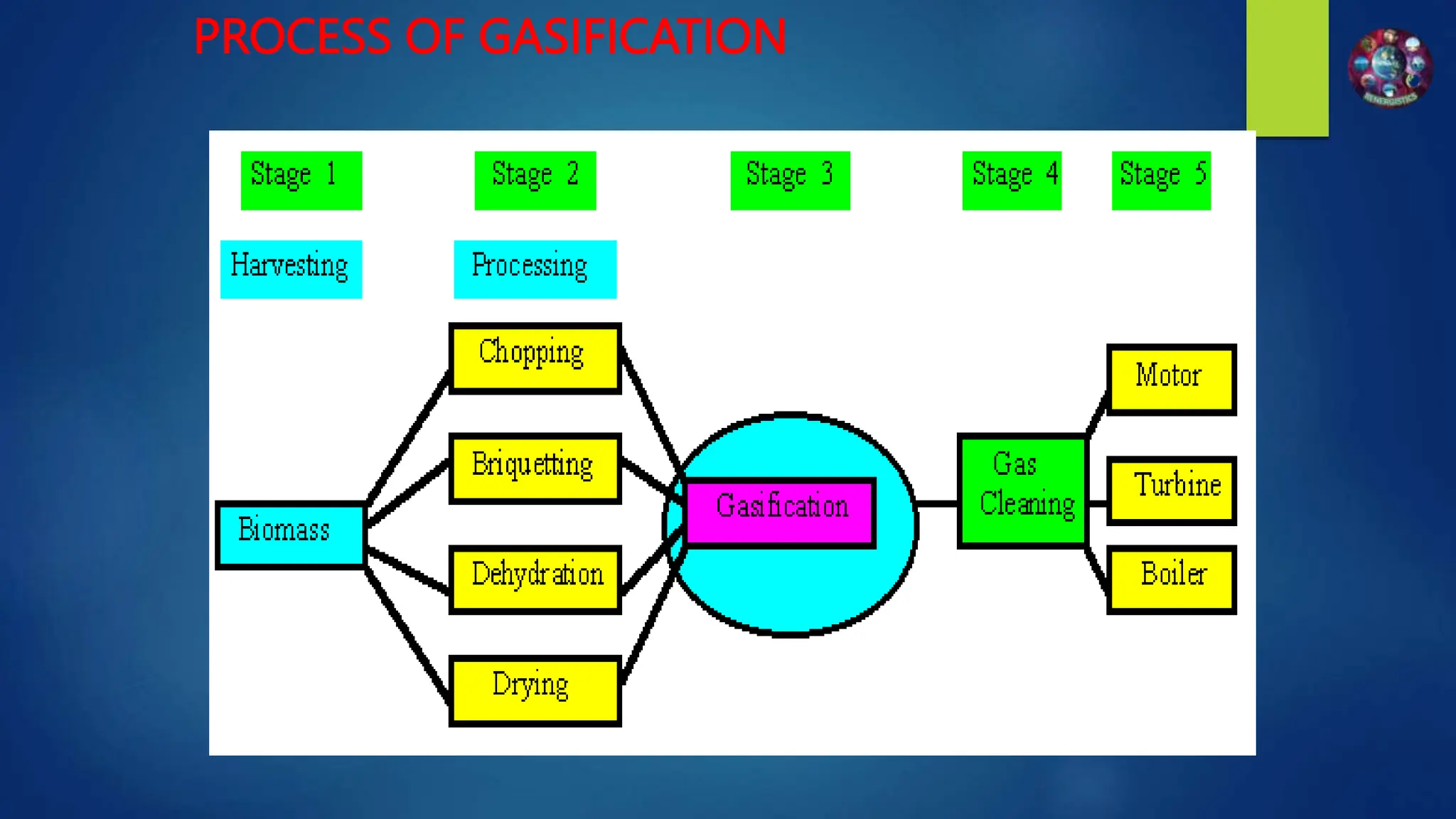
PROCESS OF GASIFICATION
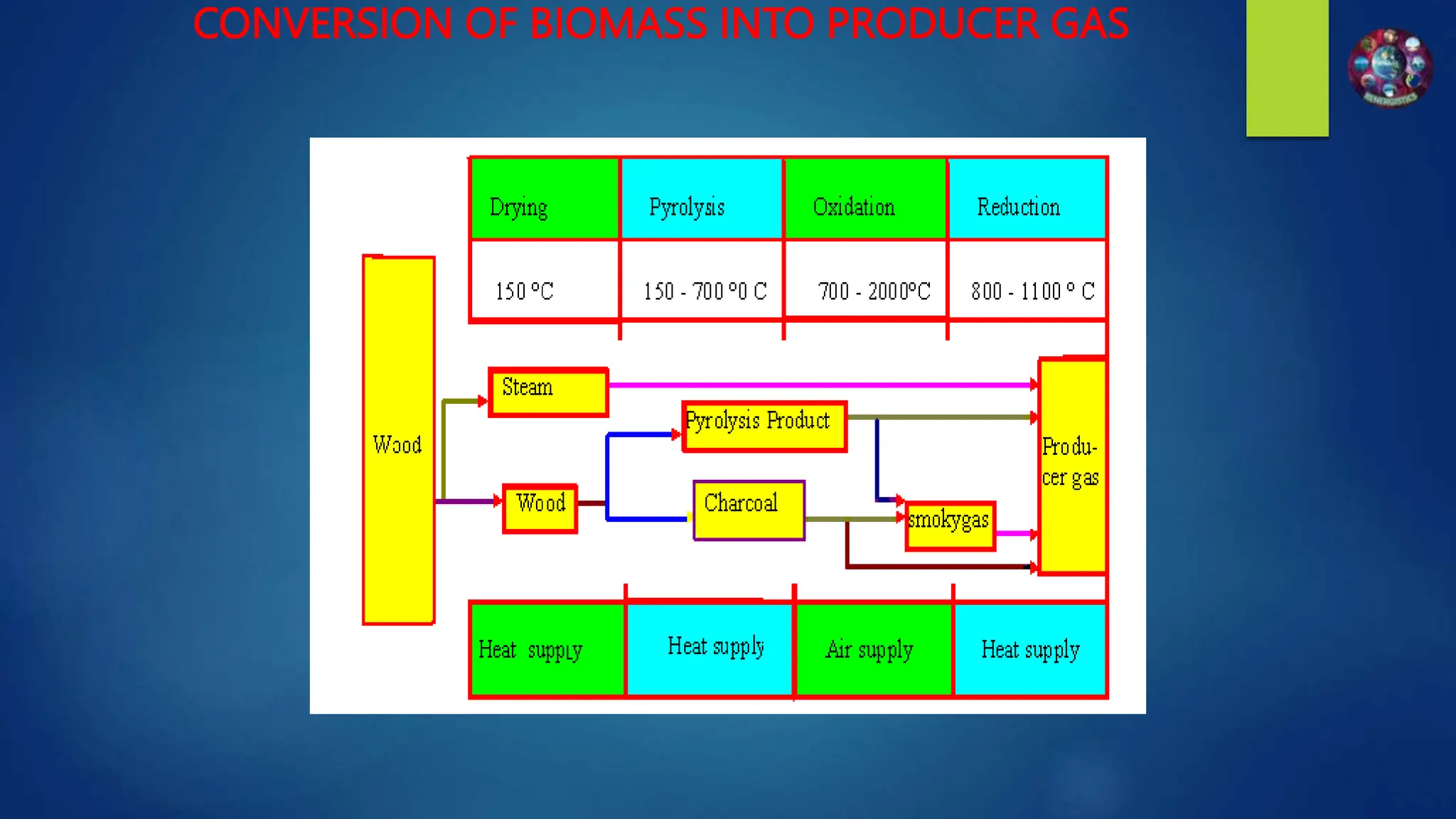
CONVERSION OF BIOMASS INTO PRODUCER GAS
VOLUMETRIC COMPOSISTION OF PRODUCER GAS
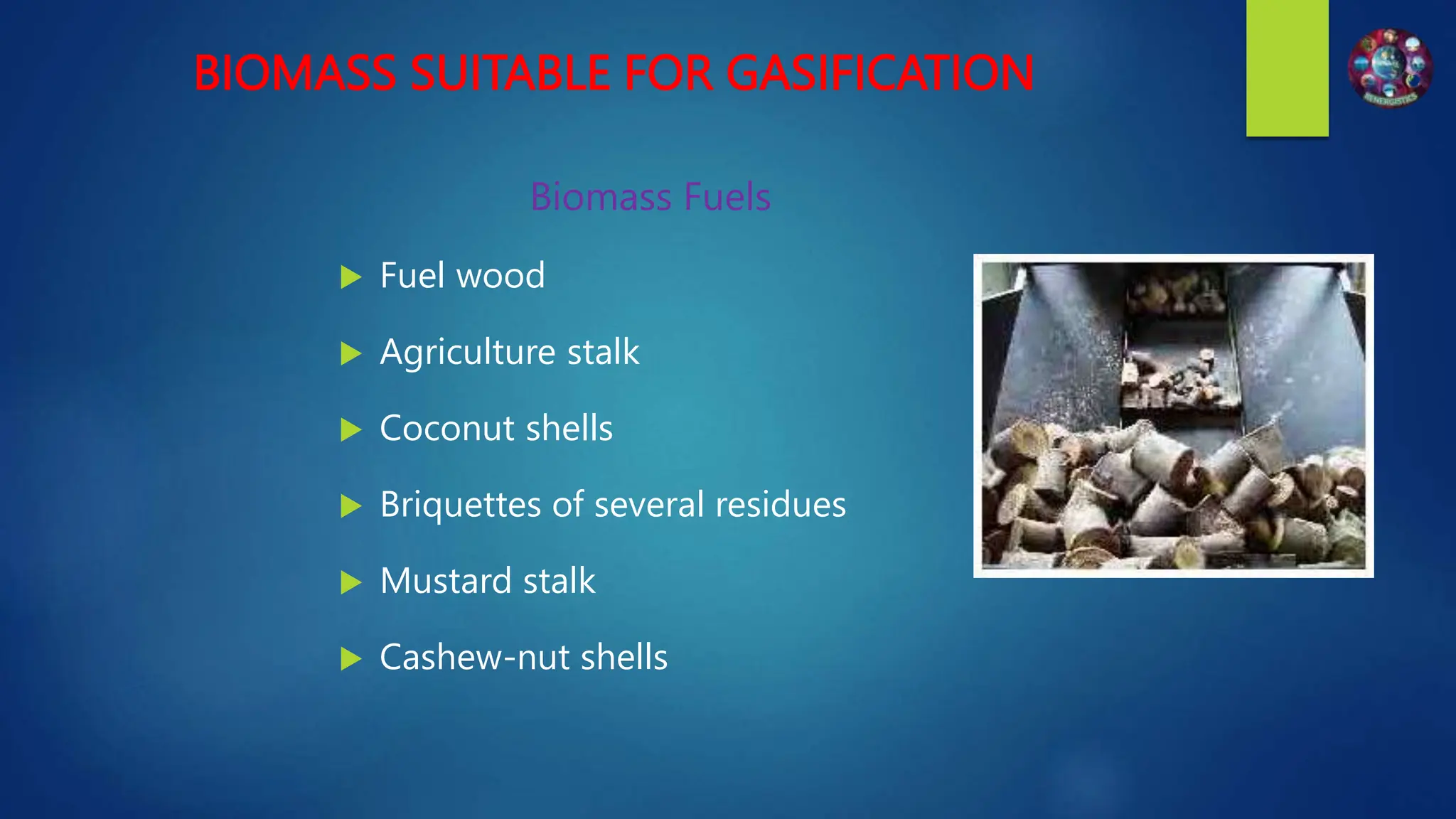
BIOMASS SUITABLE FOR GASIFICATION
Biomass Fuels
 Fuel wood
 Agriculture stalk
 Coconut shells
 Briquettes of several residues
 Mustard stalk
 Cashew-nut shells
GASIFIER
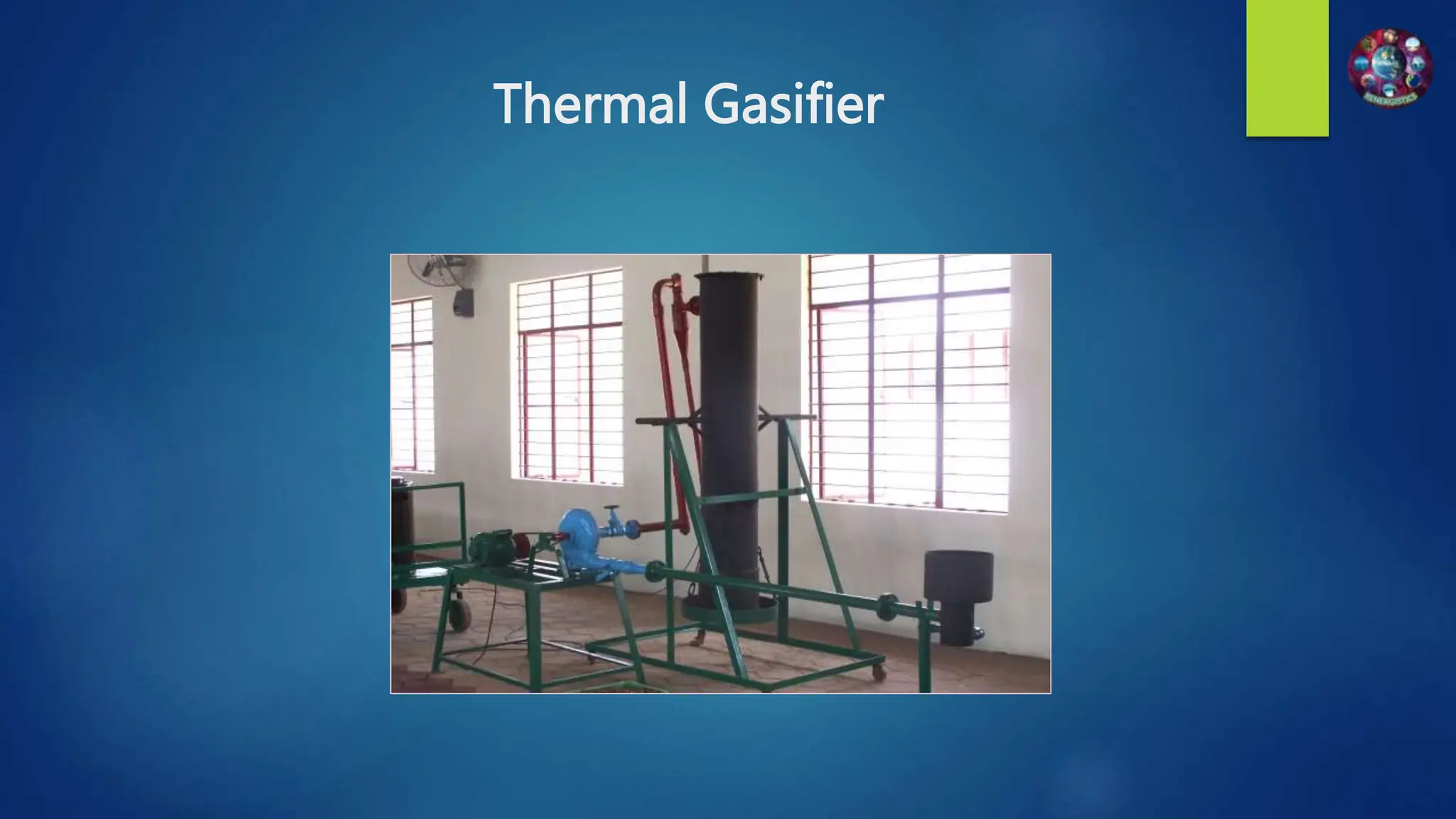
Thermal Gasifier
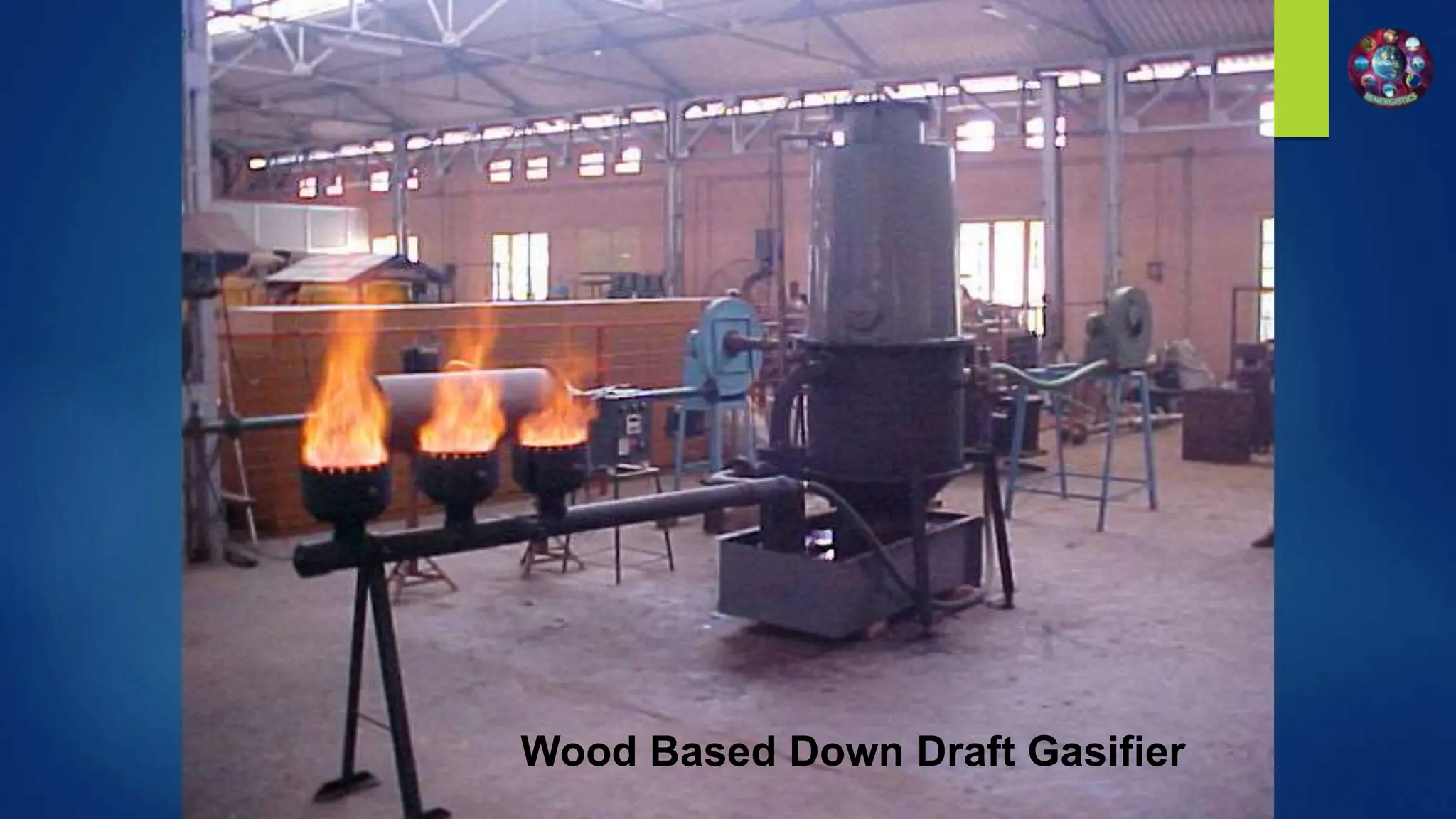
Wood Based Down Draft Gasifier
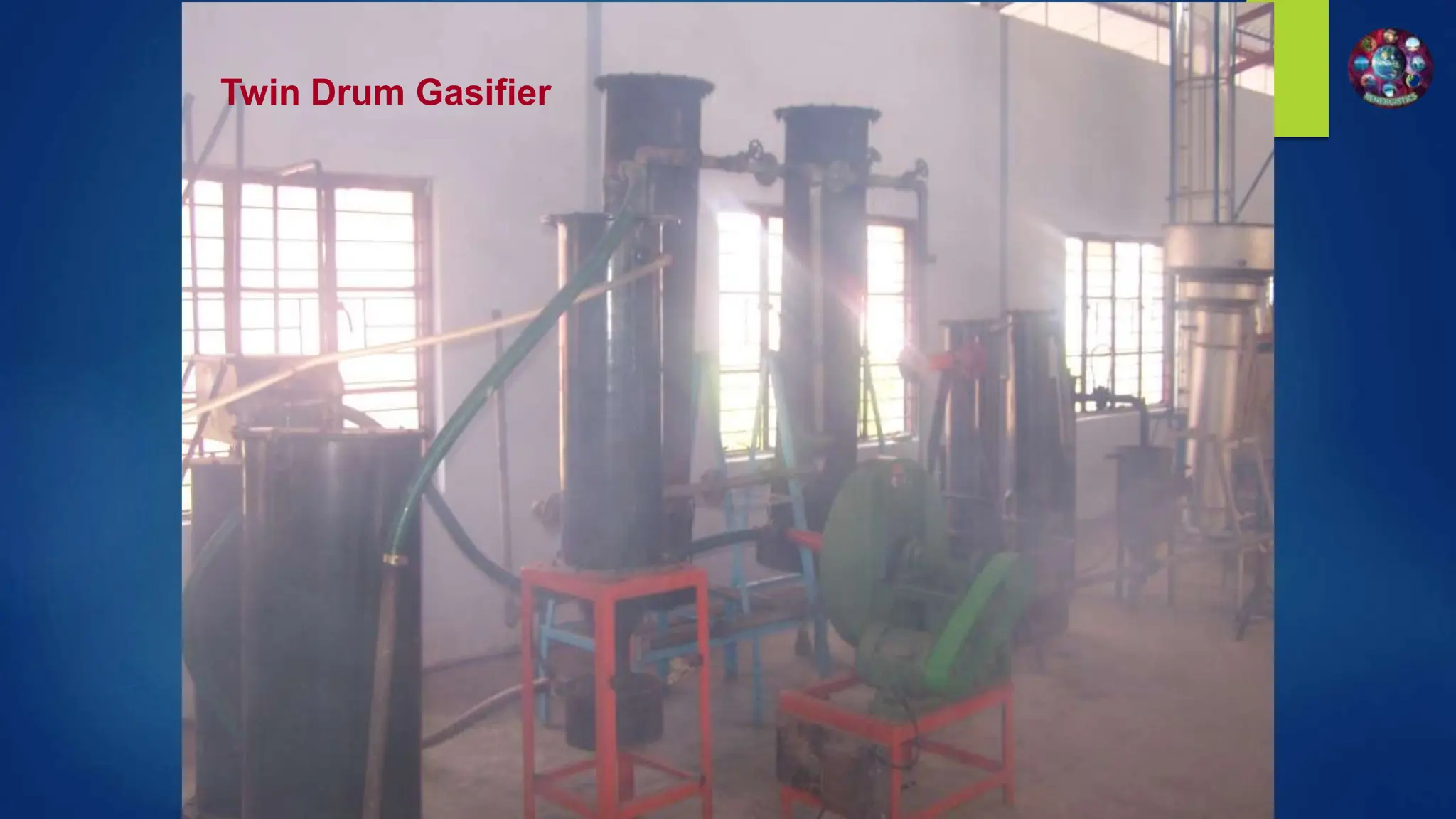
Twin Drum Gasifier
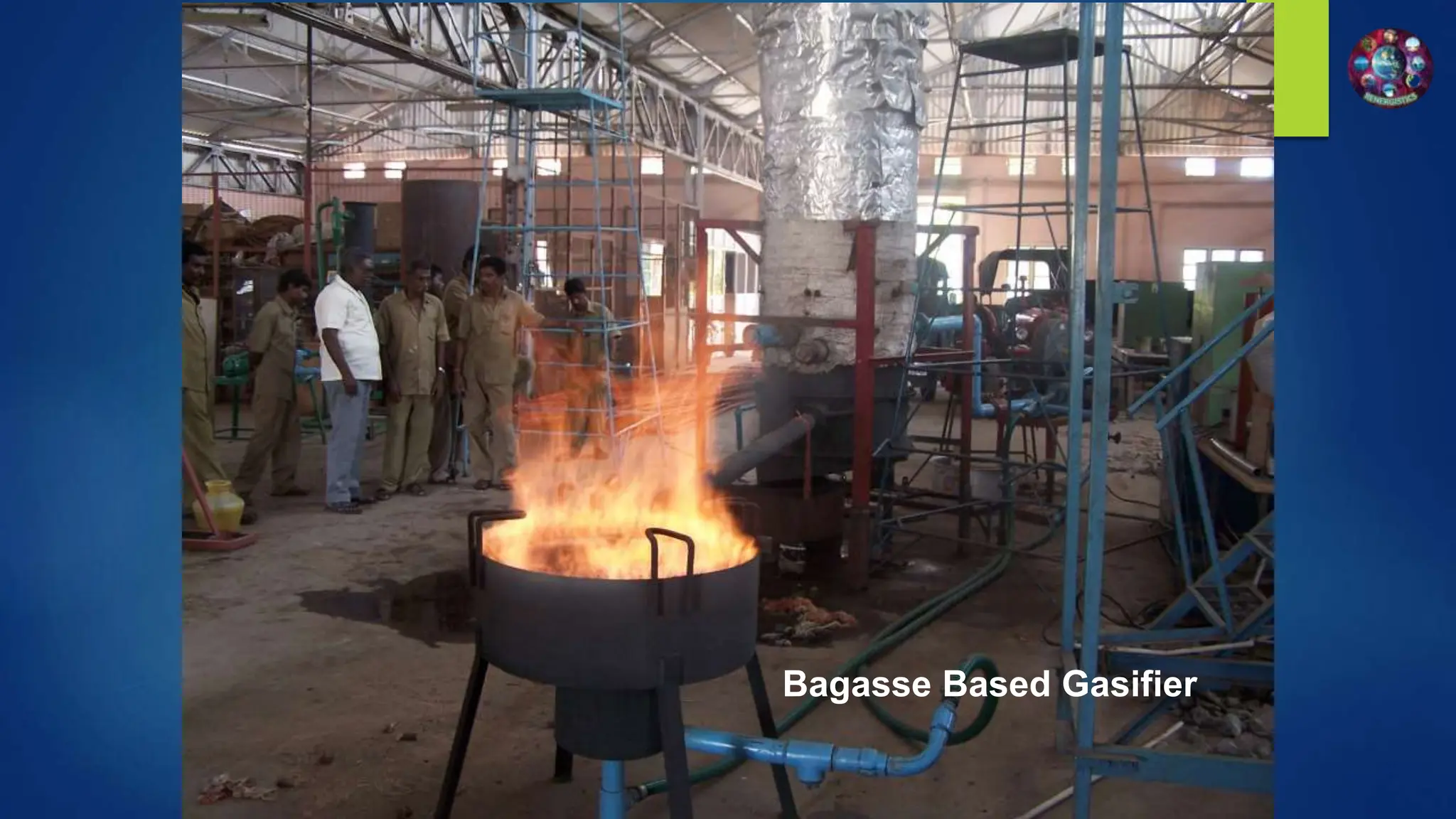
Bagasse Based Gasifier
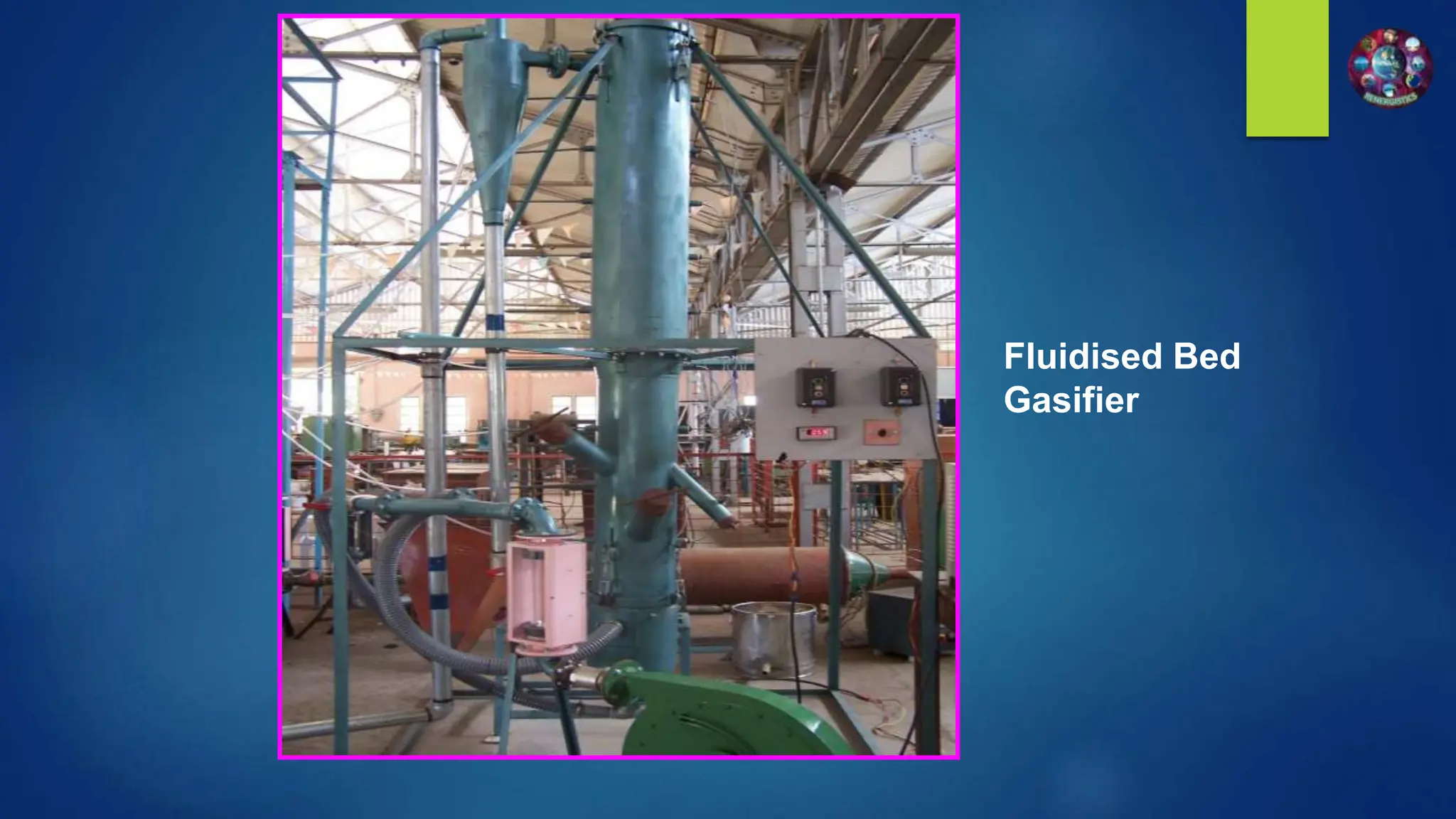
Fluidised Bed
Gasifier
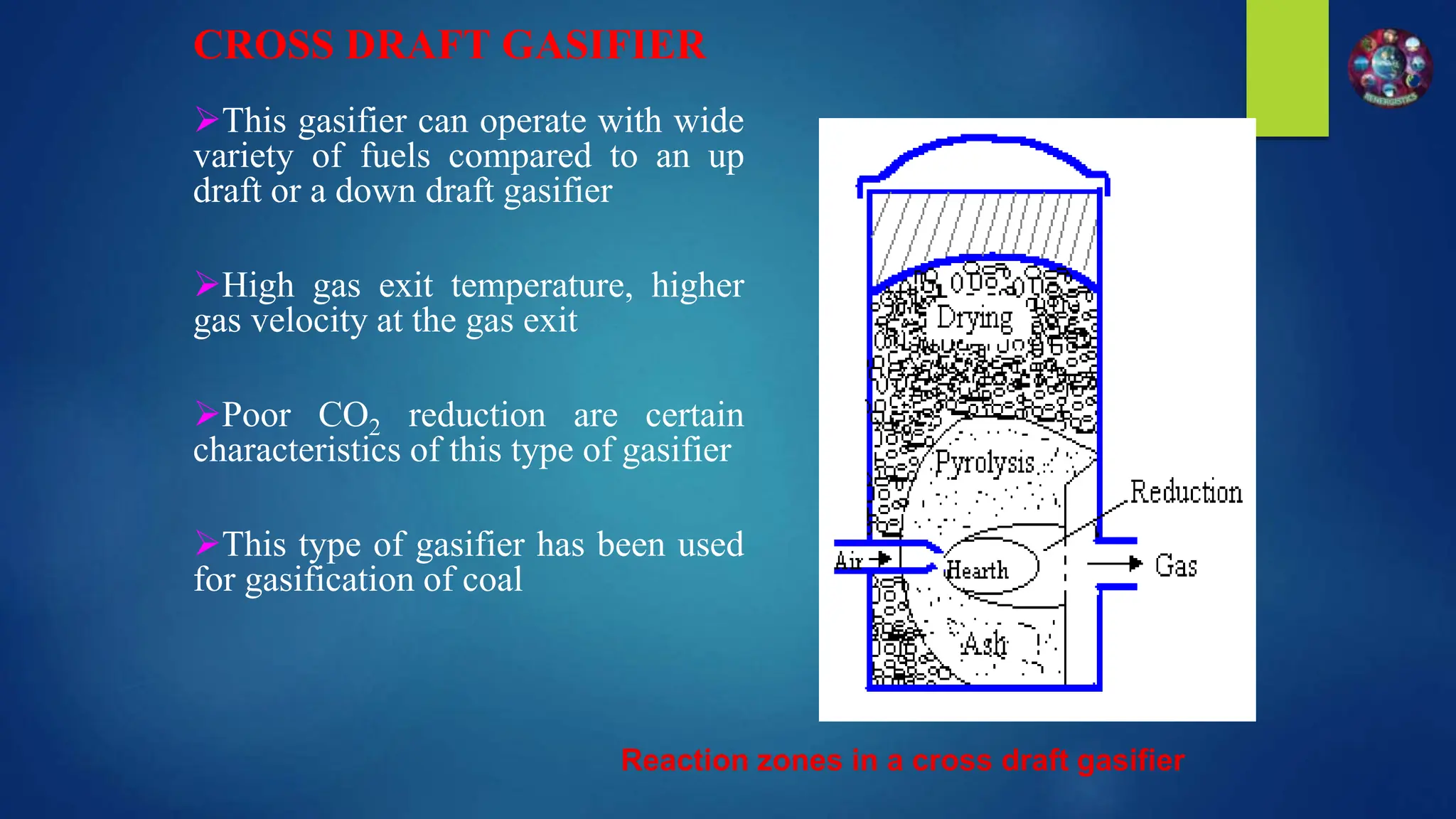
This gasifier can operate with wide
variety of fuels compared to an up
draft or a down draft gasifier
High gas exit temperature, higher
gas velocity at the gas exit
Poor CO2 reduction are certain
characteristics of this type of gasifier
This type of gasifier has been used
for gasification of coal
Reaction zones in a cross draft gasifier
CROSS DRAFT GASIFIER
FLUIDIZED BED GASIFICATION
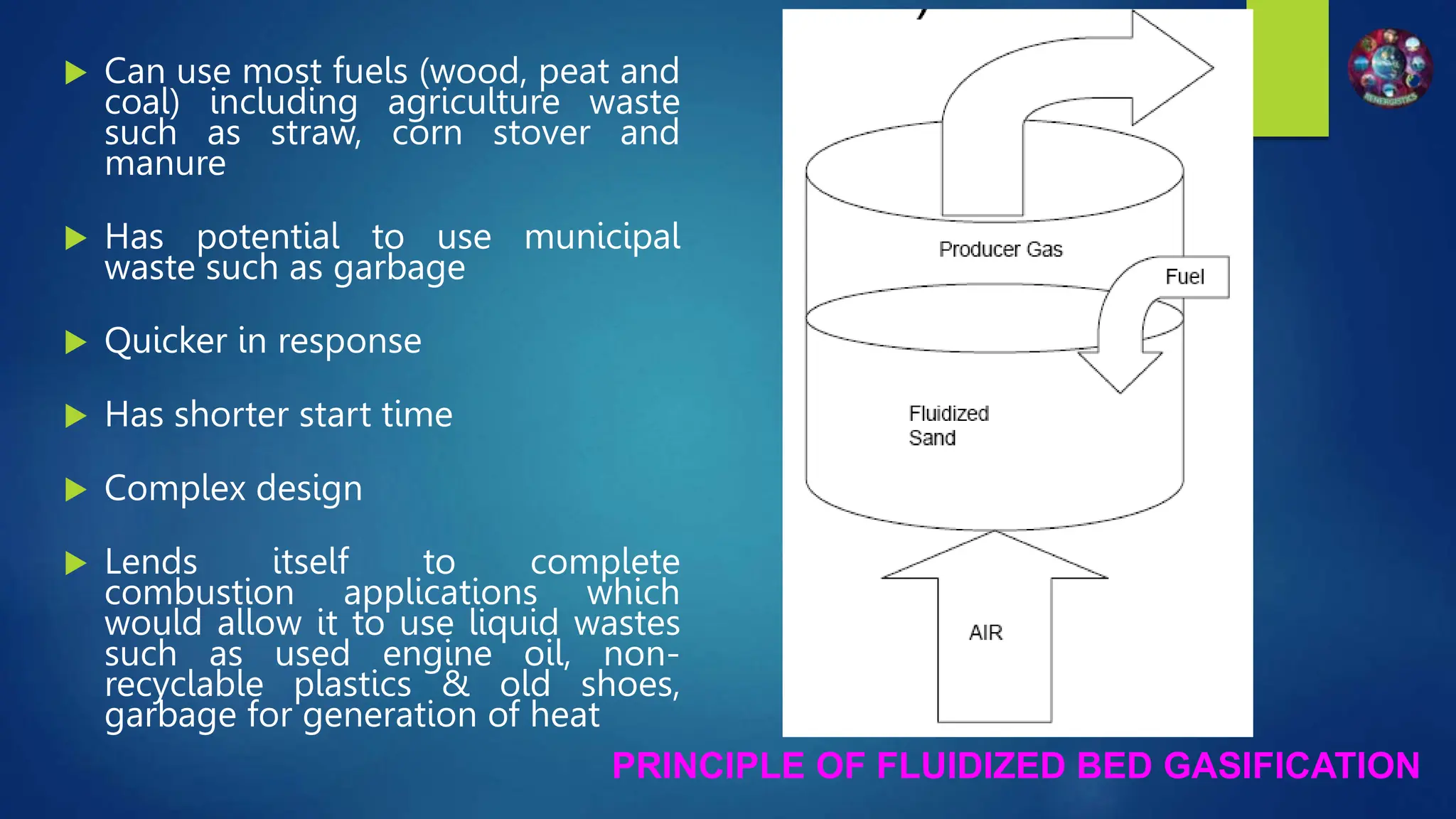
A fluidization bed is a chamber with a perforated floor
having pressurized air flowing vertically where a
particle medium usually sand, is contained. The
pressurized and flowing air helps the medium allowing
it to act as a fluid
PRINCIPLE OF FLUIDIZED BED GASIFICATION
 Can use most fuels (wood, peat and
coal) including agriculture waste
such as straw, corn stover and
manure
 Has potential to use municipal
waste such as garbage
 Quicker in response
 Has shorter start time
 Complex design
 Lends itself to complete
combustion applications which
would allow it to use liquid wastes
such as used engine oil, non-
recyclable plastics & old shoes,
garbage for generation of heat
Fluidized bed gasifier is a homogeneous reactor bed of some inert sand
material. The fuel is introduced in the inert bed material and air at the bottom
of the bed in the reactor. This gasifier is characterized by high gas exit
temperature, very high solid particulate matter in the gas and relatively low
efficiency. The gasifier can operate with low bulk density materials such as
agro-residues, leaves, etc.
FLUIDIZED BED GASIFIER
ENVIRONMENTAL BENEFITS
 The use of biomass energy has many unique qualities
that provide environmental benefits
 It can help mitigate climate change, reduce acid rain,
soil erosion, water pollution and pressure on landfills,
provide wildlife habitat and help maintain forest
health through better management
THANK YOU

Biomass gasification - types and principles

  • 1.
    Biomass Gasification BY ER. T.AYISHA NAZIBA, DR. D. RAMESH, DR. S. PUGALENDHI
  • 2.
     Biomass gasificationis a thermo-chemical process by which, biomass containing carbon, hydrogen and oxygen is reacted with restricted amount of air/ oxygen and/or steam to yield a mixture of combustible gases consisting of carbon monoxide, hydrogen and traces of methane. This mixture is called producer gas  Gasification accomplished in air sealed chamber - slight suction or pressure relative to ambient pressure Heat + biomass = gas + pyrolytic oils + char + ash + steam BIOMASS GASIFICATION
  • 3.
    GASIFICATION • Gasification isa partial oxidation process whereby a carbon source such as coal, natural gas or biomass, is broken down into carbon monoxide (CO) and Hydrogen (H2) plus carbon dioxide (CO2) and possibly hydrocarbon molecules such as methane (CH4) • This mix of gas is known as producer gas and the precise characteristics of the gas will depend on the gasification parameters such as temperature and also the oxidizer used • The oxidizer may be air, in which case the producer gas will also contain Nitrogen (N2), or steam or oxygen
  • 4.
    GASIFIER • Gasifier isan equipment which can gasify a variety of biomass such as wood waste, agricultural wastes like stalks and roots of various crops, maize cobs, etc. • The gasifier is essentially a chemical processes take place. Biomass gets dried, heated, pyrolyzed, partially oxidized and reduced, as it flows through it. • The gas produced in the gasifier is a clean burning fuel having calorific value of about 950 to 1200 Kcal/m3. • Hydrogen(18 - 20 %)and carbon - monoxide (18 - 24%) are the main constituents of the gas. • The advantages of a gasifier are very easy to operate, maintain, sturdy in construction and reliable in operation
  • 5.
    1. Grate 2. Throat 3.Air nozzle/air distribution system 4. Ash removal system/ash removal port 5. Gas outlet 6. Ignition port 7. Biomass feeding port 8. Hopper COMPONENTS OF THE GASIFIER
  • 6.
    • The significantfactor that influences the process of gasification is the equivalence ratio, Φ which is defined as Air or oxygen in process • Φ = --------------------------------------------------------- ------------ Stoichiometric air needed for complete combustion EQUIVALENCE RATIO
  • 7.
     The equivalenceratio increases the carbon monoxide level of producer gas increases (after passing through a maximum at equivalence ratio of 25 % starts decreasing and the carbon dioxide starts increasing)  The methane content of producer gas decreases with increasing Φ up to 0.25
  • 8.
    FACTORS INFLUENCING THEPERFORMANCE OF GASIFIER Fuel Qualities that affect gasifier performance are  Energy content  Fuel grain or pellet size and uniformity  Bulk weight or calorie value per volume  Tar content  Moisture content  Dust tendency  Ash and slag tendency  Reaction response  Equivalence ratio
  • 9.
    THERMO-CHEMICAL REACTIONS OCCURRINGIN GASIFICATION COMBUSTION/OXIDATION ZONE  combustion reaction - exothermic reaction - theoretical oxidation temperature - 14500C C + O2 = CO2 (+ 393 MJ/kg mole) 2H2 + O2 = 2H2O (- 242 MJ/kg mole)
  • 10.
    SEQUENCE OF REACTIONSIN A DOWNDRAFT GASIFIER Air + Water Fuel Drying Zone 65°C Tar formation, steam formation 230°C oxidation zone + 1100°C H2O (Moisture  H2O (Steam) CxHyOz  Volatile gas and liquid C + O2 = CO2 + 406 KJ/g. mols Primary reduction zone 825°C Secondary reduction zone Solid residue and gas 540°C C +H2O = CO + H2 + 131.4 kJ / g. mole C+2H2O= CO2+2H2 +78.75 kJ /g. mole C + CO2 = 2CO – 172.6 kJ/g. mole C + CO2 = 2CO – 172.6 kJ/g. mole CO2 + H2 = CO + H2O – 412 kJ/g. mole 2 CO = CO2 + C
  • 11.
    4 O2 -- - - 16.15 - 5 CH4 08.17 04.94 04.75 04.75 12.40 00.75 6 C2H6 00.43 00.26 00.25 00.25 12.30 - Sl.No Gases Wood Corn cob Barley straw Tree pruning Rice straw Peat 1 CO2 09.70 10.90 13.70 13.70 08.40 15.30 2 CO 23.90 20.90 18.80 18.80 15.30 16.15 3 H2 16.30 13.40 16.40 16.40 26.10 12.30 GAS COMPOSITION OF VARIOUS BIOMASS MATERIALS ON GASIFICATION (% by Volume)
  • 12.
  • 13.
    CONVERSION OF BIOMASSINTO PRODUCER GAS
  • 14.
  • 15.
    BIOMASS SUITABLE FORGASIFICATION Biomass Fuels  Fuel wood  Agriculture stalk  Coconut shells  Briquettes of several residues  Mustard stalk  Cashew-nut shells
  • 16.
  • 17.
  • 18.
    Wood Based DownDraft Gasifier
  • 19.
  • 20.
  • 21.
  • 22.
    This gasifier canoperate with wide variety of fuels compared to an up draft or a down draft gasifier High gas exit temperature, higher gas velocity at the gas exit Poor CO2 reduction are certain characteristics of this type of gasifier This type of gasifier has been used for gasification of coal Reaction zones in a cross draft gasifier CROSS DRAFT GASIFIER
  • 23.
    FLUIDIZED BED GASIFICATION Afluidization bed is a chamber with a perforated floor having pressurized air flowing vertically where a particle medium usually sand, is contained. The pressurized and flowing air helps the medium allowing it to act as a fluid
  • 24.
    PRINCIPLE OF FLUIDIZEDBED GASIFICATION  Can use most fuels (wood, peat and coal) including agriculture waste such as straw, corn stover and manure  Has potential to use municipal waste such as garbage  Quicker in response  Has shorter start time  Complex design  Lends itself to complete combustion applications which would allow it to use liquid wastes such as used engine oil, non- recyclable plastics & old shoes, garbage for generation of heat
  • 25.
    Fluidized bed gasifieris a homogeneous reactor bed of some inert sand material. The fuel is introduced in the inert bed material and air at the bottom of the bed in the reactor. This gasifier is characterized by high gas exit temperature, very high solid particulate matter in the gas and relatively low efficiency. The gasifier can operate with low bulk density materials such as agro-residues, leaves, etc. FLUIDIZED BED GASIFIER
  • 26.
    ENVIRONMENTAL BENEFITS  Theuse of biomass energy has many unique qualities that provide environmental benefits  It can help mitigate climate change, reduce acid rain, soil erosion, water pollution and pressure on landfills, provide wildlife habitat and help maintain forest health through better management
  • 27.