Subject
Soil and Water Conservation Engineering
Topic
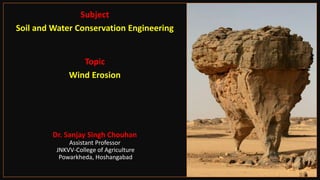
Wind Erosion
Dr. Sanjay Singh Chouhan
Assistant Professor
JNKVV-College of Agriculture
Powarkheda, Hoshangabad
Wind Erosion
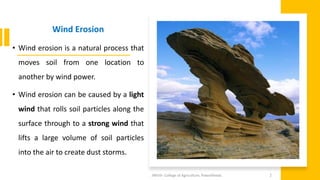
• Wind erosion is a natural process that
moves soil from one location to
another by wind power.
• Wind erosion can be caused by a light
wind that rolls soil particles along the
surface through to a strong wind that
lifts a large volume of soil particles
into the air to create dust storms.
JNKVV- College of Agriculture, Powarkheda 2
3
JNKVV-CollegeofAgriculture,Powarkheda
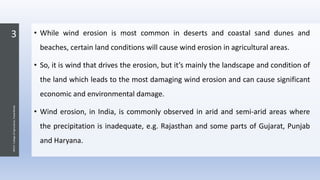
• While wind erosion is most common in deserts and coastal sand dunes and
beaches, certain land conditions will cause wind erosion in agricultural areas.
• So, it is wind that drives the erosion, but it’s mainly the landscape and condition of
the land which leads to the most damaging wind erosion and can cause significant
economic and environmental damage.
• Wind erosion, in India, is commonly observed in arid and semi-arid areas where
the precipitation is inadequate, e.g. Rajasthan and some parts of Gujarat, Punjab
and Haryana.
4
JNKVV-CollegeofAgriculture,Powarkheda
Wind Erosion Damages
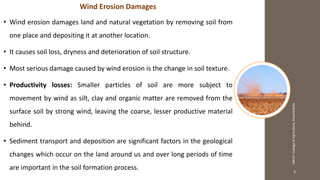
• Wind erosion damages land and natural vegetation by removing soil from
one place and depositing it at another location.
• It causes soil loss, dryness and deterioration of soil structure.
• Most serious damage caused by wind erosion is the change in soil texture.
• Productivity losses: Smaller particles of soil are more subject to
movement by wind as silt, clay and organic matter are removed from the
surface soil by strong wind, leaving the coarse, lesser productive material
behind.
• Sediment transport and deposition are significant factors in the geological
changes which occur on the land around us and over long periods of time
are important in the soil formation process.
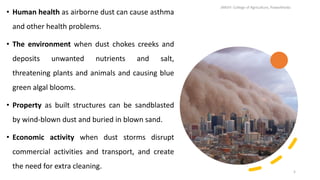
• Human health as airborne dust can cause asthma
and other health problems.
• The environment when dust chokes creeks and
deposits unwanted nutrients and salt,
threatening plants and animals and causing blue
green algal blooms.
• Property as built structures can be sandblasted
by wind-blown dust and buried in blown sand.
• Economic activity when dust storms disrupt
commercial activities and transport, and create
the need for extra cleaning.
JNKVV- College of Agriculture, Powarkheda
5
• Climate
• Soil
• Surface roughness
• Topography
• Vegetative cover
• Organic matter content
JNKVV- College of Agriculture, Powarkheda 6
Factors Affecting Wind Erosion
7
JNKVV-CollegeofAgriculture,Powarkheda
Climate
• The climatic factors that affect the wind erosion are the characteristics of wind
itself (velocity and direction) in addition to the precipitation, humidity and
temperature.
Soil
• Soil moisture conditions, texture, structure, density of particles are the soil
characteristics that influence the Soil cloudiness and thus erosion by wind.
Surface roughness
• Rough surface leads to reduction in soil loss by the reducing the wind velocity upto a
certain point and result in less soil loss.
• Rough surface also trapping the saltating soil particles and reduce the wind erosion
• In general, greater the soil roughness, lower the wind velocity against the ground and
lower is the rate of erosion.
Topography
• The land pattern also affect the rate and amount of soil loss caused by wind. If the
slope of land is not equal i.e., undulating soil leads to less soil loss than the plain area.
Soil surface characteristics depend upon the soil topography
JNKVV- College of Agriculture, Powarkheda 8
Vegetative Cover
• Surface features like vegetation or other artificial cover (mulching
etc) have the protective effect on wind erosion problem as
surface cover increases the roughness over the land surface and
thus reduces the erosive wind force on the land surface.
Organic Matter Content
• The organic content in the soil leads to reduction in soil erosion
due to binding properties of the organic matter in the soil.
JNKVV- College of Agriculture, Powarkheda 9
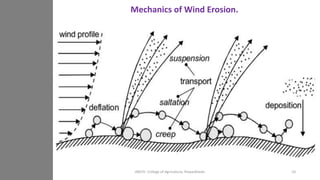
Mechanics of Wind Erosion.
JNKVV- College of Agriculture, Powarkheda 10
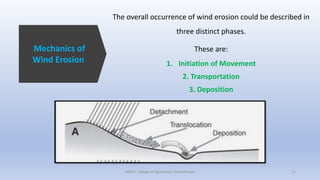
The overall occurrence of wind erosion could be described in
three distinct phases.
These are:
1. Initiation of Movement
2. Transportation
3. Deposition
JNKVV- College of Agriculture, Powarkheda 11
Mechanics of
Wind Erosion
Initiation of Movement
• The soil particles are first detached from their place by the impact
and cutting action of wind.
• These detached particles are then ready for movement by the
wind forces.
• After this initiation of movement, soil particles are moved or
transported by distinct mechanisms.
JNKVV- College of Agriculture, Powarkheda 12
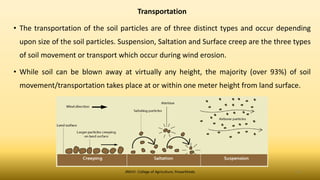
Transportation
• The transportation of the soil particles are of three distinct types and occur depending
upon size of the soil particles. Suspension, Saltation and Surface creep are the three types
of soil movement or transport which occur during wind erosion.
• While soil can be blown away at virtually any height, the majority (over 93%) of soil
movement/transportation takes place at or within one meter height from land surface.
JNKVV- College of Agriculture, Powarkheda 13
Deposition
• Deposition of soil particles occurs when the gravitational force is
greater than the forces holding the particle in the air.
• This generally happens when there is a decrease in the wind
velocity caused by vegetative or other physical barriers like
ditches or benches.
• Raindrops may also take dust out of air.
JNKVV- College of Agriculture, Powarkheda 14
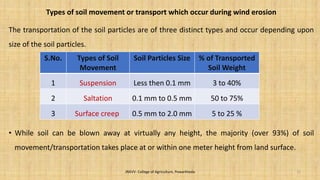
Types of soil movement or transport which occur during wind erosion
The transportation of the soil particles are of three distinct types and occur depending upon
size of the soil particles.
• While soil can be blown away at virtually any height, the majority (over 93%) of soil
movement/transportation takes place at or within one meter height from land surface.
JNKVV- College of Agriculture, Powarkheda 15
S.No. Types of Soil
Movement
Soil Particles Size % of Transported
Soil Weight
1 Suspension Less then 0.1 mm 3 to 40%
2 Saltation 0.1 mm to 0.5 mm 50 to 75%
3 Surface creep 0.5 mm to 2.0 mm 5 to 25 %
1. Suspension
• It occurs when very fine dirt and dust particles are lifted into the atmosphere.
• They can be thrown into the air through impact with other particles or by the wind itself.
• These particles can be carried very high and be transported over very long distances in
the atmosphere by the winds.
• Soil moved by suspension is the most spectacular and easiest to recognize among the
three forms of movement.
• The soil particles of less than 0.10 mm size are subjected to suspension and around 3 to
40 % of soil weights are carried by the suspension method of soil transport under the
wind erosion.
JNKVV- College of Agriculture, Powarkheda 16
2. Saltation
• The major fraction of soil moved by the wind is through the process of saltation.
• Saltation movement is caused by the pressure of the wind on soil particles as well as by
the collision of a particle with other particles.
• Soil particles (0.1 to 0.5 mm) move in a series of bounces and/or jumps and depending on
soil type, about 50 to 75% of the total weight of soil is carried in saltation.
• Soil particles moved in the process of saltation can cause severe damage to the soil
surface and vegetation.
• They travel approximately four times longer in distance than in height.
• When they strike the surface again they either bounce back into the air or knock other soil
particles from the soil mass into the air.
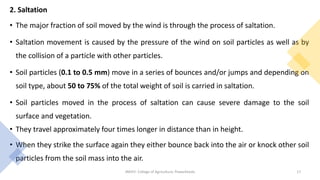
JNKVV- College of Agriculture, Powarkheda 17
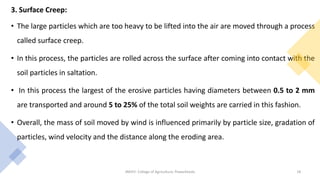
3. Surface Creep:
• The large particles which are too heavy to be lifted into the air are moved through a process
called surface creep.
• In this process, the particles are rolled across the surface after coming into contact with the
soil particles in saltation.
• In this process the largest of the erosive particles having diameters between 0.5 to 2 mm
are transported and around 5 to 25% of the total soil weights are carried in this fashion.
• Overall, the mass of soil moved by wind is influenced primarily by particle size, gradation of
particles, wind velocity and the distance along the eroding area.
JNKVV- College of Agriculture, Powarkheda 18
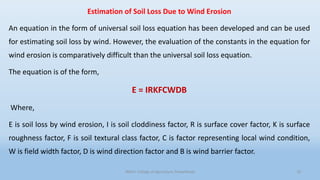
Estimation of Soil Loss Due to Wind Erosion
An equation in the form of universal soil loss equation has been developed and can be used
for estimating soil loss by wind. However, the evaluation of the constants in the equation for
wind erosion is comparatively difficult than the universal soil loss equation.
The equation is of the form,
E = IRKFCWDB
Where,
E is soil loss by wind erosion, I is soil cloddiness factor, R is surface cover factor, K is surface
roughness factor, F is soil textural class factor, C is factor representing local wind condition,
W is field width factor, D is wind direction factor and B is wind barrier factor.
JNKVV- College of Agriculture, Powarkheda 19
20
JNKVV-CollegeofAgriculture,Powarkheda
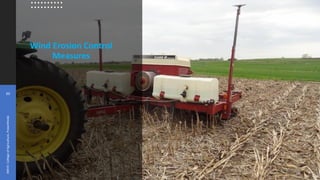
Wind Erosion Control
Measures
Wind Erosion Control
• A suitable surface soil texture is the best key to wind erosion
protection.
• Properly managed crop residues, carefully timed soil tillage, and
accurately placed crop strips and crop barriers can all effectively
reduce wind erosion.
• Proper land use and adaptation of adequate moisture conservation
practices are the main tools which help in wind erosion control.
• In the absence of crop residue, soil roughness or soil moisture can
reduce the wind erosion effectively.
JNKVV- College of Agriculture, Powarkheda 21
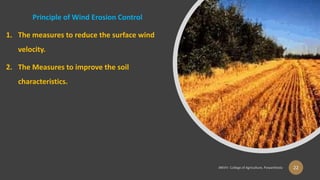
Principle of Wind Erosion Control
1. The measures to reduce the surface wind
velocity.
2. The Measures to improve the soil
characteristics.
22
JNKVV- College of Agriculture, Powarkheda 23
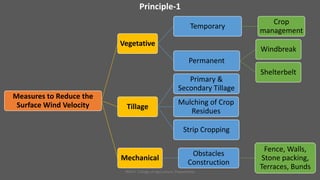
Measures to Reduce the
Surface Wind Velocity
Vegetative
Temporary
Crop
management
Permanent
Windbreak
Shelterbelt
Tillage
Primary &
Secondary Tillage
Mulching of Crop
Residues
Strip Cropping
Mechanical
Obstacles
Construction
Fence, Walls,
Stone packing,
Terraces, Bunds
Principle-1
Vegetative Measures
• It is one of the most effective and economical means to reduce the effect of wind on the
soil.
• It retards the wind velocity near the ground surface and control erosion.
• It keep the soil rough and ridged to either prevent any movement initially or to quickly
trap bouncing soil particles in the depressions of the rough surface.
• From the basic concept, the velocity of wind decreases near the ground surface because
of the resistance offered by the vegetation.
• Vegetative measures can be of two types and the use of these measures depends upon
the severity of erosion, (1) Temporary and (2) Permanent.
JNKVV- College of Agriculture, Powarkheda 24
Temporary Measures
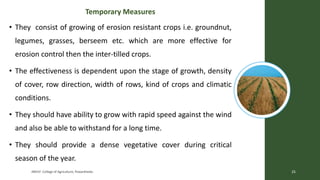
• They consist of growing of erosion resistant crops i.e. groundnut,
legumes, grasses, berseem etc. which are more effective for
erosion control then the inter-tilled crops.
• The effectiveness is dependent upon the stage of growth, density
of cover, row direction, width of rows, kind of crops and climatic
conditions.
• They should have ability to grow with rapid speed against the wind
and also be able to withstand for a long time.
• They should provide a dense vegetative cover during critical
season of the year.
JNKVV- College of Agriculture, Powarkheda 25
Permanent Measures
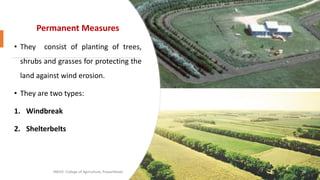
• They consist of planting of trees,
shrubs and grasses for protecting the
land against wind erosion.
• They are two types:
1. Windbreak
2. Shelterbelts
JNKVV- College of Agriculture, Powarkheda 26
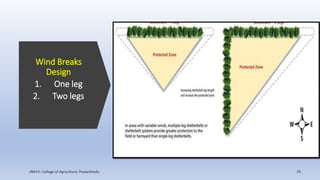
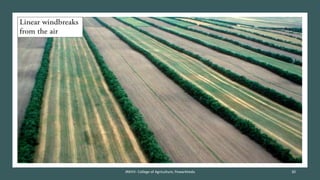
Wind Breaks
Wind Breaks
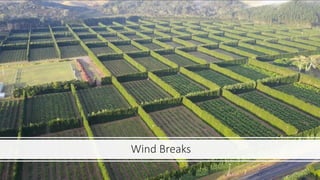
• The term wind break is defined as any type of barrier either mechanical or vegetative used
for protecting the areas like building apartments, orchards or farmsteads etc. from blowing
winds.
• The wind break acts as fencing wall around the affected areas, normally constructed by one
row or maximum up to two rows across the prevailing wind direction.
• This is a permanent vegetative measure which helps in the reduction of wind erosion.
• It reduces the wind speed up to 60-80% on leeward side.
• The windbreak reduces the wind speed on the leeward side at 200 m away up to 20 % only
and in the area as at 300m away, there is no effect at all. Therefore at an interval of 300m,
such windbreaks should be repeated.
JNKVV- College of Agriculture, Powarkheda 28
Wind Breaks
Design
1. One leg
2. Two legs
JNKVV- College of Agriculture, Powarkheda 30
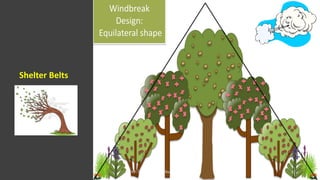
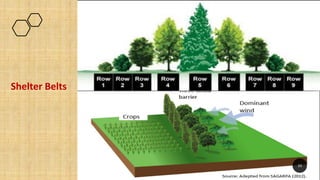
Shelter Belts
JNKVV- College of Agriculture, Powarkheda 31
32
JNKVV-CollegeofAgriculture,Powarkheda
Shelter Belts
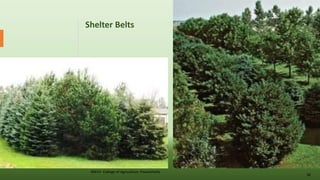
• Shelterbelt is more effective for reducing the impact of wind movement than the
wind break. Apart from controlling wind erosion, it provides fuel, reduces
evaporation and protects the orchard from hot and cold winds.
• A shelterbelt is a longer barrier than the wind break, is installed by using more than
two rows, usually at right angle to the direction of prevailing winds.
• The rows of belt can be developed by using shrubs and trees.
• It is mainly used for the conservation of soil moisture and for the protection of field
crops, against severe wind erosion.
Shelter Belts
JNKVV- College of Agriculture, Powarkheda
33
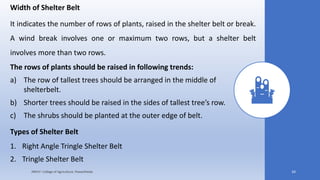
Width of Shelter Belt
It indicates the number of rows of plants, raised in the shelter belt or break.
A wind break involves one or maximum two rows, but a shelter belt
involves more than two rows.
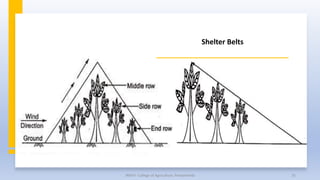
The rows of plants should be raised in following trends:
a) The row of tallest trees should be arranged in the middle of
shelterbelt.
b) Shorter trees should be raised in the sides of tallest tree’s row.
c) The shrubs should be planted at the outer edge of belt.
Types of Shelter Belt
1. Right Angle Tringle Shelter Belt
2. Tringle Shelter Belt
JNKVV- College of Agriculture, Powarkheda 34
Shelter Belts
JNKVV- College of Agriculture, Powarkheda 35
Shelter Belts
JNKVV- College of Agriculture, Powarkheda
36
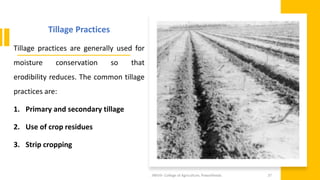
Tillage Practices
Tillage practices are generally used for
moisture conservation so that
erodibility reduces. The common tillage
practices are:
1. Primary and secondary tillage
2. Use of crop residues
3. Strip cropping
JNKVV- College of Agriculture, Powarkheda 37
Primary and
Secondary Tillage
JNKVV- College of Agriculture, Powarkheda 38
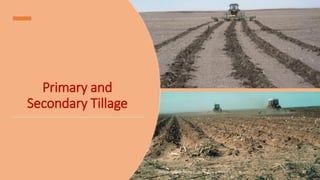
Primary and Secondary Tillage
• The main aim is to produce a rough and cloddy surface of soil to resist the wind velocity.
• The soil should be ploughed soon after the rain for clod formation.
• A network of small ridges generally 100mm high is formed throughout the field, in the
direction normal to the prevailing wind.
• They do not obstruct the wind but also changes the wind direction between the ridges and
help in soil deposition.
• Roughening can be used in both crop and pasture areas. Surface roughening alone is
inadequate for sandy soils because they produce few clods.
• Ridges that are lower than 100 mm get quickly filled with sand, whilst the crest of the ridge
that is higher than 100 mm tends to erode very quickly.
JNKVV- College of Agriculture, Powarkheda 39
Use of Crop Residues
JNKVV- College of Agriculture, Powarkheda 40
41
JNKVV-CollegeofAgriculture,Powarkheda
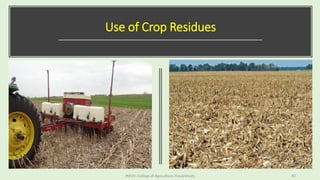
Use of Crop Residues
• Crop residues known as stubble mulching act in two ways, they reduce the
wind velocity over the land surface and trap the eroding soils on the soil
surface.
• A mixture of straw and stubble provides better protection against wind erosion.
• It also helps in better absorption of rainfall, reduce raindrop erosion, reduced
evaporation losses, increase in productivity by adding organic matter in soil.
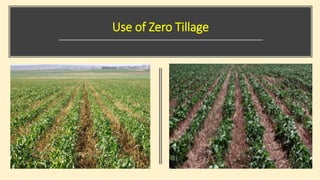
Use of Zero Tillage
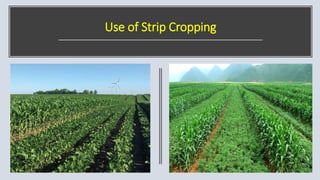
Use of Strip Cropping
44
JNKVV-CollegeofAgriculture,Powarkheda
Field and Contour Strip Cropping
• It consist of alternate strips of row crops and close growing crops in the same field.
• The strip cropping is laid out generally parallel to the field boundary or
perpendicular to the erosive wind direction.
• The width of the strip is maintained such as it should not hamper the farming
operation and should not allowed much erosion.
• The combination of row crops that permit erosion i.e. maize, cotton, potato, bajra,
jowar etc. are sown with erosion resistant crops i.e. groundnut, legumes, grasses,
berseem etc.
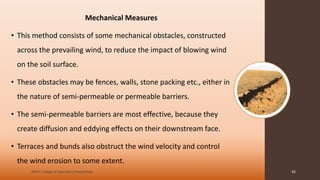
Mechanical Measures
• This method consists of some mechanical obstacles, constructed
across the prevailing wind, to reduce the impact of blowing wind
on the soil surface.
• These obstacles may be fences, walls, stone packing etc., either in
the nature of semi-permeable or permeable barriers.
• The semi-permeable barriers are most effective, because they
create diffusion and eddying effects on their downstream face.
• Terraces and bunds also obstruct the wind velocity and control
the wind erosion to some extent.
JNKVV- College of Agriculture, Powarkheda 45
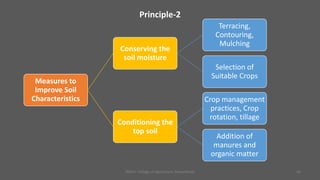
Principle-2
JNKVV- College of Agriculture, Powarkheda 46
Measures to
Improve Soil
Characteristics
Conserving the
soil moisture
Terracing,
Contouring,
Mulching
Selection of
Suitable Crops
Conditioning the
top soil
Crop management
practices, Crop
rotation, tillage
Addition of
manures and
organic matter
Conserving the Soil Moisture
• The conservation of moisture, particularly in arid semi-arid region is important
both for wind erosion control and crop growth.
• It can be achieved by increasing the soil infiltration, reducing evaporation loss and
preventing unnecessary plant growth.
• Various practices such as terracing, contouring, mulching and selection of suitable
crops should be adopted.
• Among the measures, mulching is one of the most suitable practices used
successfully to control wind erosion.
JNKVV- College of Agriculture, Powarkheda 47
Conditioning of the Top Soil
• The wind erosion is greatly influenced by the top soil condition as it affects the
detachment of soil particles.
• Adoptions of tillage practices to produce non-erosive soil aggregates is an effective
method.
• Crop management practices, crop rotation, tillage, addition of manures and organic
matter have a great effect on wind erosion control as they help to develop a good soil
structure and able to withstand wind velocity.
JNKVV- College of Agriculture, Powarkheda 48
Sand Dunes
JNKVV- College of Agriculture, Powarkheda 49
Sand Dunes
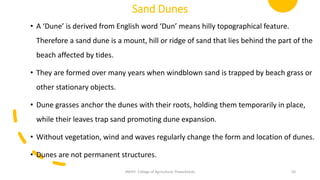
• A ‘Dune’ is derived from English word ‘Dun’ means hilly topographical feature.
Therefore a sand dune is a mount, hill or ridge of sand that lies behind the part of the
beach affected by tides.
• They are formed over many years when windblown sand is trapped by beach grass or
other stationary objects.
• Dune grasses anchor the dunes with their roots, holding them temporarily in place,
while their leaves trap sand promoting dune expansion.
• Without vegetation, wind and waves regularly change the form and location of dunes.
• Dunes are not permanent structures.
JNKVV- College of Agriculture, Powarkheda 50
JNKVV- College of Agriculture, Powarkheda 51
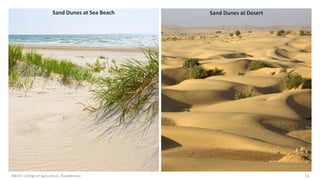
Sand Dunes at Sea Beach Sand Dunes at Desert
Thanks for listening…..
JNKVV- College of Agriculture, Powarkheda 52

Wind erosion

  • 1.
    Subject Soil and WaterConservation Engineering Topic Wind Erosion Dr. Sanjay Singh Chouhan Assistant Professor JNKVV-College of Agriculture Powarkheda, Hoshangabad
  • 2.
    Wind Erosion • Winderosion is a natural process that moves soil from one location to another by wind power. • Wind erosion can be caused by a light wind that rolls soil particles along the surface through to a strong wind that lifts a large volume of soil particles into the air to create dust storms. JNKVV- College of Agriculture, Powarkheda 2
  • 3.
    3 JNKVV-CollegeofAgriculture,Powarkheda • While winderosion is most common in deserts and coastal sand dunes and beaches, certain land conditions will cause wind erosion in agricultural areas. • So, it is wind that drives the erosion, but it’s mainly the landscape and condition of the land which leads to the most damaging wind erosion and can cause significant economic and environmental damage. • Wind erosion, in India, is commonly observed in arid and semi-arid areas where the precipitation is inadequate, e.g. Rajasthan and some parts of Gujarat, Punjab and Haryana.
  • 4.
    4 JNKVV-CollegeofAgriculture,Powarkheda Wind Erosion Damages •Wind erosion damages land and natural vegetation by removing soil from one place and depositing it at another location. • It causes soil loss, dryness and deterioration of soil structure. • Most serious damage caused by wind erosion is the change in soil texture. • Productivity losses: Smaller particles of soil are more subject to movement by wind as silt, clay and organic matter are removed from the surface soil by strong wind, leaving the coarse, lesser productive material behind. • Sediment transport and deposition are significant factors in the geological changes which occur on the land around us and over long periods of time are important in the soil formation process.
  • 5.
    • Human healthas airborne dust can cause asthma and other health problems. • The environment when dust chokes creeks and deposits unwanted nutrients and salt, threatening plants and animals and causing blue green algal blooms. • Property as built structures can be sandblasted by wind-blown dust and buried in blown sand. • Economic activity when dust storms disrupt commercial activities and transport, and create the need for extra cleaning. JNKVV- College of Agriculture, Powarkheda 5
  • 6.
    • Climate • Soil •Surface roughness • Topography • Vegetative cover • Organic matter content JNKVV- College of Agriculture, Powarkheda 6 Factors Affecting Wind Erosion
  • 7.
    7 JNKVV-CollegeofAgriculture,Powarkheda Climate • The climaticfactors that affect the wind erosion are the characteristics of wind itself (velocity and direction) in addition to the precipitation, humidity and temperature. Soil • Soil moisture conditions, texture, structure, density of particles are the soil characteristics that influence the Soil cloudiness and thus erosion by wind.
  • 8.
    Surface roughness • Roughsurface leads to reduction in soil loss by the reducing the wind velocity upto a certain point and result in less soil loss. • Rough surface also trapping the saltating soil particles and reduce the wind erosion • In general, greater the soil roughness, lower the wind velocity against the ground and lower is the rate of erosion. Topography • The land pattern also affect the rate and amount of soil loss caused by wind. If the slope of land is not equal i.e., undulating soil leads to less soil loss than the plain area. Soil surface characteristics depend upon the soil topography JNKVV- College of Agriculture, Powarkheda 8
  • 9.
    Vegetative Cover • Surfacefeatures like vegetation or other artificial cover (mulching etc) have the protective effect on wind erosion problem as surface cover increases the roughness over the land surface and thus reduces the erosive wind force on the land surface. Organic Matter Content • The organic content in the soil leads to reduction in soil erosion due to binding properties of the organic matter in the soil. JNKVV- College of Agriculture, Powarkheda 9
  • 10.
    Mechanics of WindErosion. JNKVV- College of Agriculture, Powarkheda 10
  • 11.
    The overall occurrenceof wind erosion could be described in three distinct phases. These are: 1. Initiation of Movement 2. Transportation 3. Deposition JNKVV- College of Agriculture, Powarkheda 11 Mechanics of Wind Erosion
  • 12.
    Initiation of Movement •The soil particles are first detached from their place by the impact and cutting action of wind. • These detached particles are then ready for movement by the wind forces. • After this initiation of movement, soil particles are moved or transported by distinct mechanisms. JNKVV- College of Agriculture, Powarkheda 12
  • 13.
    Transportation • The transportationof the soil particles are of three distinct types and occur depending upon size of the soil particles. Suspension, Saltation and Surface creep are the three types of soil movement or transport which occur during wind erosion. • While soil can be blown away at virtually any height, the majority (over 93%) of soil movement/transportation takes place at or within one meter height from land surface. JNKVV- College of Agriculture, Powarkheda 13
  • 14.
    Deposition • Deposition ofsoil particles occurs when the gravitational force is greater than the forces holding the particle in the air. • This generally happens when there is a decrease in the wind velocity caused by vegetative or other physical barriers like ditches or benches. • Raindrops may also take dust out of air. JNKVV- College of Agriculture, Powarkheda 14
  • 15.
    Types of soilmovement or transport which occur during wind erosion The transportation of the soil particles are of three distinct types and occur depending upon size of the soil particles. • While soil can be blown away at virtually any height, the majority (over 93%) of soil movement/transportation takes place at or within one meter height from land surface. JNKVV- College of Agriculture, Powarkheda 15 S.No. Types of Soil Movement Soil Particles Size % of Transported Soil Weight 1 Suspension Less then 0.1 mm 3 to 40% 2 Saltation 0.1 mm to 0.5 mm 50 to 75% 3 Surface creep 0.5 mm to 2.0 mm 5 to 25 %
  • 16.
    1. Suspension • Itoccurs when very fine dirt and dust particles are lifted into the atmosphere. • They can be thrown into the air through impact with other particles or by the wind itself. • These particles can be carried very high and be transported over very long distances in the atmosphere by the winds. • Soil moved by suspension is the most spectacular and easiest to recognize among the three forms of movement. • The soil particles of less than 0.10 mm size are subjected to suspension and around 3 to 40 % of soil weights are carried by the suspension method of soil transport under the wind erosion. JNKVV- College of Agriculture, Powarkheda 16
  • 17.
    2. Saltation • Themajor fraction of soil moved by the wind is through the process of saltation. • Saltation movement is caused by the pressure of the wind on soil particles as well as by the collision of a particle with other particles. • Soil particles (0.1 to 0.5 mm) move in a series of bounces and/or jumps and depending on soil type, about 50 to 75% of the total weight of soil is carried in saltation. • Soil particles moved in the process of saltation can cause severe damage to the soil surface and vegetation. • They travel approximately four times longer in distance than in height. • When they strike the surface again they either bounce back into the air or knock other soil particles from the soil mass into the air. JNKVV- College of Agriculture, Powarkheda 17
  • 18.
    3. Surface Creep: •The large particles which are too heavy to be lifted into the air are moved through a process called surface creep. • In this process, the particles are rolled across the surface after coming into contact with the soil particles in saltation. • In this process the largest of the erosive particles having diameters between 0.5 to 2 mm are transported and around 5 to 25% of the total soil weights are carried in this fashion. • Overall, the mass of soil moved by wind is influenced primarily by particle size, gradation of particles, wind velocity and the distance along the eroding area. JNKVV- College of Agriculture, Powarkheda 18
  • 19.
    Estimation of SoilLoss Due to Wind Erosion An equation in the form of universal soil loss equation has been developed and can be used for estimating soil loss by wind. However, the evaluation of the constants in the equation for wind erosion is comparatively difficult than the universal soil loss equation. The equation is of the form, E = IRKFCWDB Where, E is soil loss by wind erosion, I is soil cloddiness factor, R is surface cover factor, K is surface roughness factor, F is soil textural class factor, C is factor representing local wind condition, W is field width factor, D is wind direction factor and B is wind barrier factor. JNKVV- College of Agriculture, Powarkheda 19
  • 20.
  • 21.
    Wind Erosion Control •A suitable surface soil texture is the best key to wind erosion protection. • Properly managed crop residues, carefully timed soil tillage, and accurately placed crop strips and crop barriers can all effectively reduce wind erosion. • Proper land use and adaptation of adequate moisture conservation practices are the main tools which help in wind erosion control. • In the absence of crop residue, soil roughness or soil moisture can reduce the wind erosion effectively. JNKVV- College of Agriculture, Powarkheda 21
  • 22.
    Principle of WindErosion Control 1. The measures to reduce the surface wind velocity. 2. The Measures to improve the soil characteristics. 22
  • 23.
    JNKVV- College ofAgriculture, Powarkheda 23 Measures to Reduce the Surface Wind Velocity Vegetative Temporary Crop management Permanent Windbreak Shelterbelt Tillage Primary & Secondary Tillage Mulching of Crop Residues Strip Cropping Mechanical Obstacles Construction Fence, Walls, Stone packing, Terraces, Bunds Principle-1
  • 24.
    Vegetative Measures • Itis one of the most effective and economical means to reduce the effect of wind on the soil. • It retards the wind velocity near the ground surface and control erosion. • It keep the soil rough and ridged to either prevent any movement initially or to quickly trap bouncing soil particles in the depressions of the rough surface. • From the basic concept, the velocity of wind decreases near the ground surface because of the resistance offered by the vegetation. • Vegetative measures can be of two types and the use of these measures depends upon the severity of erosion, (1) Temporary and (2) Permanent. JNKVV- College of Agriculture, Powarkheda 24
  • 25.
    Temporary Measures • Theyconsist of growing of erosion resistant crops i.e. groundnut, legumes, grasses, berseem etc. which are more effective for erosion control then the inter-tilled crops. • The effectiveness is dependent upon the stage of growth, density of cover, row direction, width of rows, kind of crops and climatic conditions. • They should have ability to grow with rapid speed against the wind and also be able to withstand for a long time. • They should provide a dense vegetative cover during critical season of the year. JNKVV- College of Agriculture, Powarkheda 25
  • 26.
    Permanent Measures • Theyconsist of planting of trees, shrubs and grasses for protecting the land against wind erosion. • They are two types: 1. Windbreak 2. Shelterbelts JNKVV- College of Agriculture, Powarkheda 26
  • 27.
  • 28.
    Wind Breaks • Theterm wind break is defined as any type of barrier either mechanical or vegetative used for protecting the areas like building apartments, orchards or farmsteads etc. from blowing winds. • The wind break acts as fencing wall around the affected areas, normally constructed by one row or maximum up to two rows across the prevailing wind direction. • This is a permanent vegetative measure which helps in the reduction of wind erosion. • It reduces the wind speed up to 60-80% on leeward side. • The windbreak reduces the wind speed on the leeward side at 200 m away up to 20 % only and in the area as at 300m away, there is no effect at all. Therefore at an interval of 300m, such windbreaks should be repeated. JNKVV- College of Agriculture, Powarkheda 28
  • 29.
  • 30.
    JNKVV- College ofAgriculture, Powarkheda 30
  • 31.
    Shelter Belts JNKVV- Collegeof Agriculture, Powarkheda 31
  • 32.
    32 JNKVV-CollegeofAgriculture,Powarkheda Shelter Belts • Shelterbeltis more effective for reducing the impact of wind movement than the wind break. Apart from controlling wind erosion, it provides fuel, reduces evaporation and protects the orchard from hot and cold winds. • A shelterbelt is a longer barrier than the wind break, is installed by using more than two rows, usually at right angle to the direction of prevailing winds. • The rows of belt can be developed by using shrubs and trees. • It is mainly used for the conservation of soil moisture and for the protection of field crops, against severe wind erosion.
  • 33.
    Shelter Belts JNKVV- Collegeof Agriculture, Powarkheda 33
  • 34.
    Width of ShelterBelt It indicates the number of rows of plants, raised in the shelter belt or break. A wind break involves one or maximum two rows, but a shelter belt involves more than two rows. The rows of plants should be raised in following trends: a) The row of tallest trees should be arranged in the middle of shelterbelt. b) Shorter trees should be raised in the sides of tallest tree’s row. c) The shrubs should be planted at the outer edge of belt. Types of Shelter Belt 1. Right Angle Tringle Shelter Belt 2. Tringle Shelter Belt JNKVV- College of Agriculture, Powarkheda 34
  • 35.
    Shelter Belts JNKVV- Collegeof Agriculture, Powarkheda 35
  • 36.
    Shelter Belts JNKVV- Collegeof Agriculture, Powarkheda 36
  • 37.
    Tillage Practices Tillage practicesare generally used for moisture conservation so that erodibility reduces. The common tillage practices are: 1. Primary and secondary tillage 2. Use of crop residues 3. Strip cropping JNKVV- College of Agriculture, Powarkheda 37
  • 38.
    Primary and Secondary Tillage JNKVV-College of Agriculture, Powarkheda 38
  • 39.
    Primary and SecondaryTillage • The main aim is to produce a rough and cloddy surface of soil to resist the wind velocity. • The soil should be ploughed soon after the rain for clod formation. • A network of small ridges generally 100mm high is formed throughout the field, in the direction normal to the prevailing wind. • They do not obstruct the wind but also changes the wind direction between the ridges and help in soil deposition. • Roughening can be used in both crop and pasture areas. Surface roughening alone is inadequate for sandy soils because they produce few clods. • Ridges that are lower than 100 mm get quickly filled with sand, whilst the crest of the ridge that is higher than 100 mm tends to erode very quickly. JNKVV- College of Agriculture, Powarkheda 39
  • 40.
    Use of CropResidues JNKVV- College of Agriculture, Powarkheda 40
  • 41.
    41 JNKVV-CollegeofAgriculture,Powarkheda Use of CropResidues • Crop residues known as stubble mulching act in two ways, they reduce the wind velocity over the land surface and trap the eroding soils on the soil surface. • A mixture of straw and stubble provides better protection against wind erosion. • It also helps in better absorption of rainfall, reduce raindrop erosion, reduced evaporation losses, increase in productivity by adding organic matter in soil.
  • 42.
    Use of ZeroTillage
  • 43.
    Use of StripCropping
  • 44.
    44 JNKVV-CollegeofAgriculture,Powarkheda Field and ContourStrip Cropping • It consist of alternate strips of row crops and close growing crops in the same field. • The strip cropping is laid out generally parallel to the field boundary or perpendicular to the erosive wind direction. • The width of the strip is maintained such as it should not hamper the farming operation and should not allowed much erosion. • The combination of row crops that permit erosion i.e. maize, cotton, potato, bajra, jowar etc. are sown with erosion resistant crops i.e. groundnut, legumes, grasses, berseem etc.
  • 45.
    Mechanical Measures • Thismethod consists of some mechanical obstacles, constructed across the prevailing wind, to reduce the impact of blowing wind on the soil surface. • These obstacles may be fences, walls, stone packing etc., either in the nature of semi-permeable or permeable barriers. • The semi-permeable barriers are most effective, because they create diffusion and eddying effects on their downstream face. • Terraces and bunds also obstruct the wind velocity and control the wind erosion to some extent. JNKVV- College of Agriculture, Powarkheda 45
  • 46.
    Principle-2 JNKVV- College ofAgriculture, Powarkheda 46 Measures to Improve Soil Characteristics Conserving the soil moisture Terracing, Contouring, Mulching Selection of Suitable Crops Conditioning the top soil Crop management practices, Crop rotation, tillage Addition of manures and organic matter
  • 47.
    Conserving the SoilMoisture • The conservation of moisture, particularly in arid semi-arid region is important both for wind erosion control and crop growth. • It can be achieved by increasing the soil infiltration, reducing evaporation loss and preventing unnecessary plant growth. • Various practices such as terracing, contouring, mulching and selection of suitable crops should be adopted. • Among the measures, mulching is one of the most suitable practices used successfully to control wind erosion. JNKVV- College of Agriculture, Powarkheda 47
  • 48.
    Conditioning of theTop Soil • The wind erosion is greatly influenced by the top soil condition as it affects the detachment of soil particles. • Adoptions of tillage practices to produce non-erosive soil aggregates is an effective method. • Crop management practices, crop rotation, tillage, addition of manures and organic matter have a great effect on wind erosion control as they help to develop a good soil structure and able to withstand wind velocity. JNKVV- College of Agriculture, Powarkheda 48
  • 49.
    Sand Dunes JNKVV- Collegeof Agriculture, Powarkheda 49
  • 50.
    Sand Dunes • A‘Dune’ is derived from English word ‘Dun’ means hilly topographical feature. Therefore a sand dune is a mount, hill or ridge of sand that lies behind the part of the beach affected by tides. • They are formed over many years when windblown sand is trapped by beach grass or other stationary objects. • Dune grasses anchor the dunes with their roots, holding them temporarily in place, while their leaves trap sand promoting dune expansion. • Without vegetation, wind and waves regularly change the form and location of dunes. • Dunes are not permanent structures. JNKVV- College of Agriculture, Powarkheda 50
  • 51.
    JNKVV- College ofAgriculture, Powarkheda 51 Sand Dunes at Sea Beach Sand Dunes at Desert
  • 52.
    Thanks for listening….. JNKVV-College of Agriculture, Powarkheda 52