Subject
Protected Cultivation and Secondary
Agriculture
Topic
Important Engineering Properties of
Cereals, Pulses and Oilseed
by
Dr. Sanjay Singh Chouhan
Assistant Professor
College of Agriculture, JNKVV,
Powarkheda, Hoshangabad
1
Importance of Engineering Properties
Biological materials especially that are consumed as food or feed undergo various unit
operations like
• Pre-harvest to post harvest processing
• primary, secondary and tertiary processing,
• preservation,
• packaging and storage
• distribution,
• retailing,
• domestic storage and finally consumption.
Scientists and engineers need to know and understand the characteristics of the
material for designing and selecting such tools and equipment require information
regarding various properties.
JNKVV- College of Agriculture, Powarkheda 2
Important Engineering Properties
Physical properties:
Shape, Size, Volume, Surface area, Density, Specific gravity and
Porosity
Mechanical properties:
Hardness, Compressive strength, Impact & Shear Resistance and
Rheology
Thermal properties:
Specific heat, Thermal conductivity, Thermal Diffusivity, Enthalpy
and Emissivity
Aero and Hydrodynamic properties:
Terminal velocity and Drag coefficient
Frictional properties:
Angle of repose, Coefficient of friction, Rolling resistance
JNKVV- College of Agriculture, Powarkheda 3
Application of Various Engineering Properties
• Physical properties like size, shape, density, porosity has great implication in deciding
the equipment for screening, separation, handling and storage of materials, they also
come handy in calculating the heat transfer and mass diffusion rates.
• Frictional properties are useful in designing discharge and conveying devices.
• Aerodynamic and hydrodynamic properties are useful in designing spouted bed,
fluidized bed dryers, aspirators and pneumatic conveying system.
• Knowledge of thermal properties aids in designing thermal process and calculating
thermal load for canning, retorting, sterilization, pasteurization, blanching, cooking and
extrusion process.
JNKVV- College of Agriculture, Powarkheda 4
• Electric properties can be useful in designing and controlling thermal
processing and moisture content determination.
• Dielectric properties of the food strongly influenced the degree of heating of a
food material subjected to microwave or radio frequency processing.
• Rheological behavior under limited deformation has been widely used to
obtain information on the structure and viscoelasticity of materials.
JNKVV- College of Agriculture, Powarkheda 5
➢Shape
➢Size
➢Volume
➢Surface area
➢Density
➢Porosity
JNKVV- College of Agriculture, Powarkheda 6
Physical
Properties
• Size is an important physical attribute of foods used in
screening solids to separate foreign materials, grading
of fruits and vegetables, and evaluating the quality of
food materials.
• In fluid flow, and heat and mass transfer calculations, it
is necessary to know the size of the sample.
• Size of the particulate foods is also critical as it affects
the viscosity and dispersibility and stability of the
product
• It allows the sorting of fresh market various agro-
produces into size groups. This is helps in assigning
market and price differentials of large and small
produce, to match consumer preferences and to allow
pattern packing. 7
SIZE
• Size determination is mandatory for modern or on-line fruit/ vegetables/
grain/spices density sorting, for which two size-related parameters, volume and
weight, are required.
• Grading of agro-produce into size groups is often necessary in the food industry, to
meet the requirements of some primary and secondary processing machines.
Methods of measurement of size:
• Projected area method
• Micrometer measurement (Vernier caliper, Micrometer)
• Electronic system (Digital imaging)
JNKVV- College of Agriculture, Powarkheda 8
9
Shape describes the object in terms of a geometrical
body. Shape is also important in heat and mass
transfer calculations, screening solids to separate
foreign materials, grading of fruits and vegetables,
and evaluating the quality of food materials.
Some of the shapes are:
➢Round- Pea, soyabean
➢Elliptical- Rice, Wheat
➢Oblate- Orange, Pumpkin
➢Conic- Carrot, Ladies finger, Reddish
➢Obovate- Mango, Papaya
➢Truncate- Capsicum
SHAPE
JNKVV- College of Agriculture, Powarkheda 10
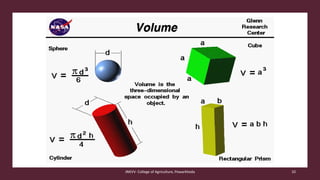
Volume
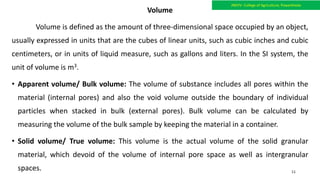
Volume is defined as the amount of three-dimensional space occupied by an object,
usually expressed in units that are the cubes of linear units, such as cubic inches and cubic
centimeters, or in units of liquid measure, such as gallons and liters. In the SI system, the
unit of volume is m3.
• Apparent volume/ Bulk volume: The volume of substance includes all pores within the
material (internal pores) and also the void volume outside the boundary of individual
particles when stacked in bulk (external pores). Bulk volume can be calculated by
measuring the volume of the bulk sample by keeping the material in a container.
• Solid volume/ True volume: This volume is the actual volume of the solid granular
material, which devoid of the volume of internal pore space as well as intergranular
spaces.
JNKVV- College of Agriculture, Powarkheda
11
JNKVV- College of Agriculture, Powarkheda 12
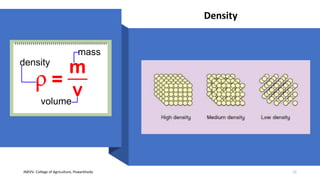
Density
Density
Bulk Density:
It is the density of material when stacked or packed in bulk. Bulk density of the material is
determined by dividing the material volume inclusive of voids to weight of product. There
are two kinds of voids, voids between particles and void within particles. The bulk density
is an important in packaging requirement and is often 2-20% of true density
Tapped Bulk Density:
Tap bulk density is measured for powdery samples. The volume is measured after tapping
the powdery material so that the product is adjusted to intergranular spaces, but it cannot
eliminate all the intergranular spaces.
JNKVV- College of Agriculture, Powarkheda
13
Particle density / true density:
Density of solid material constituting the true volume of the occupied by the material,
excluding any interior pores that are filled with air.
Apparent Density:
Apparent density is the density of a substance including all pores within the material
(internal pores). Apparent density of regular geometries can be determined from the
volume calculated using the characteristic dimensions and mass measured. Apparent
density of irregularly shaped samples may be determined by solid or liquid displacement
methods.
JNKVV- College of Agriculture, Powarkheda
14
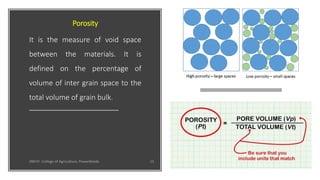
Porosity
It is the measure of void space
between the materials. It is
defined on the percentage of
volume of inter grain space to the
total volume of grain bulk.
JNKVV- College of Agriculture, Powarkheda 15
Surface Area
Surface areas of cereals are
important in investigation
related to heat transfer
studies in heating and cooling
processes.
JNKVV- College of Agriculture, Powarkheda 16
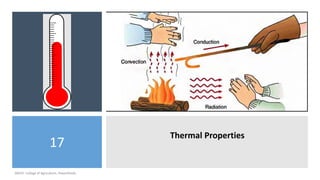
17
Thermal Properties
JNKVV- College of Agriculture, Powarkheda
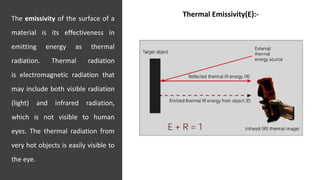
The emissivity of the surface of a
material is its effectiveness in
emitting energy as thermal
radiation. Thermal radiation
is electromagnetic radiation that
may include both visible radiation
(light) and infrared radiation,
which is not visible to human
eyes. The thermal radiation from
very hot objects is easily visible to
the eye.
JNKVV- College of Agriculture, Powarkheda 18
Thermal Emissivity(E):-
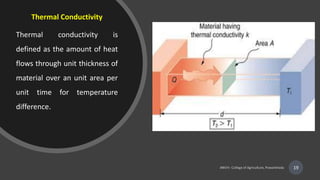
Thermal Conductivity
Thermal conductivity is
defined as the amount of heat
flows through unit thickness of
material over an unit area per
unit time for temperature
difference.
19
Specific heat
Heat required to raise the
temperature by 1°C for unit mass of
the body.
Thermal diffusivity
It is rate at which heat is diffused out
of the materials. It is the ratio
between thermal conductivity to
volumetric heat capacity.
JNKVV- College of Agriculture, Powarkheda 20
Aerodynamic
Properties
JNKVV- College of Agriculture, Powarkheda 21
Aerodynamic properties
Aero and/or hydrodynamic properties are very important
characters in hydraulic transport and handling as well as
hydraulic sorting of agricultural products.
The two important aerodynamic characteristics of a body
are
1. Terminal velocity
2. Aerodynamic drag.
JNKVV- College of Agriculture, Powarkheda 22
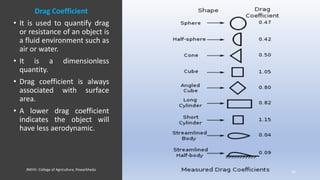
Drag Coefficient
• It is used to quantify drag
or resistance of an object is
a fluid environment such as
air or water.
• It is a dimensionless
quantity.
• Drag coefficient is always
associated with surface
area.
• A lower drag coefficient
indicates the object will
have less aerodynamic.
JNKVV- College of Agriculture, Powarkheda
23
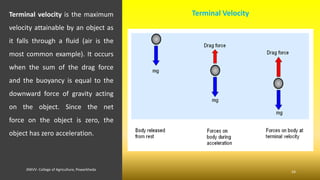
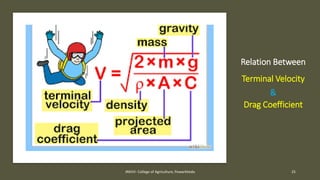
Terminal velocity is the maximum
velocity attainable by an object as
it falls through a fluid (air is the
most common example). It occurs
when the sum of the drag force
and the buoyancy is equal to the
downward force of gravity acting
on the object. Since the net
force on the object is zero, the
object has zero acceleration.
JNKVV- College of Agriculture, Powarkheda
24
Terminal Velocity
Relation Between
Terminal Velocity
&
Drag Coefficient
JNKVV- College of Agriculture, Powarkheda 25
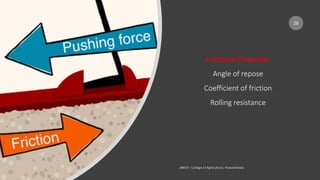
Frictional Properties
Angle of repose
Coefficient of friction
Rolling resistance
26
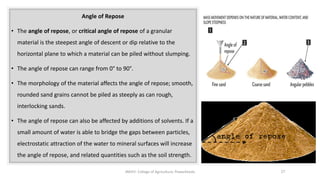
Angle of Repose
• The angle of repose, or critical angle of repose of a granular
material is the steepest angle of descent or dip relative to the
horizontal plane to which a material can be piled without slumping.
• The angle of repose can range from 0° to 90°.
• The morphology of the material affects the angle of repose; smooth,
rounded sand grains cannot be piled as steeply as can rough,
interlocking sands.
• The angle of repose can also be affected by additions of solvents. If a
small amount of water is able to bridge the gaps between particles,
electrostatic attraction of the water to mineral surfaces will increase
the angle of repose, and related quantities such as the soil strength.
JNKVV- College of Agriculture, Powarkheda 27
Coefficient of friction:
• Coefficient of friction is important in designing storage bins, hoppers, chutes, screw
conveyors, forage harvesters, and threshers.
• The material generally moves or slides in direct contact with trough, casing, and other
components of the machine.
• The various parameters affect the power requirement to drive the machine. The frictional
losses are one of the factors, which must be overcome by providing additional power to
the machine.
JNKVV- College of Agriculture, Powarkheda
28
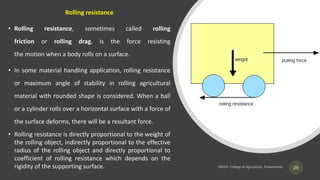
Rolling resistance
• Rolling resistance, sometimes called rolling
friction or rolling drag, is the force resisting
the motion when a body rolls on a surface.
• In some material handling application, rolling resistance
or maximum angle of stability in rolling agricultural
material with rounded shape is considered. When a ball
or a cylinder rolls over a horizontal surface with a force of
the surface deforms, there will be a resultant force.
• Rolling resistance is directly proportional to the weight of
the rolling object, indirectly proportional to the effective
radius of the rolling object and directly proportional to
coefficient of rolling resistance which depends on the
rigidity of the supporting surface. 29
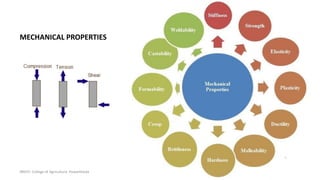
MECHANICAL PROPERTIES
JNKVV- College of Agriculture, Powarkheda 30
Mechanical Properties
• Mechanical Properties are defined as those having to do
with the behavior of the material under applied forces.
• Following this broad definition, such properties as stress
strain behavior of a material under static and dynamic
loading as well as flow characteristics of the material in air or
in water, can be classified as mechanical properties
JNKVV- College of Agriculture, Powarkheda 31
32
JNKVV-CollegeofAgriculture,Powarkheda
Strain: The unit change , due to force, in the size or shape of a body referred to its original
size or shape. Strain is non-dimensional quantity, but it is frequently expressed centimeter
per centimeter, m/m, mm/mm etc.
Stress: The intensity of a point in a body of the internal forces or components of force that
act on a given plane through the point. Stress is expressed in force per unit area (kg-force/
mm2)
Strength: The resistance to applied force (kg/cm)
Ultimate strength: The stress corresponding to the rupture point (kg/cm2)
Pressure: A measure of the mean normal stress on a point of body (kg/cm2)
JNKVV- College of Agriculture, Powarkheda 33
Thanks for listening…..

Engineering properties in post harvest processing

  • 1.
    Subject Protected Cultivation andSecondary Agriculture Topic Important Engineering Properties of Cereals, Pulses and Oilseed by Dr. Sanjay Singh Chouhan Assistant Professor College of Agriculture, JNKVV, Powarkheda, Hoshangabad 1
  • 2.
    Importance of EngineeringProperties Biological materials especially that are consumed as food or feed undergo various unit operations like • Pre-harvest to post harvest processing • primary, secondary and tertiary processing, • preservation, • packaging and storage • distribution, • retailing, • domestic storage and finally consumption. Scientists and engineers need to know and understand the characteristics of the material for designing and selecting such tools and equipment require information regarding various properties. JNKVV- College of Agriculture, Powarkheda 2
  • 3.
    Important Engineering Properties Physicalproperties: Shape, Size, Volume, Surface area, Density, Specific gravity and Porosity Mechanical properties: Hardness, Compressive strength, Impact & Shear Resistance and Rheology Thermal properties: Specific heat, Thermal conductivity, Thermal Diffusivity, Enthalpy and Emissivity Aero and Hydrodynamic properties: Terminal velocity and Drag coefficient Frictional properties: Angle of repose, Coefficient of friction, Rolling resistance JNKVV- College of Agriculture, Powarkheda 3
  • 4.
    Application of VariousEngineering Properties • Physical properties like size, shape, density, porosity has great implication in deciding the equipment for screening, separation, handling and storage of materials, they also come handy in calculating the heat transfer and mass diffusion rates. • Frictional properties are useful in designing discharge and conveying devices. • Aerodynamic and hydrodynamic properties are useful in designing spouted bed, fluidized bed dryers, aspirators and pneumatic conveying system. • Knowledge of thermal properties aids in designing thermal process and calculating thermal load for canning, retorting, sterilization, pasteurization, blanching, cooking and extrusion process. JNKVV- College of Agriculture, Powarkheda 4
  • 5.
    • Electric propertiescan be useful in designing and controlling thermal processing and moisture content determination. • Dielectric properties of the food strongly influenced the degree of heating of a food material subjected to microwave or radio frequency processing. • Rheological behavior under limited deformation has been widely used to obtain information on the structure and viscoelasticity of materials. JNKVV- College of Agriculture, Powarkheda 5
  • 6.
  • 7.
    • Size isan important physical attribute of foods used in screening solids to separate foreign materials, grading of fruits and vegetables, and evaluating the quality of food materials. • In fluid flow, and heat and mass transfer calculations, it is necessary to know the size of the sample. • Size of the particulate foods is also critical as it affects the viscosity and dispersibility and stability of the product • It allows the sorting of fresh market various agro- produces into size groups. This is helps in assigning market and price differentials of large and small produce, to match consumer preferences and to allow pattern packing. 7 SIZE
  • 8.
    • Size determinationis mandatory for modern or on-line fruit/ vegetables/ grain/spices density sorting, for which two size-related parameters, volume and weight, are required. • Grading of agro-produce into size groups is often necessary in the food industry, to meet the requirements of some primary and secondary processing machines. Methods of measurement of size: • Projected area method • Micrometer measurement (Vernier caliper, Micrometer) • Electronic system (Digital imaging) JNKVV- College of Agriculture, Powarkheda 8
  • 9.
    9 Shape describes theobject in terms of a geometrical body. Shape is also important in heat and mass transfer calculations, screening solids to separate foreign materials, grading of fruits and vegetables, and evaluating the quality of food materials. Some of the shapes are: ➢Round- Pea, soyabean ➢Elliptical- Rice, Wheat ➢Oblate- Orange, Pumpkin ➢Conic- Carrot, Ladies finger, Reddish ➢Obovate- Mango, Papaya ➢Truncate- Capsicum SHAPE
  • 10.
    JNKVV- College ofAgriculture, Powarkheda 10
  • 11.
    Volume Volume is definedas the amount of three-dimensional space occupied by an object, usually expressed in units that are the cubes of linear units, such as cubic inches and cubic centimeters, or in units of liquid measure, such as gallons and liters. In the SI system, the unit of volume is m3. • Apparent volume/ Bulk volume: The volume of substance includes all pores within the material (internal pores) and also the void volume outside the boundary of individual particles when stacked in bulk (external pores). Bulk volume can be calculated by measuring the volume of the bulk sample by keeping the material in a container. • Solid volume/ True volume: This volume is the actual volume of the solid granular material, which devoid of the volume of internal pore space as well as intergranular spaces. JNKVV- College of Agriculture, Powarkheda 11
  • 12.
    JNKVV- College ofAgriculture, Powarkheda 12 Density
  • 13.
    Density Bulk Density: It isthe density of material when stacked or packed in bulk. Bulk density of the material is determined by dividing the material volume inclusive of voids to weight of product. There are two kinds of voids, voids between particles and void within particles. The bulk density is an important in packaging requirement and is often 2-20% of true density Tapped Bulk Density: Tap bulk density is measured for powdery samples. The volume is measured after tapping the powdery material so that the product is adjusted to intergranular spaces, but it cannot eliminate all the intergranular spaces. JNKVV- College of Agriculture, Powarkheda 13
  • 14.
    Particle density /true density: Density of solid material constituting the true volume of the occupied by the material, excluding any interior pores that are filled with air. Apparent Density: Apparent density is the density of a substance including all pores within the material (internal pores). Apparent density of regular geometries can be determined from the volume calculated using the characteristic dimensions and mass measured. Apparent density of irregularly shaped samples may be determined by solid or liquid displacement methods. JNKVV- College of Agriculture, Powarkheda 14
  • 15.
    Porosity It is themeasure of void space between the materials. It is defined on the percentage of volume of inter grain space to the total volume of grain bulk. JNKVV- College of Agriculture, Powarkheda 15
  • 16.
    Surface Area Surface areasof cereals are important in investigation related to heat transfer studies in heating and cooling processes. JNKVV- College of Agriculture, Powarkheda 16
  • 17.
    17 Thermal Properties JNKVV- Collegeof Agriculture, Powarkheda
  • 18.
    The emissivity ofthe surface of a material is its effectiveness in emitting energy as thermal radiation. Thermal radiation is electromagnetic radiation that may include both visible radiation (light) and infrared radiation, which is not visible to human eyes. The thermal radiation from very hot objects is easily visible to the eye. JNKVV- College of Agriculture, Powarkheda 18 Thermal Emissivity(E):-
  • 19.
    Thermal Conductivity Thermal conductivityis defined as the amount of heat flows through unit thickness of material over an unit area per unit time for temperature difference. 19
  • 20.
    Specific heat Heat requiredto raise the temperature by 1°C for unit mass of the body. Thermal diffusivity It is rate at which heat is diffused out of the materials. It is the ratio between thermal conductivity to volumetric heat capacity. JNKVV- College of Agriculture, Powarkheda 20
  • 21.
    Aerodynamic Properties JNKVV- College ofAgriculture, Powarkheda 21
  • 22.
    Aerodynamic properties Aero and/orhydrodynamic properties are very important characters in hydraulic transport and handling as well as hydraulic sorting of agricultural products. The two important aerodynamic characteristics of a body are 1. Terminal velocity 2. Aerodynamic drag. JNKVV- College of Agriculture, Powarkheda 22
  • 23.
    Drag Coefficient • Itis used to quantify drag or resistance of an object is a fluid environment such as air or water. • It is a dimensionless quantity. • Drag coefficient is always associated with surface area. • A lower drag coefficient indicates the object will have less aerodynamic. JNKVV- College of Agriculture, Powarkheda 23
  • 24.
    Terminal velocity isthe maximum velocity attainable by an object as it falls through a fluid (air is the most common example). It occurs when the sum of the drag force and the buoyancy is equal to the downward force of gravity acting on the object. Since the net force on the object is zero, the object has zero acceleration. JNKVV- College of Agriculture, Powarkheda 24 Terminal Velocity
  • 25.
    Relation Between Terminal Velocity & DragCoefficient JNKVV- College of Agriculture, Powarkheda 25
  • 26.
    Frictional Properties Angle ofrepose Coefficient of friction Rolling resistance 26
  • 27.
    Angle of Repose •The angle of repose, or critical angle of repose of a granular material is the steepest angle of descent or dip relative to the horizontal plane to which a material can be piled without slumping. • The angle of repose can range from 0° to 90°. • The morphology of the material affects the angle of repose; smooth, rounded sand grains cannot be piled as steeply as can rough, interlocking sands. • The angle of repose can also be affected by additions of solvents. If a small amount of water is able to bridge the gaps between particles, electrostatic attraction of the water to mineral surfaces will increase the angle of repose, and related quantities such as the soil strength. JNKVV- College of Agriculture, Powarkheda 27
  • 28.
    Coefficient of friction: •Coefficient of friction is important in designing storage bins, hoppers, chutes, screw conveyors, forage harvesters, and threshers. • The material generally moves or slides in direct contact with trough, casing, and other components of the machine. • The various parameters affect the power requirement to drive the machine. The frictional losses are one of the factors, which must be overcome by providing additional power to the machine. JNKVV- College of Agriculture, Powarkheda 28
  • 29.
    Rolling resistance • Rollingresistance, sometimes called rolling friction or rolling drag, is the force resisting the motion when a body rolls on a surface. • In some material handling application, rolling resistance or maximum angle of stability in rolling agricultural material with rounded shape is considered. When a ball or a cylinder rolls over a horizontal surface with a force of the surface deforms, there will be a resultant force. • Rolling resistance is directly proportional to the weight of the rolling object, indirectly proportional to the effective radius of the rolling object and directly proportional to coefficient of rolling resistance which depends on the rigidity of the supporting surface. 29
  • 30.
    MECHANICAL PROPERTIES JNKVV- Collegeof Agriculture, Powarkheda 30
  • 31.
    Mechanical Properties • MechanicalProperties are defined as those having to do with the behavior of the material under applied forces. • Following this broad definition, such properties as stress strain behavior of a material under static and dynamic loading as well as flow characteristics of the material in air or in water, can be classified as mechanical properties JNKVV- College of Agriculture, Powarkheda 31
  • 32.
    32 JNKVV-CollegeofAgriculture,Powarkheda Strain: The unitchange , due to force, in the size or shape of a body referred to its original size or shape. Strain is non-dimensional quantity, but it is frequently expressed centimeter per centimeter, m/m, mm/mm etc. Stress: The intensity of a point in a body of the internal forces or components of force that act on a given plane through the point. Stress is expressed in force per unit area (kg-force/ mm2) Strength: The resistance to applied force (kg/cm) Ultimate strength: The stress corresponding to the rupture point (kg/cm2) Pressure: A measure of the mean normal stress on a point of body (kg/cm2)
  • 33.
    JNKVV- College ofAgriculture, Powarkheda 33 Thanks for listening…..