
Chromatography 
(Gas Chromatography) 
Presented By:- 
Ruta Satoskar 
& 
Suman Muthu
THE CHROMATOGRAPHIC PPRROOCCEESSSS -- PPAARRTTIITTIIOONNIINNGG 
(gas or liquid) 
MMOOBBIILLEE PPHHAASSEE 
SSTTAATTIIOONNAARRYY PPHHAASSEE 
Sample 
out 
Sample 
in 
(solid or heavy liquid coated onto a solid or support system)
OOrriiggiinnaall CChhrroommaattooggrraapphhyy EExxppeerriimmeenntt 
Later 
An EtOH extract 
of leaf pigments 
is applied to the 
top of the column. 
EtOH is used to 
flush the pigments 
down the column.
Common Types of Chromatography 
Tswett’s technique is based on Liquid Chromatography. There 
are now several common chromatographic methods. These 
include: 
1. Paper Chromatography 
2. Thin Layer Chromatography (TLC) 
3. Liquid Chromatography (LC) 
4. High Pressure Liquid Chromatography (HPLC) 
5. Ion Chromatography 
6. Gas Chromatography (GC)
How Does Chromatography 
Work?
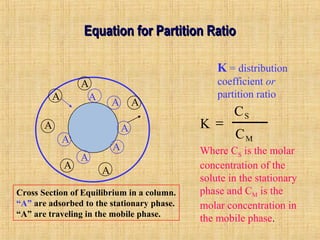
EEqquuaattiioonn ffoorr PPaarrttiittiioonn RRaattiioo 
A A 
A 
A 
A 
A 
A 
A 
A 
A 
A 
A 
K = distribution 
coefficient or 
partition ratio 
K =  
CS 
CM 
Where CS is the molar 
concentration of the 
solute in the stationary 
phase and CM is the 
molar concentration in 
the mobile phase. 
Cross Section of Equilibrium in a column. 
“A” are adsorbed to the stationary phase. 
“A” are traveling in the mobile phase.
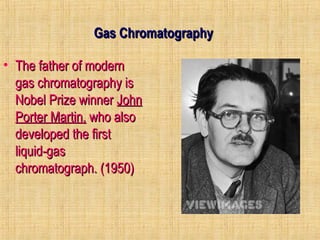
GGaass CChhrroommaattooggrraapphhyy 
• TThhee ffaatthheerr ooff mmooddeerrnn 
ggaass cchhrroommaattooggrraapphhyy iiss 
NNoobbeell PPrriizzee wwiinnnneerr JJoohhnn 
PPoorrtteerr MMaarrttiinn,, wwhhoo aallssoo 
ddeevveellooppeedd tthhee ffiirrsstt 
lliiqquuiidd--ggaass 
cchhrroommaattooggrraapphh.. ((11995500))
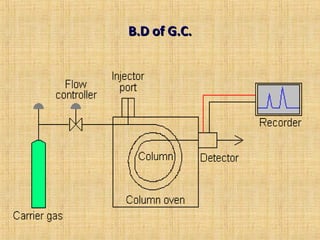
BB..DD ooff GG..CC..
Criteria for CCoommppoouunnddss ttoo bbee AAnnaallyyzzeedd bbyy GG..CC 
1.VOLATILITY. 
2.THERMOSTABILITY.
CChhrroommaattooggrraapphhiicc SSeeppaarraattiioonn 
--DDeeaallss wwiitthh bbootthh tthhee ssttaattiioonnaarryy pphhaassee aanndd 
tthhee mmoobbiillee pphhaassee.. 
• MMoobbiillee –– iinneerrtt ggaass uusseedd aass ccaarrrriieerr.. 
• SSttaattiioonnaarryy –– lliiqquuiidd ccooaatteedd oonn aa ssoolliidd oorr 
aa ssoolliidd wwiitthhiinn aa ccoolluummnn..
CChhrroommaattooggrraapphhiicc SSeeppaarraattiioonn 
• CChhrroommaattooggrraapphhiicc SSeeppaarraattiioonn 
– IInn tthhee mmoobbiillee pphhaassee,, ccoommppoonneennttss ooff tthhee ssaammppllee 
aarree uunniiqquueellyy ddrraawwnn ttoo tthhee ssttaattiioonnaarryy pphhaassee aanndd 
tthhuuss,, eenntteerr tthhiiss pphhaassee aatt ddiiffffeerreenntt ttiimmeess.. 
– TThhee ppaarrttss ooff tthhee ssaammppllee aarree sseeppaarraatteedd wwiitthhiinn tthhee 
ccoolluummnn.. 
–CCoommppoouunnddss uusseedd aatt tthhee ssttaattiioonnaarryy pphhaassee rreeaacchh 
tthhee ddeetteeccttoorr aatt uunniiqquuee ttiimmeess aanndd pprroodduuccee aa 
sseerriieess ooff ppeeaakkss aalloonngg aa ttiimmee sseeqquueennccee..
Se Chromatographic Seppaarraattiioonn AA((ccoonnttiinnuueedd)) 
– TThhee ppeeaakkss ccaann tthheenn bbee rreeaadd aanndd aannaallyyzzeedd bbyy 
aa ffoorreennssiicc sscciieennttiisstt ttoo ddeetteerrmmiinnee tthhee eexxaacctt 
ccoommppoonneennttss ooff tthhee mmiixxttuurree.. 
–RReetteennttiioonn ttiimmee iiss ddeetteerrmmiinneedd bbyy eeaacchh 
ccoommppoonneenntt rreeaacchhiinngg tthhee ddeetteeccttoorr aatt aa 
cchhaarraacctteerriissttiicc ttiimmee..
CChhrroommaattooggrraapphhiicc AAnnaallyyssiiss 
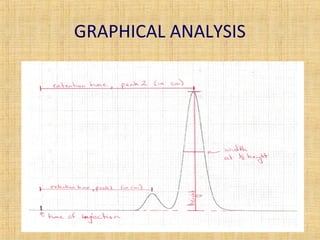
– TThhee nnuummbbeerr ooff ccoommppoonneennttss iinn aa ssaammppllee iiss 
ddeetteerrmmiinneedd bbyy tthhee nnuummbbeerr ooff ppeeaakkss.. 
– TThhee aammoouunntt ooff aa ggiivveenn ccoommppoonneenntt iinn aa ssaammppllee iiss 
ddeetteerrmmiinneedd bbyy tthhee aarreeaa uunnddeerr tthhee ppeeaakkss.. 
– TThhee iiddeennttiittyy ooff ccoommppoonneennttss ccaann bbee ddeetteerrmmiinneedd 
bbyy tthhee ggiivveenn rreetteennttiioonn ttiimmeess..
GRAPHICAL ANALYSIS
CARRIER GAS 
» Hydrogen 
• Better thermal conductivity 
• Disadvantage: it reacts with unsaturated compounds 
& inflammable 
» Helium 
• Excellent thermal conductivity 
• It is expensive 
» Nitrogen 
• Reduced sensitivity 
• It is inexpensive
RReeqquuiirreemmeennttss ooff aa ccaarrrriieerr ggaass 
Inertness 
Suitable for the detector 
High purity 
Easily available 
Cheap 
Should not cause the risk of fire 
Should give best column performance
AADDVVAANNTTAAGGEESS OOFF GG..CC 
1. Very high resolution power, complex mixtures can be 
resolved into its components by this method. 
2. Very high sensitivity with TCD, detect down to 100 
ppm 
3. It is a micro method, small sample size is required 
4. Fast analysis is possible, gas as moving phase-rapid 
equilibrium 
5. Relatively good precision & accuracy 
6. Qualitative & quantitative analysis is possible
Disadvantages of G.C. 
1. The samples analysed are limited to those that 
are volatile or can be made volatile. 
2. The samples must be thermally stable to 
prevent degradation when heated. 
3. Cannot be used to prepare samples for further 
analysis once separated. 
4. Problems can be encountered when injecting 
the sample
Applications of G.C 
• G.C is capable of separating, detecting & partially 
characterizing the organic compounds , particularly 
when present in small quantities. 
1, Qualitative analysis 
Rt & RV are used for the identification & separation 
2, Checking the purity of a compound 
Compare the chromatogram of the std. & that of the 
sample
Applications of G.C 
3, Quantitative analysis 
It is necessary to measure the peak area or peak 
height of each component 
4, Used for analysis of drugs & their metabolites.
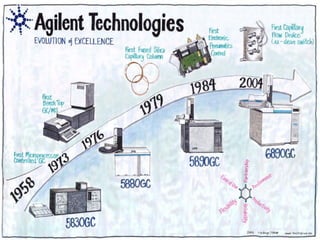
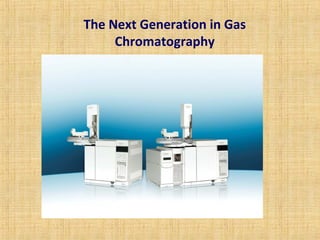
The Next Generation in Gas 
Chromatography
Gas chromatography  latest ppt

Gas chromatography latest ppt

  • 1.
    Chromatography (Gas Chromatography) Presented By:- Ruta Satoskar & Suman Muthu
  • 2.
    THE CHROMATOGRAPHIC PPRROOCCEESSSS-- PPAARRTTIITTIIOONNIINNGG (gas or liquid) MMOOBBIILLEE PPHHAASSEE SSTTAATTIIOONNAARRYY PPHHAASSEE Sample out Sample in (solid or heavy liquid coated onto a solid or support system)
  • 3.
    OOrriiggiinnaall CChhrroommaattooggrraapphhyy EExxppeerriimmeenntt Later An EtOH extract of leaf pigments is applied to the top of the column. EtOH is used to flush the pigments down the column.
  • 4.
    Common Types ofChromatography Tswett’s technique is based on Liquid Chromatography. There are now several common chromatographic methods. These include: 1. Paper Chromatography 2. Thin Layer Chromatography (TLC) 3. Liquid Chromatography (LC) 4. High Pressure Liquid Chromatography (HPLC) 5. Ion Chromatography 6. Gas Chromatography (GC)
  • 5.
  • 6.
    EEqquuaattiioonn ffoorr PPaarrttiittiioonnRRaattiioo A A A A A A A A A A A A K = distribution coefficient or partition ratio K = CS CM Where CS is the molar concentration of the solute in the stationary phase and CM is the molar concentration in the mobile phase. Cross Section of Equilibrium in a column. “A” are adsorbed to the stationary phase. “A” are traveling in the mobile phase.
  • 8.
    GGaass CChhrroommaattooggrraapphhyy •TThhee ffaatthheerr ooff mmooddeerrnn ggaass cchhrroommaattooggrraapphhyy iiss NNoobbeell PPrriizzee wwiinnnneerr JJoohhnn PPoorrtteerr MMaarrttiinn,, wwhhoo aallssoo ddeevveellooppeedd tthhee ffiirrsstt lliiqquuiidd--ggaass cchhrroommaattooggrraapphh.. ((11995500))
  • 9.
  • 10.
    Criteria for CCoommppoouunnddssttoo bbee AAnnaallyyzzeedd bbyy GG..CC 1.VOLATILITY. 2.THERMOSTABILITY.
  • 11.
    CChhrroommaattooggrraapphhiicc SSeeppaarraattiioonn --DDeeaallsswwiitthh bbootthh tthhee ssttaattiioonnaarryy pphhaassee aanndd tthhee mmoobbiillee pphhaassee.. • MMoobbiillee –– iinneerrtt ggaass uusseedd aass ccaarrrriieerr.. • SSttaattiioonnaarryy –– lliiqquuiidd ccooaatteedd oonn aa ssoolliidd oorr aa ssoolliidd wwiitthhiinn aa ccoolluummnn..
  • 12.
    CChhrroommaattooggrraapphhiicc SSeeppaarraattiioonn •CChhrroommaattooggrraapphhiicc SSeeppaarraattiioonn – IInn tthhee mmoobbiillee pphhaassee,, ccoommppoonneennttss ooff tthhee ssaammppllee aarree uunniiqquueellyy ddrraawwnn ttoo tthhee ssttaattiioonnaarryy pphhaassee aanndd tthhuuss,, eenntteerr tthhiiss pphhaassee aatt ddiiffffeerreenntt ttiimmeess.. – TThhee ppaarrttss ooff tthhee ssaammppllee aarree sseeppaarraatteedd wwiitthhiinn tthhee ccoolluummnn.. –CCoommppoouunnddss uusseedd aatt tthhee ssttaattiioonnaarryy pphhaassee rreeaacchh tthhee ddeetteeccttoorr aatt uunniiqquuee ttiimmeess aanndd pprroodduuccee aa sseerriieess ooff ppeeaakkss aalloonngg aa ttiimmee sseeqquueennccee..
  • 13.
    Se Chromatographic SeppaarraattiioonnAA((ccoonnttiinnuueedd)) – TThhee ppeeaakkss ccaann tthheenn bbee rreeaadd aanndd aannaallyyzzeedd bbyy aa ffoorreennssiicc sscciieennttiisstt ttoo ddeetteerrmmiinnee tthhee eexxaacctt ccoommppoonneennttss ooff tthhee mmiixxttuurree.. –RReetteennttiioonn ttiimmee iiss ddeetteerrmmiinneedd bbyy eeaacchh ccoommppoonneenntt rreeaacchhiinngg tthhee ddeetteeccttoorr aatt aa cchhaarraacctteerriissttiicc ttiimmee..
  • 14.
    CChhrroommaattooggrraapphhiicc AAnnaallyyssiiss –TThhee nnuummbbeerr ooff ccoommppoonneennttss iinn aa ssaammppllee iiss ddeetteerrmmiinneedd bbyy tthhee nnuummbbeerr ooff ppeeaakkss.. – TThhee aammoouunntt ooff aa ggiivveenn ccoommppoonneenntt iinn aa ssaammppllee iiss ddeetteerrmmiinneedd bbyy tthhee aarreeaa uunnddeerr tthhee ppeeaakkss.. – TThhee iiddeennttiittyy ooff ccoommppoonneennttss ccaann bbee ddeetteerrmmiinneedd bbyy tthhee ggiivveenn rreetteennttiioonn ttiimmeess..
  • 15.
  • 16.
    CARRIER GAS »Hydrogen • Better thermal conductivity • Disadvantage: it reacts with unsaturated compounds & inflammable » Helium • Excellent thermal conductivity • It is expensive » Nitrogen • Reduced sensitivity • It is inexpensive
  • 17.
    RReeqquuiirreemmeennttss ooff aaccaarrrriieerr ggaass Inertness Suitable for the detector High purity Easily available Cheap Should not cause the risk of fire Should give best column performance
  • 18.
    AADDVVAANNTTAAGGEESS OOFF GG..CC 1. Very high resolution power, complex mixtures can be resolved into its components by this method. 2. Very high sensitivity with TCD, detect down to 100 ppm 3. It is a micro method, small sample size is required 4. Fast analysis is possible, gas as moving phase-rapid equilibrium 5. Relatively good precision & accuracy 6. Qualitative & quantitative analysis is possible
  • 19.
    Disadvantages of G.C. 1. The samples analysed are limited to those that are volatile or can be made volatile. 2. The samples must be thermally stable to prevent degradation when heated. 3. Cannot be used to prepare samples for further analysis once separated. 4. Problems can be encountered when injecting the sample
  • 20.
    Applications of G.C • G.C is capable of separating, detecting & partially characterizing the organic compounds , particularly when present in small quantities. 1, Qualitative analysis Rt & RV are used for the identification & separation 2, Checking the purity of a compound Compare the chromatogram of the std. & that of the sample
  • 21.
    Applications of G.C 3, Quantitative analysis It is necessary to measure the peak area or peak height of each component 4, Used for analysis of drugs & their metabolites.
  • 22.
    The Next Generationin Gas Chromatography

Editor's Notes