DERIVATIZATION OF GAS CHROMATOGRAPHY 
& 
COMPARISION OF GAS CHROMATOGRAPHY & HPLC 
GUDIED BY: 
Mr. UTTAM PRASAD PANIGRAHY 
PRESENTED BY: 
M.Srilatha 
Pharmaceutics
ď‚–
ď‚–
ď‚–
ď‚–
ď‚–
ď‚–
ď‚–
ď‚–
ď‚–
ď‚–
ď‚–
ď‚–
ď‚–
ď‚–
ď‚–
ď‚–
ď‚–
ď‚–
ď‚–
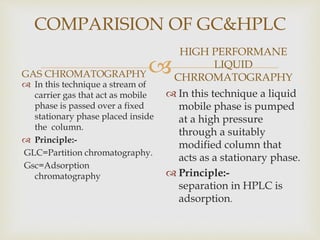
COMPARISION OF GC&HPLC 
ď‚– 
GAS CHROMATOGRAPHY 
ď‚™ In this technique a stream of 
carrier gas that act as mobile 
phase is passed over a fixed 
stationary phase placed inside 
the column. 
ď‚™ Principle:- 
GLC=Partition chromatography. 
Gsc=Adsorption 
chromatography 
HIGH PERFORMANE 
LIQUID 
CHRROMATOGRAPHY 
ď‚™ In this technique a liquid 
mobile phase is pumped 
at a high pressure 
through a suitably 
modified column that 
acts as a stationary phase. 
ď‚™ Principle:- 
separation in HPLC is 
adsorption.
ď‚– 
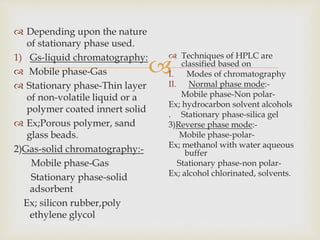
ď‚™ Depending upon the nature 
of stationary phase used. 
1) Gs-liquid chromatography: 
ď‚™ Mobile phase-Gas 
ď‚™ Stationary phase-Thin layer 
of non-volatile liquid or a 
polymer coated innert solid 
ď‚™ Ex;Porous polymer, sand 
glass beads. 
2)Gas-solid chromatography:- 
Mobile phase-Gas 
Stationary phase-solid 
adsorbent 
Ex; silicon rubber,poly 
ethylene glycol 
ď‚™ Techniques of HPLC are 
classified based on 
I. Modes of chromatography 
II. Normal phase mode:- 
Mobile phase-Non polar- 
Ex; hydrocarbon solvent alcohols 
. Stationary phase-silica gel 
3)Reverse phase mode:- 
Mobile phase-polar- 
Ex; methanol with water aqueous 
buffer 
Stationary phase-non polar- 
Ex; alcohol chlorinated, solvents.
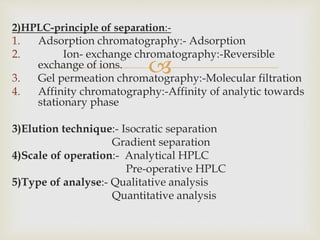
2)HPLC-principle of separation:- 
1. Adsorption chromatography:- Adsorption 
2. Ion- exchange chromatography:-Reversible 
ď‚– 
exchange of ions. 
3. Gel permeation chromatography:-Molecular filtration 
4. Affinity chromatography:-Affinity of analytic towards 
stationary phase 
3)Elution technique:- Isocratic separation 
Gradient separation 
4)Scale of operation:- Analytical HPLC 
Pre-operative HPLC 
5)Type of analyse:- Qualitative analysis 
Quantitative analysis
ď‚– 
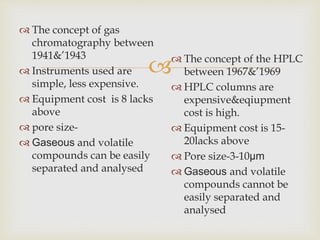
ď‚™ The concept of gas 
chromatography between 
1941&’1943 
ď‚™ Instruments used are 
simple, less expensive. 
ď‚™ Equipment cost is 8 lacks 
above 
ď‚™ pore size- 
ď‚™ Gaseous and volatile 
compounds can be easily 
separated and analysed 
ď‚™ The concept of the HPLC 
between 1967&’1969 
ď‚™ HPLC columns are 
expensive&eqiupment 
cost is high. 
ď‚™ Equipment cost is 15- 
20lacks above 
ď‚™ Pore size-3-10ÎĽm 
ď‚™ Gaseous and volatile 
compounds cannot be 
easily separated and 
analysed
ď‚– 
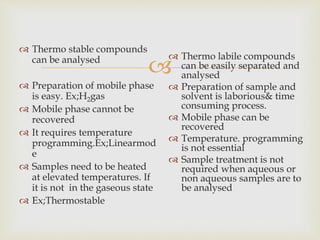
ď‚™ Thermo stable compounds 
can be analysed 
ď‚™ Preparation of mobile phase 
is easy. Ex;H2gas 
ď‚™ Mobile phase cannot be 
recovered 
ď‚™ It requires temperature 
programming.Ex;Linearmod 
e 
ď‚™ Samples need to be heated 
at elevated temperatures. If 
it is not in the gaseous state 
ď‚™ Ex;Thermostable 
ď‚™ Thermo labile compounds 
can be easily separated and 
analysed 
ď‚™ Preparation of sample and 
solvent is laborious& time 
consuming process. 
ď‚™ Mobile phase can be 
recovered 
ď‚™ Temperature. programming 
is not essential 
ď‚™ Sample treatment is not 
required when aqueous or 
non aqueous samples are to 
be analysed
ď‚– 
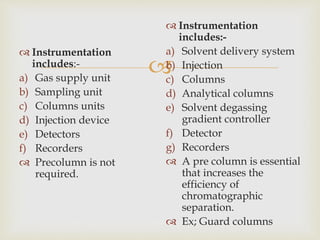
ď‚™ Instrumentation 
includes:- 
a) Gas supply unit 
b) Sampling unit 
c) Columns units 
d) Injection device 
e) Detectors 
f) Recorders 
ď‚™ Precolumn is not 
required. 
ď‚™ Instrumentation 
includes:- 
a) Solvent delivery system 
b) Injection 
c) Columns 
d) Analytical columns 
e) Solvent degassing 
gradient controller 
f) Detector 
g) Recorders 
ď‚™ A pre column is essential 
that increases the 
efficiency of 
chromatographic 
separation. 
ď‚™ Ex; Guard columns
ď‚– 
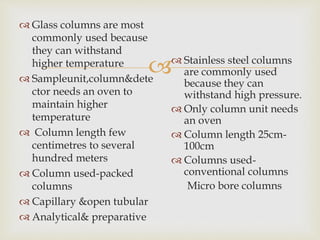
ď‚™ Glass columns are most 
commonly used because 
they can withstand 
higher temperature 
ď‚™ Sampleunit,column&dete 
ctor needs an oven to 
maintain higher 
temperature 
ď‚™ Column length few 
centimetres to several 
hundred meters 
ď‚™ Column used-packed 
columns 
ď‚™ Capillary &open tubular 
ď‚™ Analytical& preparative 
ď‚™ Stainless steel columns 
are commonly used 
because they can 
withstand high pressure. 
ď‚™ Only column unit needs 
an oven 
ď‚™ Column length 25cm- 
100cm 
ď‚™ Columns used-conventional 
columns 
Micro bore columns
Detectors used are 2 types- 
ď‚– A. Bulk property:- 
Refractive indexdectors 
Conductivity detectors 
B. Solute property:- 
UV-visible detector 
Fluorescence detectors 
Electro chemical detectors 
A. Concentration dependent:- 
ď‚™ Thermal conductivity detector 
ď‚™ Electron capture detector 
ď‚™ Argon ionization detector 
B. Mass flow dependent 
ď‚™ Nitrogen phosphorous 
detector 
ď‚™ Flame photometric detectors
ď‚–

Gc & gc vs hplc

  • 1.
    DERIVATIZATION OF GASCHROMATOGRAPHY & COMPARISION OF GAS CHROMATOGRAPHY & HPLC GUDIED BY: Mr. UTTAM PRASAD PANIGRAHY PRESENTED BY: M.Srilatha Pharmaceutics
  • 3.
  • 4.
  • 5.
  • 6.
  • 7.
  • 8.
  • 9.
  • 10.
  • 11.
  • 12.
  • 13.
  • 14.
  • 15.
  • 16.
  • 17.
  • 18.
  • 19.
  • 20.
  • 21.
  • 22.
    COMPARISION OF GC&HPLC ď‚– GAS CHROMATOGRAPHY ď‚™ In this technique a stream of carrier gas that act as mobile phase is passed over a fixed stationary phase placed inside the column. ď‚™ Principle:- GLC=Partition chromatography. Gsc=Adsorption chromatography HIGH PERFORMANE LIQUID CHRROMATOGRAPHY ď‚™ In this technique a liquid mobile phase is pumped at a high pressure through a suitably modified column that acts as a stationary phase. ď‚™ Principle:- separation in HPLC is adsorption.
  • 23.
    ď‚– ď‚™ Dependingupon the nature of stationary phase used. 1) Gs-liquid chromatography: ď‚™ Mobile phase-Gas ď‚™ Stationary phase-Thin layer of non-volatile liquid or a polymer coated innert solid ď‚™ Ex;Porous polymer, sand glass beads. 2)Gas-solid chromatography:- Mobile phase-Gas Stationary phase-solid adsorbent Ex; silicon rubber,poly ethylene glycol ď‚™ Techniques of HPLC are classified based on I. Modes of chromatography II. Normal phase mode:- Mobile phase-Non polar- Ex; hydrocarbon solvent alcohols . Stationary phase-silica gel 3)Reverse phase mode:- Mobile phase-polar- Ex; methanol with water aqueous buffer Stationary phase-non polar- Ex; alcohol chlorinated, solvents.
  • 24.
    2)HPLC-principle of separation:- 1. Adsorption chromatography:- Adsorption 2. Ion- exchange chromatography:-Reversible ď‚– exchange of ions. 3. Gel permeation chromatography:-Molecular filtration 4. Affinity chromatography:-Affinity of analytic towards stationary phase 3)Elution technique:- Isocratic separation Gradient separation 4)Scale of operation:- Analytical HPLC Pre-operative HPLC 5)Type of analyse:- Qualitative analysis Quantitative analysis
  • 25.
      Theconcept of gas chromatography between 1941&’1943  Instruments used are simple, less expensive.  Equipment cost is 8 lacks above  pore size-  Gaseous and volatile compounds can be easily separated and analysed  The concept of the HPLC between 1967&’1969  HPLC columns are expensive&eqiupment cost is high.  Equipment cost is 15- 20lacks above  Pore size-3-10μm  Gaseous and volatile compounds cannot be easily separated and analysed
  • 26.
    ď‚– ď‚™ Thermostable compounds can be analysed ď‚™ Preparation of mobile phase is easy. Ex;H2gas ď‚™ Mobile phase cannot be recovered ď‚™ It requires temperature programming.Ex;Linearmod e ď‚™ Samples need to be heated at elevated temperatures. If it is not in the gaseous state ď‚™ Ex;Thermostable ď‚™ Thermo labile compounds can be easily separated and analysed ď‚™ Preparation of sample and solvent is laborious& time consuming process. ď‚™ Mobile phase can be recovered ď‚™ Temperature. programming is not essential ď‚™ Sample treatment is not required when aqueous or non aqueous samples are to be analysed
  • 27.
    ď‚– ď‚™ Instrumentation includes:- a) Gas supply unit b) Sampling unit c) Columns units d) Injection device e) Detectors f) Recorders ď‚™ Precolumn is not required. ď‚™ Instrumentation includes:- a) Solvent delivery system b) Injection c) Columns d) Analytical columns e) Solvent degassing gradient controller f) Detector g) Recorders ď‚™ A pre column is essential that increases the efficiency of chromatographic separation. ď‚™ Ex; Guard columns
  • 28.
    ď‚– ď‚™ Glasscolumns are most commonly used because they can withstand higher temperature ď‚™ Sampleunit,column&dete ctor needs an oven to maintain higher temperature ď‚™ Column length few centimetres to several hundred meters ď‚™ Column used-packed columns ď‚™ Capillary &open tubular ď‚™ Analytical& preparative ď‚™ Stainless steel columns are commonly used because they can withstand high pressure. ď‚™ Only column unit needs an oven ď‚™ Column length 25cm- 100cm ď‚™ Columns used-conventional columns Micro bore columns
  • 29.
    Detectors used are2 types- ď‚– A. Bulk property:- Refractive indexdectors Conductivity detectors B. Solute property:- UV-visible detector Fluorescence detectors Electro chemical detectors A. Concentration dependent:- ď‚™ Thermal conductivity detector ď‚™ Electron capture detector ď‚™ Argon ionization detector B. Mass flow dependent ď‚™ Nitrogen phosphorous detector ď‚™ Flame photometric detectors
  • 30.