BY-RUTA 
SATOSKAR 
& 
SUMAN MUTHU
A Desert’s Characteristics 
Climate 
Animals 
Plants 
Seasons 
 Adaptations 
 Significance 
to 
humans
What is ECOSYSTEM? 
An ecosystem is a community of living 
organisms (plants, animals and microbes) in 
conjunction with the nonliving components of 
their environment (things like air, water and 
mineral soil). The entire planet is an 
ecosystem. In the desert ecosystem many 
organisms have learned to adapt to the hot 
climate and lack of supplements.
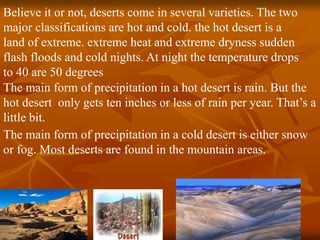
Believe it or not, deserts come in several varieties. The two 
major classifications are hot and cold. the hot desert is a 
land of extreme. extreme heat and extreme dryness sudden 
flash floods and cold nights. At night the temperature drops 
to 40 are 50 degrees 
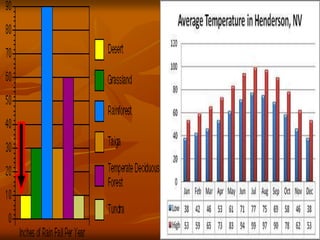
The main form of precipitation in a hot desert is rain. But the 
hot desert only gets ten inches or less of rain per year. That’s a 
little bit. 
The main form of precipitation in a cold desert is either snow 
or fog. Most deserts are found in the mountain areas.
Climate 
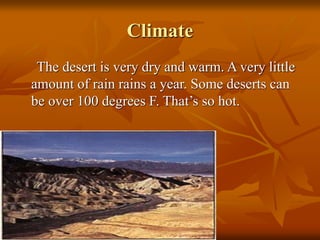
The desert is very dry and warm. A very little 
amount of rain rains a year. Some deserts can 
be over 100 degrees F. That’s so hot.
Many of the features of desert plants are adaptations traits 
that makes the plant survive in its harsh environment. Desert 
plants have two main adaptations to survive and that is 
 Ability to collect and store water 
 Features that reduce water loss 
There is a lot of plants in this biome and they are 
Saguaro 
Barrel Cactus 
Old Man Cactus 
Prickly Pear Cactus 
Dragon Tree 
Fish Hook Cactus 
Desert Spoon 
Aloe 
Joshua Tree 
Yucca
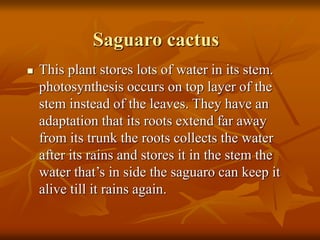
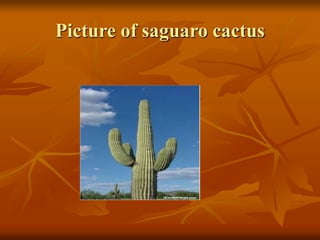
Saguaro cactus 
 This plant stores lots of water in its stem. 
photosynthesis occurs on top layer of the 
stem instead of the leaves. They have an 
adaptation that its roots extend far away 
from its trunk the roots collects the water 
after its rains and stores it in the stem the 
water that’s in side the saguaro can keep it 
alive till it rains again.
Picture of saguaro cactus
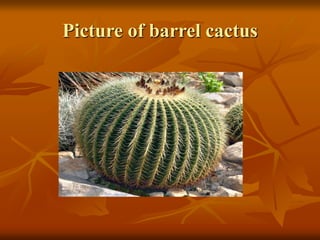
Barrel cactus 
 The out side of the barrel cactus is spongy so it 
could store water. When it gets very hot the 
plant shrinks until it rains again.
Picture of barrel cactus
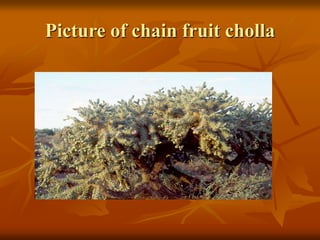
Chain Fruit Cholla 
 The chain fruit cholla are mostly found in dry 
areas like deserts . When there is a drought 
animals depend on the chain fruit cholla for 
water.
Picture of chain fruit cholla
Animals 
Desert animals must survive a harsh and hostile 
environment. 
Many animals never drink water but can get 
there water from seeds and plants. 
Many of the animals are nocturnal. 
 In some instances some animals wont come 
out of the ground for their whole life. 
An example of this is a Spadefoot toad which 
spends nine months in the ground.
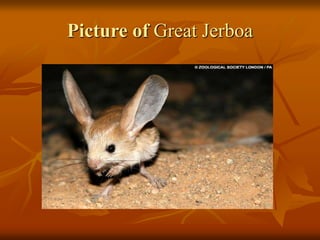
Great Jerboa 
 The great jerboa is a very small mammal they 
feed on seeds and small insects which makes 
them omnivores. 
 They are also nocturnal and they hibernate in 
the winter.
Picture of Great Jerboa
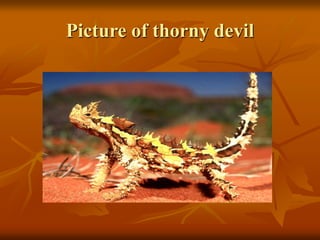
Thorny devil 
 The thorny devil is a reptile that eats termites 
and ants which makes the thorny devil a 
carnivore . 
 The thorny devil moves in a slow pace that’s 
why the thorny devil eats insects instead of 
eating bird that move very fast.
Picture of thorny devil
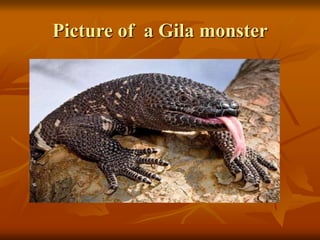
Gila Monster 
 The Gila monster eats eggs and other small 
mammals which makes it a carnivore. 
 They are primarily nocturnal but may emerge 
in the spring. 
 They are also very venomous.
Picture of a Gila monster
Armadillo lizard 
 The armadillo lizard feeds on spiders and other 
invertebrates and a wide variety of insects. 
 It has tube like nostrils and uses them to hunt 
and detect for predators. 
 The lizards head is narrow.
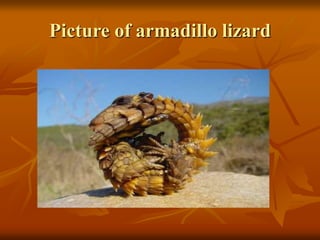
Picture of armadillo lizard
Seasons 
 The seasons are generally warm 
throughout the year and very hot in 
the summer. 
 The winters usually bring little 
rainfall. Temperatures exhibit daily 
extremes because the atmosphere 
contains little humidity to block the 
Sun’s rays.
Adaptations 
 Many of the animals in the desert have 
become nocturnal because of the extreme 
heat. 
 Both plants and animals have learned to 
store water, avoid heat by staying 
underground, and taking water from 
nearby plants.
Human impact 
 Poachers are a main cause of dying animals. 
Poachers catch animals of all kinds to make 
money for usually just one part, like the elephant 
tusk. 
 With the growing popularity of transportation, 
many roads are being built in not only the desert, 
but all the other biomes. 
 The main problem with these roads are the fact 
that they destroy habitats and endanger animals. 
Road kill is also a main factor in these dying 
animals. 
 These problems can be easily taken care of if other 
means of transportation were encouraged.
Interesting facts 
 There are cold deserts as well as hot deserts there 
are many bizarre animals in the deserts. 
 The plant has to adapt to the hot weather by 
storing water in there stems. 
 The Gobi Desert is cold almost all year round. 
 Deserts spread through desertification. This 
happens when grasslands surrounding deserts 
become dry. 
 Some deserts have gotten nicknames such as 
Death Valley because of the lack of water
OASIS 
 Oases are parts of the desert where plants 
grow and water is almost always 
available. 
 An oasis is formed by a pool of water 
trapped between layers of rock and the 
desert floor. 
 The water can allow people to settle and 
even grow crops in the desert.
Conclusion 
 The desert brings us interesting and 
unusual animals such as the thorny devil. 
 The desert can get extremely hot in the 
day, but at night it can drop below 
freezing.
THE END

Desert print this ppt

  • 1.
    BY-RUTA SATOSKAR & SUMAN MUTHU
  • 2.
    A Desert’s Characteristics Climate Animals Plants Seasons  Adaptations  Significance to humans
  • 3.
    What is ECOSYSTEM? An ecosystem is a community of living organisms (plants, animals and microbes) in conjunction with the nonliving components of their environment (things like air, water and mineral soil). The entire planet is an ecosystem. In the desert ecosystem many organisms have learned to adapt to the hot climate and lack of supplements.
  • 4.
    Believe it ornot, deserts come in several varieties. The two major classifications are hot and cold. the hot desert is a land of extreme. extreme heat and extreme dryness sudden flash floods and cold nights. At night the temperature drops to 40 are 50 degrees The main form of precipitation in a hot desert is rain. But the hot desert only gets ten inches or less of rain per year. That’s a little bit. The main form of precipitation in a cold desert is either snow or fog. Most deserts are found in the mountain areas.
  • 5.
    Climate The desertis very dry and warm. A very little amount of rain rains a year. Some deserts can be over 100 degrees F. That’s so hot.
  • 7.
    Many of thefeatures of desert plants are adaptations traits that makes the plant survive in its harsh environment. Desert plants have two main adaptations to survive and that is  Ability to collect and store water  Features that reduce water loss There is a lot of plants in this biome and they are Saguaro Barrel Cactus Old Man Cactus Prickly Pear Cactus Dragon Tree Fish Hook Cactus Desert Spoon Aloe Joshua Tree Yucca
  • 8.
    Saguaro cactus This plant stores lots of water in its stem. photosynthesis occurs on top layer of the stem instead of the leaves. They have an adaptation that its roots extend far away from its trunk the roots collects the water after its rains and stores it in the stem the water that’s in side the saguaro can keep it alive till it rains again.
  • 9.
  • 10.
    Barrel cactus The out side of the barrel cactus is spongy so it could store water. When it gets very hot the plant shrinks until it rains again.
  • 11.
  • 12.
    Chain Fruit Cholla  The chain fruit cholla are mostly found in dry areas like deserts . When there is a drought animals depend on the chain fruit cholla for water.
  • 13.
    Picture of chainfruit cholla
  • 14.
    Animals Desert animalsmust survive a harsh and hostile environment. Many animals never drink water but can get there water from seeds and plants. Many of the animals are nocturnal.  In some instances some animals wont come out of the ground for their whole life. An example of this is a Spadefoot toad which spends nine months in the ground.
  • 15.
    Great Jerboa The great jerboa is a very small mammal they feed on seeds and small insects which makes them omnivores.  They are also nocturnal and they hibernate in the winter.
  • 16.
  • 17.
    Thorny devil The thorny devil is a reptile that eats termites and ants which makes the thorny devil a carnivore .  The thorny devil moves in a slow pace that’s why the thorny devil eats insects instead of eating bird that move very fast.
  • 18.
  • 19.
    Gila Monster The Gila monster eats eggs and other small mammals which makes it a carnivore.  They are primarily nocturnal but may emerge in the spring.  They are also very venomous.
  • 20.
    Picture of aGila monster
  • 21.
    Armadillo lizard The armadillo lizard feeds on spiders and other invertebrates and a wide variety of insects.  It has tube like nostrils and uses them to hunt and detect for predators.  The lizards head is narrow.
  • 22.
  • 24.
    Seasons  Theseasons are generally warm throughout the year and very hot in the summer.  The winters usually bring little rainfall. Temperatures exhibit daily extremes because the atmosphere contains little humidity to block the Sun’s rays.
  • 25.
    Adaptations  Manyof the animals in the desert have become nocturnal because of the extreme heat.  Both plants and animals have learned to store water, avoid heat by staying underground, and taking water from nearby plants.
  • 26.
    Human impact Poachers are a main cause of dying animals. Poachers catch animals of all kinds to make money for usually just one part, like the elephant tusk.  With the growing popularity of transportation, many roads are being built in not only the desert, but all the other biomes.  The main problem with these roads are the fact that they destroy habitats and endanger animals. Road kill is also a main factor in these dying animals.  These problems can be easily taken care of if other means of transportation were encouraged.
  • 27.
    Interesting facts There are cold deserts as well as hot deserts there are many bizarre animals in the deserts.  The plant has to adapt to the hot weather by storing water in there stems.  The Gobi Desert is cold almost all year round.  Deserts spread through desertification. This happens when grasslands surrounding deserts become dry.  Some deserts have gotten nicknames such as Death Valley because of the lack of water
  • 28.
    OASIS  Oasesare parts of the desert where plants grow and water is almost always available.  An oasis is formed by a pool of water trapped between layers of rock and the desert floor.  The water can allow people to settle and even grow crops in the desert.
  • 29.
    Conclusion  Thedesert brings us interesting and unusual animals such as the thorny devil.  The desert can get extremely hot in the day, but at night it can drop below freezing.
  • 30.