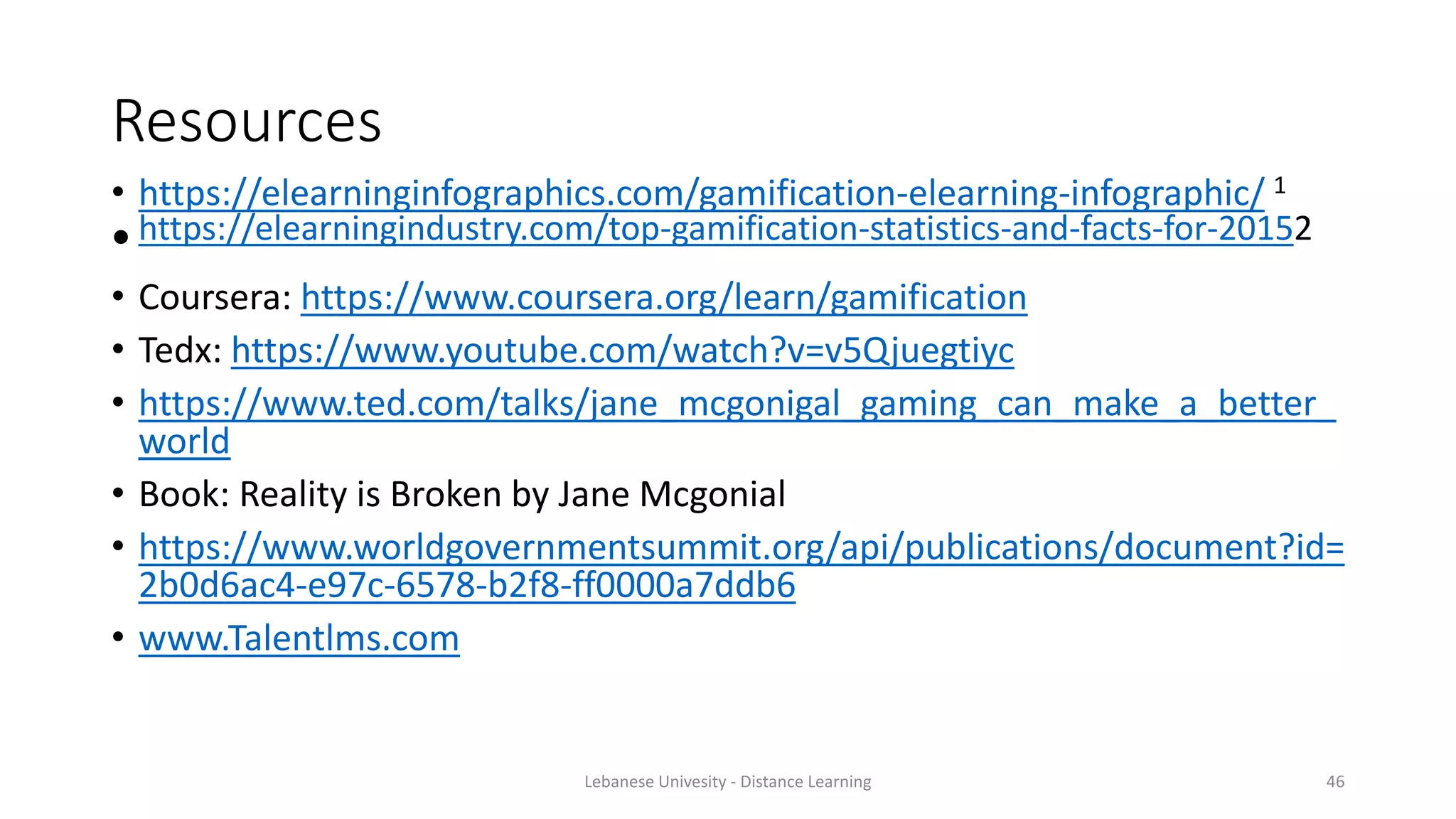
Gamification In Education
Presented by Bilal Saadeh
Distance Learning Course
Dr. Hisham Khoury
Lebanese Univesity - Distance Learning 1
What is Gamification
General Definition
Gamification is the process of taking something that already exists – a
website, an enterprise application, an online community – and
integrating game mechanics into it to motivate participation,
engagement, and loyalty.
Lebanese Univesity - Distance Learning 2
The gamification of learning (in education) is an educational approach
to motivate students to learn by using video game design and game
elements in learning environments. The goal is to maximize enjoyment
and engagement through capturing the interest of learners and
inspiring them to continue learning.
Gamification In Education
Lebanese Univesity - Distance Learning 3
Lebanese Univesity - Distance Learning 4
History of Gamfication
1912
American Jack popcorn –
Distributing Prizes
Lebanese Univesity - Distance Learning 5
History of Gamfication
1980
Telnet – MUD
By Roy Trubshaw and
Richard Bartle1
Essex university
Lebanese Univesity - Distance Learning 6
History of Gamfication
1980
Telnet – MUD
By Roy Trubshaw and
Richard Bartle
Lebanese Univesity - Distance Learning 7
History of Gamfication
1980 – Present
Researches to show that
kids can learn from
video games
Lebanese Univesity - Distance Learning 8
History of Gamfication
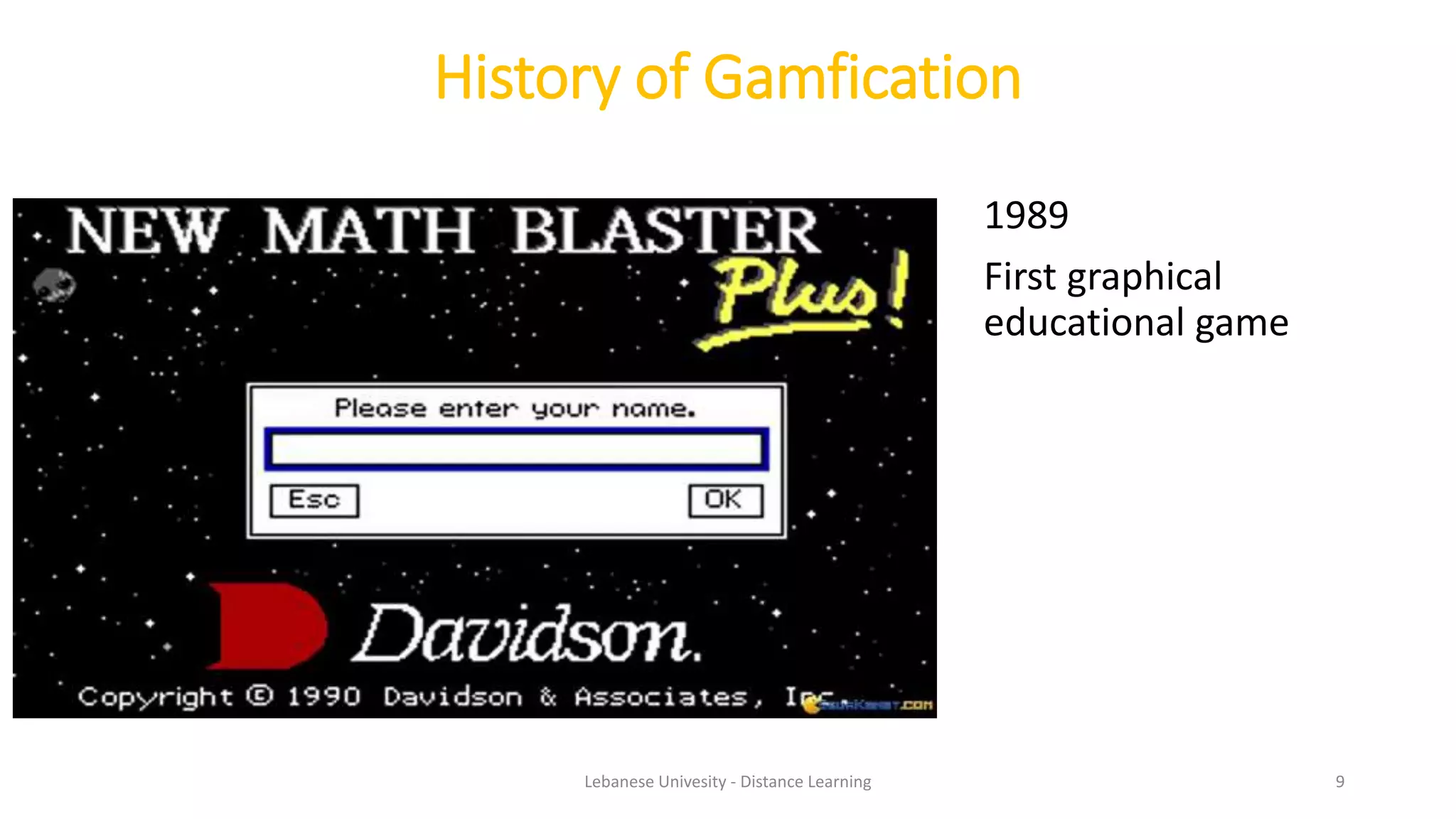
1989
First graphical
educational game
Lebanese Univesity - Distance Learning 9
History of Gamfication
2002– Present
Building Simulations for
private, academic,
military sectors
Lebanese Univesity - Distance Learning 10
History of Gamfication
2003 – Conundra
Converting the
hardware into
entertaining platform
Lebanese Univesity - Distance Learning 11
History of Gamfication
2011 – present
Jane McGonigal’s game-
changer, Reality is Broken is
officially released at the
summit.
Lebanese Univesity - Distance Learning 12
Where we find gamification
Heath Marketing Politics Training
Education
Lebanese Univesity - Distance Learning 13
• Hours Played
People spends 3 Billions hour
per week playing games
Gamfication Stats
• Expected Market Growth
2015: 1.7 Billion $
2018: 5.5 Billion $
Lebanese Univesity - Distance Learning 14
• Gamers
Age of average Gamers is 35
years around the world
Gamfication Stats
• Who Plays2
61% CEO, CFO takes daily
breaks to games
Lebanese Univesity - Distance Learning 15
Why Gamification
1.Better learning experience.
The learner can experience “fun” during the game and still learn if the level of
engagement is high. A good gamification strategy with high levels of engagement will
lead to an increase in recall and retention.
2.Better learning environment.
Gamification in eLearning provides an effective, informal learning environment, and
helps learners practice real-life situations and challenges in a safe environment. This
leads to a more engaged learning experience that facilitates better knowledge
retention.
3.Instant feedback.
It provides instant feedback so that learners know what they know or what they should
know. This too facilitates better learner engagement and thereby better recall and
retention.
Lebanese Univesity - Distance Learning 16
• The freedom to fail: games allow mistakes to be made with little
consequence;
• The freedom to experiment: games allow players to explore and
discover new strategies and pieces of information;
• The freedom to discover different identities: games encourage
players to see problems from a different perspective;
• The freedom of effort: games allow players to go through periods of
intense activity and relative inactivity, so that players can pause and
reflect on tasks they have accomplished.
Why Gamification in E-Learning
Lebanese Univesity - Distance Learning 17
Structure of
Gamification
Lebanese Univesity - Distance Learning 18
Games
Feedback
Rules
Goals
Structure of Gamification
Lebanese Univesity - Distance Learning 19
Structure of Gamifiction
Mechenical
Emotional
Personal
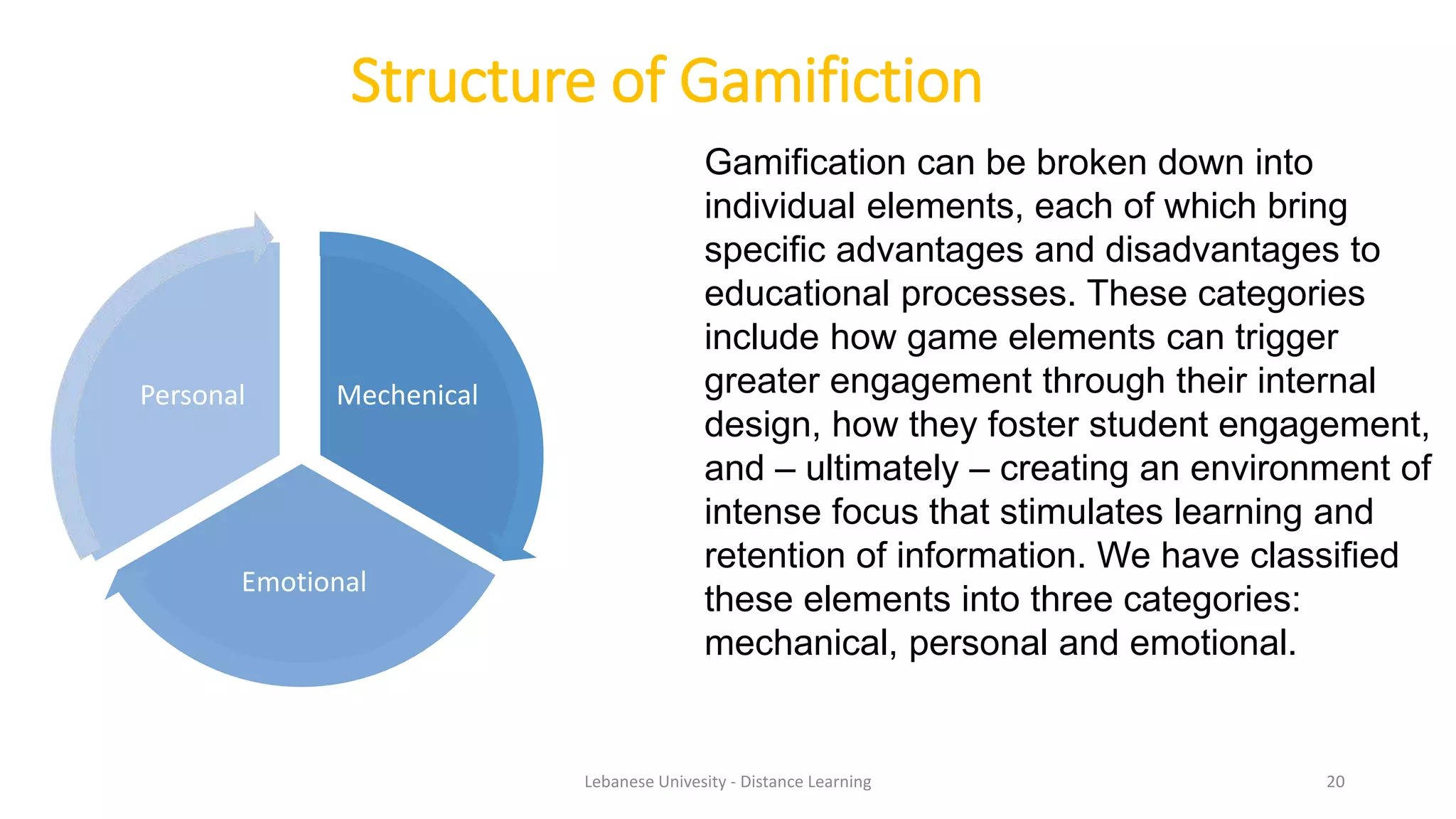
Gamification can be broken down into
individual elements, each of which bring
specific advantages and disadvantages to
educational processes. These categories
include how game elements can trigger
greater engagement through their internal
design, how they foster student engagement,
and – ultimately – creating an environment of
intense focus that stimulates learning and
retention of information. We have classified
these elements into three categories:
mechanical, personal and emotional.
Lebanese Univesity - Distance Learning 20
Structure of Gamification in Education
Lebanese Univesity - Distance Learning 21
Mechanical Structure
Incremental Progression system: goals, challenges,
quests…
A game’s sub-goals, often called missions, levels, or
quests, are layered in such a way as to present
incremental challenges to the player. They are clearly
defined and segmented, and in many cases offer rewards.
Lebanese Univesity - Distance Learning 22
Mechanical Structure
Badges
Provides more intermediate goals for the game, to ensure
that the player is not only focused on the immediate task,
which
might lead to lack of interest once completed, or on the
ultimate goal of the course, which might be too far off to
trigger motivation.
Lebanese Univesity - Distance Learning 23
Mechanical Structure
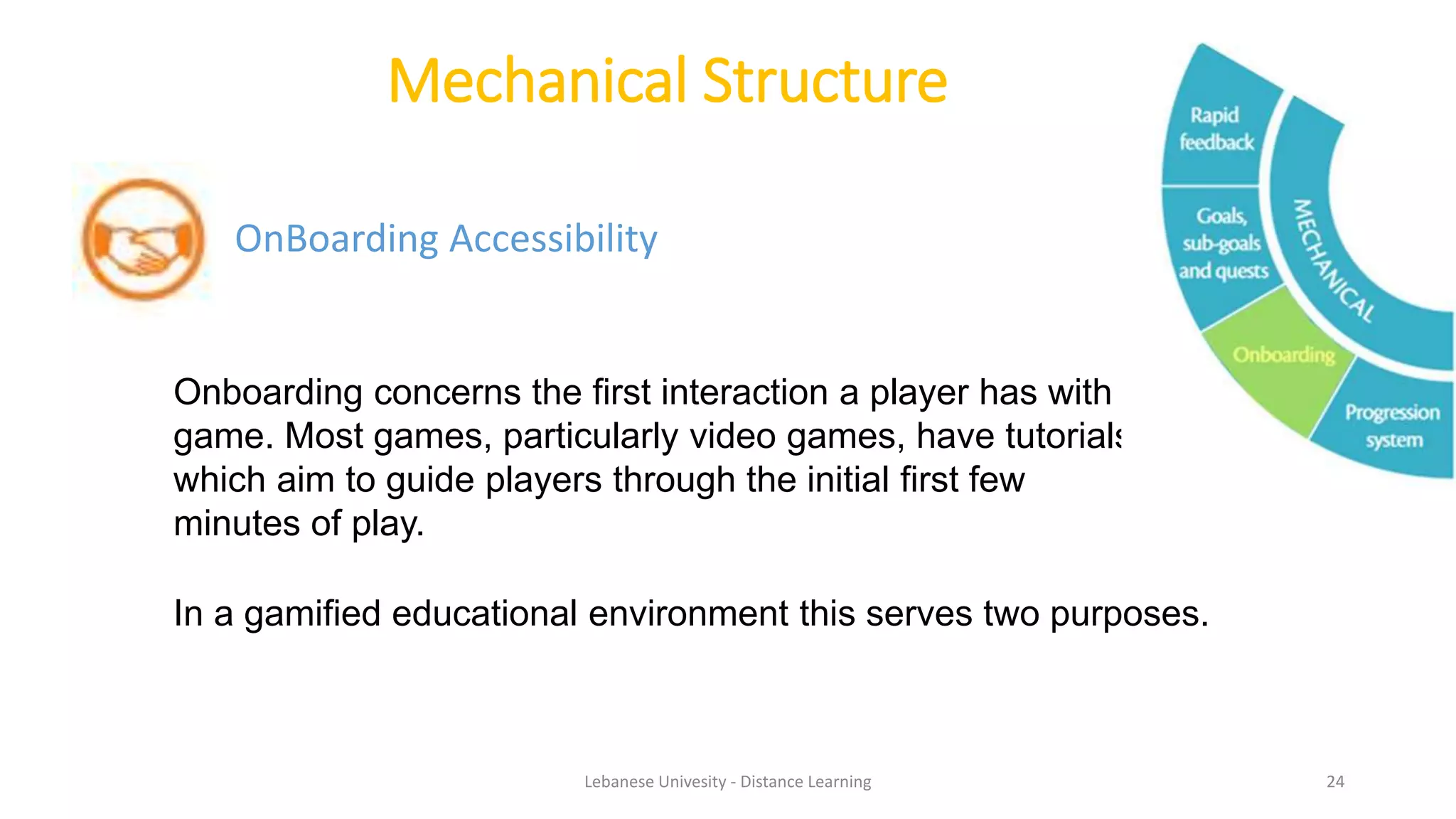
OnBoarding Accessibility
Onboarding concerns the first interaction a player has with a
game. Most games, particularly video games, have tutorials,
which aim to guide players through the initial first few
minutes of play.
In a gamified educational environment this serves two purposes.
Lebanese Univesity - Distance Learning 24
Mechanical Structure
OnBoarding Accessibility
Second, it saves time for the teacher, who would otherwise
be required to explain the process of the experience to the
class – a time-consuming and non-individualised
mechanism for conveying information.
First, it helps decrease uncertainty among the students
about how to complete the task.
Lebanese Univesity - Distance Learning 25
Mechanical Structure
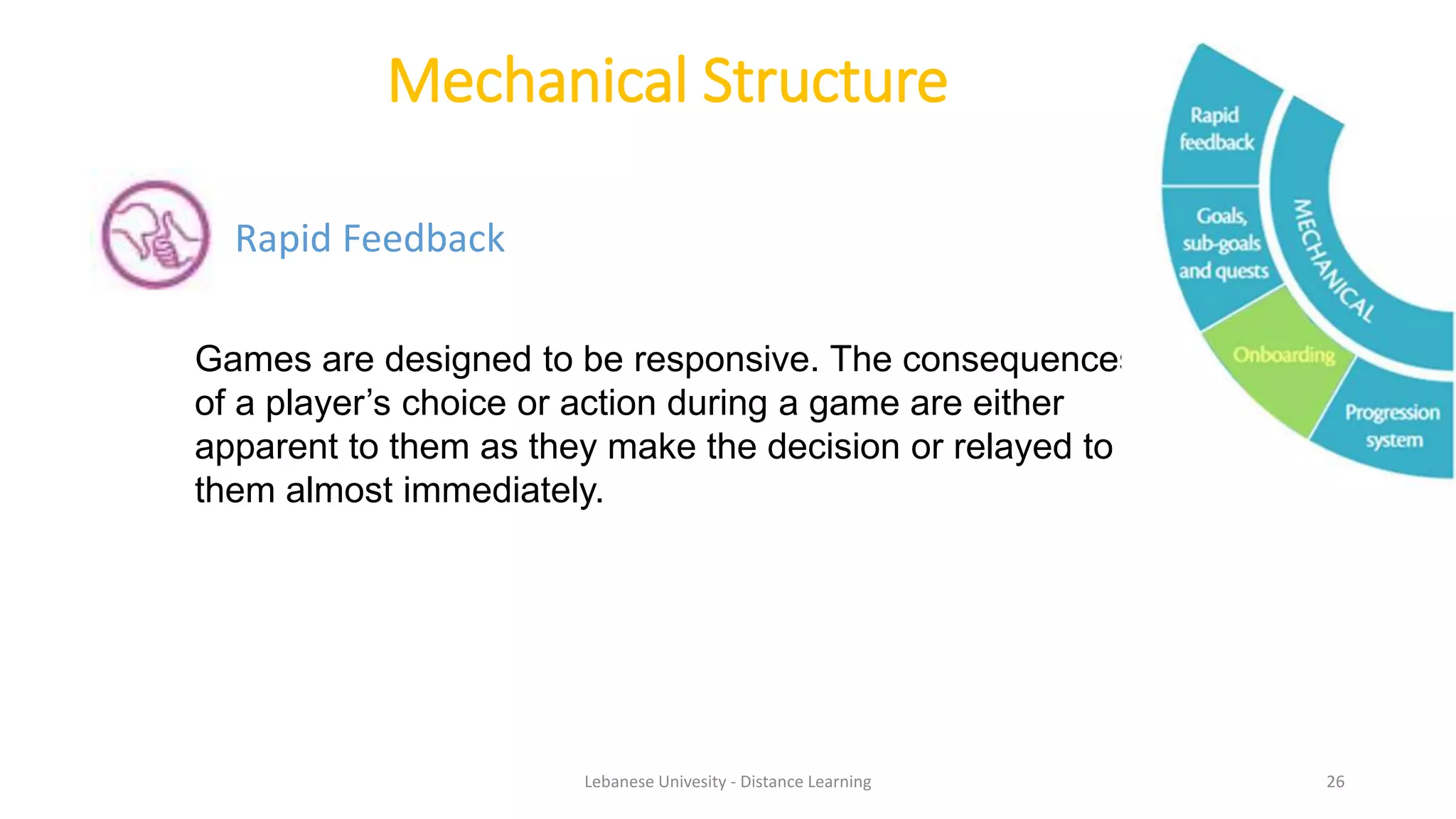
Rapid Feedback
Games are designed to be responsive. The consequences
of a player’s choice or action during a game are either
apparent to them as they make the decision or relayed to
them almost immediately.
Lebanese Univesity - Distance Learning 26
Personal
Avatars
In the context of education, gamification of this type may
allow students to project a profile of themselves. It can
allow students to experiment with different forms of
identity and approach their studies from different
perspectives.
The benefits of this form of gamification are primarily
social. Part of the appeal of games is that they allow
players to adopt new identities or roles, and make
meaningful decisions in-game from an unfamiliar
vantage point.
Lebanese Univesity - Distance Learning 27
Personal
This form of gamification is designed to use group-based
activities to provide an incentive for learners to keep
learning.
Collective Responsibility
Applying this element of gamification to education is relatively
simple, and largely pre-dates the gamification movement. By
giving students a level of social responsibility, their emotional
investment may increase.
Lebanese Univesity - Distance Learning 28
Personal
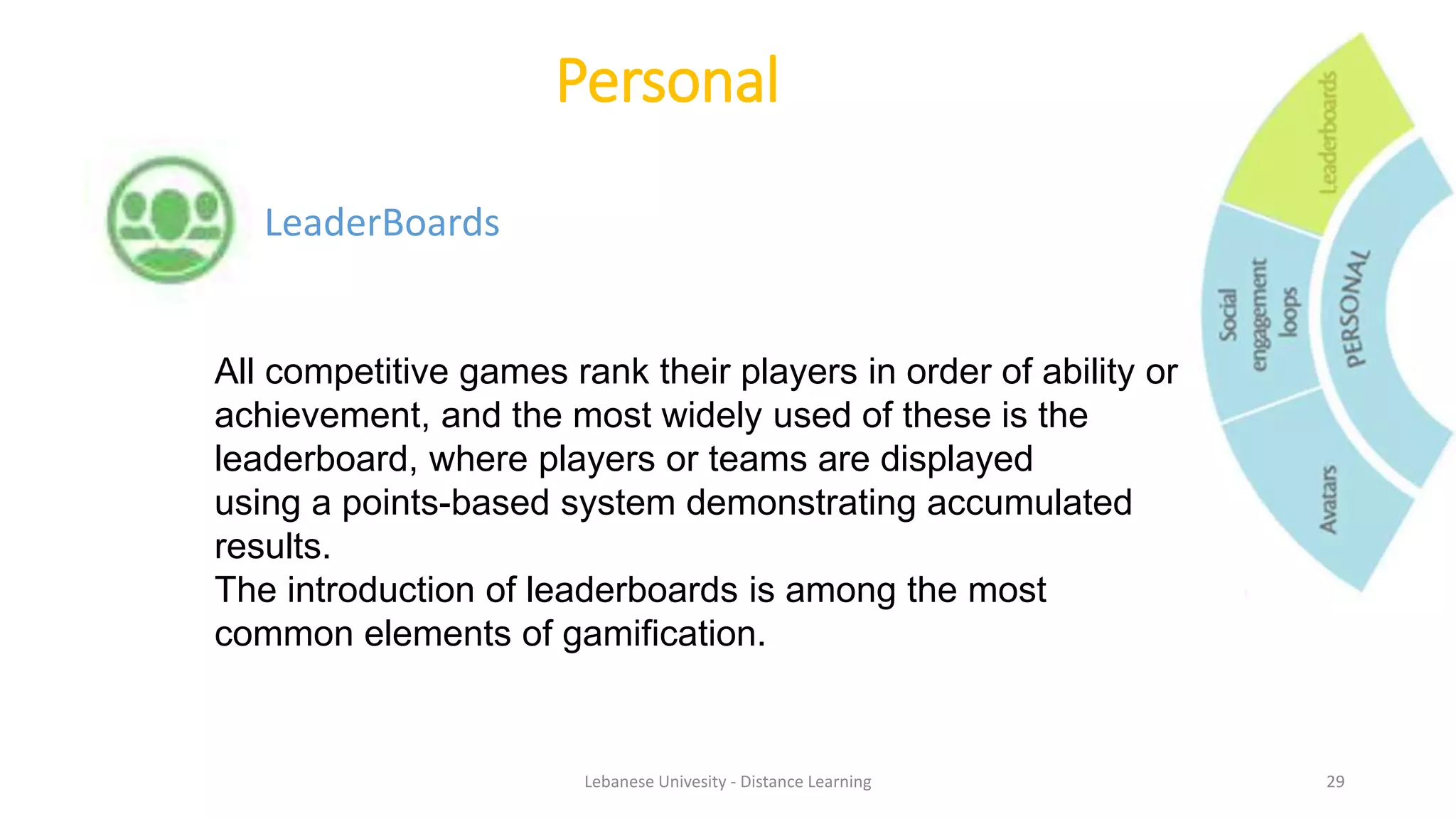
LeaderBoards
All competitive games rank their players in order of ability or
achievement, and the most widely used of these is the
leaderboard, where players or teams are displayed
using a points-based system demonstrating accumulated
results.
The introduction of leaderboards is among the most
common elements of gamification.
Lebanese Univesity - Distance Learning 29
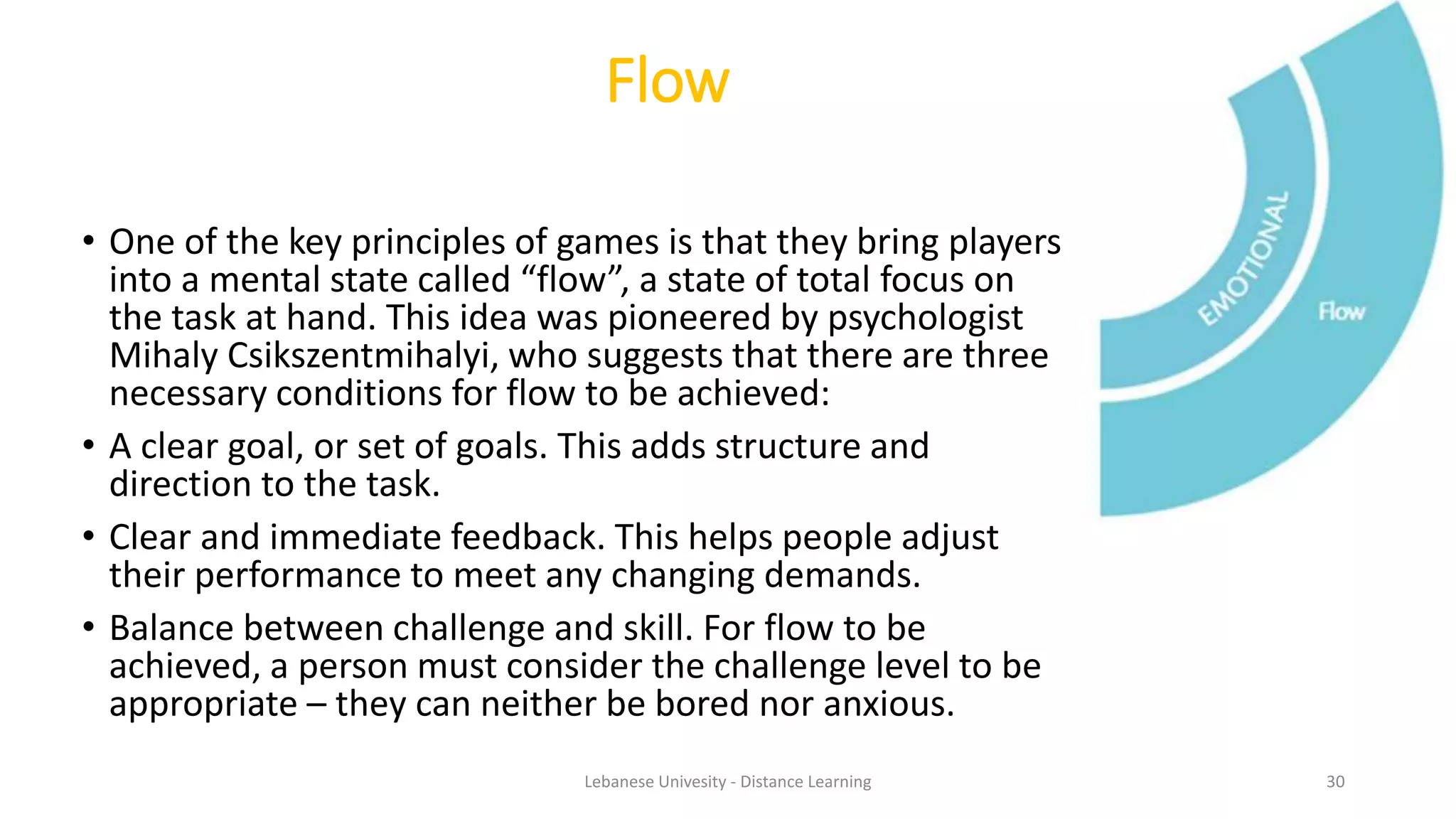
• One of the key principles of games is that they bring players
into a mental state called “flow”, a state of total focus on
the task at hand. This idea was pioneered by psychologist
Mihaly Csikszentmihalyi, who suggests that there are three
necessary conditions for flow to be achieved:
• A clear goal, or set of goals. This adds structure and
direction to the task.
• Clear and immediate feedback. This helps people adjust
their performance to meet any changing demands.
• Balance between challenge and skill. For flow to be
achieved, a person must consider the challenge level to be
appropriate – they can neither be bored nor anxious.
Flow
Lebanese Univesity - Distance Learning 30
• Feasibility
• Student Interests
• Misaligned objectives
• Inappropriately applied gamification
What lacks Gamification
Lebanese Univesity - Distance Learning 31
The most important thing is for teachers to avoid introducing
chocolate-covered broccoli! It may look good at first, but learners will
know what they’re being fed by the time they take the first bite. If
gamification is applied to educational content in an inconsiderate
way, learners are likely to only focus on the rewards and not the
learning process itself. This will end in frustration for both educators
and learners, and will kill the effort more or less immediately.
What lacks Gamification
Lebanese Univesity - Distance Learning 32
Quest to Learn is a fully gamified high school in Manhattan with an
innovative educational philosophy developed by top educators and
game theorists at The Institute of Play, with funding from The
MacArthur Foundation.
Real Examples About Gamification
Lebanese Univesity - Distance Learning 33
• TalentLMS integrates some of the more well-known and battle-tested
techniques, such as Points, Badges, Levels, Leaderboards, and
Rewards.
TalentLMS
Lebanese Univesity - Distance Learning 34
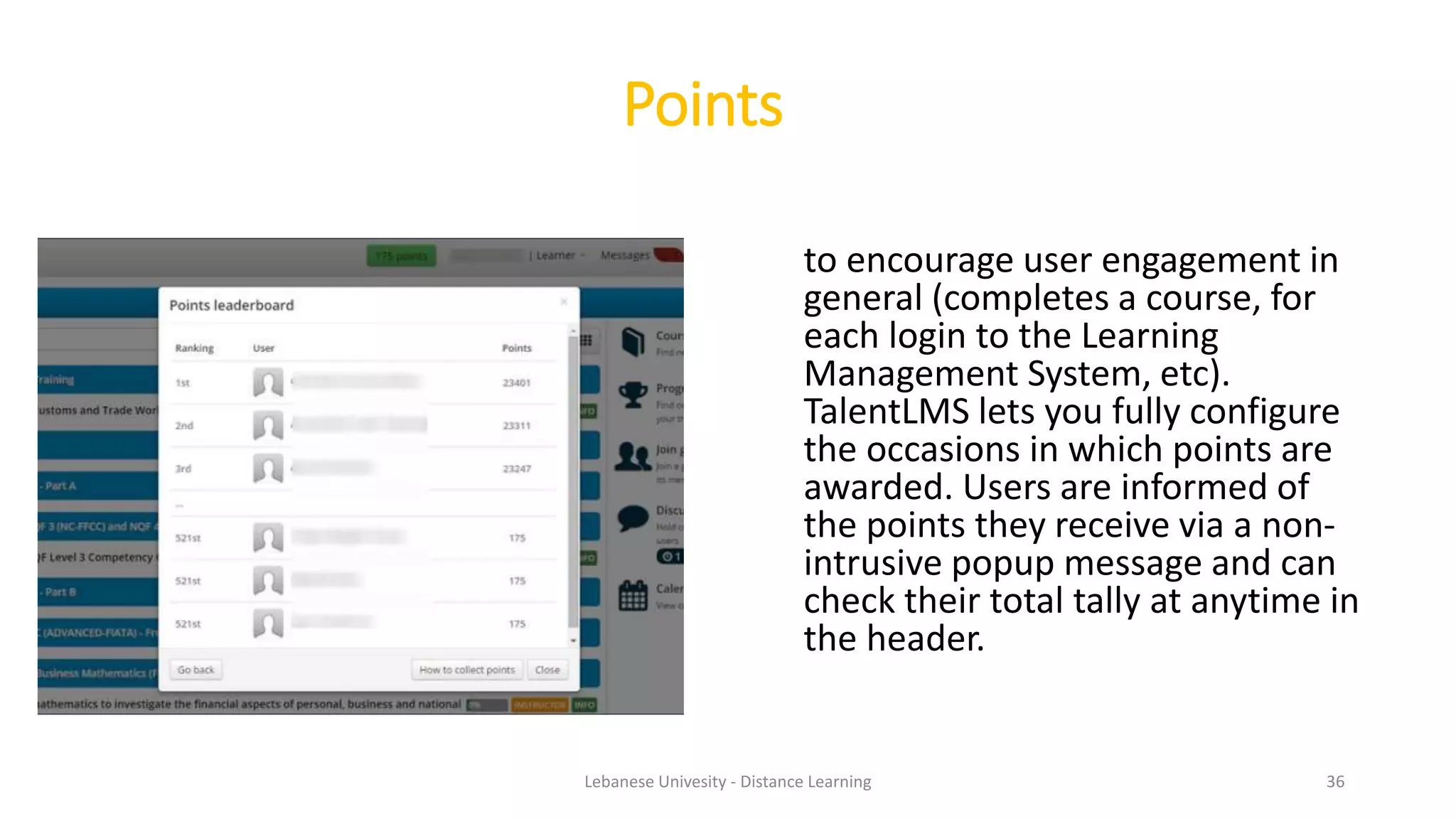
• to encourage user engagement
in general (completes a course,
for each login to the Learning
Management System, etc).
TalentLMS lets you fully
configure the occasions in which
points are awarded. Users are
informed of the points they
receive via a non-intrusive popup
message and can check their
total tally at anytime in the
header.
Points
Lebanese Univesity - Distance Learning 35
to encourage user engagement in
general (completes a course, for
each login to the Learning
Management System, etc).
TalentLMS lets you fully configure
the occasions in which points are
awarded. Users are informed of
the points they receive via a non-
intrusive popup message and can
check their total tally at anytime in
the header.
Points
Lebanese Univesity - Distance Learning 36
Badges are awarded to users on
certain achievements and are
displayed in their header and
profile page. The badging
system features 8 categories,
with each category offering 8
levels of badges, and has been
designed to make acquiring
badges increasingly difficult as
the user progresses (to keep the
whole thing interesting).
Badges
Lebanese Univesity - Distance Learning 37
• Badges in TalentLMS are compatible with Mozilla’s OpenBadges initiative,
and administrators are also given the option customize all of the badge
icons and descriptions.
Badges
Lebanese Univesity - Distance Learning 38
Levels are like ranking up in the
army or getting a promotion at
work. In TalentLMS all users
start at level 1 and progress
from there, and getting to a
higher level makes more courses
available
Levels
Lebanese Univesity - Distance Learning 39
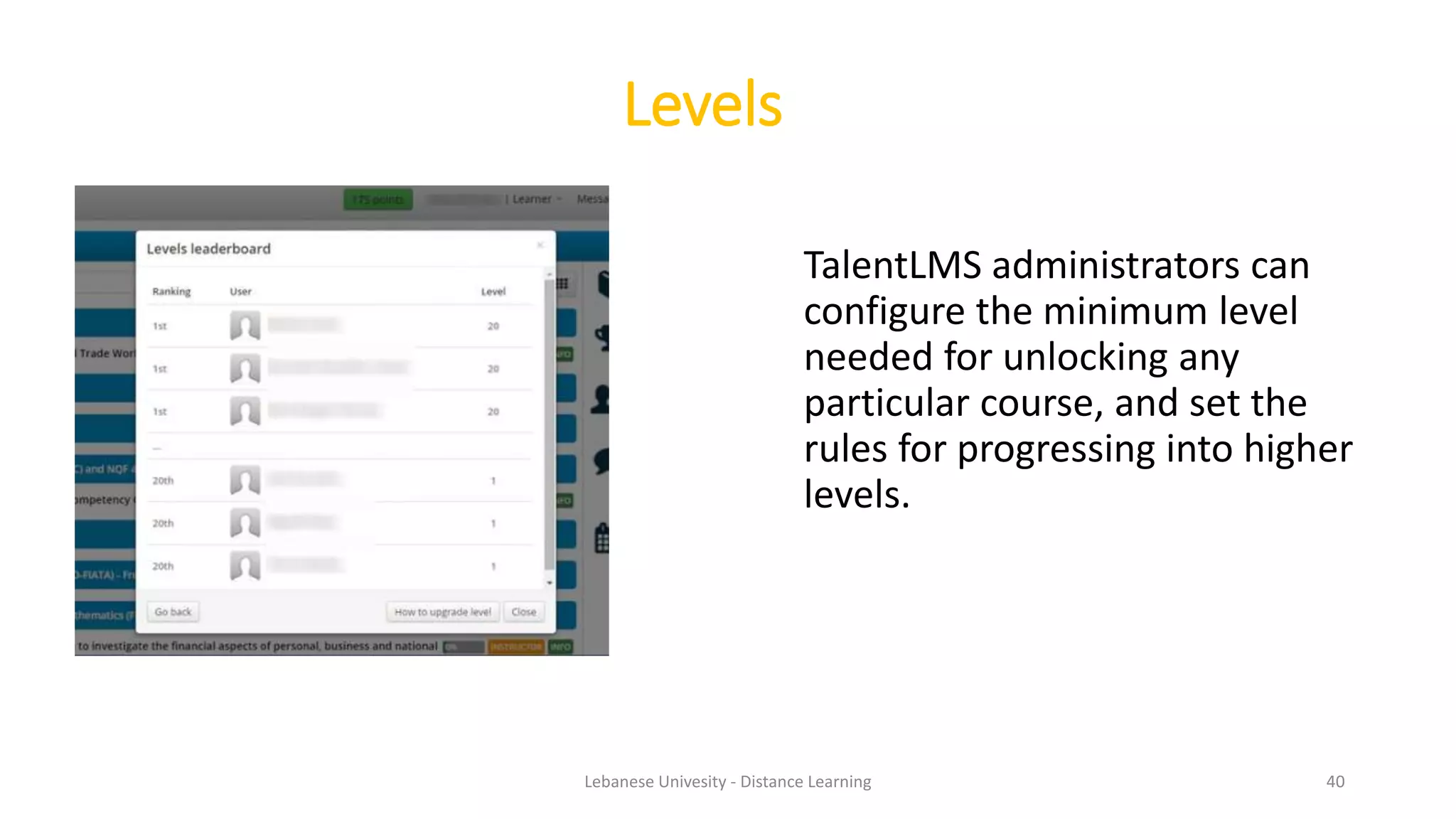
TalentLMS administrators can
configure the minimum level
needed for unlocking any
particular course, and set the
rules for progressing into higher
levels.
Levels
Lebanese Univesity - Distance Learning 40
Leaderboards is just a gamification
name for a “high score” list.
A TalentLMS leaderboard is
basically a webpage that offers a
visual depiction of the user's
ranking under various metrics
(Points, Badges, Certifications,
etc.) compared to fellow learners;
including the very best (“high
scores”) and others immediately
above and below them.
LeaderBoards
Lebanese Univesity - Distance Learning 41
The idea here is to give users a
good overview of their position
compared to others, so that
they get motivated to improve
it.
LeaderBoards
Lebanese Univesity - Distance Learning 42
TalentLMS offers Rewards.
Unlike other gamification
elements that are mostly
symbolic, rewards involve
actually, err, rewarding the users
for their engagement, e.g. by
giving them a discount, some
special offer, etc.
Rewards
Lebanese Univesity - Distance Learning 43
Gamification In LMS
AcademyLMS AccordLMS Axonify ExpertusOne MatrixLms TalentLms
Points Activity points Social learning Points Leaderboard Points
Badges Badges
Microlearning
features on
mobile
Progress
tracking
Points Levels
Leaderboards Leaderboards Leaderboards
Customizable
badges
Badges Leaderboards
Social learning
User profiles and
dashboards
Points Prizes Levels RewardsLebanese Univesity - Distance Learning 44
Lebanese Univesity - Distance Learning 45
Resources
• https://elearninginfographics.com/gamification-elearning-infographic/ 1
•https://elearningindustry.com/top-gamification-statistics-and-facts-for-20152
• Coursera: https://www.coursera.org/learn/gamification
• Tedx: https://www.youtube.com/watch?v=v5Qjuegtiyc
• https://www.ted.com/talks/jane_mcgonigal_gaming_can_make_a_better_
world
• Book: Reality is Broken by Jane Mcgonial
• https://www.worldgovernmentsummit.org/api/publications/document?id=
2b0d6ac4-e97c-6578-b2f8-ff0000a7ddb6
• www.Talentlms.com
Lebanese Univesity - Distance Learning 46

Gamification in Education

  • 1.
    Gamification In Education Presentedby Bilal Saadeh Distance Learning Course Dr. Hisham Khoury Lebanese Univesity - Distance Learning 1
  • 2.
    What is Gamification GeneralDefinition Gamification is the process of taking something that already exists – a website, an enterprise application, an online community – and integrating game mechanics into it to motivate participation, engagement, and loyalty. Lebanese Univesity - Distance Learning 2
  • 3.
    The gamification oflearning (in education) is an educational approach to motivate students to learn by using video game design and game elements in learning environments. The goal is to maximize enjoyment and engagement through capturing the interest of learners and inspiring them to continue learning. Gamification In Education Lebanese Univesity - Distance Learning 3
  • 4.
    Lebanese Univesity -Distance Learning 4
  • 5.
    History of Gamfication 1912 AmericanJack popcorn – Distributing Prizes Lebanese Univesity - Distance Learning 5
  • 6.
    History of Gamfication 1980 Telnet– MUD By Roy Trubshaw and Richard Bartle1 Essex university Lebanese Univesity - Distance Learning 6
  • 7.
    History of Gamfication 1980 Telnet– MUD By Roy Trubshaw and Richard Bartle Lebanese Univesity - Distance Learning 7
  • 8.
    History of Gamfication 1980– Present Researches to show that kids can learn from video games Lebanese Univesity - Distance Learning 8
  • 9.
    History of Gamfication 1989 Firstgraphical educational game Lebanese Univesity - Distance Learning 9
  • 10.
    History of Gamfication 2002–Present Building Simulations for private, academic, military sectors Lebanese Univesity - Distance Learning 10
  • 11.
    History of Gamfication 2003– Conundra Converting the hardware into entertaining platform Lebanese Univesity - Distance Learning 11
  • 12.
    History of Gamfication 2011– present Jane McGonigal’s game- changer, Reality is Broken is officially released at the summit. Lebanese Univesity - Distance Learning 12
  • 13.
    Where we findgamification Heath Marketing Politics Training Education Lebanese Univesity - Distance Learning 13
  • 14.
    • Hours Played Peoplespends 3 Billions hour per week playing games Gamfication Stats • Expected Market Growth 2015: 1.7 Billion $ 2018: 5.5 Billion $ Lebanese Univesity - Distance Learning 14
  • 15.
    • Gamers Age ofaverage Gamers is 35 years around the world Gamfication Stats • Who Plays2 61% CEO, CFO takes daily breaks to games Lebanese Univesity - Distance Learning 15
  • 16.
    Why Gamification 1.Better learningexperience. The learner can experience “fun” during the game and still learn if the level of engagement is high. A good gamification strategy with high levels of engagement will lead to an increase in recall and retention. 2.Better learning environment. Gamification in eLearning provides an effective, informal learning environment, and helps learners practice real-life situations and challenges in a safe environment. This leads to a more engaged learning experience that facilitates better knowledge retention. 3.Instant feedback. It provides instant feedback so that learners know what they know or what they should know. This too facilitates better learner engagement and thereby better recall and retention. Lebanese Univesity - Distance Learning 16
  • 17.
    • The freedomto fail: games allow mistakes to be made with little consequence; • The freedom to experiment: games allow players to explore and discover new strategies and pieces of information; • The freedom to discover different identities: games encourage players to see problems from a different perspective; • The freedom of effort: games allow players to go through periods of intense activity and relative inactivity, so that players can pause and reflect on tasks they have accomplished. Why Gamification in E-Learning Lebanese Univesity - Distance Learning 17
  • 18.
  • 19.
  • 20.
    Structure of Gamifiction Mechenical Emotional Personal Gamificationcan be broken down into individual elements, each of which bring specific advantages and disadvantages to educational processes. These categories include how game elements can trigger greater engagement through their internal design, how they foster student engagement, and – ultimately – creating an environment of intense focus that stimulates learning and retention of information. We have classified these elements into three categories: mechanical, personal and emotional. Lebanese Univesity - Distance Learning 20
  • 21.
    Structure of Gamificationin Education Lebanese Univesity - Distance Learning 21
  • 22.
    Mechanical Structure Incremental Progressionsystem: goals, challenges, quests… A game’s sub-goals, often called missions, levels, or quests, are layered in such a way as to present incremental challenges to the player. They are clearly defined and segmented, and in many cases offer rewards. Lebanese Univesity - Distance Learning 22
  • 23.
    Mechanical Structure Badges Provides moreintermediate goals for the game, to ensure that the player is not only focused on the immediate task, which might lead to lack of interest once completed, or on the ultimate goal of the course, which might be too far off to trigger motivation. Lebanese Univesity - Distance Learning 23
  • 24.
    Mechanical Structure OnBoarding Accessibility Onboardingconcerns the first interaction a player has with a game. Most games, particularly video games, have tutorials, which aim to guide players through the initial first few minutes of play. In a gamified educational environment this serves two purposes. Lebanese Univesity - Distance Learning 24
  • 25.
    Mechanical Structure OnBoarding Accessibility Second,it saves time for the teacher, who would otherwise be required to explain the process of the experience to the class – a time-consuming and non-individualised mechanism for conveying information. First, it helps decrease uncertainty among the students about how to complete the task. Lebanese Univesity - Distance Learning 25
  • 26.
    Mechanical Structure Rapid Feedback Gamesare designed to be responsive. The consequences of a player’s choice or action during a game are either apparent to them as they make the decision or relayed to them almost immediately. Lebanese Univesity - Distance Learning 26
  • 27.
    Personal Avatars In the contextof education, gamification of this type may allow students to project a profile of themselves. It can allow students to experiment with different forms of identity and approach their studies from different perspectives. The benefits of this form of gamification are primarily social. Part of the appeal of games is that they allow players to adopt new identities or roles, and make meaningful decisions in-game from an unfamiliar vantage point. Lebanese Univesity - Distance Learning 27
  • 28.
    Personal This form ofgamification is designed to use group-based activities to provide an incentive for learners to keep learning. Collective Responsibility Applying this element of gamification to education is relatively simple, and largely pre-dates the gamification movement. By giving students a level of social responsibility, their emotional investment may increase. Lebanese Univesity - Distance Learning 28
  • 29.
    Personal LeaderBoards All competitive gamesrank their players in order of ability or achievement, and the most widely used of these is the leaderboard, where players or teams are displayed using a points-based system demonstrating accumulated results. The introduction of leaderboards is among the most common elements of gamification. Lebanese Univesity - Distance Learning 29
  • 30.
    • One ofthe key principles of games is that they bring players into a mental state called “flow”, a state of total focus on the task at hand. This idea was pioneered by psychologist Mihaly Csikszentmihalyi, who suggests that there are three necessary conditions for flow to be achieved: • A clear goal, or set of goals. This adds structure and direction to the task. • Clear and immediate feedback. This helps people adjust their performance to meet any changing demands. • Balance between challenge and skill. For flow to be achieved, a person must consider the challenge level to be appropriate – they can neither be bored nor anxious. Flow Lebanese Univesity - Distance Learning 30
  • 31.
    • Feasibility • StudentInterests • Misaligned objectives • Inappropriately applied gamification What lacks Gamification Lebanese Univesity - Distance Learning 31
  • 32.
    The most importantthing is for teachers to avoid introducing chocolate-covered broccoli! It may look good at first, but learners will know what they’re being fed by the time they take the first bite. If gamification is applied to educational content in an inconsiderate way, learners are likely to only focus on the rewards and not the learning process itself. This will end in frustration for both educators and learners, and will kill the effort more or less immediately. What lacks Gamification Lebanese Univesity - Distance Learning 32
  • 33.
    Quest to Learnis a fully gamified high school in Manhattan with an innovative educational philosophy developed by top educators and game theorists at The Institute of Play, with funding from The MacArthur Foundation. Real Examples About Gamification Lebanese Univesity - Distance Learning 33
  • 34.
    • TalentLMS integratessome of the more well-known and battle-tested techniques, such as Points, Badges, Levels, Leaderboards, and Rewards. TalentLMS Lebanese Univesity - Distance Learning 34
  • 35.
    • to encourageuser engagement in general (completes a course, for each login to the Learning Management System, etc). TalentLMS lets you fully configure the occasions in which points are awarded. Users are informed of the points they receive via a non-intrusive popup message and can check their total tally at anytime in the header. Points Lebanese Univesity - Distance Learning 35
  • 36.
    to encourage userengagement in general (completes a course, for each login to the Learning Management System, etc). TalentLMS lets you fully configure the occasions in which points are awarded. Users are informed of the points they receive via a non- intrusive popup message and can check their total tally at anytime in the header. Points Lebanese Univesity - Distance Learning 36
  • 37.
    Badges are awardedto users on certain achievements and are displayed in their header and profile page. The badging system features 8 categories, with each category offering 8 levels of badges, and has been designed to make acquiring badges increasingly difficult as the user progresses (to keep the whole thing interesting). Badges Lebanese Univesity - Distance Learning 37
  • 38.
    • Badges inTalentLMS are compatible with Mozilla’s OpenBadges initiative, and administrators are also given the option customize all of the badge icons and descriptions. Badges Lebanese Univesity - Distance Learning 38
  • 39.
    Levels are likeranking up in the army or getting a promotion at work. In TalentLMS all users start at level 1 and progress from there, and getting to a higher level makes more courses available Levels Lebanese Univesity - Distance Learning 39
  • 40.
    TalentLMS administrators can configurethe minimum level needed for unlocking any particular course, and set the rules for progressing into higher levels. Levels Lebanese Univesity - Distance Learning 40
  • 41.
    Leaderboards is justa gamification name for a “high score” list. A TalentLMS leaderboard is basically a webpage that offers a visual depiction of the user's ranking under various metrics (Points, Badges, Certifications, etc.) compared to fellow learners; including the very best (“high scores”) and others immediately above and below them. LeaderBoards Lebanese Univesity - Distance Learning 41
  • 42.
    The idea hereis to give users a good overview of their position compared to others, so that they get motivated to improve it. LeaderBoards Lebanese Univesity - Distance Learning 42
  • 43.
    TalentLMS offers Rewards. Unlikeother gamification elements that are mostly symbolic, rewards involve actually, err, rewarding the users for their engagement, e.g. by giving them a discount, some special offer, etc. Rewards Lebanese Univesity - Distance Learning 43
  • 44.
    Gamification In LMS AcademyLMSAccordLMS Axonify ExpertusOne MatrixLms TalentLms Points Activity points Social learning Points Leaderboard Points Badges Badges Microlearning features on mobile Progress tracking Points Levels Leaderboards Leaderboards Leaderboards Customizable badges Badges Leaderboards Social learning User profiles and dashboards Points Prizes Levels RewardsLebanese Univesity - Distance Learning 44
  • 45.
    Lebanese Univesity -Distance Learning 45
  • 46.
    Resources • https://elearninginfographics.com/gamification-elearning-infographic/ 1 •https://elearningindustry.com/top-gamification-statistics-and-facts-for-20152 •Coursera: https://www.coursera.org/learn/gamification • Tedx: https://www.youtube.com/watch?v=v5Qjuegtiyc • https://www.ted.com/talks/jane_mcgonigal_gaming_can_make_a_better_ world • Book: Reality is Broken by Jane Mcgonial • https://www.worldgovernmentsummit.org/api/publications/document?id= 2b0d6ac4-e97c-6578-b2f8-ff0000a7ddb6 • www.Talentlms.com Lebanese Univesity - Distance Learning 46

Editor's Notes

  • #10 The company of cracker jack started to put toys inside the
  • #19 Games are most boring…
  • #20 Gamification of Education: A Review of Literature 1 Department of Business and Information Technology, Missouri University of Science and Technology, Rolla, Missouri, United States
  • #21 Gamification of Education: A Review of Literature 1 Department of Business and Information Technology, Missouri University of Science and Technology, Rolla, Missouri, United States
  • #22 Gamification of Education: A Review of Literature 1 Department of Business and Information Technology, Missouri University of Science and Technology, Rolla, Missouri, United States