
Towards a framework for applying
Gamification in Education
Konstantina Tzouvara
konstantina.tzouvara@st.ouc.ac.cy,
Dr. Panagiotis Zaharias
panagiotis.zacharias@ouc.ac.cy
Presented at 7th International Conference in Open and

Distance Learning - ICODL 2013
Gamification
• Gamification is the use of game design elements
and game mechanics in non-game contexts.
• Mechanics such as assigning points to
activities, advancing through levels, using badges
as status-markers, integrating surprise and
delight etc.
• Why?
– to increase
motivation, engagement, effectiveness, loyalty

• … the ultimate goal is to change people’s
behaviour for the better.
Playful design to affect behavior
• Examples:
• The funtheory.com
http://www.thefuntheory.com/

The piano stairs
http://www.youtube.com/watch?v=2lXh2n0aPyw
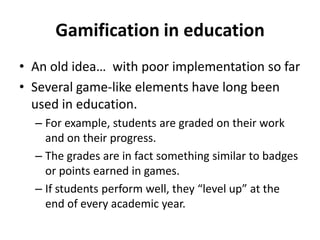
Gamification in education
• An old idea… with poor implementation so far
• Several game-like elements have long been
used in education.
– For example, students are graded on their work
and on their progress.
– The grades are in fact something similar to badges
or points earned in games.
– If students perform well, they “level up” at the
end of every academic year.
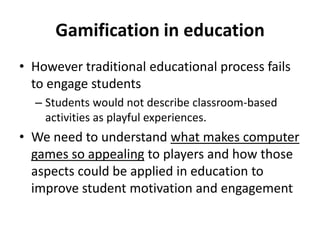
Gamification in education
• However traditional educational process fails
to engage students
– Students would not describe classroom-based
activities as playful experiences.

• We need to understand what makes computer
games so appealing to players and how those
aspects could be applied in education to
improve student motivation and engagement
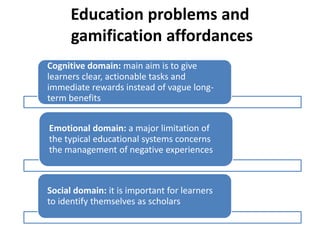
Education problems and
gamification affordances
Cognitive domain: main aim is to give
learners clear, actionable tasks and
immediate rewards instead of vague longterm benefits
Emotional domain: a major limitation of
the typical educational systems concerns
the management of negative experiences

Social domain: it is important for learners
to identify themselves as scholars
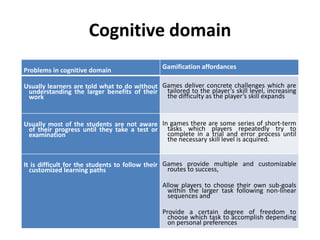
Cognitive domain
Problems in cognitive domain

Gamification affordances

Usually learners are told what to do without Games deliver concrete challenges which are
understanding the larger benefits of their tailored to the player’s skill level, increasing
the difficulty as the player’s skill expands
work

Usually most of the students are not aware In games there are some series of short-term
of their progress until they take a test or tasks which players repeatedly try to
complete in a trial and error process until
examination
the necessary skill level is acquired.
It is difficult for the students to follow their Games provide multiple and customizable
routes to success,
customized learning paths
Allow players to choose their own sub-goals
within the larger task following non-linear
sequences and
Provide a certain degree of freedom to
choose which task to accomplish depending
on personal preferences
Emotional domain
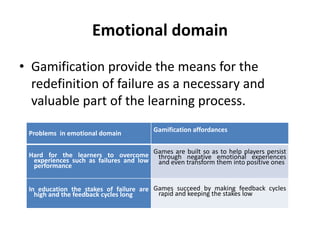
• Gamification provide the means for the
redefinition of failure as a necessary and
valuable part of the learning process.
Problems in emotional domain
Hard for the learners to overcome
experiences such as failures and low
performance

Gamification affordances
Games are built so as to help players persist
through negative emotional experiences
and even transform them into positive ones

In education the stakes of failure are Games succeed by making feedback cycles
rapid and keeping the stakes low
high and the feedback cycles long
Social domain
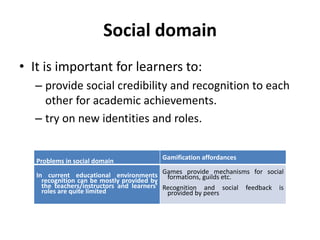
• It is important for learners to:
– provide social credibility and recognition to each
other for academic achievements.
– try on new identities and roles.

Problems in social domain

Gamification affordances

Games provide mechanisms for social
In current educational environments formations, guilds etc.
recognition can be mostly provided by
the teachers/instructors and learners’ Recognition and social feedback is
roles are quite limited
provided by peers
Gamification in e-learning
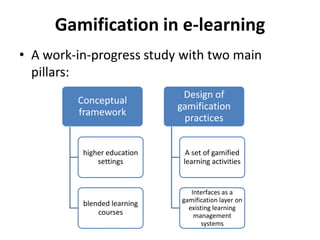
• A work-in-progress study with two main
pillars:
Conceptual
framework

Design of
gamification
practices

higher education
settings

A set of gamified
learning activities

blended learning
courses

Interfaces as a
gamification layer on
existing learning
management
systems
Thank you !
panagiotis.zacharias@ouc.ac.cy

Gamification in education

  • 1.
    Towards a frameworkfor applying Gamification in Education Konstantina Tzouvara konstantina.tzouvara@st.ouc.ac.cy, Dr. Panagiotis Zaharias panagiotis.zacharias@ouc.ac.cy Presented at 7th International Conference in Open and Distance Learning - ICODL 2013
  • 2.
    Gamification • Gamification isthe use of game design elements and game mechanics in non-game contexts. • Mechanics such as assigning points to activities, advancing through levels, using badges as status-markers, integrating surprise and delight etc. • Why? – to increase motivation, engagement, effectiveness, loyalty • … the ultimate goal is to change people’s behaviour for the better.
  • 3.
    Playful design toaffect behavior • Examples: • The funtheory.com http://www.thefuntheory.com/ The piano stairs http://www.youtube.com/watch?v=2lXh2n0aPyw
  • 4.
    Gamification in education •An old idea… with poor implementation so far • Several game-like elements have long been used in education. – For example, students are graded on their work and on their progress. – The grades are in fact something similar to badges or points earned in games. – If students perform well, they “level up” at the end of every academic year.
  • 5.
    Gamification in education •However traditional educational process fails to engage students – Students would not describe classroom-based activities as playful experiences. • We need to understand what makes computer games so appealing to players and how those aspects could be applied in education to improve student motivation and engagement
  • 6.
    Education problems and gamificationaffordances Cognitive domain: main aim is to give learners clear, actionable tasks and immediate rewards instead of vague longterm benefits Emotional domain: a major limitation of the typical educational systems concerns the management of negative experiences Social domain: it is important for learners to identify themselves as scholars
  • 7.
    Cognitive domain Problems incognitive domain Gamification affordances Usually learners are told what to do without Games deliver concrete challenges which are understanding the larger benefits of their tailored to the player’s skill level, increasing the difficulty as the player’s skill expands work Usually most of the students are not aware In games there are some series of short-term of their progress until they take a test or tasks which players repeatedly try to complete in a trial and error process until examination the necessary skill level is acquired. It is difficult for the students to follow their Games provide multiple and customizable routes to success, customized learning paths Allow players to choose their own sub-goals within the larger task following non-linear sequences and Provide a certain degree of freedom to choose which task to accomplish depending on personal preferences
  • 8.
    Emotional domain • Gamificationprovide the means for the redefinition of failure as a necessary and valuable part of the learning process. Problems in emotional domain Hard for the learners to overcome experiences such as failures and low performance Gamification affordances Games are built so as to help players persist through negative emotional experiences and even transform them into positive ones In education the stakes of failure are Games succeed by making feedback cycles rapid and keeping the stakes low high and the feedback cycles long
  • 9.
    Social domain • Itis important for learners to: – provide social credibility and recognition to each other for academic achievements. – try on new identities and roles. Problems in social domain Gamification affordances Games provide mechanisms for social In current educational environments formations, guilds etc. recognition can be mostly provided by the teachers/instructors and learners’ Recognition and social feedback is roles are quite limited provided by peers
  • 10.
    Gamification in e-learning •A work-in-progress study with two main pillars: Conceptual framework Design of gamification practices higher education settings A set of gamified learning activities blended learning courses Interfaces as a gamification layer on existing learning management systems
  • 11.