
D2L Gamification 
Leveraging the Tools Already at Your Disposal
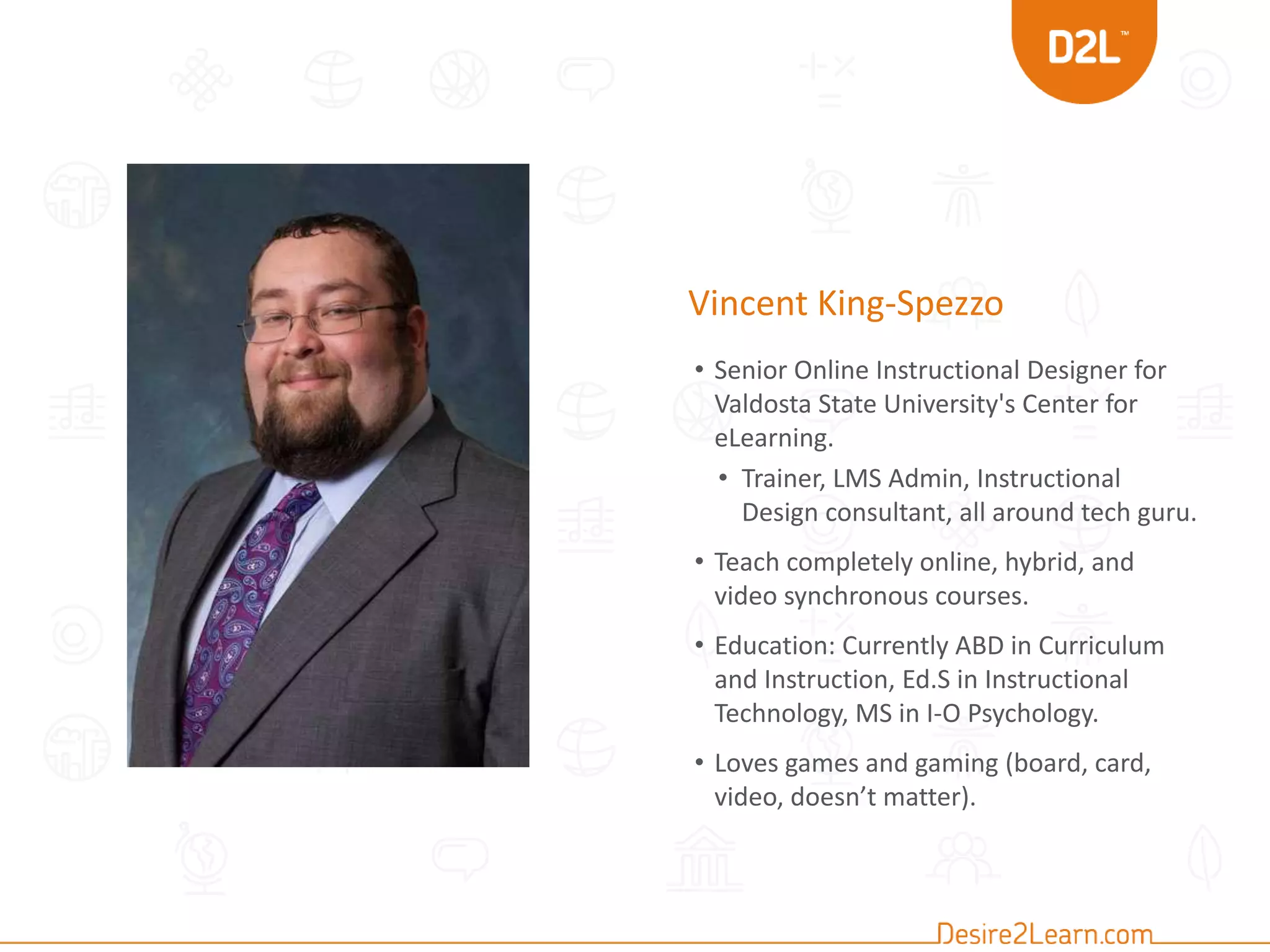
Vincent King-Spezzo 
• Senior Online Instructional Designer for 
Valdosta State University's Center for 
eLearning. 
• Trainer, LMS Admin, Instructional 
Design consultant, all around tech guru. 
• Teach completely online, hybrid, and 
video synchronous courses. 
• Education: Currently ABD in Curriculum 
and Instruction, Ed.S in Instructional 
Technology, MS in I-O Psychology. 
• Loves games and gaming (board, card, 
video, doesn’t matter).
Let’s play a game. 
1. Go to http://tinyurl.com/oa97kvl 
2. You will be asked a series of numbered questions 
that correspond to slides marked with 
and followed by a number. 
0 
3. Choose your answer to the question and click 
the “Next” button. If you are right, you will 
advance to the next question. If you are wrong, 
it’s game over.
Rules and Tips 
• Get all the questions right, and you win! 
• Win and you get a badge! 
• Be vigilant as I go through the presentation, not 
all question blocks are easy to spot. 
• Play fair. No cheating or answer sharing please. 
• You will need the slide to answer the question 
(unless you are a really good guesser). 
• If you miss even one you are out.
Gamification 101 
Brief Background on the Basics
Definitions (I’ve Got a Few) 
Gamification is… 
• The process of making non-game activities more 
fun and engaging. 
• Using game theories and mechanics to motivate 
non-game behaviors. 
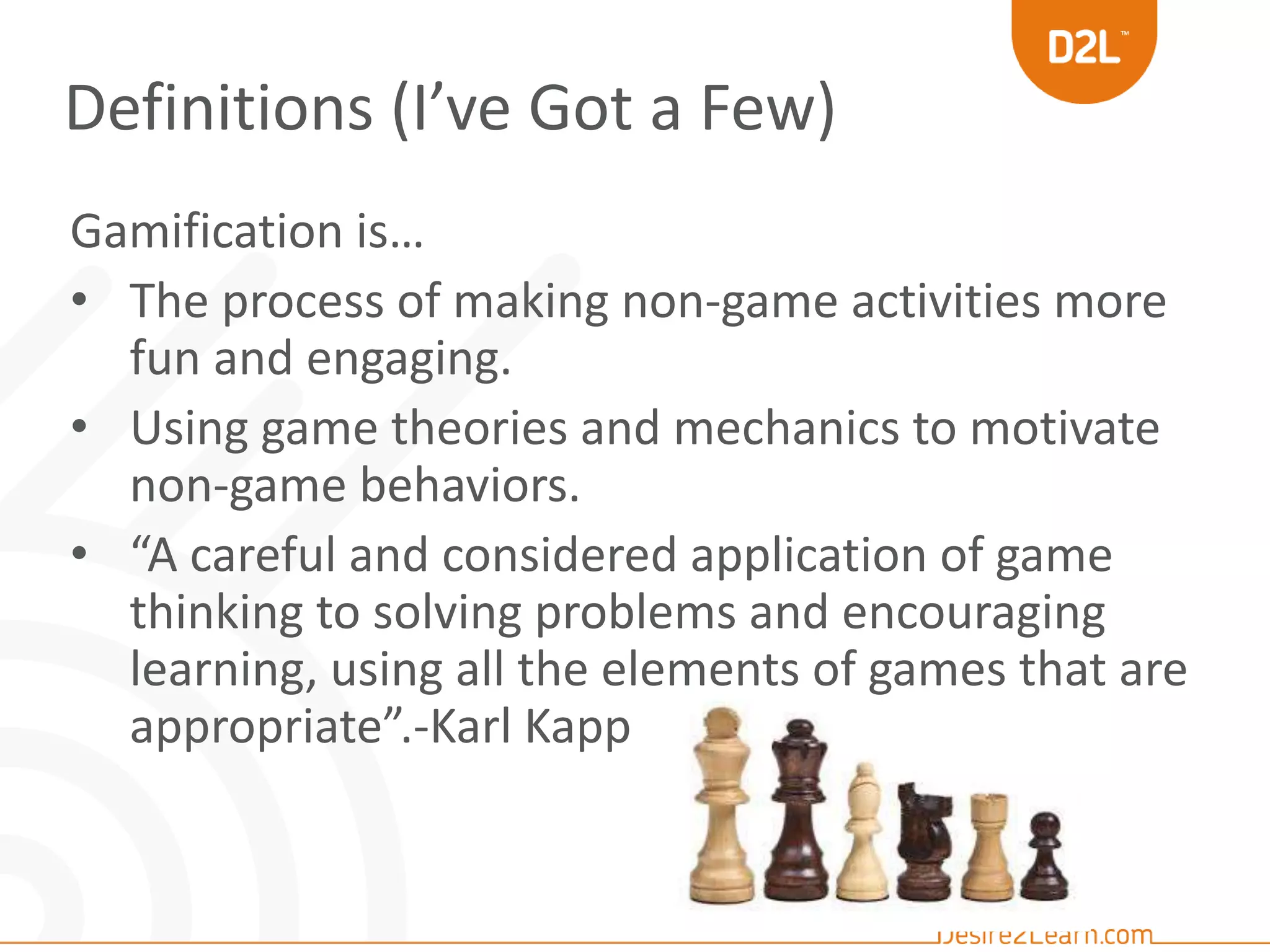
• “A careful and considered application of game 
thinking to solving problems and encouraging 
learning, using all the elements of games that are 
appropriate”.-Karl Kapp
Core Definition 
• Use of game elements and game design 
techniques in non-game contexts 
• Game elements 
• Parts of the game: Points, Badges 
Leaderboards, Achievements, Avatars, Levels, 
Quests, Rewards, Teams, Boss Fights, etc. 
• Game design techniques 
• Think like a game designer: Goals=Challenges, 
Participants=Players, Instruction=Tutorial, etc.
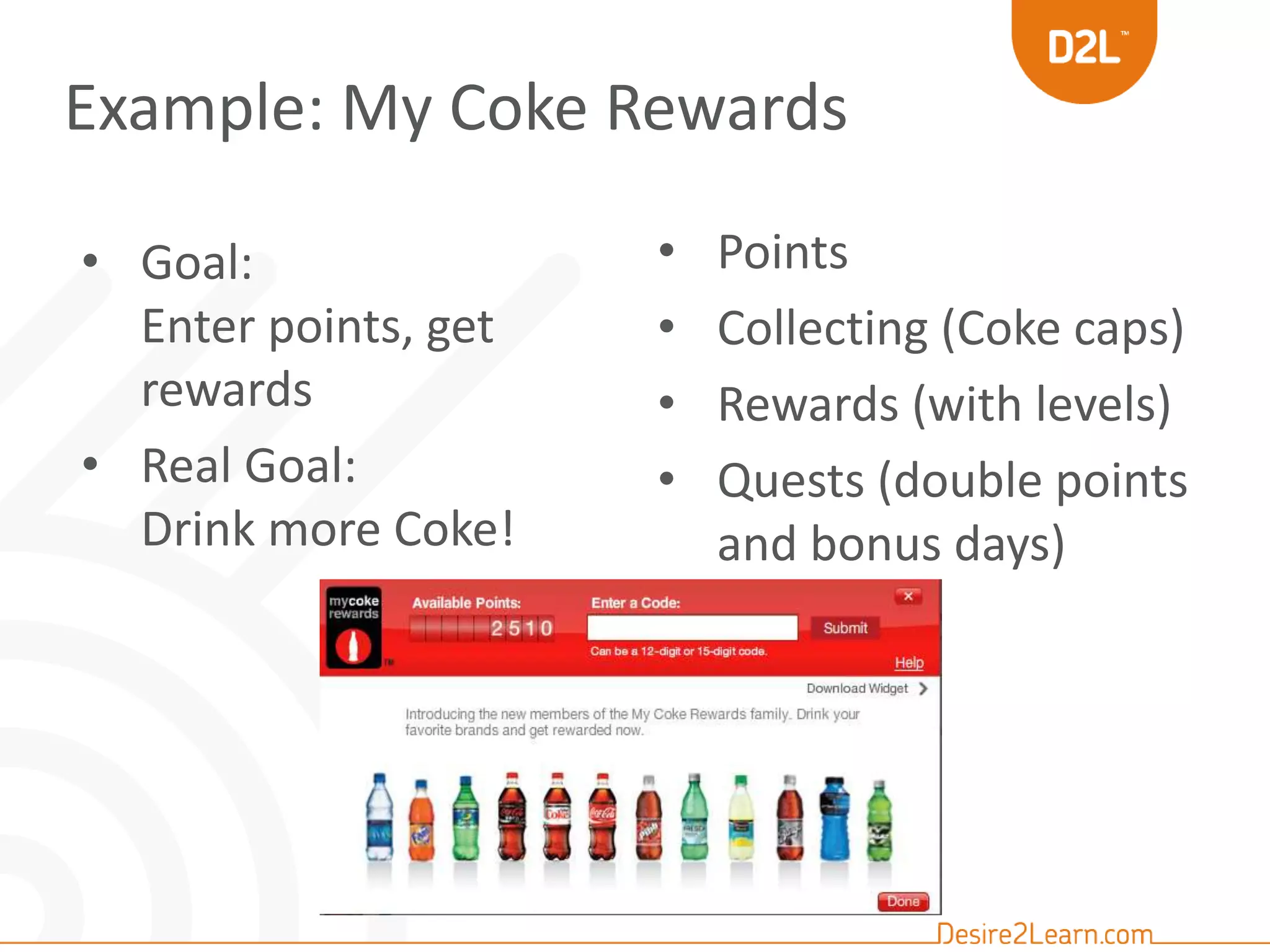
Example: My Coke Rewards 
• Points 
• Collecting (Coke caps) 
• Rewards (with levels) 
• Quests (double points 
and bonus days) 
• Goal: 
Enter points, get 
rewards 
• Real Goal: 
Drink more Coke!
PBL: The Gamification Trinity 
1 
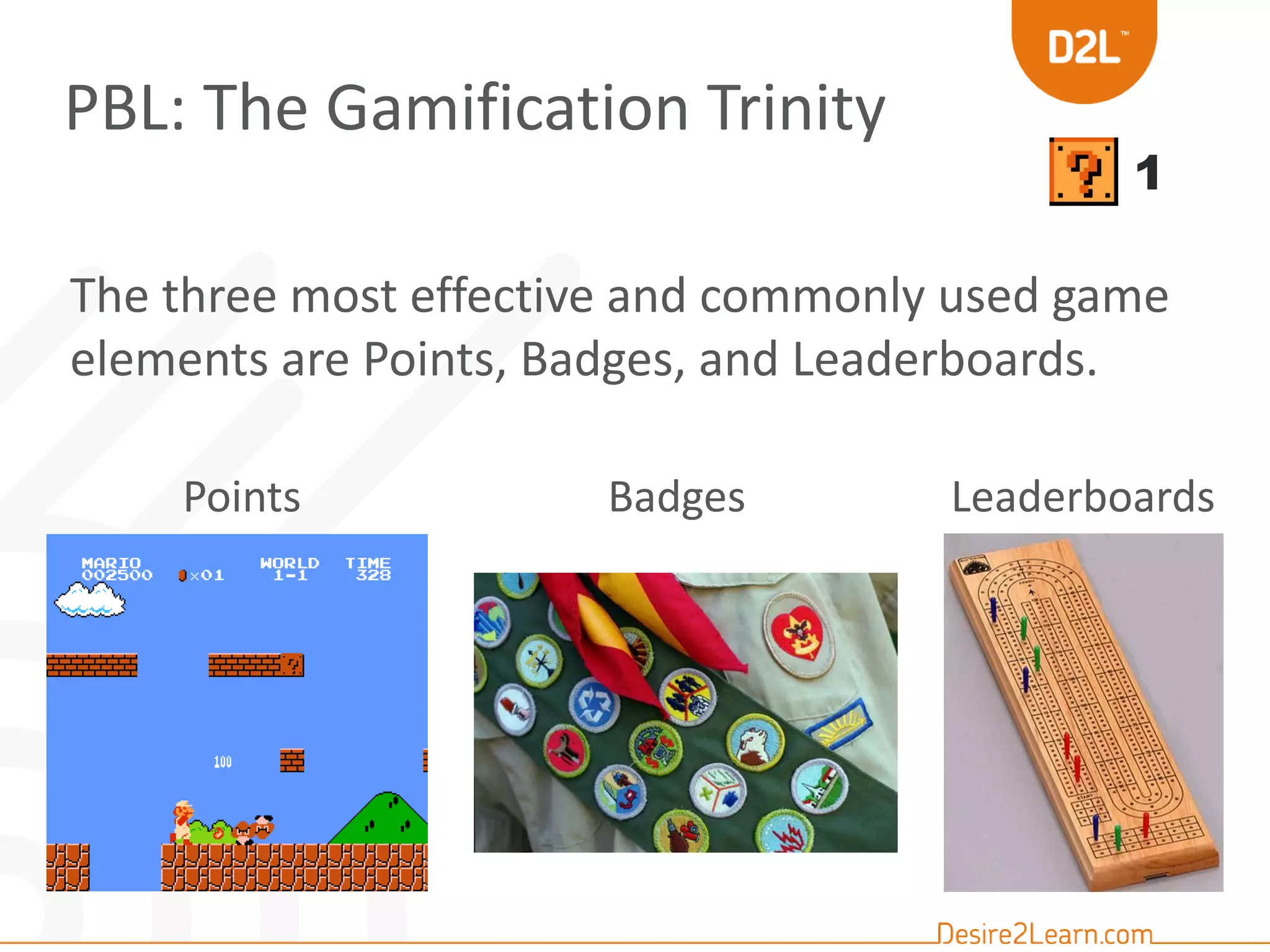
The three most effective and commonly used game 
elements are Points, Badges, and Leaderboards. 
Points Badges Leaderboards
Points 
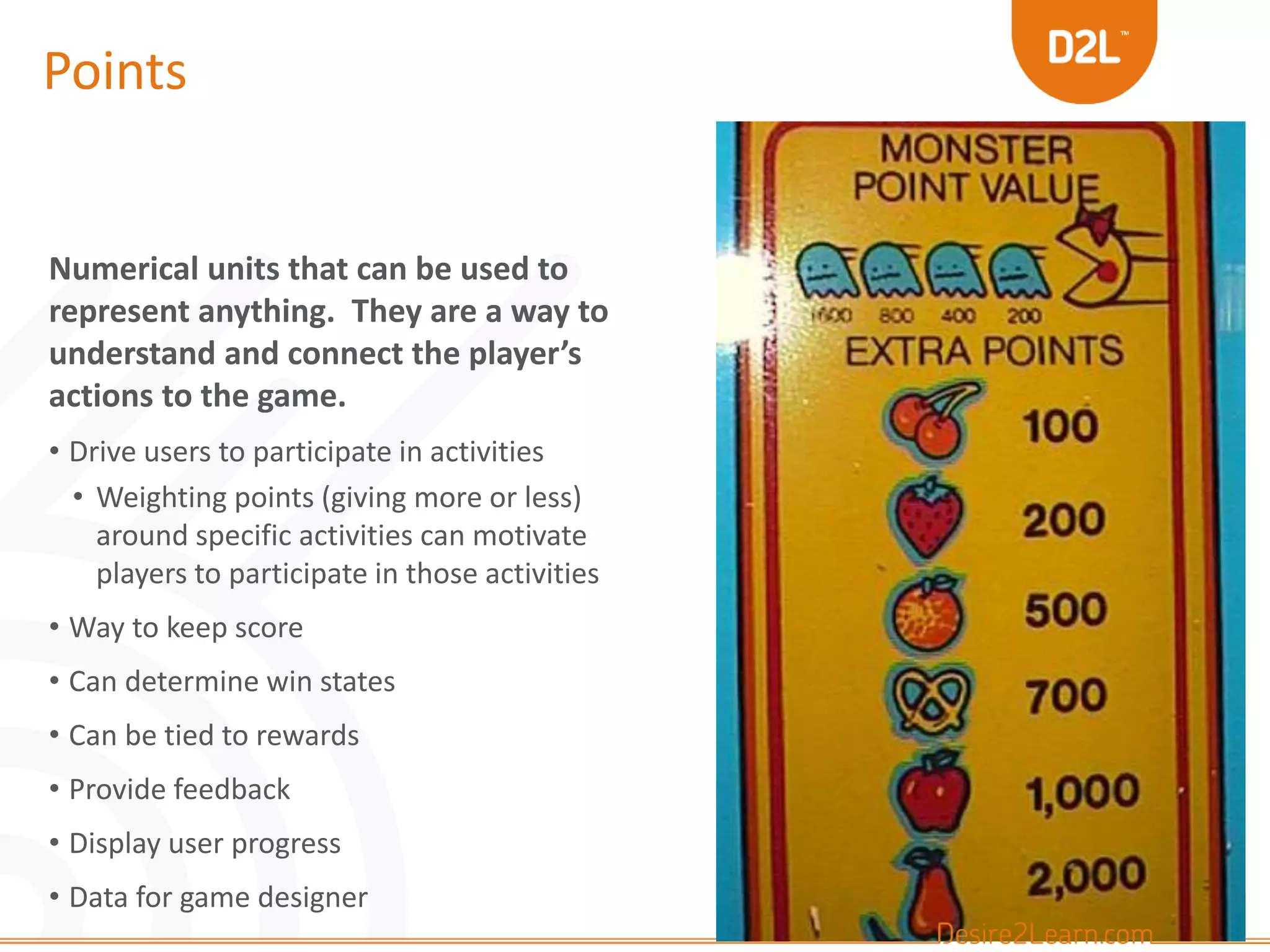
Numerical units that can be used to 
represent anything. They are a way to 
understand and connect the player’s 
actions to the game. 
• Drive users to participate in activities 
• Weighting points (giving more or less) 
around specific activities can motivate 
players to participate in those activities 
• Way to keep score 
• Can determine win states 
• Can be tied to rewards 
• Provide feedback 
• Display user progress 
• Data for game designer
Badges 
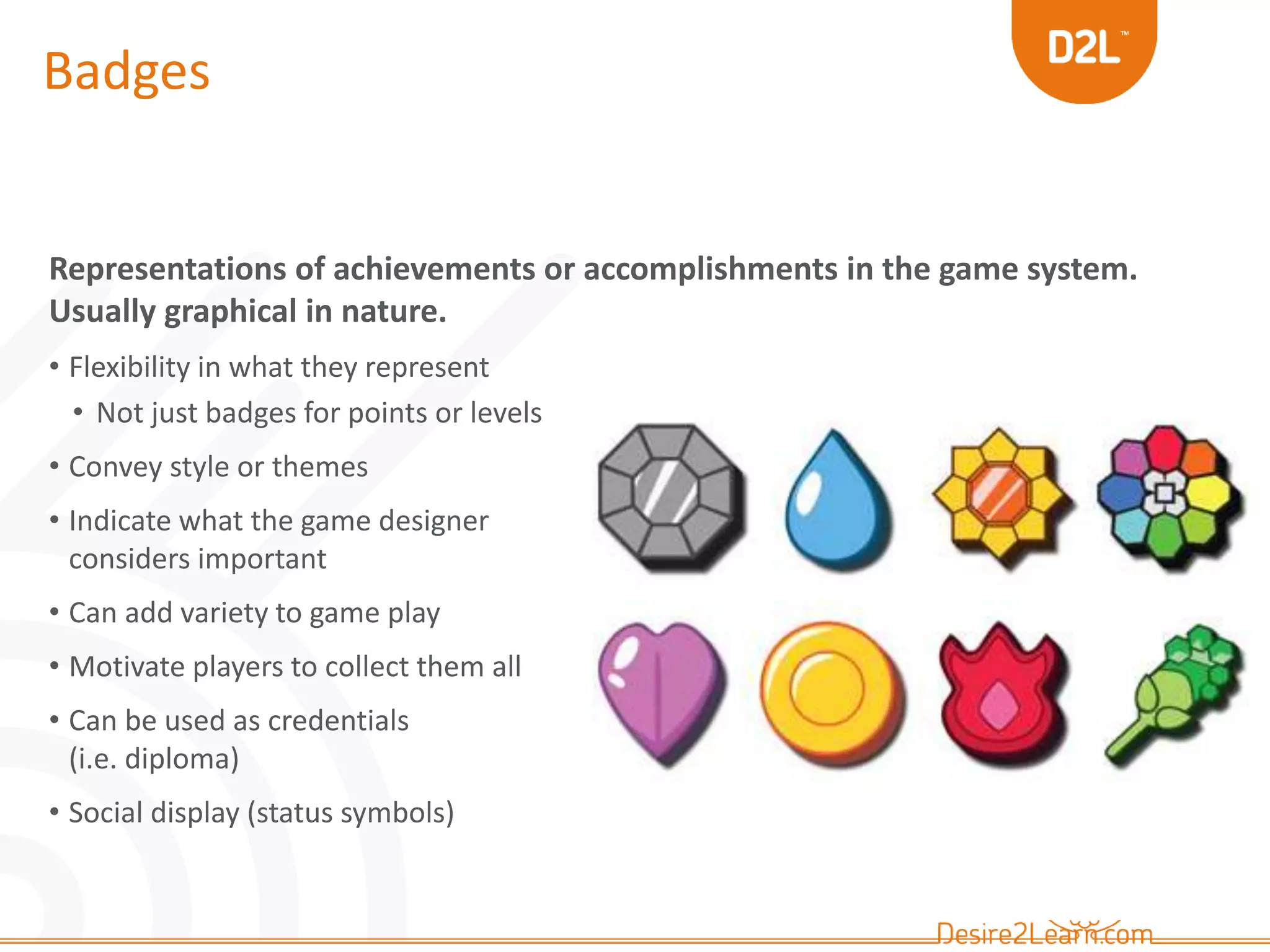
Representations of achievements or accomplishments in the game system. 
Usually graphical in nature. 
• Flexibility in what they represent 
• Not just badges for points or levels 
• Convey style or themes 
• Indicate what the game designer 
considers important 
• Can add variety to game play 
• Motivate players to collect them all 
• Can be used as credentials 
(i.e. diploma) 
• Social display (status symbols)
Leaderboards 
2 
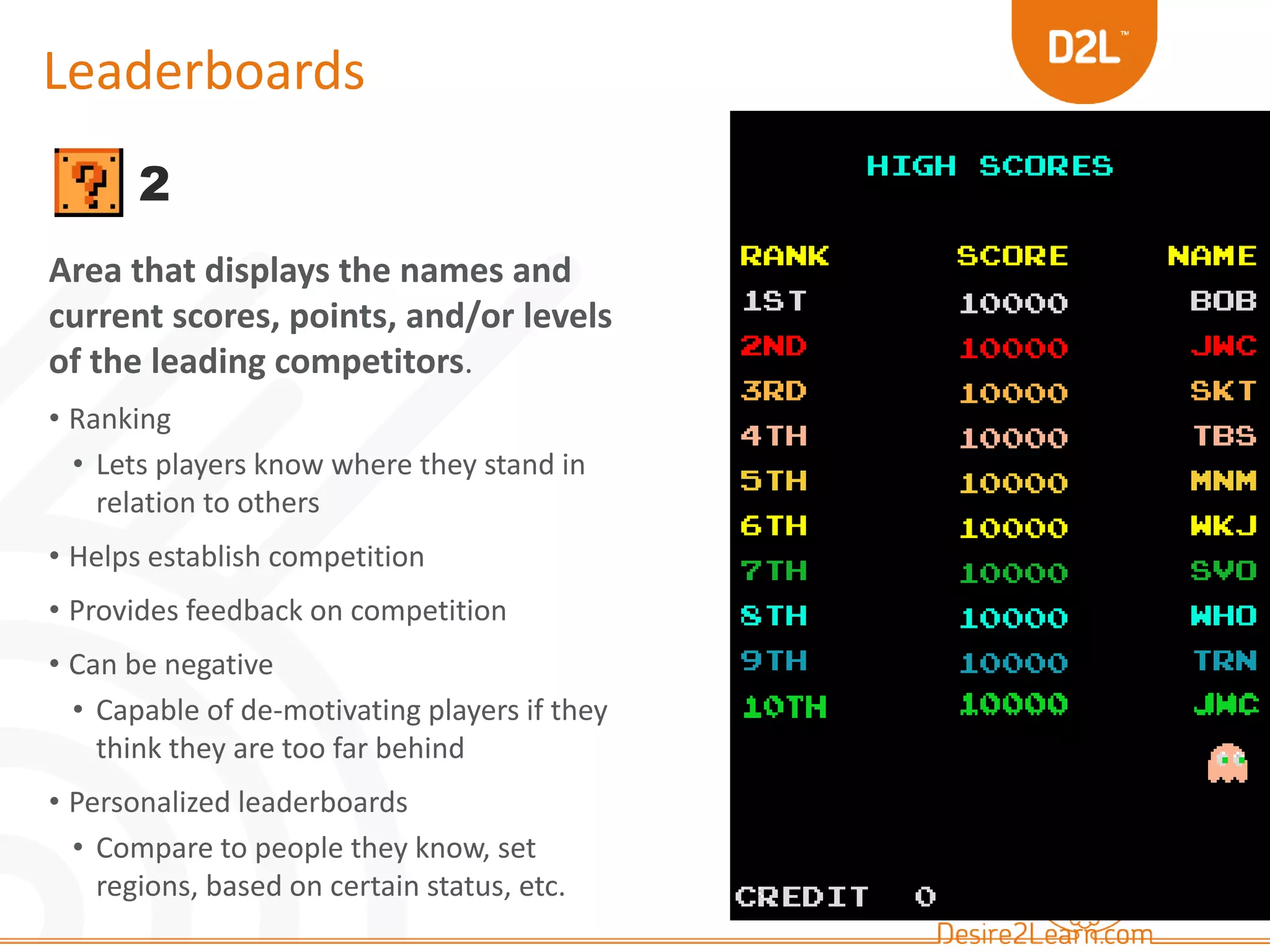
Area that displays the names and 
current scores, points, and/or levels 
of the leading competitors. 
• Ranking 
• Lets players know where they stand in 
relation to others 
• Helps establish competition 
• Provides feedback on competition 
• Can be negative 
• Capable of de-motivating players if they 
think they are too far behind 
• Personalized leaderboards 
• Compare to people they know, set 
regions, based on certain status, etc.
Just Scratching the Surface 
• Need more than just PBL for game elements. 
• Core elements and widely used, but you need more 
for a robust gaming system that players will continue 
to engage with. 
• The elements are not the game. 
• Elements are the blocks, game design is the glue. 
• It’s more than just about the reward. 
• If reward was enough, you wouldn’t need the game.
Some Advanced Concepts 
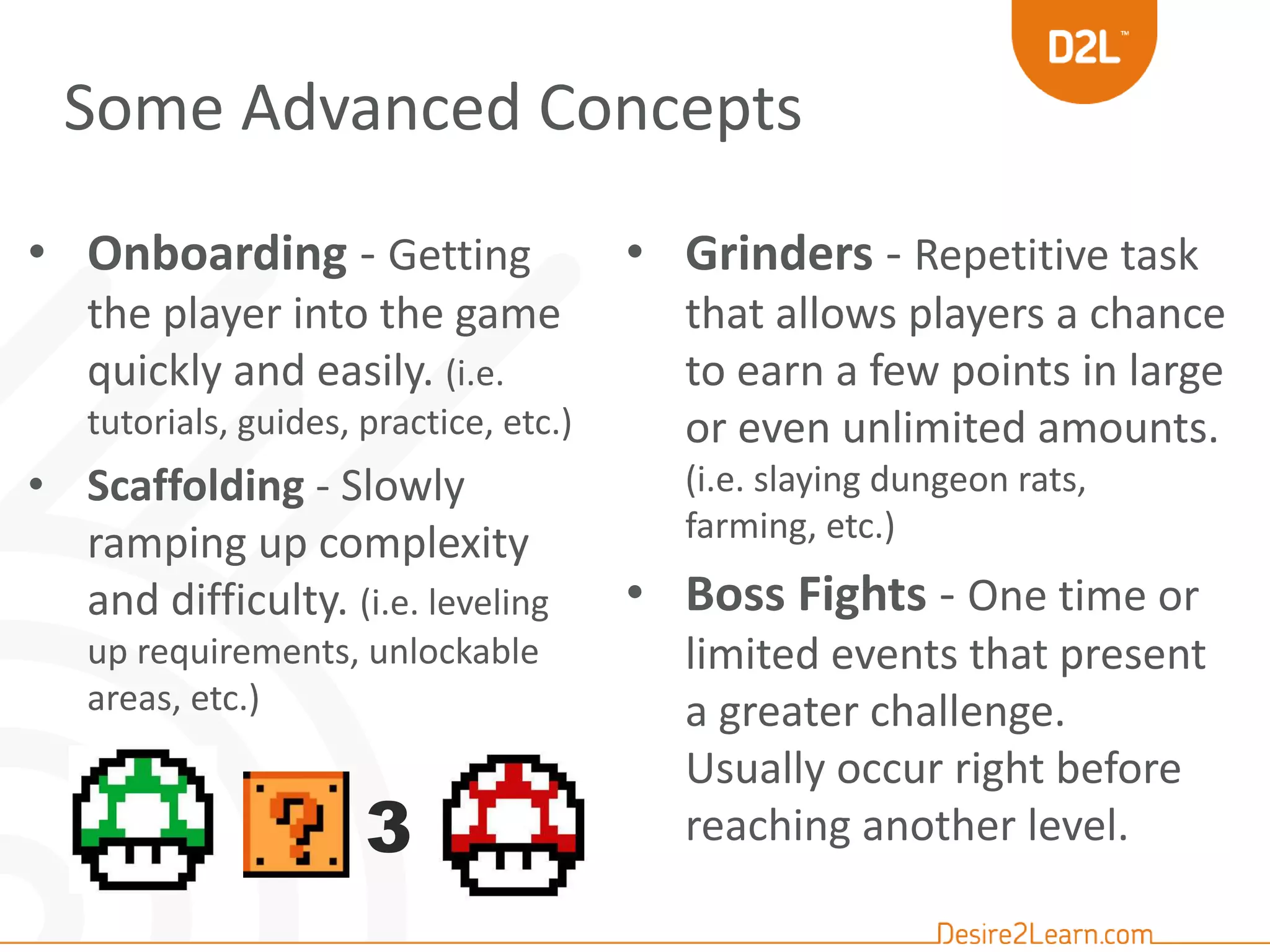
• Onboarding - Getting 
the player into the game 
quickly and easily. (i.e. 
tutorials, guides, practice, etc.) 
• Scaffolding - Slowly 
ramping up complexity 
and difficulty. (i.e. leveling 
up requirements, unlockable 
areas, etc.) 
• Grinders - Repetitive task 
that allows players a chance 
to earn a few points in large 
or even unlimited amounts. 
(i.e. slaying dungeon rats, 
farming, etc.) 
• Boss Fights - One time or 
limited events that present 
a greater challenge. 
Usually occur right before 
3 reaching another level.
Gamification System for D2L 
Tools You Can Use Already in Your Favorite LMS
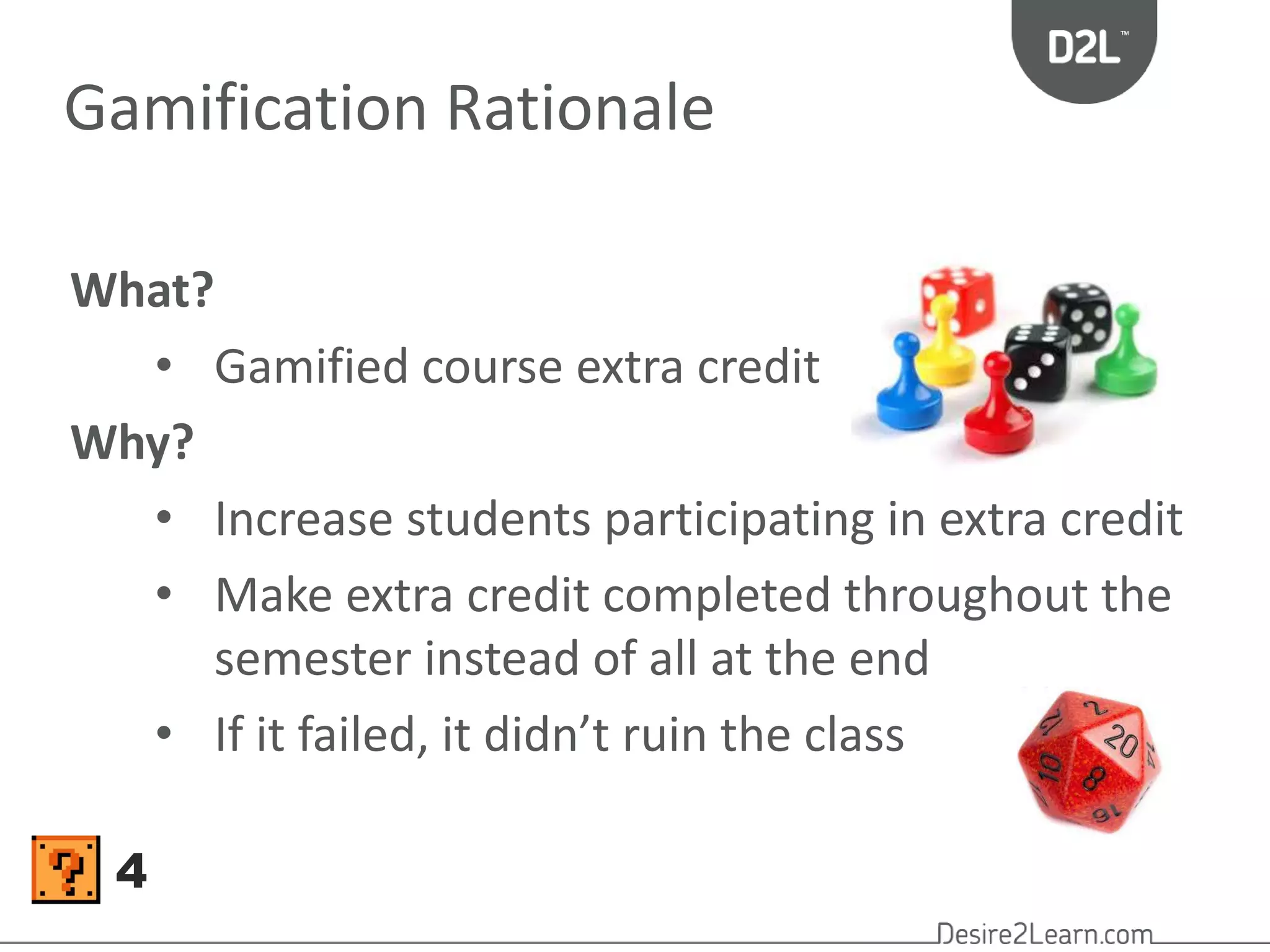
Gamification Rationale 
What? 
• Gamified course extra credit 
Why? 
• Increase students participating in extra credit 
• Make extra credit completed throughout the 
semester instead of all at the end 
• If it failed, it didn’t ruin the class 
4
My Gamification System 
• Goal: Earn up to 5% extra credit on final grade 
• Points: Earned throughout semester via in class 
activities, optional assignments, Pop-Questions, 
etc. 
• Levels: 
5 points = Level 1 - Worth 1% Extra Credit 
15 points = Level 2 - Worth 2% Extra Credit 
30 points = Level 3 - Worth 3% Extra Credit 
50 points = Level 4 - Worth 4% Extra Credit 
100 + points = Level 5 - Worth 5% Extra Credit
My Gamification System 
• Progress Status: Two columns found in 
gradebook. One with point total and one with 
current level. 
• Badging: Receive email with badge when 
reaching a new level. 
• Leaderboard: Updated weekly (or more). 
Displayed as top 5 in News widget. 
• Top Scoring Student: Student with highest point 
total will receive the ability to create one of the 
essay questions that will be on the final exam.
Earning Points 
• Variety in game play = Different types of activities 
• Pop-Questions 
• Short answer and/or opinionative 
• Range of points 
• Used for onboarding and early scaffolding 
• Optional Assignments (Boss Fights) 
• Harder, higher level thinking, more work involved 
• Large amount of points earned 
• Bonus points for speed and/or quality 
• Grinders 
• Repetitive task with simple rules 
• Low point value 
• No point cap 
5
D2L Tools Used for Points 
• Activities for points completed in Discussions 
• One board per Grinder/Pop-Question 
• Easy to setup start/end times 
• Easy to count points for Grinders 
• Student can see competition 
• Announced new opportunities via News widget 
• Students who turned on notifications received edge 
in timed events.
D2L Tools Used for Points 
• Point totals/progress 
• Gradebook column 
• Updated manually 
• No different than grading 
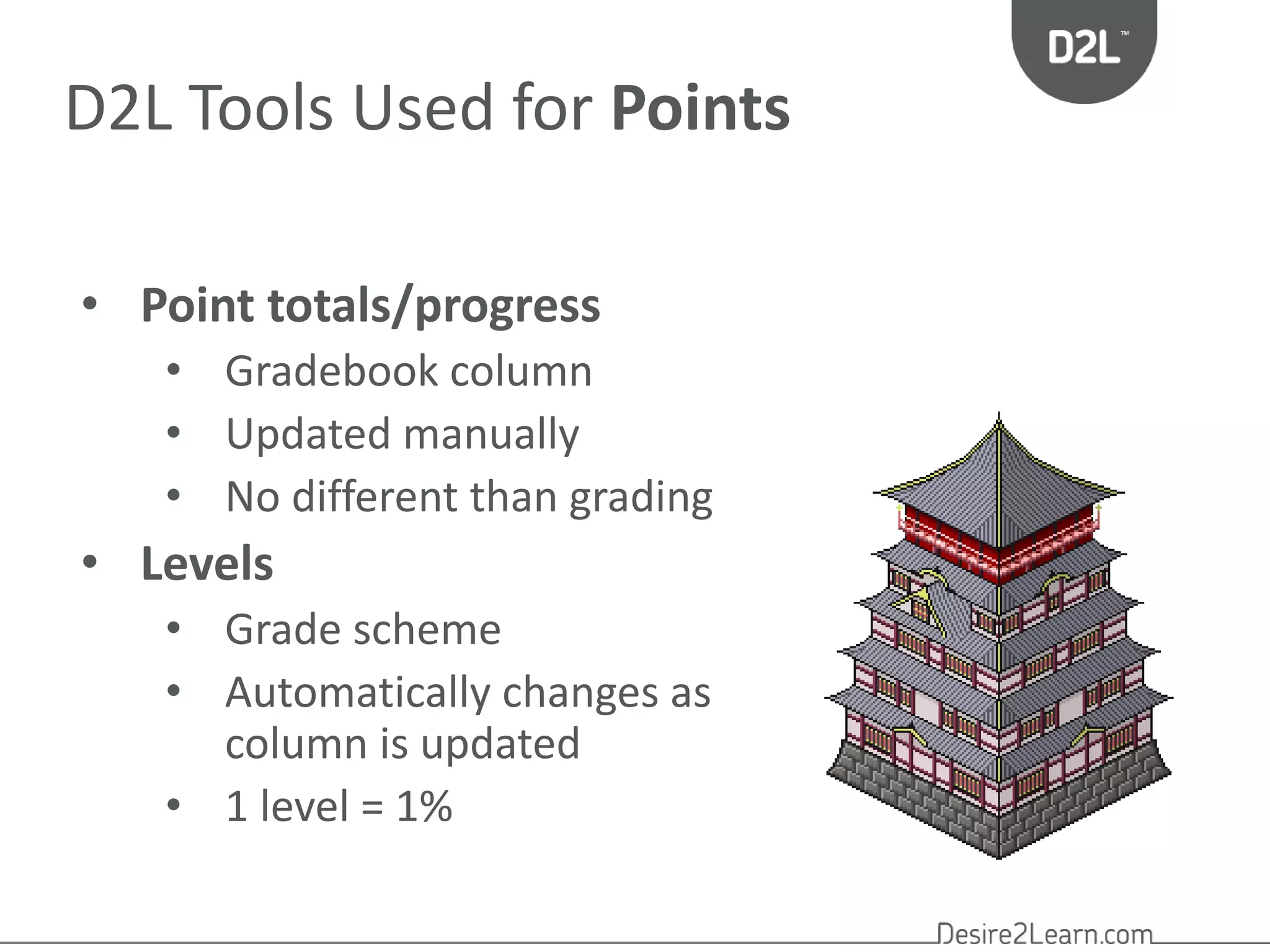
• Levels 
• Grade scheme 
• Automatically changes as 
column is updated 
• 1 level = 1%
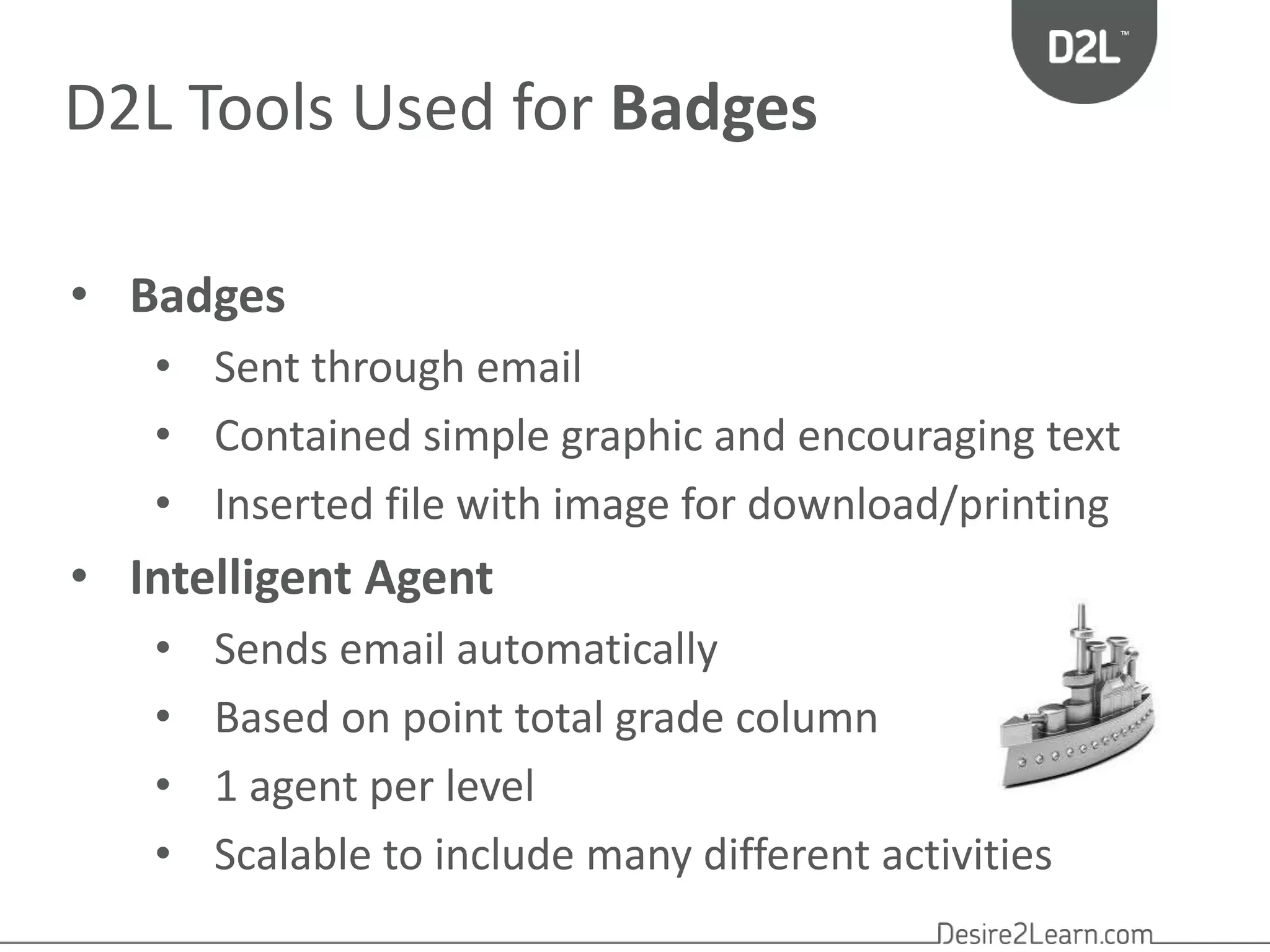
D2L Tools Used for Badges 
• Badges 
• Sent through email 
• Contained simple graphic and encouraging text 
• Inserted file with image for download/printing 
• Intelligent Agent 
• Sends email automatically 
• Based on point total grade column 
• 1 agent per level 
• Scalable to include many different activities
D2L Tools Used for Leaderboards 
• Leaderboard 
• Created News item 
• Once a week minimum update 
• Listed top 5 with names, levels, and points 
• For top 5, just sort the point column in Gradebook 
6 
• Also used to congratulate people who reached level 5
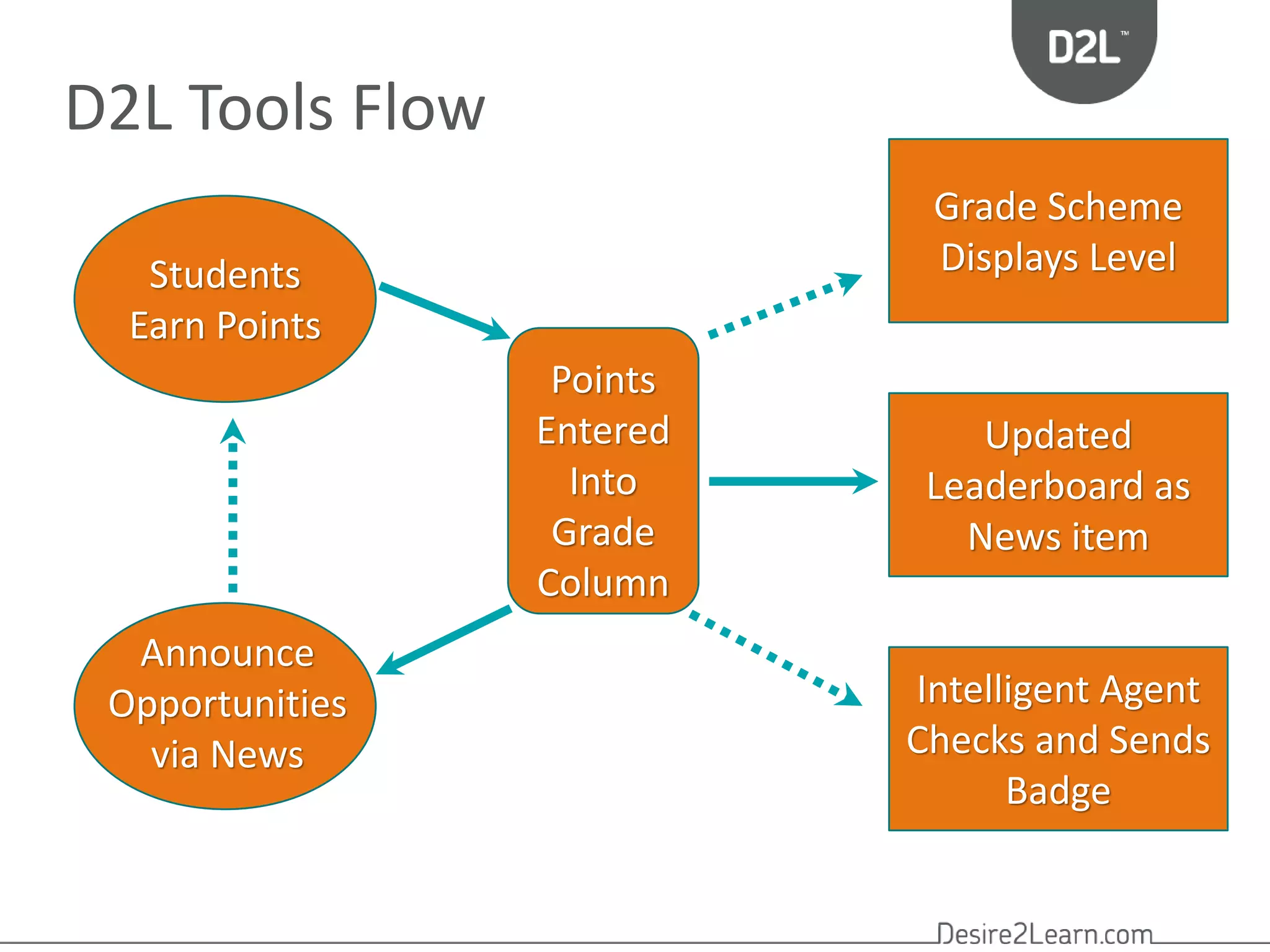
Grade Scheme 
Students Displays Level 
Earn Points 
Intelligent Agent 
Checks and Sends 
Badge 
D2L Tools Flow 
Points 
Entered 
Into 
Grade 
Column 
Announce 
Opportunities 
via News 
Updated 
Leaderboard as 
News item
What else can gaming teach us? 
• Instructions 
• Modeled board game instructions 
• Used for all optional assignments, Pop-Questions, 
and Grinders 
• Clearly communicates 
• Goal 
• Rules 
• Point Values
Case Study: Intro to Psychology 
How it Went, What Worked, and What Wrecked
Class Description Student Statistics 
• Entry level undergraduate 
Psychology course 
• Core curriculum class 
• Required for some majors 
• Met twice a week, 5:30pm-8:15pm 
• Short term, 2nd half of the semester 
• 15 total students 
• Mixture of majors including some 
Psychology 
• Majority Freshman 
• 1 student on probation 
• 3 students considered at risk 
Intro to Psychology 
Extra Feature 
1 student connected as a distance learner via video conference technology
Observed Gaming 
• In general students seemed to react well 
• About half started right away 
• All participated in the end 
• Not many questions 
• Specific players 
• Distance learner was highly competitive at first 
• Probationary student completed most of the activities
Observed Gaming 7 
• Grinder creation 
• Didn’t start out with them 
• Added around midterm 
• Became very popular for players 
• Helped players compete better 
• Ensured players could level up
Observed Gaming 
• Competition 
• Clearly viewable with leaderboard and grinders 
• Student dropped from top 5; 
the next week they were #1 
• Sniping for the win 
• Winner of highest total was in 4th place with 104 points 
• 1 hour before class, they made 100 points on a Grinder 
• 2nd place stated “I didn’t like making memes, but if I had 
seen that ‘they’ were doing that many I would have 
made a bunch more”
Final Standings 
Hi Score = 206 points (only needed 100 for level 5) 
4 students finished at level 5 (all over 100 points) 
3 students finished at level 4 
1 students finished at level 3 
6 students finished at level 2 
0 students finished at level 1 
1 student finished with some points, but did not reach 
level 1
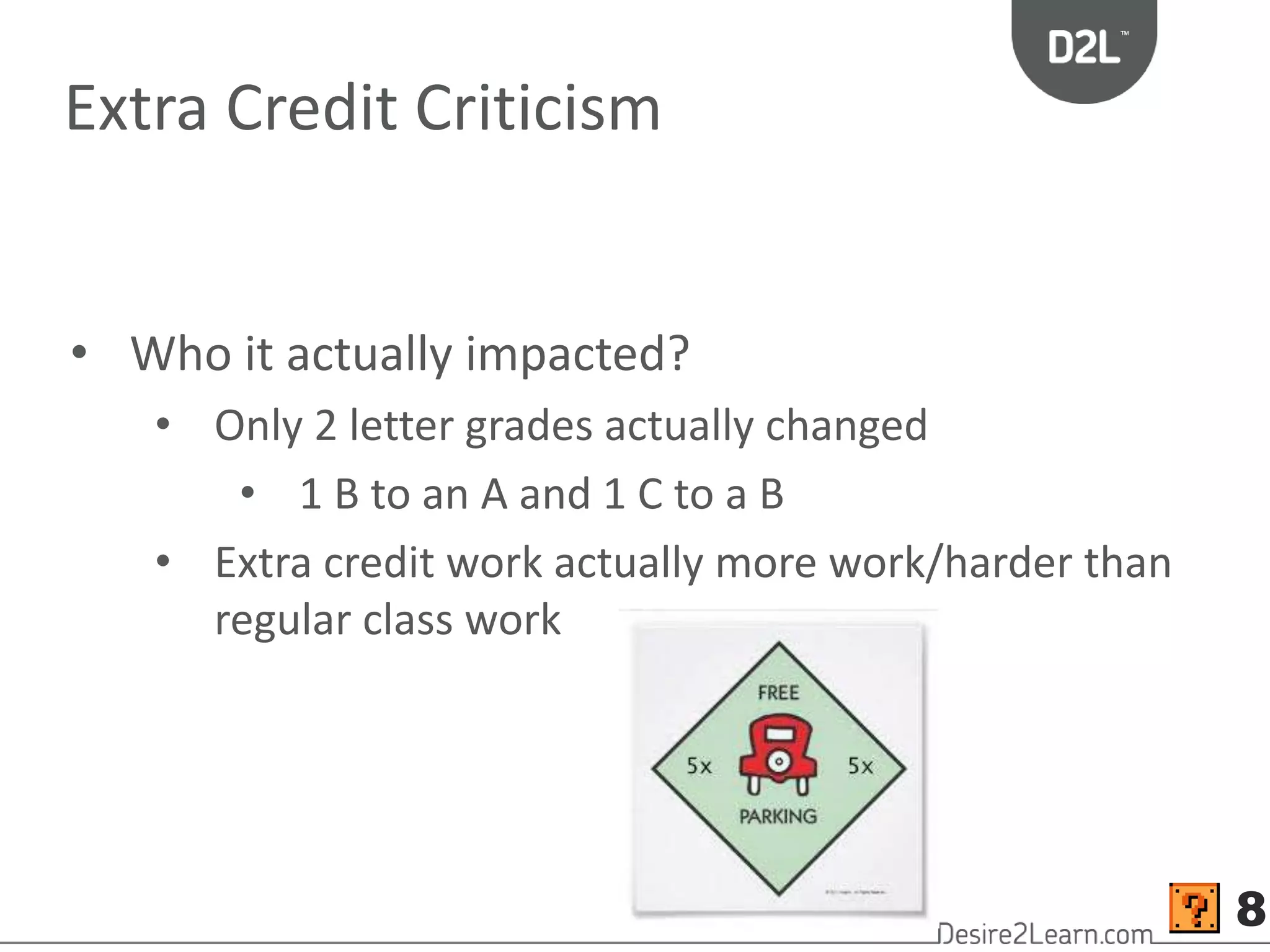
Extra Credit Criticism 
• Who it actually impacted? 
• Only 2 letter grades actually changed 
• 1 B to an A and 1 C to a B 
• Extra credit work actually more work/harder than 
regular class work 
8
Survey Data 
• Conducted after final standing 
• Anonymous 
• Forced 4 point scale 
• Highly Agree - Highly Disagree 
• Separated from Student Opinion of Instruction
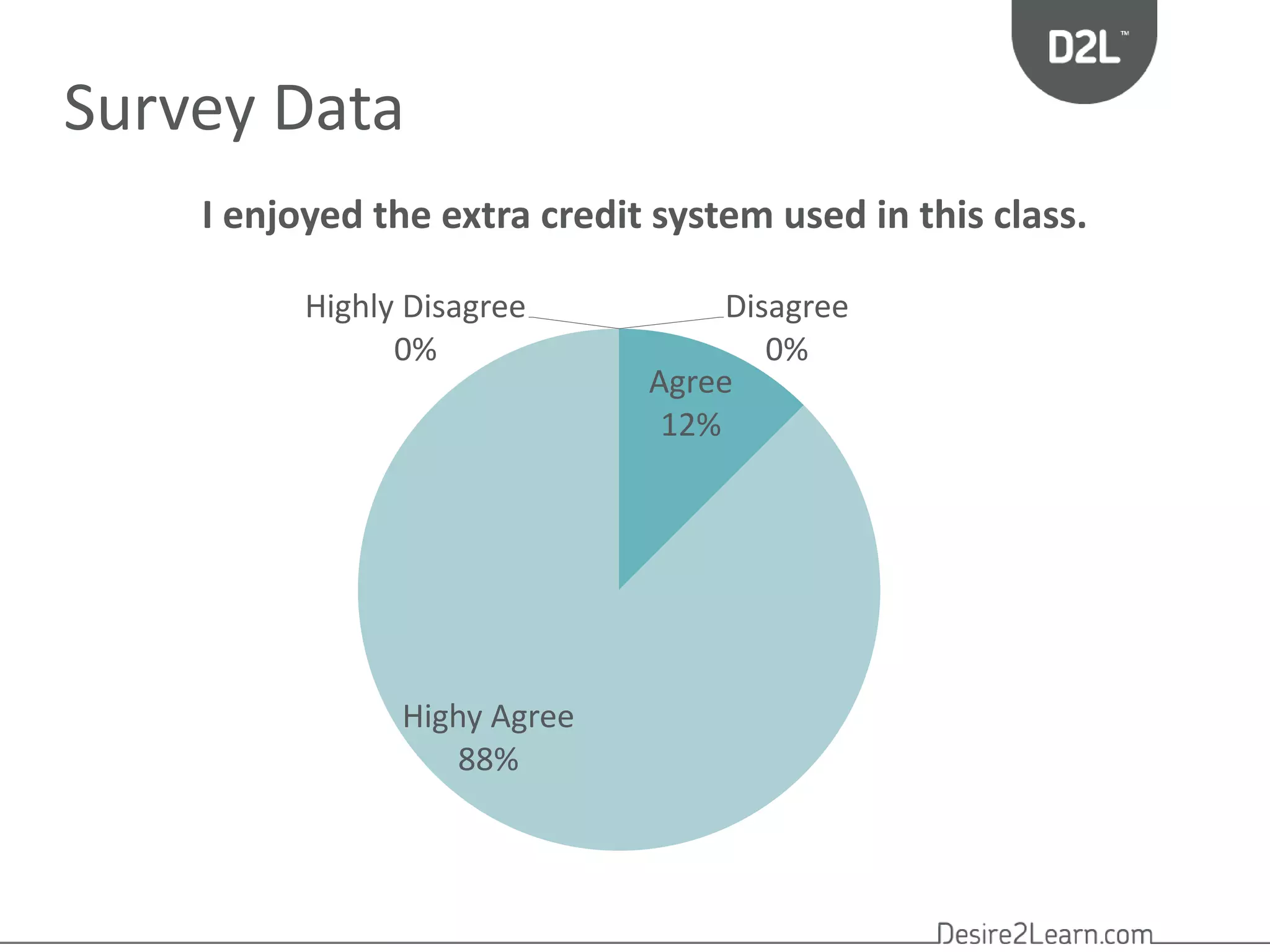
Highly Disagree 
0% 
Disagree 
0% 
Agree 
12% 
Highy Agree 
88% 
Survey Data 
I enjoyed the extra credit system used in this class.
Highly Disagree 
0% 
Disagree 
0% 
Agree 
22% 
Highy Agree 
78% 
Survey Data 
I found the extra credit system easy to understand.
Highly Disagree 
0% 
Disagree 
0% 
Agree 
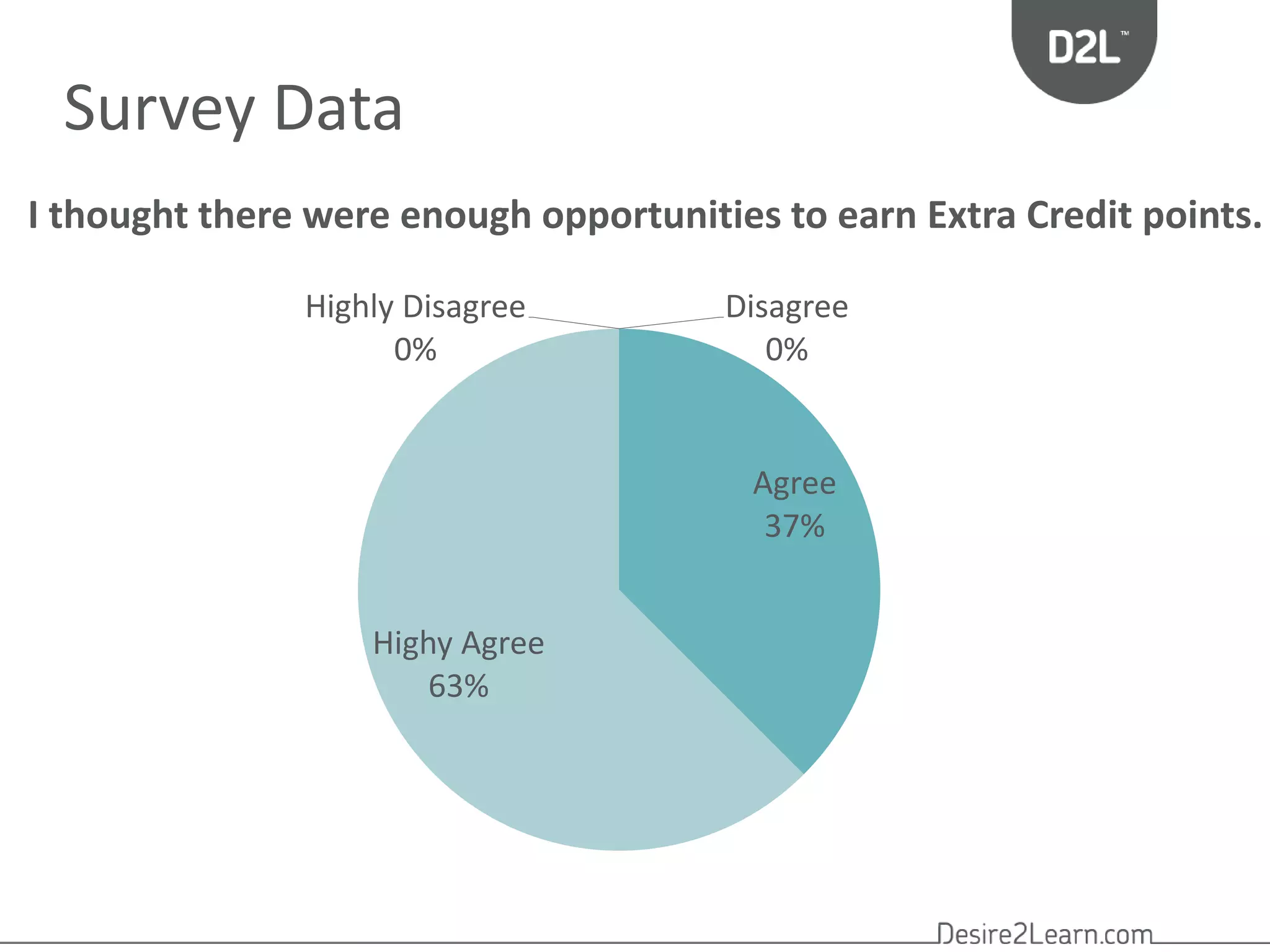
37% 
Highy Agree 
63% 
Survey Data 
I thought there were enough opportunities to earn Extra Credit points.
Survey Data 
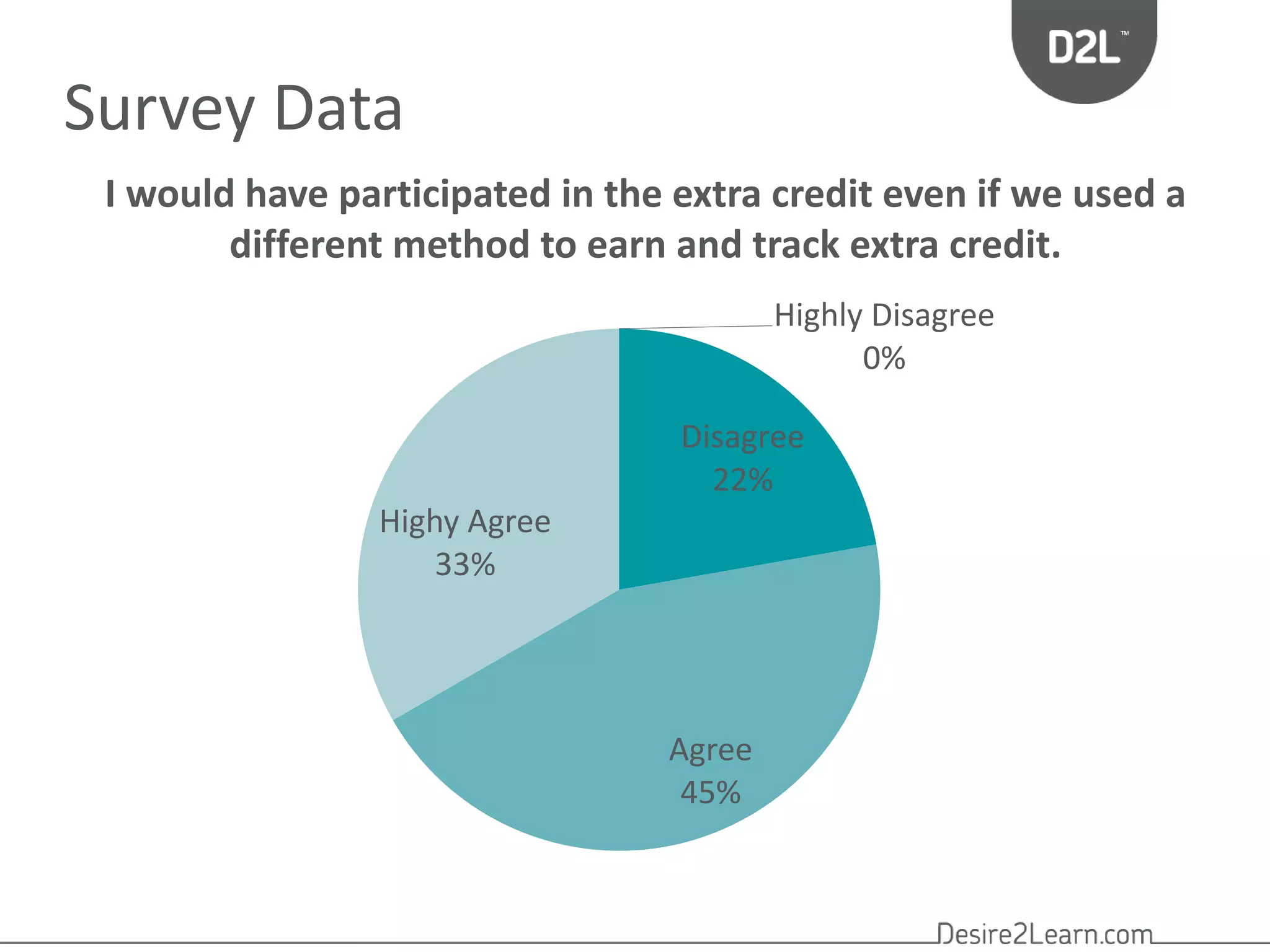
I would have participated in the extra credit even if we used a 
different method to earn and track extra credit. 
Highly Disagree 
0% 
Disagree 
22% 
Agree 
45% 
Highy Agree 
33%
Survey Data 
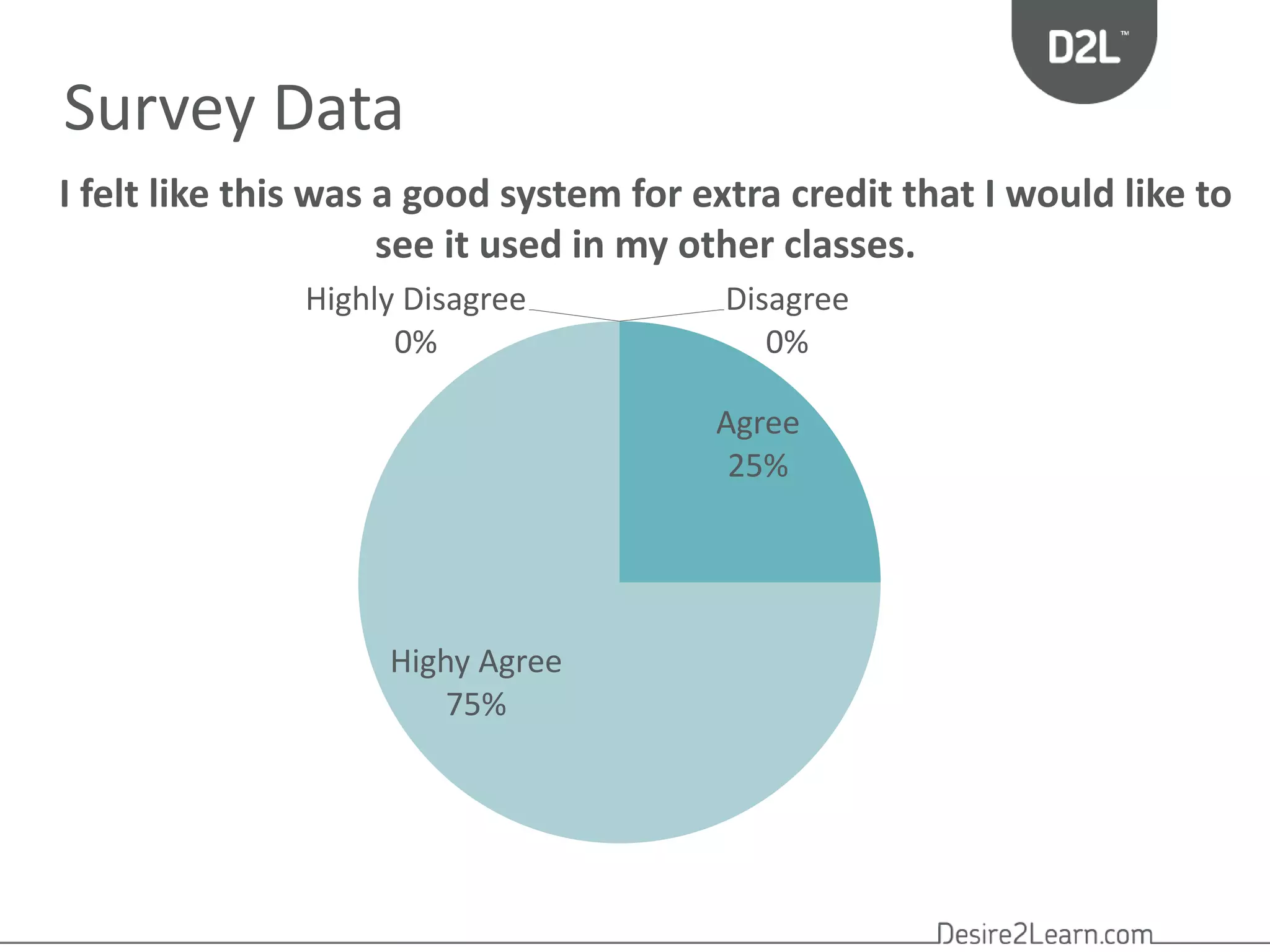
I felt like this was a good system for extra credit that I would like to 
see it used in my other classes. 
Highly Disagree 
0% 
Disagree 
0% 
Agree 
25% 
Highy Agree 
75%
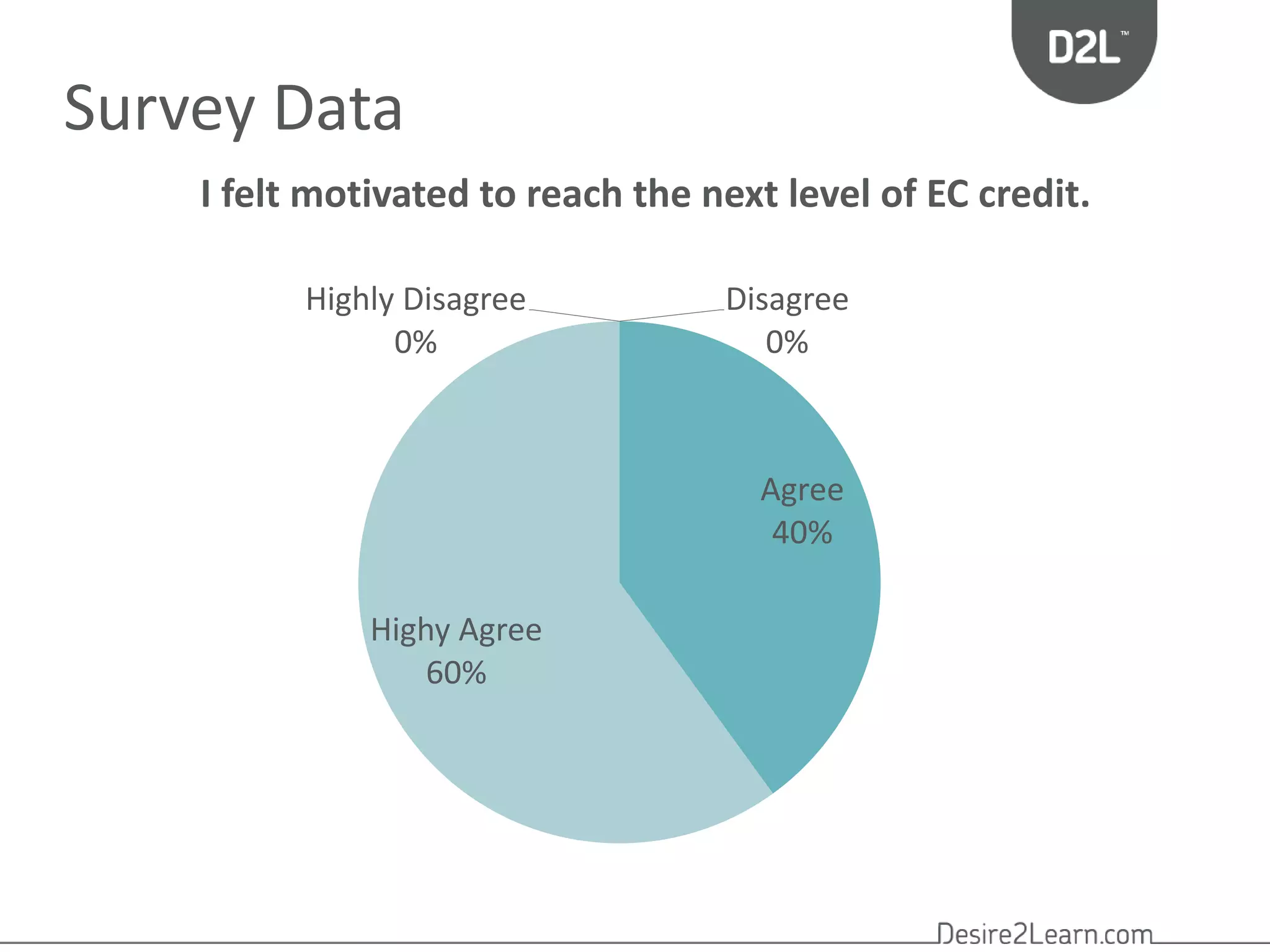
Highly Disagree 
0% 
Disagree 
0% 
Agree 
40% 
Highy Agree 
60% 
Survey Data 
I felt motivated to reach the next level of EC credit.
Survey Data 
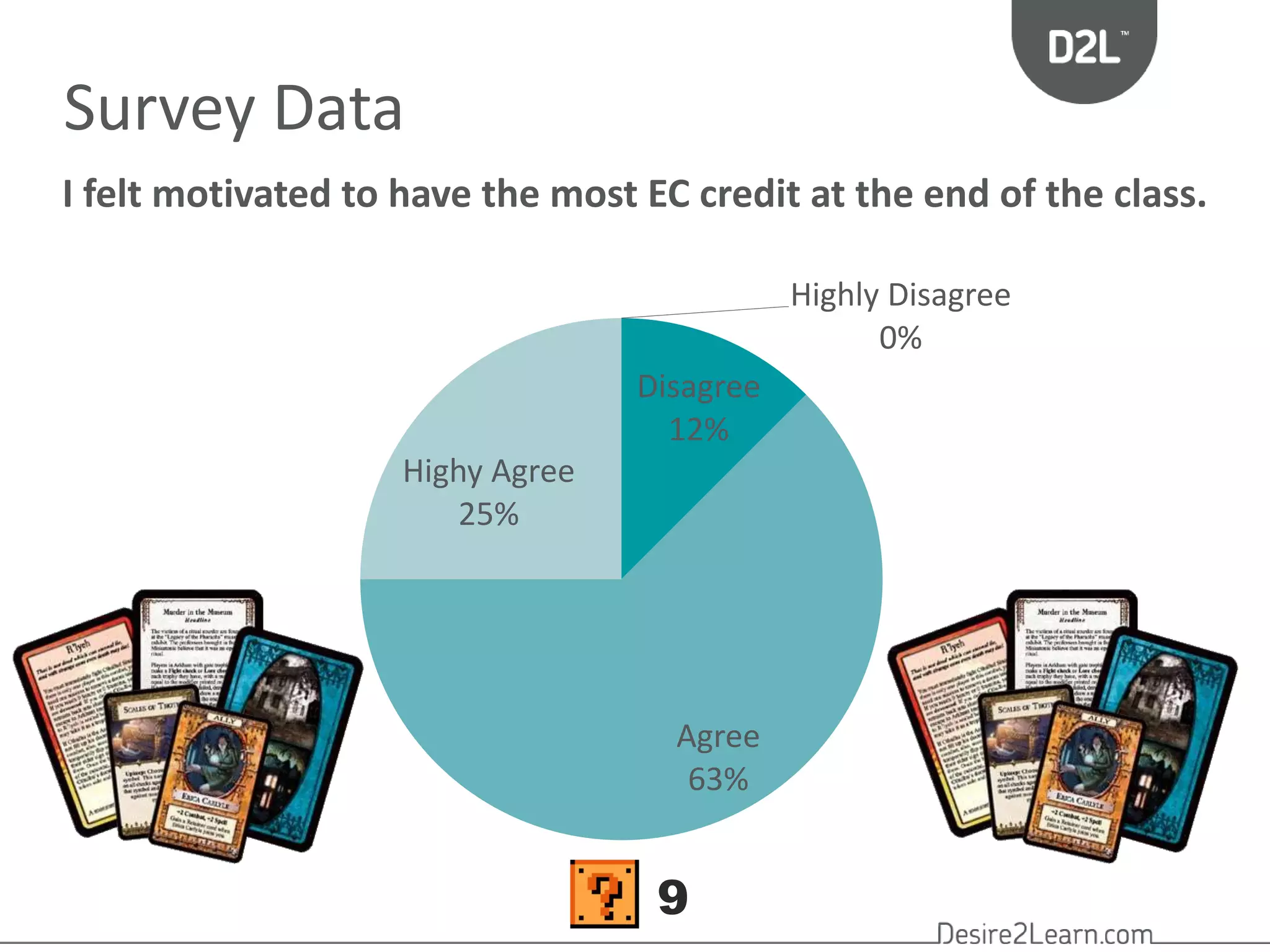
I felt motivated to have the most EC credit at the end of the class. 
Highly Disagree 
0% 
Disagree 
12% 
Agree 
63% 
Highy Agree 
25% 
9
Survey Comments at a Glance 
• “The extra credit tasks were both fun and 
informative.” 
• “This extra credit system was different than any 
other way I've received points. I liked how 
students were competing for the most points.” 
• 
• “More professors should use this technique. It is 
very helpful” 
• 
• “I liked the opportunities to have an unlimited 
amount of posts.”
Roll: Success v Failure 
Critical Hits Fumbles 
• Intelligent Agent skipped 
some levels initially 
• Didn’t Badge non-point/ 
non-level items 
• Onboarding 
• “The only thing I'm 
frustrated is that I missed 
several pop-quizzes 
because I was not alerted” 
• Gaming system in general 
• Level of complexity 
• Level of engagement 
• Competition fostered 
• Kinds of activities 
• Rewards 
• Grinders
What’s Next?
Next Time On Gamification 
• Better onboarding 
• More Grinders early on 
• More Levels (.5% each perhaps) 
• Scheduled and Random encounters 
• More updates to the Leaderboard 
• Update Badging 
10
Updating Badges 
• Include for events/actions and not just specific 
levels/points 
• Have hidden/rare Badges 
• Add way to display Badges 
• Consider incorporating an external Badging 
system (ie Credly) 
• Can still use Intelligent Agents
What Others are Exploring 
• Platforms just for gamifying a classroom 
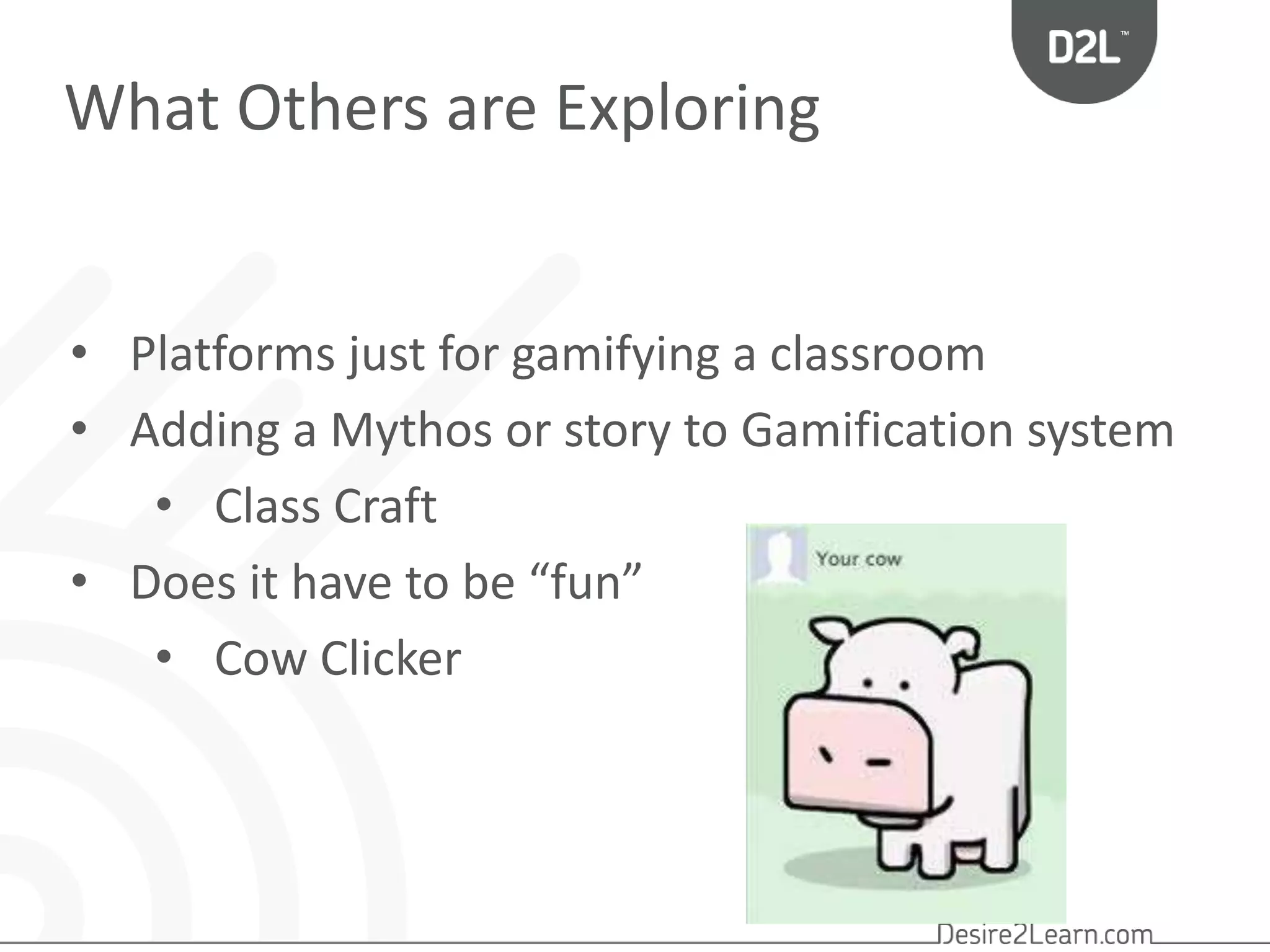
• Adding a Mythos or story to Gamification system 
• Class Craft 
• Does it have to be “fun” 
• Cow Clicker
Questions

Brightspace Webinar with Vincent Spezzo

  • 1.
    D2L Gamification Leveragingthe Tools Already at Your Disposal
  • 2.
    Vincent King-Spezzo •Senior Online Instructional Designer for Valdosta State University's Center for eLearning. • Trainer, LMS Admin, Instructional Design consultant, all around tech guru. • Teach completely online, hybrid, and video synchronous courses. • Education: Currently ABD in Curriculum and Instruction, Ed.S in Instructional Technology, MS in I-O Psychology. • Loves games and gaming (board, card, video, doesn’t matter).
  • 3.
    Let’s play agame. 1. Go to http://tinyurl.com/oa97kvl 2. You will be asked a series of numbered questions that correspond to slides marked with and followed by a number. 0 3. Choose your answer to the question and click the “Next” button. If you are right, you will advance to the next question. If you are wrong, it’s game over.
  • 4.
    Rules and Tips • Get all the questions right, and you win! • Win and you get a badge! • Be vigilant as I go through the presentation, not all question blocks are easy to spot. • Play fair. No cheating or answer sharing please. • You will need the slide to answer the question (unless you are a really good guesser). • If you miss even one you are out.
  • 5.
    Gamification 101 BriefBackground on the Basics
  • 6.
    Definitions (I’ve Gota Few) Gamification is… • The process of making non-game activities more fun and engaging. • Using game theories and mechanics to motivate non-game behaviors. • “A careful and considered application of game thinking to solving problems and encouraging learning, using all the elements of games that are appropriate”.-Karl Kapp
  • 7.
    Core Definition •Use of game elements and game design techniques in non-game contexts • Game elements • Parts of the game: Points, Badges Leaderboards, Achievements, Avatars, Levels, Quests, Rewards, Teams, Boss Fights, etc. • Game design techniques • Think like a game designer: Goals=Challenges, Participants=Players, Instruction=Tutorial, etc.
  • 8.
    Example: My CokeRewards • Points • Collecting (Coke caps) • Rewards (with levels) • Quests (double points and bonus days) • Goal: Enter points, get rewards • Real Goal: Drink more Coke!
  • 9.
    PBL: The GamificationTrinity 1 The three most effective and commonly used game elements are Points, Badges, and Leaderboards. Points Badges Leaderboards
  • 10.
    Points Numerical unitsthat can be used to represent anything. They are a way to understand and connect the player’s actions to the game. • Drive users to participate in activities • Weighting points (giving more or less) around specific activities can motivate players to participate in those activities • Way to keep score • Can determine win states • Can be tied to rewards • Provide feedback • Display user progress • Data for game designer
  • 11.
    Badges Representations ofachievements or accomplishments in the game system. Usually graphical in nature. • Flexibility in what they represent • Not just badges for points or levels • Convey style or themes • Indicate what the game designer considers important • Can add variety to game play • Motivate players to collect them all • Can be used as credentials (i.e. diploma) • Social display (status symbols)
  • 12.
    Leaderboards 2 Areathat displays the names and current scores, points, and/or levels of the leading competitors. • Ranking • Lets players know where they stand in relation to others • Helps establish competition • Provides feedback on competition • Can be negative • Capable of de-motivating players if they think they are too far behind • Personalized leaderboards • Compare to people they know, set regions, based on certain status, etc.
  • 13.
    Just Scratching theSurface • Need more than just PBL for game elements. • Core elements and widely used, but you need more for a robust gaming system that players will continue to engage with. • The elements are not the game. • Elements are the blocks, game design is the glue. • It’s more than just about the reward. • If reward was enough, you wouldn’t need the game.
  • 14.
    Some Advanced Concepts • Onboarding - Getting the player into the game quickly and easily. (i.e. tutorials, guides, practice, etc.) • Scaffolding - Slowly ramping up complexity and difficulty. (i.e. leveling up requirements, unlockable areas, etc.) • Grinders - Repetitive task that allows players a chance to earn a few points in large or even unlimited amounts. (i.e. slaying dungeon rats, farming, etc.) • Boss Fights - One time or limited events that present a greater challenge. Usually occur right before 3 reaching another level.
  • 15.
    Gamification System forD2L Tools You Can Use Already in Your Favorite LMS
  • 16.
    Gamification Rationale What? • Gamified course extra credit Why? • Increase students participating in extra credit • Make extra credit completed throughout the semester instead of all at the end • If it failed, it didn’t ruin the class 4
  • 17.
    My Gamification System • Goal: Earn up to 5% extra credit on final grade • Points: Earned throughout semester via in class activities, optional assignments, Pop-Questions, etc. • Levels: 5 points = Level 1 - Worth 1% Extra Credit 15 points = Level 2 - Worth 2% Extra Credit 30 points = Level 3 - Worth 3% Extra Credit 50 points = Level 4 - Worth 4% Extra Credit 100 + points = Level 5 - Worth 5% Extra Credit
  • 18.
    My Gamification System • Progress Status: Two columns found in gradebook. One with point total and one with current level. • Badging: Receive email with badge when reaching a new level. • Leaderboard: Updated weekly (or more). Displayed as top 5 in News widget. • Top Scoring Student: Student with highest point total will receive the ability to create one of the essay questions that will be on the final exam.
  • 19.
    Earning Points •Variety in game play = Different types of activities • Pop-Questions • Short answer and/or opinionative • Range of points • Used for onboarding and early scaffolding • Optional Assignments (Boss Fights) • Harder, higher level thinking, more work involved • Large amount of points earned • Bonus points for speed and/or quality • Grinders • Repetitive task with simple rules • Low point value • No point cap 5
  • 20.
    D2L Tools Usedfor Points • Activities for points completed in Discussions • One board per Grinder/Pop-Question • Easy to setup start/end times • Easy to count points for Grinders • Student can see competition • Announced new opportunities via News widget • Students who turned on notifications received edge in timed events.
  • 21.
    D2L Tools Usedfor Points • Point totals/progress • Gradebook column • Updated manually • No different than grading • Levels • Grade scheme • Automatically changes as column is updated • 1 level = 1%
  • 22.
    D2L Tools Usedfor Badges • Badges • Sent through email • Contained simple graphic and encouraging text • Inserted file with image for download/printing • Intelligent Agent • Sends email automatically • Based on point total grade column • 1 agent per level • Scalable to include many different activities
  • 23.
    D2L Tools Usedfor Leaderboards • Leaderboard • Created News item • Once a week minimum update • Listed top 5 with names, levels, and points • For top 5, just sort the point column in Gradebook 6 • Also used to congratulate people who reached level 5
  • 24.
    Grade Scheme StudentsDisplays Level Earn Points Intelligent Agent Checks and Sends Badge D2L Tools Flow Points Entered Into Grade Column Announce Opportunities via News Updated Leaderboard as News item
  • 25.
    What else cangaming teach us? • Instructions • Modeled board game instructions • Used for all optional assignments, Pop-Questions, and Grinders • Clearly communicates • Goal • Rules • Point Values
  • 26.
    Case Study: Introto Psychology How it Went, What Worked, and What Wrecked
  • 27.
    Class Description StudentStatistics • Entry level undergraduate Psychology course • Core curriculum class • Required for some majors • Met twice a week, 5:30pm-8:15pm • Short term, 2nd half of the semester • 15 total students • Mixture of majors including some Psychology • Majority Freshman • 1 student on probation • 3 students considered at risk Intro to Psychology Extra Feature 1 student connected as a distance learner via video conference technology
  • 28.
    Observed Gaming •In general students seemed to react well • About half started right away • All participated in the end • Not many questions • Specific players • Distance learner was highly competitive at first • Probationary student completed most of the activities
  • 29.
    Observed Gaming 7 • Grinder creation • Didn’t start out with them • Added around midterm • Became very popular for players • Helped players compete better • Ensured players could level up
  • 30.
    Observed Gaming •Competition • Clearly viewable with leaderboard and grinders • Student dropped from top 5; the next week they were #1 • Sniping for the win • Winner of highest total was in 4th place with 104 points • 1 hour before class, they made 100 points on a Grinder • 2nd place stated “I didn’t like making memes, but if I had seen that ‘they’ were doing that many I would have made a bunch more”
  • 31.
    Final Standings HiScore = 206 points (only needed 100 for level 5) 4 students finished at level 5 (all over 100 points) 3 students finished at level 4 1 students finished at level 3 6 students finished at level 2 0 students finished at level 1 1 student finished with some points, but did not reach level 1
  • 32.
    Extra Credit Criticism • Who it actually impacted? • Only 2 letter grades actually changed • 1 B to an A and 1 C to a B • Extra credit work actually more work/harder than regular class work 8
  • 33.
    Survey Data •Conducted after final standing • Anonymous • Forced 4 point scale • Highly Agree - Highly Disagree • Separated from Student Opinion of Instruction
  • 34.
    Highly Disagree 0% Disagree 0% Agree 12% Highy Agree 88% Survey Data I enjoyed the extra credit system used in this class.
  • 35.
    Highly Disagree 0% Disagree 0% Agree 22% Highy Agree 78% Survey Data I found the extra credit system easy to understand.
  • 36.
    Highly Disagree 0% Disagree 0% Agree 37% Highy Agree 63% Survey Data I thought there were enough opportunities to earn Extra Credit points.
  • 37.
    Survey Data Iwould have participated in the extra credit even if we used a different method to earn and track extra credit. Highly Disagree 0% Disagree 22% Agree 45% Highy Agree 33%
  • 38.
    Survey Data Ifelt like this was a good system for extra credit that I would like to see it used in my other classes. Highly Disagree 0% Disagree 0% Agree 25% Highy Agree 75%
  • 39.
    Highly Disagree 0% Disagree 0% Agree 40% Highy Agree 60% Survey Data I felt motivated to reach the next level of EC credit.
  • 40.
    Survey Data Ifelt motivated to have the most EC credit at the end of the class. Highly Disagree 0% Disagree 12% Agree 63% Highy Agree 25% 9
  • 41.
    Survey Comments ata Glance • “The extra credit tasks were both fun and informative.” • “This extra credit system was different than any other way I've received points. I liked how students were competing for the most points.” • • “More professors should use this technique. It is very helpful” • • “I liked the opportunities to have an unlimited amount of posts.”
  • 42.
    Roll: Success vFailure Critical Hits Fumbles • Intelligent Agent skipped some levels initially • Didn’t Badge non-point/ non-level items • Onboarding • “The only thing I'm frustrated is that I missed several pop-quizzes because I was not alerted” • Gaming system in general • Level of complexity • Level of engagement • Competition fostered • Kinds of activities • Rewards • Grinders
  • 43.
  • 44.
    Next Time OnGamification • Better onboarding • More Grinders early on • More Levels (.5% each perhaps) • Scheduled and Random encounters • More updates to the Leaderboard • Update Badging 10
  • 45.
    Updating Badges •Include for events/actions and not just specific levels/points • Have hidden/rare Badges • Add way to display Badges • Consider incorporating an external Badging system (ie Credly) • Can still use Intelligent Agents
  • 46.
    What Others areExploring • Platforms just for gamifying a classroom • Adding a Mythos or story to Gamification system • Class Craft • Does it have to be “fun” • Cow Clicker
  • 47.

Editor's Notes

  • #7 Many definitions. Relatively new field. Most overlap. No real one definition
  • #8 At the core and what I use as the definition Deconstruct a game you know, what are it’s parts. Those are the elements, how they fit together is the design
  • #17 Already we see here some of the key concepts right? Points, rewards scaffolding
  • #18 Already we see here some of the key concepts right? Points, rewards scaffolding
  • #19 Already we see here some of the key concepts right? Points, rewards scaffolding
  • #20 Popquestions= like what do you think is the best psychology job you can get or list maslows hierarchy of needs etc. Optional assignments= find a website or article that is pro psudeopsychology. State why it is not hard science or the one on taking color perception tests/ color blind tests Grinders- meme board and personality test board