Course Structure.
Introduction to Gamification
Fun & Learning Experience
Mechanics, Dynamics and Components
Storytelling in Games & Gamification
How to Gamify
Level 1. Introduction to
Gamification
Makes everyone a
Hero!!
Level 1.
Introduction to
Gamification
Level 1.
Introduction to
Gamification
Level 1.
Introduction to
Gamification
Level 1.
Introduction to
Gamification
Benefits
• Make classrooms more fun and engaging
• Motivate students to complete activities
• Help students focus to be more attentive to what they are
learning
• Allow students engage in friendly competititions with peers
Level 1.
Introduction to
Gamification
Problems
• Gamification can become predictable and boring
• Poorly designed gamified activities can seem meaningless
(if learning objectives are not well defined)
• Gamification can seem manipulative (ethical questions
arise)
Level 1.
Introduction to
Gamification
Gaming dynamics
Why do we (or children) love to
play videogames?
Go to www.menti.com and
use the code 85 91 98
Level 1.
Introduction to
Gamification
What player type
are you?
Take the Bartle test
Level 1.
Introduction to
Gamification
Go to
http://matthewbarr.co.uk/bartle/
Level 1.
Introduction to
Gamification
Level 1.
Introduction to
Gamification
Level 1.
Introduction to
Gamification
What player type
are you?
Intrinsic User Types
Level 1.
Introduction to
Gamification
What player type
are you?
Player (Extrinsic) User
Sub-Types:
Essentially the Player is motivated by
rewards, plain and simple. They will do
similar things to the intrinsically
motivated group, but only if there is a
reward at the end of it!
Level 1.
Introduction to
Gamification
Level 1.
Introduction to
Gamification
What player type
are you?
Disruptor User Types
Level 1.
Introduction to
Gamification
Level 1.
Introduction to
Gamification
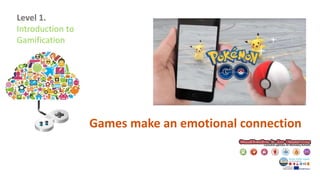
Games make an emotional connection
Level 2. Fun and Learning
Experience
Level 2. Fun and
Learning Experience
Level 2. Fun and
Learning Experience
Level 3. Mechanics, Dynamics
and Components
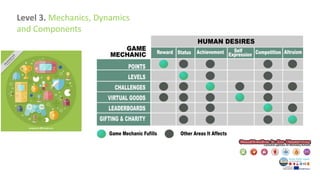
Structured as a pyramid, Components are the base element,
with Mechanics in the middle, and Dynamics at the top.
Level 3. Mechanics, Dynamics
and Components
Level 3. Mechanics, Dynamics
and Components
Level 3. Mechanics, Dynamics
and Components
Level 3. Mechanics, Dynamics
and Components
Implementation of a Gamification experience
• Define (learning) objectives
• Delineate target behaviors (assessment goals)
• Describe players (students)
• Devise activity cycles (beginning --> end; loops; branches)
• Incorporate FUN
• (Then, finally) Deploy the appropriate Mechanics and Components
Level 3. Mechanics, Dynamics
and Components
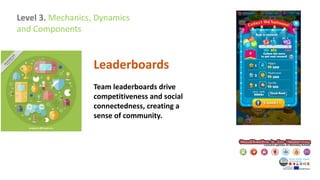
Leaderboards
Team leaderboards drive
competitiveness and social
connectedness, creating a
sense of community.
Level 3. Mechanics, Dynamics
and Components
Level 4. Storytelling
Components
1. The elements of a Story
2. The Storyline
3. The Structure
Level 4. Storytelling
1.The elements of a
Story
• A Story needs a main carácter
(Hero)
• With Intention
• And Quality
Level 4. Storytelling
1.The elements of a
Story
• A Story needs a goal
• Something to Aim for
Level 4. Storytelling
1.The elements of a
Story
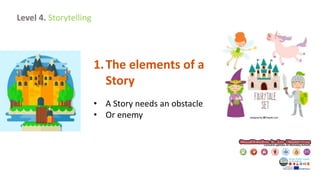
• A Story needs an obstacle
• Or enemy
Level 4. Storytelling
1.The elements of a Story
Level 4. Storytelling
• Hero • Obstacle • Goal
2. Story Line: A pattern
Level 4. Storytelling
2. Story Line: A pattern
Level 4. Storytelling
3. The Structure
Level 4. Storytelling
Level 5. How to Gamify
Level 4.
How to
Gamify
Level 4. How to Gamify
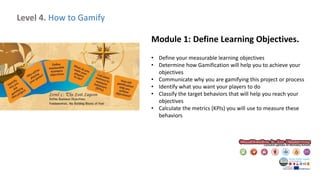
Module 1: Define Learning Objectives.
• Define your measurable learning objectives
• Determine how Gamification will help you to achieve your
objectives
• Communicate why you are gamifying this project or process
• Identify what you want your players to do
• Classify the target behaviors that will help you reach your
objectives
• Calculate the metrics (KPIs) you will use to measure these
behaviors
Level 4. How to Gamify
Module 2: Create an Epic Adventure
• Frame and wrap your quest in a spellbinding story
• Access public domain stories to find characters that you can use
to build your storyline
• Experience The Story Coaster, Joseph Campbell's Monomyth,
and Rory's Story Cubes
• Weave analogies and stories to make the training stickable, so
that players remember facts and transfer skills to real world
scenarios
• Create a narrative thread that pulls through the entire game
• Craft a compelling storyline using the four elements of a story:
characters, plot, conflict, and resolution
Level 4. How to Gamify
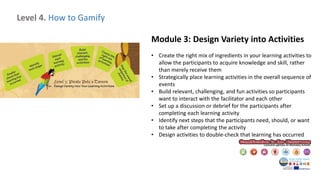
Module 3: Design Variety into Activities
• Create the right mix of ingredients in your learning activities to
allow the participants to acquire knowledge and skill, rather
than merely receive them
• Strategically place learning activities in the overall sequence of
events
• Build relevant, challenging, and fun activities so participants
want to interact with the facilitator and each other
• Set up a discussion or debrief for the participants after
completing each learning activity
• Identify next steps that the participants need, should, or want
to take after completing the activity
• Design activities to double-check that learning has occurred
Level 4. How to Gamify
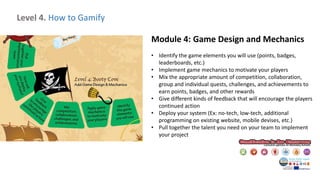
Module 4: Game Design and Mechanics
• Identify the game elements you will use (points, badges,
leaderboards, etc.)
• Implement game mechanics to motivate your players
• Mix the appropriate amount of competition, collaboration,
group and individual quests, challenges, and achievements to
earn points, badges, and other rewards
• Give different kinds of feedback that will encourage the players
continued action
• Deploy your system (Ex: no-tech, low-tech, additional
programming on existing website, mobile devises, etc.)
• Pull together the talent you need on your team to implement
your project
Level 4. How to Gamify
Module 5: Tally up the Aesthetics So They
Wanna Play!
• Label the feelings and emotions you want your players to
experience
• Construct a consistent, attractive - even charming and
captivating - cohesiveness that ties the entire project together
• Create an overall design that appeals to different senses -
touch, sight, and sound - using colors, designs, textures, and
manipulatives
• Design props, badges, chance cards, and rewards that are not
only fun for users to earn, but also fun to look at
• Tie everything back to the other four levels, especially the
learning objectives
• Answer the question: Is it fun?
Level 4. How to Gamify
Introduction to Gamification Learning Experience

Introduction to Gamification Learning Experience

  • 2.
    Course Structure. Introduction toGamification Fun & Learning Experience Mechanics, Dynamics and Components Storytelling in Games & Gamification How to Gamify
  • 3.
    Level 1. Introductionto Gamification
  • 4.
  • 5.
  • 6.
  • 7.
  • 8.
  • 9.
    Benefits • Make classroomsmore fun and engaging • Motivate students to complete activities • Help students focus to be more attentive to what they are learning • Allow students engage in friendly competititions with peers Level 1. Introduction to Gamification
  • 10.
    Problems • Gamification canbecome predictable and boring • Poorly designed gamified activities can seem meaningless (if learning objectives are not well defined) • Gamification can seem manipulative (ethical questions arise) Level 1. Introduction to Gamification
  • 11.
    Gaming dynamics Why dowe (or children) love to play videogames? Go to www.menti.com and use the code 85 91 98 Level 1. Introduction to Gamification
  • 12.
    What player type areyou? Take the Bartle test Level 1. Introduction to Gamification Go to http://matthewbarr.co.uk/bartle/
  • 13.
  • 14.
  • 15.
  • 16.
    What player type areyou? Intrinsic User Types Level 1. Introduction to Gamification
  • 17.
    What player type areyou? Player (Extrinsic) User Sub-Types: Essentially the Player is motivated by rewards, plain and simple. They will do similar things to the intrinsically motivated group, but only if there is a reward at the end of it! Level 1. Introduction to Gamification
  • 18.
    Level 1. Introduction to Gamification Whatplayer type are you? Disruptor User Types
  • 19.
  • 20.
    Level 1. Introduction to Gamification Gamesmake an emotional connection
  • 21.
    Level 2. Funand Learning Experience
  • 22.
    Level 2. Funand Learning Experience
  • 23.
    Level 2. Funand Learning Experience
  • 24.
    Level 3. Mechanics,Dynamics and Components
  • 25.
    Structured as apyramid, Components are the base element, with Mechanics in the middle, and Dynamics at the top. Level 3. Mechanics, Dynamics and Components
  • 26.
    Level 3. Mechanics,Dynamics and Components
  • 27.
    Level 3. Mechanics,Dynamics and Components
  • 28.
    Level 3. Mechanics,Dynamics and Components Implementation of a Gamification experience • Define (learning) objectives • Delineate target behaviors (assessment goals) • Describe players (students) • Devise activity cycles (beginning --> end; loops; branches) • Incorporate FUN • (Then, finally) Deploy the appropriate Mechanics and Components
  • 29.
    Level 3. Mechanics,Dynamics and Components
  • 30.
    Leaderboards Team leaderboards drive competitivenessand social connectedness, creating a sense of community. Level 3. Mechanics, Dynamics and Components
  • 32.
  • 33.
    Components 1. The elementsof a Story 2. The Storyline 3. The Structure Level 4. Storytelling
  • 34.
    1.The elements ofa Story • A Story needs a main carácter (Hero) • With Intention • And Quality Level 4. Storytelling
  • 35.
    1.The elements ofa Story • A Story needs a goal • Something to Aim for Level 4. Storytelling
  • 36.
    1.The elements ofa Story • A Story needs an obstacle • Or enemy Level 4. Storytelling
  • 37.
    1.The elements ofa Story Level 4. Storytelling • Hero • Obstacle • Goal
  • 38.
    2. Story Line:A pattern Level 4. Storytelling
  • 39.
    2. Story Line:A pattern Level 4. Storytelling
  • 40.
    3. The Structure Level4. Storytelling
  • 41.
    Level 5. Howto Gamify
  • 42.
  • 43.
    Level 4. Howto Gamify Module 1: Define Learning Objectives. • Define your measurable learning objectives • Determine how Gamification will help you to achieve your objectives • Communicate why you are gamifying this project or process • Identify what you want your players to do • Classify the target behaviors that will help you reach your objectives • Calculate the metrics (KPIs) you will use to measure these behaviors
  • 44.
    Level 4. Howto Gamify Module 2: Create an Epic Adventure • Frame and wrap your quest in a spellbinding story • Access public domain stories to find characters that you can use to build your storyline • Experience The Story Coaster, Joseph Campbell's Monomyth, and Rory's Story Cubes • Weave analogies and stories to make the training stickable, so that players remember facts and transfer skills to real world scenarios • Create a narrative thread that pulls through the entire game • Craft a compelling storyline using the four elements of a story: characters, plot, conflict, and resolution
  • 45.
    Level 4. Howto Gamify Module 3: Design Variety into Activities • Create the right mix of ingredients in your learning activities to allow the participants to acquire knowledge and skill, rather than merely receive them • Strategically place learning activities in the overall sequence of events • Build relevant, challenging, and fun activities so participants want to interact with the facilitator and each other • Set up a discussion or debrief for the participants after completing each learning activity • Identify next steps that the participants need, should, or want to take after completing the activity • Design activities to double-check that learning has occurred
  • 46.
    Level 4. Howto Gamify Module 4: Game Design and Mechanics • Identify the game elements you will use (points, badges, leaderboards, etc.) • Implement game mechanics to motivate your players • Mix the appropriate amount of competition, collaboration, group and individual quests, challenges, and achievements to earn points, badges, and other rewards • Give different kinds of feedback that will encourage the players continued action • Deploy your system (Ex: no-tech, low-tech, additional programming on existing website, mobile devises, etc.) • Pull together the talent you need on your team to implement your project
  • 47.
    Level 4. Howto Gamify Module 5: Tally up the Aesthetics So They Wanna Play! • Label the feelings and emotions you want your players to experience • Construct a consistent, attractive - even charming and captivating - cohesiveness that ties the entire project together • Create an overall design that appeals to different senses - touch, sight, and sound - using colors, designs, textures, and manipulatives • Design props, badges, chance cards, and rewards that are not only fun for users to earn, but also fun to look at • Tie everything back to the other four levels, especially the learning objectives • Answer the question: Is it fun?
  • 48.
    Level 4. Howto Gamify