Introduction to Gamification
by Snizhana Bezhnar
― What is Gamification?
― Psychology and motivation of
Gamification
― History
― Best Practices
― Gamification Theory
― Game Mechanics and Components
― A fly in the ointment
― Conclusion
Agenda
Gamification is the use of game thinking and game
mechanics in non-game contexts to engage users in
solving problems MOTIVATE them to certain
behavior.
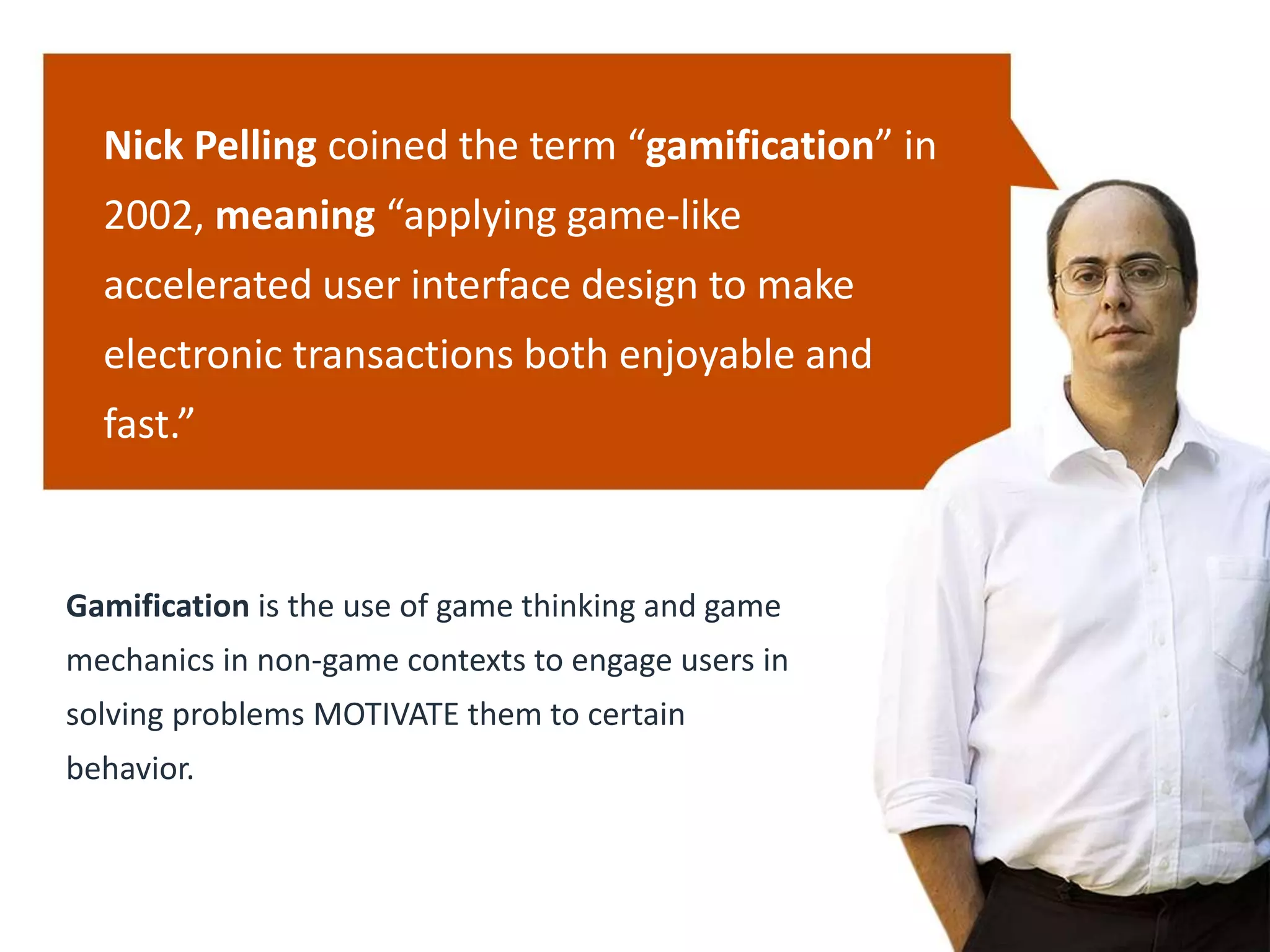
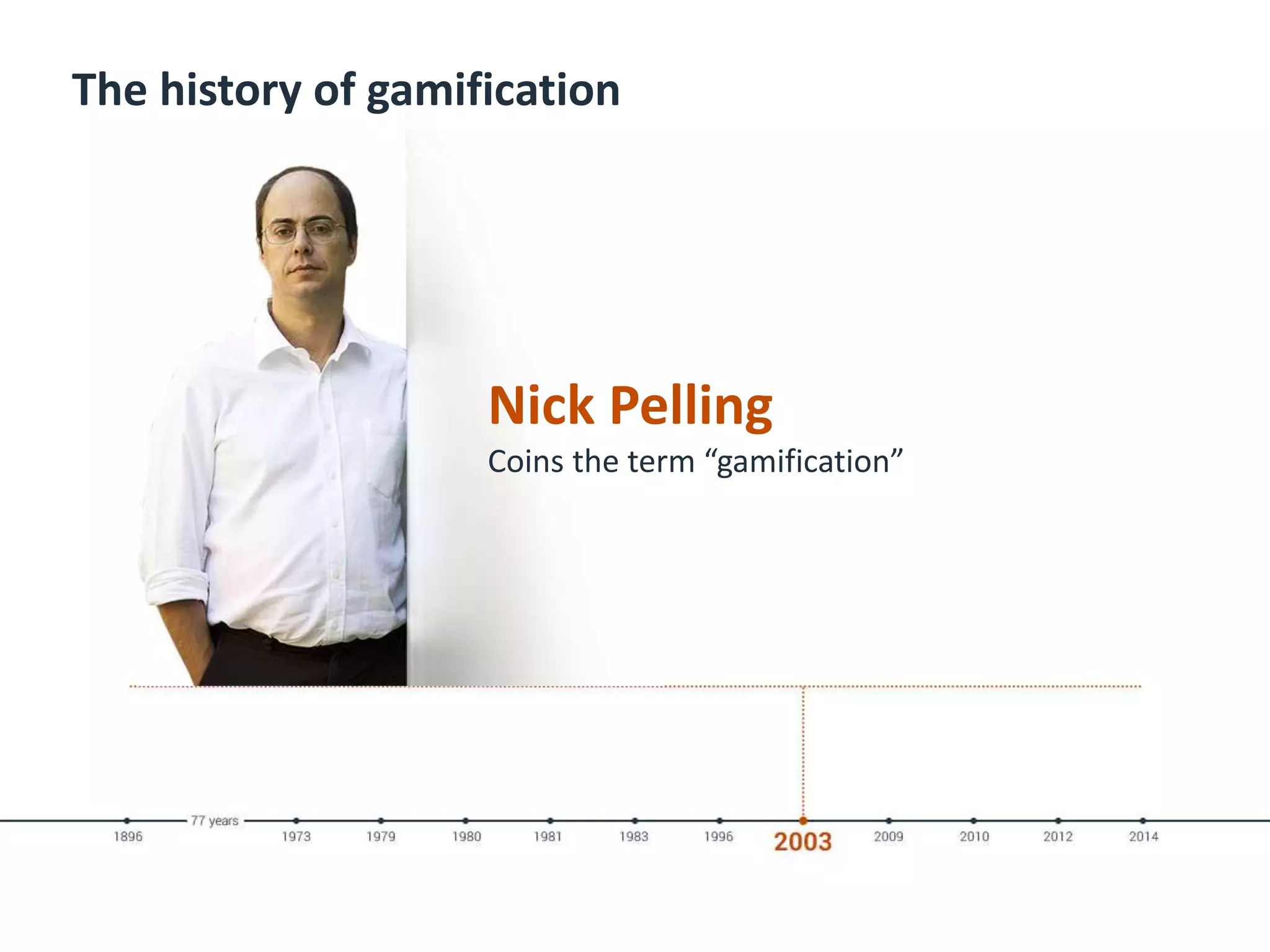
Nick Pelling coined the term “gamification” in
2002, meaning “applying game-like
accelerated user interface design to make
electronic transactions both enjoyable and
fast.”
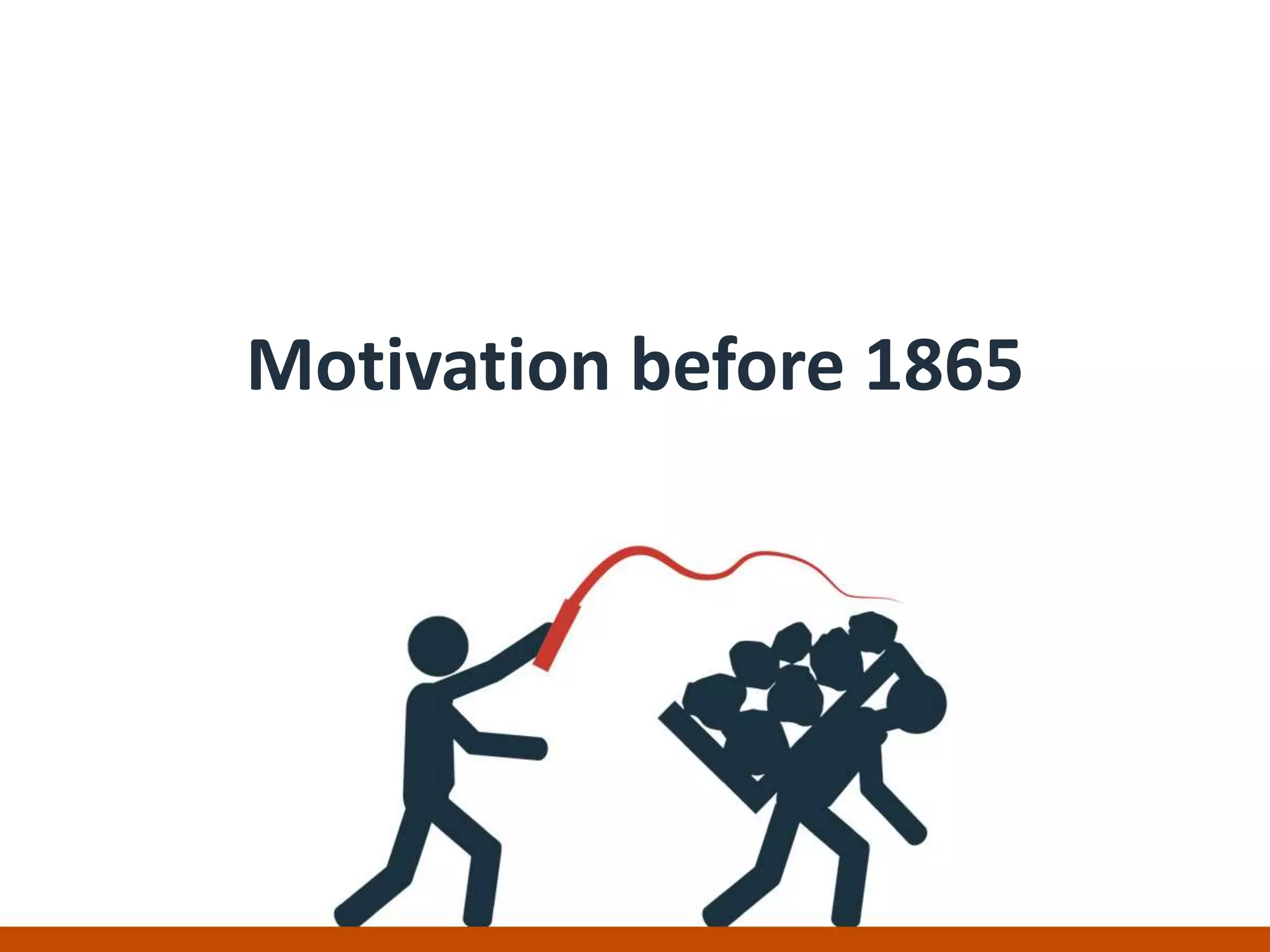
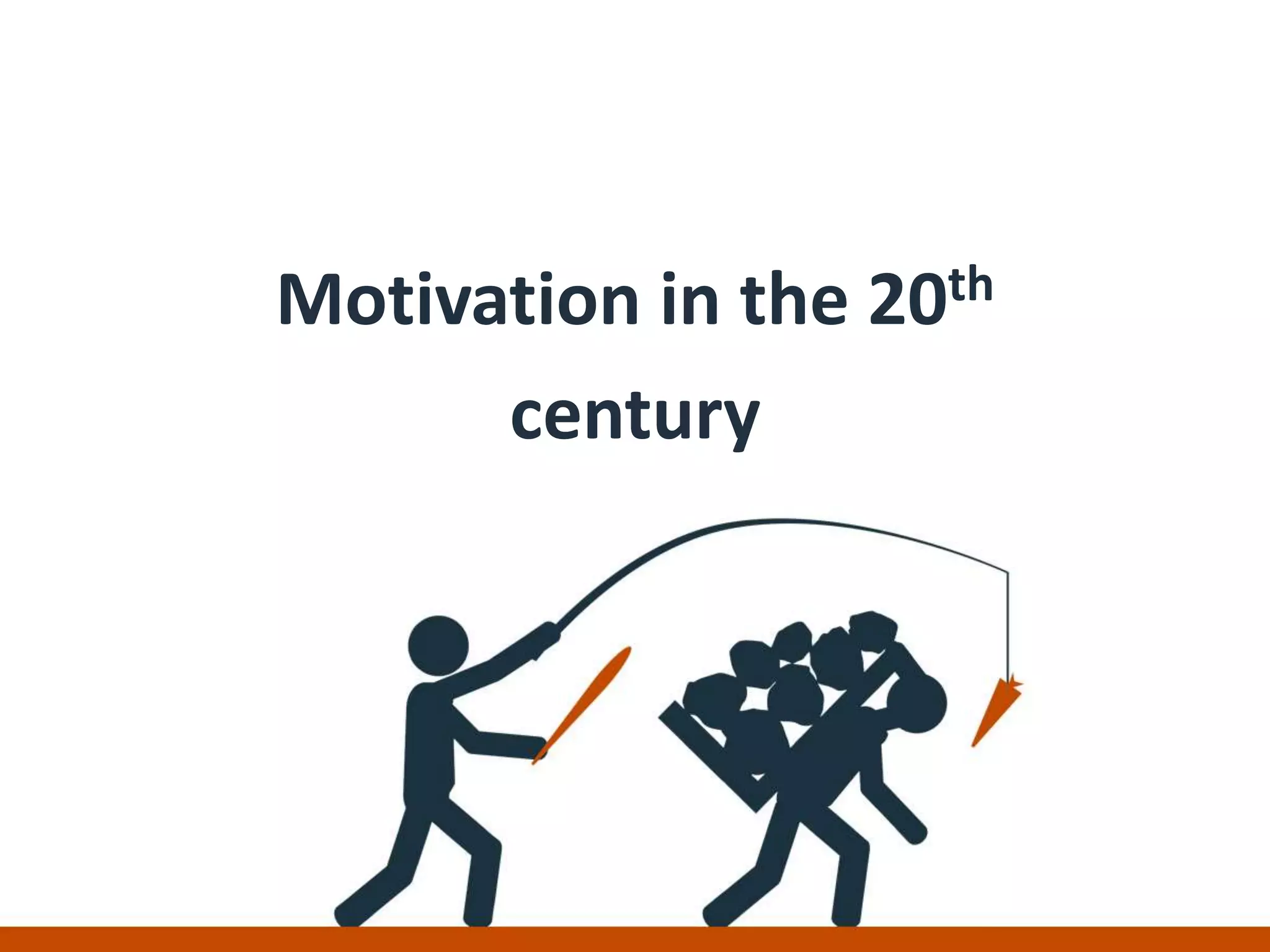
How do you motivate
people to certain behavior?
Motivation before 1865
Motivation in the 20th
century
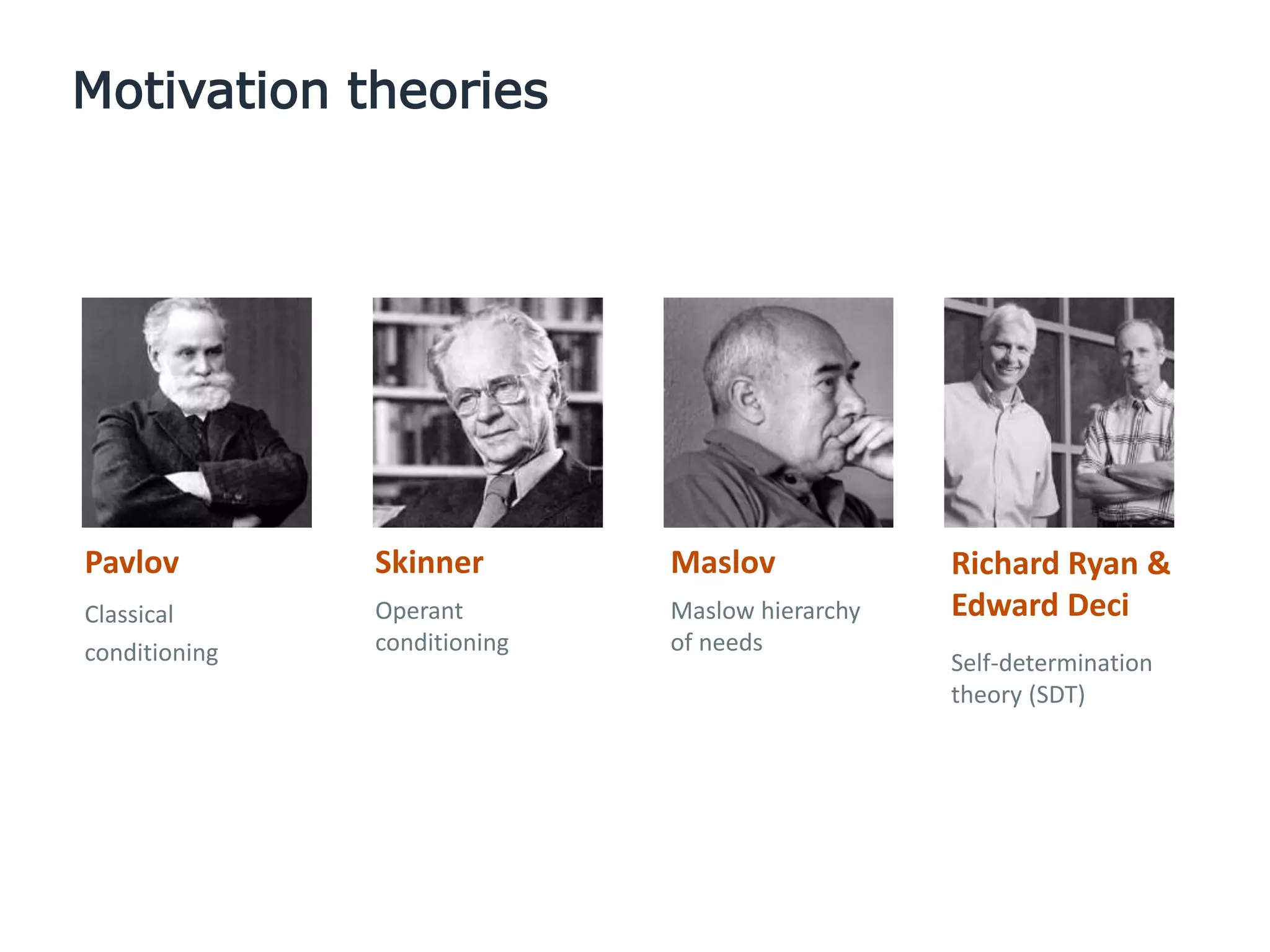
Pavlov
Classical
conditioning
Motivation theories
Skinner
Operant
conditioning
Maslov
Maslow hierarchy
of needs
Richard Ryan &
Edward Deci
Self-determination
theory (SDT)
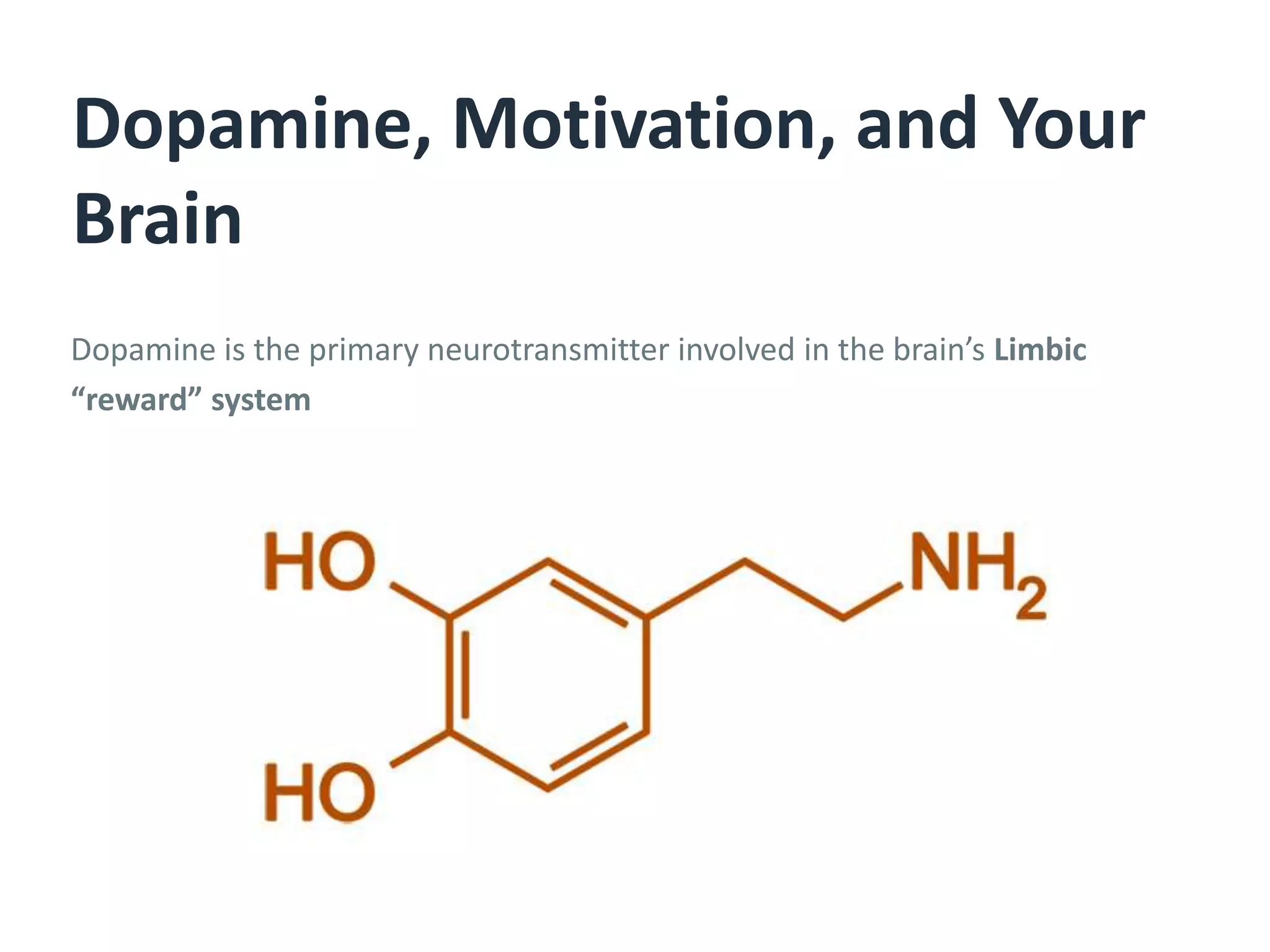
Dopamine is the primary neurotransmitter involved in the brain’s Limbic
“reward” system
Dopamine, Motivation, and Your
Brain
Reward
Reward
Status
Reward
Status
Power
Reward
Status
Power
Achievement
Reward
Status
Power
Achievement
Interest
Reward
Status
Power
Achievement
Interest
Purpose
Reward
Status
Power
Achievement
Interest
Purpose
Fear
Reward
Status
Power
Achievement
Interest
Purpose
Fear
...
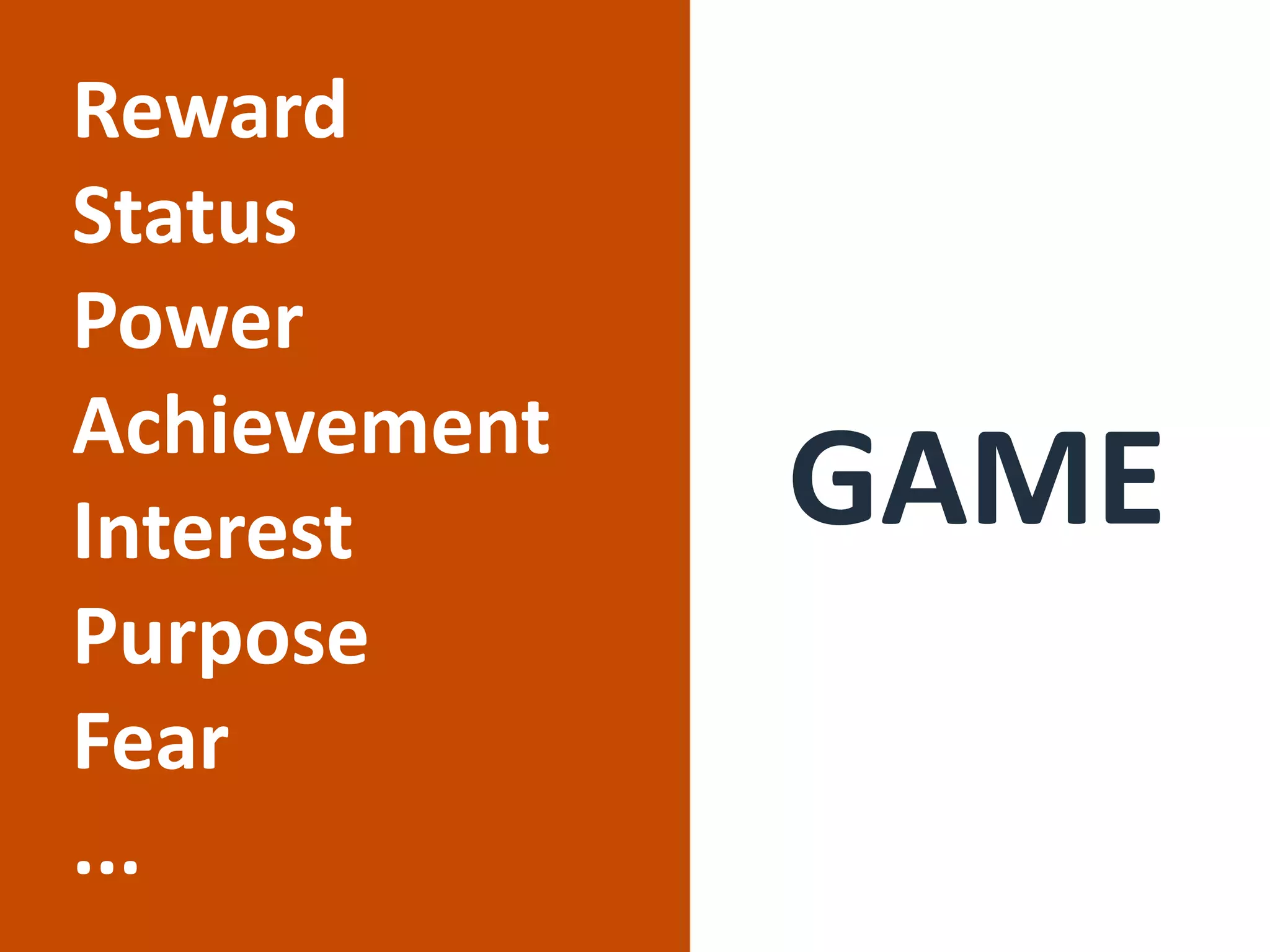
Reward
Status
Power
Achievement
Interest
Purpose
Fear
...
GAME
Gamification is about figuring out
what makes games so engaging,
then applying those principles to
work, education, etc.
The history of gamification
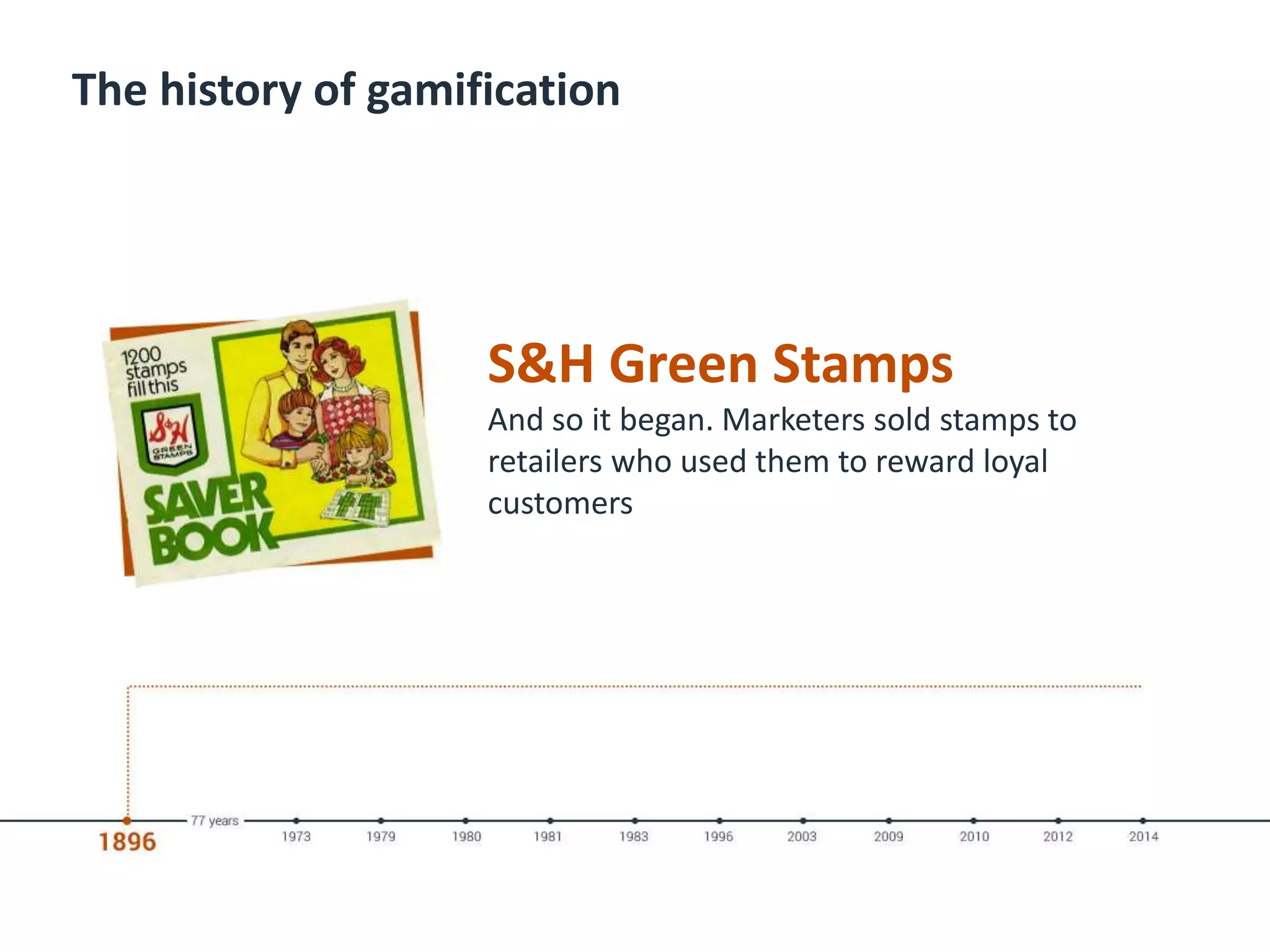
S&H Green Stamps
And so it began. Marketers sold stamps to
retailers who used them to reward loyal
customers
The history of gamification
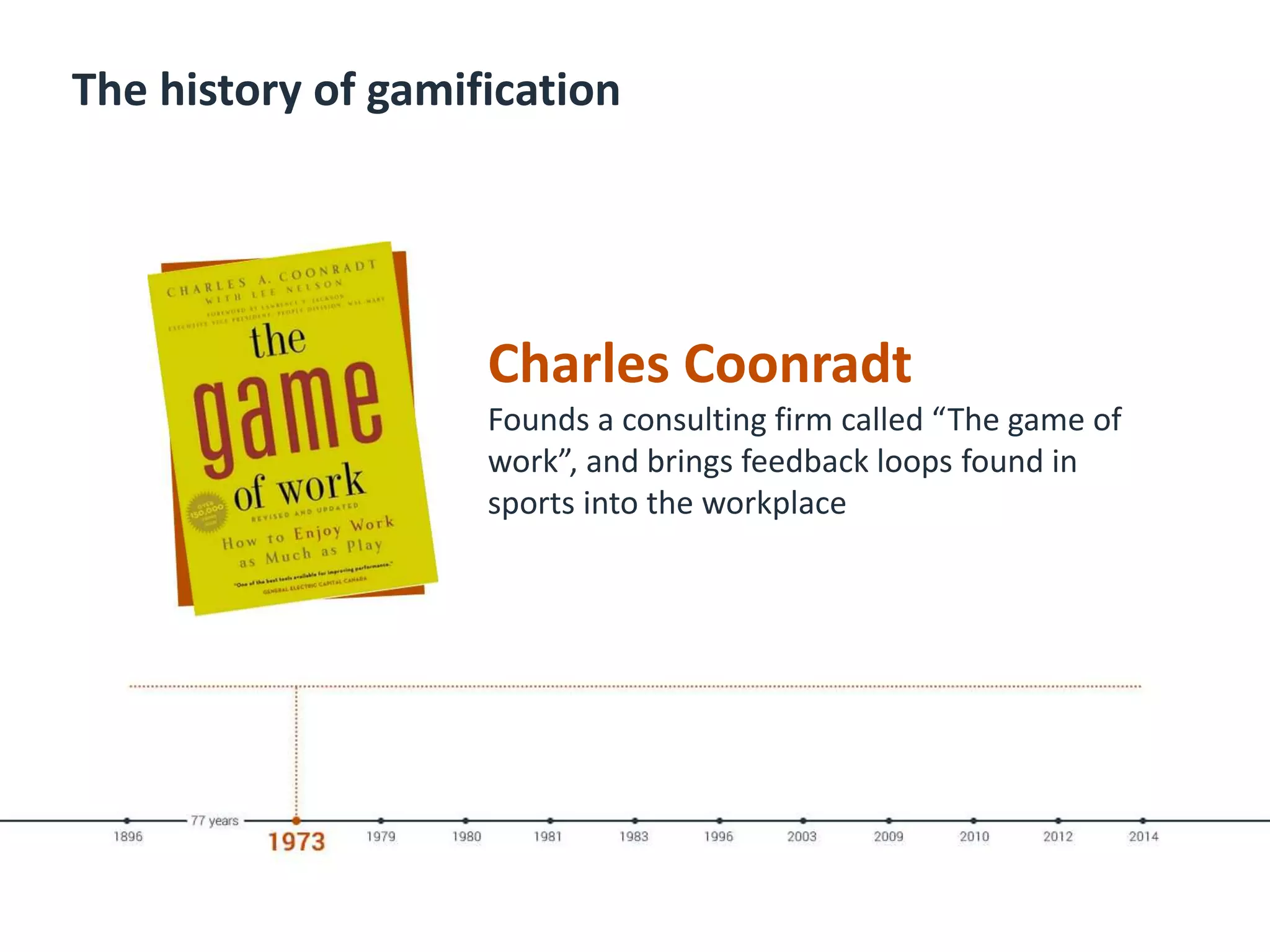
Charles Coonradt
Founds a consulting firm called “The game of
work”, and brings feedback loops found in
sports into the workplace
The history of gamification
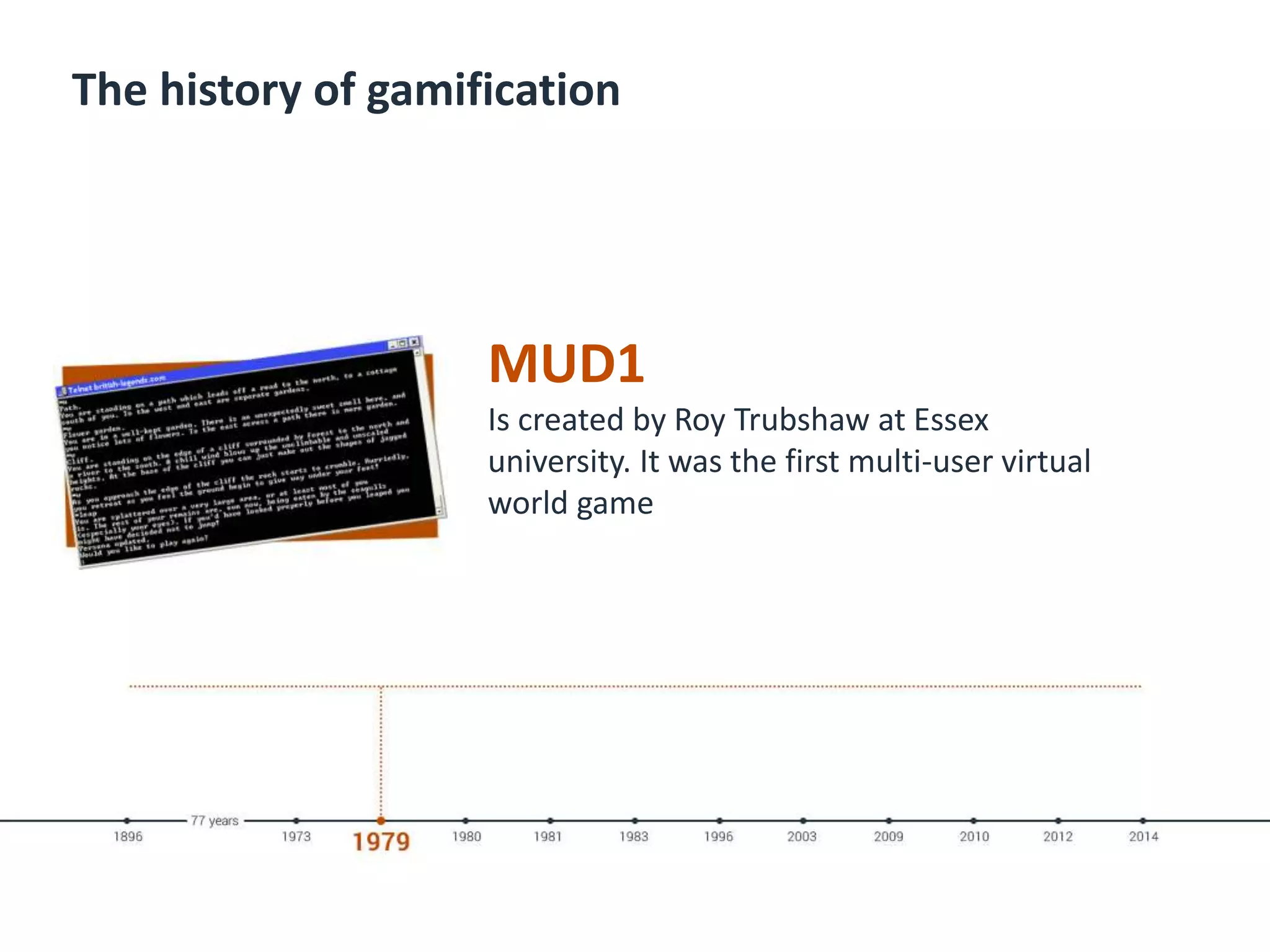
MUD1
Is created by Roy Trubshaw at Essex
university. It was the first multi-user virtual
world game
The history of gamification
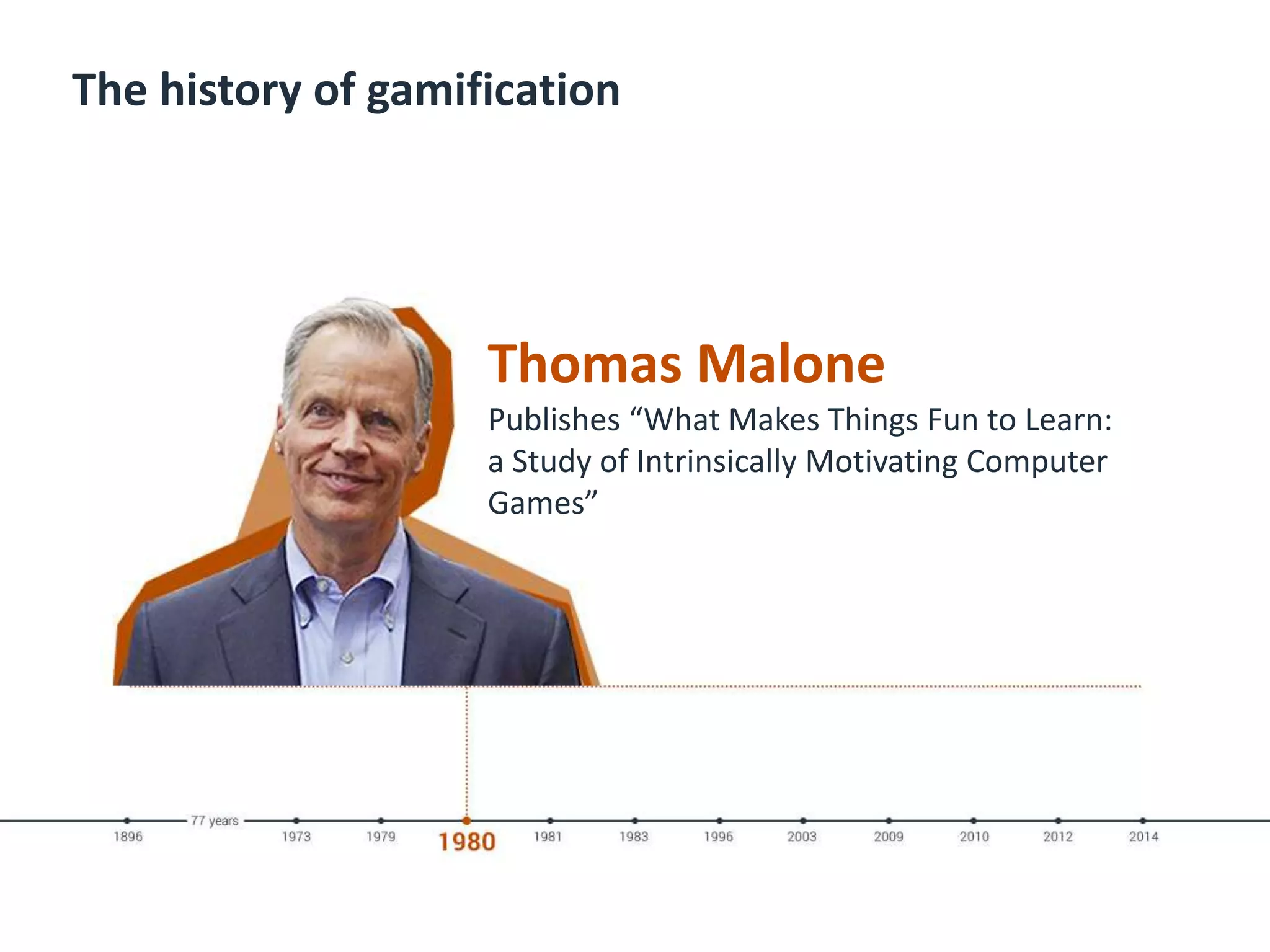
Thomas Malone
Publishes “What Makes Things Fun to Learn:
a Study of Intrinsically Motivating Computer
Games”
The history of gamification
American Airlines
Introduces AAdvantage, the first frequent
flyer program
The history of gamification
Holiday Inn
Launches the first hotel loyalty program
The history of gamification
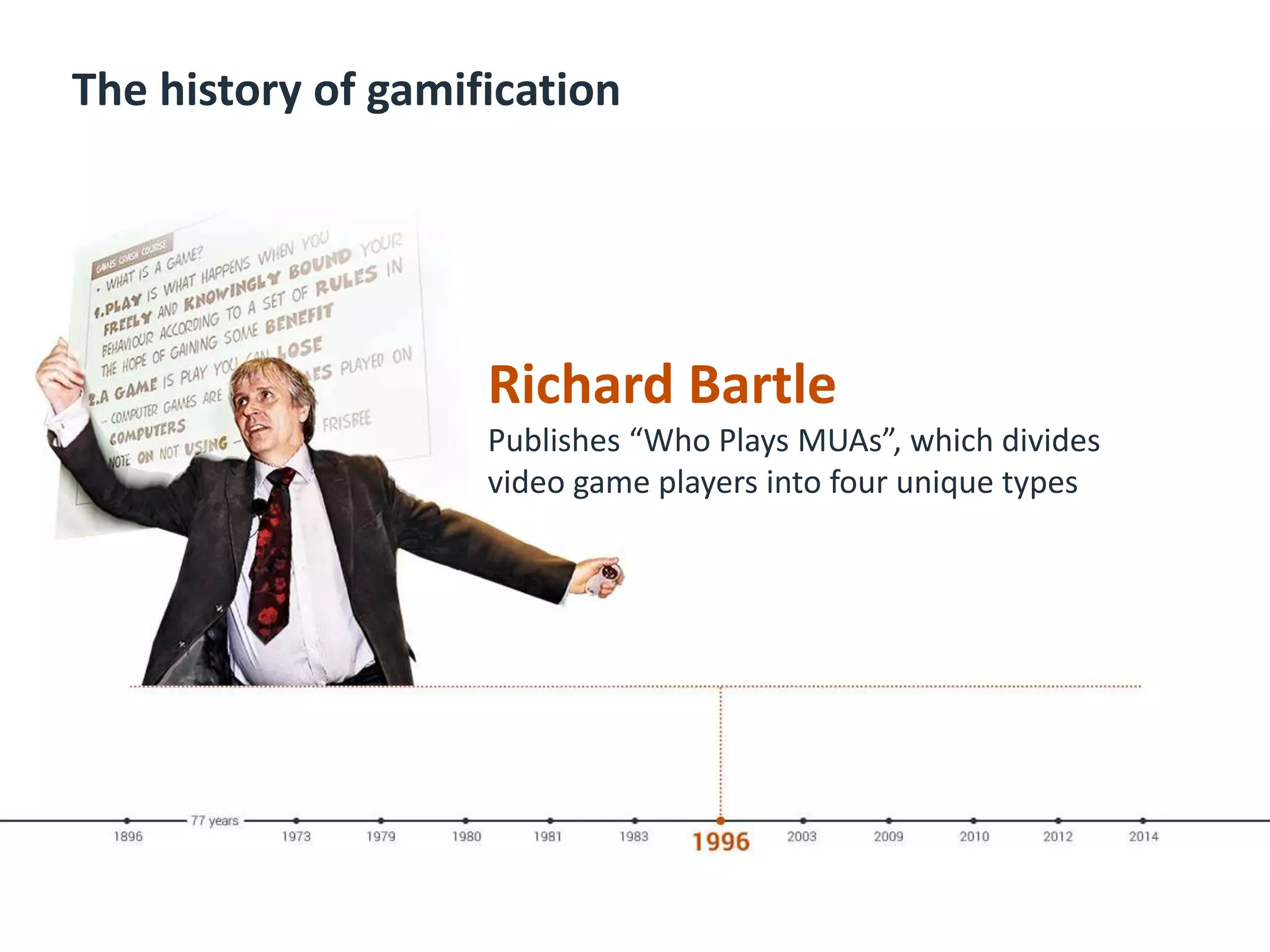
Richard Bartle
Publishes “Who Plays MUAs”, which divides
video game players into four unique types
The history of gamification
Nick Pelling
Coins the term “gamification”
The history of gamification
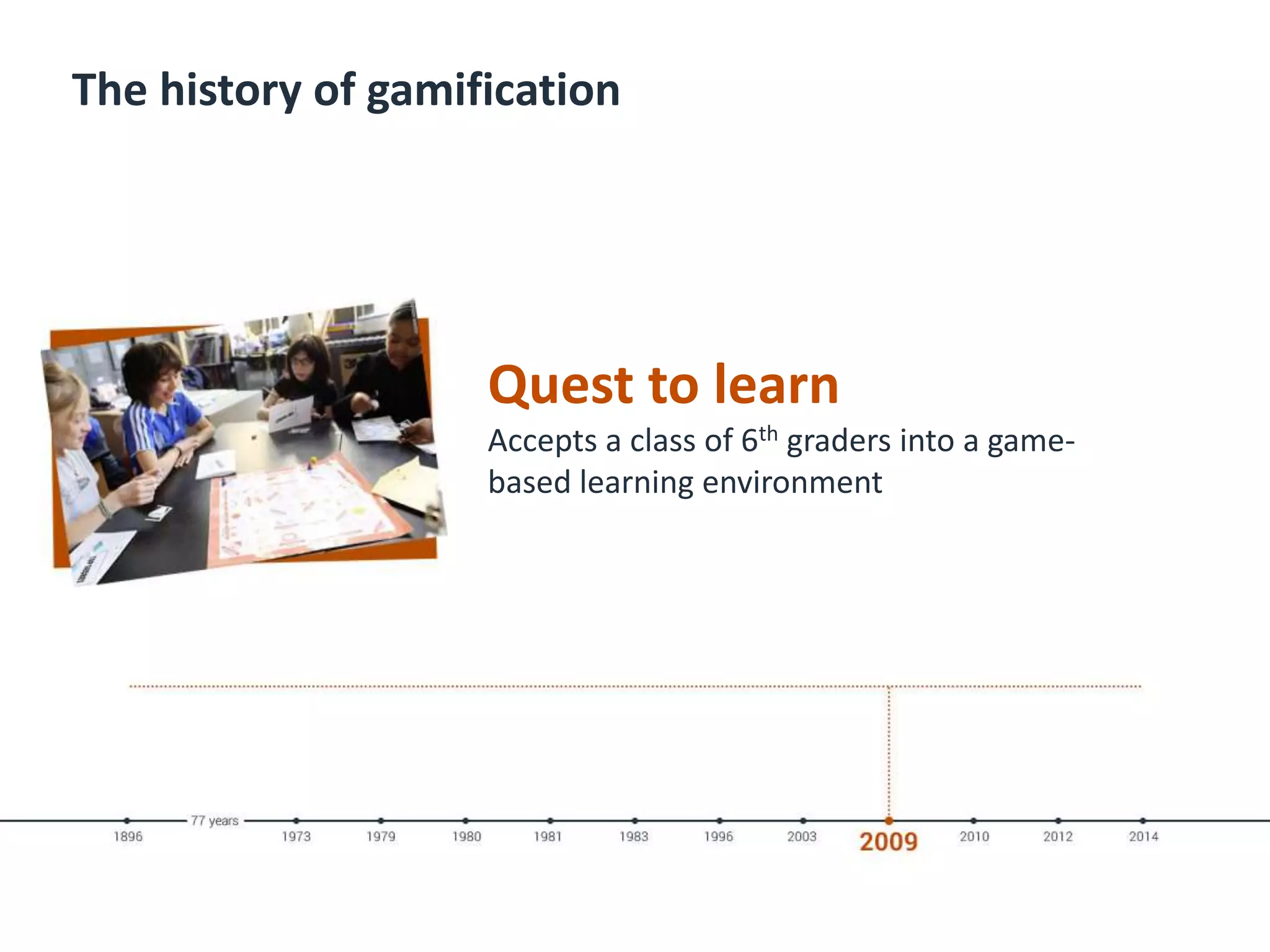
Quest to learn
Accepts a class of 6th graders into a game-
based learning environment
The history of gamification
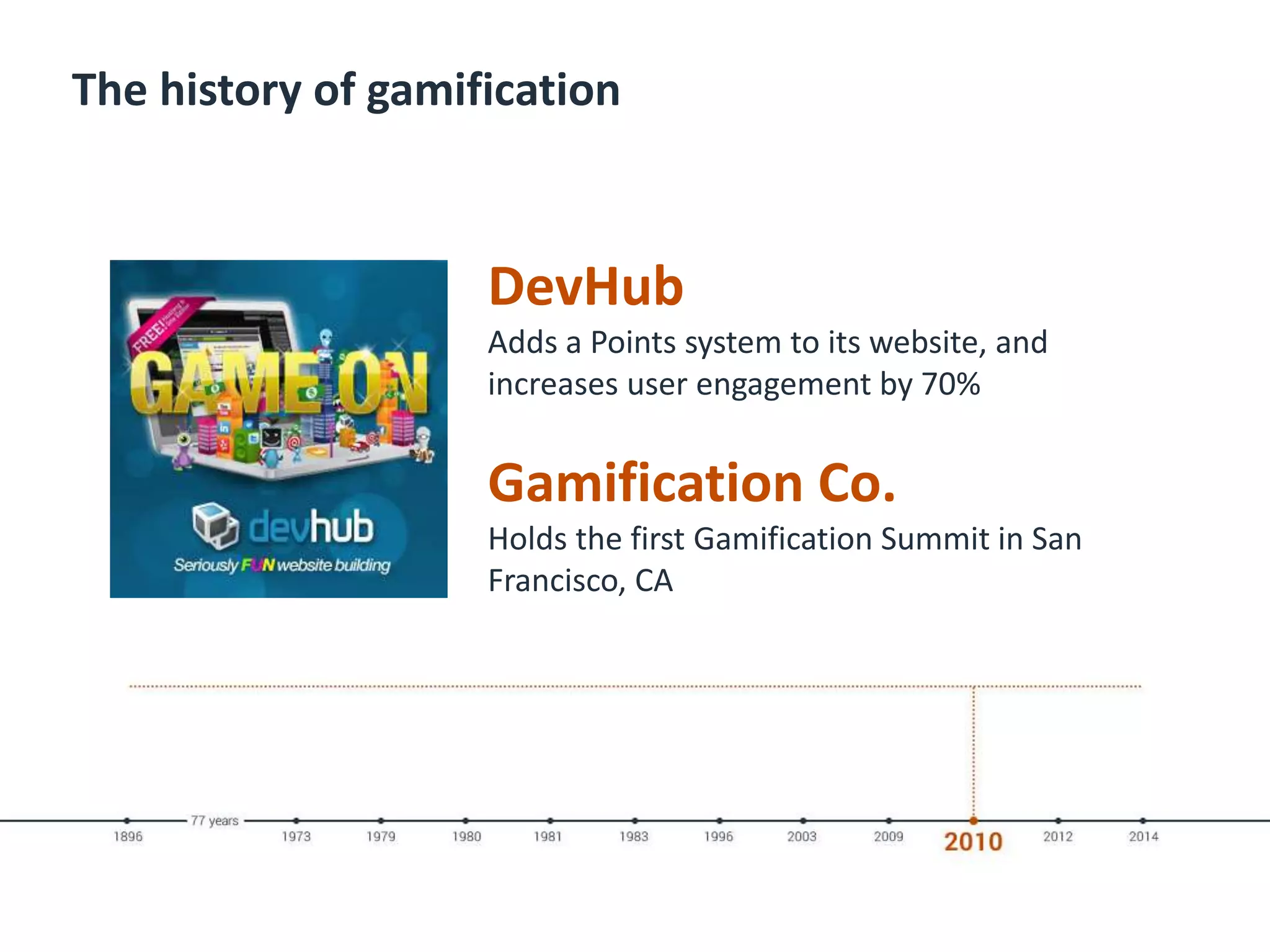
DevHub
Adds a Points system to its website, and
increases user engagement by 70%
Gamification Co.
Holds the first Gamification Summit in San
Francisco, CA
The history of gamification
45 000 people
Enroll Coursera online Gamification course
Mozilla open Badges
Initiative is launched. The open source
badges can be used to mark
accomplishments online
The history of gamification
M2 Research
Predicts that gamification will be a 2.8 billion
dollar industry by 2016
Does it really work so good?
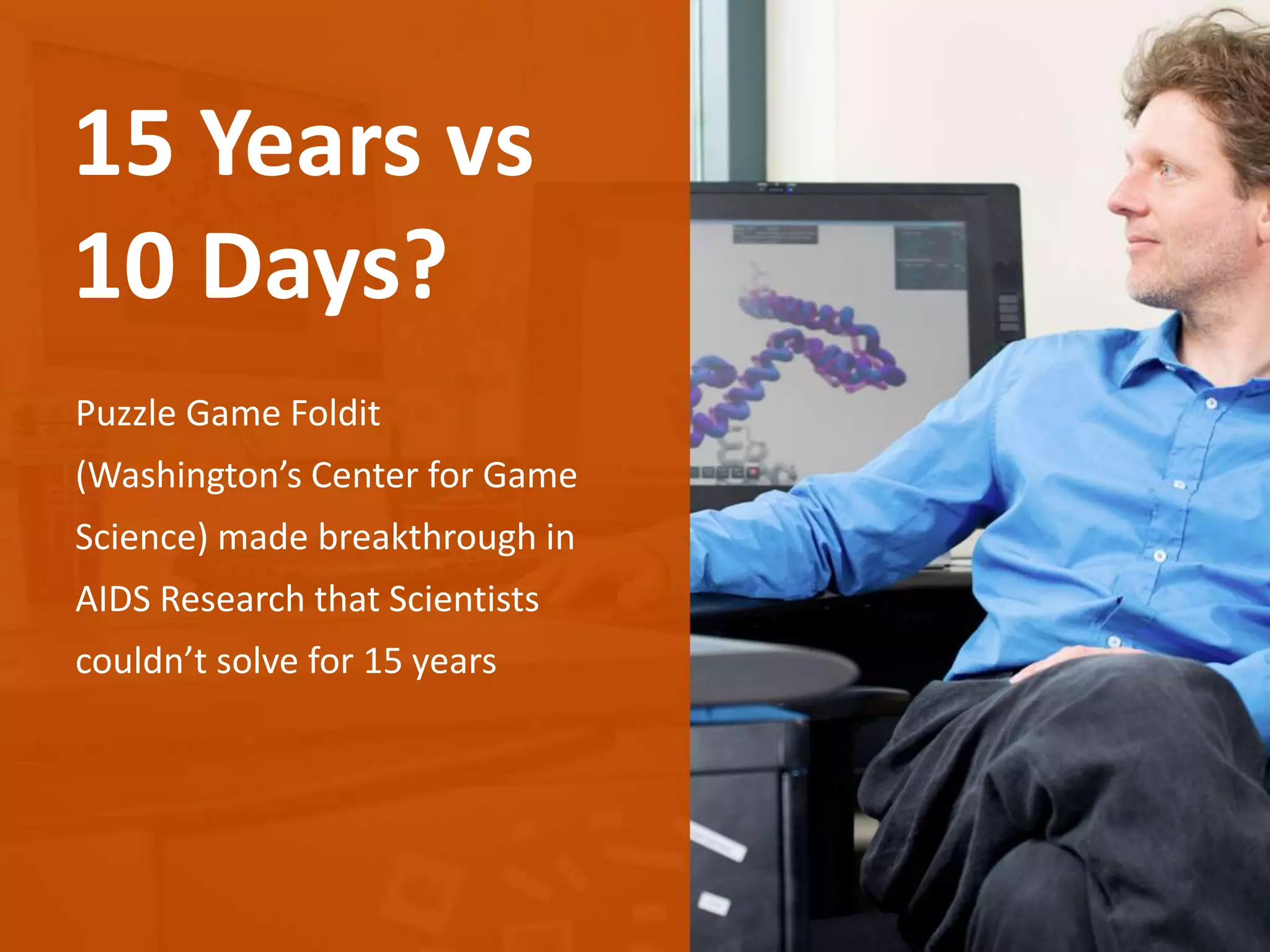
Puzzle Game Foldit
(Washington’s Center for Game
Science) made breakthrough in
AIDS Research that Scientists
couldn’t solve for 15 years
15 Years vs
10 Days?
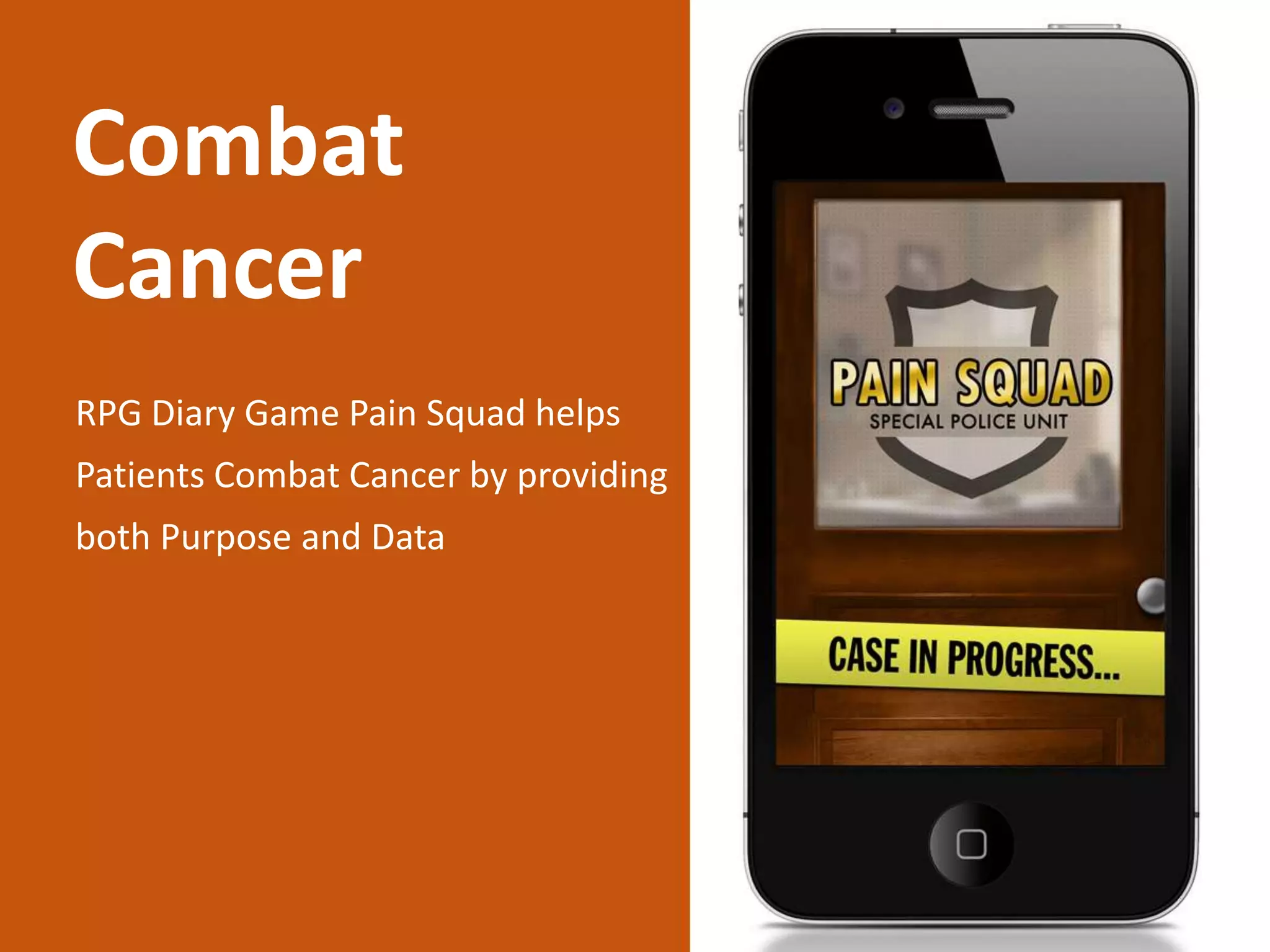
RPG Diary Game Pain Squad helps
Patients Combat Cancer by providing
both Purpose and Data
Combat
Cancer
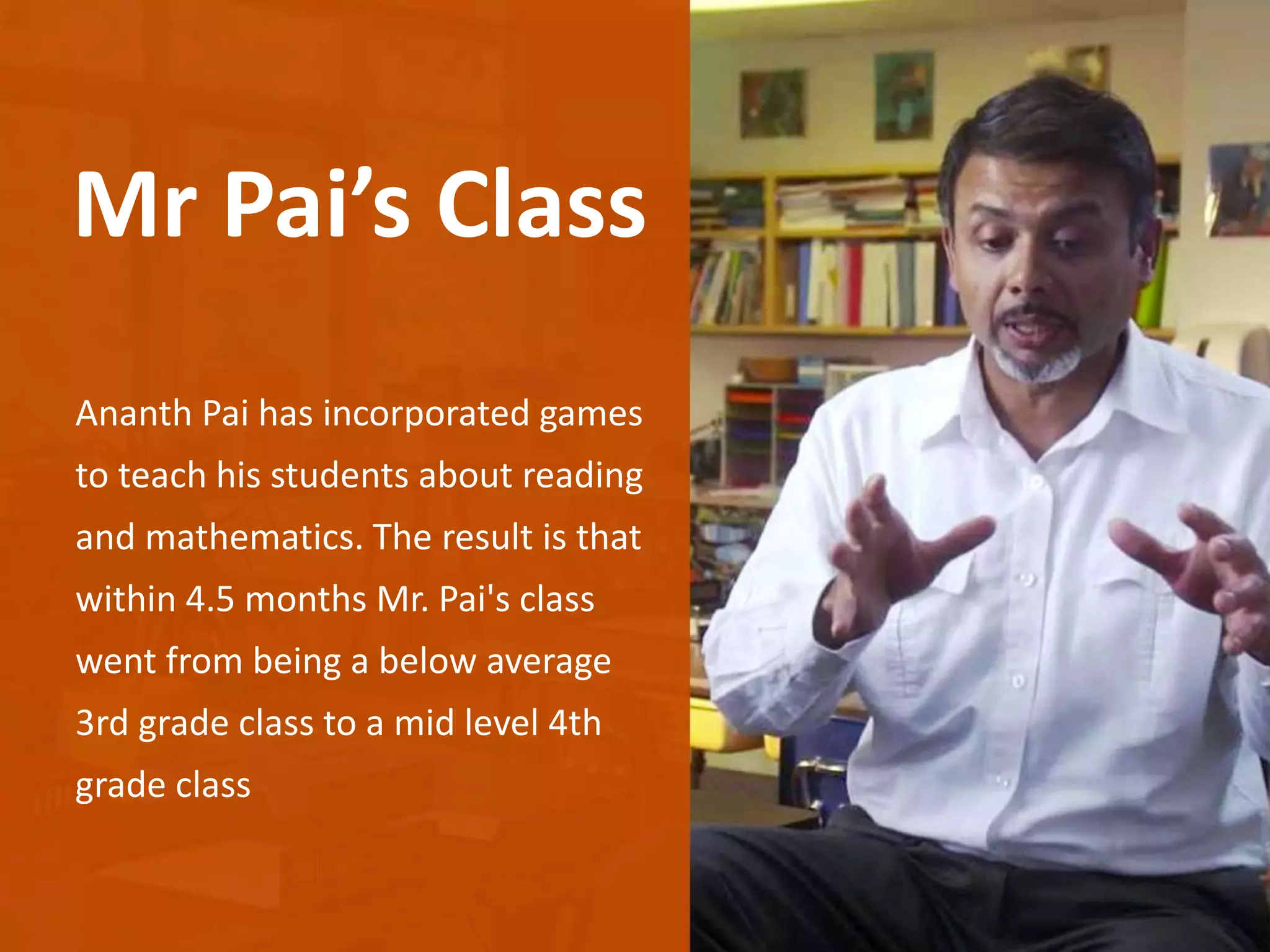
Ananth Pai has incorporated games
to teach his students about reading
and mathematics. The result is that
within 4.5 months Mr. Pai's class
went from being a below average
3rd grade class to a mid level 4th
grade class
Mr Pai’s Class
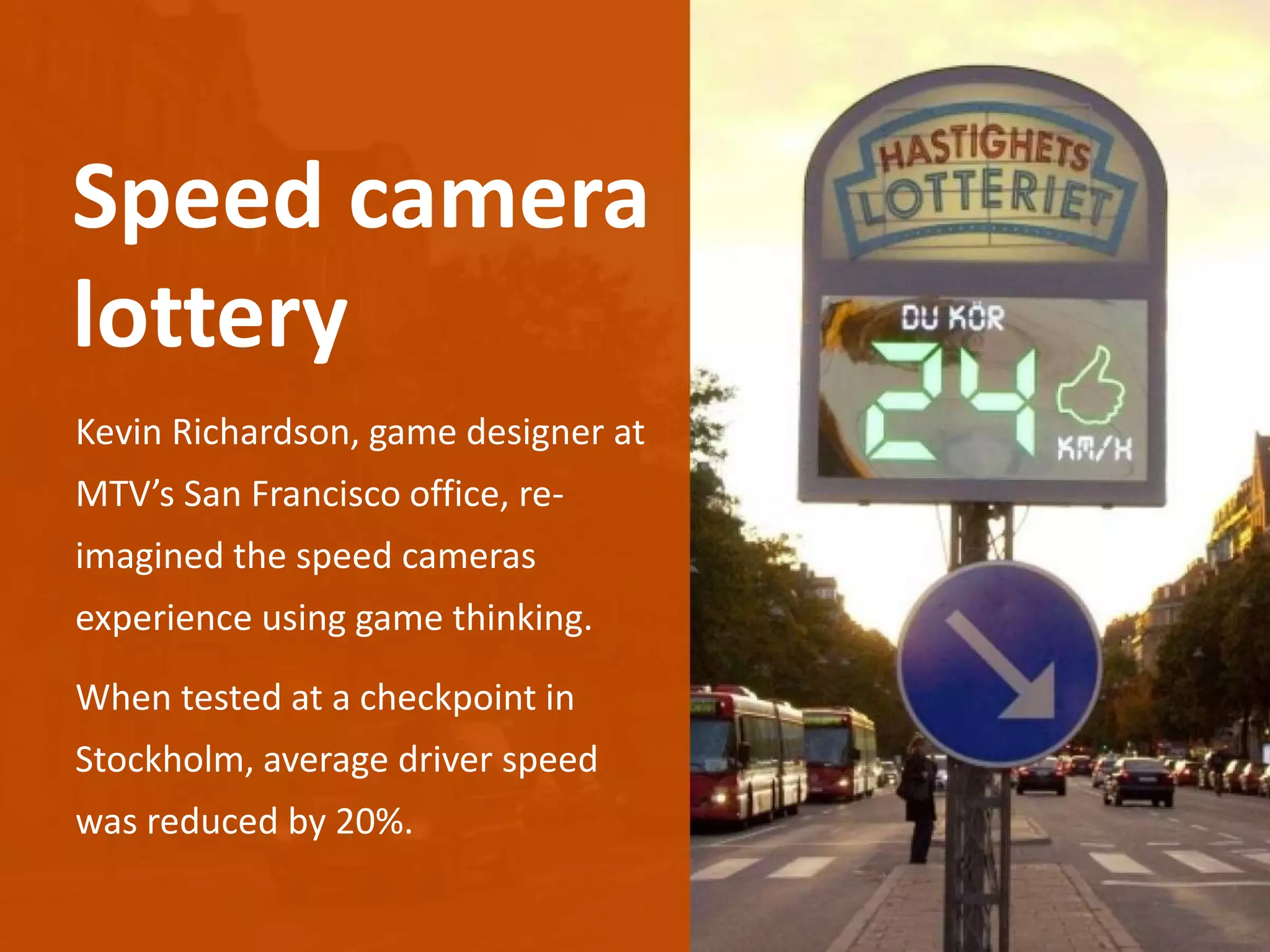
Kevin Richardson, game designer at
MTV’s San Francisco office, re-
imagined the speed cameras
experience using game thinking.
When tested at a checkpoint in
Stockholm, average driver speed
was reduced by 20%.
Speed camera
lottery
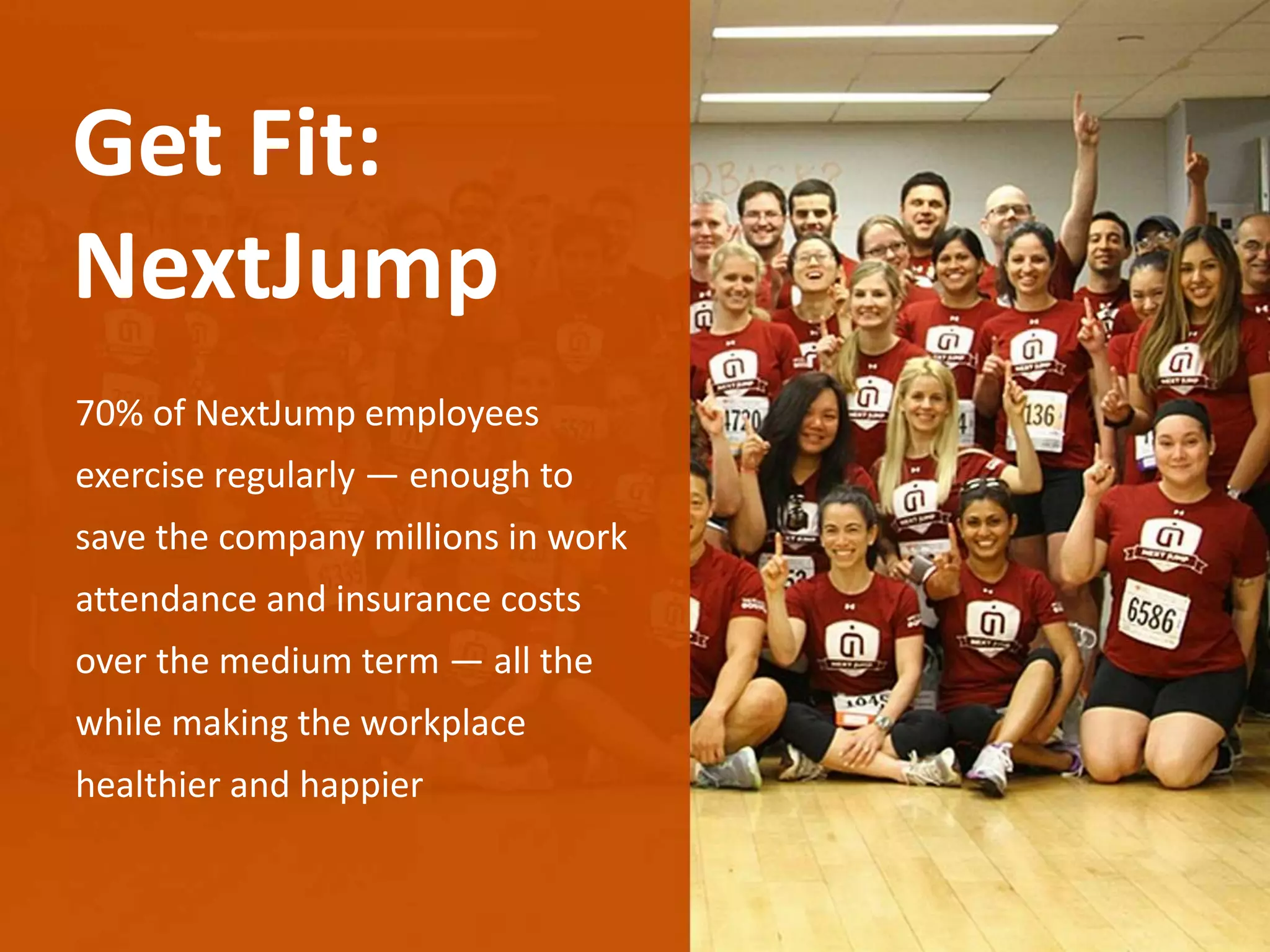
70% of NextJump employees
exercise regularly — enough to
save the company millions in work
attendance and insurance costs
over the medium term — all the
while making the workplace
healthier and happier
Get Fit:
NextJump
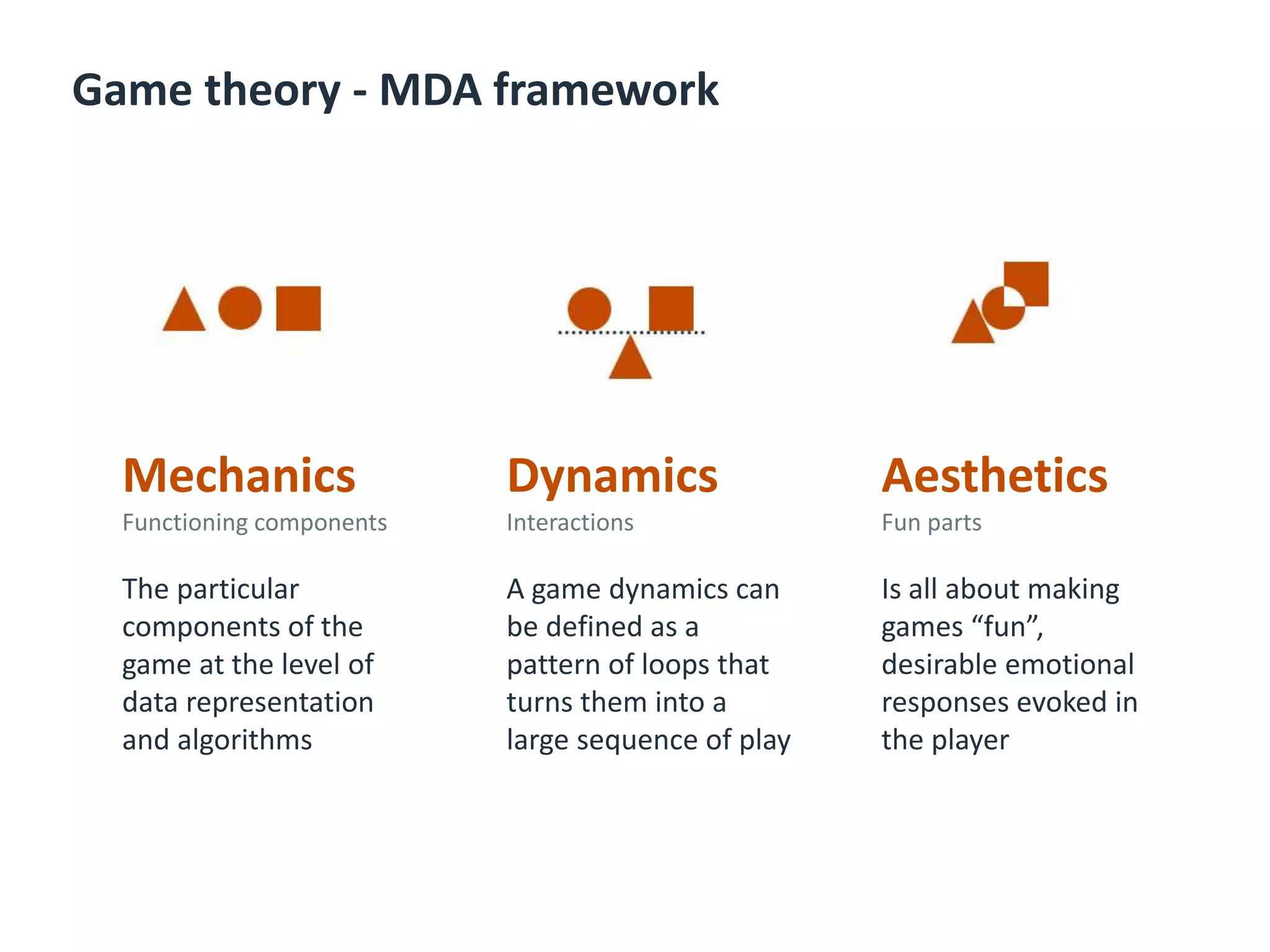
Game theory - MDA framework
Mechanics
Functioning components
The particular
components of the
game at the level of
data representation
and algorithms
Dynamics
Interactions
A game dynamics can
be defined as a
pattern of loops that
turns them into a
large sequence of play
Aesthetics
Fun parts
Is all about making
games “fun”,
desirable emotional
responses evoked in
the player
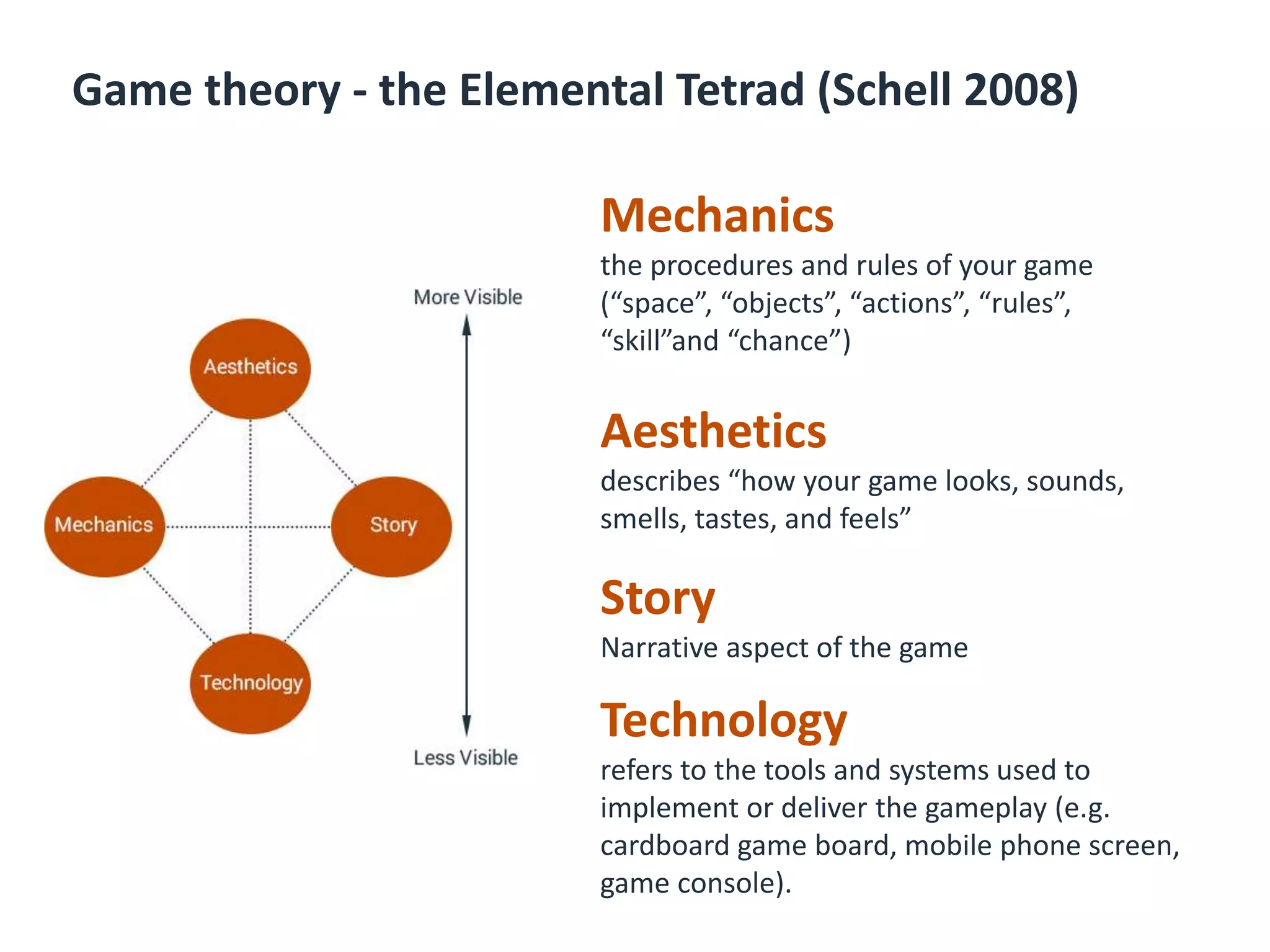
Game theory - the Elemental Tetrad (Schell 2008)
Mechanics
the procedures and rules of your game
(“space”, “objects”, “actions”, “rules”,
“skill”and “chance”)
Aesthetics
describes “how your game looks, sounds,
smells, tastes, and feels”
Story
Narrative aspect of the game
Technology
refers to the tools and systems used to
implement or deliver the gameplay (e.g.
cardboard game board, mobile phone screen,
game console).
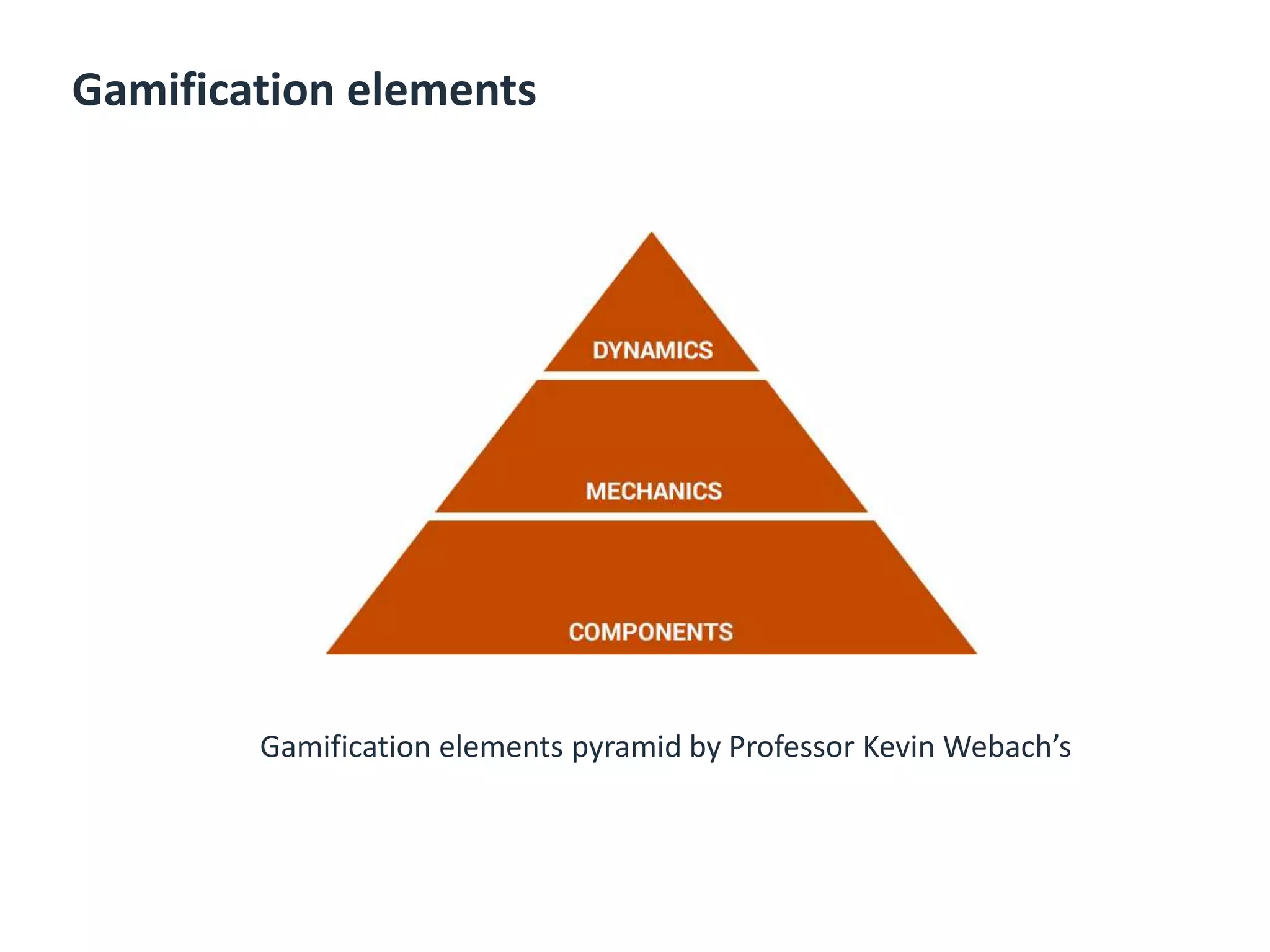
Gamification elements
Gamification elements pyramid by Professor Kevin Webach’s
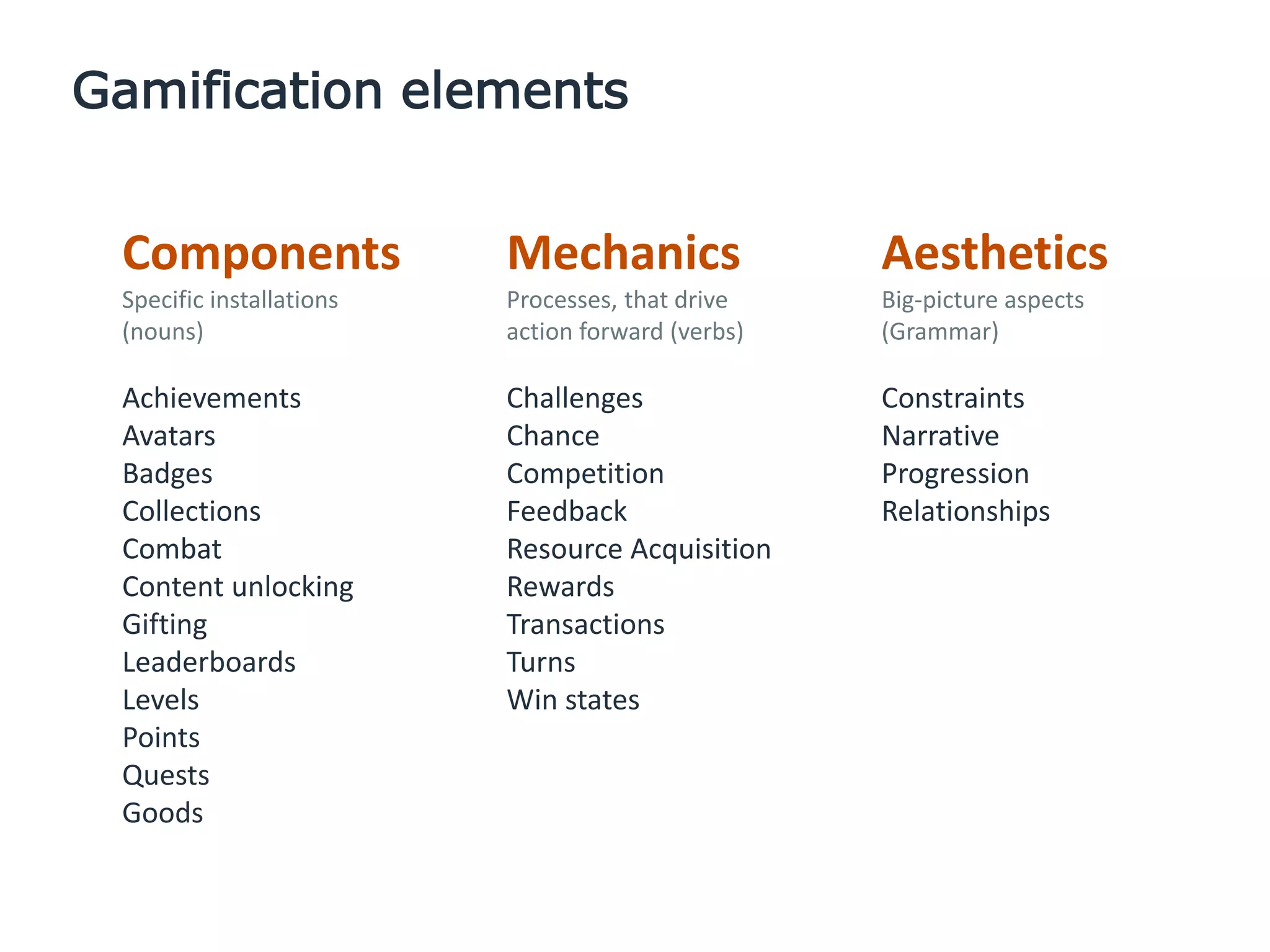
Gamification elements
Components
Specific installations
(nouns)
Achievements
Avatars
Badges
Collections
Combat
Content unlocking
Gifting
Leaderboards
Levels
Points
Quests
Goods
Mechanics
Processes, that drive
action forward (verbs)
Challenges
Chance
Competition
Feedback
Resource Acquisition
Rewards
Transactions
Turns
Win states
Aesthetics
Big-picture aspects
(Grammar)
Constraints
Narrative
Progression
Relationships
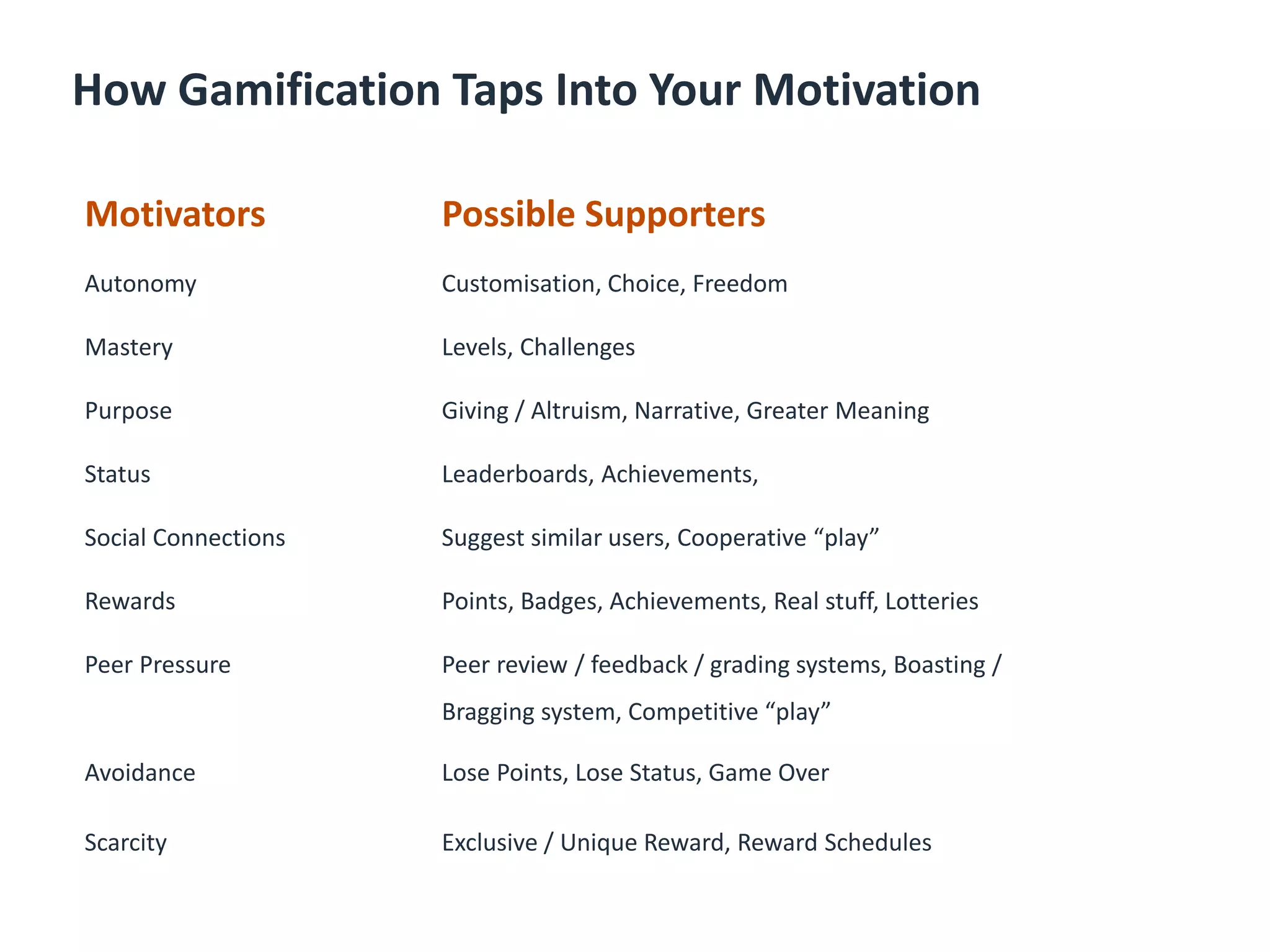
How Gamification Taps Into Your Motivation
Motivators Possible Supporters
Autonomy Customisation, Сhoice, Freedom
Mastery Levels, Challenges
Purpose Giving / Altruism, Narrative, Greater Meaning
Status Leaderboards, Achievements,
Social Connections Suggest similar users, Cooperative “play”
Rewards Points, Badges, Achievements, Real stuff, Lotteries
Peer Pressure Peer review / feedback / grading systems, Boasting /
Bragging system, Competitive “play”
Avoidance Lose Points, Lose Status, Game Over
Scarcity Exclusive / Unique Reward, Reward Schedules
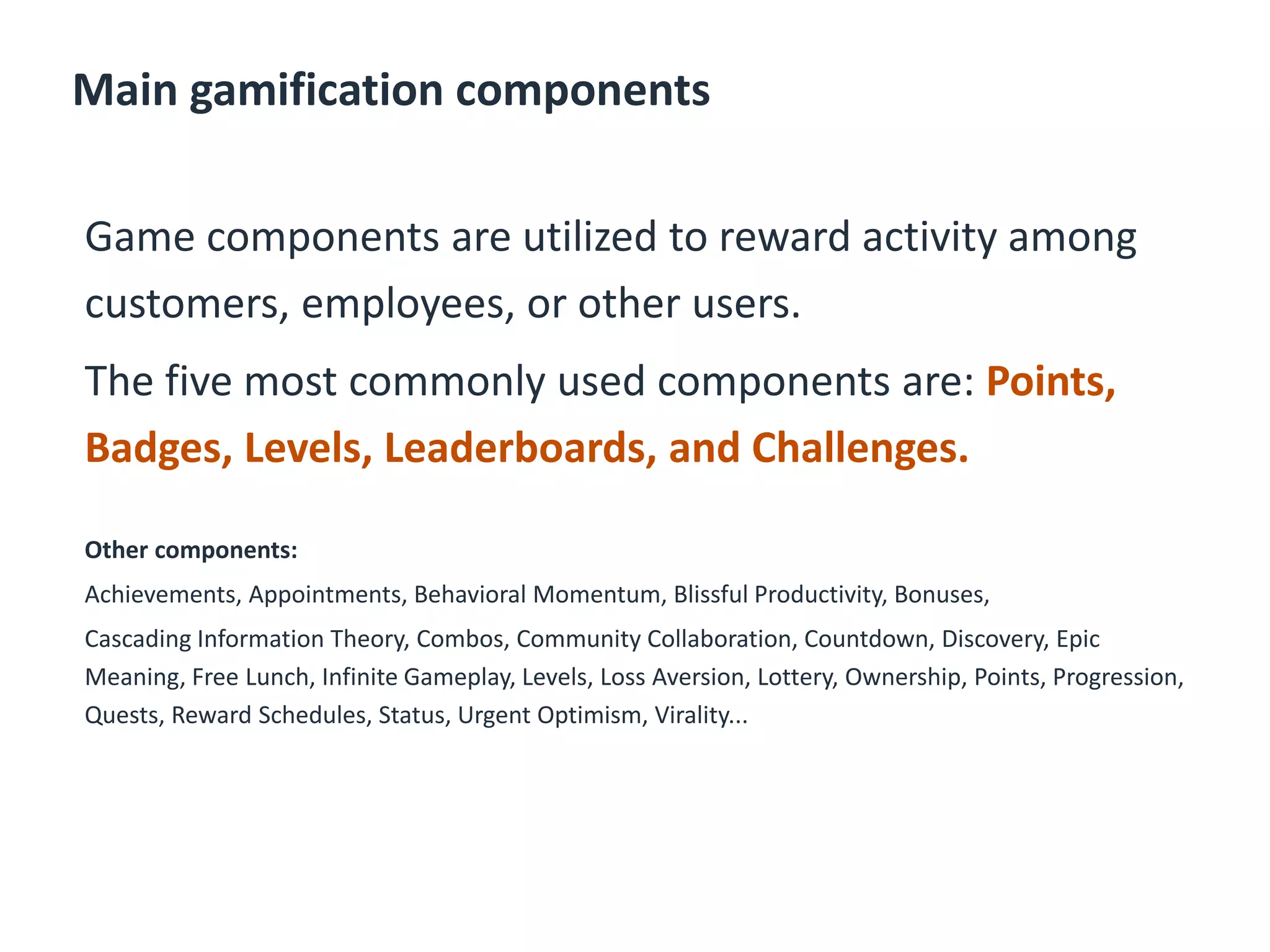
Main gamification components
Game components are utilized to reward activity among
customers, employees, or other users.
The five most commonly used components are: Points,
Badges, Levels, Leaderboards, and Challenges.
Other components:
Achievements, Appointments, Behavioral Momentum, Blissful Productivity, Bonuses,
Cascading Information Theory, Combos, Community Collaboration, Countdown, Discovery, Epic
Meaning, Free Lunch, Infinite Gameplay, Levels, Loss Aversion, Lottery, Ownership, Points, Progression,
Quests, Reward Schedules, Status, Urgent Optimism, Virality...
Points
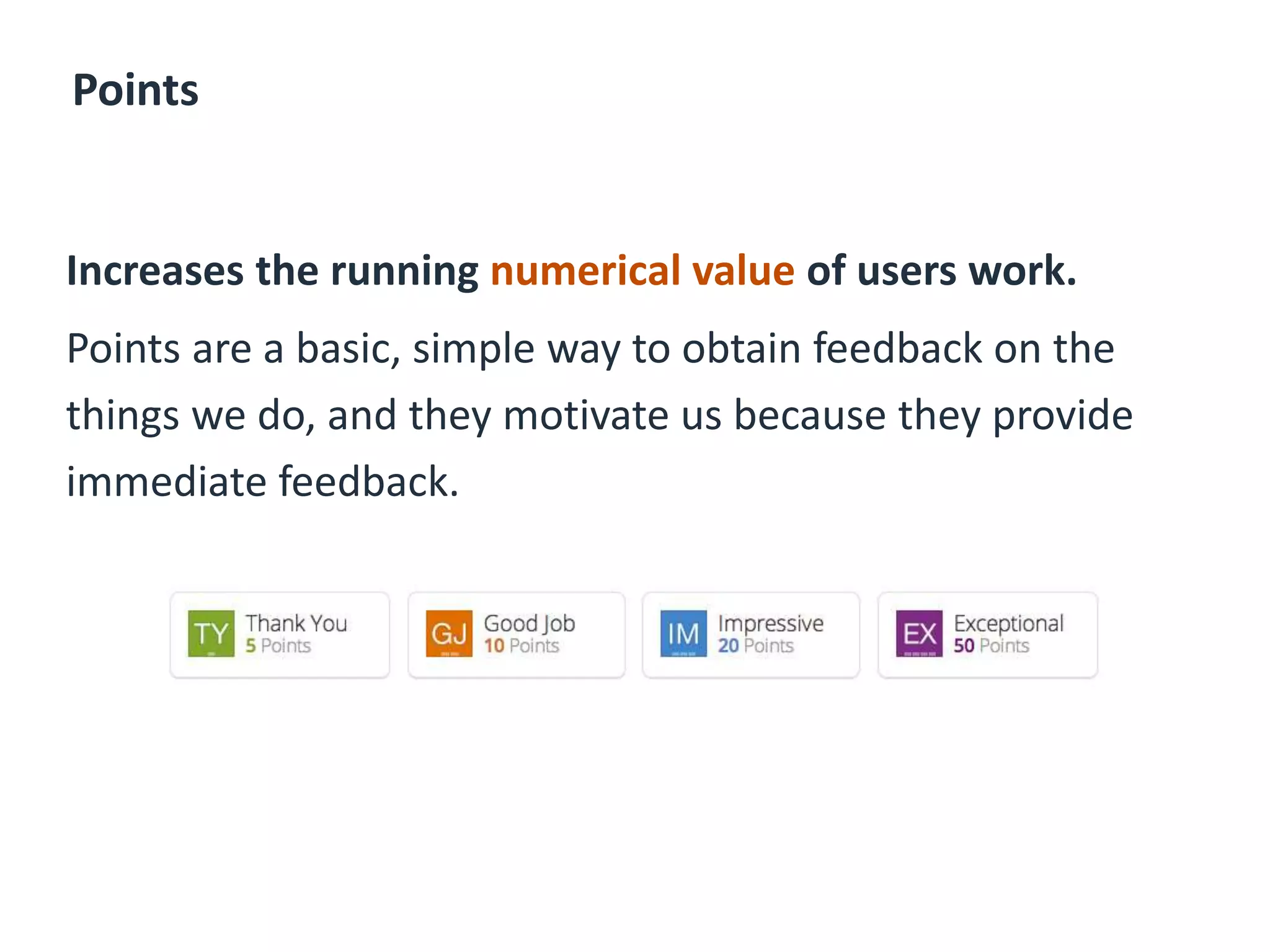
Increases the running numerical value of users work.
Points are a basic, simple way to obtain feedback on the
things we do, and they motivate us because they provide
immediate feedback.
Badges
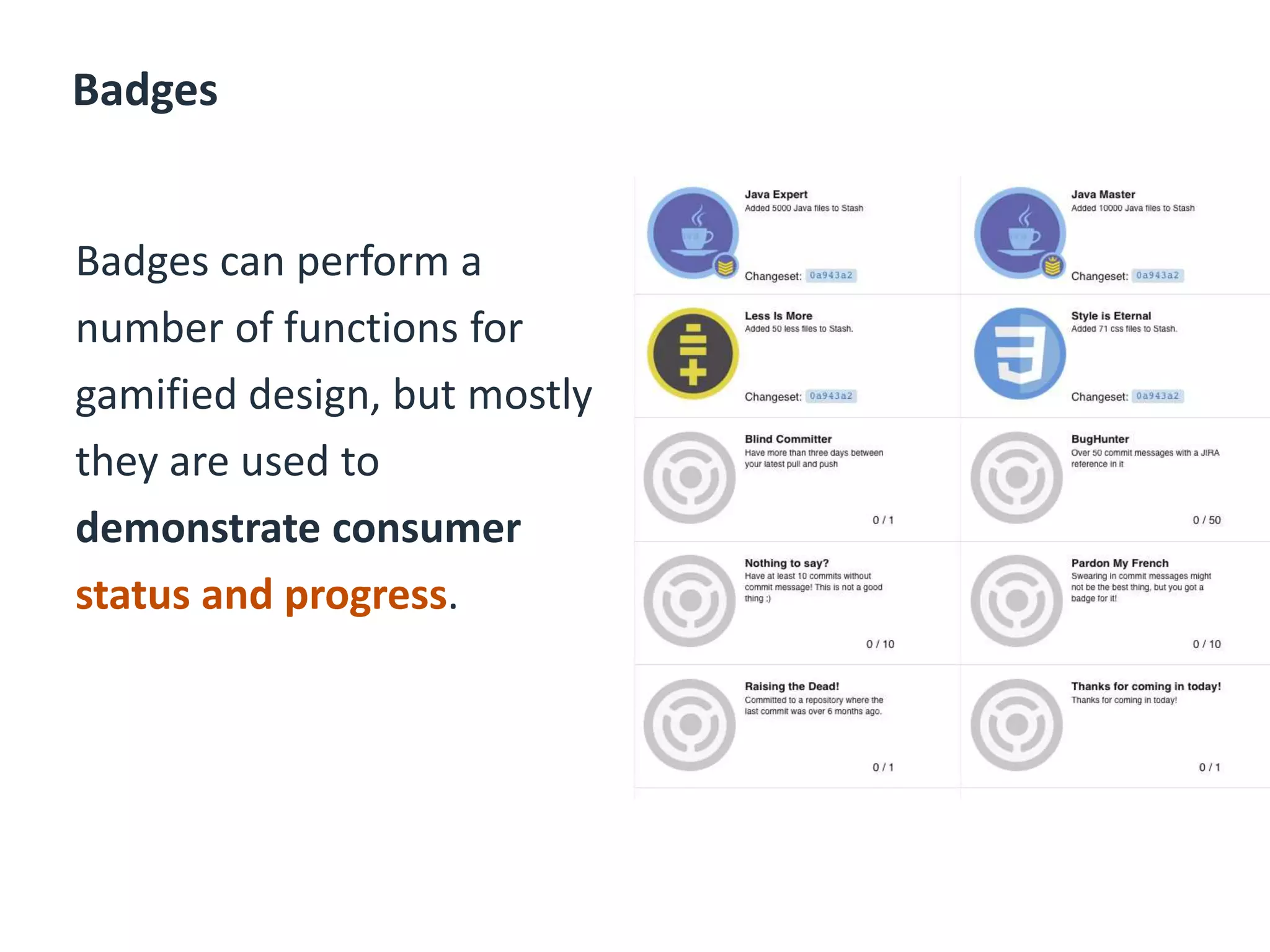
Badges can perform a
number of functions for
gamified design, but mostly
they are used to
demonstrate consumer
status and progress.
Levels
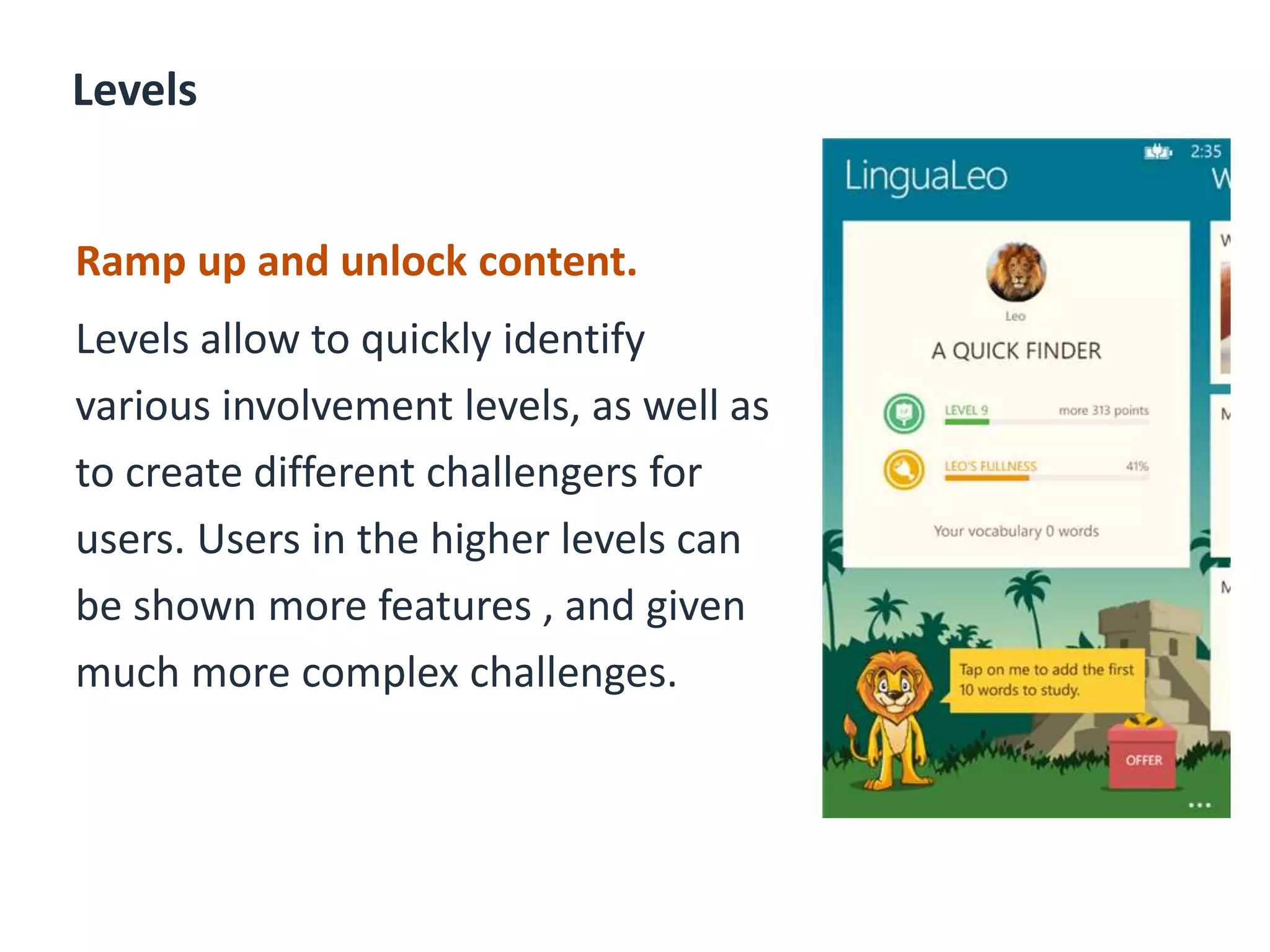
Ramp up and unlock content.
Levels allow to quickly identify
various involvement levels, as well as
to create different challengers for
users. Users in the higher levels can
be shown more features , and given
much more complex challenges.
Leaderboards, Ratings
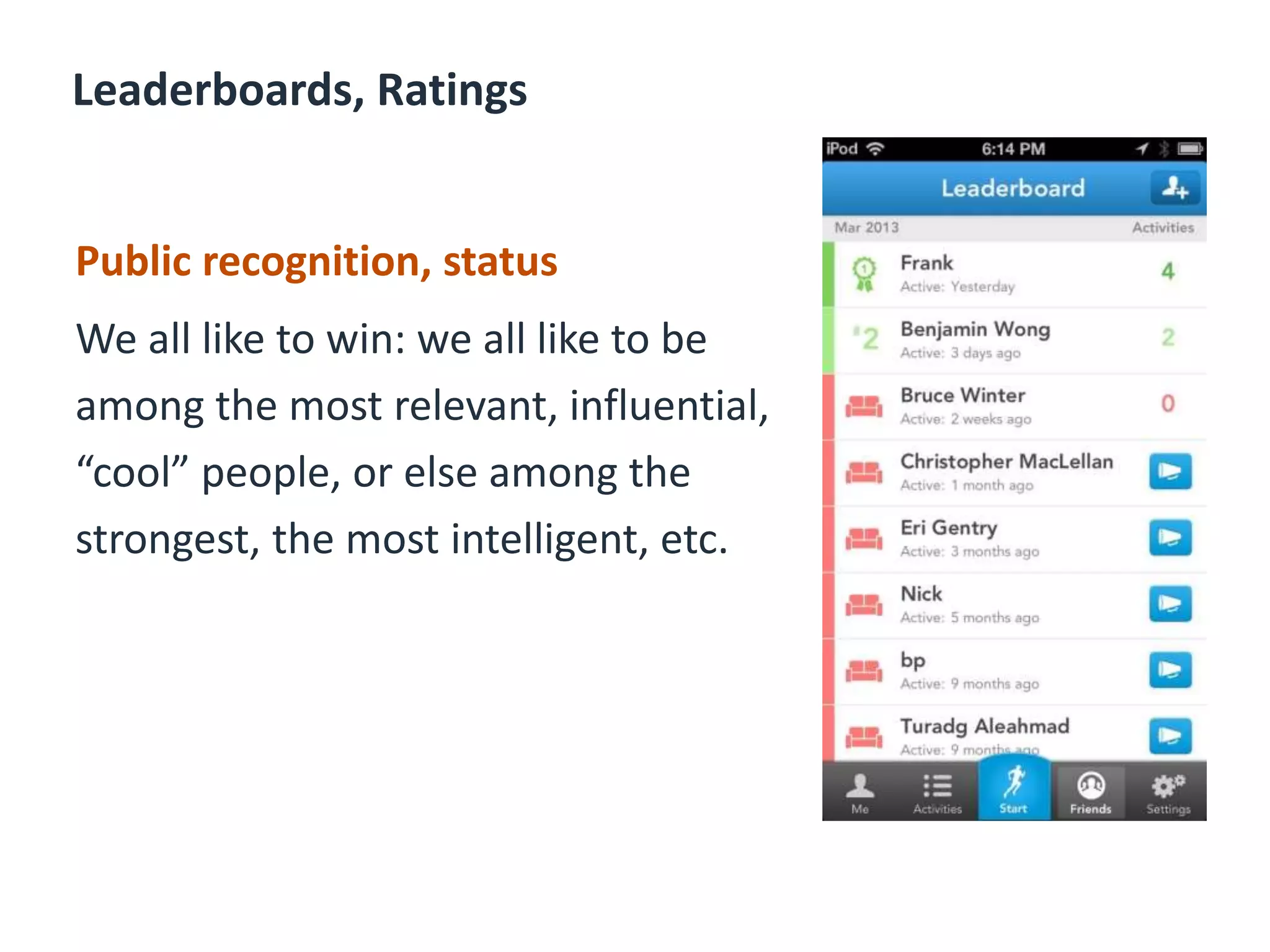
Public recognition, status
We all like to win: we all like to be
among the most relevant, influential,
“cool” people, or else among the
strongest, the most intelligent, etc.
Challenges
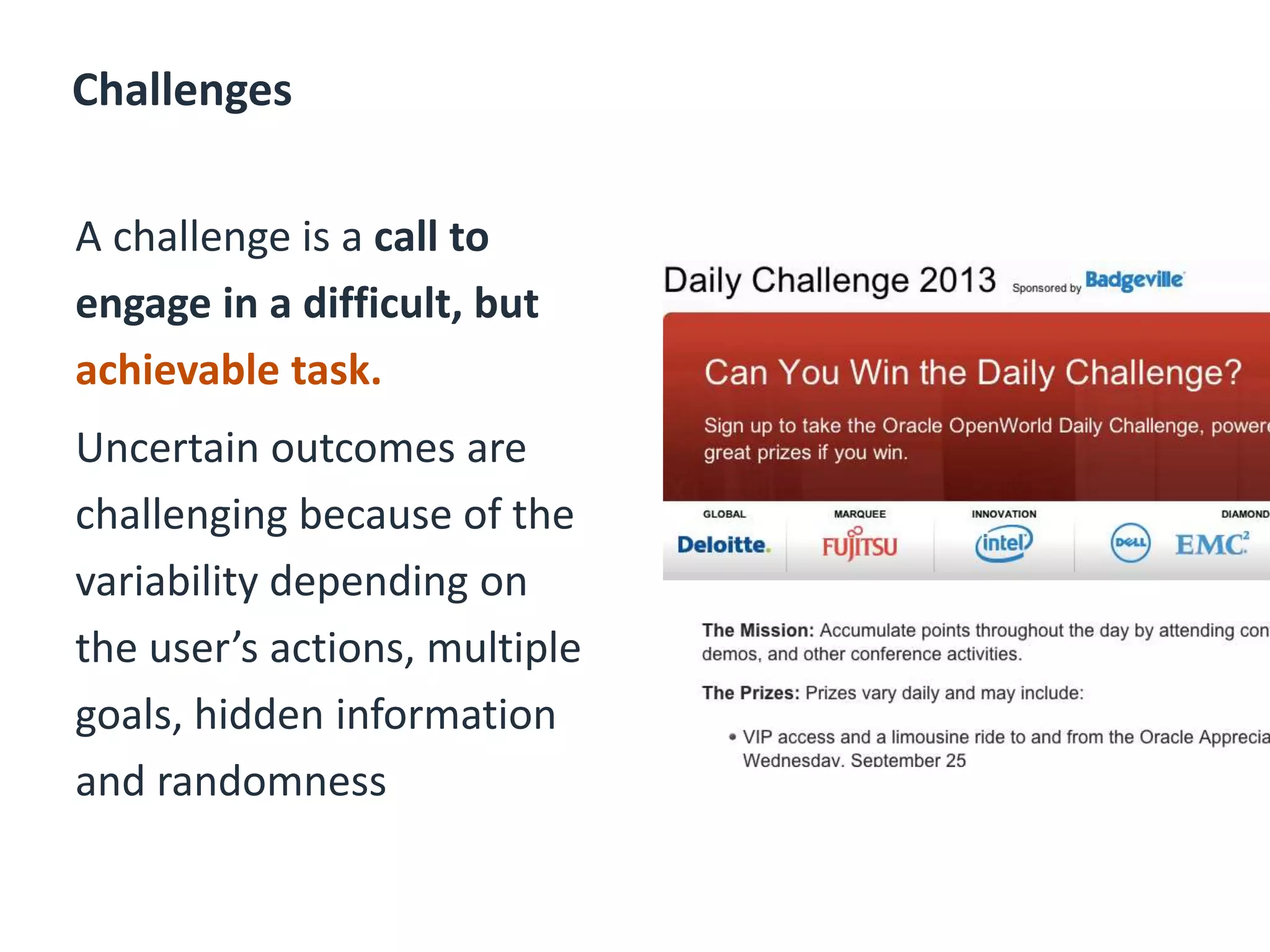
A challenge is a call to
engage in a difficult, but
achievable task.
Uncertain outcomes are
challenging because of the
variability depending on
the user’s actions, multiple
goals, hidden information
and randomness
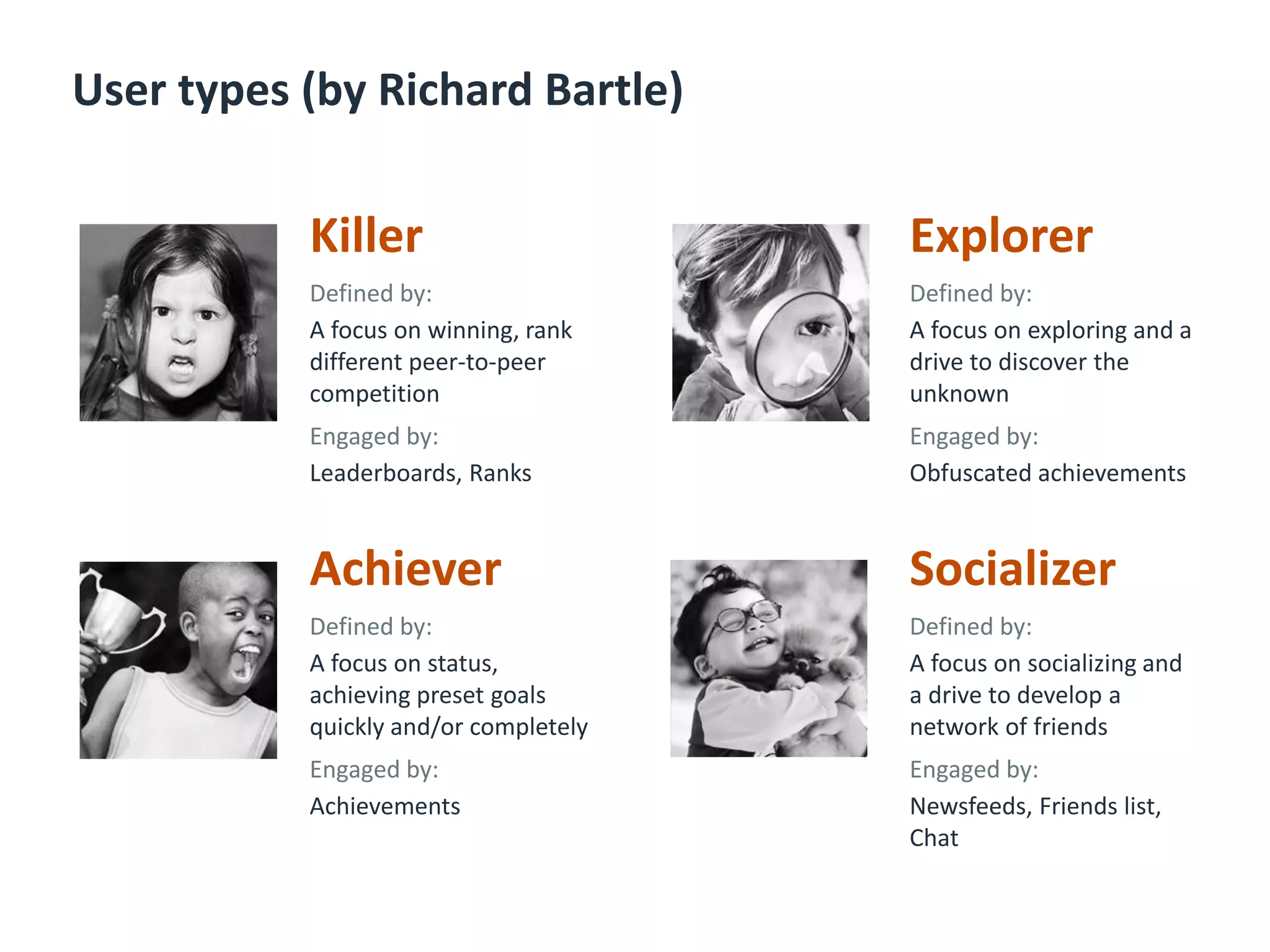
User types (by Richard Bartle)
Killer
Defined by:
A focus on winning, rank
different peer-to-peer
competition
Engaged by:
Leaderboards, Ranks
Explorer
Defined by:
A focus on exploring and a
drive to discover the
unknown
Engaged by:
Obfuscated achievements
Achiever
Defined by:
A focus on status,
achieving preset goals
quickly and/or completely
Engaged by:
Achievements
Socializer
Defined by:
A focus on socializing and
a drive to develop a
network of friends
Engaged by:
Newsfeeds, Friends list,
Chat
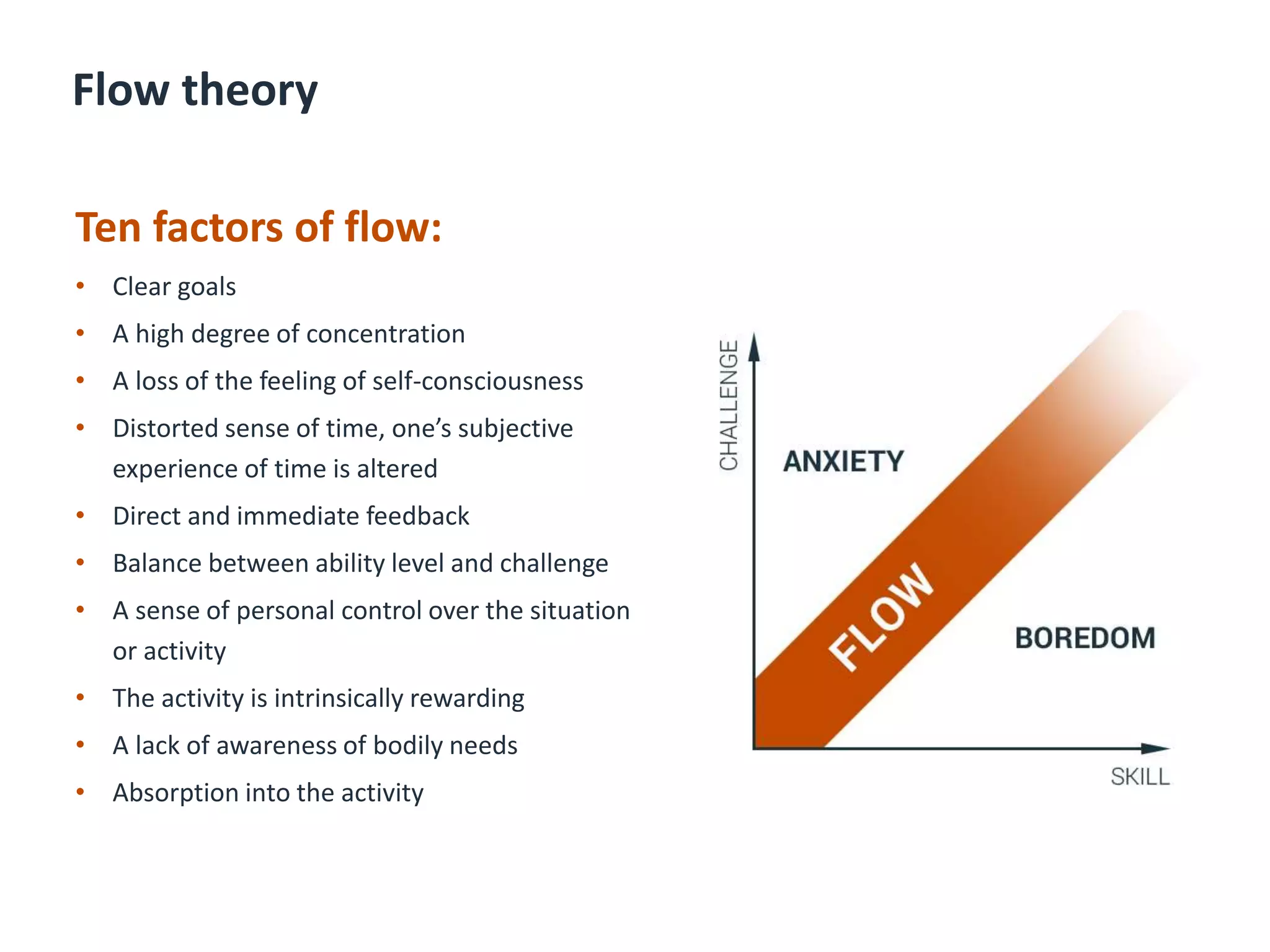
Flow theory
Ten factors of flow:
• Clear goals
• A high degree of concentration
• A loss of the feeling of self-consciousness
• Distorted sense of time, one’s subjective
experience of time is altered
• Direct and immediate feedback
• Balance between ability level and challenge
• A sense of personal control over the situation
or activity
• The activity is intrinsically rewarding
• A lack of awareness of bodily needs
• Absorption into the activity
A fly in the ointment
The side effects
Cobra effect
Getting rid of cobras in Delhi
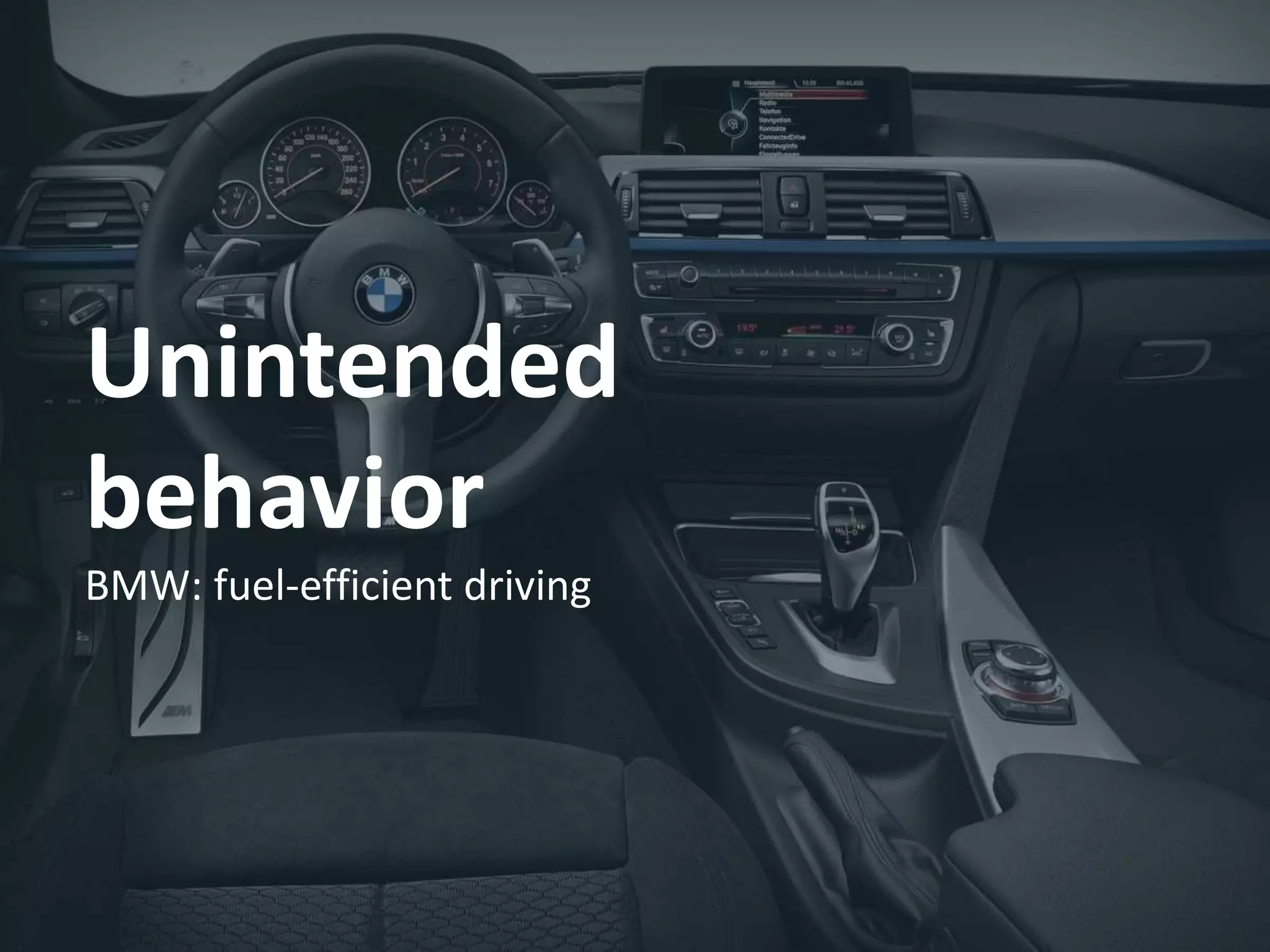
Unintended
behavior
BMW: fuel-efficient driving
Questions to ask yourself before gamifying your
product/service
• What is your main reason for gamifying your
product/service?
• Is your product ready for Gamification?
• What are your goals?
• What are your users goals? What motivates them?
• What are the main benefits you expect to achieve?
Questions to ask yourself during gamifying your
product/service
• Do you have Achievements a player would be proud of or
share?
• Do you have the right analytics tools and goals set?
• Do you know where players drop out, where do they lose
interest?
• What are the challenges? Do they require skill or luck?
• Have you thoroughly thought about your game design from
a cheater's perspective to see possible exploits they would
see?
Questions to ask yourself during gamifying your
product/service
• Do you give players meaningful choices? Would you benefit
from making them more or less frequent?
• How can you give your players more ways to contact or
interact with one another?
• Have you spent enough time on your User Interface and
insuring players really enjoy the graphical elements of the
Gamification?
• Do players value their virtual currency or goods?
• …
Questions

Introduction to Gamification

  • 1.
  • 2.
    ― What isGamification? ― Psychology and motivation of Gamification ― History ― Best Practices ― Gamification Theory ― Game Mechanics and Components ― A fly in the ointment ― Conclusion Agenda
  • 3.
    Gamification is theuse of game thinking and game mechanics in non-game contexts to engage users in solving problems MOTIVATE them to certain behavior. Nick Pelling coined the term “gamification” in 2002, meaning “applying game-like accelerated user interface design to make electronic transactions both enjoyable and fast.”
  • 4.
    How do youmotivate people to certain behavior?
  • 5.
  • 6.
    Motivation in the20th century
  • 7.
  • 8.
    Dopamine is theprimary neurotransmitter involved in the brain’s Limbic “reward” system Dopamine, Motivation, and Your Brain
  • 9.
  • 10.
  • 11.
  • 12.
  • 13.
  • 14.
  • 15.
  • 16.
  • 17.
  • 18.
    Gamification is aboutfiguring out what makes games so engaging, then applying those principles to work, education, etc.
  • 19.
    The history ofgamification S&H Green Stamps And so it began. Marketers sold stamps to retailers who used them to reward loyal customers
  • 20.
    The history ofgamification Charles Coonradt Founds a consulting firm called “The game of work”, and brings feedback loops found in sports into the workplace
  • 21.
    The history ofgamification MUD1 Is created by Roy Trubshaw at Essex university. It was the first multi-user virtual world game
  • 22.
    The history ofgamification Thomas Malone Publishes “What Makes Things Fun to Learn: a Study of Intrinsically Motivating Computer Games”
  • 23.
    The history ofgamification American Airlines Introduces AAdvantage, the first frequent flyer program
  • 24.
    The history ofgamification Holiday Inn Launches the first hotel loyalty program
  • 25.
    The history ofgamification Richard Bartle Publishes “Who Plays MUAs”, which divides video game players into four unique types
  • 26.
    The history ofgamification Nick Pelling Coins the term “gamification”
  • 27.
    The history ofgamification Quest to learn Accepts a class of 6th graders into a game- based learning environment
  • 28.
    The history ofgamification DevHub Adds a Points system to its website, and increases user engagement by 70% Gamification Co. Holds the first Gamification Summit in San Francisco, CA
  • 29.
    The history ofgamification 45 000 people Enroll Coursera online Gamification course Mozilla open Badges Initiative is launched. The open source badges can be used to mark accomplishments online
  • 30.
    The history ofgamification M2 Research Predicts that gamification will be a 2.8 billion dollar industry by 2016
  • 31.
    Does it reallywork so good?
  • 32.
    Puzzle Game Foldit (Washington’sCenter for Game Science) made breakthrough in AIDS Research that Scientists couldn’t solve for 15 years 15 Years vs 10 Days?
  • 33.
    RPG Diary GamePain Squad helps Patients Combat Cancer by providing both Purpose and Data Combat Cancer
  • 34.
    Ananth Pai hasincorporated games to teach his students about reading and mathematics. The result is that within 4.5 months Mr. Pai's class went from being a below average 3rd grade class to a mid level 4th grade class Mr Pai’s Class
  • 35.
    Kevin Richardson, gamedesigner at MTV’s San Francisco office, re- imagined the speed cameras experience using game thinking. When tested at a checkpoint in Stockholm, average driver speed was reduced by 20%. Speed camera lottery
  • 36.
    70% of NextJumpemployees exercise regularly — enough to save the company millions in work attendance and insurance costs over the medium term — all the while making the workplace healthier and happier Get Fit: NextJump
  • 37.
    Game theory -MDA framework Mechanics Functioning components The particular components of the game at the level of data representation and algorithms Dynamics Interactions A game dynamics can be defined as a pattern of loops that turns them into a large sequence of play Aesthetics Fun parts Is all about making games “fun”, desirable emotional responses evoked in the player
  • 38.
    Game theory -the Elemental Tetrad (Schell 2008) Mechanics the procedures and rules of your game (“space”, “objects”, “actions”, “rules”, “skill”and “chance”) Aesthetics describes “how your game looks, sounds, smells, tastes, and feels” Story Narrative aspect of the game Technology refers to the tools and systems used to implement or deliver the gameplay (e.g. cardboard game board, mobile phone screen, game console).
  • 39.
    Gamification elements Gamification elementspyramid by Professor Kevin Webach’s
  • 40.
    Gamification elements Components Specific installations (nouns) Achievements Avatars Badges Collections Combat Contentunlocking Gifting Leaderboards Levels Points Quests Goods Mechanics Processes, that drive action forward (verbs) Challenges Chance Competition Feedback Resource Acquisition Rewards Transactions Turns Win states Aesthetics Big-picture aspects (Grammar) Constraints Narrative Progression Relationships
  • 41.
    How Gamification TapsInto Your Motivation Motivators Possible Supporters Autonomy Customisation, Сhoice, Freedom Mastery Levels, Challenges Purpose Giving / Altruism, Narrative, Greater Meaning Status Leaderboards, Achievements, Social Connections Suggest similar users, Cooperative “play” Rewards Points, Badges, Achievements, Real stuff, Lotteries Peer Pressure Peer review / feedback / grading systems, Boasting / Bragging system, Competitive “play” Avoidance Lose Points, Lose Status, Game Over Scarcity Exclusive / Unique Reward, Reward Schedules
  • 42.
    Main gamification components Gamecomponents are utilized to reward activity among customers, employees, or other users. The five most commonly used components are: Points, Badges, Levels, Leaderboards, and Challenges. Other components: Achievements, Appointments, Behavioral Momentum, Blissful Productivity, Bonuses, Cascading Information Theory, Combos, Community Collaboration, Countdown, Discovery, Epic Meaning, Free Lunch, Infinite Gameplay, Levels, Loss Aversion, Lottery, Ownership, Points, Progression, Quests, Reward Schedules, Status, Urgent Optimism, Virality...
  • 43.
    Points Increases the runningnumerical value of users work. Points are a basic, simple way to obtain feedback on the things we do, and they motivate us because they provide immediate feedback.
  • 44.
    Badges Badges can performa number of functions for gamified design, but mostly they are used to demonstrate consumer status and progress.
  • 45.
    Levels Ramp up andunlock content. Levels allow to quickly identify various involvement levels, as well as to create different challengers for users. Users in the higher levels can be shown more features , and given much more complex challenges.
  • 46.
    Leaderboards, Ratings Public recognition,status We all like to win: we all like to be among the most relevant, influential, “cool” people, or else among the strongest, the most intelligent, etc.
  • 47.
    Challenges A challenge isa call to engage in a difficult, but achievable task. Uncertain outcomes are challenging because of the variability depending on the user’s actions, multiple goals, hidden information and randomness
  • 48.
    User types (byRichard Bartle) Killer Defined by: A focus on winning, rank different peer-to-peer competition Engaged by: Leaderboards, Ranks Explorer Defined by: A focus on exploring and a drive to discover the unknown Engaged by: Obfuscated achievements Achiever Defined by: A focus on status, achieving preset goals quickly and/or completely Engaged by: Achievements Socializer Defined by: A focus on socializing and a drive to develop a network of friends Engaged by: Newsfeeds, Friends list, Chat
  • 49.
    Flow theory Ten factorsof flow: • Clear goals • A high degree of concentration • A loss of the feeling of self-consciousness • Distorted sense of time, one’s subjective experience of time is altered • Direct and immediate feedback • Balance between ability level and challenge • A sense of personal control over the situation or activity • The activity is intrinsically rewarding • A lack of awareness of bodily needs • Absorption into the activity
  • 51.
    A fly inthe ointment The side effects
  • 52.
    Cobra effect Getting ridof cobras in Delhi
  • 53.
  • 54.
    Questions to askyourself before gamifying your product/service • What is your main reason for gamifying your product/service? • Is your product ready for Gamification? • What are your goals? • What are your users goals? What motivates them? • What are the main benefits you expect to achieve?
  • 55.
    Questions to askyourself during gamifying your product/service • Do you have Achievements a player would be proud of or share? • Do you have the right analytics tools and goals set? • Do you know where players drop out, where do they lose interest? • What are the challenges? Do they require skill or luck? • Have you thoroughly thought about your game design from a cheater's perspective to see possible exploits they would see?
  • 56.
    Questions to askyourself during gamifying your product/service • Do you give players meaningful choices? Would you benefit from making them more or less frequent? • How can you give your players more ways to contact or interact with one another? • Have you spent enough time on your User Interface and insuring players really enjoy the graphical elements of the Gamification? • Do players value their virtual currency or goods? • …
  • 57.