
GAMIFICATION
nagaRAJ
U
Make Your Tent Card
nagaRAJU
The third is to learn how to do it effectively, and
the fourth is to understand some specific, concrete applications of gamification.
Change, We Must
nagaRAJU
The third is to learn how to do it effectively, and
the fourth is to understand some specific, concrete applications of gamification.
Change, We Must
nagaRAJU
The third is to learn how to do it effectively, and
the fourth is to understand some specific, concrete applications of gamification.
If we teach today
as we taught yesterday,
we rob students
of tomorrow.
- John Dewey 1917
Brainstorm
nagaRAJU
 Why are students disengaged?
 Why aren’t they learning the way
we expect them to?
 How can we get greater learner
attention?
 How to engage learners for
extended periods of time?
The third is to learn how to do it effectively, and
the fourth is to understand some specific, concrete applications of gamification.
Choose any ONE of the questions and list as many answers as you can think
of.
Speaking
nagaRAJU
Discuss and pick up 6 of the following to start a new civilization.
MRP: male, religious pujari, age unknown
MHD: male, homosexual doctor, age 46
FBV: female, beautiful ventriloquist, age 30
MWG: male, warrior with a gun, age unknown
MVC: male, valiant chief of a tribe, age unknown
FTW: female, the tribal chief’s pregnant wife, age unknown
MSJ: male, scholarly juror, age 41
FUA: female, university professor, atheist, age 34
FHM: female, handicapped meteorologist, age unknown
FAA: female, agronomist, alcoholic, age unknown
Games
nagaRAJU
Games
nagaRAJU
 What are games?
 What makes games
fun?
 Who plays games?
 Why do we play
games?
The third is to learn how to do it effectively, and
the fourth is to understand some specific, concrete applications of gamification.
Competition
Collection
Celebration
Communicatio
n
Collaboration
Creativity
Game features
nagaRAJU
 Captures / retains learners’ attention
 Engages and entertains them
 Challenges them
 Teaches them
 Adds greater creativity
 Creates more connections
Make it impossible to fail
Listening
nagaRAJU
I am sitting in the morning at the diner on the corner.
I ____________________ at the counter for the man to pour the coffee.
And he fills it only half-way and before I even argue
he ____________________ out the window at somebody coming in.
"It is always nice to see you," says the man behind the counter
to the woman who has come in. She _____________________ her umbrella.
And I look the other way as they ____________________ their hello's
and I ____________________ not to see them and instead I pour the milk.
I open up the paper there's a story of an actor
who had died while he _____________________ . It was no one I had heard of.
And I'm turning to the horoscope and _____________________ for the funnies
when I ____________________ someone watching me and so I raise my head.
There's a woman on the outside ____________________ inside. Does she see
me?
No, she does not really see me ‘cause she sees her own reflection.
And I _____________________ not to notice that she's hitching up her skirt,
and while she ____________________ her stockings her hair has gotten wet.
Oh this rain it will continue through the morning as I ____________________
to the bells of the cathedral.
I ____________________ of your voice
and of the midnight picnic once upon a time before the rain began.
And I finish up my coffee and it's time to catch the train.
Games, Gaming, Gamification, GBL
nagaRAJU
1. Introduction
2. What are Games?
3. What is Gaming?
4. What is Gamification?
5. What about Game-Based Learning (GBL)?
Jigsaw Reading
Games are NOT Gamification
nagaRAJU
The third is to learn how to do it effectively, and
the fourth is to understand some specific, concrete applications of gamification.
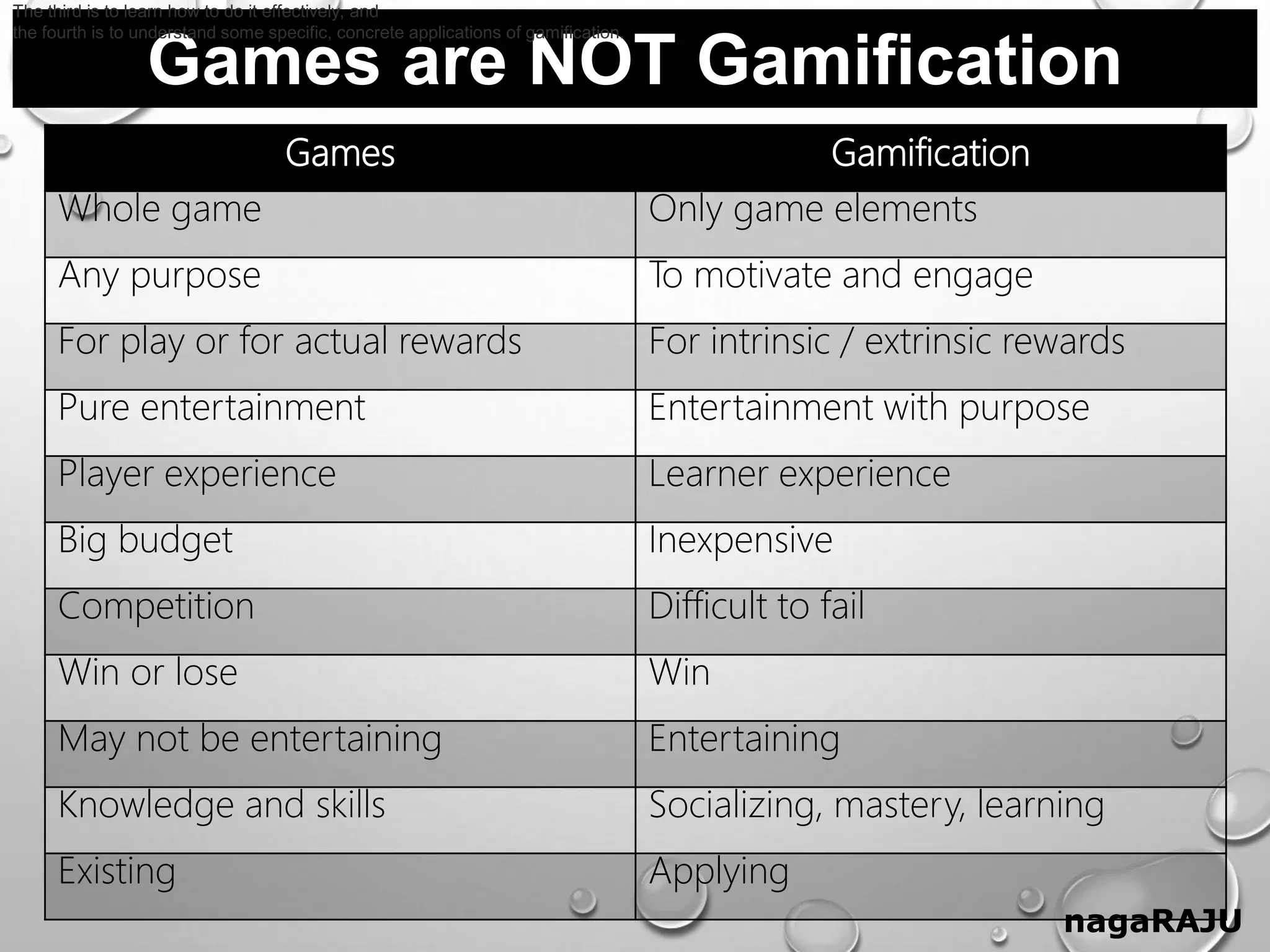
Games Gamification
Whole game Only game elements
Any purpose To motivate and engage
For play or for actual rewards For intrinsic / extrinsic rewards
Pure entertainment Entertainment with purpose
Player experience Learner experience
Big budget Inexpensive
Competition Difficult to fail
Win or lose Win
May not be entertaining Entertaining
Knowledge and skills Socializing, mastery, learning
Existing Applying
Gamification
nagaRAJU
The third is to learn how to do it effectively, and
the fourth is to understand some specific, concrete applications of gamification.
Game
Elements
Non Game
Context
(Classroom)
Outcomes
(joy, perseverance,
excitement, rules,
points, badges,
leaderboards,
feedback)
(participation,
engagement,
loyalty,
learning)
History of Gamification
nagaRAJU
2002 - coined by Nick Pelling
2009 - picked up momentum (FourSquare)
2013 - US$ 430 mn industry
2018 - US$ 5.5 bn industry
Today - Gamification is ubiquitous
Types of Gamification
nagaRAJU
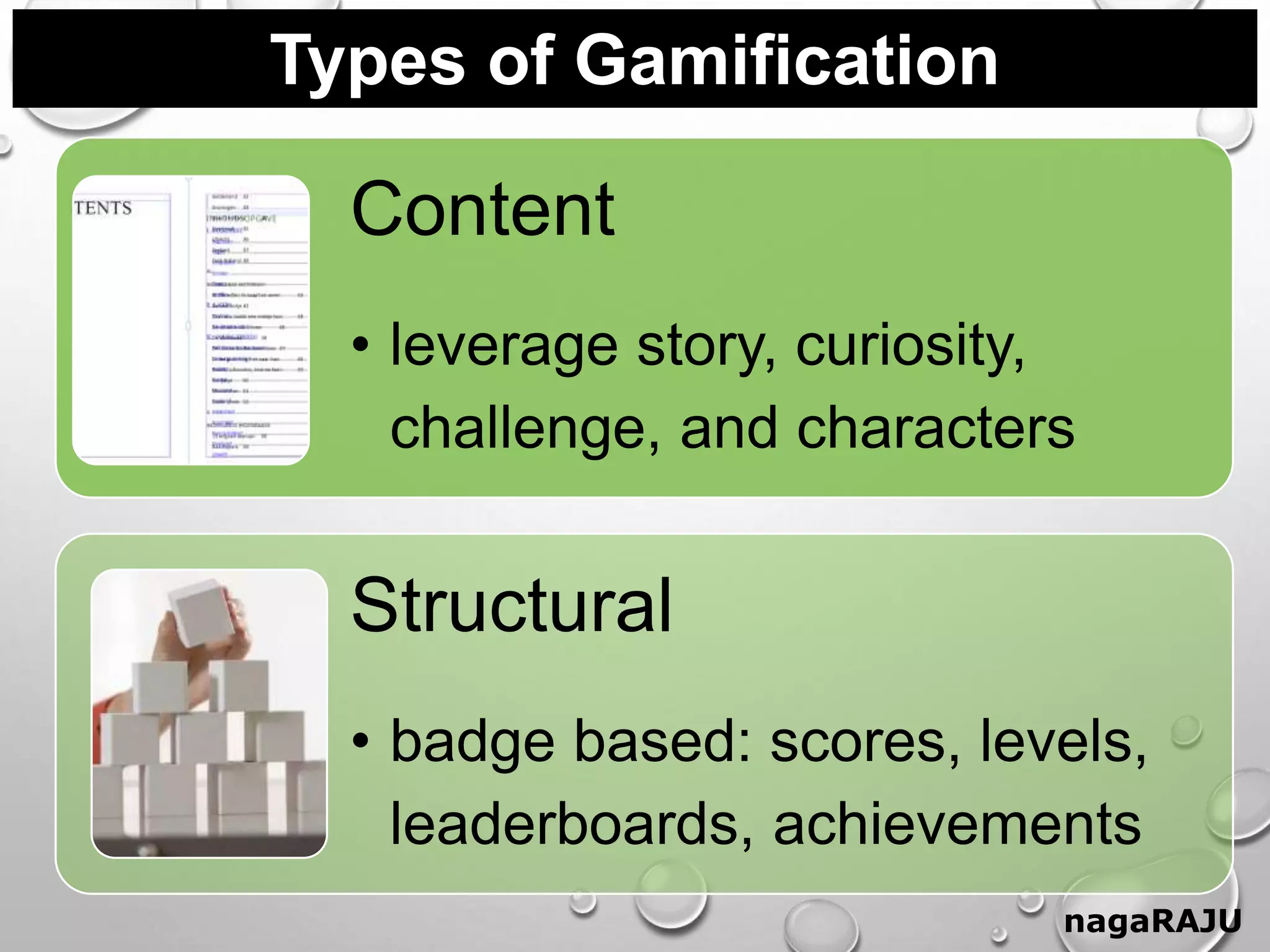
Content
• leverage story, curiosity,
challenge, and characters
Structural
• badge based: scores, levels,
leaderboards, achievements
Why Gamification?
nagaRAJU
1.
2
3.
4.
5.
6.
7.
8.
9.
10.
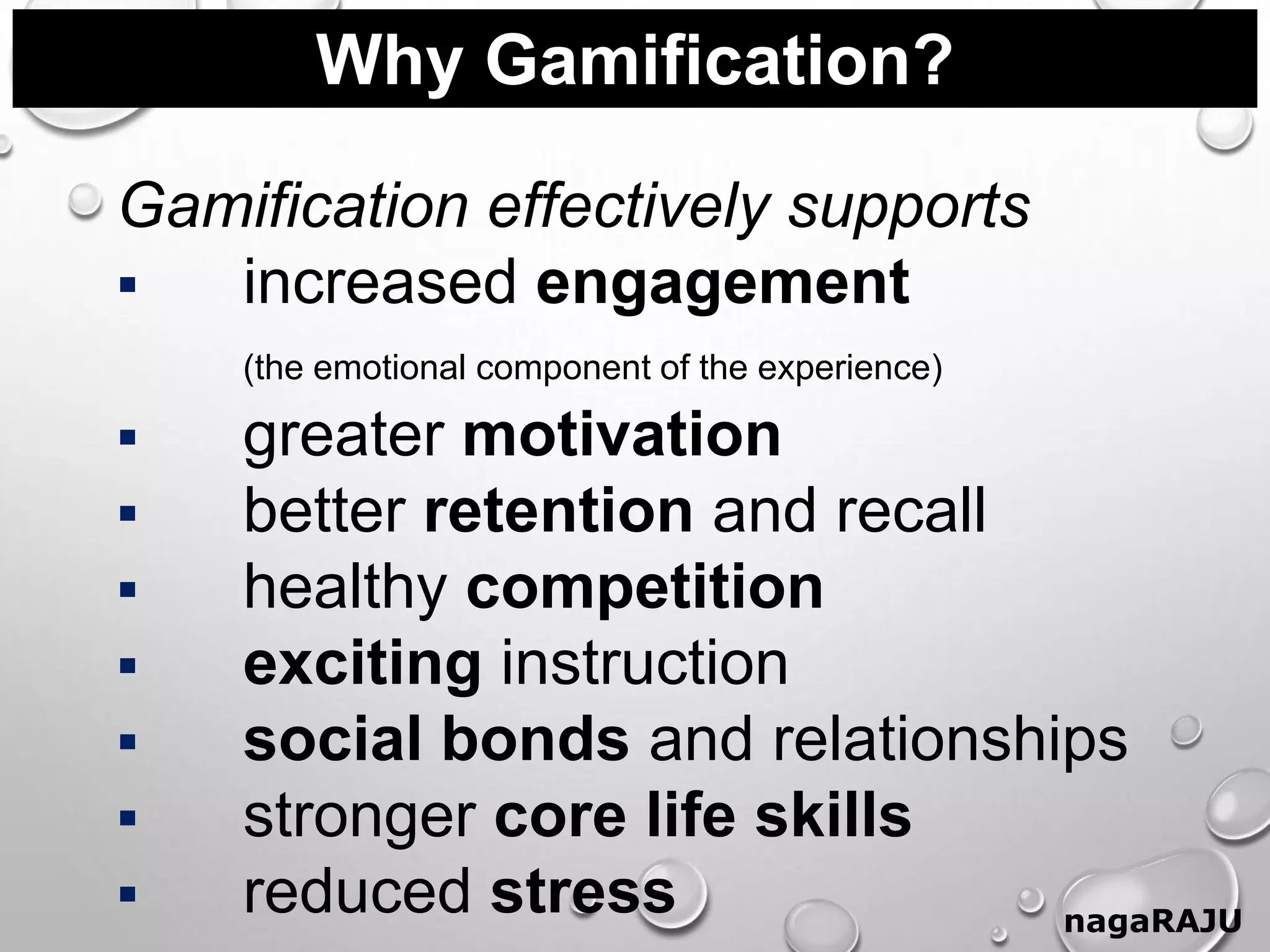
Why Gamification?
nagaRAJU
Gamification effectively supports
 increased engagement
(the emotional component of the experience)
 greater motivation
 better retention and recall
 healthy competition
 exciting instruction
 social bonds and relationships
 stronger core life skills
 reduced stress
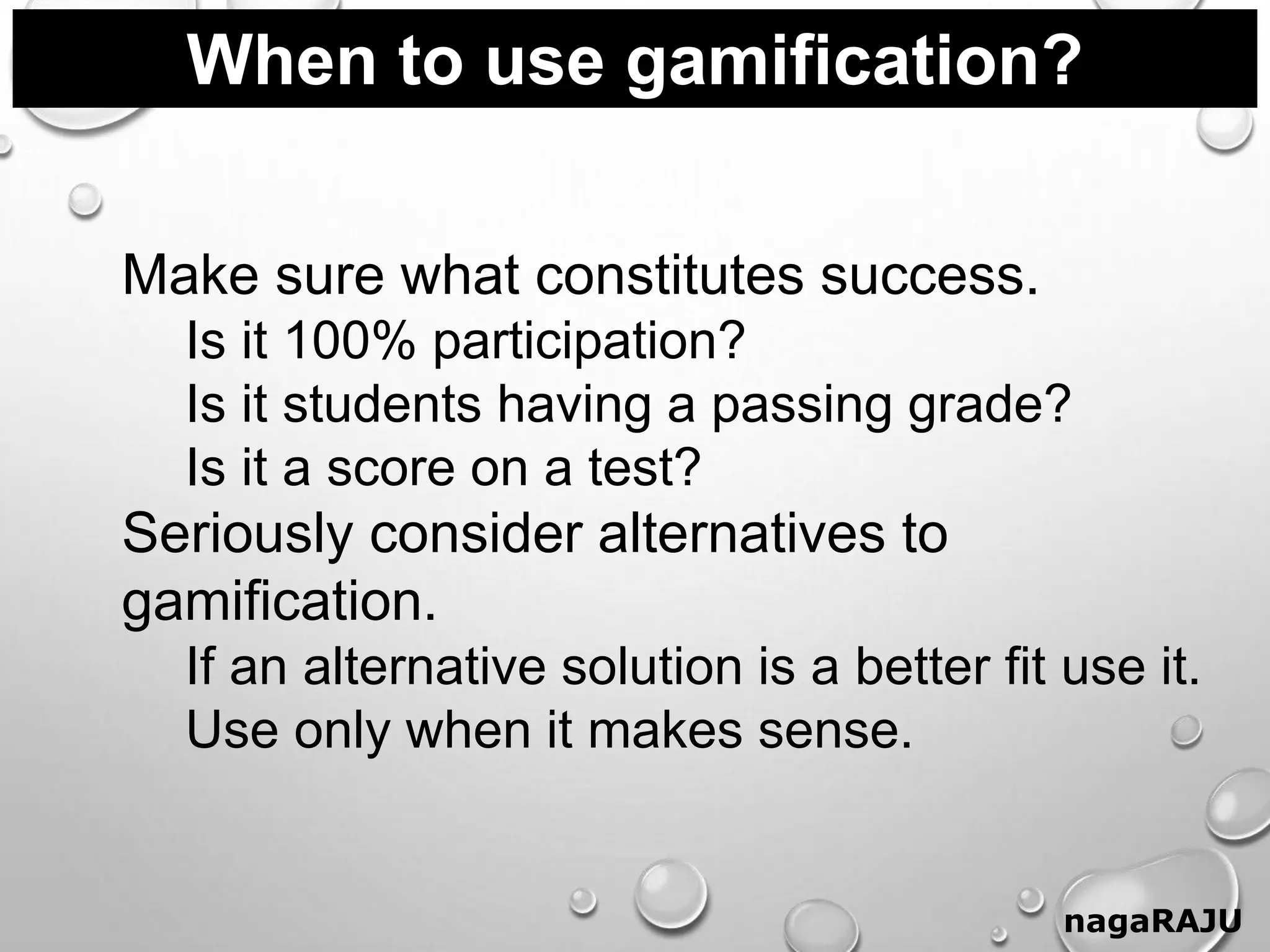
When to use gamification?
nagaRAJU
Make sure what constitutes success.
Is it 100% participation?
Is it students having a passing grade?
Is it a score on a test?
Seriously consider alternatives to
gamification.
If an alternative solution is a better fit use it.
Use only when it makes sense.
How is this game gamified?
nagaRAJU
Guides
Highlighters
Random
Rewards
Suspense
Milestones
Feedback
Choices
Challenges
Playful barriers
Freedom to fail
Badges
nagaRAJU
Virtual Rewards
nagaRAJU
Greater the driving efficiency, more the green leaves and
vines
Leaderboards
nagaRAJU
Brainscape
nagaRAJU
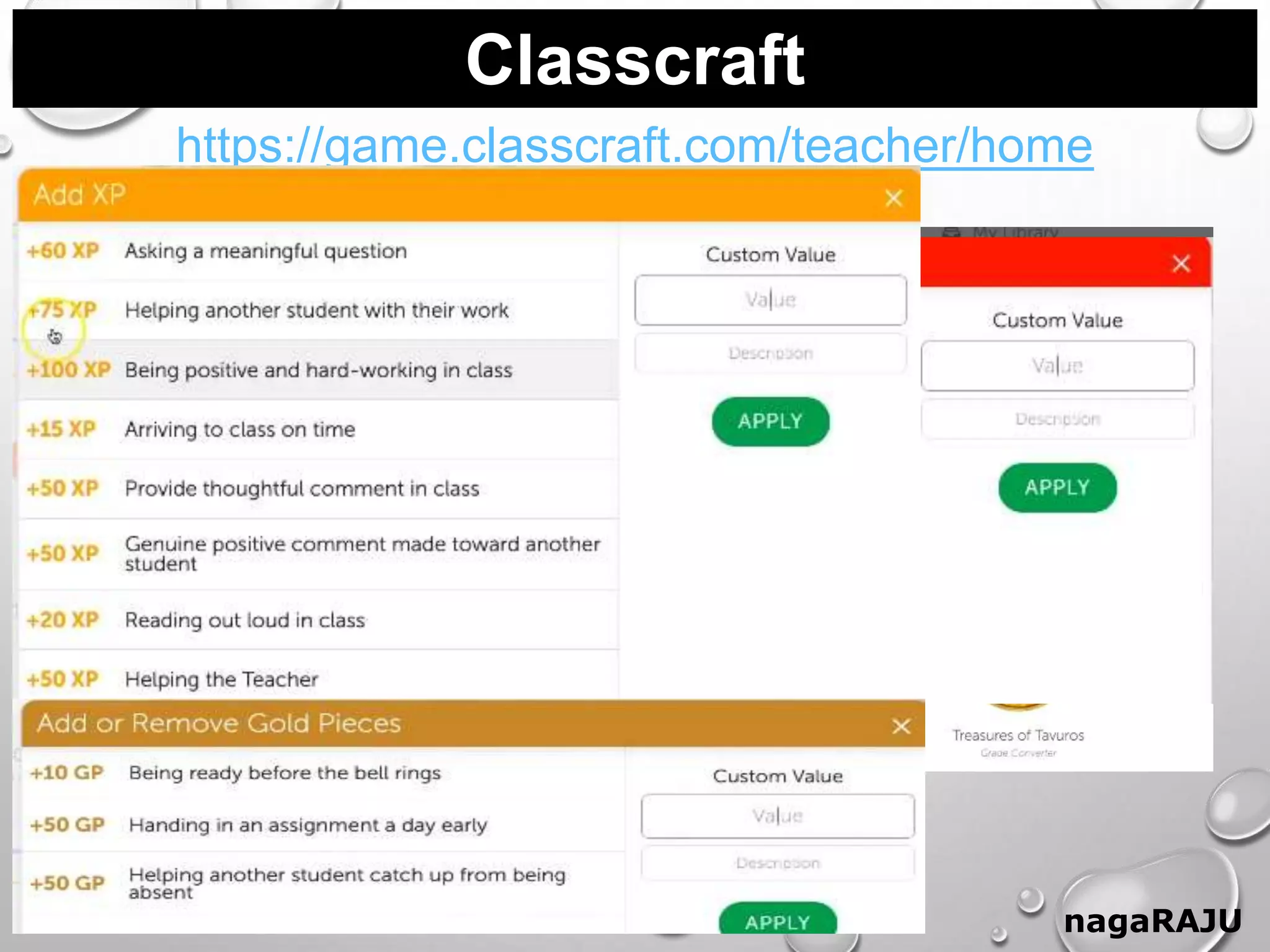
Classcraft
nagaRAJU
https://game.classcraft.com/teacher/home
Udemy
nagaRAJU
Duolingo
nagaRAJU
 Small, daily goals
 Progress indicator
 E-mail notifications
 Rewards
 Incentives
TED.Ed
nagaRAJU
Quizlet
nagaRAJU
https://quizlet.com/en-gb
Kahoot
nagaRAJU
www.kahoot.it
www.get.kahoot.it
www.create.kahoot.it
www.socrative.com
www.flubaroo.com
www.plickers.com
Edmodo
nagaRAJU
 Provide digital resources
 Create online polls
 Write short summaries of lessons
 Post homework
 Managed and controlled by teacher
 Private messages not possible
 Anonymous posting is not possible
 Teachers can delete posts
 Parental access is optional
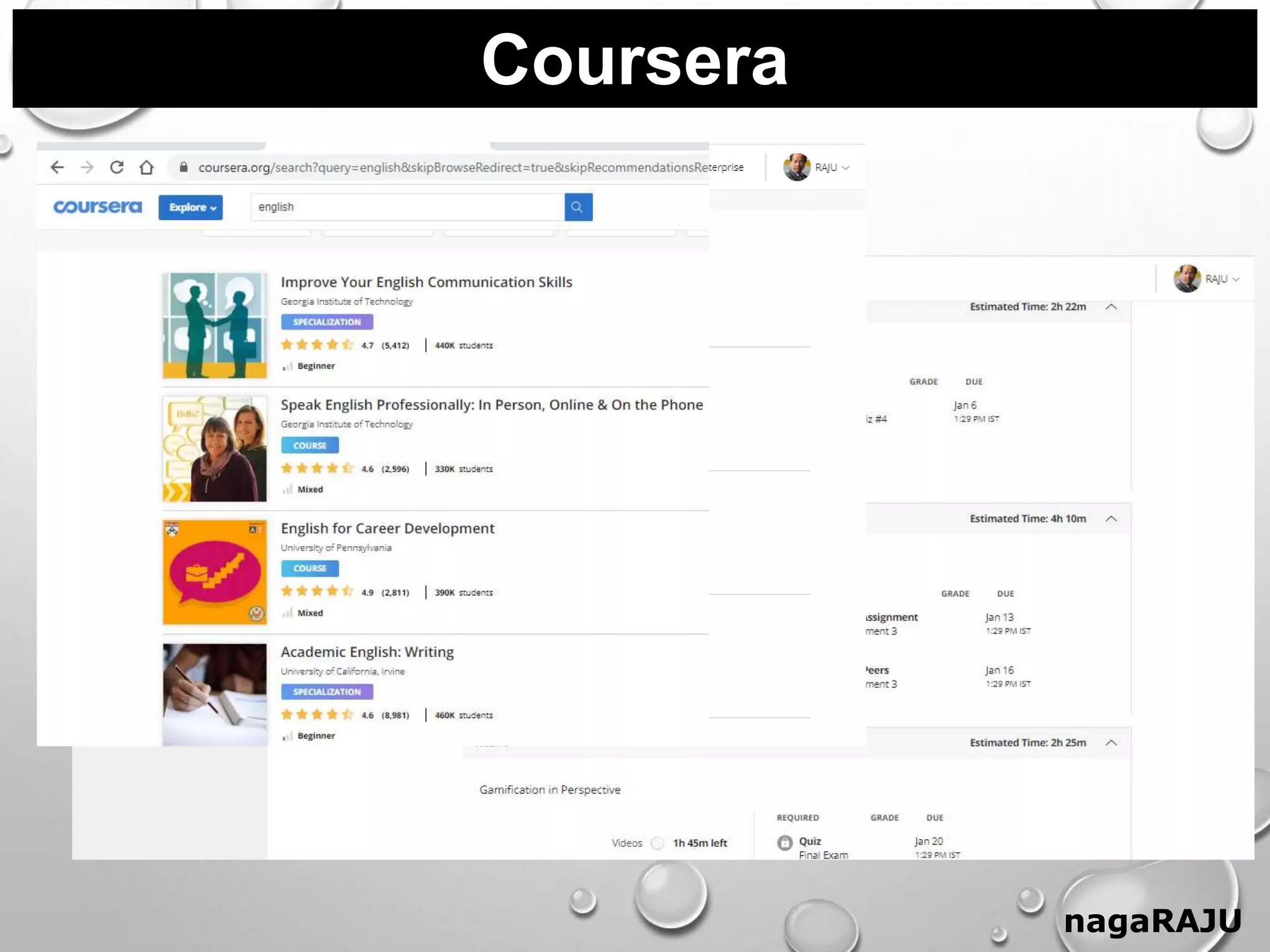
Coursera
nagaRAJU
Language Exchange websites
nagaRAJU
https://www.duolingo.com
https://www.busuu.com/en
https://www.easylanguageexchange.com
http://www.lingoglobe.com/
https://www.verbling.com/
https://www.gospeaky.com/
https://coeffee.com/login
https://howdoyou.do/
http://www.myenglishteacher.eu/
Grammar
nagaRAJU
1. arrive late to a movie _______________________________
2. dream in English _____________________________________
3. quarrel with your spouse _______________________________
4. lose your purse _____________________________________
5. sleep in class ___________________________________
6. eat raw fish __________________________________
7. go to traffic court _______________________________
8. act crazy with friends ____________________________
9. go on a ‘blind date’ ______________________________
10. meet a celebrity _________________________
11. get on the wrong bus or train ___________________
12. dance to loud music _____________________________
nagaRAJU
This slideshow is available at
www.slideshare.net/lionnagaraju
www.authorstream.com/tag/lionnagaraju
Thank you
lionnagaraju@gmail.com

Gamification

  • 1.
  • 2.
    Make Your TentCard nagaRAJU The third is to learn how to do it effectively, and the fourth is to understand some specific, concrete applications of gamification.
  • 3.
    Change, We Must nagaRAJU Thethird is to learn how to do it effectively, and the fourth is to understand some specific, concrete applications of gamification.
  • 4.
    Change, We Must nagaRAJU Thethird is to learn how to do it effectively, and the fourth is to understand some specific, concrete applications of gamification. If we teach today as we taught yesterday, we rob students of tomorrow. - John Dewey 1917
  • 5.
    Brainstorm nagaRAJU  Why arestudents disengaged?  Why aren’t they learning the way we expect them to?  How can we get greater learner attention?  How to engage learners for extended periods of time? The third is to learn how to do it effectively, and the fourth is to understand some specific, concrete applications of gamification. Choose any ONE of the questions and list as many answers as you can think of.
  • 6.
    Speaking nagaRAJU Discuss and pickup 6 of the following to start a new civilization. MRP: male, religious pujari, age unknown MHD: male, homosexual doctor, age 46 FBV: female, beautiful ventriloquist, age 30 MWG: male, warrior with a gun, age unknown MVC: male, valiant chief of a tribe, age unknown FTW: female, the tribal chief’s pregnant wife, age unknown MSJ: male, scholarly juror, age 41 FUA: female, university professor, atheist, age 34 FHM: female, handicapped meteorologist, age unknown FAA: female, agronomist, alcoholic, age unknown
  • 7.
  • 8.
    Games nagaRAJU  What aregames?  What makes games fun?  Who plays games?  Why do we play games? The third is to learn how to do it effectively, and the fourth is to understand some specific, concrete applications of gamification. Competition Collection Celebration Communicatio n Collaboration Creativity
  • 9.
    Game features nagaRAJU  Captures/ retains learners’ attention  Engages and entertains them  Challenges them  Teaches them  Adds greater creativity  Creates more connections Make it impossible to fail
  • 10.
    Listening nagaRAJU I am sittingin the morning at the diner on the corner. I ____________________ at the counter for the man to pour the coffee. And he fills it only half-way and before I even argue he ____________________ out the window at somebody coming in. "It is always nice to see you," says the man behind the counter to the woman who has come in. She _____________________ her umbrella. And I look the other way as they ____________________ their hello's and I ____________________ not to see them and instead I pour the milk. I open up the paper there's a story of an actor who had died while he _____________________ . It was no one I had heard of. And I'm turning to the horoscope and _____________________ for the funnies when I ____________________ someone watching me and so I raise my head. There's a woman on the outside ____________________ inside. Does she see me? No, she does not really see me ‘cause she sees her own reflection. And I _____________________ not to notice that she's hitching up her skirt, and while she ____________________ her stockings her hair has gotten wet. Oh this rain it will continue through the morning as I ____________________ to the bells of the cathedral. I ____________________ of your voice and of the midnight picnic once upon a time before the rain began. And I finish up my coffee and it's time to catch the train.
  • 11.
    Games, Gaming, Gamification,GBL nagaRAJU 1. Introduction 2. What are Games? 3. What is Gaming? 4. What is Gamification? 5. What about Game-Based Learning (GBL)? Jigsaw Reading
  • 12.
    Games are NOTGamification nagaRAJU The third is to learn how to do it effectively, and the fourth is to understand some specific, concrete applications of gamification. Games Gamification Whole game Only game elements Any purpose To motivate and engage For play or for actual rewards For intrinsic / extrinsic rewards Pure entertainment Entertainment with purpose Player experience Learner experience Big budget Inexpensive Competition Difficult to fail Win or lose Win May not be entertaining Entertaining Knowledge and skills Socializing, mastery, learning Existing Applying
  • 13.
    Gamification nagaRAJU The third isto learn how to do it effectively, and the fourth is to understand some specific, concrete applications of gamification. Game Elements Non Game Context (Classroom) Outcomes (joy, perseverance, excitement, rules, points, badges, leaderboards, feedback) (participation, engagement, loyalty, learning)
  • 14.
    History of Gamification nagaRAJU 2002- coined by Nick Pelling 2009 - picked up momentum (FourSquare) 2013 - US$ 430 mn industry 2018 - US$ 5.5 bn industry Today - Gamification is ubiquitous
  • 15.
    Types of Gamification nagaRAJU Content •leverage story, curiosity, challenge, and characters Structural • badge based: scores, levels, leaderboards, achievements
  • 16.
  • 17.
    Why Gamification? nagaRAJU Gamification effectivelysupports  increased engagement (the emotional component of the experience)  greater motivation  better retention and recall  healthy competition  exciting instruction  social bonds and relationships  stronger core life skills  reduced stress
  • 18.
    When to usegamification? nagaRAJU Make sure what constitutes success. Is it 100% participation? Is it students having a passing grade? Is it a score on a test? Seriously consider alternatives to gamification. If an alternative solution is a better fit use it. Use only when it makes sense.
  • 19.
    How is thisgame gamified? nagaRAJU Guides Highlighters Random Rewards Suspense Milestones Feedback Choices Challenges Playful barriers Freedom to fail
  • 20.
  • 21.
    Virtual Rewards nagaRAJU Greater thedriving efficiency, more the green leaves and vines
  • 22.
  • 23.
  • 24.
  • 25.
  • 26.
    Duolingo nagaRAJU  Small, dailygoals  Progress indicator  E-mail notifications  Rewards  Incentives
  • 27.
  • 28.
  • 29.
  • 30.
    Edmodo nagaRAJU  Provide digitalresources  Create online polls  Write short summaries of lessons  Post homework  Managed and controlled by teacher  Private messages not possible  Anonymous posting is not possible  Teachers can delete posts  Parental access is optional
  • 31.
  • 32.
  • 33.
    Grammar nagaRAJU 1. arrive lateto a movie _______________________________ 2. dream in English _____________________________________ 3. quarrel with your spouse _______________________________ 4. lose your purse _____________________________________ 5. sleep in class ___________________________________ 6. eat raw fish __________________________________ 7. go to traffic court _______________________________ 8. act crazy with friends ____________________________ 9. go on a ‘blind date’ ______________________________ 10. meet a celebrity _________________________ 11. get on the wrong bus or train ___________________ 12. dance to loud music _____________________________
  • 34.
    nagaRAJU This slideshow isavailable at www.slideshare.net/lionnagaraju www.authorstream.com/tag/lionnagaraju Thank you lionnagaraju@gmail.com

Editor's Notes

  • #2 Gamification is the application of game-design elements and game principles in non-game contexts. It can also be defined as a set of activities and processes to solve problems by using or applying the characteristics of game elements. Gamification is an underutilized element in instructional design. Many games promote communication, cooperation, and even competition amongst players. Some of the most immersive games have a rich narrative that spawns creativity and imagination in its players. Finally, depending on how they are designed, games can both teach and test their players. They are incredible packages of teaching, learning, and assessment. Fun is the Future: Mastering Gamification
  • #3 10 points – pen 15 -20 points – magazine 25 – 30 points – book 35 and more – other gifts
  • #6 Form a circle. Write down a few reasons why students are disengaged in classrooms. Share any two you have written with teachers sitting on your left and on your right. Make additional notes. Who has the highest number of reasons? Awards to the top three with the highest number of reasons. Offering incentives to leaners and encouraging them to accumulate rewards throughout their journey can instantly boost their involvement with the classroom. Our learners are our players. Our goal is to get students into play by making our lessons enticing, easy, simple and smooth. Onboarding, Scaffolding are pathways to mastery. Winning effect Dopamine + Testastonone Gamification is a loyalty program on steroids.
  • #8 Imagine young children at play think what motivates them, what skills they're practicing, how they organize themselves, why do they try to outdo each other.   This might be an interesting starting point for a workshop/discussion on this:   It's usually not for any great reward that they play.  And yet, they organize themselves, set out rules, work together in teams, and then become very, very passionate about what they're doing, and try to excel and outdo each other--all only for the sake of "play."  "Gamification," perhaps, means trying to bring that into the classroom. Take elements from games and integrate them into instruction.
  • #9  Games, engaging activities played for amusement or fun, are high-octane learning machines that encourage us to experiment, to develop strategies and learn new skills. Everyone has the capacity to enjoy games. Games are a part of every culture. Games are a shared human experience. Even games can become boring. Games are fun because Winning, achievement, progress Problem solving Exploring Team work Recognition Triumphing Collecting Surprise Imagination Sharing Customization Role playing Goofing off Chilling out Would you buy an electronic product for which newer versions or updates are not available? Sometime during 5th or 6th grade, smiling stops, fun ends and learning is substituted by worksheets, homework, discipline, silence, rigour, memory. We blame students, we blame resources and we blame everything. But, the truth is the students are bored. Like you will be bored with this talk soon if it continues. When you are bored, you look into your watches, you count the windows or tie up your shoelaces. The most powerful resource that you have is your students. But we don’t ask them what they want.
  • #10 Game features: users are all participants – students points that are accumulated as a result of executing tasks levels which users pass depending on the points; badges which serve as rewards for completing actions ranking of users according to their achievements
  • #11  listen look think feel look try straighten wait shake kiss drink look pretend
  • #13 One example of that might be dividing the class into teams and having them "compete" to complete some activity (again, in a good-natured way).   Following this idea, it'd seem that the "rewards" should not be grades or promotion, or whatever the usual academic rewards are, but something much more playful--a piece of candy, a cheer, whatever.  The poster / team introduction activity is one example.  If these kind of activities are set up properly, they really do motivate learners, not because the teams get any great reward (they don't), but because people naturally like to compete, and play.   It engages us and allows us to leverage several of our natural human desires: socializing, learning, mastery, achievement, and status. Applying game design techniques, addictive game elements, game thinking to non-game situations to motivate and engage the learner. Games are things that are designed systematically, thoughtfully, imaginatively, artistically to make learning fun. Adding game elements such as storytelling, problem-solving, aesthetics, rules, collaboration, competition, reward systems, feedback, and learning through trial and error into non-game situations  Gamification is the process of taking something that already exists – a website, an enterprise application, an online community – and integrating game mechanics into it to motivate participation, engagement, and loyalty. Gamification takes the data-driven techniques that game designers use to engage players, and applies them to non-game experiences to motivate actions that add value to your business When people hear gamification, they envision games created for a business purpose. But corporate gamification is not about creating something new. It is about amplifying the effect of an existing, core experience by applying the motivational techniques that make games so engaging. It engages us and allows us to leverage several of our natural human desires: socializing, learning, mastery, achievement, and status. Gamification is light-hearted. Certain behaviors which initially seem difficult, boring and tedious can be made fun. We are motivated to perform certain actions and engage in certain behaviors in return for rewards. Rewards trigger the release of dopamine in our brain. Endorphins and dopamine are responsible for feelings of pleasure and these chemicals come out during positive game-playing experiences.
  • #14 We shouldn’t use games only as rewards (do all the tasks and then we can play a game at the end of the class), warmers, time-fillers and media. We need to redesign the whole lesson and make it similar to computer games in structure. If we want to engage modern students, we should move to an absolutely new pedagogical approach based on game-design principles.
  • #16  Gamification makes learning engaging, visually compelling, and personalized. How to add game elements to instructional design and use reward systems for learner engagement?
  • #17  if you can gamify the process, you are rewarding the behavior and it's like a dopamine release in the brain. Humans like a game. By increasing the learning stakes, even if they are virtual and not real, learners have a higher level of investment.
  • #18 Better learning experience (fun) for recall and retention Better (effective, informal) learning environment Strong behavioural changes, in addition to points, badges and leaderboards Fulfils most learning needs Provides instant feedback Performance gain We don’t need technology to create a gamified learning experience It is a powerful, rich tool to fill any engagement gap. It makes learning fun, making learning engaging and gamelike. Potential options / variety makes learning a popular experience. Resolving several common classroom issues such as: student participation/talk time, student engagement, differentiation, data tracking, and increasing student achievement. Gamification techniques strive to leverage people’s natural desires for socializing, learning, progression, mastery, competition, achievement, status, self-expression, altruism. The increased willingness to participate and engage is supported biologically by dopamine, which is released when a person experiences pleasure and increases motivation to continue doing the thing that gave pleasure. This is how gaming rewards work.  Lessons that are gamified increase retention because learners feel more of a connection with the material. When learners feel challenged, they are motivated to keep going and come back for more. Challenges can take many forms; it could be unlocking sections in a course, it could be a mystery that has to be solved  or a compelling narrative with an adversary that is an obstacle to the learner's triumph. Three step model: build tension, build urgency, create time constraints. Gamification goes beyond physical rewards and promotes a mindset of constant achievement. Having learners set their own goals for the course and then measuring their progress toward the goal is a way to motivate. It engages us and allows us to leverage several of our natural human desires: socializing, learning, mastery, achievement, and status.
  • #19 Students who complete 60% of their grade-level math on Khan Academy experience 1.8 times their expected growth on the NWEA MAP Test, a popular assessment test.
  • #20 It is a mistake to think that adding points and levels will automatically make a boring experience fun and more effective.  So, it’s more important to decide how, when and why you introduce points, badges and levels. What are your students’ needs and pain points? Which elements suit your gamification framework? If your students require rewards, add XPs. If your students care about their status, add levels. If they like socializing and are altruistic, add gifting and charity. Giving points for meeting academic objectives Creating competition within the classroom Creating unique rewards
  • #22 Ford Efficiency Leaves: Drivers are motivated to grow their virtual plants with many leaves, and thus learn how to drive particularly efficiently and economically. The display of the leaves is way more intuitive and attractive than a mere numerical score. Similar Rewards and Incentives Allow a selfie with the teacher Allow the student to sit in teacher’s chair Allow the student to wear sunglasses for a while
  • #26 Udemy utilizes progress bars to indicate the student’s progress and to encourage completion of a course. They also dangle a trophy at the end of the course as their reward for completing it. Udemy truly excels on the teach-side of the platform. Anyone from anywhere in the world can create their own online course. They have the complete creative freedom to choose any topic and use their video editing skills to make their course stand out.
  • #27 Duolingo utilizes progress indicators such as daily goals and streaks to make a player feel accomplished and get them to come back for daily usage. In Duolingo, players get lives. Every time you fail a lesson, you lose a life. Run out of lives and you’ll have to wait until you can continue learning.
  • #28 TEDEd empowers educators to select a video, create their own lessons, and share it with the world. Choose a video, add a description, add a quiz (multiple choice or open-ended), and prompt some discussion.
  • #32 Coursera is an online learning platform that provides universal access to the world’s best education from top universities. Allows students and teachers to collaborate and communicate while taking a course.