Radiometric Methods
Radiometric Method
• Radiometric method is based on the detection
of gamma rays from geological environments
using airborne, car borne and ground
methods.
• The method is based on natural radioactivity
that was discovered in 1896 by Henri
Becquerel when studying uranium sulphate.
Natural radioactivity
• Radioactivity is the process of decay or change in
atomic nucleus that results in change of charge or
its state of mass or both.
• There are three products of radioactive decay:
alpha rays, beta rays and gamma rays. The first
two are not really rays but are particles as they
have both mass and electrical charge.
• Gamma rays are electromagnetic radiations that
are produced as a product during loss of alpha or
beta particle.
Radioactivity
• Radioactivity is a spontaneous disintegration
of some naturally occurring elements into
stable elements. The nuclei of an element X
with atomic number z are made up of protons
and neutrons. The total number of protons
and neutrons is the mass number A.
• Atoms with atomic number greater than 82
are unstable and tend to disintegrate into
small atoms.
isotopes
• Atoms having the same atomic number but
different mass numbers are called isotopes.
Elements having atomic number (Z >83) are
very unstable.
• Such atoms will disintegrate producing -
particles, -particles -ray radiation.
• During the process heat is also generated.
Alpha and Beta Particles
• The particles are ordinary electrons with
negative charge.
• Alpha particles are helium nuclei consisting of
two protons and two neutrons.
• Once a helium particle is ejected from the
parent nucleus it acquire orbital electrons
from the environment and becomes a neutral
helium atom.
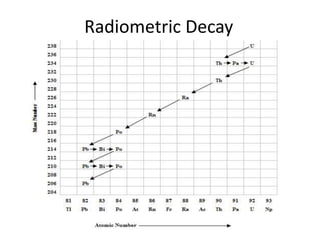
Radiometric Decay
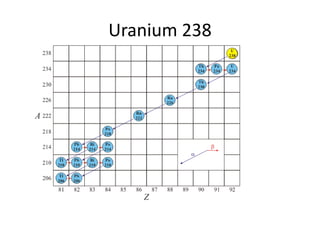
Uranium 238
Gamma Rays
• Gamma radiations have their origin in a
nuclear decay process. These are EM waves of
extremely short wavelength.
• Gamma rays have no electrical charge neither
mass and therefore are capable of penetrating
through earth materials.
Characteristics of gamma rays
• Affect photographic emulsions.
• Ionise gas making it electrically conducting.
• Produce scintillation or phosphorescence in
certain minerals and chemical compounds.
• These properties are used in their detections.
Radioactive equilibrium
• Parent atoms decay into
daughter atoms in which
also decay into other
atoms until equilibrium is
reached. At equilibrium
the number of daughter
atoms decaying per unit
time is the same as the
number being created by
disintegration of the
parent atoms.
• 1N1 =2N2=3N3
• Where  is the decay
constant and N is number
of atoms.
Occurrence of Radioactive elements
• Over 20 natural occurring elements have been
reported, however uranium, thorium,
potassium and rubidium are the only
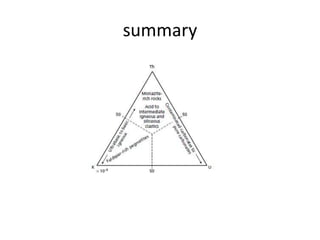
important elements in geology.
• These elements are used in dating of rocks
and others have applications in prospecting
for minerals, groundwater and hydrocarbon
resources.
Importance of others
• The reason why other elements are not useful
is that they occur in minute quantities in the
earth’s crust.
Potassium Minerals
• Mineral
• (i) Orthoclase and microcline feldspars [KAlSi3O8]
• (ii) Muscovite [H2KAl(SiO4)3]
• (iii) Alunite [K2Al6(OH)12SiO4]
• (iv) Sylvite, carnallite [KCl, MgCl2.6H2O]
• Occurrence
• (i) Main constituents in acid igneous rocks and pegmatites
• (ii) Main constituents in acid igneous rocks and pegmatites
• (iii) Alteration in acid volcanics
• (iv) Saline deposits in sediments
Thorium Minerals
(i) Monazite [ThO2 + rare earth phosphate]
(ii) Thorianite [(Th,U)O2]
(iii) Thorite, uranothorite [ThSiO4 + U]
• Occurrence
• (i) Granites, pegmatites, gneiss
• (ii), (iii) Granites, pegmatites, placers
Uranium Minerals
• (i) Uraninite [oxide of U, Pb, Ra +Th, rare earths]
• (ii) Carnotite [K2O.2UO3.V2O5.2H2O]
• (iii) Gummite [uraninite alteration]
• Occurrence
• (i) Granites, pegmatites and with vein deposits of
Ag, Pb, Cu, etc.
• (ii) Sandstones
• (iii) Associated with uraninite
summary
Process of Radioactive decay
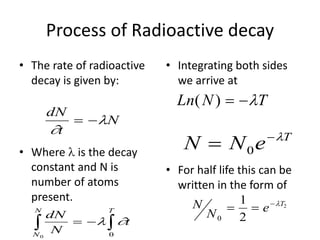
• The rate of radioactive
decay is given by:
• Where  is the decay
constant and N is
number of atoms
present.
• Integrating both sides
we arrive at
• For half life this can be
written in the form of
N
N e T
0
1
2
2
  
N N e T
 
0

dN
t
N


 
dN
N
t
N
N T
 
 
 
0 0
Ln N T
( )  
Radioactive decay
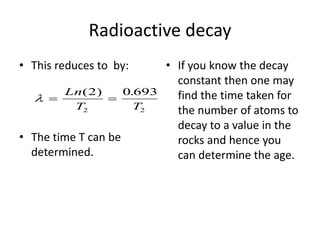
• This reduces to by:
• The time T can be
determined.
• If you know the decay
constant then one may
find the time taken for
the number of atoms to
decay to a value in the
rocks and hence you
can determine the age.
  
Ln
T T
( ) .
2 0 693
2 2
Instrumentation
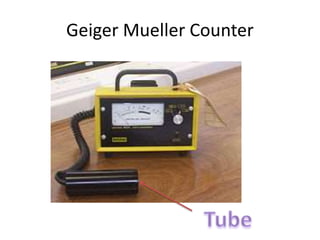
• The earliest instruments of
detecting natural radiations
was the Geiger Mueller
Counter. The GM works on
principle of ionization that a
particle enters the tube
with argon gas it pulls an
electron from the argon
atom that is then attracted
to central wire put +400V .
On its way it knocks more
electrons that are detected
at once.
• GM is efficient for detecting
alpha particles although
versions for detecting
gamma and beta particles
also exist.
Geiger Mueller Counter
Scintillation Meters
• Some substances emit light when hit by
radioactive particles such as gamma rays. ( ZnS,
anthracene, stilbene, scheelite). NaI crystals
when treated with thallium is a activated in
causing scintillation.
• Most of the gamma ray detectors are made from
NaI crystals. The light is emitted as photons and
the intensity of light emitted is proportional to
the energy of the gamma ray absorbed.
Gamma Ray Spectrometers
• Gamma ray spectrometers are scintillometers that are
designed to distinguish the gamma rays according to
their energy levels.
• Gamma rays from the three natural radioactive
elements have different energy levels and hence can
be characterized.
• The intensity of light emitted induces a voltage whose
amplitude is proportional to the original -ray energy.
This can occur when the -ray loses all its energy at
once by photo conversion.
• Light is received by a photo multiplier Tube, converting
light into a voltage
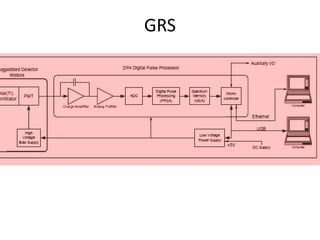
GRS
GRS
• GRS consists of the detector and Console. The
detectors are ranked according to crystal size.
The larger the crystal size the better is the
detector.
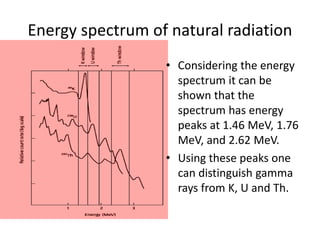
Energy spectrum of natural radiation
• Considering the energy
spectrum it can be
shown that the
spectrum has energy
peaks at 1.46 MeV, 1.76
MeV, and 2.62 MeV.
• Using these peaks one
can distinguish gamma
rays from K, U and Th.
Energy Windows
• Channel 1: Total Count 0.4 - 3.00 MeV
• Channel 2: Potassium 1.36 – 1.56 MeV
• Channel 3: Uranium 1.66 – 1.86 MeV
• Channel 4: Thorium 2.42 - 2.82 MeV
Converting counts into element
Content
• Gamma Ray Spectrometers may measure
elements in form of counts per unit time or
counts may be converted into element
content if the GRS is calibrated.
• If GRS is calibrated the gamma counts are
converted in element content ( U and Th in
ppm whereas K is given in %).
• Any GRS can be calibrated if you have samples
with known concentrations of U, Th and K.
element
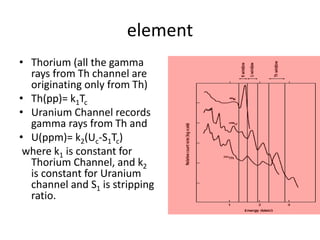
• Thorium (all the gamma
rays from Th channel are
originating only from Th)
• Th(pp)= k1Tc
• Uranium Channel records
gamma rays from Th and
• U(ppm)= k2(Uc-S1Tc)
where k1 is constant for
Thorium Channel, and k2
is constant for Uranium
channel and S1 is stripping
ratio.
element
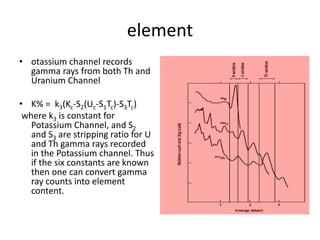
• otassium channel records
gamma rays from both Th and
Uranium Channel
• K% = k3(Kc-S2(Uc-S1Tc)-S3Tc)
where k3 is constant for
Potassium Channel, and S2
and S3 are stripping ratio for U
and Th gamma rays recorded
in the Potassium channel. Thus
if the six constants are known
then one can convert gamma
ray counts into element
content.
Radiometric Surveys
• Radiometric surveys
may be conducted by
airborne sampling rate
is 60-70 m.
• Background radiations
are obtained by flying
over a body of water or
orienting crystals
upward.
• Radiations are affected
by weather and in
particular rain. A wet
soil traps some of the
radiations in the soil.
Radiometric surveys
should be conducted
during the dry season
to have uniform soil
conditions.
continued
• Other factors affecting
readings are
topography. Over the
hills less readings are
counted as compared in
valleys because of the
circle of influence.
• Most spectrometers are
calibrated assuming a
flat surface.
• Any departure from
that geometry affects
the reading positively or
negatively.
Data Presentation
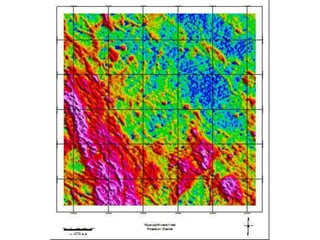
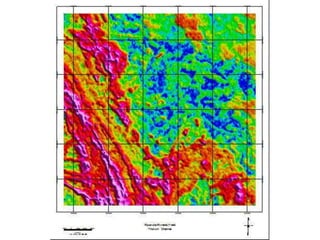
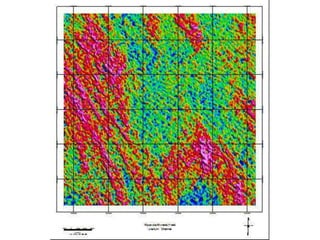
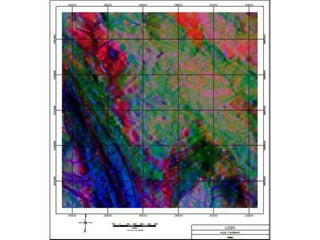
• Results of radiometric surveys may be
represented as maps for each element, or
profiles, or composite map in which response
of all 3 elements are represented using the
three primary colours (RGB), Red for K, Green
for Thorium and Blue for Uranium.
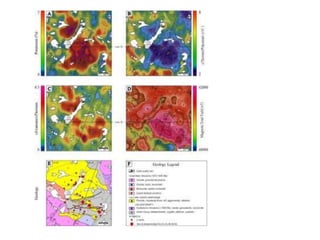
• Enhancement of anomalies by calculating
element ratios ie U/Th, U:K.
Applications
• The radiometric methods are applied in
mineral exploration of radioactive minerals:
• Uranium and Thorium deposits.
• Deposits associated with uranium minerals
such as phosphates and carbonatites.
• Gold deposits associated with hydrothermal
alterations.
• Placer deposits ( monazite).
Radiometric Methods, isotops, Alpha and Beta Particles

Radiometric Methods, isotops, Alpha and Beta Particles

  • 1.
  • 2.
    Radiometric Method • Radiometricmethod is based on the detection of gamma rays from geological environments using airborne, car borne and ground methods. • The method is based on natural radioactivity that was discovered in 1896 by Henri Becquerel when studying uranium sulphate.
  • 3.
    Natural radioactivity • Radioactivityis the process of decay or change in atomic nucleus that results in change of charge or its state of mass or both. • There are three products of radioactive decay: alpha rays, beta rays and gamma rays. The first two are not really rays but are particles as they have both mass and electrical charge. • Gamma rays are electromagnetic radiations that are produced as a product during loss of alpha or beta particle.
  • 4.
    Radioactivity • Radioactivity isa spontaneous disintegration of some naturally occurring elements into stable elements. The nuclei of an element X with atomic number z are made up of protons and neutrons. The total number of protons and neutrons is the mass number A. • Atoms with atomic number greater than 82 are unstable and tend to disintegrate into small atoms.
  • 5.
    isotopes • Atoms havingthe same atomic number but different mass numbers are called isotopes. Elements having atomic number (Z >83) are very unstable. • Such atoms will disintegrate producing - particles, -particles -ray radiation. • During the process heat is also generated.
  • 6.
    Alpha and BetaParticles • The particles are ordinary electrons with negative charge. • Alpha particles are helium nuclei consisting of two protons and two neutrons. • Once a helium particle is ejected from the parent nucleus it acquire orbital electrons from the environment and becomes a neutral helium atom.
  • 7.
  • 8.
  • 9.
    Gamma Rays • Gammaradiations have their origin in a nuclear decay process. These are EM waves of extremely short wavelength. • Gamma rays have no electrical charge neither mass and therefore are capable of penetrating through earth materials.
  • 10.
    Characteristics of gammarays • Affect photographic emulsions. • Ionise gas making it electrically conducting. • Produce scintillation or phosphorescence in certain minerals and chemical compounds. • These properties are used in their detections.
  • 11.
    Radioactive equilibrium • Parentatoms decay into daughter atoms in which also decay into other atoms until equilibrium is reached. At equilibrium the number of daughter atoms decaying per unit time is the same as the number being created by disintegration of the parent atoms. • 1N1 =2N2=3N3 • Where  is the decay constant and N is number of atoms.
  • 12.
    Occurrence of Radioactiveelements • Over 20 natural occurring elements have been reported, however uranium, thorium, potassium and rubidium are the only important elements in geology. • These elements are used in dating of rocks and others have applications in prospecting for minerals, groundwater and hydrocarbon resources.
  • 13.
    Importance of others •The reason why other elements are not useful is that they occur in minute quantities in the earth’s crust.
  • 14.
    Potassium Minerals • Mineral •(i) Orthoclase and microcline feldspars [KAlSi3O8] • (ii) Muscovite [H2KAl(SiO4)3] • (iii) Alunite [K2Al6(OH)12SiO4] • (iv) Sylvite, carnallite [KCl, MgCl2.6H2O] • Occurrence • (i) Main constituents in acid igneous rocks and pegmatites • (ii) Main constituents in acid igneous rocks and pegmatites • (iii) Alteration in acid volcanics • (iv) Saline deposits in sediments
  • 15.
    Thorium Minerals (i) Monazite[ThO2 + rare earth phosphate] (ii) Thorianite [(Th,U)O2] (iii) Thorite, uranothorite [ThSiO4 + U] • Occurrence • (i) Granites, pegmatites, gneiss • (ii), (iii) Granites, pegmatites, placers
  • 16.
    Uranium Minerals • (i)Uraninite [oxide of U, Pb, Ra +Th, rare earths] • (ii) Carnotite [K2O.2UO3.V2O5.2H2O] • (iii) Gummite [uraninite alteration] • Occurrence • (i) Granites, pegmatites and with vein deposits of Ag, Pb, Cu, etc. • (ii) Sandstones • (iii) Associated with uraninite
  • 17.
  • 18.
    Process of Radioactivedecay • The rate of radioactive decay is given by: • Where  is the decay constant and N is number of atoms present. • Integrating both sides we arrive at • For half life this can be written in the form of N N e T 0 1 2 2    N N e T   0  dN t N     dN N t N N T       0 0 Ln N T ( )  
  • 19.
    Radioactive decay • Thisreduces to by: • The time T can be determined. • If you know the decay constant then one may find the time taken for the number of atoms to decay to a value in the rocks and hence you can determine the age.    Ln T T ( ) . 2 0 693 2 2
  • 20.
    Instrumentation • The earliestinstruments of detecting natural radiations was the Geiger Mueller Counter. The GM works on principle of ionization that a particle enters the tube with argon gas it pulls an electron from the argon atom that is then attracted to central wire put +400V . On its way it knocks more electrons that are detected at once. • GM is efficient for detecting alpha particles although versions for detecting gamma and beta particles also exist.
  • 21.
  • 22.
    Scintillation Meters • Somesubstances emit light when hit by radioactive particles such as gamma rays. ( ZnS, anthracene, stilbene, scheelite). NaI crystals when treated with thallium is a activated in causing scintillation. • Most of the gamma ray detectors are made from NaI crystals. The light is emitted as photons and the intensity of light emitted is proportional to the energy of the gamma ray absorbed.
  • 23.
    Gamma Ray Spectrometers •Gamma ray spectrometers are scintillometers that are designed to distinguish the gamma rays according to their energy levels. • Gamma rays from the three natural radioactive elements have different energy levels and hence can be characterized. • The intensity of light emitted induces a voltage whose amplitude is proportional to the original -ray energy. This can occur when the -ray loses all its energy at once by photo conversion. • Light is received by a photo multiplier Tube, converting light into a voltage
  • 24.
  • 25.
    GRS • GRS consistsof the detector and Console. The detectors are ranked according to crystal size. The larger the crystal size the better is the detector.
  • 26.
    Energy spectrum ofnatural radiation • Considering the energy spectrum it can be shown that the spectrum has energy peaks at 1.46 MeV, 1.76 MeV, and 2.62 MeV. • Using these peaks one can distinguish gamma rays from K, U and Th.
  • 27.
    Energy Windows • Channel1: Total Count 0.4 - 3.00 MeV • Channel 2: Potassium 1.36 – 1.56 MeV • Channel 3: Uranium 1.66 – 1.86 MeV • Channel 4: Thorium 2.42 - 2.82 MeV
  • 28.
    Converting counts intoelement Content • Gamma Ray Spectrometers may measure elements in form of counts per unit time or counts may be converted into element content if the GRS is calibrated. • If GRS is calibrated the gamma counts are converted in element content ( U and Th in ppm whereas K is given in %). • Any GRS can be calibrated if you have samples with known concentrations of U, Th and K.
  • 29.
    element • Thorium (allthe gamma rays from Th channel are originating only from Th) • Th(pp)= k1Tc • Uranium Channel records gamma rays from Th and • U(ppm)= k2(Uc-S1Tc) where k1 is constant for Thorium Channel, and k2 is constant for Uranium channel and S1 is stripping ratio.
  • 30.
    element • otassium channelrecords gamma rays from both Th and Uranium Channel • K% = k3(Kc-S2(Uc-S1Tc)-S3Tc) where k3 is constant for Potassium Channel, and S2 and S3 are stripping ratio for U and Th gamma rays recorded in the Potassium channel. Thus if the six constants are known then one can convert gamma ray counts into element content.
  • 31.
    Radiometric Surveys • Radiometricsurveys may be conducted by airborne sampling rate is 60-70 m. • Background radiations are obtained by flying over a body of water or orienting crystals upward. • Radiations are affected by weather and in particular rain. A wet soil traps some of the radiations in the soil. Radiometric surveys should be conducted during the dry season to have uniform soil conditions.
  • 32.
    continued • Other factorsaffecting readings are topography. Over the hills less readings are counted as compared in valleys because of the circle of influence. • Most spectrometers are calibrated assuming a flat surface. • Any departure from that geometry affects the reading positively or negatively.
  • 33.
    Data Presentation • Resultsof radiometric surveys may be represented as maps for each element, or profiles, or composite map in which response of all 3 elements are represented using the three primary colours (RGB), Red for K, Green for Thorium and Blue for Uranium. • Enhancement of anomalies by calculating element ratios ie U/Th, U:K.
  • 38.
    Applications • The radiometricmethods are applied in mineral exploration of radioactive minerals: • Uranium and Thorium deposits. • Deposits associated with uranium minerals such as phosphates and carbonatites. • Gold deposits associated with hydrothermal alterations. • Placer deposits ( monazite).