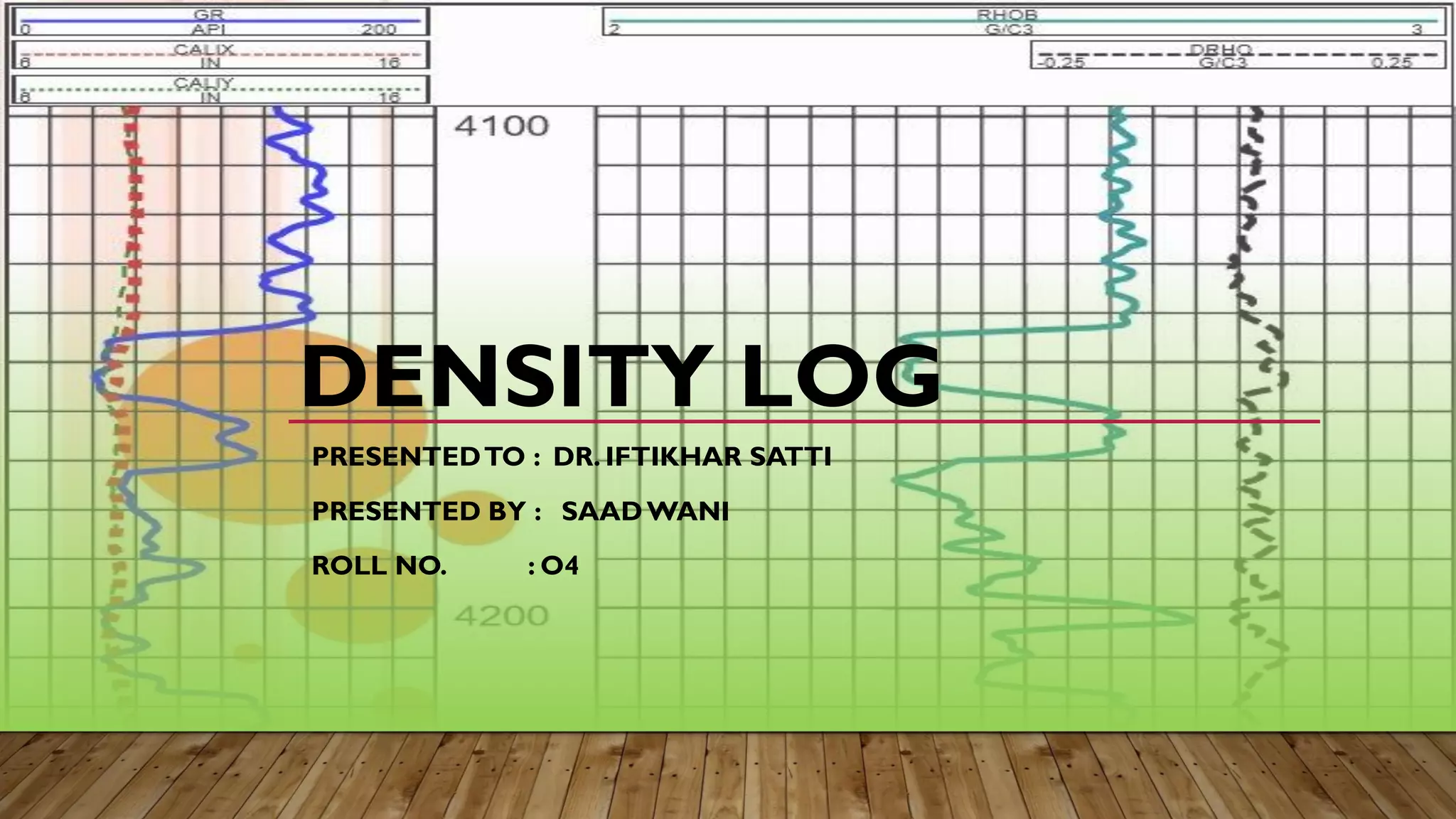
DENSITY LOG
PRESENTEDTO : DR. IFTIKHAR SATTI
PRESENTED BY : SAADWANI
ROLL NO. : O4
DEFINITION
• Formation Density logging is a well logging tool that can provide a
continuous record of a formation's bulk density along the length of a
borehole.
• This is one of three well logging tools that are commonly used to
calculate porosity, the other two being sonic logging & neutron porosity
logging.
HISTORY & PRINCIPLE
• The tool was initially developed in the 1950s & was in use throughout the hydrocarbon
industry by the 1960s
• A type of active nuclear tool, a radioactive source & detector are lowered down the
borehole & the source emits medium-energy gamma rays into the formation.
• These gamma rays interact with electrons in the formation & are scattered in an
interaction known as Compton scattering.
USES OF FORMATION DENSITY LOG
• This method is the most reliable porosity indicator for s&stones & limestones because their
density is well-known.
• On the other hand the density of clay minerals such as mudstone is highly variable, depending
on depositional environment, overburden pressure & other factors.
• Its main use is to derive a value for the total porosity of the formation.
• It s also useful in the detection of gas-bearing formations & in the recognition of evaporites.
• The combination of formation density log data with neutron log data gives one of the best
ways of identifying lithologies in a borehole.
DENSITY LOG
• Advantage: -
Automatically compensates for Mudcake and minor borehole irregularities.
• Limitations:
=> Correction valid only if Mudcake or standoff < 0.75” and is uniform along pad. --
m b => Abnormally low density (high porosity) in washed out (> 17”) hole or rough hole.
TOOLS
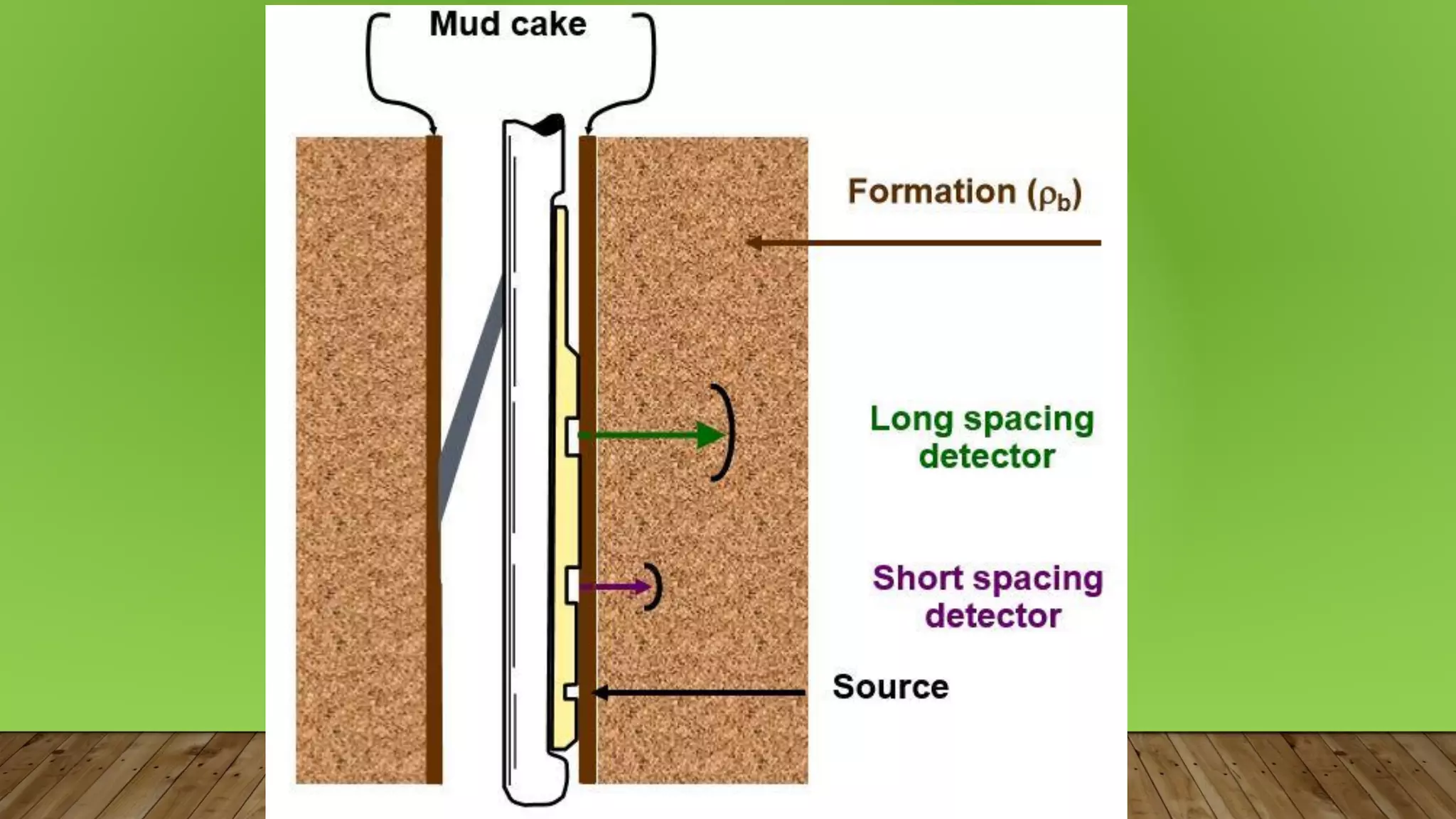
• A radioactive source: usually caesium-137 or cobalt-60, and emits gamma rays of medium
energy (in the range 0.2 – 2 MeV). For example, caesium-137 emits gamma rays with a
energy of 0.662 MeV.
• A short range detector.This detector is very similar to the detectors used in the natural
gamma ray tools,and is placed 7 inches from the source.
• A long range detector.This detector is identical to the short range detector, and is placed
16 inches from the source.
PROCESS OF MEASURING
• The radiometric measurement of density is based on the Gamma transmission principle.
• The gamma rays enter the formation and undergo compton scattering by interaction
with the electrons in the atoms composing the formation.
• Compton scattering reduces the energy of the gamma rays in a step-wise manner , and
scatters the gamma rays in all directions.
• When the energy of the gamma rays is less than 0.5 MeV they may undergo photo
electric absorption by interaction with the atomic electrons.
• The flux of gamma rays that reach each of the two detectors is therefore attenuated by
the formation, and the amount of attenuation is dependent upon the density of electrons
in the formation.
• The extent to which it is attenuated is directly proportional to the density of the
measured material.
• Moreover the measurement performance is not affected by temperature, pressure,
viscosity, color or chemical properties of the measured material.
PROCESS OF MEASURING
RELATION / INTERPRETATION
• A formation with a high bulk density, has a high number density of electrons. It attenuates
the gamma rays significantly, and hence a low gamma ray count rate is recorded at the
sensors.
• A formation with a low bulk density, has a low number density of electrons. It attenuates
the gamma rays less than a high density formation, and hence a higher gamma ray count
rate is recorded at the sensors.
DEPTH OF INVESTIGATION
• About 80% signal of short spacing detector comes from within 5 cm of the borehole wall,
which is commonly mainly mudcake .
• About 80% signal of the long spacing detector comes from within 10 cm of the borehole wall.
• Therefore the tool has a shallow depth of investigation.
• The vertical resolution at the typical logging speed (1300 ft/hr)is good which is defined by the
distance between the two detectors.
• The high vertical resolution means that the log is useful for defining formation boundaries.
LOG PRESENTATION
• The formation density log is
recorded in tracks 2 and 3 of the
standard API log presentation on a
linear scale.
• The scale is usually spans 1.95 to
2.95 g/cm3 as this is the normal
range for rocks.
DETERMINATION OF POROSITY
• Formation bulk density is a function of matrix density, porosity and formation fluid density
• Density porosity is defined as:
∅ = 𝜌 𝑚𝑎𝑡𝑟𝑖𝑥 − 𝜌 𝑏𝑢𝑙𝑘 /𝜌(𝑚𝑎𝑡𝑟𝑖𝑥) − 𝜌(𝑓𝑙𝑢𝑖𝑑)
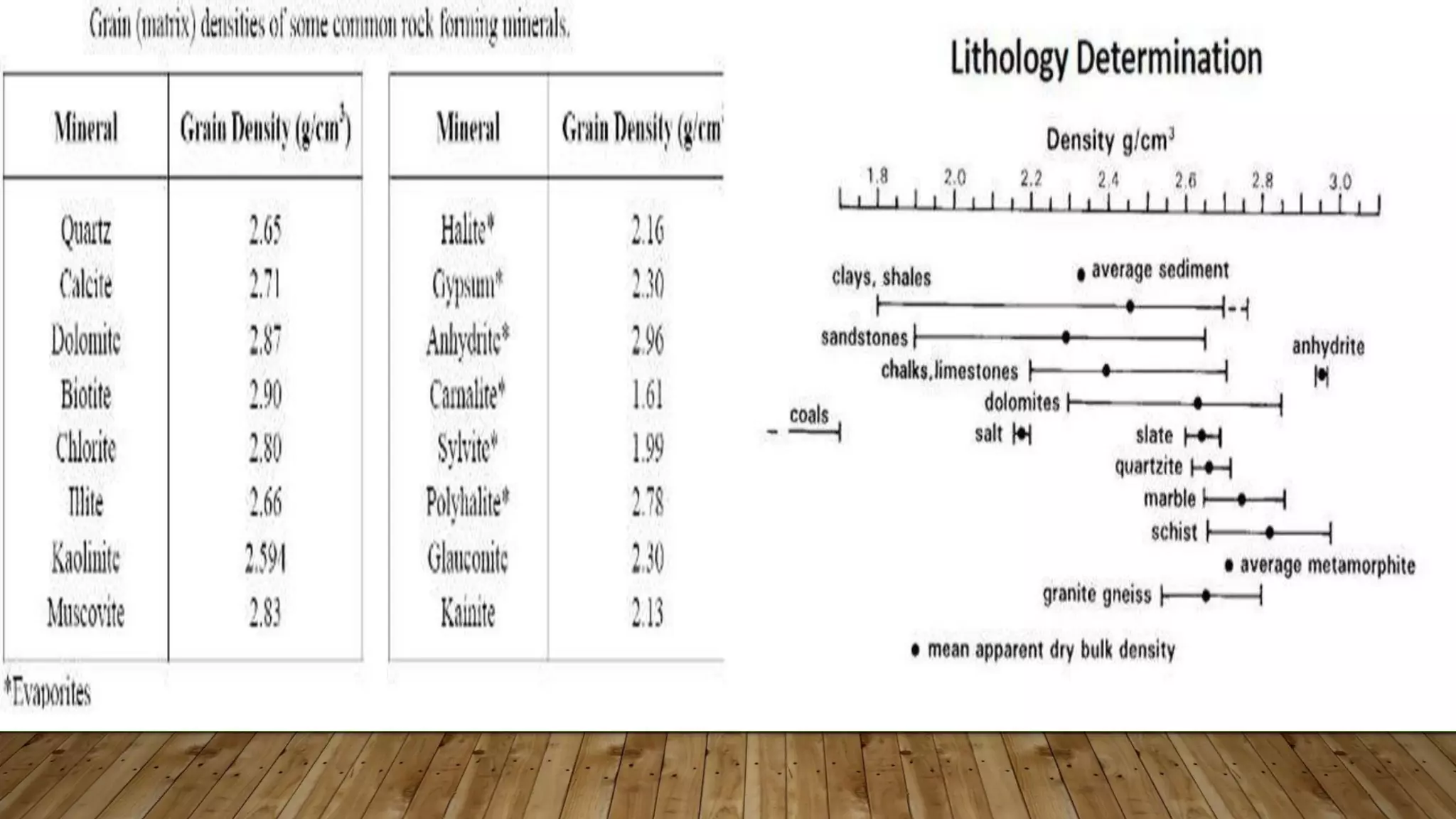
• Common values of matrix density (in g/cm³) are:
Quartz sand - 2.65
Limestone - 2.71
Dolomite - 2.87
• The matrix density and the fluid density need to be known
• The porosity of a formation can be obtained from the bulk density if the mean density of the rock matrix and that of the fluids
it contains are known.
IDENTIFICATION OF LITHOLOGY
• Formation density is not a useful tool for identifying lithology alone since most
sedimentary rocks can have a range of densities that commonly overlap.
• When used in combination with the neutron log, lithology can be determined.
• Evaporites are usually very pure and have consistent densities, making them more easily
identifiable the other sedimentary rocks
THANK YOU

Density Log

  • 1.
    DENSITY LOG PRESENTEDTO :DR. IFTIKHAR SATTI PRESENTED BY : SAADWANI ROLL NO. : O4
  • 2.
    DEFINITION • Formation Densitylogging is a well logging tool that can provide a continuous record of a formation's bulk density along the length of a borehole. • This is one of three well logging tools that are commonly used to calculate porosity, the other two being sonic logging & neutron porosity logging.
  • 3.
    HISTORY & PRINCIPLE •The tool was initially developed in the 1950s & was in use throughout the hydrocarbon industry by the 1960s • A type of active nuclear tool, a radioactive source & detector are lowered down the borehole & the source emits medium-energy gamma rays into the formation. • These gamma rays interact with electrons in the formation & are scattered in an interaction known as Compton scattering.
  • 4.
    USES OF FORMATIONDENSITY LOG • This method is the most reliable porosity indicator for s&stones & limestones because their density is well-known. • On the other hand the density of clay minerals such as mudstone is highly variable, depending on depositional environment, overburden pressure & other factors. • Its main use is to derive a value for the total porosity of the formation. • It s also useful in the detection of gas-bearing formations & in the recognition of evaporites. • The combination of formation density log data with neutron log data gives one of the best ways of identifying lithologies in a borehole.
  • 5.
    DENSITY LOG • Advantage:- Automatically compensates for Mudcake and minor borehole irregularities. • Limitations: => Correction valid only if Mudcake or standoff < 0.75” and is uniform along pad. -- m b => Abnormally low density (high porosity) in washed out (> 17”) hole or rough hole.
  • 6.
    TOOLS • A radioactivesource: usually caesium-137 or cobalt-60, and emits gamma rays of medium energy (in the range 0.2 – 2 MeV). For example, caesium-137 emits gamma rays with a energy of 0.662 MeV. • A short range detector.This detector is very similar to the detectors used in the natural gamma ray tools,and is placed 7 inches from the source. • A long range detector.This detector is identical to the short range detector, and is placed 16 inches from the source.
  • 8.
    PROCESS OF MEASURING •The radiometric measurement of density is based on the Gamma transmission principle. • The gamma rays enter the formation and undergo compton scattering by interaction with the electrons in the atoms composing the formation. • Compton scattering reduces the energy of the gamma rays in a step-wise manner , and scatters the gamma rays in all directions. • When the energy of the gamma rays is less than 0.5 MeV they may undergo photo electric absorption by interaction with the atomic electrons.
  • 9.
    • The fluxof gamma rays that reach each of the two detectors is therefore attenuated by the formation, and the amount of attenuation is dependent upon the density of electrons in the formation. • The extent to which it is attenuated is directly proportional to the density of the measured material. • Moreover the measurement performance is not affected by temperature, pressure, viscosity, color or chemical properties of the measured material. PROCESS OF MEASURING
  • 10.
    RELATION / INTERPRETATION •A formation with a high bulk density, has a high number density of electrons. It attenuates the gamma rays significantly, and hence a low gamma ray count rate is recorded at the sensors. • A formation with a low bulk density, has a low number density of electrons. It attenuates the gamma rays less than a high density formation, and hence a higher gamma ray count rate is recorded at the sensors.
  • 11.
    DEPTH OF INVESTIGATION •About 80% signal of short spacing detector comes from within 5 cm of the borehole wall, which is commonly mainly mudcake . • About 80% signal of the long spacing detector comes from within 10 cm of the borehole wall. • Therefore the tool has a shallow depth of investigation. • The vertical resolution at the typical logging speed (1300 ft/hr)is good which is defined by the distance between the two detectors. • The high vertical resolution means that the log is useful for defining formation boundaries.
  • 12.
    LOG PRESENTATION • Theformation density log is recorded in tracks 2 and 3 of the standard API log presentation on a linear scale. • The scale is usually spans 1.95 to 2.95 g/cm3 as this is the normal range for rocks.
  • 13.
    DETERMINATION OF POROSITY •Formation bulk density is a function of matrix density, porosity and formation fluid density • Density porosity is defined as: ∅ = 𝜌 𝑚𝑎𝑡𝑟𝑖𝑥 − 𝜌 𝑏𝑢𝑙𝑘 /𝜌(𝑚𝑎𝑡𝑟𝑖𝑥) − 𝜌(𝑓𝑙𝑢𝑖𝑑) • Common values of matrix density (in g/cm³) are: Quartz sand - 2.65 Limestone - 2.71 Dolomite - 2.87 • The matrix density and the fluid density need to be known • The porosity of a formation can be obtained from the bulk density if the mean density of the rock matrix and that of the fluids it contains are known.
  • 14.
    IDENTIFICATION OF LITHOLOGY •Formation density is not a useful tool for identifying lithology alone since most sedimentary rocks can have a range of densities that commonly overlap. • When used in combination with the neutron log, lithology can be determined. • Evaporites are usually very pure and have consistent densities, making them more easily identifiable the other sedimentary rocks
  • 16.