Presented by;
Azhar Mahmood
Roll # 09
BS Applied geology 4th prof. Geophysics
University Of The Punjab Lahore










Introduction
Spontaneous potential log
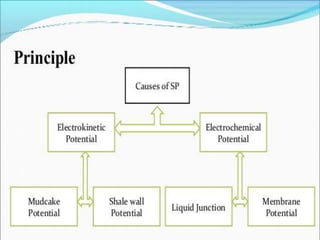
Principle
How it works
Measurement tools
Log presentation
Factors Effecting SP Log Response
Applications
What is SP ?





Called self or spontaneous potential .
SP is the naturally occuring electrical potential
difference in the Earth .
Spontaneous potentials (SP) are usually caused by
charge separation in clay or other minerals, due to
presence of semi-permeable interface impeding the
diffusion of ions through the pore space of rocks, or by
natural flow of a conducting fluid through the rocks.




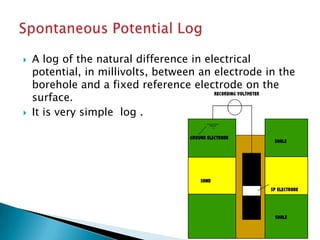
A log of the natural difference in electrical
potential, in millivolts, between an electrode in the
borehole and a fixed reference electrode on the
surface.
It is very simple log .






A conductive borehole fluid (i.e., a water based
mud).
A sandwich of a porous and permeable bed
between low porosity and impermeable formations.
A difference in salinity between the borehole fluid
and the formation fluid, which are the mud filtrate
and the formation fluid in most cases.
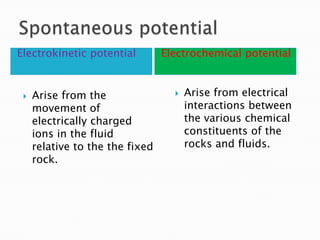
Electrokinetic potential



Arise from the
movement of
electrically charged
ions in the fluid
relative to the the fixed
rock.

Electrochemical potential



Arise from electrical
interactions between
the various chemical
constituents of the
rocks and fluids.
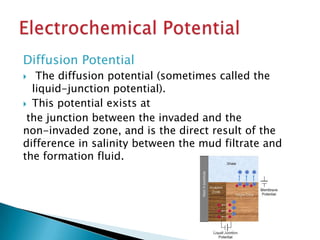
Diffusion Potential
The diffusion potential (sometimes called the

liquid-junction potential).
 This potential exists at
the junction between the invaded and the
non-invaded zone, and is the direct result of the
difference in salinity between the mud filtrate and
the formation fluid.

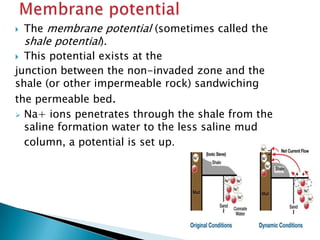
The membrane potential (sometimes called the

shale potential).
 This potential exists at the
junction between the non-invaded zone and the
shale (or other impermeable rock) sandwiching
the permeable bed.
 Na+ ions penetrates through the shale from the
saline formation water to the less saline mud
column, a potential is set up.





The shale wall potential. This potential is the

same in origin to the mud cake potential, but
applies to the flow of fluids from the borehole into
shale formations. It is usually very small because
the flow into impermeable shale is small.

The mud cake potential. This potential is produced
by the movement of charged ions through the mud
cake and invaded zone in a permeable formation.


The spontaneous potential produced in bore hole are actual
result of these two processes combine.



The mud filtrate is less saline than the formation water so it

becomes negetivly charge as a result of diffusion potential.


But above the sand opposite the shale because the shale
potential the saline solution (mud flitrate) becomes positivly
charge.



The excess charge is therefore negetive opposite the sand and

positive opposite the shale.


This couple works in a complementry sense and creates a SP
currents flowing between the mud filtrate the porous formation







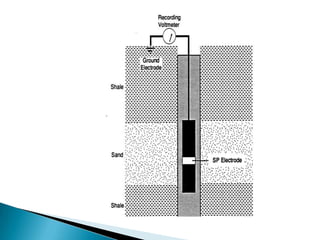
The tool is extremely simple.
SP log consists of an electrode that is suspended in
the bore hole.
Another electrode that fixed on the surface.
A voltmeter that measure the potential difference
b/w bore hole electrode and ground electrode.
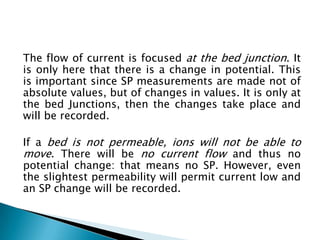
The flow of current is focused at the bed junction. It
is only here that there is a change in potential. This
is important since SP measurements are made not of
absolute values, but of changes in values. It is only at
the bed Junctions, then the changes take place and
will be recorded.
If a bed is not permeable, ions will not be able to
move. There will be no current flow and thus no
potential change: that means no SP. However, even
the slightest permeability will permit current low and
an SP change will be recorded.


Good earth is difficult to find .



Sometimes fixed electrode is attatched to rig
legs which is a big mistake.

Because


The operation of sea waves on the rig legs
induces potentials in the rig legs that give
rise to wavy patterns in the recorded SP log
which cannot be removed.
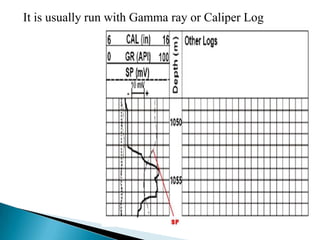
SP is shown in millivolts in Track 1.
 With negative deflections to the left and positive
ones to the right.
 In reading the SP log it is best to first define a shale
base line.
 This is the typical SP level for shales
shale base line can be found by comparing the SP
log with the GR log response.
Permeable formation will have then variable intensity
to left or right of this Shale base line .

It is usually run with Gamma ray or Caliper Log


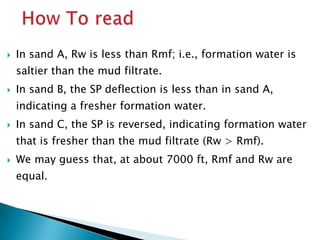
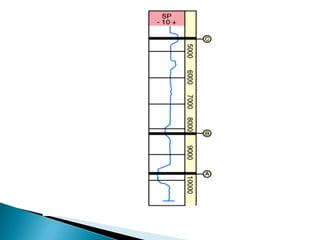
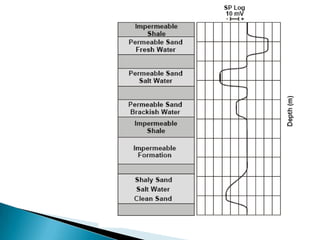
In sand A, Rw is less than Rmf; i.e., formation water is
saltier than the mud filtrate.



In sand B, the SP deflection is less than in sand A,
indicating a fresher formation water.



In sand C, the SP is reversed, indicating formation water

that is fresher than the mud filtrate (Rw > Rmf).


We may guess that, at about 7000 ft, Rmf and Rw are
equal.


Salinity



Resistivity



Bed thickness



Influence of clay






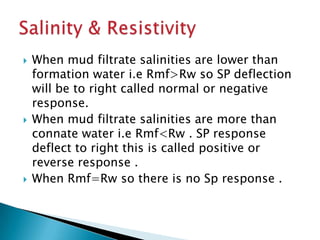
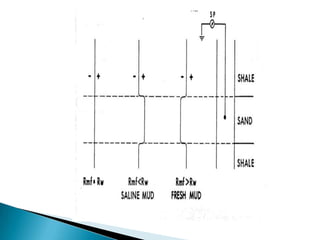
When mud filtrate salinities are lower than
formation water i.e Rmf>Rw so SP deflection
will be to right called normal or negative
response.
When mud filtrate salinities are more than
connate water i.e Rmf<Rw . SP response
deflect to right this is called positive or
reverse response .
When Rmf=Rw so there is no Sp response .



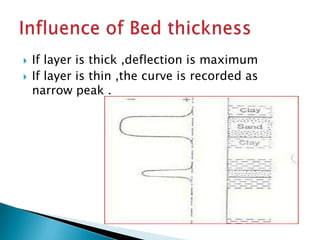
If layer is thick ,deflection is maximum
If layer is thin ,the curve is recorded as
narrow peak .


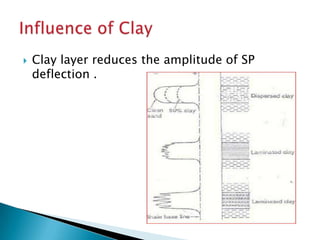
Clay layer reduces the amplitude of SP
deflection .
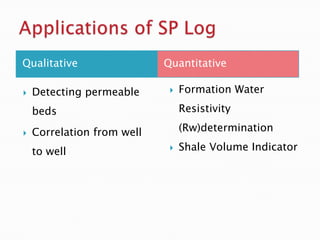
Qualitative


Detecting permeable

Quantitative


Formation Water

beds


Resistivity

Correlation from well

(Rw)determination

to well



Shale Volume Indicator
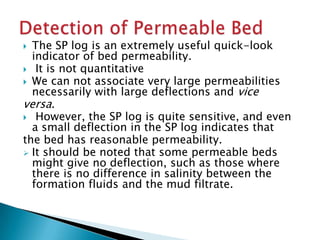
The SP log is an extremely useful quick-look
indicator of bed permeability.
 It is not quantitative
 We can not associate very large permeabilities
necessarily with large deflections and vice
versa.
 However, the SP log is quite sensitive, and even
a small deflection in the SP log indicates that
the bed has reasonable permeability.
 It should be noted that some permeable beds
might give no deflection, such as those where
there is no difference in salinity between the
formation fluids and the mud filtrate.







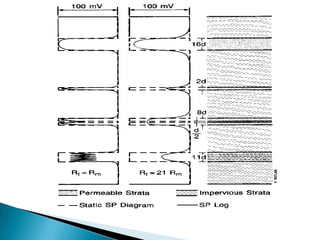
The SP log is sometimes a useful additional
log to use in correlation, but is rarely used
alone.
If used then, wells should be drilled with the
same mud, and the salinities in the
formations should be constant between wells.
The SP log can be used to follow facies
changes. However, it has been largely
replaced by the GR log which has a higher
resolution and is more reliable
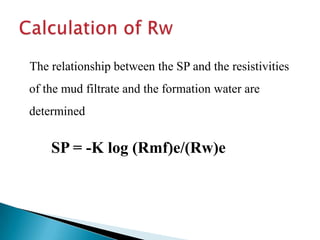
The relationship between the SP and the resistivities

of the mud filtrate and the formation water are
determined

SP = -K log (Rmf)e/(Rw)e
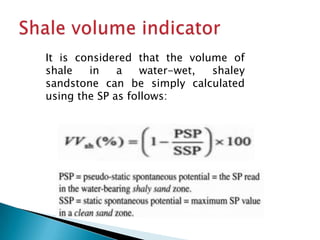
It is considered that the volume of
shale
in
a
water-wet,
shaley
sandstone can be simply calculated
using the SP as follows:
Spontaneous potential Log

Spontaneous potential Log

  • 2.
    Presented by; Azhar Mahmood Roll# 09 BS Applied geology 4th prof. Geophysics University Of The Punjab Lahore
  • 3.
            Introduction Spontaneous potential log Principle Howit works Measurement tools Log presentation Factors Effecting SP Log Response Applications
  • 4.
    What is SP?    Called self or spontaneous potential . SP is the naturally occuring electrical potential difference in the Earth . Spontaneous potentials (SP) are usually caused by charge separation in clay or other minerals, due to presence of semi-permeable interface impeding the diffusion of ions through the pore space of rocks, or by natural flow of a conducting fluid through the rocks.
  • 5.
      A log ofthe natural difference in electrical potential, in millivolts, between an electrode in the borehole and a fixed reference electrode on the surface. It is very simple log .
  • 6.
       A conductive boreholefluid (i.e., a water based mud). A sandwich of a porous and permeable bed between low porosity and impermeable formations. A difference in salinity between the borehole fluid and the formation fluid, which are the mud filtrate and the formation fluid in most cases.
  • 8.
    Electrokinetic potential  Arise fromthe movement of electrically charged ions in the fluid relative to the the fixed rock. Electrochemical potential  Arise from electrical interactions between the various chemical constituents of the rocks and fluids.
  • 9.
    Diffusion Potential The diffusionpotential (sometimes called the liquid-junction potential).  This potential exists at the junction between the invaded and the non-invaded zone, and is the direct result of the difference in salinity between the mud filtrate and the formation fluid. 
  • 10.
    The membrane potential(sometimes called the shale potential).  This potential exists at the junction between the non-invaded zone and the shale (or other impermeable rock) sandwiching the permeable bed.  Na+ ions penetrates through the shale from the saline formation water to the less saline mud column, a potential is set up. 
  • 11.
      The shale wallpotential. This potential is the same in origin to the mud cake potential, but applies to the flow of fluids from the borehole into shale formations. It is usually very small because the flow into impermeable shale is small. The mud cake potential. This potential is produced by the movement of charged ions through the mud cake and invaded zone in a permeable formation.
  • 12.
     The spontaneous potentialproduced in bore hole are actual result of these two processes combine.  The mud filtrate is less saline than the formation water so it becomes negetivly charge as a result of diffusion potential.  But above the sand opposite the shale because the shale potential the saline solution (mud flitrate) becomes positivly charge.  The excess charge is therefore negetive opposite the sand and positive opposite the shale.  This couple works in a complementry sense and creates a SP currents flowing between the mud filtrate the porous formation
  • 13.
        The tool isextremely simple. SP log consists of an electrode that is suspended in the bore hole. Another electrode that fixed on the surface. A voltmeter that measure the potential difference b/w bore hole electrode and ground electrode.
  • 15.
    The flow ofcurrent is focused at the bed junction. It is only here that there is a change in potential. This is important since SP measurements are made not of absolute values, but of changes in values. It is only at the bed Junctions, then the changes take place and will be recorded. If a bed is not permeable, ions will not be able to move. There will be no current flow and thus no potential change: that means no SP. However, even the slightest permeability will permit current low and an SP change will be recorded.
  • 16.
     Good earth isdifficult to find .  Sometimes fixed electrode is attatched to rig legs which is a big mistake. Because  The operation of sea waves on the rig legs induces potentials in the rig legs that give rise to wavy patterns in the recorded SP log which cannot be removed.
  • 18.
    SP is shownin millivolts in Track 1.  With negative deflections to the left and positive ones to the right.  In reading the SP log it is best to first define a shale base line.  This is the typical SP level for shales shale base line can be found by comparing the SP log with the GR log response. Permeable formation will have then variable intensity to left or right of this Shale base line . 
  • 19.
    It is usuallyrun with Gamma ray or Caliper Log
  • 20.
     In sand A,Rw is less than Rmf; i.e., formation water is saltier than the mud filtrate.  In sand B, the SP deflection is less than in sand A, indicating a fresher formation water.  In sand C, the SP is reversed, indicating formation water that is fresher than the mud filtrate (Rw > Rmf).  We may guess that, at about 7000 ft, Rmf and Rw are equal.
  • 22.
  • 23.
       When mud filtratesalinities are lower than formation water i.e Rmf>Rw so SP deflection will be to right called normal or negative response. When mud filtrate salinities are more than connate water i.e Rmf<Rw . SP response deflect to right this is called positive or reverse response . When Rmf=Rw so there is no Sp response .
  • 25.
      If layer isthick ,deflection is maximum If layer is thin ,the curve is recorded as narrow peak .
  • 26.
     Clay layer reducesthe amplitude of SP deflection .
  • 27.
  • 28.
    The SP logis an extremely useful quick-look indicator of bed permeability.  It is not quantitative  We can not associate very large permeabilities necessarily with large deflections and vice versa.  However, the SP log is quite sensitive, and even a small deflection in the SP log indicates that the bed has reasonable permeability.  It should be noted that some permeable beds might give no deflection, such as those where there is no difference in salinity between the formation fluids and the mud filtrate. 
  • 31.
       The SP logis sometimes a useful additional log to use in correlation, but is rarely used alone. If used then, wells should be drilled with the same mud, and the salinities in the formations should be constant between wells. The SP log can be used to follow facies changes. However, it has been largely replaced by the GR log which has a higher resolution and is more reliable
  • 32.
    The relationship betweenthe SP and the resistivities of the mud filtrate and the formation water are determined SP = -K log (Rmf)e/(Rw)e
  • 33.
    It is consideredthat the volume of shale in a water-wet, shaley sandstone can be simply calculated using the SP as follows: