Predictive Futures
Cognitive Analytics
Todays Speakers
Stuart Gillen
Director,
Business Development
Kumar Ramasundaran
Director,
Digital Automation
Tim Shea
Senior Analyst
AI/Machine Learning
Why Oil & Gas Needs This
June 1, 2016
Tim Shea
Senior Analyst
ARC Advisory Group
tshea@arcweb.com
VISION, EXPERIENCE, ANSWERS FOR INDUSTRY © ARC Advisory Group • 4
Who is ARC Advisory Group?
• Market intelligent and strategic advisory services firm focused on
automation, both process and discrete as well as hybrid
• Global with offices in Boston, Houston, Austin, Europe, Japan, China, India,
and Singapore
• Everything from basic market research reports to strategic consulting,
system selection, automation strategy development
• We work closely with both owner operators/end users, global service
providers and automation and technology suppliers
• Intelligence Partner to Industry Since 1986
VISION, EXPERIENCE, ANSWERS FOR INDUSTRY © ARC Advisory Group • 5
Impact of Low Oil Prices and Near Term Future Outlook
• Upstream Capex down >25% in 2016 due to continued pressure on oil prices.
Layoffs >250,000 and counting; bankruptcies >130 and counting
• Seeing growing number (~70) of offshore, subsea, and LNG projects delayed,
some even cancelled. EIA forecasting reduction in US production of >700,000
bbl/d in 2016
• “Lower for longer” environment forcing companies to assess new
technologies that drive down costs, increase production, improve asset
uptime and/or improve collaboration
• ARC believes the total business value that new technologies such as IIoT,
AI/machine learning and others can bring oil & gas lies in the many billions of
dollars
VISION, EXPERIENCE, ANSWERS FOR INDUSTRY © ARC Advisory Group • 6
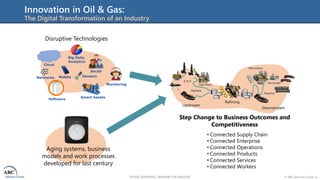
Innovation in Oil & Gas:
The Digital Transformation of an Industry
Disruptive Technologies
Cloud
Mobile
Social
Big Data,
Analytics
Software
Networks
Smart Assets
Sensors
Monitoring
Aging systems, business
models and work processes
developed for last century
Step Change to Business Outcomes and
Competitiveness
• Connected Supply Chain
• Connected Enterprise
• Connected Operations
• Connected Products
• Connected Services
• Connected Workers
VISION, EXPERIENCE, ANSWERS FOR INDUSTRY © ARC Advisory Group • 7
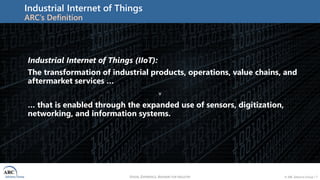
Industrial Internet of Things
ARC’s Definition
v
Industrial Internet of Things (IIoT):
The transformation of industrial products, operations, value chains, and
aftermarket services …
… that is enabled through the expanded use of sensors, digitization,
networking, and information systems.
VISION, EXPERIENCE, ANSWERS FOR INDUSTRY © ARC Advisory Group • 8
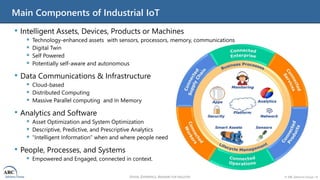
Main Components of Industrial IoT
• Intelligent Assets, Devices, Products or Machines
 Technology-enhanced assets with sensors, processors, memory, communications
 Digital Twin
 Self Powered
 Potentially self-aware and autonomous
• Data Communications & Infrastructure
 Cloud-based
 Distributed Computing
 Massive Parallel computing and In Memory
• Analytics and Software
 Asset Optimization and System Optimization
 Descriptive, Predictive, and Prescriptive Analytics
 “Intelligent Information” when and where people need it
• People, Processes, and Systems
 Empowered and Engaged, connected in context.
VISION, EXPERIENCE, ANSWERS FOR INDUSTRY © ARC Advisory Group • 9
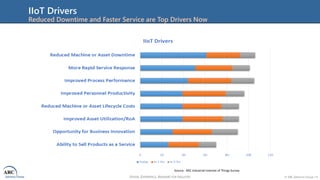
IIoT Drivers
Reduced Downtime and Faster Service are Top Drivers Now
Source: ARC Industrial Internet of Things Survey
VISION, EXPERIENCE, ANSWERS FOR INDUSTRY © ARC Advisory Group • 10
IIoT Value Proposition for Asset Owners
• Improve performance
 Reduce downtime using predictive maintenance
 Easily share info internally & externally
 Collaborate with suppliers to solve process problems
• Lower asset lifecycle costs
 Supports remote monitoring, remote fixes and updates
 Lower service costs
• Platform for Innovation
 Pay for value, not for product
 Collaborate with suppliers to improve products to meet your needs
IIoT can help you achieve breakthrough performance
VISION, EXPERIENCE, ANSWERS FOR INDUSTRY © ARC Advisory Group • 11
Some Applications Benefitting from AI/Machine Learning
• Drilling Optimization – closed loop drilling, increase ROP, etc.
• Well monitoring and optimization
 Well spacing optimization
 “Frac zone” multi-pad well drilling visibility
 Field/Reservoir level optimization
• Production planning and monitoring:
 Artificial lift (pump) optimization
 Compressor and turbine optimization
VISION, EXPERIENCE, ANSWERS FOR INDUSTRY © ARC Advisory Group • 12
Some Applications Benefitting from AI/Machine Learning
• Asset Integrity Management/Asset Performance Management:
 Leverage data and analytics to extend asset lifecycle and lower TCO
 IIoT can enhance/automate maintenance while resource constrained
• Supply chain management/optimization
 Visibility into supply chain and ecosystems
 Transportation and logistics optimization
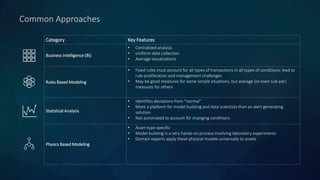
Category Key Features
Business Intelligence (BI)
• Centralized analysis
• Uniform data collection
• Average visualizations
Rules Based Modeling
• Fixed rules must account for all types of transactions in all types of conditions; lead to
rule proliferation and management challenges
• May be good measures for some simple situations, but average (or even sub-par)
measures for others
Statistical Analysis
• Identifies deviations from “normal”
• More a platform for model building and data scientists than an alert generating
solution
• Not automated to account for changing conditions
Physics Based Modeling
• Asset-type specific
• Model building Is a very hands-on process involving laboratory experiments
• Domain experts apply these physical models universally to assets
Common Approaches
Enables machines to penetrate the complexity of data to identify associations
Presents powerful techniques to handle unstructured data
Continuously learns not only from previous insights, but also for new data entering the system
Provides NLP support to enable human to machine and machine to machine communication
Does not require rules, instead relies on hypothesis generation using multiple data sets
which might not always appear connected or relevant
Benefits of Cognitive Analytics
NLP: Natural Language Processing
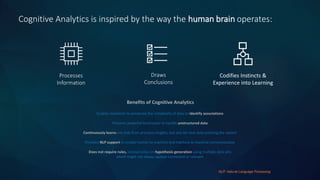
Cognitive Analytics is inspired by the way the human brain operates:
Processes
Information
Draws
Conclusions
Codifies Instincts &
Experience into Learning
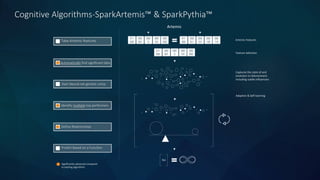
Cognitive Algorithms-SparkArtemis™ & SparkPythia™
Artemis
Artemis FeaturesTake Artemis features
Captures the state of and
evolution to failure/event
including subtle influencers
Start Neural net genetic comp
Predict Based on a Function
Significantly advanced compared
to existing algorithms
Feature Selection
Automatically find significant data
Adaptive & Self-learning
Identify multiple top performers
Define Relationships
Cognitive Algorithms-SparkPythia™
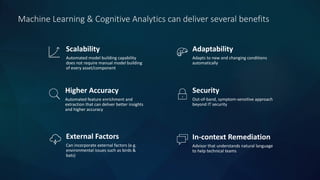
Machine Learning & Cognitive Analytics can deliver several benefits
External Factors
Can incorporate external factors (e.g.
environmental issues such as birds &
bats)
Scalability
Automated model building capability
does not require manual model building
of every asset/component
In-context Remediation
Advisor that understands natural language
to help technical teams
Security
Out-of-band, symptom-sensitive approach
beyond IT security
Adaptability
Adapts to new and changing conditions
automatically
Higher Accuracy
Automated feature enrichment and
extraction that can deliver better insights
and higher accuracy
Use Case
About FlowServe
 Largest Pump
Manufacturer in the
United States
 Market Cap of $6.22B
 Founded in 1790 (26
years after America)
 Over 18,000 employees
in 56 countries
World Headquarters
Sales Offices
Service Centers & Quick Response Centers
Manufacturing Plants & Regional Operations Centers
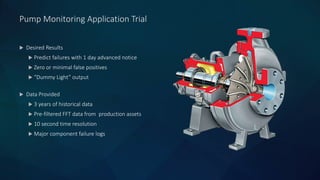
Pump Monitoring Application Trial
 Desired Results
 Predict failures with 1 day advanced notice
 Zero or minimal false positives
 “Dummy Light” output
 Data Provided
 3 years of historical data
 Pre-filtered FFT data from production assets
 10 second time resolution
 Major component failure logs
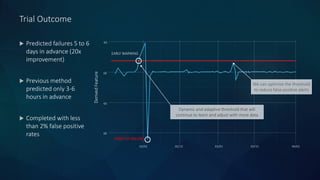
Trial Outcome
60
60
60
60
02/01 02/15 03/01 03/15 04/01
DerivedFeature
EARLY WARNING
Dynamic and adaptive threshold that will
continue to learn and adjust with more data
We can optimize the threshold
to reduce false positive alerts
POINT OF FAILURE
 Predicted failures 5 to 6
days in advance (20x
improvement)
 Previous method
predicted only 3-6
hours in advance
 Completed with less
than 2% false positive
rates
Next Steps
 Deploy on Azure cloud instances
 Pending results of expanded sites, committed to enterprise wide roll-out
 Explore predictive models for other major components
 Explore adjacent Intelligent Documentation problem
Questions
Stuart Gillen
Director,
Business Development
Kumar Ramasundaran
Director,
Digital Automation
Tim Shea
Senior Analyst

Artificial Intelligence Application in Oil and Gas

  • 1.
  • 2.
    Todays Speakers Stuart Gillen Director, BusinessDevelopment Kumar Ramasundaran Director, Digital Automation Tim Shea Senior Analyst
  • 3.
    AI/Machine Learning Why Oil& Gas Needs This June 1, 2016 Tim Shea Senior Analyst ARC Advisory Group tshea@arcweb.com
  • 4.
    VISION, EXPERIENCE, ANSWERSFOR INDUSTRY © ARC Advisory Group • 4 Who is ARC Advisory Group? • Market intelligent and strategic advisory services firm focused on automation, both process and discrete as well as hybrid • Global with offices in Boston, Houston, Austin, Europe, Japan, China, India, and Singapore • Everything from basic market research reports to strategic consulting, system selection, automation strategy development • We work closely with both owner operators/end users, global service providers and automation and technology suppliers • Intelligence Partner to Industry Since 1986
  • 5.
    VISION, EXPERIENCE, ANSWERSFOR INDUSTRY © ARC Advisory Group • 5 Impact of Low Oil Prices and Near Term Future Outlook • Upstream Capex down >25% in 2016 due to continued pressure on oil prices. Layoffs >250,000 and counting; bankruptcies >130 and counting • Seeing growing number (~70) of offshore, subsea, and LNG projects delayed, some even cancelled. EIA forecasting reduction in US production of >700,000 bbl/d in 2016 • “Lower for longer” environment forcing companies to assess new technologies that drive down costs, increase production, improve asset uptime and/or improve collaboration • ARC believes the total business value that new technologies such as IIoT, AI/machine learning and others can bring oil & gas lies in the many billions of dollars
  • 6.
    VISION, EXPERIENCE, ANSWERSFOR INDUSTRY © ARC Advisory Group • 6 Innovation in Oil & Gas: The Digital Transformation of an Industry Disruptive Technologies Cloud Mobile Social Big Data, Analytics Software Networks Smart Assets Sensors Monitoring Aging systems, business models and work processes developed for last century Step Change to Business Outcomes and Competitiveness • Connected Supply Chain • Connected Enterprise • Connected Operations • Connected Products • Connected Services • Connected Workers
  • 7.
    VISION, EXPERIENCE, ANSWERSFOR INDUSTRY © ARC Advisory Group • 7 Industrial Internet of Things ARC’s Definition v Industrial Internet of Things (IIoT): The transformation of industrial products, operations, value chains, and aftermarket services … … that is enabled through the expanded use of sensors, digitization, networking, and information systems.
  • 8.
    VISION, EXPERIENCE, ANSWERSFOR INDUSTRY © ARC Advisory Group • 8 Main Components of Industrial IoT • Intelligent Assets, Devices, Products or Machines  Technology-enhanced assets with sensors, processors, memory, communications  Digital Twin  Self Powered  Potentially self-aware and autonomous • Data Communications & Infrastructure  Cloud-based  Distributed Computing  Massive Parallel computing and In Memory • Analytics and Software  Asset Optimization and System Optimization  Descriptive, Predictive, and Prescriptive Analytics  “Intelligent Information” when and where people need it • People, Processes, and Systems  Empowered and Engaged, connected in context.
  • 9.
    VISION, EXPERIENCE, ANSWERSFOR INDUSTRY © ARC Advisory Group • 9 IIoT Drivers Reduced Downtime and Faster Service are Top Drivers Now Source: ARC Industrial Internet of Things Survey
  • 10.
    VISION, EXPERIENCE, ANSWERSFOR INDUSTRY © ARC Advisory Group • 10 IIoT Value Proposition for Asset Owners • Improve performance  Reduce downtime using predictive maintenance  Easily share info internally & externally  Collaborate with suppliers to solve process problems • Lower asset lifecycle costs  Supports remote monitoring, remote fixes and updates  Lower service costs • Platform for Innovation  Pay for value, not for product  Collaborate with suppliers to improve products to meet your needs IIoT can help you achieve breakthrough performance
  • 11.
    VISION, EXPERIENCE, ANSWERSFOR INDUSTRY © ARC Advisory Group • 11 Some Applications Benefitting from AI/Machine Learning • Drilling Optimization – closed loop drilling, increase ROP, etc. • Well monitoring and optimization  Well spacing optimization  “Frac zone” multi-pad well drilling visibility  Field/Reservoir level optimization • Production planning and monitoring:  Artificial lift (pump) optimization  Compressor and turbine optimization
  • 12.
    VISION, EXPERIENCE, ANSWERSFOR INDUSTRY © ARC Advisory Group • 12 Some Applications Benefitting from AI/Machine Learning • Asset Integrity Management/Asset Performance Management:  Leverage data and analytics to extend asset lifecycle and lower TCO  IIoT can enhance/automate maintenance while resource constrained • Supply chain management/optimization  Visibility into supply chain and ecosystems  Transportation and logistics optimization
  • 13.
    Category Key Features BusinessIntelligence (BI) • Centralized analysis • Uniform data collection • Average visualizations Rules Based Modeling • Fixed rules must account for all types of transactions in all types of conditions; lead to rule proliferation and management challenges • May be good measures for some simple situations, but average (or even sub-par) measures for others Statistical Analysis • Identifies deviations from “normal” • More a platform for model building and data scientists than an alert generating solution • Not automated to account for changing conditions Physics Based Modeling • Asset-type specific • Model building Is a very hands-on process involving laboratory experiments • Domain experts apply these physical models universally to assets Common Approaches
  • 14.
    Enables machines topenetrate the complexity of data to identify associations Presents powerful techniques to handle unstructured data Continuously learns not only from previous insights, but also for new data entering the system Provides NLP support to enable human to machine and machine to machine communication Does not require rules, instead relies on hypothesis generation using multiple data sets which might not always appear connected or relevant Benefits of Cognitive Analytics NLP: Natural Language Processing Cognitive Analytics is inspired by the way the human brain operates: Processes Information Draws Conclusions Codifies Instincts & Experience into Learning
  • 15.
    Cognitive Algorithms-SparkArtemis™ &SparkPythia™ Artemis Artemis FeaturesTake Artemis features Captures the state of and evolution to failure/event including subtle influencers Start Neural net genetic comp Predict Based on a Function Significantly advanced compared to existing algorithms Feature Selection Automatically find significant data Adaptive & Self-learning Identify multiple top performers Define Relationships
  • 16.
  • 18.
    Machine Learning &Cognitive Analytics can deliver several benefits External Factors Can incorporate external factors (e.g. environmental issues such as birds & bats) Scalability Automated model building capability does not require manual model building of every asset/component In-context Remediation Advisor that understands natural language to help technical teams Security Out-of-band, symptom-sensitive approach beyond IT security Adaptability Adapts to new and changing conditions automatically Higher Accuracy Automated feature enrichment and extraction that can deliver better insights and higher accuracy
  • 19.
  • 20.
    About FlowServe  LargestPump Manufacturer in the United States  Market Cap of $6.22B  Founded in 1790 (26 years after America)  Over 18,000 employees in 56 countries World Headquarters Sales Offices Service Centers & Quick Response Centers Manufacturing Plants & Regional Operations Centers
  • 21.
    Pump Monitoring ApplicationTrial  Desired Results  Predict failures with 1 day advanced notice  Zero or minimal false positives  “Dummy Light” output  Data Provided  3 years of historical data  Pre-filtered FFT data from production assets  10 second time resolution  Major component failure logs
  • 22.
    Trial Outcome 60 60 60 60 02/01 02/1503/01 03/15 04/01 DerivedFeature EARLY WARNING Dynamic and adaptive threshold that will continue to learn and adjust with more data We can optimize the threshold to reduce false positive alerts POINT OF FAILURE  Predicted failures 5 to 6 days in advance (20x improvement)  Previous method predicted only 3-6 hours in advance  Completed with less than 2% false positive rates
  • 23.
    Next Steps  Deployon Azure cloud instances  Pending results of expanded sites, committed to enterprise wide roll-out  Explore predictive models for other major components  Explore adjacent Intelligent Documentation problem
  • 24.
    Questions Stuart Gillen Director, Business Development KumarRamasundaran Director, Digital Automation Tim Shea Senior Analyst

Editor's Notes

  • #5 Quickly address at high level
  • #6 Main takeaway is that the “Lower for longer” environment creating opportunity/forcing owner operators to consider new technologies and changing mindsets – strong value proposition of new technologies is now being heard and adoption is growing since financial survival (not just shareholder value) in many cases is not assured
  • #7 Lower for longer environment is forcing companies to think differently and act differently using disruptive technologies that can help improve all facets of value chain What particular tech do you plan on calling out? Intelligent pumps Intelligent completion
  • #8 Read as is but add “… and information systems that are increasingly employing cognitive computing, machine learning, etc. This slide is a bit hard to read. Have Nicholas look at it.
  • #9 Key components of IoT are listed on this slide as is (not much detail discussed except): Key focus will be on the Analytics and Software components and how AI/machine learning can play a role Talking about drilling with closed-loop systems. Analysis provides options and expedites decision making.
  • #10 Focus is on two major drivers: increasing asset uptime/availability (minimize downtime) and increasing production of wells, etc., increasing employee productivity (or helping deal with Great Crew change), and ability for operational excellence Any thought on how lack of new wells means requisite increased production in existing wells?
  • #11 Not much here since reiterates much of previous slide Quickly Reiterate Benefits: Improve performance/uptime of assets Lower costs Platform for innovation/operational excellence Can we make text white?
  • #12 Provide some examples – either generic anecdotally or with specific owner operator’s names and some of the potential ROI, paybacks, etc.
  • #13 Provide some examples – either generic anecdotally or with specific owner operator’s names and some of the potential ROI, paybacks, etc. Summary – I’ve shown some examples as to how people are doing things today. Passing to Stuart to explain the current methods of doing this and how machine learning is pushing the state of the art to really augment human capabilities (help you do what you’ve been trying to do for 20 years).
  • #16 – 37% of non-productive drill time is spent on stuck pipe [BP] http://www.slb.com/~/media/Files/resources/oilfield_review/ors91/oct91/5_perspective.pdf
  • #17 I want to start this section out by first discussing typical ways in which organizations or users approach a data analytics project. These are loosely in order of least to most advanced The first category is that of the Business Intelligence Software. For many of us, Excel is the first tool we turn to when trying to solve a data science problem Excel is OK, but as most of us know it has its limitations in the amount of data it can ingest. For example, yesterday I was trying to load one day’s worth of OSI PI data and Excel was unable to load even a small amount of tags. Additionally, it can be difficult to create and manage rules, formulas, etc., and then creating appealing dashboards. Second, there are rules based modelling engines. These can be considered “If This then That” types of engines. While these types of systems can be affective they many times require a large amount of Subject Matter Experts time and knowledge and quickly become unmanageable because of the sheer number of changing variables in any “real” system. Next there are statistical, sometimes called Advanced Pattern Recognition, tools. These tools typically look at standard deviations from a “normal” operating condition and alert operators when unaccounted deviations occur. These systems work well in use cases where the normal is known and fluctuations are rare, such as Nuclear generation; but struggle again when there are many dynamically changing signals. Very infrequently do they account for drift or capture degradation over time. Finally, there is physics based modeling where users (or more typically consultants, manufacturers, etc.) provide a model of the asset, in this case a turbine, which is then used to predict failures. These models require extensive time from domain experts to ensure the accuracy of the model. More importantly, these models are often created in lab settings, making them static to a particular location or operating regime, meaning they don’t dynamically adapt to changing conditions well.
  • #18 At SparkCognition we take a cognitive analytics approach. This is really a fancy way of saying we approach the problem similarly to how the human brain would: “cognitively”. We don’t just look at one approach or algorithm to the problem, but rather use several different techniques to identify associations in the data. One of the central tenants of the cognitive approach, and what differentiates us from all of the “common approaches”, is the ability for users who are not PhD’s in Machine Learning to easily create dynamic, probabilistic models which continuously adapt and learn to new inputs from the system. The tools aren’t restricted to rigid structured data, but can also reach out and look at unstructured data in conjunction with Natural Language Processing and IBM Watson to bring context to the information. As a refresher for structured vs unstructured data. Structured data, as the name implies, refers to information where there is a high degree of organization. Unstructured data is essentially the opposite. As an example, think of Wikipedia. In Wikipedia there is structured information including things like the “entry ID”, “Publication Date”, “Title”, and “Authors”. Anyone wanting to do a search on these topics can do so in a fairly, straightforward, “structured” way. But, think about the actual content. This is far larger in volume and would be considered Unstructured data. The strength of NLP is in being able to parse the unstructured data and include it with structured data to find unique patterns. An example we have worked on in the O&M world is to take maintenance manuals and correlate the information to the problem the operator is experiencing and returning dynamic results. Imagine previously where the customer had manuals which referred to procedures in other manuals which might refer to steps in a third or fourth manual. Wouldn’t it be great, given a particular fault code that instead of manually trying to deduce which manual to go find the procedure the maintenance engineer simply typed in her fault code and the software, using Natural Language Processing and SparkCognition algorithms, could look at all the maintenance manuals, ingest their data, and dynamically present her with the correct procedures in one place?
  • #19 To really explain how cognitive analytics can be used in context, I want to walk you through an example of how two algorithms or ours, SparkArtemis and SparkPythia, can be used to predict stuck pipe.  First, Artemis needs to ingest all of the feature data. In this case, we were pulling 70 inputs from an EDR system. The second step is that SparkArtemis does something called feature expansion, which takes those 70 inputs and creates second, third, and even fourth order derivations of those inputs. This results in 1000s of new features to look at. That’s where Pythia comes in. We need some way to automatically find the “right features” to use for our models. Pythia digs through the 1000s of features at our disposal to find those that are most differentiated and relevant to actually identifying stuck pipe. After the features have been selected, a model needs to be created. We don’t just select a Neural Network or other algorithms with a fancy name. Our method is far more advanced. We build several different models utilizing a variety of data science algorithms and then ensemble them to create the most accurate model for the given data set. In this case, we were able to build a globally optimal model that predicted stuck pipe with over two hours of advance warning! To get a better, understanding of how this works, I want to break it down in a different way…
  • #20 Imagine you have several blind folded people in a room with an elephant.  One feels the tail, thinks he has a rope.  Another feels the tusk, thinks she has a spear.  The 3rd feels the side and thinks he has a wall.  Individually, they are all different things, but if you ensemble those responses in the correct way, you can put together a bigger picture and realize you have an elephant.  This is, in a simple way, what SparkPythia does, but it goes one step further and continues learning as new data is ingested. 
  • #21 Now that SparkPythia has created a model, those models need to be deployed to the asset; but how is this done…
  • #22 In conclusion. The SparkCognition Algorithms provide users a simple way to create dynamic models without having a PhD in data science and can in real time adjust to changing parameters. We have utilized the algorithms in a variety of applications where we have taken vast amounts of data and been able to improve safety, performance, and reliability of modern machinery.
  • #23 Before we dive into the to specific techniques SparkCognition employed to solve the gearbox problem Maggie described, I thought I would spend the next few slides discussing some machine learning basics.
  • #24 The first concept is that of Unsupervised learning. Imagine you are given a bag of marbles and asked to label or sort them.
  • #25 With unsupervised learning we don’t know what the “buckets” or labels are and therefore need to implement a model which can appropriately cluster the marbles and put them in appropriate buckets. In this example, for instance, our model may try and identify the marbles based on their size (small, medium or large) and group those into the appropriate bin. As you can see from this simple example there are numerous other ways the model could try and interpret the marbles (pattern, color, etc.). The power of machine learning is to employ all of these techniques and find the “best fit”.
  • #26 With supervised learning we are given the “buckets” and labels and now need to implement techniques which can appropriately classify the marbles into the corresponding bins. In this simple example we classify the marbles by colors.
  • #27 A more familiar example is a spreadsheet which contains information about an asset like ID, Date/Time, and Value. In this case because we don’t have any labelled failure data we have to use unsupervised learning techniques and try and detect outliers or anomalies in our datasets. However, if we are then given failure information such as component and action taken we can apply supervised techniques allowing us to classify and predict failures. If the data is available supervised learning can provide deeper insights into what might be going on within your system, however, as you can see from the previous example even having unlabeled data can lead to impactful results. For the Invenergy use case we had labelled data and was therefore able to utilize supervised learning to build our model., but for other applications we have had to utilize unsupervised learning.