RADIOACTIVE SURVEY
GEOPHYSICAL SURVEY
RADIATION :
The emission of energy as electromagnetic waves or as moving subatomic
particles, especially high-energy particles that cause ionization.
Radioactivity :
The act in which an atom releases radiation suddenly and spontaneously.
Radioactivity is caused when an atom wants to give away some of its energy.
Radio metrics :
Useful for the study of geomorphology and soils. Its also known as Gamma-
Ray Spectrometry.
RADIOMETRIC SURVEY
• Radiometrics is a measure of the natural radiation in the earth’s surface, which can
tell us about the distribution of certain soils and rocks. Geologists and geophysicists
routinely use it as a geological mapping tool to tell them where certain rock types
change.
• A radiometric survey measures the spatial distribution of three radioactive
elements (potassium-K, thorium- Th and uranium-U) in the top cm of the earth’s
crust. The abundances of K, Th and U are measured by detecting the gamma-rays
produced during the natural radioactive decay of these elements.
• The gamma-rays are packets of electromagnetic radiation characterised by their high
frequency and energy.
• They are quite penetrating, and can travel about 35 centimetres through rock and
several hundred metres through the air.
• Each gamma ray has a characteristic energy, and measurement of this energy allows
the specific potassium, uranium and thorium radiation to be diagnosed.
• There are 45 minerals that exhibit strong radioactivity, and a further 225 that are very
strong and to which exposure should be limited for health reasons.
AIR BORNE RADIOMETRIC SURVEY
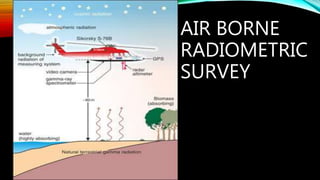
• Airborne gamma-ray spectrometric surveys estimate the concentrations of
the radioelements at the Earth's surface by measuring the gamma radiation
above the ground from low-flying aircraft or helicopters.
• Not-that-remote-sensing gamma-ray spectrometry is typically flown at 80 m
to 120 m above the terrain
• A surface mapping technique, not penetrative, so we must understand the
surface
• Uses geophysical instrumentation, but is a geochemical application
AIR BORNE
RADIOMETRIC
SURVEY
• Potassium (K) is the major element, Uranium (U) is a mobile trace element and
Thorium (Th) is a relatively immobile trace element.
• No fixed field of view – hot point sources may lie outside nominal view
• Gamma ray flux decreases exponentially from source
• Single measurement, big area, = average of rock, overburden, water,
vegetation, etc.
GROUND RADIOMETRIC SURVEY
•Instruments for detecting radioactivity
There are two principal instruments,
1. Geiger counter
2. Scintillometer
1.Geiger-Müller counter is a simple and cheap
device that responds primarily to Beta radiation.
It must be held close to the outcrop to detect the Beta rays, and is
thus a tool of limited application, seldom used in modern
prospecting.
2.Scintillometerworks by counting scintillations
produced in a detector by gamma radiation.
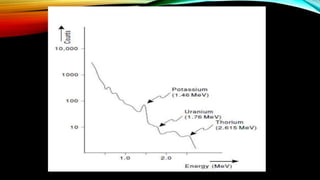
• A logical extension of the scintillometer is a spectrometer that
distinguishes characteristic gamma rays from 40K, U and Th.
• Therefore gamma radiation from different sources has different
energy levels.
• Typical natural gamma- ray spectrum recorded at ground level.
APPLICATIONS
• Its used primarily as a geological mapping tool.
• Potassium alteration, which is often associated with hydrothermal ore
deposits, can be detected using the gamma-ray spectrometric method.
• It is also used for uranium and thorium exploration, heat flow studies and
environmental mapping and for extracting hydrocarbon.
• Mineral Exploration – Radiometric surveys have been used successfully to
map uranium deposits.
• Engineering applications – the use of surface radiometric measurements in
geotechnical and archaeological applications has been extremely limited.
• Soil mapping – Air-borne and ground radiometric surveys with high resolution
can be used to map soils up to a scale of 1:25,000 and even 1:10,000. This info
can be used by land managers in efficient land management.
• More detailed examination of the radiometric results can yield additional
information about the soil types such as soil texture, horizon changes and
homogeneity in the top 40 cm.
THANK YOU

Radioactive Survey

  • 1.
  • 2.
    RADIATION : The emissionof energy as electromagnetic waves or as moving subatomic particles, especially high-energy particles that cause ionization. Radioactivity : The act in which an atom releases radiation suddenly and spontaneously. Radioactivity is caused when an atom wants to give away some of its energy. Radio metrics : Useful for the study of geomorphology and soils. Its also known as Gamma- Ray Spectrometry.
  • 3.
    RADIOMETRIC SURVEY • Radiometricsis a measure of the natural radiation in the earth’s surface, which can tell us about the distribution of certain soils and rocks. Geologists and geophysicists routinely use it as a geological mapping tool to tell them where certain rock types change. • A radiometric survey measures the spatial distribution of three radioactive elements (potassium-K, thorium- Th and uranium-U) in the top cm of the earth’s crust. The abundances of K, Th and U are measured by detecting the gamma-rays produced during the natural radioactive decay of these elements.
  • 4.
    • The gamma-raysare packets of electromagnetic radiation characterised by their high frequency and energy. • They are quite penetrating, and can travel about 35 centimetres through rock and several hundred metres through the air. • Each gamma ray has a characteristic energy, and measurement of this energy allows the specific potassium, uranium and thorium radiation to be diagnosed. • There are 45 minerals that exhibit strong radioactivity, and a further 225 that are very strong and to which exposure should be limited for health reasons.
  • 5.
    AIR BORNE RADIOMETRICSURVEY • Airborne gamma-ray spectrometric surveys estimate the concentrations of the radioelements at the Earth's surface by measuring the gamma radiation above the ground from low-flying aircraft or helicopters. • Not-that-remote-sensing gamma-ray spectrometry is typically flown at 80 m to 120 m above the terrain • A surface mapping technique, not penetrative, so we must understand the surface • Uses geophysical instrumentation, but is a geochemical application
  • 6.
  • 7.
    • Potassium (K)is the major element, Uranium (U) is a mobile trace element and Thorium (Th) is a relatively immobile trace element. • No fixed field of view – hot point sources may lie outside nominal view • Gamma ray flux decreases exponentially from source • Single measurement, big area, = average of rock, overburden, water, vegetation, etc.
  • 8.
    GROUND RADIOMETRIC SURVEY •Instrumentsfor detecting radioactivity There are two principal instruments, 1. Geiger counter 2. Scintillometer 1.Geiger-Müller counter is a simple and cheap device that responds primarily to Beta radiation. It must be held close to the outcrop to detect the Beta rays, and is thus a tool of limited application, seldom used in modern prospecting.
  • 9.
    2.Scintillometerworks by countingscintillations produced in a detector by gamma radiation. • A logical extension of the scintillometer is a spectrometer that distinguishes characteristic gamma rays from 40K, U and Th. • Therefore gamma radiation from different sources has different energy levels. • Typical natural gamma- ray spectrum recorded at ground level.
  • 11.
    APPLICATIONS • Its usedprimarily as a geological mapping tool. • Potassium alteration, which is often associated with hydrothermal ore deposits, can be detected using the gamma-ray spectrometric method. • It is also used for uranium and thorium exploration, heat flow studies and environmental mapping and for extracting hydrocarbon. • Mineral Exploration – Radiometric surveys have been used successfully to map uranium deposits.
  • 12.
    • Engineering applications– the use of surface radiometric measurements in geotechnical and archaeological applications has been extremely limited. • Soil mapping – Air-borne and ground radiometric surveys with high resolution can be used to map soils up to a scale of 1:25,000 and even 1:10,000. This info can be used by land managers in efficient land management. • More detailed examination of the radiometric results can yield additional information about the soil types such as soil texture, horizon changes and homogeneity in the top 40 cm.
  • 13.