1
Presentation on Neutron Log
2
Zubair Kamboh
Contents
3
 Log
 Neutron log
 Hydrogen Index
 Tools
 Log format
 Log Presentation
 Calibration
 Log characteristics
 Applications
 The Neutron-Density Combination
 Conclusion
 References
LOG
Continuous record as function of depth Of observation
made on the rock and fluids of the geological section
exposed in a well bore.
Graphically plotted to scale on narrow paper strip
4
Neutron Log
A reaction between radioactive elements emits fast
neutrons, which collide with the nuclei of other
atoms, most importantly hydrogen nuclei. Detectors
count the slowed neutrons deflected back to the tool. An
apparent neutron porosity can be obtained based on the
hydrogen index.
5
6
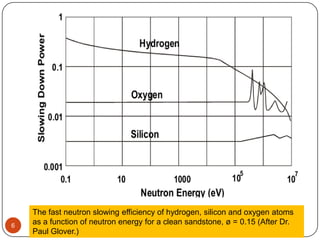
The fast neutron slowing efficiency of hydrogen, silicon and oxygen atoms
as a function of neutron energy for a clean sandstone, ø = 0.15 (After Dr.
Paul Glover.)
7
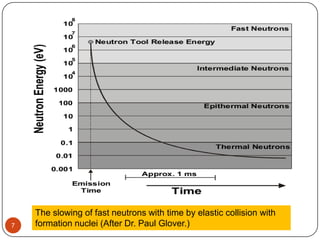
The slowing of fast neutrons with time by elastic collision with
formation nuclei (After Dr. Paul Glover.)
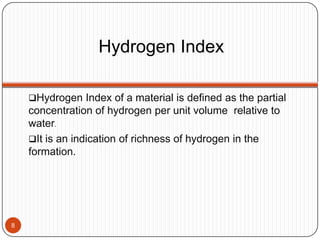
Hydrogen Index
Hydrogen Index of a material is defined as the partial
concentration of hydrogen per unit volume relative to
water.
It is an indication of richness of hydrogen in the
formation.
8
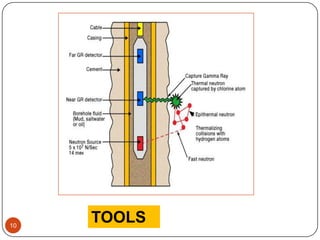
Tools
There are three main types of neutron tool, which are:
The Gamma Ray/Neutron Tool (GNT)
The Sidewall Neutron Porosity Tool (SNP)
The Compensated Neutron Log (CNL)
9
10
TOOLS
Log Format
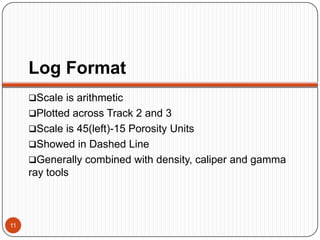
Scale is arithmetic
Plotted across Track 2 and 3
Scale is 45(left)-15 Porosity Units
Showed in Dashed Line
Generally combined with density, caliper and gamma
ray tools
11
Log Presentation
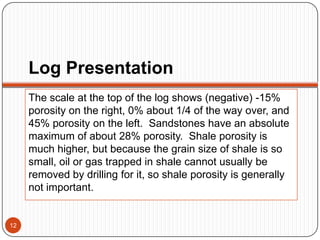
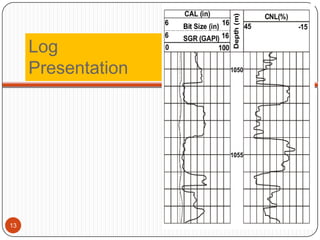
The scale at the top of the log shows (negative) -15%
porosity on the right, 0% about 1/4 of the way over, and
45% porosity on the left. Sandstones have an absolute
maximum of about 28% porosity. Shale porosity is
much higher, but because the grain size of shale is so
small, oil or gas trapped in shale cannot usually be
removed by drilling for it, so shale porosity is generally
not important.
12
Log
Presentation
13
Calibration
API Neutron Calibration Pit at the University of Houston
Three blocks of carbonate with accurately known
porosities that are filled with fresh water.
19% porosity Indiana limestone, API value of 1000 API
neutron units.
The response of the tool is then checked in 1.9%
Carthage Marble, 26 % Austin limestone, and 100%
fresh water.
14
15
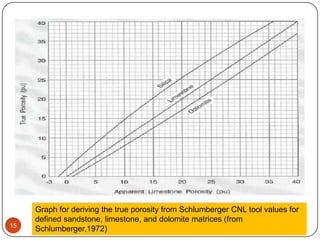
Graph for deriving the true porosity from Schlumberger CNL tool values for
defined sandstone, limestone, and dolomite matrices (from
Schlumberger,1972)
Log characteristics
Depth of Investigation:
15-25 cm
Varies with HI and therefore porosity
Vertical Resolution:
60cm with SNP
40cm with CNL
16
Applications
Quantitative
Qualitative
17
QUANTITAVE USE
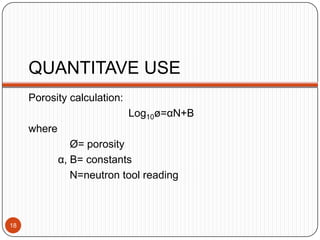
Porosity calculation:
Log10ø=αN+B
where
Ø= porosity
α, B= constants
N=neutron tool reading
18
QUANTITAVE USE
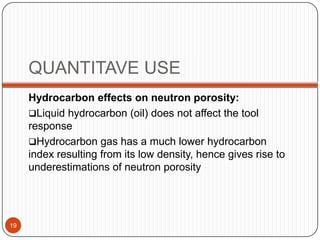
Hydrocarbon effects on neutron porosity:
Liquid hydrocarbon (oil) does not affect the tool
response
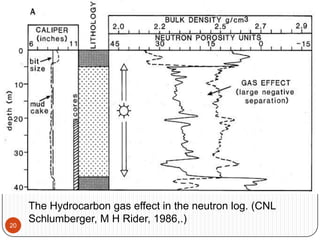
Hydrocarbon gas has a much lower hydrocarbon
index resulting from its low density, hence gives rise to
underestimations of neutron porosity
19
The Hydrocarbon gas effect in the neutron log. (CNL
Schlumberger, M H Rider, 1986,.)
20
QUANTITAVE USE
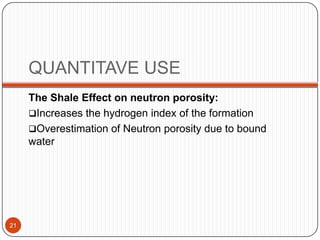
The Shale Effect on neutron porosity:
Increases the hydrogen index of the formation
Overestimation of Neutron porosity due to bound
water
21
QUALITATIVE USE
Lithology identification:
Shale
Sand
Evaporites
Coal
Volcanic and Intrusive rock
22
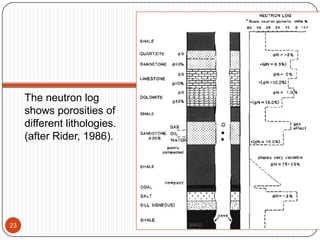
The neutron log
shows porosities of
different lithologies.
(after Rider, 1986).
23
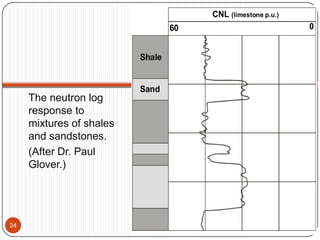
The neutron log
response to
mixtures of shales
and sandstones.
(After Dr. Paul
Glover.)
24
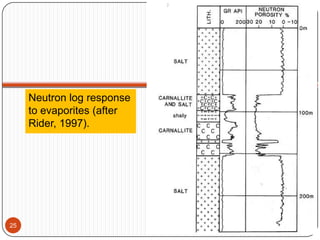
Neutron log response
to evaporites (after
Rider, 1997).
25
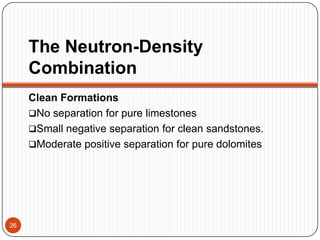
The Neutron-Density
Combination
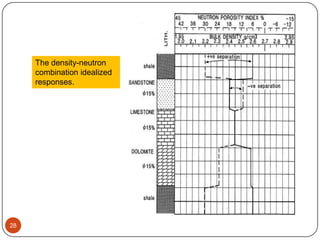
Clean Formations
No separation for pure limestones
Small negative separation for clean sandstones.
Moderate positive separation for pure dolomites
26
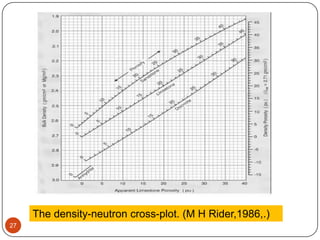
27
The density-neutron cross-plot. (M H Rider,1986,.)
28
The density-neutron
combination idealized
responses.
29
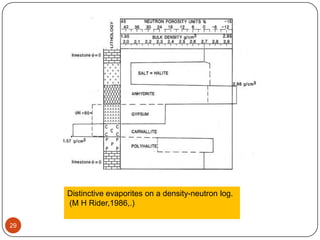
Distinctive evaporites on a density-neutron log.
(M H Rider,1986,.)
Conclusion
The neutron-density combination is best lithology
indicator for most formations
Shales and shaliness and evaporites can be identified
Clean formations and even matrix type can be
suggested
30
References
Engler.T.W.(2011). Neutron Logs-Lecture Notes For
PET.370.
Glover. P. The Neutron Log- Petrophysicist MSc Course
Notes .pp.152-171.
Rider.M.H. (1986, 1987).The Geochemical
Interpretation Of Well Logs.pp.106-118.
Serra.O.(1984).Fundamentals of well-log
Interpretation.p.135.
http://ipims.com/data/fe11/G4426.asp?UserID=&Code=
30025
31

Neutron log