DRILLING BITS 
JAMES A. CRAIG
Table of Contents 
 
Types of Bit 
 
Drag Bit 
 
Roller Cutter Bit 
 
Drill Bit Classification 
 
Drag Bit Classification 
 
Roller Cutter Bit Classification 
 
Drill Bit Grading 
 
Tooth Wear/Loss 
 
Bearing Wear 
 
Gauge Wear
 
Types of Bit 
 
Drag Bit 
 
Roller Cutter Bit 
 
Drill Bit Classification 
 
Drag Bit Classification 
 
Roller Cutter Bit Classification 
 
Drill Bit Grading 
 
Tooth Wear/Loss 
 
Bearing Wear 
 
Gauge Wear
Table of Contents 
 
Types of Bit 
 
Drag Bit 
 
Roller Cutter Bit 
 
Drill Bit Classification 
 
Drag Bit Classification 
 
Roller Cutter Bit Classification 
 
Drill Bit Grading 
 
Tooth Wear/Loss 
 
Bearing Wear 
 
Gauge Wear
DRILLING BITS 
 
A steel-toothed piece of equipment attached to the lower end of the drillstring in order to: 
 
crush, 
 
scrape and, 
 
grind 
formation loose. 
 
The two types available are: 
 
drag bits 
 
rolling cutter bits
Drag Bits 
 
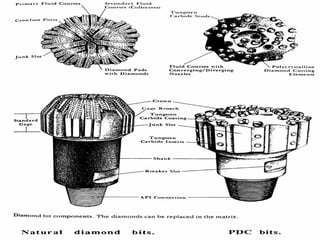
They consist of fixed cutter blades that are integral with the body of the bit and rotate as a unit with the drillstring. The cutting element consists of steelcutters, diamond, or polycrystalline diamond compact (PDC). 
 
Steelcutter bits 
 
the serrated steel blades are set at different angles(e.g. a fishtail bit). 
 
Natural diamond bits 
 
the face or crown of the bit consists of many diamonds set in a tungsten carbide matrix.
 
Polycrystalline diamond compact (PDC) bits 
 
a layer of synthetic PDC is bonded to a cemented tungsten carbide, it contains many diamond crystals bonded together. The sintered PDC compact is bonded either to a tungsten carbide bit-body matrix or to a tungsten carbide stud that is mounted in a steel bit. 
 
Thermally stable polycrystalline (TSP) bits 
 
these bits are manufactured in a similar fashion to PDC bits but are tolerant of much higher temperatures than PDC bits.
Roller Cutter Bits 
 
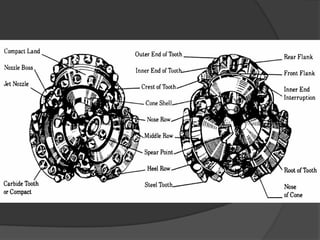
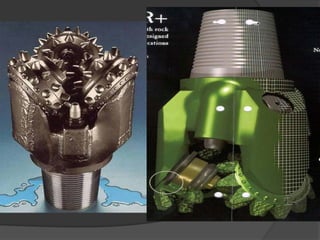
They have two or more cones containing the cutting elements which rotate about the axis of the cone as the bit is rotated at the bottom of the hole. The 3-cone rolling cutter bit is by far the most common. 
 
Important factors to consider in this type of bit are: structural materials, bearing-seal-lubricating design, cutting structure arrangements, and hydraulic arrangements.
 
Structural materials 
 
steels with appropriate yield strength, impact resistance, machineability, and heat-treated properties are usually selected.Cones are commonly heat treated and made of NiMo-steel, teeth are sometimes made of NiCrMo- steel 
 
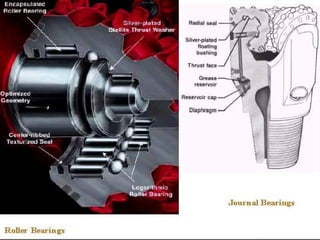
Bearing-seal-lubricating design 
 
they function as a unit and they must be able to withstand large impact loads, chemicals in the drilling fluids, and high temperature. 
○ 
Sealed bearings –grease lubricant (much longer life) 
–pressure surges can cause leak 
○ 
Journal bearings –wear-resistant hard surface on journal –O-ring seal and grease 
–solid lubricant inside cone journal race
 
Cutting structure arrangements 
 
the arrangement must provide efficient penetration of the formation to be drilled with accurate cut gauge. The gauge of the hole drilled is maintained by the outside cutters which are also known as gauge cutters.Teeth are vulnerable to wear and that increases in abrasive sandstone formations. When the gauge cutters are worn out, the consequent hole drilled is undergauge. The cones rotate at the bottom of the hole and drill hole predominanatly with a grinding and chipping action. The teeth are pressed onto the formation below the bit and applies a force exceeding the compressive strength of the rock 
 
Hydraulic arrangements 
 
they must be designed so as to efficiently remove and evacuate all cuttings from the bottom hole.
Drill Bit Classification 
 
Drill bits are classified by IADC (International Association of Drilling Contractor) to identify similar bit types made from different manufacturers. 
 
Drag bit classification –it consists of four digits. 
 
First Digit–an alphabet. It defines the type of cutter and the body material. 
○ 
D: natural diamond matrix body 
○ 
M: matrix body PDC 
○ 
S: steel body PDC 
○ 
T: matrix body TSP 
○ 
O: others
 
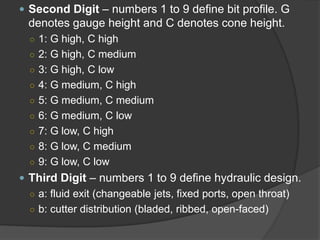
Second Digit–numbers 1 to 9 define bit profile. G denotes gauge height and C denotes cone height. 
○ 
1: G high, C high 
○ 
2: G high, C medium 
○ 
3: G high, C low 
○ 
4: G medium, C high 
○ 
5: G medium, C medium 
○ 
6: G medium, C low 
○ 
7: G low, C high 
○ 
8: G low, C medium 
○ 
9: G low, C low 
 
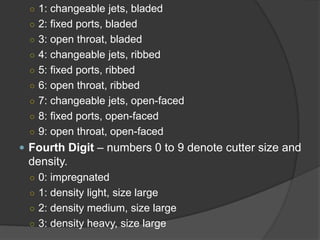
Third Digit–numbers 1 to 9 define hydraulic design. 
○ 
a: fluid exit (changeable jets, fixed ports, open throat) 
○ 
b: cutter distribution (bladed, ribbed, open-faced)
○ 
1: changeable jets, bladed 
○ 
2: fixed ports, bladed 
○ 
3: open throat, bladed 
○ 
4: changeable jets, ribbed 
○ 
5: fixed ports, ribbed 
○ 
6: open throat, ribbed 
○ 
7: changeable jets, open-faced 
○ 
8: fixed ports, open-faced 
○ 
9: open throat, open-faced 
 
Fourth Digit–numbers 0 to 9 denote cutter size and density. 
○ 
0: impregnated 
○ 
1: density light, size large 
○ 
2: density medium, size large 
○ 
3: density heavy, size large
○ 
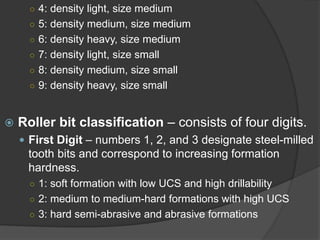
4: density light, size medium 
○ 
5: density medium, size medium 
○ 
6: density heavy, size medium 
○ 
7: density light, size small 
○ 
8: density medium, size small 
○ 
9: density heavy, size small 
 
Roller bit classification –consists of four digits. 
 
First Digit–numbers 1, 2, and 3 designate steel-milled tooth bits and correspond to increasing formation hardness. 
○ 
1: soft formation with low UCS and high drillability 
○ 
2: medium to medium-hard formations with high UCS 
○ 
3: hard semi-abrasive and abrasive formations
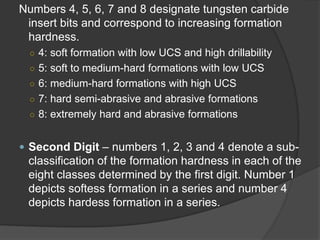
Numbers 4, 5, 6, 7 and 8 designate tungsten carbide insert bits and correspond to increasing formation hardness. 
○ 
4: soft formation with low UCS and high drillability 
○ 
5: softto medium-hard formations with lowUCS 
○ 
6: medium-hard formationswith high UCS 
○ 
7: hard semi-abrasive and abrasive formations 
○ 
8: extremely hard and abrasive formations 
 
Second Digit–numbers 1, 2, 3 and 4 denote a sub- classification of the formation hardness in eachof the eight classes determined by the first digit. Number 1 depicts softess formation in a series and number 4 depicts hardess formation in a series.
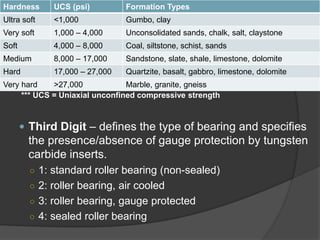
*** UCS = Uniaxial unconfined compressive strength 
 
Third Digit–defines the type of bearing and specifies the presence/absence of gauge protection by tungsten carbide inserts. 
○ 
1: standard roller bearing (non-sealed) 
○ 
2: roller bearing, air cooled 
○ 
3: roller bearing, gauge protected 
○ 
4: sealed roller bearing 
Hardness 
UCS (psi) 
Formation Types 
Ultra soft 
<1,000 
Gumbo, clay 
Very soft 
1,000 –4,000 
Unconsolidated sands, chalk, salt, claystone 
Soft 
4,000 –8,000 
Coal, siltstone, schist, sands 
Medium 
8,000 –17,000 
Sandstone, slate, shale, limestone, dolomite 
Hard 
17,000 –27,000 
Quartzite, basalt, gabbro, limestone, dolomite 
Very hard 
>27,000 
Marble, granite, gneiss
○ 
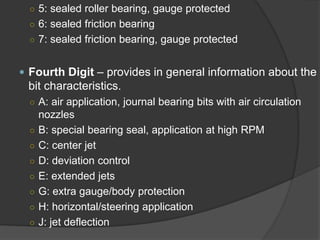
5: sealed roller bearing, gauge protected 
○ 
6: sealed friction bearing 
○ 
7: sealed friction bearing, gauge protected 
 
Fourth Digit–provides in general information about the bit characteristics. 
○ 
A: air application, journal bearing bits with air circulation nozzles 
○ 
B: special bearing seal, application at high RPM 
○ 
C: center jet 
○ 
D: deviation control 
○ 
E: extended jets 
○ 
G: extra gauge/body protection 
○ 
H: horizontal/steering application 
○ 
J: jet deflection
○ 
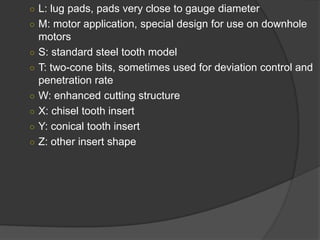
L: lug pads, pads very close to gauge diameter 
○ 
M: motor application, special design for use on downhole motors 
○ 
S: standard steel tooth model 
○ 
T: two-cone bits, sometimes used for deviation control and penetration rate 
○ 
W: enhanced cutting structure 
○ 
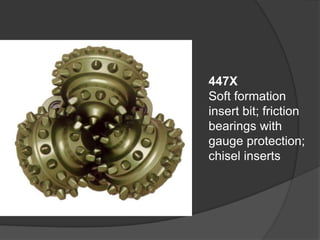
X: chisel tooth insert 
○ 
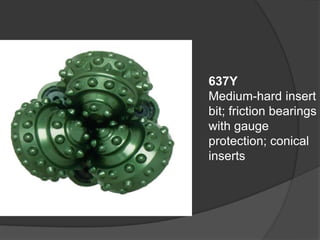
Y: conical tooth insert 
○ 
Z: other insert shape
 
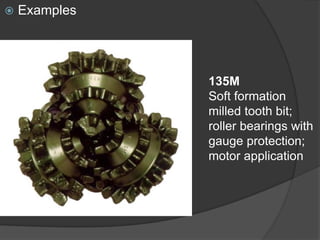
Examples 
135M 
Soft formation milled tooth bit; roller bearings with gauge protection; motor application
447X 
Soft formation insert bit; friction bearings with gauge protection; chisel inserts
637Y 
Medium-hard insert bit; friction bearings with gauge protection; conical inserts
Drill Bit Grading 
 
Dull drill bits are graded after runs according to tooth wear/loss, worn bearings, and gauge wear. 
 
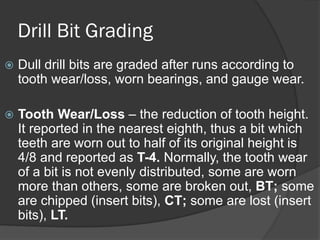
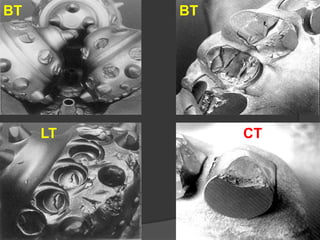
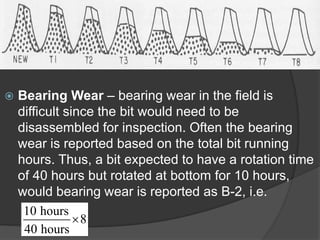
Tooth Wear/Loss–the reduction of tooth height. It reported in the nearest eighth, thus a bit which teeth are worn out to half of its original height is 4/8 and reported as T-4.Normally, the tooth wear of a bit is not evenly distributed, some are worn more than others, some are broken out,BT;some are chipped (insert bits),CT;some are lost (insert bits), LT.
BT 
LT 
CT 
BT
 
Bearing Wear–bearing wear in the field is difficult since the bit would need to be disassembled for inspection. Often the bearing wear is reported based on the total bit running hours. Thus, a bit expected to have a rotation time of 40 hours butrotated at bottom for 10 hours, would bearing wear is reported as B-2, i.e. 10 hours840 hours×
 
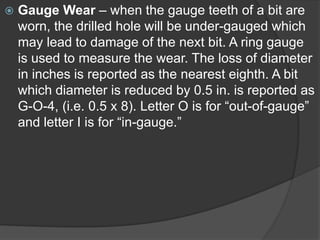
Gauge Wear–when the gauge teeth of a bit are worn, the drilled hole will be under-gauged which may lead to damage of the next bit. A ring gauge is used to measure the wear. The loss of diameter in inches is reported as the nearest eighth. A bit which diameter is reduced by 0.5 in. is reported as G-O-4, (i.e. 0.5 x 8). Letter O is for “out-of-gauge” and letter I is for “in-gauge.”
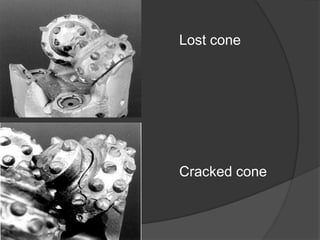
Cracked cone 
Lost cone
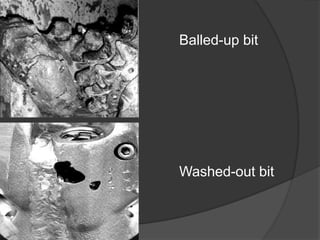
Balled-up bit 
Washed-out bit

Drilling Engineering - Drill Bit

  • 1.
  • 2.
    Table of Contents  Types of Bit  Drag Bit  Roller Cutter Bit  Drill Bit Classification  Drag Bit Classification  Roller Cutter Bit Classification  Drill Bit Grading  Tooth Wear/Loss  Bearing Wear  Gauge Wear
  • 3.
     Types ofBit  Drag Bit  Roller Cutter Bit  Drill Bit Classification  Drag Bit Classification  Roller Cutter Bit Classification  Drill Bit Grading  Tooth Wear/Loss  Bearing Wear  Gauge Wear
  • 4.
    Table of Contents  Types of Bit  Drag Bit  Roller Cutter Bit  Drill Bit Classification  Drag Bit Classification  Roller Cutter Bit Classification  Drill Bit Grading  Tooth Wear/Loss  Bearing Wear  Gauge Wear
  • 5.
    DRILLING BITS  A steel-toothed piece of equipment attached to the lower end of the drillstring in order to:  crush,  scrape and,  grind formation loose.  The two types available are:  drag bits  rolling cutter bits
  • 6.
    Drag Bits  They consist of fixed cutter blades that are integral with the body of the bit and rotate as a unit with the drillstring. The cutting element consists of steelcutters, diamond, or polycrystalline diamond compact (PDC).  Steelcutter bits  the serrated steel blades are set at different angles(e.g. a fishtail bit).  Natural diamond bits  the face or crown of the bit consists of many diamonds set in a tungsten carbide matrix.
  • 7.
     Polycrystalline diamondcompact (PDC) bits  a layer of synthetic PDC is bonded to a cemented tungsten carbide, it contains many diamond crystals bonded together. The sintered PDC compact is bonded either to a tungsten carbide bit-body matrix or to a tungsten carbide stud that is mounted in a steel bit.  Thermally stable polycrystalline (TSP) bits  these bits are manufactured in a similar fashion to PDC bits but are tolerant of much higher temperatures than PDC bits.
  • 9.
    Roller Cutter Bits  They have two or more cones containing the cutting elements which rotate about the axis of the cone as the bit is rotated at the bottom of the hole. The 3-cone rolling cutter bit is by far the most common.  Important factors to consider in this type of bit are: structural materials, bearing-seal-lubricating design, cutting structure arrangements, and hydraulic arrangements.
  • 12.
     Structural materials  steels with appropriate yield strength, impact resistance, machineability, and heat-treated properties are usually selected.Cones are commonly heat treated and made of NiMo-steel, teeth are sometimes made of NiCrMo- steel  Bearing-seal-lubricating design  they function as a unit and they must be able to withstand large impact loads, chemicals in the drilling fluids, and high temperature. ○ Sealed bearings –grease lubricant (much longer life) –pressure surges can cause leak ○ Journal bearings –wear-resistant hard surface on journal –O-ring seal and grease –solid lubricant inside cone journal race
  • 14.
     Cutting structurearrangements  the arrangement must provide efficient penetration of the formation to be drilled with accurate cut gauge. The gauge of the hole drilled is maintained by the outside cutters which are also known as gauge cutters.Teeth are vulnerable to wear and that increases in abrasive sandstone formations. When the gauge cutters are worn out, the consequent hole drilled is undergauge. The cones rotate at the bottom of the hole and drill hole predominanatly with a grinding and chipping action. The teeth are pressed onto the formation below the bit and applies a force exceeding the compressive strength of the rock  Hydraulic arrangements  they must be designed so as to efficiently remove and evacuate all cuttings from the bottom hole.
  • 15.
    Drill Bit Classification  Drill bits are classified by IADC (International Association of Drilling Contractor) to identify similar bit types made from different manufacturers.  Drag bit classification –it consists of four digits.  First Digit–an alphabet. It defines the type of cutter and the body material. ○ D: natural diamond matrix body ○ M: matrix body PDC ○ S: steel body PDC ○ T: matrix body TSP ○ O: others
  • 16.
     Second Digit–numbers1 to 9 define bit profile. G denotes gauge height and C denotes cone height. ○ 1: G high, C high ○ 2: G high, C medium ○ 3: G high, C low ○ 4: G medium, C high ○ 5: G medium, C medium ○ 6: G medium, C low ○ 7: G low, C high ○ 8: G low, C medium ○ 9: G low, C low  Third Digit–numbers 1 to 9 define hydraulic design. ○ a: fluid exit (changeable jets, fixed ports, open throat) ○ b: cutter distribution (bladed, ribbed, open-faced)
  • 17.
    ○ 1: changeablejets, bladed ○ 2: fixed ports, bladed ○ 3: open throat, bladed ○ 4: changeable jets, ribbed ○ 5: fixed ports, ribbed ○ 6: open throat, ribbed ○ 7: changeable jets, open-faced ○ 8: fixed ports, open-faced ○ 9: open throat, open-faced  Fourth Digit–numbers 0 to 9 denote cutter size and density. ○ 0: impregnated ○ 1: density light, size large ○ 2: density medium, size large ○ 3: density heavy, size large
  • 18.
    ○ 4: densitylight, size medium ○ 5: density medium, size medium ○ 6: density heavy, size medium ○ 7: density light, size small ○ 8: density medium, size small ○ 9: density heavy, size small  Roller bit classification –consists of four digits.  First Digit–numbers 1, 2, and 3 designate steel-milled tooth bits and correspond to increasing formation hardness. ○ 1: soft formation with low UCS and high drillability ○ 2: medium to medium-hard formations with high UCS ○ 3: hard semi-abrasive and abrasive formations
  • 19.
    Numbers 4, 5,6, 7 and 8 designate tungsten carbide insert bits and correspond to increasing formation hardness. ○ 4: soft formation with low UCS and high drillability ○ 5: softto medium-hard formations with lowUCS ○ 6: medium-hard formationswith high UCS ○ 7: hard semi-abrasive and abrasive formations ○ 8: extremely hard and abrasive formations  Second Digit–numbers 1, 2, 3 and 4 denote a sub- classification of the formation hardness in eachof the eight classes determined by the first digit. Number 1 depicts softess formation in a series and number 4 depicts hardess formation in a series.
  • 20.
    *** UCS =Uniaxial unconfined compressive strength  Third Digit–defines the type of bearing and specifies the presence/absence of gauge protection by tungsten carbide inserts. ○ 1: standard roller bearing (non-sealed) ○ 2: roller bearing, air cooled ○ 3: roller bearing, gauge protected ○ 4: sealed roller bearing Hardness UCS (psi) Formation Types Ultra soft <1,000 Gumbo, clay Very soft 1,000 –4,000 Unconsolidated sands, chalk, salt, claystone Soft 4,000 –8,000 Coal, siltstone, schist, sands Medium 8,000 –17,000 Sandstone, slate, shale, limestone, dolomite Hard 17,000 –27,000 Quartzite, basalt, gabbro, limestone, dolomite Very hard >27,000 Marble, granite, gneiss
  • 21.
    ○ 5: sealedroller bearing, gauge protected ○ 6: sealed friction bearing ○ 7: sealed friction bearing, gauge protected  Fourth Digit–provides in general information about the bit characteristics. ○ A: air application, journal bearing bits with air circulation nozzles ○ B: special bearing seal, application at high RPM ○ C: center jet ○ D: deviation control ○ E: extended jets ○ G: extra gauge/body protection ○ H: horizontal/steering application ○ J: jet deflection
  • 22.
    ○ L: lugpads, pads very close to gauge diameter ○ M: motor application, special design for use on downhole motors ○ S: standard steel tooth model ○ T: two-cone bits, sometimes used for deviation control and penetration rate ○ W: enhanced cutting structure ○ X: chisel tooth insert ○ Y: conical tooth insert ○ Z: other insert shape
  • 23.
     Examples 135M Soft formation milled tooth bit; roller bearings with gauge protection; motor application
  • 24.
    447X Soft formationinsert bit; friction bearings with gauge protection; chisel inserts
  • 25.
    637Y Medium-hard insertbit; friction bearings with gauge protection; conical inserts
  • 26.
    Drill Bit Grading  Dull drill bits are graded after runs according to tooth wear/loss, worn bearings, and gauge wear.  Tooth Wear/Loss–the reduction of tooth height. It reported in the nearest eighth, thus a bit which teeth are worn out to half of its original height is 4/8 and reported as T-4.Normally, the tooth wear of a bit is not evenly distributed, some are worn more than others, some are broken out,BT;some are chipped (insert bits),CT;some are lost (insert bits), LT.
  • 27.
  • 28.
     Bearing Wear–bearingwear in the field is difficult since the bit would need to be disassembled for inspection. Often the bearing wear is reported based on the total bit running hours. Thus, a bit expected to have a rotation time of 40 hours butrotated at bottom for 10 hours, would bearing wear is reported as B-2, i.e. 10 hours840 hours×
  • 29.
     Gauge Wear–whenthe gauge teeth of a bit are worn, the drilled hole will be under-gauged which may lead to damage of the next bit. A ring gauge is used to measure the wear. The loss of diameter in inches is reported as the nearest eighth. A bit which diameter is reduced by 0.5 in. is reported as G-O-4, (i.e. 0.5 x 8). Letter O is for “out-of-gauge” and letter I is for “in-gauge.”
  • 30.
  • 31.