



© 2010 McGraw-Hill Higher Education. All rights reserved.
Chapter 6
Biomechanics
© 2010 McGraw-Hill Higher Education. All rights reserved.
Exploring Biomechanics
 Biomechanics: bio means “life”
 Study of the actions of forces
 Term first used 1970’s
 Includes both internal forces produced by
muscles and external forces that act on the body
 Biomechanics human movement is one sub
discipline of exercise science
© 2010 McGraw-Hill Higher Education. All rights reserved.
Exploring Biomechanics
 Biomechanics
 Academic backgrounds: zoology, medicine, engineering,
physical therapy
 Common interest in biomechanical aspects of the structure
and function of living things
 Undergraduate course
 Usually requires prerequisite courses
 Focusing on forces acting on the human body
 Biomechanics commonly a quantitative field of study
 Strong math, computer applications and problem solving
© 2010 McGraw-Hill Higher Education. All rights reserved.
History of Biomechanics
 Aristotle (384-322 B.C.)
 Archimedes (287-212
B.C.)
 Galen (131-201 A.D.)
 Leonardo da Vinci
(1452-1519)
 Galileo (1564-1642)
 Giovanni Alfonso Borelli
(1608-1679)
 Isaac Newton (1643-1727)
 Eadweard Muybridge
(1831-1904)
 Julius Wolff (1836-1902)
 Christian Wilhelm Braune
(1831-1892) & Otto
Fischer (1861-1971)
© 2010 McGraw-Hill Higher Education. All rights reserved.
Basic Biomechanics--Kinematics
 Kinematics
 The form, pattern, or sequencing of movement with
respect to time
 Qualitative
 Involving nonnumeric description of quality
 Quantitative
 Involving the use of numbers
 Kinematic analysis often requires the use of both
visual description and quantitative measurement
© 2010 McGraw-Hill Higher Education. All rights reserved.
Basic Biomechanics--Kinematics
 Kinematic quantities: distance, displacement,
speed, velocity, acceleration
 Vector quantities have both size and direction
 Displacement, velocity, acceleration
© 2010 McGraw-Hill Higher Education. All rights reserved.
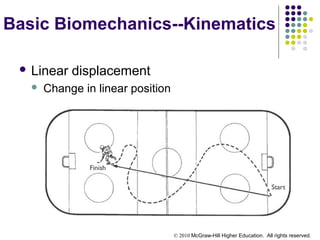
Basic Biomechanics--Kinematics
 Linear displacement
 Change in linear position
© 2010 McGraw-Hill Higher Education. All rights reserved.
Basic Biomechanics--Kinematics
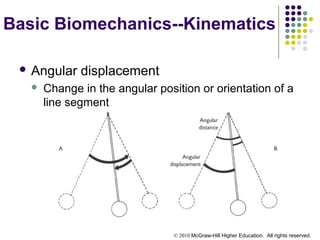
 Angular displacement
 Change in the angular position or orientation of a
line segment
© 2010 McGraw-Hill Higher Education. All rights reserved.
Basic Biomechanics--Kinematics
 Angular--most human movement requires
angular quantities
 Rotation around a central line or point
 Primarily rotational motion occurs at joints
 Linear velocity
 Rate of change in linear position
 Angular velocity
 Angular displacement divided by the time interval
which displacement occurs
© 2010 McGraw-Hill Higher Education. All rights reserved.
Basic Biomechanics--Kinematics
 Acceleration
 Angular acceleration
 Does not take into account particular
circumstances or rules when faced with a moral
problem
 With every moral situation, there is a blank slate
and each case must be viewed independently
© 2010 McGraw-Hill Higher Education. All rights reserved.
Basic Biomechanics--Kinematics
 Biomechanics use quantitative kinematics to
research differences between skilled performers
and non-athletes. Examples:
 Runners stride length & frequency
 Swimmer’s stroke rate & length
 Track events velocity of takeoff
 High jumpers vertical displacement
 Basketball angle of projection, angle of release
 Throwing events aerodynamics of flight path
 Swinging (bat, racquet) timing, project speed and
angle
© 2010 McGraw-Hill Higher Education. All rights reserved.
Basic Biomechanics--Kinematics
 Skilled performers move body segments at high
rate of angular velocity
 Most biomechanical studies of human kinematics
involve non-athletes:
 Infant through maternity developmental stages
 Adapted P.E. kinematic patterns with motor disorders
 Therapeutic uses to aid in recovery of
injuries/surgeries
© 2010 McGraw-Hill Higher Education. All rights reserved.
Basic Biomechanics--Kinematics
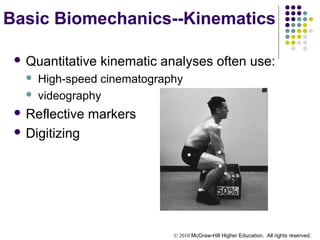
 Quantitative kinematic analyses often use:
 High-speed cinematography
 videography
 Reflective markers
 Digitizing
© 2010 McGraw-Hill Higher Education. All rights reserved.
 Kinetics
 Study of the action of forces
 Force
 The product of mass and acceleration
 Push or pull acting on a body
 Vector quantity: magnitude, direction & point
of application to a body
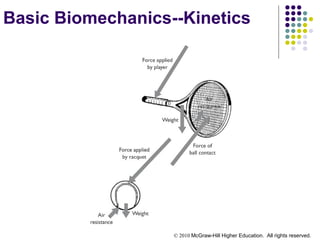
 Free body diagram
 First step used when analyzing actions
 Body, body segment or object of interest
Basic Biomechanics--Kinetics
© 2010 McGraw-Hill Higher Education. All rights reserved.
Basic Biomechanics--Kinetics
© 2010 McGraw-Hill Higher Education. All rights reserved.
Basic Biomechanics--Kinetics
Force rarely acts in isolation
 Net force
 Overall effect of many forces acting on a body
 Vector sum of all the acting forces
 Net force zero = acting forces balanced in
magnitude and direction
 Net force present = body moves in the direction
of the net force with acceleration
© 2010 McGraw-Hill Higher Education. All rights reserved.
Basic Biomechanics--Kinetics
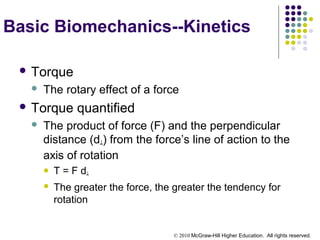
 Torque
 The rotary effect of a force
 Torque quantified
 The product of force (F) and the perpendicular
distance (d┴) from the force’s line of action to the
axis of rotation
 T = F d┴
 The greater the force, the greater the tendency for
rotation
© 2010 McGraw-Hill Higher Education. All rights reserved.
Basic Biomechanics--Kinetics
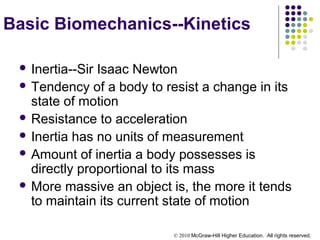
 Inertia--Sir Isaac Newton
 Tendency of a body to resist a change in its
state of motion
 Resistance to acceleration
 Inertia has no units of measurement
 Amount of inertia a body possesses is
directly proportional to its mass
 More massive an object is, the more it tends
to maintain its current state of motion
© 2010 McGraw-Hill Higher Education. All rights reserved.
Basic Biomechanics--Kinetics
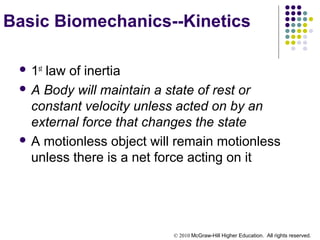
 1st
law of inertia
 A Body will maintain a state of rest or
constant velocity unless acted on by an
external force that changes the state
 A motionless object will remain motionless
unless there is a net force acting on it
© 2010 McGraw-Hill Higher Education. All rights reserved.
Basic Biomechanics--Kinetics
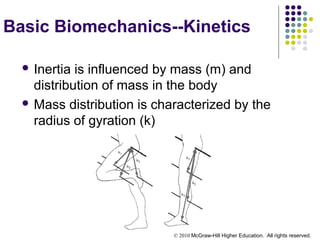
 Inertia is influenced by mass (m) and
distribution of mass in the body
 Mass distribution is characterized by the
radius of gyration (k)
© 2010 McGraw-Hill Higher Education. All rights reserved.
Basic Biomechanics--Kinetics
 Newton’s 2nd
law--law of acceleration
 A force applied to a body causes an acceleration of that body of a
magnitude proportional to the force, in the direction of the force, and
inversely proportional to the body’s mass
 The greater the amount of force applied, the
greater the speed
 F=ma
 Angular motion, the law becomes:
 When a torque acts on a body, the resulting angular
acceleration is in the direction of the torque and of a
magnitude inversely proportional to its moment of
inertia
© 2010 McGraw-Hill Higher Education. All rights reserved.
Basic Biomechanics--Kinetics
 Newton’s 3rd
law--law of reaction
 For every action, there is an equal and opposite
reaction
 In terms of forces:
 When one body exerts a force on a second, the
second body exerts a reaction force that is equal in
magnitude and opposite in direction on the first body
© 2010 McGraw-Hill Higher Education. All rights reserved.
Basic Biomechanics--Kinetics
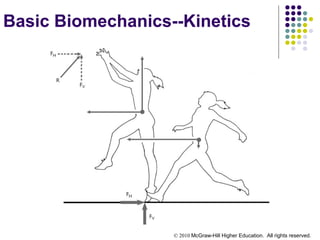
 Ground reaction forces
 Are measured during gait, each contact the foot
makes with floor is analyzed
 Walking, running patterns throughout development
stages using force platforms
 Magnitude of the vertical component of the GRF
during running is generally two to three times the
runner’s body weight
 Runner’s are classified as rearfoot, midfoot, or
forefoot strikers
© 2010 McGraw-Hill Higher Education. All rights reserved.
Basic Biomechanics--Kinetics
© 2010 McGraw-Hill Higher Education. All rights reserved.
Basic Biomechanics--Kinetics
 GRF is an external force acting on the human
body
 Magnitude and direction have implications for
performance in many sporting events
 High jumper’s
 Baseball pitching
 Golf
© 2010 McGraw-Hill Higher Education. All rights reserved.
Basic Biomechanics--Kinetics
 Friction is a force that acts at the interface of
surfaces in contact in the direction opposite
the direction of motion or impending motion
 Units of force (N)
 The size of the friction force is the product of
the coefficient of friction (µ) and the normal
(perpendicular) reaction force (R).
© 2010 McGraw-Hill Higher Education. All rights reserved.
Basic Biomechanics--Kinetics
 Factors influencing the value of friction µ
 Relative roughness and hardness of the surfaces
 Type of molecular interaction between surfaces
 Greater the molecular interaction, the greater
is the value of µ
© 2010 McGraw-Hill Higher Education. All rights reserved.
Basic Biomechanics--Kinetics
 Normal reaction force (R)
 Sum of all acting vertical forces (usually body’s
weight)
 Altered magnitude R
 Increased or decreased
 When friction is altered, how does this change
motion?
© 2010 McGraw-Hill Higher Education. All rights reserved.
Basic Biomechanics--Kinetics
 Altering the coefficient between two
surfaces can change friction
 Use of gloves, thin wax…
 Important daily influence to prevent
slippage
© 2010 McGraw-Hill Higher Education. All rights reserved.
Basic Biomechanics--Kinetics
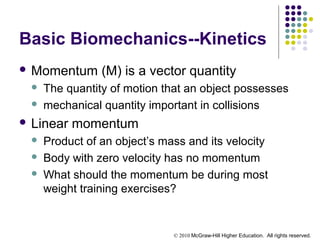
 Momentum (M) is a vector quantity
 The quantity of motion that an object possesses
 mechanical quantity important in collisions
 Linear momentum
 Product of an object’s mass and its velocity
 Body with zero velocity has no momentum
 What should the momentum be during most
weight training exercises?
© 2010 McGraw-Hill Higher Education. All rights reserved.
Basic Biomechanics--Kinetics
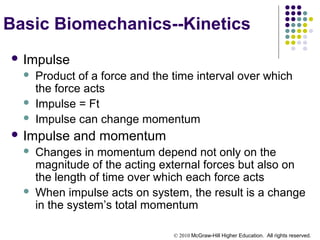
 Impulse
 Product of a force and the time interval over which
the force acts
 Impulse = Ft
 Impulse can change momentum
 Impulse and momentum
 Changes in momentum depend not only on the
magnitude of the acting external forces but also on
the length of time over which each force acts
 When impulse acts on system, the result is a change
in the system’s total momentum
© 2010 McGraw-Hill Higher Education. All rights reserved.
Basic Biomechanics--Kinetics
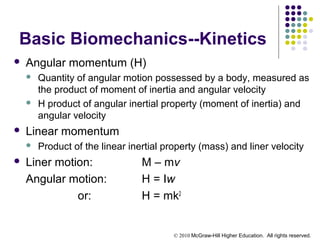
 Angular momentum (H)
 Quantity of angular motion possessed by a body, measured as
the product of moment of inertia and angular velocity
 H product of angular inertial property (moment of inertia) and
angular velocity
 Linear momentum
 Product of the linear inertial property (mass) and liner velocity
 Liner motion: M – mv
Angular motion: H = Iw
or: H = mk2
© 2010 McGraw-Hill Higher Education. All rights reserved.
Basic Biomechanics--Kinetics
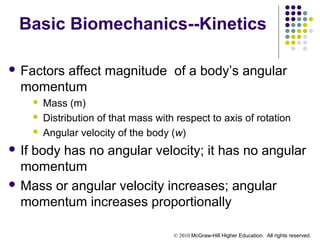
 Factors affect magnitude of a body’s angular
momentum
 Mass (m)
 Distribution of that mass with respect to axis of rotation
 Angular velocity of the body (w)
 If body has no angular velocity; it has no angular
momentum
 Mass or angular velocity increases; angular
momentum increases proportionally
© 2010 McGraw-Hill Higher Education. All rights reserved.
Basic Biomechanics--Kinetics
 Factor that most dramatically influences angular
momentum
 Distribution of mass with respect to the axis of rotation
 Why?
 Angular momentum is proportional to the momentum
result from multiplying units of mass, units of length
squared, and units of angular velocity
 Kg ·m2
/s
© 2010 McGraw-Hill Higher Education. All rights reserved.
Basic Biomechanics--Kinetics
 Angular impulse
 Change in angular momentum equal to the
product of torque and time interval over which the
torque acts
 Angular impulse generates a change in angular
momentum
© 2010 McGraw-Hill Higher Education. All rights reserved.
Basic Biomechanics--Fluid Mechanics
 Fluid (interchangeably with liquid)
 Is any substance that tends to flow or continuously
deform when acted on by a shear force
 Both gases & liquids are fluids
 Archimedes Principle
 The magnitude of the buoyant force is equal to the
weight of the fluid displaced by the body
 If magnitude of weight is greater than buoyant force,
the body sinks, moving downward in the direction of
the net force
© 2010 McGraw-Hill Higher Education. All rights reserved.
Basic Biomechanics--Fluid Mechanics
 Buoyancy is studied in relation to floatation of
human body in water
 Difference in floatability is function of body
density
 Density of bone and muscle is greater than the
density of fat
 What changes with floatation when a person
holds inspired air in the lungs?
© 2010 McGraw-Hill Higher Education. All rights reserved.
Basic Biomechanics--Fluid
Mechanics
 Orientation of the body as it floats in
water is determined by the relative
position of the totally body center of
gravity relative to the total body center of
volume
 What is center of gravity?
© 2010 McGraw-Hill Higher Education. All rights reserved.
Basic Biomechanics--Fluid
Mechanics
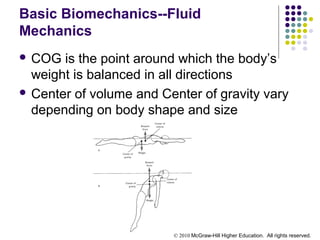
 COG is the point around which the body’s
weight is balanced in all directions
 Center of volume and Center of gravity vary
depending on body shape and size
© 2010 McGraw-Hill Higher Education. All rights reserved.
Basic Biomechanics--Fluid
Mechanics
 Drag
 Generally, a resistance force:
 A force that slows the motion of a body moving
through a fluid
 Theoretical square law
 The magnitude of the drag force increases approx
with the square of velocity
 Effect seen with high velocity sports: cycling, speed
skating, downhill skiing, bobsled, luge
 3 types of drag
 Skin friction/surface drag
 Form drag/profile drag
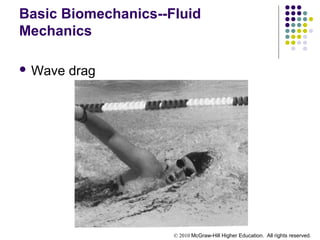
 Wave drag
© 2010 McGraw-Hill Higher Education. All rights reserved.
Basic Biomechanics--Fluid
Mechanics
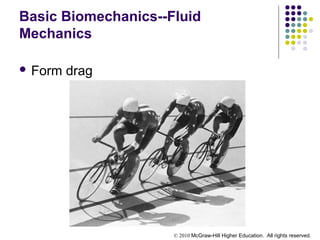
 Form drag
© 2010 McGraw-Hill Higher Education. All rights reserved.
Basic Biomechanics--Fluid
Mechanics
 Wave drag
© 2010 McGraw-Hill Higher Education. All rights reserved.
Basic Biomechanics--Fluid
Mechanics
 Force that acts perpendicular to fluid flow is
lift
 Lift can assume any direction (not just
vertically upward)
 Determined by direction of fluid flow and
orientation of body
 Can be generated by foil
 Shape capable of generating lift in the presence of a
fluid flow
 Human hand during swimming
© 2010 McGraw-Hill Higher Education. All rights reserved.
Basic Biomechanics
 The study of biomechanics covers
many other topics that help us to
better understand human
movement in relation to forces
acting on the body, joint
movements and forms of motion
© 2010 McGraw-Hill Higher Education. All rights reserved.
Professional Organizations
 Advantageous for students to consider
student memberships with professional
organizations in their chosen field of sport
science study
 Biomechanics has many supported journals
 Memberships include discounts: journal
subscriptions, conference fees and
opportunities for students to interact with
professionals
© 2010 McGraw-Hill Higher Education. All rights reserved.
Professional Organizations
 American Society of Biomechanics
 Canadian Society of Biomechanics
 European Society of Biomechanics
 International Society of Biomechanics
 International Society of Biomechanics in Sport
 Mulit-disciplinary organizations
 American College of Sports Medicine
 American Alliance for Health, Physical Education,
Recreation and Dance
© 2010 McGraw-Hill Higher Education. All rights reserved.
Careers
 What are some potential career opportunities
in biomechanics?

FW275 Biomechanics

  • 1.
    © 2010 McGraw-HillHigher Education. All rights reserved. Chapter 6 Biomechanics
  • 2.
    © 2010 McGraw-HillHigher Education. All rights reserved. Exploring Biomechanics  Biomechanics: bio means “life”  Study of the actions of forces  Term first used 1970’s  Includes both internal forces produced by muscles and external forces that act on the body  Biomechanics human movement is one sub discipline of exercise science
  • 3.
    © 2010 McGraw-HillHigher Education. All rights reserved. Exploring Biomechanics  Biomechanics  Academic backgrounds: zoology, medicine, engineering, physical therapy  Common interest in biomechanical aspects of the structure and function of living things  Undergraduate course  Usually requires prerequisite courses  Focusing on forces acting on the human body  Biomechanics commonly a quantitative field of study  Strong math, computer applications and problem solving
  • 4.
    © 2010 McGraw-HillHigher Education. All rights reserved. History of Biomechanics  Aristotle (384-322 B.C.)  Archimedes (287-212 B.C.)  Galen (131-201 A.D.)  Leonardo da Vinci (1452-1519)  Galileo (1564-1642)  Giovanni Alfonso Borelli (1608-1679)  Isaac Newton (1643-1727)  Eadweard Muybridge (1831-1904)  Julius Wolff (1836-1902)  Christian Wilhelm Braune (1831-1892) & Otto Fischer (1861-1971)
  • 5.
    © 2010 McGraw-HillHigher Education. All rights reserved. Basic Biomechanics--Kinematics  Kinematics  The form, pattern, or sequencing of movement with respect to time  Qualitative  Involving nonnumeric description of quality  Quantitative  Involving the use of numbers  Kinematic analysis often requires the use of both visual description and quantitative measurement
  • 6.
    © 2010 McGraw-HillHigher Education. All rights reserved. Basic Biomechanics--Kinematics  Kinematic quantities: distance, displacement, speed, velocity, acceleration  Vector quantities have both size and direction  Displacement, velocity, acceleration
  • 7.
    © 2010 McGraw-HillHigher Education. All rights reserved. Basic Biomechanics--Kinematics  Linear displacement  Change in linear position
  • 8.
    © 2010 McGraw-HillHigher Education. All rights reserved. Basic Biomechanics--Kinematics  Angular displacement  Change in the angular position or orientation of a line segment
  • 9.
    © 2010 McGraw-HillHigher Education. All rights reserved. Basic Biomechanics--Kinematics  Angular--most human movement requires angular quantities  Rotation around a central line or point  Primarily rotational motion occurs at joints  Linear velocity  Rate of change in linear position  Angular velocity  Angular displacement divided by the time interval which displacement occurs
  • 10.
    © 2010 McGraw-HillHigher Education. All rights reserved. Basic Biomechanics--Kinematics  Acceleration  Angular acceleration  Does not take into account particular circumstances or rules when faced with a moral problem  With every moral situation, there is a blank slate and each case must be viewed independently
  • 11.
    © 2010 McGraw-HillHigher Education. All rights reserved. Basic Biomechanics--Kinematics  Biomechanics use quantitative kinematics to research differences between skilled performers and non-athletes. Examples:  Runners stride length & frequency  Swimmer’s stroke rate & length  Track events velocity of takeoff  High jumpers vertical displacement  Basketball angle of projection, angle of release  Throwing events aerodynamics of flight path  Swinging (bat, racquet) timing, project speed and angle
  • 12.
    © 2010 McGraw-HillHigher Education. All rights reserved. Basic Biomechanics--Kinematics  Skilled performers move body segments at high rate of angular velocity  Most biomechanical studies of human kinematics involve non-athletes:  Infant through maternity developmental stages  Adapted P.E. kinematic patterns with motor disorders  Therapeutic uses to aid in recovery of injuries/surgeries
  • 13.
    © 2010 McGraw-HillHigher Education. All rights reserved. Basic Biomechanics--Kinematics  Quantitative kinematic analyses often use:  High-speed cinematography  videography  Reflective markers  Digitizing
  • 14.
    © 2010 McGraw-HillHigher Education. All rights reserved.  Kinetics  Study of the action of forces  Force  The product of mass and acceleration  Push or pull acting on a body  Vector quantity: magnitude, direction & point of application to a body  Free body diagram  First step used when analyzing actions  Body, body segment or object of interest Basic Biomechanics--Kinetics
  • 15.
    © 2010 McGraw-HillHigher Education. All rights reserved. Basic Biomechanics--Kinetics
  • 16.
    © 2010 McGraw-HillHigher Education. All rights reserved. Basic Biomechanics--Kinetics Force rarely acts in isolation  Net force  Overall effect of many forces acting on a body  Vector sum of all the acting forces  Net force zero = acting forces balanced in magnitude and direction  Net force present = body moves in the direction of the net force with acceleration
  • 17.
    © 2010 McGraw-HillHigher Education. All rights reserved. Basic Biomechanics--Kinetics  Torque  The rotary effect of a force  Torque quantified  The product of force (F) and the perpendicular distance (d┴) from the force’s line of action to the axis of rotation  T = F d┴  The greater the force, the greater the tendency for rotation
  • 18.
    © 2010 McGraw-HillHigher Education. All rights reserved. Basic Biomechanics--Kinetics  Inertia--Sir Isaac Newton  Tendency of a body to resist a change in its state of motion  Resistance to acceleration  Inertia has no units of measurement  Amount of inertia a body possesses is directly proportional to its mass  More massive an object is, the more it tends to maintain its current state of motion
  • 19.
    © 2010 McGraw-HillHigher Education. All rights reserved. Basic Biomechanics--Kinetics  1st law of inertia  A Body will maintain a state of rest or constant velocity unless acted on by an external force that changes the state  A motionless object will remain motionless unless there is a net force acting on it
  • 20.
    © 2010 McGraw-HillHigher Education. All rights reserved. Basic Biomechanics--Kinetics  Inertia is influenced by mass (m) and distribution of mass in the body  Mass distribution is characterized by the radius of gyration (k)
  • 21.
    © 2010 McGraw-HillHigher Education. All rights reserved. Basic Biomechanics--Kinetics  Newton’s 2nd law--law of acceleration  A force applied to a body causes an acceleration of that body of a magnitude proportional to the force, in the direction of the force, and inversely proportional to the body’s mass  The greater the amount of force applied, the greater the speed  F=ma  Angular motion, the law becomes:  When a torque acts on a body, the resulting angular acceleration is in the direction of the torque and of a magnitude inversely proportional to its moment of inertia
  • 22.
    © 2010 McGraw-HillHigher Education. All rights reserved. Basic Biomechanics--Kinetics  Newton’s 3rd law--law of reaction  For every action, there is an equal and opposite reaction  In terms of forces:  When one body exerts a force on a second, the second body exerts a reaction force that is equal in magnitude and opposite in direction on the first body
  • 23.
    © 2010 McGraw-HillHigher Education. All rights reserved. Basic Biomechanics--Kinetics  Ground reaction forces  Are measured during gait, each contact the foot makes with floor is analyzed  Walking, running patterns throughout development stages using force platforms  Magnitude of the vertical component of the GRF during running is generally two to three times the runner’s body weight  Runner’s are classified as rearfoot, midfoot, or forefoot strikers
  • 24.
    © 2010 McGraw-HillHigher Education. All rights reserved. Basic Biomechanics--Kinetics
  • 25.
    © 2010 McGraw-HillHigher Education. All rights reserved. Basic Biomechanics--Kinetics  GRF is an external force acting on the human body  Magnitude and direction have implications for performance in many sporting events  High jumper’s  Baseball pitching  Golf
  • 26.
    © 2010 McGraw-HillHigher Education. All rights reserved. Basic Biomechanics--Kinetics  Friction is a force that acts at the interface of surfaces in contact in the direction opposite the direction of motion or impending motion  Units of force (N)  The size of the friction force is the product of the coefficient of friction (µ) and the normal (perpendicular) reaction force (R).
  • 27.
    © 2010 McGraw-HillHigher Education. All rights reserved. Basic Biomechanics--Kinetics  Factors influencing the value of friction µ  Relative roughness and hardness of the surfaces  Type of molecular interaction between surfaces  Greater the molecular interaction, the greater is the value of µ
  • 28.
    © 2010 McGraw-HillHigher Education. All rights reserved. Basic Biomechanics--Kinetics  Normal reaction force (R)  Sum of all acting vertical forces (usually body’s weight)  Altered magnitude R  Increased or decreased  When friction is altered, how does this change motion?
  • 29.
    © 2010 McGraw-HillHigher Education. All rights reserved. Basic Biomechanics--Kinetics  Altering the coefficient between two surfaces can change friction  Use of gloves, thin wax…  Important daily influence to prevent slippage
  • 30.
    © 2010 McGraw-HillHigher Education. All rights reserved. Basic Biomechanics--Kinetics  Momentum (M) is a vector quantity  The quantity of motion that an object possesses  mechanical quantity important in collisions  Linear momentum  Product of an object’s mass and its velocity  Body with zero velocity has no momentum  What should the momentum be during most weight training exercises?
  • 31.
    © 2010 McGraw-HillHigher Education. All rights reserved. Basic Biomechanics--Kinetics  Impulse  Product of a force and the time interval over which the force acts  Impulse = Ft  Impulse can change momentum  Impulse and momentum  Changes in momentum depend not only on the magnitude of the acting external forces but also on the length of time over which each force acts  When impulse acts on system, the result is a change in the system’s total momentum
  • 32.
    © 2010 McGraw-HillHigher Education. All rights reserved. Basic Biomechanics--Kinetics  Angular momentum (H)  Quantity of angular motion possessed by a body, measured as the product of moment of inertia and angular velocity  H product of angular inertial property (moment of inertia) and angular velocity  Linear momentum  Product of the linear inertial property (mass) and liner velocity  Liner motion: M – mv Angular motion: H = Iw or: H = mk2
  • 33.
    © 2010 McGraw-HillHigher Education. All rights reserved. Basic Biomechanics--Kinetics  Factors affect magnitude of a body’s angular momentum  Mass (m)  Distribution of that mass with respect to axis of rotation  Angular velocity of the body (w)  If body has no angular velocity; it has no angular momentum  Mass or angular velocity increases; angular momentum increases proportionally
  • 34.
    © 2010 McGraw-HillHigher Education. All rights reserved. Basic Biomechanics--Kinetics  Factor that most dramatically influences angular momentum  Distribution of mass with respect to the axis of rotation  Why?  Angular momentum is proportional to the momentum result from multiplying units of mass, units of length squared, and units of angular velocity  Kg ·m2 /s
  • 35.
    © 2010 McGraw-HillHigher Education. All rights reserved. Basic Biomechanics--Kinetics  Angular impulse  Change in angular momentum equal to the product of torque and time interval over which the torque acts  Angular impulse generates a change in angular momentum
  • 36.
    © 2010 McGraw-HillHigher Education. All rights reserved. Basic Biomechanics--Fluid Mechanics  Fluid (interchangeably with liquid)  Is any substance that tends to flow or continuously deform when acted on by a shear force  Both gases & liquids are fluids  Archimedes Principle  The magnitude of the buoyant force is equal to the weight of the fluid displaced by the body  If magnitude of weight is greater than buoyant force, the body sinks, moving downward in the direction of the net force
  • 37.
    © 2010 McGraw-HillHigher Education. All rights reserved. Basic Biomechanics--Fluid Mechanics  Buoyancy is studied in relation to floatation of human body in water  Difference in floatability is function of body density  Density of bone and muscle is greater than the density of fat  What changes with floatation when a person holds inspired air in the lungs?
  • 38.
    © 2010 McGraw-HillHigher Education. All rights reserved. Basic Biomechanics--Fluid Mechanics  Orientation of the body as it floats in water is determined by the relative position of the totally body center of gravity relative to the total body center of volume  What is center of gravity?
  • 39.
    © 2010 McGraw-HillHigher Education. All rights reserved. Basic Biomechanics--Fluid Mechanics  COG is the point around which the body’s weight is balanced in all directions  Center of volume and Center of gravity vary depending on body shape and size
  • 40.
    © 2010 McGraw-HillHigher Education. All rights reserved. Basic Biomechanics--Fluid Mechanics  Drag  Generally, a resistance force:  A force that slows the motion of a body moving through a fluid  Theoretical square law  The magnitude of the drag force increases approx with the square of velocity  Effect seen with high velocity sports: cycling, speed skating, downhill skiing, bobsled, luge  3 types of drag  Skin friction/surface drag  Form drag/profile drag  Wave drag
  • 41.
    © 2010 McGraw-HillHigher Education. All rights reserved. Basic Biomechanics--Fluid Mechanics  Form drag
  • 42.
    © 2010 McGraw-HillHigher Education. All rights reserved. Basic Biomechanics--Fluid Mechanics  Wave drag
  • 43.
    © 2010 McGraw-HillHigher Education. All rights reserved. Basic Biomechanics--Fluid Mechanics  Force that acts perpendicular to fluid flow is lift  Lift can assume any direction (not just vertically upward)  Determined by direction of fluid flow and orientation of body  Can be generated by foil  Shape capable of generating lift in the presence of a fluid flow  Human hand during swimming
  • 44.
    © 2010 McGraw-HillHigher Education. All rights reserved. Basic Biomechanics  The study of biomechanics covers many other topics that help us to better understand human movement in relation to forces acting on the body, joint movements and forms of motion
  • 45.
    © 2010 McGraw-HillHigher Education. All rights reserved. Professional Organizations  Advantageous for students to consider student memberships with professional organizations in their chosen field of sport science study  Biomechanics has many supported journals  Memberships include discounts: journal subscriptions, conference fees and opportunities for students to interact with professionals
  • 46.
    © 2010 McGraw-HillHigher Education. All rights reserved. Professional Organizations  American Society of Biomechanics  Canadian Society of Biomechanics  European Society of Biomechanics  International Society of Biomechanics  International Society of Biomechanics in Sport  Mulit-disciplinary organizations  American College of Sports Medicine  American Alliance for Health, Physical Education, Recreation and Dance
  • 47.
    © 2010 McGraw-HillHigher Education. All rights reserved. Careers  What are some potential career opportunities in biomechanics?