CONTENTS:
Basics of Biomechanics
 Principles of
Biomechanics
Statics and dynamics
Kinematics
Kinetics
BIOMECHANICS:
 Is the study of structure and function of
mechanical aspect of Biological systems, at any
level from whole organisms to organs, cells,
using methods of mechanics.
 Is the science of movement of living body
including how Muscles, Bones, Tendons, and
ligaments work together to produce movement.
 Is the part of larger field of kinesiology, that is
the study of movements in human body
PRINCIPLES OF BIOMECHANICS:
 1. STABILITY:
The lower the center of mass, the
larger the base of support, the
closer the center of mass to the
base of support, the greater the
mass, the more is the stability .
 For e.g., Sumo squat position- the
legs are wider apart from each
other, which provides larger base
of support and hence, increases the
stability
2. MAXIMUM EFFORT: The
production of maximum force
requires the use of all possible joint
movements that contribute to task’s
objective. For e.g., While playing
Golf- One requires maximum effort
to hit the ball, so as to reach the goal.
 3. MAXIMUM VELOCITY: The
production of maximum velocity requires the
use of joints in order from largest to smallest.
For e.g., while hitting a Golf ball- One
requires the use of all possible joints from
largest to smallest [i.e. Shoulder to fingers] to
provide maximum velocity to ball to reach the
goal.
 4. LINEAR MOTION: The greater the
applied impulse, the greater the increase in
velocity. For e.g., slam-dunking a basketball-
the impulse here is provided by hand to
increase the velocity of ball to goal.
6. PRODUCTION OF ANGULAR
MOTION: Angular motion is produced
by application of a force acting at some
distance from an axis, that is, by torque.
For e.g., basketball players- the
pitchers while lifting the ball to make
goal, Firstly lifts the ball by holding it
over the head and then gradually while
pushing the ball in net, a slight torque is
produced [i.e. a turning effect of force]
which further produces an angular
motion
 7. CONSERVATION OF ANGULAR
MOMENTUM: Angular momentum is constant
when: an athlete or object is free in the space.
For e.g., while Diving- Divers tends to maintain
the constant angular momentum by Rotating the
whole body throughout the motion for safety.
BIOMECHANICAL STUDY
STATIC:
Involves all forces acting on body
being in balance, resulting in the
body being in equilibrium. Study of
conditions under which object
remains at rest.
 For e.g.:- study of forces acting on
man while standing, sitting, lying
and kneeling.
DYNAMICS: Involves the study
of systems in motion while
unbalanced due to unequal
forces acting on the body during
walking, running, jumping,
throwing, lifting etc. This
Includes kinetics and kinematics
1. A branch of biomechanics that describes
or study the motion of a body irrespective
of forces that produce the motion is
known as kinematics.
2. It involves the time, space, and mass
aspects of a moving system.
3. It also include the description of motion.
4. Osteokinematics. and
5. Arthrokinematics.
KINEMATICS •
KINEMATICS
 Kinematics includes set of concepts to show
us the change in position over time that is
displacement.
 There are 5 kinematic variables:
1. Type of displacement (motion)
2. The location of displacement in space
3. Direction of displacement of segment.
4. Magnitude of displacement
5. Rate of change in displacement (velocity) or
rate of change of velocity (Acceleration)
KINETICS
KINETICS:
 It is a branch of biomechanics which
studies the effects of all forces acting on a
body.
 FORCE: Is a push or pull exerted by one
object on another.
 It is define as product of mass and
acceleration.
 F = m × a
 Unit: N ( Newton)
TYPES OF FORCE ACTING ON BODY
 INTERNAL FORCES …
 EXTERNAL FORCES …
INTERNAL FORCEES:-
Internal forces are forces that act
on structure of body arising from
the body itself. The contact of two
structures of body produces force
E.g. Muscles, Ligaments, Bones.
 Internal forces are most readily
recognized as essential for
initiation of movement.
EXTERNAL FORCES
External forces are push or pull on
the body arising from sources
outside the body.
External force can either facilitate
or restrict movement
Examples of external forces acts on human
body are…………..
Gravity
 CENTRE OF GRAVITY:
Hypothetical point at
which all mass of
object or segment
appears to be
concentrated.
 Its lies
approximately
anterior to second
Sacral
FORCE OF GRAVITY: Gravity acts
on each unit mass that composes
an object, acting always vertically
downward and the force created
by gravity on body is defined as
Force of Gravity.
Force of gravity acting on object
have it’s point of application at
center of gravity
Inertial and gravitational forces
 In the optimal erect standing posture,
little or no accelerations of body occurs,
except that the body undergoes a
constant swaying motion called postural
sway or sway envelope
 The extent of the sway envelope for a
normal individual standing with about 4
inches between the feet can be as large as
12 degree in the sagittal plane and 16
degree in the frontal plane.
Ground reaction force
 Whenever the body contacts the ground,
the ground pushes back on the body.
This force is known as the ground
reaction force(GRF).
 The GRF is equal in magnitude but
opposite in the direction of the
gravitational force in the erect static
standing posture.
 The point of application of the GRF is at
the body’s center of pressure(CoP),
Force system
 ASPECTS OF FORCE: Are
 Magnitude.
 Point of application.
 Direction of force.
Types of force system.
1) Liner force system.
2) Concurrent force system.
3) Parallel force system.
LINEAR FORCE SYSTEM
 Linear force
exists whenever
two or more
forces act on
same segment, in
same plane and
in same line.
CONCURRENT FORCE SYSTEM:-
 When two or
more vectors
applied to same
object are not
collinear but
converge
(intersect), the
vectors are then
Part of
concurrent
PARALLEL FORCE SYSTEM:-
 FORCE COUPLE: Two forces that are equal in
magnitude, opposite in direction, parallel and
applied to same object at different point.
 Parallel force system exists whenever two or
more forces applied to same object are parallel to
each other.
 Forces in force couple are parallel to each other,
then the two forces are said to be parallel force
system.
 Torque generated by each force is determined by
multiplying magnitude of force by its distance.
RESOLUTION OF FORCE SYSTEM
 The process of splitting up the given force
into a number of components without
changing its net effect on body is called as
resolution of force.
 A force is generally resoled along 2 mutually
perpendicular direction.
 Parallel / Horizontal component: Represented
by F(x)
 Perpendicular / vertical component:
Represented by F(y)
TENSILE FORCES
 Tensile forces are always equal in magnitude, opposite
in direction and applied parallel to long axis of object.
 Are Co- linear, Co-planar and applied to same object
 Tensile vectors are part of same linear force system.
 If there are no two opposite pulls on an object, there
will- Not be any tension on object.
SHEAR AND FRICTION FORCES
a. Shear force is any force that has action line
parallel to contacting surfaces and that creates or
limits movement between surfaces.
b. Friction force exist on an object whenever there
is a contact force on that object., always parallel
to contacting surface with direction opposite.
c. Friction can oppose a movement but it cannot
create a movement.
A) Static friction: When objects are not moving
and magnitude can change with shear force.
B) Kinetic friction: When the objects are moving
and magnitude remains same.
Laws of newton
NEWTON‘S LAW OF MOTION
 FIRST LAW (LAW OF INERTIA) says that an
object will remain at rest or in uniform
motion in a straight line unless acted upon
by a an external force. It may be seen as a
statement about inertia, that objects will
remain in there state of motion unless a force
acts to change the motion.
INERTIA APPLIED TO BIOMECHANICS
 Consider the late swing phase of gait and the
forces going forward with lower extremity.
Just prior to heel strike there are almost no
muscle activated that bring extremity
forward, yet it is still proceeding to travel
forward in space. This is inertia.
 To deal with this inertia the body develops an
eccentric contraction of hamstrings to slow
down extremity to prepare for heel strike and
to reduce harsh reactionary forces.
SECOND LAW ( LAW OF ACCELERATION)
 The second law states that the
acceleration of an object is dependent
upon two variables – the net force
acting upon the object and the mass of
the object.
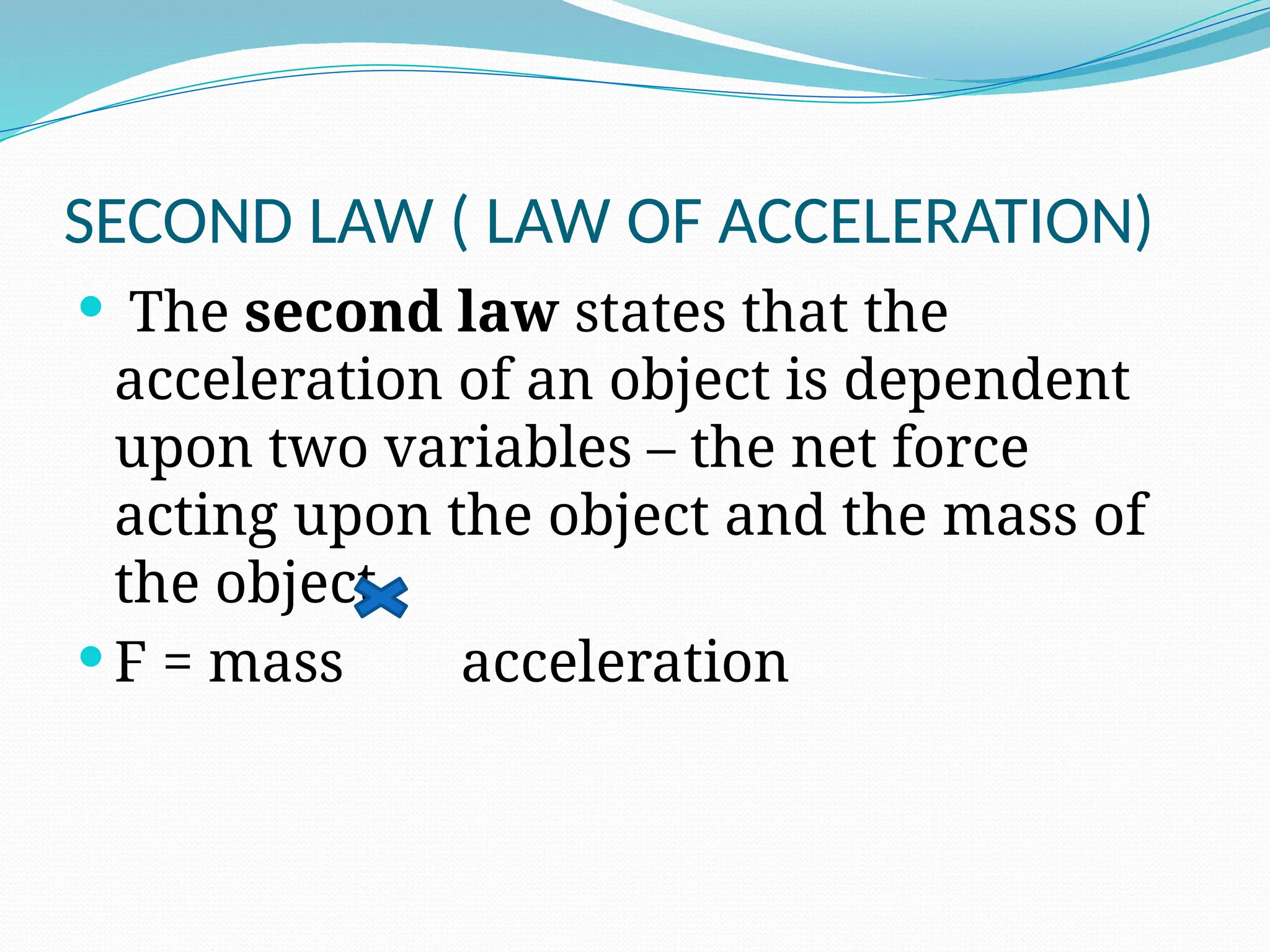
 F = mass acceleration
SECOND LAW TO BIOMECHANICS
 With any human movement, F= ma can
be used to create a simplified calculation
of force. This equation can be used with
static position.
 Consider the static forward head posture
 Gravity and mass of head imposes an
anteroinferior force. To counter this force
and prevent your neck from snapping off
at your desk, you have to constantly
contract your levator scapulae, upper
THIRD LAW (LAW OF REACTION)
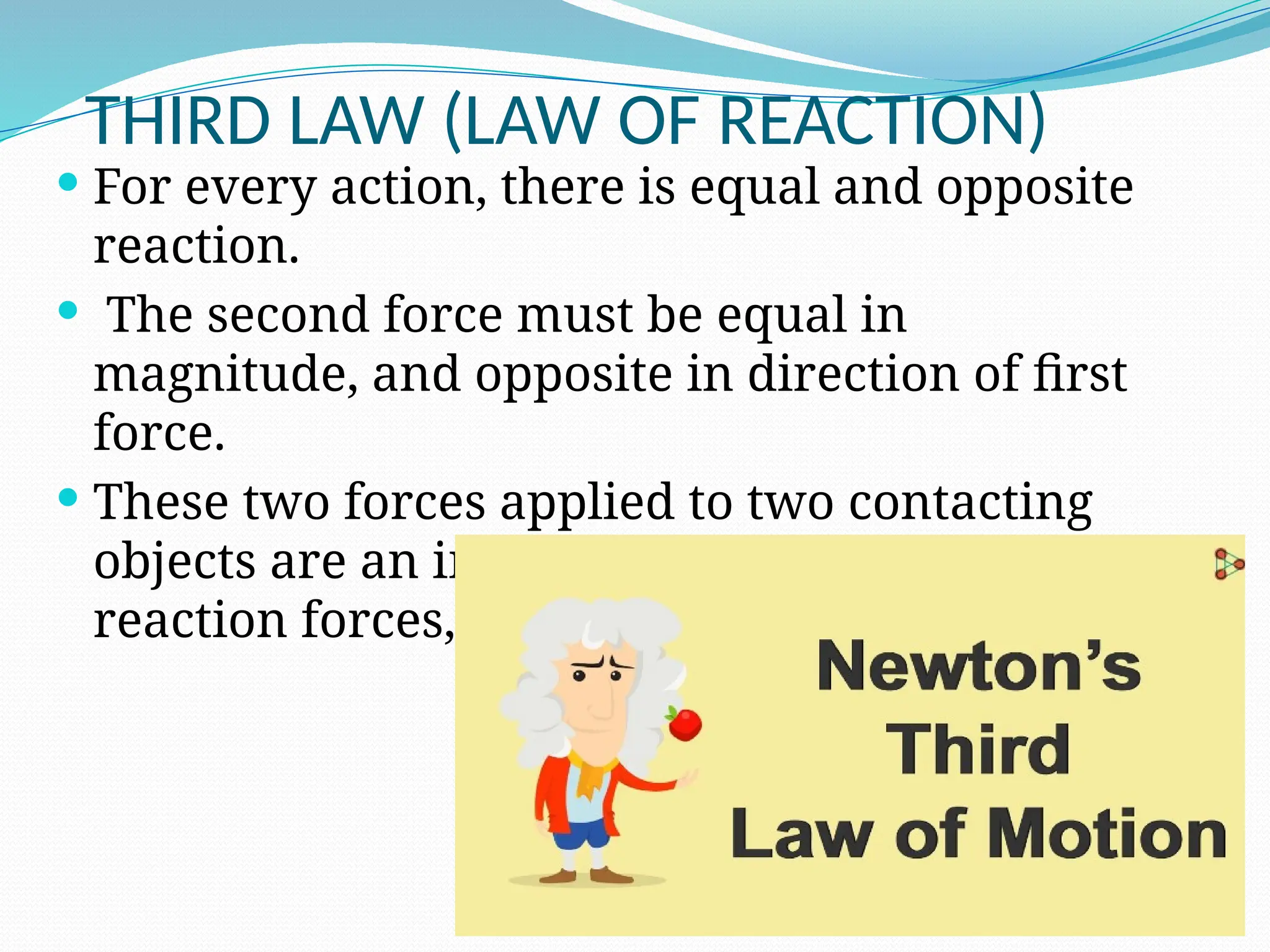
 For every action, there is equal and opposite
reaction.
 The second force must be equal in
magnitude, and opposite in direction of first
force.
 These two forces applied to two contacting
objects are an interaction pair, Action
reaction forces, reaction forces.
THIRD LAW APPLIED TO BIOMECHANICS
 Suppose putting ankle wait on patient ‘s
leg will create an increase in force of
mass and downward pull with gravity,
the reaction is that opposing muscle
will have to create force to overcome
this mass.
 Again, Ground reaction
forces ,Running on soft ground will
result in much less impact forces than
running on hard concrete
ANATOMICAL PULLEY
In the human body when the tendon
of the skeletal muscles slide over a
round bony surface, the “system”
acts like a simple pulley. A simple
pulley provides a change in the
direction of the force or muscles pull.
There is no change in the amount of
force produce by the muscles.
 For example:- the knee act as a simple pulley
by which the quadriceps femoris muscles
extends the leg.
LEVER :
 A lever is a rigid bar which is capable of producing movement
about a fixed point called fulcrum.
 Work done when force or effort (E), is applied at one point on
the lever, acts upon another force or weight(W), acting at a
second point on the lever.
 The perpendicular distance from the fulcrum to the effort(E)
may be called the Effort Arm and that from the fulcrum to the
weight(W) as the Weight Arm.
 In the body a lever is represented by a Bone, which is capable
of producing movement about a fulcrum formed at the
articulating surfaces of a joint; the effort which works the
lever is supplied by the force of muscular contraction, applied
at the point of insertion to the bone, while the weight may be
either at center of gravity of the part moved, or of the object
lifted.
Types of lever:-
First class lever
Second class lever
Third class lever
FIRST CLASS LEVERS
 The fulcrum is between the effort and the
weight; may be situated centrally, or towards
either or the weight, consequently the effort’s
and the weight’s arms may be equal, or one may
exceed the other in length.
 They are rare in body.
 One example is joint between the head and the
first vertebra. The weight(resistance) is the head,
the pivot is the joint, and the muscular
action(force) come from any of the posterior
muscles
SECOND CLASS LEVER
 The weight is in between the fulcrum and the
effort, and the effort’s arm must therefore always
exceed the weight’s arm.
 In human body, an example of second class lever
in the lower limb is demonstrated when the heels
raised to stand on the toes.
 The tarsal and metatarsal homes are stabilized by
muscular action to form the lever, the fulcrum is
at the metatarsophalangeal joint, and the weight
of the body is transmitted through the ankle joint
to the talus.
THIRD CLASS LEVER
 The effort is in between the fulcrum and the
weight, and the weight’s arm must therefore
exceed the effort’s arm.
 The example of third class lever in human body
is when the lever is the forearm, the fulcrum is
the elbow joint, and when the effort is supplied
by the contraction of the Biceps Muscle applied
at its insertion, and the weight is some object
held in hand.
Mechanical advantages of lever
 Mechanical advantage(M Ad) is a measure of the
mechanical efficiency of the lever system.
 It is a relationship between the torque of external
force and the torque of a muscular force
 Also M Ad = EA/RA (EA= effort arm;
RA= resistance
arm)
 When the effort arm is larger than the
resistance arm, the mechanical advantage will
be greater than the one, hence the magnitude of
the effort force working through a larger
moment arm can be smaller than the
magnitude of the resistance force, yet still
create greater torque “win”.
Mechanical advantage and classes
of lever
 In first class lever, the mechanical advantage
can be greater than, less than, or equal to one.
 In second class lever, the mechanical
advantage will always be greater than one. The
magnitude of the effort force can be less than
the magnitude of resistance.
 In third class lever, the mechanical advantage
will always be less than one. The magnitude of
the effort force can be greater than the
magnitude of resistance.
References:-
 Joint structure and function (5th
edition) by
norkin and levangie.
 WWW.google.com
Thank you
Made by – Jayant Pande (1805)
Pragati Belekar(1807)

kinetics biomechanics occupational therapy.pptx

  • 2.
    CONTENTS: Basics of Biomechanics Principles of Biomechanics Statics and dynamics Kinematics Kinetics
  • 3.
    BIOMECHANICS:  Is thestudy of structure and function of mechanical aspect of Biological systems, at any level from whole organisms to organs, cells, using methods of mechanics.  Is the science of movement of living body including how Muscles, Bones, Tendons, and ligaments work together to produce movement.  Is the part of larger field of kinesiology, that is the study of movements in human body
  • 4.
  • 5.
    The lower thecenter of mass, the larger the base of support, the closer the center of mass to the base of support, the greater the mass, the more is the stability .  For e.g., Sumo squat position- the legs are wider apart from each other, which provides larger base of support and hence, increases the stability
  • 6.
    2. MAXIMUM EFFORT:The production of maximum force requires the use of all possible joint movements that contribute to task’s objective. For e.g., While playing Golf- One requires maximum effort to hit the ball, so as to reach the goal.
  • 7.
     3. MAXIMUMVELOCITY: The production of maximum velocity requires the use of joints in order from largest to smallest. For e.g., while hitting a Golf ball- One requires the use of all possible joints from largest to smallest [i.e. Shoulder to fingers] to provide maximum velocity to ball to reach the goal.
  • 8.
     4. LINEARMOTION: The greater the applied impulse, the greater the increase in velocity. For e.g., slam-dunking a basketball- the impulse here is provided by hand to increase the velocity of ball to goal.
  • 9.
    6. PRODUCTION OFANGULAR MOTION: Angular motion is produced by application of a force acting at some distance from an axis, that is, by torque. For e.g., basketball players- the pitchers while lifting the ball to make goal, Firstly lifts the ball by holding it over the head and then gradually while pushing the ball in net, a slight torque is produced [i.e. a turning effect of force] which further produces an angular motion
  • 10.
     7. CONSERVATIONOF ANGULAR MOMENTUM: Angular momentum is constant when: an athlete or object is free in the space. For e.g., while Diving- Divers tends to maintain the constant angular momentum by Rotating the whole body throughout the motion for safety.
  • 11.
    BIOMECHANICAL STUDY STATIC: Involves allforces acting on body being in balance, resulting in the body being in equilibrium. Study of conditions under which object remains at rest.  For e.g.:- study of forces acting on man while standing, sitting, lying and kneeling.
  • 12.
    DYNAMICS: Involves thestudy of systems in motion while unbalanced due to unequal forces acting on the body during walking, running, jumping, throwing, lifting etc. This Includes kinetics and kinematics
  • 13.
    1. A branchof biomechanics that describes or study the motion of a body irrespective of forces that produce the motion is known as kinematics. 2. It involves the time, space, and mass aspects of a moving system. 3. It also include the description of motion. 4. Osteokinematics. and 5. Arthrokinematics. KINEMATICS •
  • 14.
    KINEMATICS  Kinematics includesset of concepts to show us the change in position over time that is displacement.  There are 5 kinematic variables: 1. Type of displacement (motion) 2. The location of displacement in space 3. Direction of displacement of segment. 4. Magnitude of displacement 5. Rate of change in displacement (velocity) or rate of change of velocity (Acceleration)
  • 15.
  • 16.
    KINETICS:  It isa branch of biomechanics which studies the effects of all forces acting on a body.  FORCE: Is a push or pull exerted by one object on another.  It is define as product of mass and acceleration.  F = m × a  Unit: N ( Newton)
  • 17.
    TYPES OF FORCEACTING ON BODY  INTERNAL FORCES …  EXTERNAL FORCES …
  • 18.
    INTERNAL FORCEES:- Internal forcesare forces that act on structure of body arising from the body itself. The contact of two structures of body produces force E.g. Muscles, Ligaments, Bones.  Internal forces are most readily recognized as essential for initiation of movement.
  • 19.
    EXTERNAL FORCES External forcesare push or pull on the body arising from sources outside the body. External force can either facilitate or restrict movement
  • 20.
    Examples of externalforces acts on human body are…………..
  • 21.
    Gravity  CENTRE OFGRAVITY: Hypothetical point at which all mass of object or segment appears to be concentrated.  Its lies approximately anterior to second Sacral
  • 22.
    FORCE OF GRAVITY:Gravity acts on each unit mass that composes an object, acting always vertically downward and the force created by gravity on body is defined as Force of Gravity. Force of gravity acting on object have it’s point of application at center of gravity
  • 23.
    Inertial and gravitationalforces  In the optimal erect standing posture, little or no accelerations of body occurs, except that the body undergoes a constant swaying motion called postural sway or sway envelope  The extent of the sway envelope for a normal individual standing with about 4 inches between the feet can be as large as 12 degree in the sagittal plane and 16 degree in the frontal plane.
  • 24.
    Ground reaction force Whenever the body contacts the ground, the ground pushes back on the body. This force is known as the ground reaction force(GRF).  The GRF is equal in magnitude but opposite in the direction of the gravitational force in the erect static standing posture.  The point of application of the GRF is at the body’s center of pressure(CoP),
  • 26.
    Force system  ASPECTSOF FORCE: Are  Magnitude.  Point of application.  Direction of force.
  • 27.
    Types of forcesystem. 1) Liner force system. 2) Concurrent force system. 3) Parallel force system.
  • 28.
    LINEAR FORCE SYSTEM Linear force exists whenever two or more forces act on same segment, in same plane and in same line.
  • 29.
    CONCURRENT FORCE SYSTEM:- When two or more vectors applied to same object are not collinear but converge (intersect), the vectors are then Part of concurrent
  • 30.
    PARALLEL FORCE SYSTEM:- FORCE COUPLE: Two forces that are equal in magnitude, opposite in direction, parallel and applied to same object at different point.  Parallel force system exists whenever two or more forces applied to same object are parallel to each other.  Forces in force couple are parallel to each other, then the two forces are said to be parallel force system.  Torque generated by each force is determined by multiplying magnitude of force by its distance.
  • 31.
    RESOLUTION OF FORCESYSTEM  The process of splitting up the given force into a number of components without changing its net effect on body is called as resolution of force.  A force is generally resoled along 2 mutually perpendicular direction.  Parallel / Horizontal component: Represented by F(x)  Perpendicular / vertical component: Represented by F(y)
  • 32.
    TENSILE FORCES  Tensileforces are always equal in magnitude, opposite in direction and applied parallel to long axis of object.  Are Co- linear, Co-planar and applied to same object  Tensile vectors are part of same linear force system.  If there are no two opposite pulls on an object, there will- Not be any tension on object.
  • 33.
    SHEAR AND FRICTIONFORCES a. Shear force is any force that has action line parallel to contacting surfaces and that creates or limits movement between surfaces. b. Friction force exist on an object whenever there is a contact force on that object., always parallel to contacting surface with direction opposite. c. Friction can oppose a movement but it cannot create a movement. A) Static friction: When objects are not moving and magnitude can change with shear force. B) Kinetic friction: When the objects are moving and magnitude remains same.
  • 34.
  • 35.
    NEWTON‘S LAW OFMOTION  FIRST LAW (LAW OF INERTIA) says that an object will remain at rest or in uniform motion in a straight line unless acted upon by a an external force. It may be seen as a statement about inertia, that objects will remain in there state of motion unless a force acts to change the motion.
  • 36.
    INERTIA APPLIED TOBIOMECHANICS  Consider the late swing phase of gait and the forces going forward with lower extremity. Just prior to heel strike there are almost no muscle activated that bring extremity forward, yet it is still proceeding to travel forward in space. This is inertia.  To deal with this inertia the body develops an eccentric contraction of hamstrings to slow down extremity to prepare for heel strike and to reduce harsh reactionary forces.
  • 37.
    SECOND LAW (LAW OF ACCELERATION)  The second law states that the acceleration of an object is dependent upon two variables – the net force acting upon the object and the mass of the object.  F = mass acceleration
  • 38.
    SECOND LAW TOBIOMECHANICS  With any human movement, F= ma can be used to create a simplified calculation of force. This equation can be used with static position.  Consider the static forward head posture  Gravity and mass of head imposes an anteroinferior force. To counter this force and prevent your neck from snapping off at your desk, you have to constantly contract your levator scapulae, upper
  • 40.
    THIRD LAW (LAWOF REACTION)  For every action, there is equal and opposite reaction.  The second force must be equal in magnitude, and opposite in direction of first force.  These two forces applied to two contacting objects are an interaction pair, Action reaction forces, reaction forces.
  • 41.
    THIRD LAW APPLIEDTO BIOMECHANICS  Suppose putting ankle wait on patient ‘s leg will create an increase in force of mass and downward pull with gravity, the reaction is that opposing muscle will have to create force to overcome this mass.  Again, Ground reaction forces ,Running on soft ground will result in much less impact forces than running on hard concrete
  • 42.
    ANATOMICAL PULLEY In thehuman body when the tendon of the skeletal muscles slide over a round bony surface, the “system” acts like a simple pulley. A simple pulley provides a change in the direction of the force or muscles pull. There is no change in the amount of force produce by the muscles.
  • 43.
     For example:-the knee act as a simple pulley by which the quadriceps femoris muscles extends the leg.
  • 44.
    LEVER :  Alever is a rigid bar which is capable of producing movement about a fixed point called fulcrum.  Work done when force or effort (E), is applied at one point on the lever, acts upon another force or weight(W), acting at a second point on the lever.  The perpendicular distance from the fulcrum to the effort(E) may be called the Effort Arm and that from the fulcrum to the weight(W) as the Weight Arm.  In the body a lever is represented by a Bone, which is capable of producing movement about a fulcrum formed at the articulating surfaces of a joint; the effort which works the lever is supplied by the force of muscular contraction, applied at the point of insertion to the bone, while the weight may be either at center of gravity of the part moved, or of the object lifted.
  • 45.
    Types of lever:- Firstclass lever Second class lever Third class lever
  • 46.
    FIRST CLASS LEVERS The fulcrum is between the effort and the weight; may be situated centrally, or towards either or the weight, consequently the effort’s and the weight’s arms may be equal, or one may exceed the other in length.  They are rare in body.  One example is joint between the head and the first vertebra. The weight(resistance) is the head, the pivot is the joint, and the muscular action(force) come from any of the posterior muscles
  • 48.
    SECOND CLASS LEVER The weight is in between the fulcrum and the effort, and the effort’s arm must therefore always exceed the weight’s arm.  In human body, an example of second class lever in the lower limb is demonstrated when the heels raised to stand on the toes.  The tarsal and metatarsal homes are stabilized by muscular action to form the lever, the fulcrum is at the metatarsophalangeal joint, and the weight of the body is transmitted through the ankle joint to the talus.
  • 50.
    THIRD CLASS LEVER The effort is in between the fulcrum and the weight, and the weight’s arm must therefore exceed the effort’s arm.  The example of third class lever in human body is when the lever is the forearm, the fulcrum is the elbow joint, and when the effort is supplied by the contraction of the Biceps Muscle applied at its insertion, and the weight is some object held in hand.
  • 52.
    Mechanical advantages oflever  Mechanical advantage(M Ad) is a measure of the mechanical efficiency of the lever system.  It is a relationship between the torque of external force and the torque of a muscular force  Also M Ad = EA/RA (EA= effort arm; RA= resistance arm)
  • 53.
     When theeffort arm is larger than the resistance arm, the mechanical advantage will be greater than the one, hence the magnitude of the effort force working through a larger moment arm can be smaller than the magnitude of the resistance force, yet still create greater torque “win”.
  • 54.
    Mechanical advantage andclasses of lever  In first class lever, the mechanical advantage can be greater than, less than, or equal to one.  In second class lever, the mechanical advantage will always be greater than one. The magnitude of the effort force can be less than the magnitude of resistance.  In third class lever, the mechanical advantage will always be less than one. The magnitude of the effort force can be greater than the magnitude of resistance.
  • 55.
    References:-  Joint structureand function (5th edition) by norkin and levangie.  WWW.google.com
  • 56.
    Thank you Made by– Jayant Pande (1805) Pragati Belekar(1807)