Chapter 3: Motivation
3
MotivationMotivation
C H A P T E R
Session Outline
• What is motivation?
• Views of motivation
• Five guidelines for building motivation
• Developing a realistic view of motivation
• Achievement motivation and
competitiveness
(continued)
Session Outline (continued)
• Why are achievement motivation and
competitiveness important?
• Theories of achievement motivation
• Developing achievement motivation and
competitiveness
• Implications for professional practice
What Is Motivation?
• Motivation is the direction and intensity of
effort.
– Direction of effort refers to whether an individual
seeks out, approaches, or is attracted to situations.
– Intensity of effort refers to how much effort an
individual puts forth in a situation.
• Direction and intensity of effort are closely
related.
Views of Motivation
• Participant- or trait-centered view
• Situation-centered view
• Interactional view
Figure 3.1
Five Guidelines for Building
Motivation: Guidelines 1 and 2
• Guideline 1: Both situations and traits
motivate people.
• Guideline 2: People have multiple motives
for involvement. Understand why people
participate in physical activity.
Motives for Involvement
• People participate for more than one
reason.
• People may have competing motives for
involvement.
• People have both shared and unique
motives.
• Motives change over time.
• Motives differ across cultures.
How to Identify Participant Motives
• Observe participants.
• Talk informally to others.
• Ask participants directly.
Major Motives for Sport Participants
• Improving skills
• Having fun
• Being with friends
• Experiencing thrills and excitement
• Achieving success
• Developing fitness
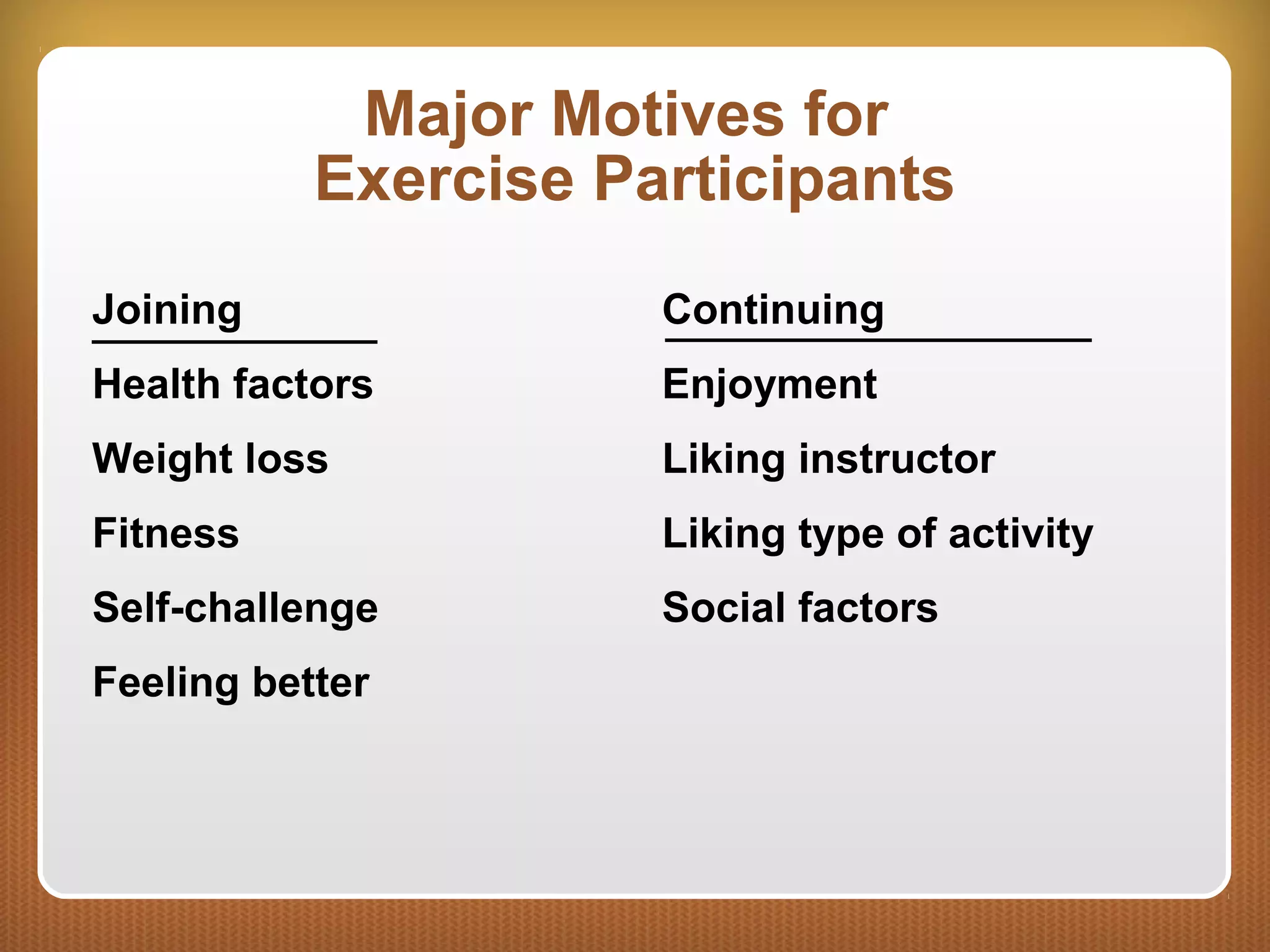
Major Motives for
Exercise Participants
Joining
Health factors
Weight loss
Fitness
Self-challenge
Feeling better
Continuing
Enjoyment
Liking instructor
Liking type of activity
Social factors
Five Guidelines for Building
Motivation: Guideline 3
• Guideline 3: Change the environment to
enhance motivation.
– Provide both competitive and recreational
opportunities.
– Provide for multiple motives and opportunities.
– Adjust to individuals within groups.
Five Guidelines for Building
Motivation: Guidelines 4 and 5
• Guideline 4: Leaders influence motivation
directly and indirectly.
• Guideline 5: Use behavior modification to
change undesirable participant motives.
Developing a Realistic
View of Motivation
• Motivation is a key variable in both learning
and performance contexts.
• Physical and psychological factors beyond
motivation influence behavior and must be
considered.
• Some motivational factors are more easily
influenced than others.
Achievement Motivation
and Competitiveness
• Achievement motivation is a person’s
orientation to strive for task success,
persist in the face of failure, and experience
pride in accomplishments (Gill, 2000).
• Competitiveness is a disposition to strive
for satisfaction when making comparisons
with some standard of excellence in the
presence of evaluative others (Martens,
1986).
Keys to Achievement Motivation
and Competitiveness
• Achievement motivation: Self-comparison
of achievement.
• Competitiveness: Social evaluation or
comparison.
Achievement Motivation Influences
• Choice of activities
• Effort to pursue goals
• Intensity of effort
• Persistence in the face of failure
Theories of Achievement Motivation
• Need achievement theory
• Attribution theory
• Achievement goal theory
• Competence motivation theory
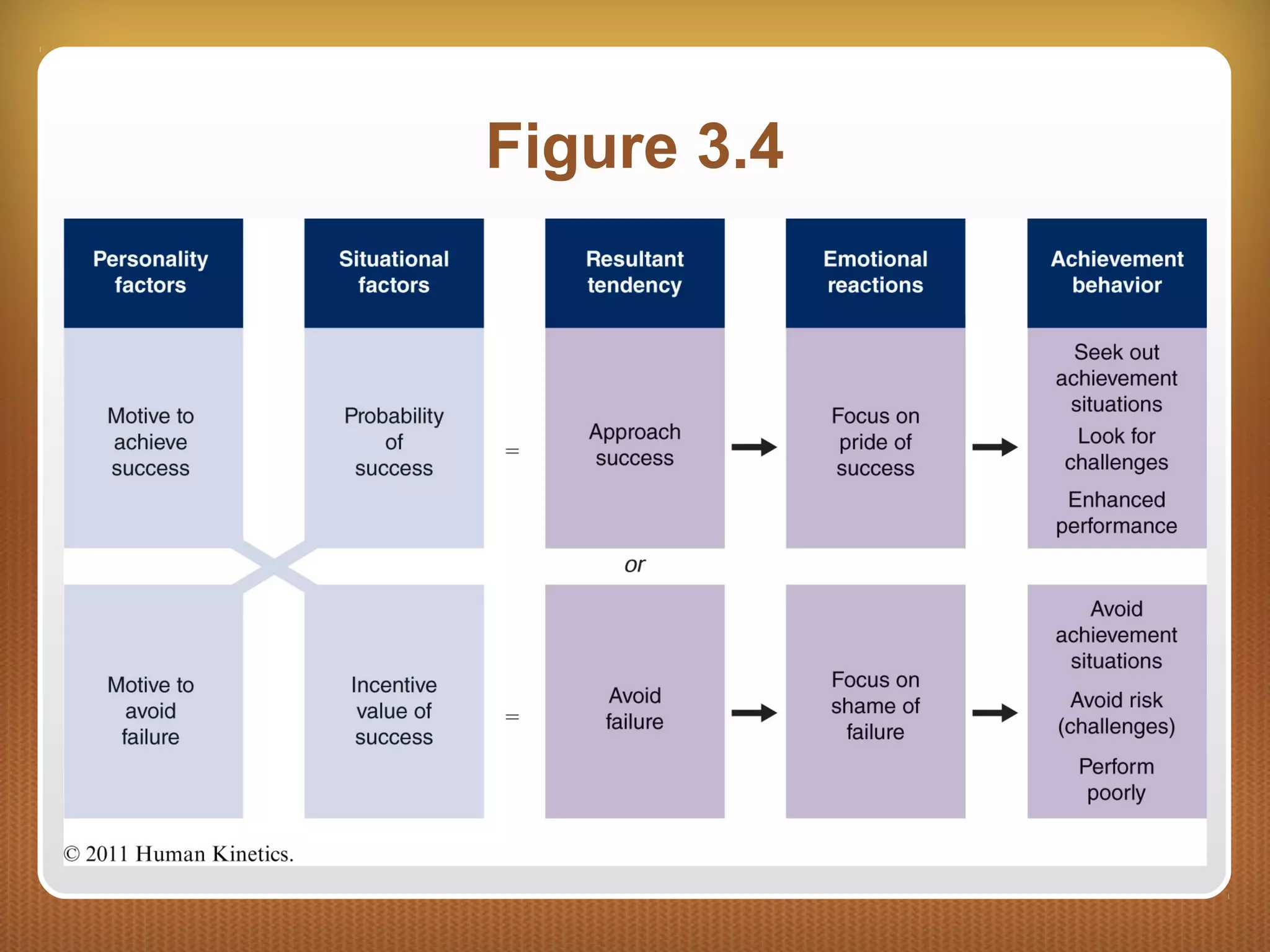
Figure 3.4
Attribution Theory
• Attributions: How people explain their
successes and failures
• Examples include the following:
– Stability
– Locus of causality
– Locus of control
Figure 3.5
Table 3.1
Achievement Goal Theory
• Outcome goal orientation (or competitive
goal orientation): Comparing performance
with and defeating others.
• Task (mastery) goal orientation: Improving
relative to one’s own past performances.
• Social goal orientation: Judging
competence in terms of affiliation with the
group and recognition of being liked by
others.
Figure 3.6
Keys of Achievement Goal Theory
• Focus extra attention on task-oriented
goals.
• Foster mastery or task motivational
climates.
Keys of Competence
Motivation Theory
• People are motivated to feel worthy or
competent.
• Feelings of competence and worth, as well
as perceptions of control, determine
motives.
Figure 3.7
What Achievement Motivation Says
About High Achievers
• High motivational orientation to achieve
success
• Low motivation orientation to avoid failure
• Focus on the pride of success
(continued)
What Achievement Motivation Says
About High Achievers (continued)
• Ascribe success to stable and internal
factors within their control
• Ascribe failure to unstable and external
factors outside their control
• Usually adopt task goals
(continued)
What Achievement Motivation Says
About High Achievers (continued)
• Perceived competence and control: Have
high perceived competence and feel that
achievement is within their control
• Task choice: Seek out challenges, able
competitors, and demanding tasks
• Performance: Perform well in evaluative
conditions
What Achievement Motivation Says
About Low Achievers
• Low motivational orientation to achieve
success
• High motivational orientation to avoid
failure
• Focus on shame and worry that may result
from failure
(continued)
What Achievement Motivation Says
About Low Achievers (continued)
• Ascribe success to unstable and external
factors outside their control
• Ascribe failure to stable and internal factors
within their control
• Usually adopt outcome goals
(continued)
What Achievement Motivation Says
About Low Achievers (continued)
• Perceived competence and control: Have
low perceived competence and feel that
achievement is outside their control
• Task choice: Avoid challenges, seek out
very difficult or very easy tasks or
competitors
• Performance: Perform poorly in evaluative
conditions
Stages of Developing Achievement
Motivation and Competitiveness
• Autonomous competence stage
• Social comparison stage
• Integrated (self- and social-comparison)
stage
Figure 3.8
Keys to Developing Achievement
Motivation and Competitiveness
• Recognize stage of achievement motivation.
• Ultimate goal is the integrated stage.
• Motivational climate influences achievement
motivation.
Implication for Professional Practice
1. Recognize the interaction of personal and
situational factors influencing achievement
behavior.
– Stage of achievement behavior
– Goal orientation
– Attributions
– Situations approached or avoided
(continued)
Implications for Professional Practice
(continued)
2. Emphasize mastery (task) goals and
downplay outcome goals. Create a mastery
motivational climate.
3. Monitor and alter attributional feedback.
4. Monitor and correct inappropriate
attributions.
(continued)
Implications for Professional Practice
(continued)
5. Determine when competitive goals are
appropriate.
6. Enhance feelings of competence and
control.

FW279 Motivation

  • 1.
  • 2.
    Session Outline • Whatis motivation? • Views of motivation • Five guidelines for building motivation • Developing a realistic view of motivation • Achievement motivation and competitiveness (continued)
  • 3.
    Session Outline (continued) •Why are achievement motivation and competitiveness important? • Theories of achievement motivation • Developing achievement motivation and competitiveness • Implications for professional practice
  • 4.
    What Is Motivation? •Motivation is the direction and intensity of effort. – Direction of effort refers to whether an individual seeks out, approaches, or is attracted to situations. – Intensity of effort refers to how much effort an individual puts forth in a situation. • Direction and intensity of effort are closely related.
  • 5.
    Views of Motivation •Participant- or trait-centered view • Situation-centered view • Interactional view
  • 6.
  • 7.
    Five Guidelines forBuilding Motivation: Guidelines 1 and 2 • Guideline 1: Both situations and traits motivate people. • Guideline 2: People have multiple motives for involvement. Understand why people participate in physical activity.
  • 8.
    Motives for Involvement •People participate for more than one reason. • People may have competing motives for involvement. • People have both shared and unique motives. • Motives change over time. • Motives differ across cultures.
  • 9.
    How to IdentifyParticipant Motives • Observe participants. • Talk informally to others. • Ask participants directly.
  • 10.
    Major Motives forSport Participants • Improving skills • Having fun • Being with friends • Experiencing thrills and excitement • Achieving success • Developing fitness
  • 11.
    Major Motives for ExerciseParticipants Joining Health factors Weight loss Fitness Self-challenge Feeling better Continuing Enjoyment Liking instructor Liking type of activity Social factors
  • 12.
    Five Guidelines forBuilding Motivation: Guideline 3 • Guideline 3: Change the environment to enhance motivation. – Provide both competitive and recreational opportunities. – Provide for multiple motives and opportunities. – Adjust to individuals within groups.
  • 13.
    Five Guidelines forBuilding Motivation: Guidelines 4 and 5 • Guideline 4: Leaders influence motivation directly and indirectly. • Guideline 5: Use behavior modification to change undesirable participant motives.
  • 14.
    Developing a Realistic Viewof Motivation • Motivation is a key variable in both learning and performance contexts. • Physical and psychological factors beyond motivation influence behavior and must be considered. • Some motivational factors are more easily influenced than others.
  • 15.
    Achievement Motivation and Competitiveness •Achievement motivation is a person’s orientation to strive for task success, persist in the face of failure, and experience pride in accomplishments (Gill, 2000). • Competitiveness is a disposition to strive for satisfaction when making comparisons with some standard of excellence in the presence of evaluative others (Martens, 1986).
  • 16.
    Keys to AchievementMotivation and Competitiveness • Achievement motivation: Self-comparison of achievement. • Competitiveness: Social evaluation or comparison.
  • 17.
    Achievement Motivation Influences •Choice of activities • Effort to pursue goals • Intensity of effort • Persistence in the face of failure
  • 18.
    Theories of AchievementMotivation • Need achievement theory • Attribution theory • Achievement goal theory • Competence motivation theory
  • 19.
  • 20.
    Attribution Theory • Attributions:How people explain their successes and failures • Examples include the following: – Stability – Locus of causality – Locus of control
  • 21.
  • 22.
  • 23.
    Achievement Goal Theory •Outcome goal orientation (or competitive goal orientation): Comparing performance with and defeating others. • Task (mastery) goal orientation: Improving relative to one’s own past performances. • Social goal orientation: Judging competence in terms of affiliation with the group and recognition of being liked by others.
  • 24.
  • 25.
    Keys of AchievementGoal Theory • Focus extra attention on task-oriented goals. • Foster mastery or task motivational climates.
  • 26.
    Keys of Competence MotivationTheory • People are motivated to feel worthy or competent. • Feelings of competence and worth, as well as perceptions of control, determine motives.
  • 27.
  • 28.
    What Achievement MotivationSays About High Achievers • High motivational orientation to achieve success • Low motivation orientation to avoid failure • Focus on the pride of success (continued)
  • 29.
    What Achievement MotivationSays About High Achievers (continued) • Ascribe success to stable and internal factors within their control • Ascribe failure to unstable and external factors outside their control • Usually adopt task goals (continued)
  • 30.
    What Achievement MotivationSays About High Achievers (continued) • Perceived competence and control: Have high perceived competence and feel that achievement is within their control • Task choice: Seek out challenges, able competitors, and demanding tasks • Performance: Perform well in evaluative conditions
  • 31.
    What Achievement MotivationSays About Low Achievers • Low motivational orientation to achieve success • High motivational orientation to avoid failure • Focus on shame and worry that may result from failure (continued)
  • 32.
    What Achievement MotivationSays About Low Achievers (continued) • Ascribe success to unstable and external factors outside their control • Ascribe failure to stable and internal factors within their control • Usually adopt outcome goals (continued)
  • 33.
    What Achievement MotivationSays About Low Achievers (continued) • Perceived competence and control: Have low perceived competence and feel that achievement is outside their control • Task choice: Avoid challenges, seek out very difficult or very easy tasks or competitors • Performance: Perform poorly in evaluative conditions
  • 34.
    Stages of DevelopingAchievement Motivation and Competitiveness • Autonomous competence stage • Social comparison stage • Integrated (self- and social-comparison) stage
  • 35.
  • 36.
    Keys to DevelopingAchievement Motivation and Competitiveness • Recognize stage of achievement motivation. • Ultimate goal is the integrated stage. • Motivational climate influences achievement motivation.
  • 37.
    Implication for ProfessionalPractice 1. Recognize the interaction of personal and situational factors influencing achievement behavior. – Stage of achievement behavior – Goal orientation – Attributions – Situations approached or avoided (continued)
  • 38.
    Implications for ProfessionalPractice (continued) 2. Emphasize mastery (task) goals and downplay outcome goals. Create a mastery motivational climate. 3. Monitor and alter attributional feedback. 4. Monitor and correct inappropriate attributions. (continued)
  • 39.
    Implications for ProfessionalPractice (continued) 5. Determine when competitive goals are appropriate. 6. Enhance feelings of competence and control.

Editor's Notes