Dr. Rinku Yadav, PT
BPT, MPT (Sports Rehabilitation)
Exercise Therapy Equipment’s used in
Physical Therapy Departments!
In Physical Therapy, Exercise Therapy Unit is also
termed as “Therapeutic Gymnasium”.
The word “therapeutic” means
“contributing towards relief and cure”
and
the word “Gymnasium” is a Greek origin
meaning “a fitness center”.
DEFINITION
A Therapeutic Gymnasium can be defined as
“a fitness center where a Physical Therapist
contributes towards relief of pain and cure of
various ailments via exercises”.
OR
A Therapeutic Gymnasium is “a covered location
equipped for physical exercises”.
A Therapeutic Gymnasium usually includes:
• Tilt Table
• Quadriceps Table
• Static/Stationary Bicycle
• Wall Bar
• Shoulder Wheel
• Traction Table and Machine
• Continuous Passive Motion Apparatus (CPM) for both Upper and Lower limbs
• Parallel Bars
• Medicine Balls (of various weights usually 1-11 kg)
• Ankle Exerciser
• Balance Board
• Weight Cuffs (of various weights e.g. 150 gm. – 4000 gm.)
• Dumbbells (of various weights usually 1-5 kg)
• Shoulder Pulley
• Jogger
• Finger Ladder
• Vestibular/Physio/Swiss/Gym Ball
• Hand Exerciser/Gripper
• Staircase/Training Stairs
• Bolster
• Therabands and Theratubes
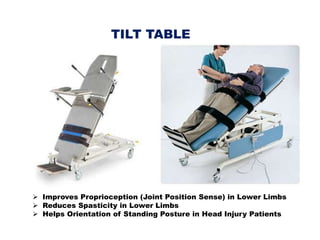
TILT TABLE
 Improves Proprioception (Joint Position Sense) in Lower Limbs
 Reduces Spasticity in Lower Limbs
 Helps Orientation of Standing Posture in Head Injury Patients
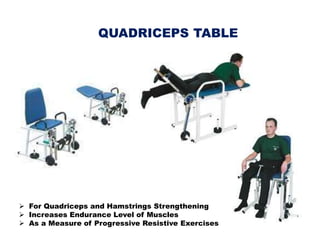
QUADRICEPS TABLE
 For Quadriceps and Hamstrings Strengthening
 Increases Endurance Level of Muscles
 As a Measure of Progressive Resistive Exercises
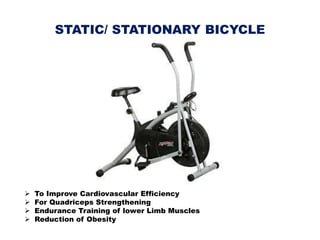
STATIC/ STATIONARY BICYCLE
 To Improve Cardiovascular Efficiency
 For Quadriceps Strengthening
 Endurance Training of lower Limb Muscles
 Reduction of Obesity
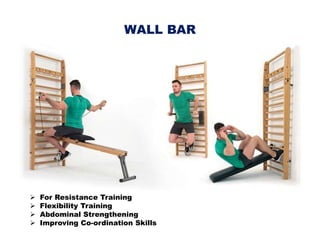
WALL BAR
 For Resistance Training
 Flexibility Training
 Abdominal Strengthening
 Improving Co-ordination Skills
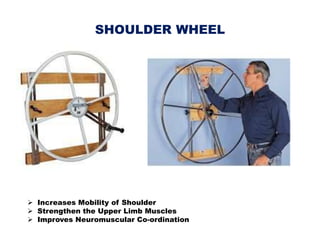
SHOULDER WHEEL
 Increases Mobility of Shoulder
 Strengthen the Upper Limb Muscles
 Improves Neuromuscular Co-ordination
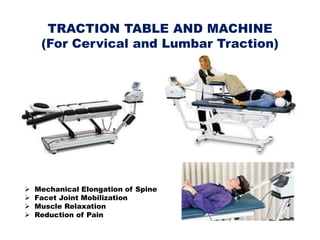
TRACTION TABLE AND MACHINE
(For Cervical and Lumbar Traction)
 Mechanical Elongation of Spine
 Facet Joint Mobilization
 Muscle Relaxation
 Reduction of Pain
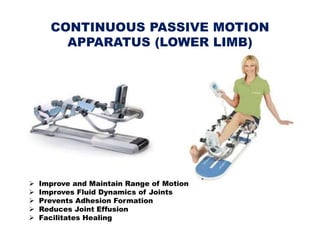
CONTINUOUS PASSIVE MOTION
APPARATUS (LOWER LIMB)
 Improve and Maintain Range of Motion
 Improves Fluid Dynamics of Joints
 Prevents Adhesion Formation
 Reduces Joint Effusion
 Facilitates Healing
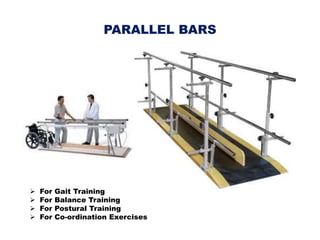
PARALLEL BARS
 For Gait Training
 For Balance Training
 For Postural Training
 For Co-ordination Exercises
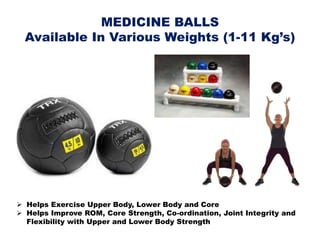
MEDICINE BALLS
Available In Various Weights (1-11 Kg’s)
 Helps Exercise Upper Body, Lower Body and Core
 Helps Improve ROM, Core Strength, Co-ordination, Joint Integrity and
Flexibility with Upper and Lower Body Strength
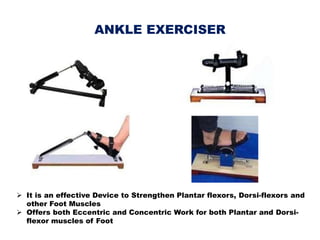
ANKLE EXERCISER
 It is an effective Device to Strengthen Plantar flexors, Dorsi-flexors and
other Foot Muscles
 Offers both Eccentric and Concentric Work for both Plantar and Dorsi-
flexor muscles of Foot
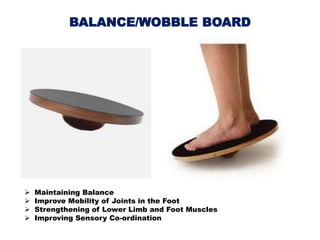
BALANCE/WOBBLE BOARD
 Maintaining Balance
 Improve Mobility of Joints in the Foot
 Strengthening of Lower Limb and Foot Muscles
 Improving Sensory Co-ordination
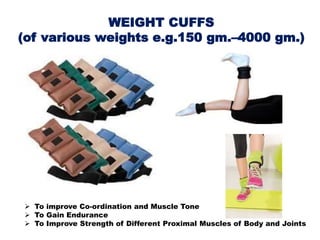
WEIGHT CUFFS
(of various weights e.g.150 gm.–4000 gm.)
 To improve Co-ordination and Muscle Tone
 To Gain Endurance
 To Improve Strength of Different Proximal Muscles of Body and Joints
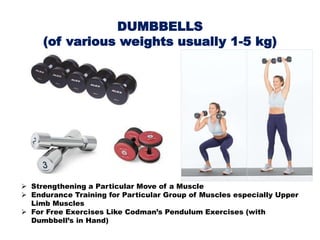
DUMBBELLS
(of various weights usually 1-5 kg)
 Strengthening a Particular Move of a Muscle
 Endurance Training for Particular Group of Muscles especially Upper
Limb Muscles
 For Free Exercises Like Codman’s Pendulum Exercises (with
Dumbbell’s in Hand)
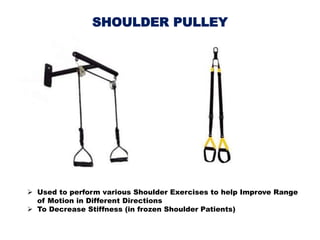
SHOULDER PULLEY
 Used to perform various Shoulder Exercises to help Improve Range
of Motion in Different Directions
 To Decrease Stiffness (in frozen Shoulder Patients)
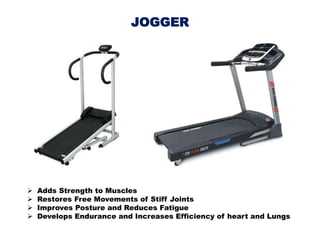
JOGGER
 Adds Strength to Muscles
 Restores Free Movements of Stiff Joints
 Improves Posture and Reduces Fatigue
 Develops Endurance and Increases Efficiency of heart and Lungs
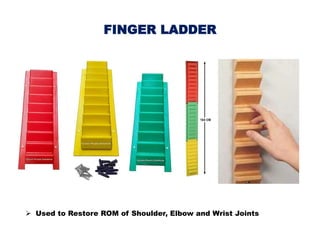
FINGER LADDER
 Used to Restore ROM of Shoulder, Elbow and Wrist Joints
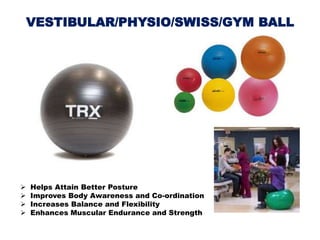
VESTIBULAR/PHYSIO/SWISS/GYM BALL
 Helps Attain Better Posture
 Improves Body Awareness and Co-ordination
 Increases Balance and Flexibility
 Enhances Muscular Endurance and Strength
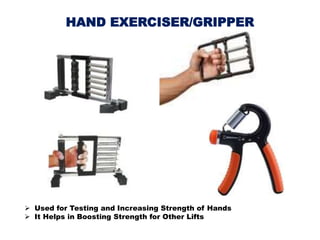
HAND EXERCISER/GRIPPER
 Used for Testing and Increasing Strength of Hands
 It Helps in Boosting Strength for Other Lifts
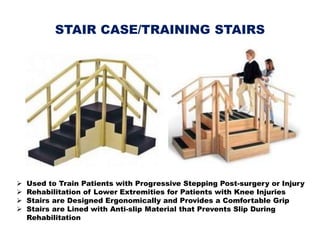
STAIR CASE/TRAINING STAIRS
 Used to Train Patients with Progressive Stepping Post-surgery or Injury
 Rehabilitation of Lower Extremities for Patients with Knee Injuries
 Stairs are Designed Ergonomically and Provides a Comfortable Grip
 Stairs are Lined with Anti-slip Material that Prevents Slip During
Rehabilitation
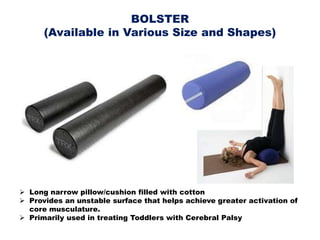
BOLSTER
(Available in Various Size and Shapes)
 Long narrow pillow/cushion filled with cotton
 Provides an unstable surface that helps achieve greater activation of
core musculature.
 Primarily used in treating Toddlers with Cerebral Palsy
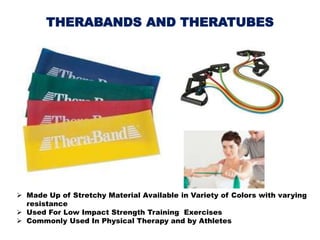
THERABANDS AND THERATUBES
 Made Up of Stretchy Material Available in Variety of Colors with varying
resistance
 Used For Low Impact Strength Training Exercises
 Commonly Used In Physical Therapy and by Athletes
An Introduction To Exercise Therapy Unit !

An Introduction To Exercise Therapy Unit !

  • 1.
    Dr. Rinku Yadav,PT BPT, MPT (Sports Rehabilitation)
  • 2.
    Exercise Therapy Equipment’sused in Physical Therapy Departments!
  • 3.
    In Physical Therapy,Exercise Therapy Unit is also termed as “Therapeutic Gymnasium”.
  • 4.
    The word “therapeutic”means “contributing towards relief and cure” and the word “Gymnasium” is a Greek origin meaning “a fitness center”.
  • 5.
    DEFINITION A Therapeutic Gymnasiumcan be defined as “a fitness center where a Physical Therapist contributes towards relief of pain and cure of various ailments via exercises”. OR A Therapeutic Gymnasium is “a covered location equipped for physical exercises”.
  • 6.
    A Therapeutic Gymnasiumusually includes: • Tilt Table • Quadriceps Table • Static/Stationary Bicycle • Wall Bar • Shoulder Wheel • Traction Table and Machine • Continuous Passive Motion Apparatus (CPM) for both Upper and Lower limbs • Parallel Bars • Medicine Balls (of various weights usually 1-11 kg) • Ankle Exerciser • Balance Board • Weight Cuffs (of various weights e.g. 150 gm. – 4000 gm.) • Dumbbells (of various weights usually 1-5 kg) • Shoulder Pulley • Jogger • Finger Ladder • Vestibular/Physio/Swiss/Gym Ball • Hand Exerciser/Gripper • Staircase/Training Stairs • Bolster • Therabands and Theratubes
  • 7.
    TILT TABLE  ImprovesProprioception (Joint Position Sense) in Lower Limbs  Reduces Spasticity in Lower Limbs  Helps Orientation of Standing Posture in Head Injury Patients
  • 8.
    QUADRICEPS TABLE  ForQuadriceps and Hamstrings Strengthening  Increases Endurance Level of Muscles  As a Measure of Progressive Resistive Exercises
  • 9.
    STATIC/ STATIONARY BICYCLE To Improve Cardiovascular Efficiency  For Quadriceps Strengthening  Endurance Training of lower Limb Muscles  Reduction of Obesity
  • 10.
    WALL BAR  ForResistance Training  Flexibility Training  Abdominal Strengthening  Improving Co-ordination Skills
  • 11.
    SHOULDER WHEEL  IncreasesMobility of Shoulder  Strengthen the Upper Limb Muscles  Improves Neuromuscular Co-ordination
  • 12.
    TRACTION TABLE ANDMACHINE (For Cervical and Lumbar Traction)  Mechanical Elongation of Spine  Facet Joint Mobilization  Muscle Relaxation  Reduction of Pain
  • 13.
    CONTINUOUS PASSIVE MOTION APPARATUS(LOWER LIMB)  Improve and Maintain Range of Motion  Improves Fluid Dynamics of Joints  Prevents Adhesion Formation  Reduces Joint Effusion  Facilitates Healing
  • 14.
    PARALLEL BARS  ForGait Training  For Balance Training  For Postural Training  For Co-ordination Exercises
  • 15.
    MEDICINE BALLS Available InVarious Weights (1-11 Kg’s)  Helps Exercise Upper Body, Lower Body and Core  Helps Improve ROM, Core Strength, Co-ordination, Joint Integrity and Flexibility with Upper and Lower Body Strength
  • 16.
    ANKLE EXERCISER  Itis an effective Device to Strengthen Plantar flexors, Dorsi-flexors and other Foot Muscles  Offers both Eccentric and Concentric Work for both Plantar and Dorsi- flexor muscles of Foot
  • 17.
    BALANCE/WOBBLE BOARD  MaintainingBalance  Improve Mobility of Joints in the Foot  Strengthening of Lower Limb and Foot Muscles  Improving Sensory Co-ordination
  • 18.
    WEIGHT CUFFS (of variousweights e.g.150 gm.–4000 gm.)  To improve Co-ordination and Muscle Tone  To Gain Endurance  To Improve Strength of Different Proximal Muscles of Body and Joints
  • 19.
    DUMBBELLS (of various weightsusually 1-5 kg)  Strengthening a Particular Move of a Muscle  Endurance Training for Particular Group of Muscles especially Upper Limb Muscles  For Free Exercises Like Codman’s Pendulum Exercises (with Dumbbell’s in Hand)
  • 20.
    SHOULDER PULLEY  Usedto perform various Shoulder Exercises to help Improve Range of Motion in Different Directions  To Decrease Stiffness (in frozen Shoulder Patients)
  • 21.
    JOGGER  Adds Strengthto Muscles  Restores Free Movements of Stiff Joints  Improves Posture and Reduces Fatigue  Develops Endurance and Increases Efficiency of heart and Lungs
  • 22.
    FINGER LADDER  Usedto Restore ROM of Shoulder, Elbow and Wrist Joints
  • 23.
    VESTIBULAR/PHYSIO/SWISS/GYM BALL  HelpsAttain Better Posture  Improves Body Awareness and Co-ordination  Increases Balance and Flexibility  Enhances Muscular Endurance and Strength
  • 24.
    HAND EXERCISER/GRIPPER  Usedfor Testing and Increasing Strength of Hands  It Helps in Boosting Strength for Other Lifts
  • 25.
    STAIR CASE/TRAINING STAIRS Used to Train Patients with Progressive Stepping Post-surgery or Injury  Rehabilitation of Lower Extremities for Patients with Knee Injuries  Stairs are Designed Ergonomically and Provides a Comfortable Grip  Stairs are Lined with Anti-slip Material that Prevents Slip During Rehabilitation
  • 26.
    BOLSTER (Available in VariousSize and Shapes)  Long narrow pillow/cushion filled with cotton  Provides an unstable surface that helps achieve greater activation of core musculature.  Primarily used in treating Toddlers with Cerebral Palsy
  • 27.
    THERABANDS AND THERATUBES Made Up of Stretchy Material Available in Variety of Colors with varying resistance  Used For Low Impact Strength Training Exercises  Commonly Used In Physical Therapy and by Athletes