Chapter 2: Personality and Sport
2
Personality and SportPersonality and Sport
C H A P T E R
Session Outline
• What is personality?
• What makes up personality?
• Approaches to understanding personality
• Measuring personality
• Dos and don’ts in personality testing
(continued)
Session Outline (continued)
• Selected findings in personality research
• Cognitive strategies and athletic success
• Your role in understanding personality
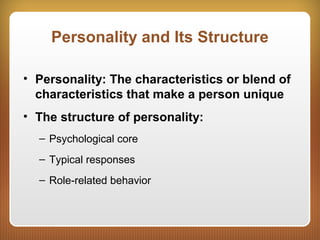
Personality and Its Structure
• Personality: The characteristics or blend of
characteristics that make a person unique
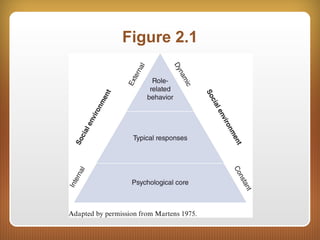
• The structure of personality:
– Psychological core
– Typical responses
– Role-related behavior
Figure 2.1
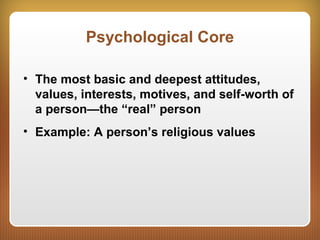
Psychological Core
• The most basic and deepest attitudes,
values, interests, motives, and self-worth of
a person—the “real” person
• Example: A person’s religious values
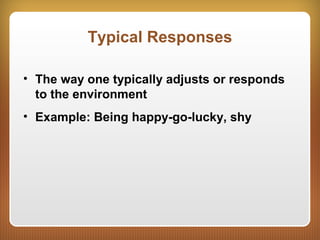
Typical Responses
• The way one typically adjusts or responds
to the environment
• Example: Being happy-go-lucky, shy
Role-Related Behavior
• How one acts in a particular social situation
• Example: Behavior as a student, parent, or
friend
Approaches to Understanding
Personality
• Psychodynamic approach
• Trait approach
• Situational approach
• Interactional approach
• Phenomenological approach
Psychodynamic Approach
• Behavior is determined by several
unconscious, constantly changing factors
that often conflict with one another.
• Emphasis is placed on understanding the
person as a whole rather than identifying
isolated traits.
Trait Approach
• Behavior is determined by relatively stable
traits that are fundamental units of
personality.
• These traits predispose one to act in a
certain way, regardless of the situation.
Big 5 Model
of Personality Components
• Neuroticism
• Extroversion
• Openness to experience
• Agreeableness
• Conscientiousness
Perfectionism
• Perfectionism has been one of the most
widely studied personality characteristics in
sport psychology in recent years.
• Perfectionism is a multidimensional
construct that consists of various
components, including setting high
standards, feeling concern over mistakes,
and being highly organized.
(continued)
Perfectionism (continued)
• Depending on the specific components
characterizing one’s perfectionistic
personality, perfectionism can lead to both
highly positive and extremely negative
consequences (maladaptive versus
adaptive perfectionism).
Situational Approach
• Behavior is determined largely by the
situation or environment.
• The situation is a more important
determinant of behavior than particular
personality traits.
• The situational approach is not as widely
embraced by most sport psychologists.
Interactional Approach
• Behavior is determined by both the person
and the situational factors as well as by
their interaction.
• The majority of contemporary sport and
exercise psychologists favor the
interactional approach.
Phenomenological Approach
• Behavior is best determined by accounting
for situational and personal characteristics.
• A person’s understanding and interpretation
of one’s self and environment are critical.
• The phenomenological view is often
stressed by today’s sport psychologists.
Research Support
for Psychodynamic Approach
• Current impact: Has little influence and
hasn’t been adopted by most contemporary
sport psychologists.
• Weakness: Focuses almost entirely on
internal determinants of behavior, giving
little attention to the social environment.
• Contribution: Has increased awareness that
unconscious determinants of behavior
exist.
Research Support for Trait Approach
• Current impact: Has little influence.
• Weakness: Knowing traits will not always
help predict behavior in particular
situations.
• Contribution: Emphasizes the importance of
traits and the measurement of such
dispositions.
Research Support
for Situational Approach
• Current impact: Has little influence.
• Weakness: Situation will not always
influence individual behavior.
• Contribution: Emphasizes the importance of
the situation.
Research Support
for Interactional Approach
• Current impact: Has considerable influence
and has been adopted by most
contemporary sport psychologists.
• Weakness: None.
• Contribution: Emphasizes the consideration
of both trait and situational variables and
their interaction.
Research Support
for Phenomenological Approach
• Current impact: Has considerable influence
and has been adopted by many
contemporary sport psychologists.
• Weakness: None.
• Contribution: Emphasizes the contribution
of a person’s interpretation of one’s self and
environment while considering both trait
and situational variables and their
interaction.
Measuring Personality:
Traits and States
• Measure both traits and states.
• A trait is a typical style of behavior.
• State is the situation’s effect on behavior—a
“right now” feeling that can change from
moment to moment.
Measuring Personality
• There are general versus situation-specific
(sport-specific) measures.
• Situation-specific trait tests predict
behavior more accurately than do general
trait measures.
(continued)
Measuring Personality (continued)
• It is often more effective to compare
personality test scores to a person’s own
previous test results than to group norms.
• Projective tests are interesting but difficult
to score.
Dos and Don’ts in Personality Testing
• DO inform participants about the purpose of
the personality test and exactly how it will
be used.
• DO allow only qualified individuals who
have an understanding of testing principles
and measurement error to give personality
tests.
(continued)
Dos and Don’ts in Personality Testing
(continued)
• DO integrate personality test results with
other information obtained about the
participant.
• DO use sport- and exercise-specific tests
whenever possible, giving them in
consultation with a sport psychologist.
• DO use both state and trait measures of
personality.
(continued)
Dos and Don’ts in Personality Testing
(continued)
• DO provide participants with specific
feedback concerning the results of the test.
• DO compare individuals against their own
baseline levels rather than against
normative information.
(continued)
Dos and Don’ts in Personality Testing
(continued)
• DON’T use clinical personality tests that
focus on abnormality to study an average
population of sport and exercise
participants.
• DON’T use personality tests to decide who
makes a team or program and who doesn’t.
(continued)
Dos and Don’ts in Personality Testing
(continued)
• DON’T give or interpret personality tests
unless you are qualified to do so by the APA
or another certifying organization.
• DON’T use personality tests to predict
behavior in sport and exercise settings
without considering other sources of
information.
Selected Findings
in Personality Research
• Some relationship exists between
personality traits and states and sport
performance, but it is far from perfect or
precise.
• No single definitive personality profile has
been found that consistently distinguishes
athletes from nonathletes.
(continued)
Selected Findings in Personality
Research (continued)
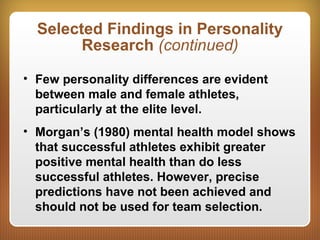
• Few personality differences are evident
between male and female athletes,
particularly at the elite level.
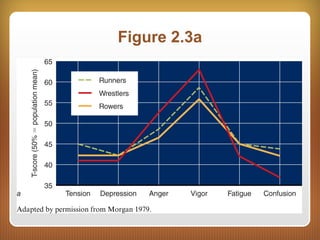
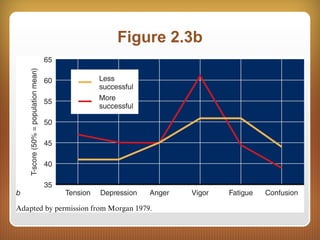
• Morgan’s (1980) mental health model shows
that successful athletes exhibit greater
positive mental health than do less
successful athletes. However, precise
predictions have not been achieved and
should not be used for team selection.
Figure 2.3a
Figure 2.3b
Selected Findings
in Personality Research
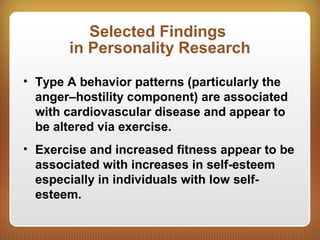
• Type A behavior patterns (particularly the
anger–hostility component) are associated
with cardiovascular disease and appear to
be altered via exercise.
• Exercise and increased fitness appear to be
associated with increases in self-esteem
especially in individuals with low self-
esteem.
Cognitive Strategies and
Athletic Success
• Cognitive strategies and mental strategies
are among the skills and behaviors that
athletes use in competition.
• Although they’re not personality traits in the
traditional sense, cognitive strategies
reflect the behavior aspect of personality
and interact with personality
characteristics.
(continued)
Cognitive Strategies and
Athletic Success (continued)
• Both quantitative and qualitative cognitive
strategy measures have been shown to
differentiate between more and less
successful athletes.
• Overachieving high school athletes scored
higher on coachability, concentration,
coping with adversity, and total cognitive
strategy than average and underachieving
athletes. (continued)
Cognitive Strategies and
Athletic Success (continued)
• Cognitive strategies have been shown to be
related to superior performance in elite
sport.
• Elite athletes show superior ability to cope
with adversity and mentally prepare
compared to non-elite athletes.
(continued)
Cognitive Strategies and
Athletic Success (continued)
• Olympic medal-winning wrestlers more
often used positive self-talk, had a narrower
and more immediate focus of attention, and
were better prepared mentally for
unforeseen negative events.
• Mental preparation and planning are critical
components of athletic success.
Cognitive Strategies and Athletic
Success: Guidelines for Practice
• Enhance confidence and practice specific
plans to deal with adversity during
competition.
• Practice routines to deal with unusual
circumstances and distractions before and
during competition.
• Concentrate wholly on the upcoming
performance and block out irrelevant events
and thoughts. (continued)
Cognitive Strategies and Athletic
Success: Guidelines for Practice
(continued)
• Use several mental rehearsals before
competition.
• Don’t worry about other competitors before
a competition; instead, focus on what you
can control.
• Develop detailed competition plans.
• Learn to regulate arousal and anxiety.
Your Role in
Understanding Personality
• Consider both personality traits and
situations.
• Be an informed consumer.
• Be a good communicator.
• Be a good observer.
• Be knowledgeable about mental strategies.

FW279 Personality and Sport

  • 1.
    Chapter 2: Personalityand Sport 2 Personality and SportPersonality and Sport C H A P T E R
  • 2.
    Session Outline • Whatis personality? • What makes up personality? • Approaches to understanding personality • Measuring personality • Dos and don’ts in personality testing (continued)
  • 3.
    Session Outline (continued) •Selected findings in personality research • Cognitive strategies and athletic success • Your role in understanding personality
  • 4.
    Personality and ItsStructure • Personality: The characteristics or blend of characteristics that make a person unique • The structure of personality: – Psychological core – Typical responses – Role-related behavior
  • 5.
  • 6.
    Psychological Core • Themost basic and deepest attitudes, values, interests, motives, and self-worth of a person—the “real” person • Example: A person’s religious values
  • 7.
    Typical Responses • Theway one typically adjusts or responds to the environment • Example: Being happy-go-lucky, shy
  • 8.
    Role-Related Behavior • Howone acts in a particular social situation • Example: Behavior as a student, parent, or friend
  • 9.
    Approaches to Understanding Personality •Psychodynamic approach • Trait approach • Situational approach • Interactional approach • Phenomenological approach
  • 10.
    Psychodynamic Approach • Behavioris determined by several unconscious, constantly changing factors that often conflict with one another. • Emphasis is placed on understanding the person as a whole rather than identifying isolated traits.
  • 11.
    Trait Approach • Behavioris determined by relatively stable traits that are fundamental units of personality. • These traits predispose one to act in a certain way, regardless of the situation.
  • 12.
    Big 5 Model ofPersonality Components • Neuroticism • Extroversion • Openness to experience • Agreeableness • Conscientiousness
  • 13.
    Perfectionism • Perfectionism hasbeen one of the most widely studied personality characteristics in sport psychology in recent years. • Perfectionism is a multidimensional construct that consists of various components, including setting high standards, feeling concern over mistakes, and being highly organized. (continued)
  • 14.
    Perfectionism (continued) • Dependingon the specific components characterizing one’s perfectionistic personality, perfectionism can lead to both highly positive and extremely negative consequences (maladaptive versus adaptive perfectionism).
  • 15.
    Situational Approach • Behavioris determined largely by the situation or environment. • The situation is a more important determinant of behavior than particular personality traits. • The situational approach is not as widely embraced by most sport psychologists.
  • 16.
    Interactional Approach • Behavioris determined by both the person and the situational factors as well as by their interaction. • The majority of contemporary sport and exercise psychologists favor the interactional approach.
  • 17.
    Phenomenological Approach • Behavioris best determined by accounting for situational and personal characteristics. • A person’s understanding and interpretation of one’s self and environment are critical. • The phenomenological view is often stressed by today’s sport psychologists.
  • 18.
    Research Support for PsychodynamicApproach • Current impact: Has little influence and hasn’t been adopted by most contemporary sport psychologists. • Weakness: Focuses almost entirely on internal determinants of behavior, giving little attention to the social environment. • Contribution: Has increased awareness that unconscious determinants of behavior exist.
  • 19.
    Research Support forTrait Approach • Current impact: Has little influence. • Weakness: Knowing traits will not always help predict behavior in particular situations. • Contribution: Emphasizes the importance of traits and the measurement of such dispositions.
  • 20.
    Research Support for SituationalApproach • Current impact: Has little influence. • Weakness: Situation will not always influence individual behavior. • Contribution: Emphasizes the importance of the situation.
  • 21.
    Research Support for InteractionalApproach • Current impact: Has considerable influence and has been adopted by most contemporary sport psychologists. • Weakness: None. • Contribution: Emphasizes the consideration of both trait and situational variables and their interaction.
  • 22.
    Research Support for PhenomenologicalApproach • Current impact: Has considerable influence and has been adopted by many contemporary sport psychologists. • Weakness: None. • Contribution: Emphasizes the contribution of a person’s interpretation of one’s self and environment while considering both trait and situational variables and their interaction.
  • 23.
    Measuring Personality: Traits andStates • Measure both traits and states. • A trait is a typical style of behavior. • State is the situation’s effect on behavior—a “right now” feeling that can change from moment to moment.
  • 24.
    Measuring Personality • Thereare general versus situation-specific (sport-specific) measures. • Situation-specific trait tests predict behavior more accurately than do general trait measures. (continued)
  • 25.
    Measuring Personality (continued) •It is often more effective to compare personality test scores to a person’s own previous test results than to group norms. • Projective tests are interesting but difficult to score.
  • 26.
    Dos and Don’tsin Personality Testing • DO inform participants about the purpose of the personality test and exactly how it will be used. • DO allow only qualified individuals who have an understanding of testing principles and measurement error to give personality tests. (continued)
  • 27.
    Dos and Don’tsin Personality Testing (continued) • DO integrate personality test results with other information obtained about the participant. • DO use sport- and exercise-specific tests whenever possible, giving them in consultation with a sport psychologist. • DO use both state and trait measures of personality. (continued)
  • 28.
    Dos and Don’tsin Personality Testing (continued) • DO provide participants with specific feedback concerning the results of the test. • DO compare individuals against their own baseline levels rather than against normative information. (continued)
  • 29.
    Dos and Don’tsin Personality Testing (continued) • DON’T use clinical personality tests that focus on abnormality to study an average population of sport and exercise participants. • DON’T use personality tests to decide who makes a team or program and who doesn’t. (continued)
  • 30.
    Dos and Don’tsin Personality Testing (continued) • DON’T give or interpret personality tests unless you are qualified to do so by the APA or another certifying organization. • DON’T use personality tests to predict behavior in sport and exercise settings without considering other sources of information.
  • 31.
    Selected Findings in PersonalityResearch • Some relationship exists between personality traits and states and sport performance, but it is far from perfect or precise. • No single definitive personality profile has been found that consistently distinguishes athletes from nonathletes. (continued)
  • 32.
    Selected Findings inPersonality Research (continued) • Few personality differences are evident between male and female athletes, particularly at the elite level. • Morgan’s (1980) mental health model shows that successful athletes exhibit greater positive mental health than do less successful athletes. However, precise predictions have not been achieved and should not be used for team selection.
  • 33.
  • 34.
  • 35.
    Selected Findings in PersonalityResearch • Type A behavior patterns (particularly the anger–hostility component) are associated with cardiovascular disease and appear to be altered via exercise. • Exercise and increased fitness appear to be associated with increases in self-esteem especially in individuals with low self- esteem.
  • 36.
    Cognitive Strategies and AthleticSuccess • Cognitive strategies and mental strategies are among the skills and behaviors that athletes use in competition. • Although they’re not personality traits in the traditional sense, cognitive strategies reflect the behavior aspect of personality and interact with personality characteristics. (continued)
  • 37.
    Cognitive Strategies and AthleticSuccess (continued) • Both quantitative and qualitative cognitive strategy measures have been shown to differentiate between more and less successful athletes. • Overachieving high school athletes scored higher on coachability, concentration, coping with adversity, and total cognitive strategy than average and underachieving athletes. (continued)
  • 38.
    Cognitive Strategies and AthleticSuccess (continued) • Cognitive strategies have been shown to be related to superior performance in elite sport. • Elite athletes show superior ability to cope with adversity and mentally prepare compared to non-elite athletes. (continued)
  • 39.
    Cognitive Strategies and AthleticSuccess (continued) • Olympic medal-winning wrestlers more often used positive self-talk, had a narrower and more immediate focus of attention, and were better prepared mentally for unforeseen negative events. • Mental preparation and planning are critical components of athletic success.
  • 40.
    Cognitive Strategies andAthletic Success: Guidelines for Practice • Enhance confidence and practice specific plans to deal with adversity during competition. • Practice routines to deal with unusual circumstances and distractions before and during competition. • Concentrate wholly on the upcoming performance and block out irrelevant events and thoughts. (continued)
  • 41.
    Cognitive Strategies andAthletic Success: Guidelines for Practice (continued) • Use several mental rehearsals before competition. • Don’t worry about other competitors before a competition; instead, focus on what you can control. • Develop detailed competition plans. • Learn to regulate arousal and anxiety.
  • 42.
    Your Role in UnderstandingPersonality • Consider both personality traits and situations. • Be an informed consumer. • Be a good communicator. • Be a good observer. • Be knowledgeable about mental strategies.