THEORIES AND
MODELS OF
LEARNING AND
INSTRUCTION
ETEC 510 Presentation by William Hiser,
Felisa Isakson, Robert Burke and Maribel
Ruiz
 Behaviorism, Cognitivism,
Constructivism: Comparing
Critical Features from an
Instructional Design
Perspective
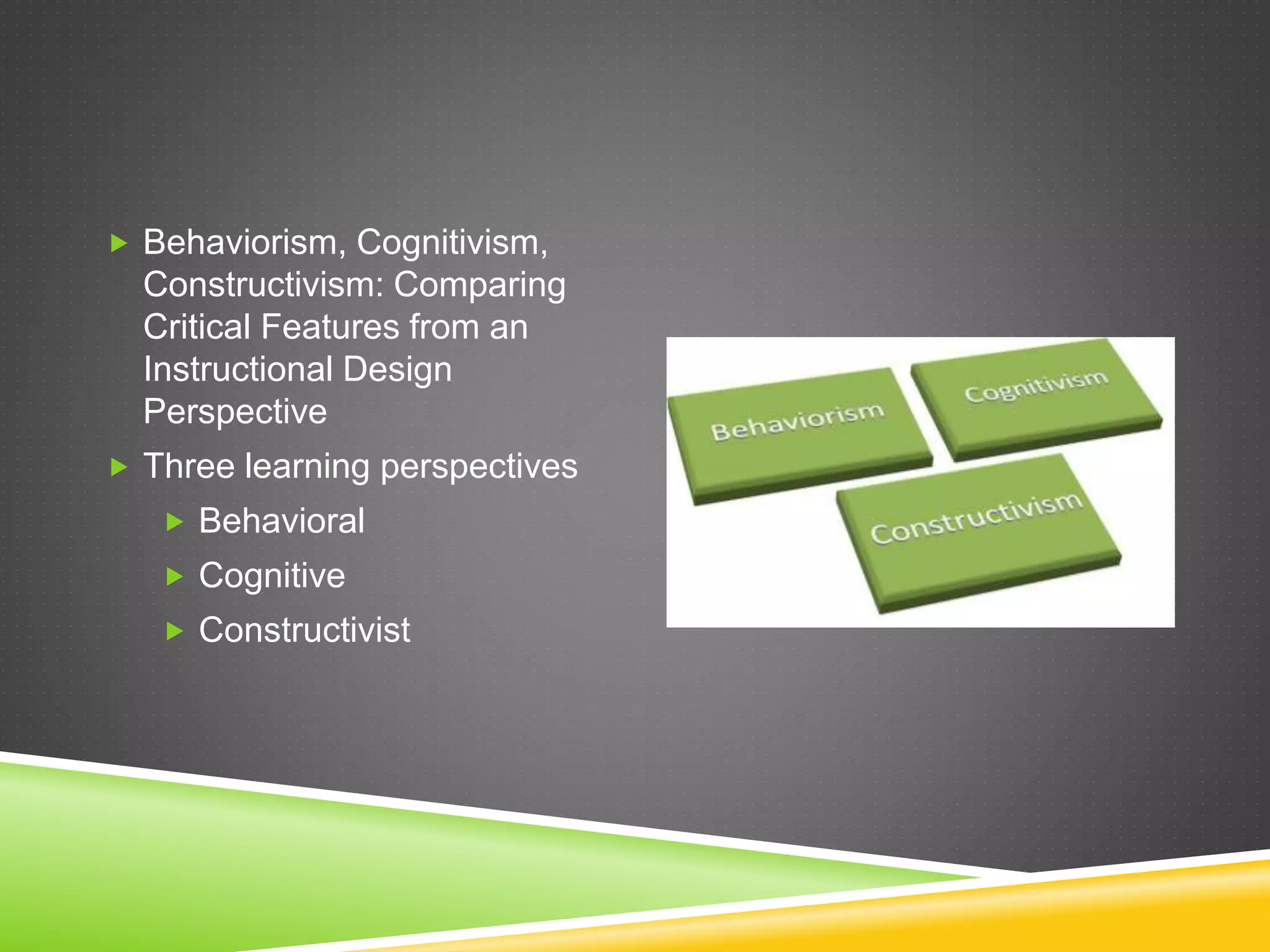
 Three learning perspectives
 Behavioral
 Cognitive
 Constructivist
BEHAVIORISM
 Equates learning with either the form or frequency of observable
performance
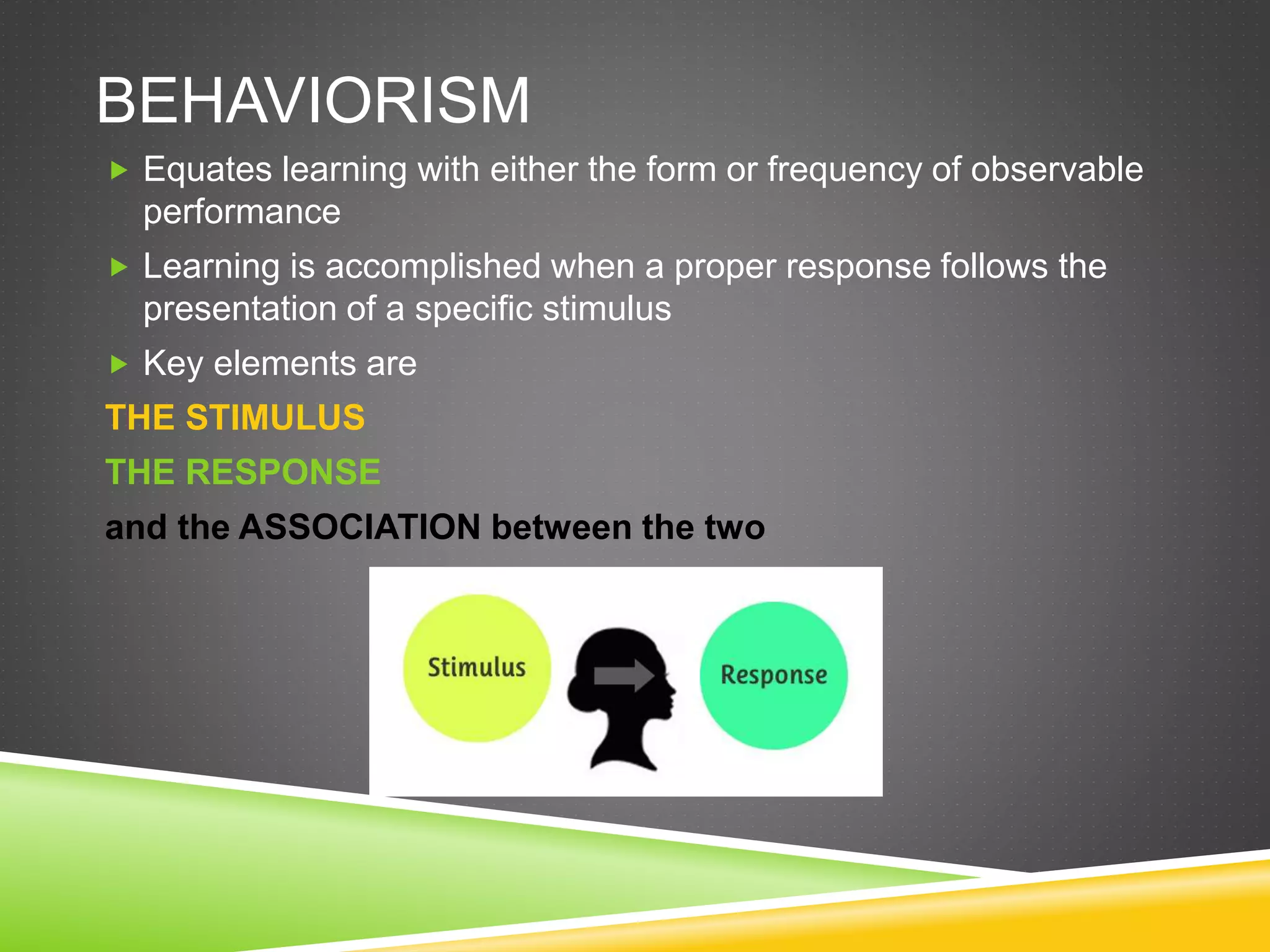
 Learning is accomplished when a proper response follows the
presentation of a specific stimulus
 Key elements are
THE STIMULUS
THE RESPONSE
and the ASSOCIATION between the two
COGNITIVISM
 Began development in the 1950s after Behaviorism.
 Cognitive Theory is seen as “moved to the forefront of current
learning behaviors” (Bednar et al. 1991)
 Cognitive theories stress acquisition of knowledge and internal
mental structures
 The focus is on students’ learning process, how information is
received, organized, stored and retrieved by the mind.
 Real focus on cognitive approach is changing the learner by
encouraging new learning strategies
CONSTRUCTIVISM
 Belief that knowledge “is a function of how the individual creates
MEANING from his or her own experiences”
 A theory that equates learning with creating meaning from
experience
 Constructivist believe the mind filters input from the world to
produce tis own unique reality
 Humans CREATE meaning as opposed to ACQURING it
INTRODUCTION TO INSTRUCTIONAL
DESIGN
 Function of an educational system is to facilitate intentional
learning-accomplish many goals that would take much longer
without instruction
 Instruction is defined as a set of events embedded in purposeful
activities that facilitate learning
 External learning-printed pages, instructors lecture, group of student
activities
 Internal learning-directing attention, rehearsing, reflecting, and
monitoring progress
 Teacher includes many different tasks-selecting material, managing
class time, monitoring instructional activities and serve as learning
facilitator
 Instruction is more effective when the teacher can select, plan,
develop activities to best help students learn
BASIC ASSUMPTIONS ABOUT
INSTRUCTIONAL DESIGN
 First assumption - Instructional design aimed at intentional learning.
Learning outcomes guide the design and selection of learning activities
 Second assumption - John Carroll (1963) mentions 5 variables that
affect the degree of learning attained by a student
1. Learner perseverance 2. Time allowed 3. Quality of instruction 4.aptitude 5.student’s
ability to learn higher learner is not able to be accomplished if the student is not motivated or
able to do the task that needs to be accomplished
 Third assumption - Design models can be applied: teachers plan lessons
for an activity, three day workshop, curriculum development, etc.
 Fourth assumption - designers don’t design perfect instruction; they
perfect instructional designs
 Fifth assumption - aligned desired outcomes, instructional methods, and
student assessments
 Sixth assumption - different types of learning outcomes call for different
types of instruction
LEARNING PRINCIPALS
 We have our own way of learning
 Learning is a process that leads to change in a
learners disposition and capabilities that can be
reflected in behavior (Gagné,1985)
 Learning situations: (a)external (b)internal-stored
memories and intentions of the learners/include a
desire to learn
 “Conditions of learning” : external and internal factors
for the learner that enable learning to occur.
PSYCHOLOGICAL FOUNDATIONS OF
INSTRUCTIONAL DESIGN
Cognitive Approach:
 Cognitive Information Processing Theory - promotes the
concept of three memory systems in the learning process.
Each systems provides an essential outcome on how the
individual comprehends the subject matter; in this case
technology incorporating instructional design.
 Sensory, short-term memory, and long-term memory
are the three systems that focus on any psychological
approach through cognitive discipline
KEY POINTS IN COGNITIVE
APPROACHES:
 As a tool, the computer has several advantages that can aid in
individual’s cognitive development.
1. Computers are motivating for young children, increasing their time
in on- task behavior.
2. Computers provide consistent and frequent reinforcement.
3. Computers allow children to work independently at their own pace.
4. Software programs often provide extensive scaffolding of learning.
5. The computer provides unique opportunities that may enhance
learning. Computers can allow children to access unlimited
information.
 There are cognitive advantages to using computers, thowever avoid
too much drill and skill software. In one study, children’s creativity
was reduced by 50% after using this type of software.
Sensory Memory
 From the psychological, noting a structure for conveying an impulse that results or tends
to result in sensation, as a nerve.
Short-term Memory
 Known to most as one who can retain a certain amount of knowledge, for a specific
amount of time.
Long-term Memory
 A modern definition is information that is retained over a long period of time, and over the
entire span of one’s life.
Cognitive Load
 Reiser discusses the idea of absorbing information and learning how to grasp concept of
solving problems, and looking at the solutions. The schema theory, what is relevant to
instruction and comprehension. In the long run its absorbed by long-term memory.
Situated Learning Theory
 Organizational proponents points out the strength, and integrations of learning how to
work in a collaboration setting. In respects to Wenger’s views, participation
CONSTRUCTIVISM IN PRACTICAL AND
HISTORICAL CONTEXT
 Constructivism theory is based on the idea that knowledge is
constructed by the knower based on a mental activity and has
the following basic precepts:
1. Learning is an active process. opportunities arise as people
encounter cognitive conflict or challenge, a social activity
involving collaboration
2. Where possible, reflection, assessment, and feedback should be
embedded.
3. Learners should take primary responsibility for their learning and
“own”the process as far as possible.
CONSTRUCTIVISM IN PRACTICAL AND
HISTORICAL CONTEXT
Potential Benefits of Constructivism
 Correspondence to how people really learn
 Higher-order learning outcomes
 Better integration of affect and emotion
 More relevance to job and out of the classroom performance
CONSTRUCTIVISM IN PRACTICAL AND
HISTORICAL CONTEXT
Some Risks and Challenges
 Shift in energy/Control from Instructor to Learner
 Learners must be prepared to take on new work
 Learners must be motivated and emotionally mature
enough to work independently
 Learners must have prior knowledge of information
 Learners must have adequate access to needed information
CONSTRUCTIVISM IN PRACTICAL AND HISTORICAL
CONTEXT
Getting the Learning Right
 Low-level outcomes due to inefficient activity
 Misalignment with standards and objectives
 Mistaking activities for targeted learning
 Seduction of media/production values
 Hard to measure benefits
 Ties to privilege and access

Theories and models of learning instruction revised

  • 1.
    THEORIES AND MODELS OF LEARNINGAND INSTRUCTION ETEC 510 Presentation by William Hiser, Felisa Isakson, Robert Burke and Maribel Ruiz
  • 2.
     Behaviorism, Cognitivism, Constructivism:Comparing Critical Features from an Instructional Design Perspective  Three learning perspectives  Behavioral  Cognitive  Constructivist
  • 3.
    BEHAVIORISM  Equates learningwith either the form or frequency of observable performance  Learning is accomplished when a proper response follows the presentation of a specific stimulus  Key elements are THE STIMULUS THE RESPONSE and the ASSOCIATION between the two
  • 4.
    COGNITIVISM  Began developmentin the 1950s after Behaviorism.  Cognitive Theory is seen as “moved to the forefront of current learning behaviors” (Bednar et al. 1991)  Cognitive theories stress acquisition of knowledge and internal mental structures  The focus is on students’ learning process, how information is received, organized, stored and retrieved by the mind.  Real focus on cognitive approach is changing the learner by encouraging new learning strategies
  • 5.
    CONSTRUCTIVISM  Belief thatknowledge “is a function of how the individual creates MEANING from his or her own experiences”  A theory that equates learning with creating meaning from experience  Constructivist believe the mind filters input from the world to produce tis own unique reality  Humans CREATE meaning as opposed to ACQURING it
  • 6.
    INTRODUCTION TO INSTRUCTIONAL DESIGN Function of an educational system is to facilitate intentional learning-accomplish many goals that would take much longer without instruction  Instruction is defined as a set of events embedded in purposeful activities that facilitate learning  External learning-printed pages, instructors lecture, group of student activities  Internal learning-directing attention, rehearsing, reflecting, and monitoring progress  Teacher includes many different tasks-selecting material, managing class time, monitoring instructional activities and serve as learning facilitator  Instruction is more effective when the teacher can select, plan, develop activities to best help students learn
  • 7.
    BASIC ASSUMPTIONS ABOUT INSTRUCTIONALDESIGN  First assumption - Instructional design aimed at intentional learning. Learning outcomes guide the design and selection of learning activities  Second assumption - John Carroll (1963) mentions 5 variables that affect the degree of learning attained by a student 1. Learner perseverance 2. Time allowed 3. Quality of instruction 4.aptitude 5.student’s ability to learn higher learner is not able to be accomplished if the student is not motivated or able to do the task that needs to be accomplished  Third assumption - Design models can be applied: teachers plan lessons for an activity, three day workshop, curriculum development, etc.  Fourth assumption - designers don’t design perfect instruction; they perfect instructional designs  Fifth assumption - aligned desired outcomes, instructional methods, and student assessments  Sixth assumption - different types of learning outcomes call for different types of instruction
  • 8.
    LEARNING PRINCIPALS  Wehave our own way of learning  Learning is a process that leads to change in a learners disposition and capabilities that can be reflected in behavior (Gagné,1985)  Learning situations: (a)external (b)internal-stored memories and intentions of the learners/include a desire to learn  “Conditions of learning” : external and internal factors for the learner that enable learning to occur.
  • 9.
    PSYCHOLOGICAL FOUNDATIONS OF INSTRUCTIONALDESIGN Cognitive Approach:  Cognitive Information Processing Theory - promotes the concept of three memory systems in the learning process. Each systems provides an essential outcome on how the individual comprehends the subject matter; in this case technology incorporating instructional design.  Sensory, short-term memory, and long-term memory are the three systems that focus on any psychological approach through cognitive discipline
  • 10.
    KEY POINTS INCOGNITIVE APPROACHES:  As a tool, the computer has several advantages that can aid in individual’s cognitive development. 1. Computers are motivating for young children, increasing their time in on- task behavior. 2. Computers provide consistent and frequent reinforcement. 3. Computers allow children to work independently at their own pace. 4. Software programs often provide extensive scaffolding of learning. 5. The computer provides unique opportunities that may enhance learning. Computers can allow children to access unlimited information.  There are cognitive advantages to using computers, thowever avoid too much drill and skill software. In one study, children’s creativity was reduced by 50% after using this type of software.
  • 11.
    Sensory Memory  Fromthe psychological, noting a structure for conveying an impulse that results or tends to result in sensation, as a nerve. Short-term Memory  Known to most as one who can retain a certain amount of knowledge, for a specific amount of time. Long-term Memory  A modern definition is information that is retained over a long period of time, and over the entire span of one’s life. Cognitive Load  Reiser discusses the idea of absorbing information and learning how to grasp concept of solving problems, and looking at the solutions. The schema theory, what is relevant to instruction and comprehension. In the long run its absorbed by long-term memory. Situated Learning Theory  Organizational proponents points out the strength, and integrations of learning how to work in a collaboration setting. In respects to Wenger’s views, participation
  • 12.
    CONSTRUCTIVISM IN PRACTICALAND HISTORICAL CONTEXT  Constructivism theory is based on the idea that knowledge is constructed by the knower based on a mental activity and has the following basic precepts: 1. Learning is an active process. opportunities arise as people encounter cognitive conflict or challenge, a social activity involving collaboration 2. Where possible, reflection, assessment, and feedback should be embedded. 3. Learners should take primary responsibility for their learning and “own”the process as far as possible.
  • 13.
    CONSTRUCTIVISM IN PRACTICALAND HISTORICAL CONTEXT Potential Benefits of Constructivism  Correspondence to how people really learn  Higher-order learning outcomes  Better integration of affect and emotion  More relevance to job and out of the classroom performance
  • 14.
    CONSTRUCTIVISM IN PRACTICALAND HISTORICAL CONTEXT Some Risks and Challenges  Shift in energy/Control from Instructor to Learner  Learners must be prepared to take on new work  Learners must be motivated and emotionally mature enough to work independently  Learners must have prior knowledge of information  Learners must have adequate access to needed information
  • 15.
    CONSTRUCTIVISM IN PRACTICALAND HISTORICAL CONTEXT Getting the Learning Right  Low-level outcomes due to inefficient activity  Misalignment with standards and objectives  Mistaking activities for targeted learning  Seduction of media/production values  Hard to measure benefits  Ties to privilege and access