Five Things Instructional
Designers Can Learn from
Game Designers
By Karl M. Kapp
Bloomsburg University
Gamification of Learning &Instruction
EMAIL: kkapp@bloomu.edu
TWITTER: @kkapp
BLOG: http://karlkapp.com/kapp-notes/
Covert Takeaway Challenge
Notes
Slides
Additional Ideas
www.karlkapp.com/kapp-notes
4

2
3
What variables do I
balance to keep my
person happy?
Work Life Harmony

How should I
manage my time?
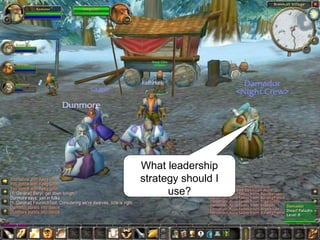
What leadership
strategy should I
use?
Not another
online
lecture.
Sorry, had you
on mute, could
you repeat the
question.
I am going to
need more
coffee.
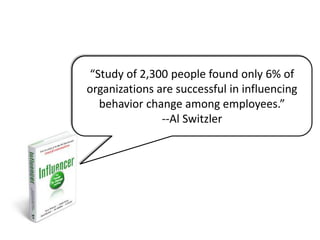
“Study of 2,300 people found only 6% of
organizations are successful in influencing
behavior change among employees.”
--Al Switzler
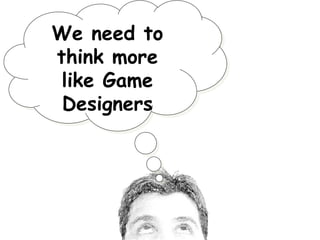
We need to
think more
like Game
Designers
The Dragon Slayer Mission
You are a game designer at SuperGame
Corporation which has hit some hard times lately.
It is Friday at 4:55 PM and you only have two things on you mind…
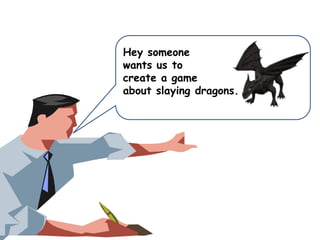
Hey someone
wants us to
create a game
about slaying dragons.
We are competing internally for the
project. Winning team earns the
right to work on the project.
Two Development Teams

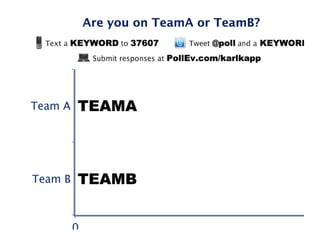
teama

teamb
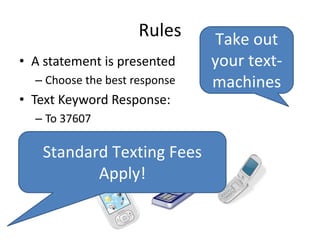
Rules
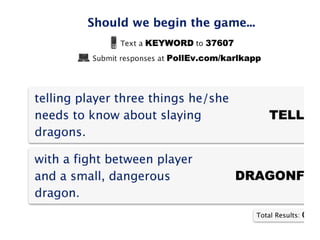
• A statement is presented
– Choose the best response

• Text Keyword Response:
– To 37607

Standard Texting Fees
Apply!

Take out
your textmachines
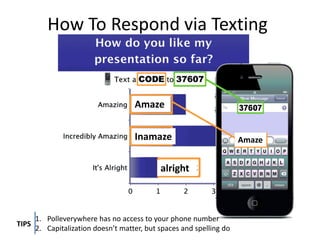
How To Respond via Texting

Amaze
Inamaze
alright

TIPS

1. Polleverywhere has no access to your phone number
2. Capitalization doesn’t matter, but spaces and spelling do

Amaze
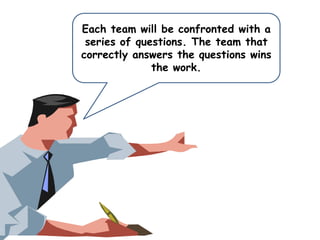
Each team will be confronted with a
series of questions. The team that
correctly answers the questions wins
the work.
What about the other team?
Losers are assigned to the
Watching Paint Dry game that’s
been under development.
Wow, I heard about that project,
its almost as fun as… never mind.
Dragon Slaying is much better.
First decision about this dragon slaying
game is how to start the game…what
should the players first in-game
experience be?
You have two choices:
Tell the player three things he/she needs to
know about slaying dragons.
or

Begin with a fight between the player and a
small, dangerous dragon.
Why does this answer make
sense?

Not Sure?
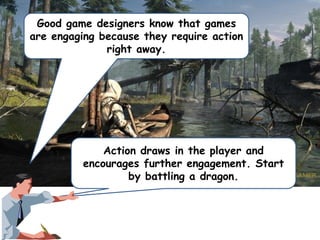
Good game designers know that games
are engaging because they require action
right away.

Action draws in the player and
encourages further engagement. Start
by battling a dragon.
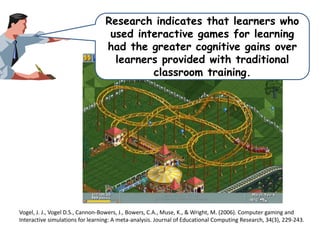
Research indicates that learners who
used interactive games for learning
had the greater cognitive gains over
learners provided with traditional
classroom training.

Vogel, J. J., Vogel D.S., Cannon-Bowers, J., Bowers, C.A., Muse, K., & Wright, M. (2006). Computer gaming and
Interactive simulations for learning: A meta-analysis. Journal of Educational Computing Research, 34(3), 229-243.
Too often instructional design is about
the content and not about the actions
that need to occur.
Game Design is about action.
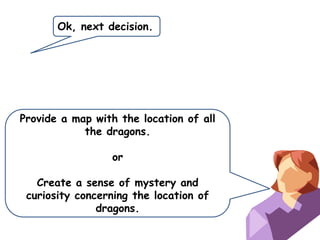
Ok, next decision.

Provide a map with the location of all
the dragons.
or
Create a sense of mystery and
curiosity concerning the location of
dragons.
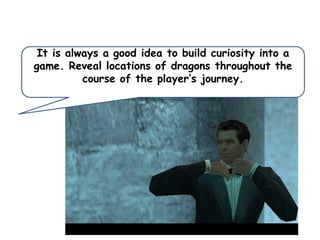
It is always a good idea to build curiosity into a
game. Reveal locations of dragons throughout the
course of the player’s journey.
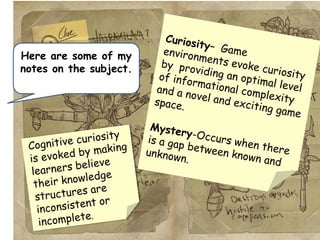
Here are some of my
notes on the subject.
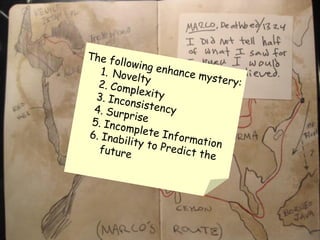
A sense of suspense, mystery
and intrigue draws people into
games and can draw them into
learning as well.
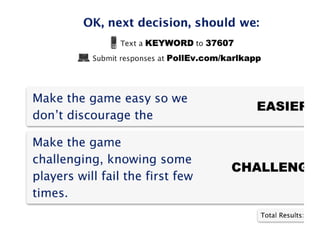
OK, next decision, should we:
Make the game easy so we don’t discourage the
players.
or

Make the game challenging, knowing some
players will fail the first few times.
It needs to be challenging.

Jones, B., Valdez, G., Norakowski, J., & Rasmussen, C. (1994). Designing learning and technology
for educational reform. North Central Regional Educational Laboratory. [Online]. Available:
http://www.ncrtec.org/capacity/profile/profwww.htm and Schlechty, P. C. (1997). Inventing
better schools: An action plan for educational reform. San Francisco, CA: Jossey-Bass. Chapter 2
“The Gamification of Learning and Instruction.”
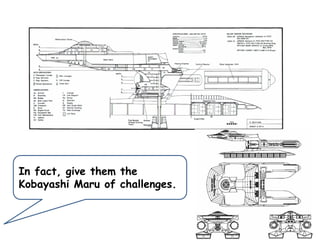
In fact, give them the
Kobayashi Maru of challenges.
Harsh!
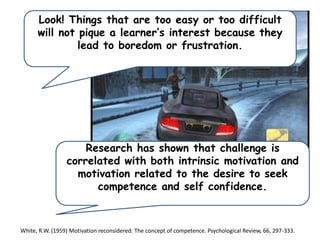
Look! Things that are too easy or too difficult
will not pique a learner’s interest because they
lead to boredom or frustration.

Research has shown that challenge is
correlated with both intrinsic motivation and
motivation related to the desire to seek
competence and self confidence.

White, R.W. (1959) Motivation reconsidered: The concept of competence. Psychological Review, 66, 297-333.
Well said!
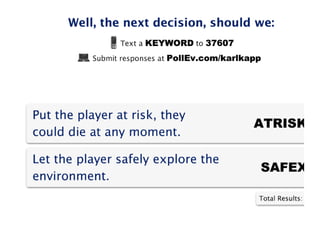
Well, the next decision, should we:
Put the player at risk, they could die at any
moment.
or
Let the player safely explore the environment.
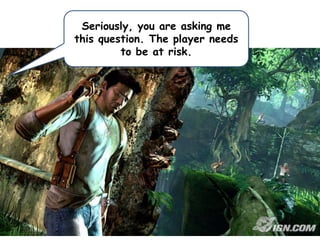
Seriously, you are asking me
this question. The player needs
to be at risk.
No risk, or danger equal no skin in
the game.

Get the player emotionally involved
by putting him or her at “mock”
risk.
In games, failing is allowed, it’s
acceptable, and it’s part of the
process. Games accommodate
failure with multiple lives, second
chances and alternative methods of
success.
Do you punish failure in your
learning design or do you allow and
encourage the freedom to fail?
Last decision, should we:

Give player choices about what level to enter
the game.
or
Create one path for every player.
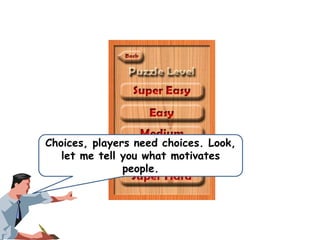
Choices, players need choices. Look,
let me tell you what motivates
people.
People are motivated when they have
autonomy, mastery and relatedness.
Hey, isn’t that the Self-Determination Theory?
Why, yes…yes it is.
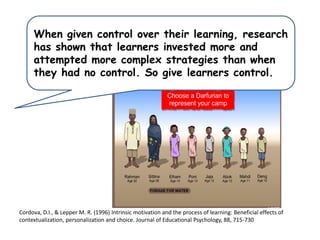
When given control over their learning, research
has shown that learners invested more and
attempted more complex strategies than when
they had no control. So give learners control.

Cordova, D.I., & Lepper M. R. (1996) Intrinsic motivation and the process of learning: Beneficial effects of
contextualization, personalization and choice. Journal of Educational Psychology, 88, 715-730
Lot of information, thanks. So let
me ask one more question.
Ok, so which team won?
Well, there all winners to me….
Ugh….
How about a re-cap…
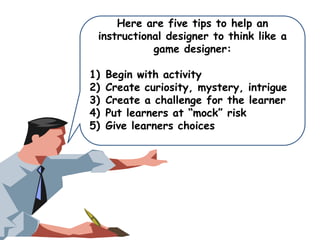
Here are five tips to help an
instructional designer to think like a
game designer:
1)
2)
3)
4)
5)

Begin with activity
Create curiosity, mystery, intrigue
Create a challenge for the learner
Put learners at “mock” risk
Give learners choices
Bonus information.
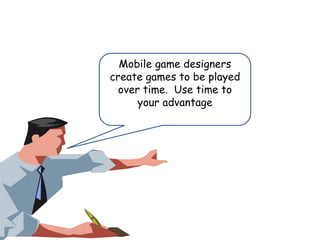
Mobile game designers
create games to be played
over time. Use time to
your advantage
A study using a randomized control group conducted a
trial between Aug 10, 2009, and Nov 30, 2012, at ten
sites in southeast India with over 500 subjects.

Working Indian men (aged 35—55 years) with impaired
glucose tolerance were randomly assigned to either a
mobile phone messaging intervention or standard care.

Ramachandran, A. et. al. Effectiveness of mobile phone messaging in prevention of type 2 diabetes by lifestyle modification in men in
India: a prospective, parallel-group, randomised controlled trial The Lancet Diabetes & Endocrinology, Early Online Publication, 11
September 2013 doi:10.1016/S2213-8587(13)70067-6
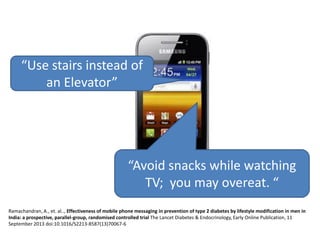
“Use stairs instead of
an Elevator”

“Avoid snacks while watching
TV; you may overeat. “
Ramachandran, A., et. al.., Effectiveness of mobile phone messaging in prevention of type 2 diabetes by lifestyle modification in men in
India: a prospective, parallel-group, randomised controlled trial The Lancet Diabetes & Endocrinology, Early Online Publication, 11
September 2013 doi:10.1016/S2213-8587(13)70067-6
Lowered risk of developing
Type 2 diabetes by 36%.

Ramachandran, A., et. al.., Effectiveness of mobile phone messaging in prevention of type 2 diabetes by lifestyle modification in men in
India: a prospective, parallel-group, randomised controlled trial The Lancet Diabetes & Endocrinology, Early Online Publication, 11
September 2013 doi:10.1016/S2213-8587(13)70067-6
Larsen DP, Butler AC, Roediger HL 3rd. Repeated testing improves long-term retention relative to repeated study: a randomized controlled
trial. Med Educ 43: 1174–1181, 2009.
Dobson, J. L. (2013) Retrieval practice is an efficient method of enhancing the retention of anatomy and physiology information Advances
in Physiology Education 37: 184–191, 2013; doi:10.1152/advan.00174.2012.
Covert Takeaway Challenge
Copy of Slides and Notes available at
www.karlkapp.com

Contact Karl at:
kkapp@bloomu.edu
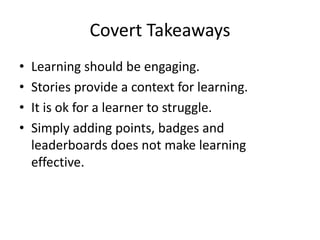
Covert Takeaways
•
•
•
•

Learning should be engaging.
Stories provide a context for learning.
It is ok for a learner to struggle.
Simply adding points, badges and
leaderboards does not make learning
effective.

Five Things Game Designers Can Teach eLearning Designers

  • 1.
    Five Things Instructional DesignersCan Learn from Game Designers By Karl M. Kapp Bloomsburg University Gamification of Learning &Instruction EMAIL: kkapp@bloomu.edu TWITTER: @kkapp BLOG: http://karlkapp.com/kapp-notes/
  • 3.
  • 4.
  • 5.
  • 9.
    What variables doI balance to keep my person happy? Work Life Harmony How should I manage my time?
  • 10.
  • 12.
  • 13.
    Sorry, had you onmute, could you repeat the question.
  • 14.
    I am goingto need more coffee.
  • 15.
    “Study of 2,300people found only 6% of organizations are successful in influencing behavior change among employees.” --Al Switzler
  • 16.
    We need to thinkmore like Game Designers
  • 17.
  • 18.
    You are agame designer at SuperGame Corporation which has hit some hard times lately.
  • 19.
    It is Fridayat 4:55 PM and you only have two things on you mind…
  • 20.
    Hey someone wants usto create a game about slaying dragons.
  • 21.
    We are competinginternally for the project. Winning team earns the right to work on the project.
  • 22.
  • 23.
    Rules • A statementis presented – Choose the best response • Text Keyword Response: – To 37607 Standard Texting Fees Apply! Take out your textmachines
  • 24.
    How To Respondvia Texting Amaze Inamaze alright TIPS 1. Polleverywhere has no access to your phone number 2. Capitalization doesn’t matter, but spaces and spelling do Amaze
  • 26.
    Each team willbe confronted with a series of questions. The team that correctly answers the questions wins the work.
  • 27.
    What about theother team?
  • 28.
    Losers are assignedto the Watching Paint Dry game that’s been under development.
  • 29.
    Wow, I heardabout that project, its almost as fun as… never mind. Dragon Slaying is much better.
  • 30.
    First decision aboutthis dragon slaying game is how to start the game…what should the players first in-game experience be?
  • 31.
    You have twochoices: Tell the player three things he/she needs to know about slaying dragons. or Begin with a fight between the player and a small, dangerous dragon.
  • 33.
    Why does thisanswer make sense? Not Sure?
  • 34.
    Good game designersknow that games are engaging because they require action right away. Action draws in the player and encourages further engagement. Start by battling a dragon.
  • 35.
    Research indicates thatlearners who used interactive games for learning had the greater cognitive gains over learners provided with traditional classroom training. Vogel, J. J., Vogel D.S., Cannon-Bowers, J., Bowers, C.A., Muse, K., & Wright, M. (2006). Computer gaming and Interactive simulations for learning: A meta-analysis. Journal of Educational Computing Research, 34(3), 229-243.
  • 36.
    Too often instructionaldesign is about the content and not about the actions that need to occur. Game Design is about action.
  • 37.
    Ok, next decision. Providea map with the location of all the dragons. or Create a sense of mystery and curiosity concerning the location of dragons.
  • 39.
    It is alwaysa good idea to build curiosity into a game. Reveal locations of dragons throughout the course of the player’s journey.
  • 40.
    Here are someof my notes on the subject.
  • 42.
    A sense ofsuspense, mystery and intrigue draws people into games and can draw them into learning as well.
  • 43.
    OK, next decision,should we: Make the game easy so we don’t discourage the players. or Make the game challenging, knowing some players will fail the first few times.
  • 45.
    It needs tobe challenging. Jones, B., Valdez, G., Norakowski, J., & Rasmussen, C. (1994). Designing learning and technology for educational reform. North Central Regional Educational Laboratory. [Online]. Available: http://www.ncrtec.org/capacity/profile/profwww.htm and Schlechty, P. C. (1997). Inventing better schools: An action plan for educational reform. San Francisco, CA: Jossey-Bass. Chapter 2 “The Gamification of Learning and Instruction.”
  • 46.
    In fact, givethem the Kobayashi Maru of challenges.
  • 47.
  • 48.
    Look! Things thatare too easy or too difficult will not pique a learner’s interest because they lead to boredom or frustration. Research has shown that challenge is correlated with both intrinsic motivation and motivation related to the desire to seek competence and self confidence. White, R.W. (1959) Motivation reconsidered: The concept of competence. Psychological Review, 66, 297-333.
  • 49.
  • 50.
    Well, the nextdecision, should we: Put the player at risk, they could die at any moment. or Let the player safely explore the environment.
  • 52.
    Seriously, you areasking me this question. The player needs to be at risk.
  • 53.
    No risk, ordanger equal no skin in the game. Get the player emotionally involved by putting him or her at “mock” risk.
  • 54.
    In games, failingis allowed, it’s acceptable, and it’s part of the process. Games accommodate failure with multiple lives, second chances and alternative methods of success.
  • 55.
    Do you punishfailure in your learning design or do you allow and encourage the freedom to fail?
  • 56.
    Last decision, shouldwe: Give player choices about what level to enter the game. or Create one path for every player.
  • 58.
    Choices, players needchoices. Look, let me tell you what motivates people.
  • 59.
    People are motivatedwhen they have autonomy, mastery and relatedness.
  • 60.
    Hey, isn’t thatthe Self-Determination Theory?
  • 61.
  • 62.
    When given controlover their learning, research has shown that learners invested more and attempted more complex strategies than when they had no control. So give learners control. Cordova, D.I., & Lepper M. R. (1996) Intrinsic motivation and the process of learning: Beneficial effects of contextualization, personalization and choice. Journal of Educational Psychology, 88, 715-730
  • 63.
    Lot of information,thanks. So let me ask one more question.
  • 64.
    Ok, so whichteam won?
  • 65.
    Well, there allwinners to me….
  • 66.
  • 67.
    How about are-cap…
  • 68.
    Here are fivetips to help an instructional designer to think like a game designer: 1) 2) 3) 4) 5) Begin with activity Create curiosity, mystery, intrigue Create a challenge for the learner Put learners at “mock” risk Give learners choices
  • 69.
  • 70.
    Mobile game designers creategames to be played over time. Use time to your advantage
  • 71.
    A study usinga randomized control group conducted a trial between Aug 10, 2009, and Nov 30, 2012, at ten sites in southeast India with over 500 subjects. Working Indian men (aged 35—55 years) with impaired glucose tolerance were randomly assigned to either a mobile phone messaging intervention or standard care. Ramachandran, A. et. al. Effectiveness of mobile phone messaging in prevention of type 2 diabetes by lifestyle modification in men in India: a prospective, parallel-group, randomised controlled trial The Lancet Diabetes & Endocrinology, Early Online Publication, 11 September 2013 doi:10.1016/S2213-8587(13)70067-6
  • 72.
    “Use stairs insteadof an Elevator” “Avoid snacks while watching TV; you may overeat. “ Ramachandran, A., et. al.., Effectiveness of mobile phone messaging in prevention of type 2 diabetes by lifestyle modification in men in India: a prospective, parallel-group, randomised controlled trial The Lancet Diabetes & Endocrinology, Early Online Publication, 11 September 2013 doi:10.1016/S2213-8587(13)70067-6
  • 73.
    Lowered risk ofdeveloping Type 2 diabetes by 36%. Ramachandran, A., et. al.., Effectiveness of mobile phone messaging in prevention of type 2 diabetes by lifestyle modification in men in India: a prospective, parallel-group, randomised controlled trial The Lancet Diabetes & Endocrinology, Early Online Publication, 11 September 2013 doi:10.1016/S2213-8587(13)70067-6
  • 74.
    Larsen DP, ButlerAC, Roediger HL 3rd. Repeated testing improves long-term retention relative to repeated study: a randomized controlled trial. Med Educ 43: 1174–1181, 2009. Dobson, J. L. (2013) Retrieval practice is an efficient method of enhancing the retention of anatomy and physiology information Advances in Physiology Education 37: 184–191, 2013; doi:10.1152/advan.00174.2012.
  • 75.
  • 78.
    Copy of Slidesand Notes available at www.karlkapp.com Contact Karl at: kkapp@bloomu.edu
  • 79.
    Covert Takeaways • • • • Learning shouldbe engaging. Stories provide a context for learning. It is ok for a learner to struggle. Simply adding points, badges and leaderboards does not make learning effective.