Staff Development
by
James Lake
IMPACTS ON LEARNING AND
INSTRUCTION
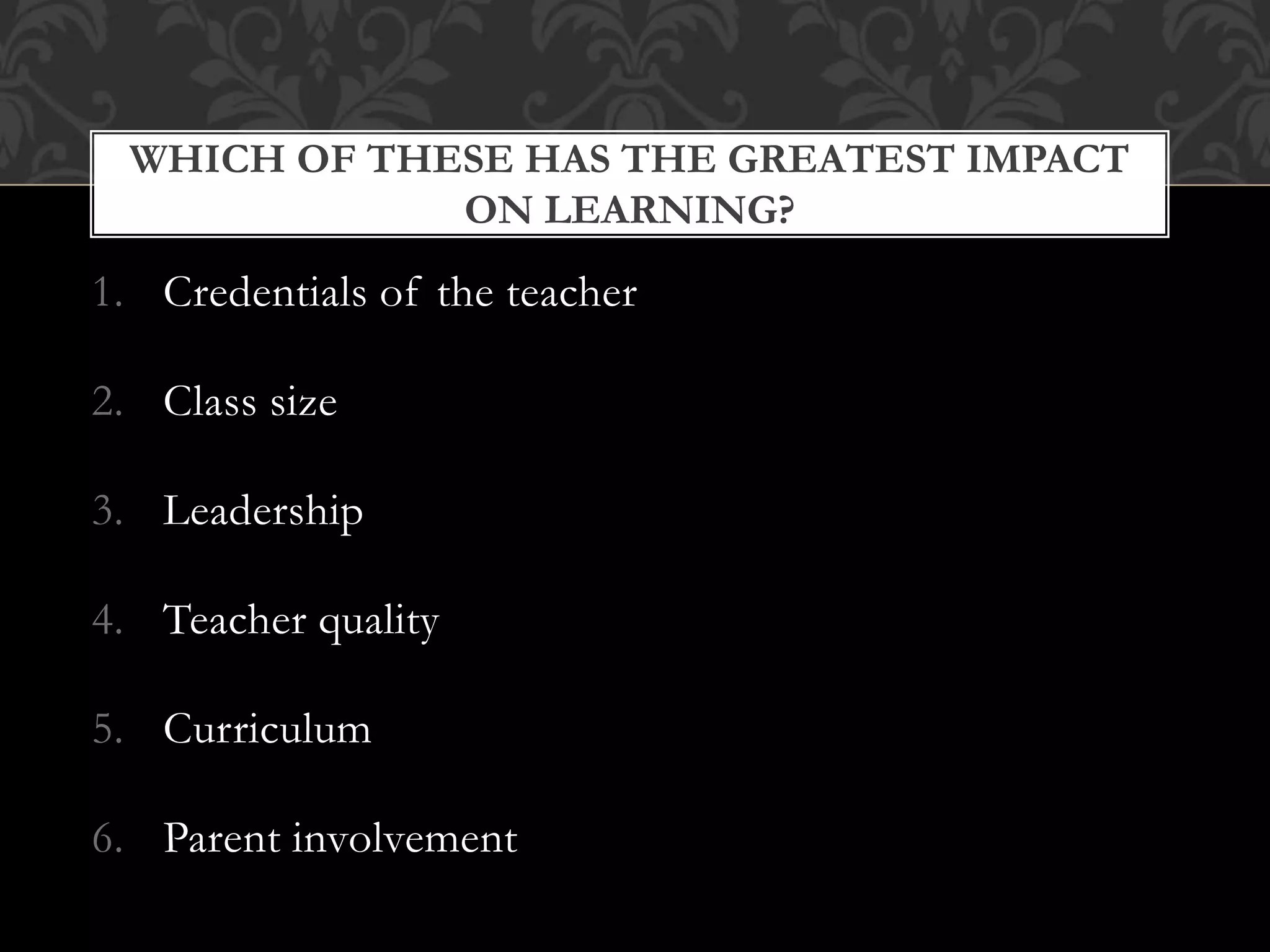
1. Credentials of the teacher
2. Class size
3. Leadership
4. Teacher quality
5. Curriculum
6. Parent involvement
WHICH OF THESE HAS THE GREATEST IMPACT
ON LEARNING?
K-12 Study over 2 years
Synthesis of 35 years of high profile research
studies
Looked at students entering at the 50th percentile
and spending 2 years in different types of schools
with different types of teachers.
ROBERT MARZANO’S RESEARCH (2003)
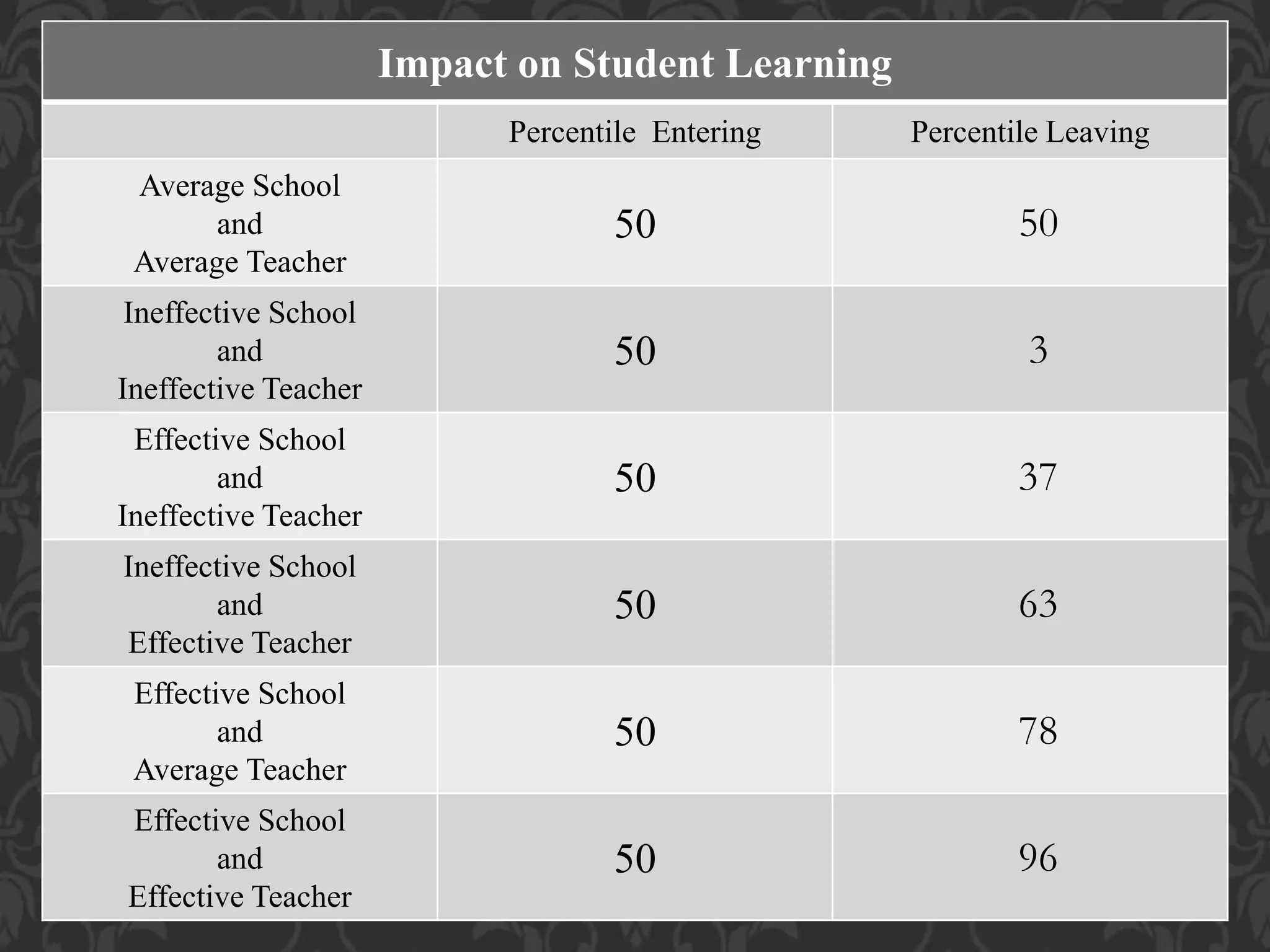
Impact on Student Learning
Percentile Entering Percentile Leaving
Average School
and
Average Teacher
50
Ineffective School
and
Ineffective Teacher
50
Effective School
and
Ineffective Teacher
50
Ineffective School
and
Effective Teacher
50
Effective School
and
Average Teacher
50
Effective School
and
Effective Teacher
50
50
3
37
78
96
63
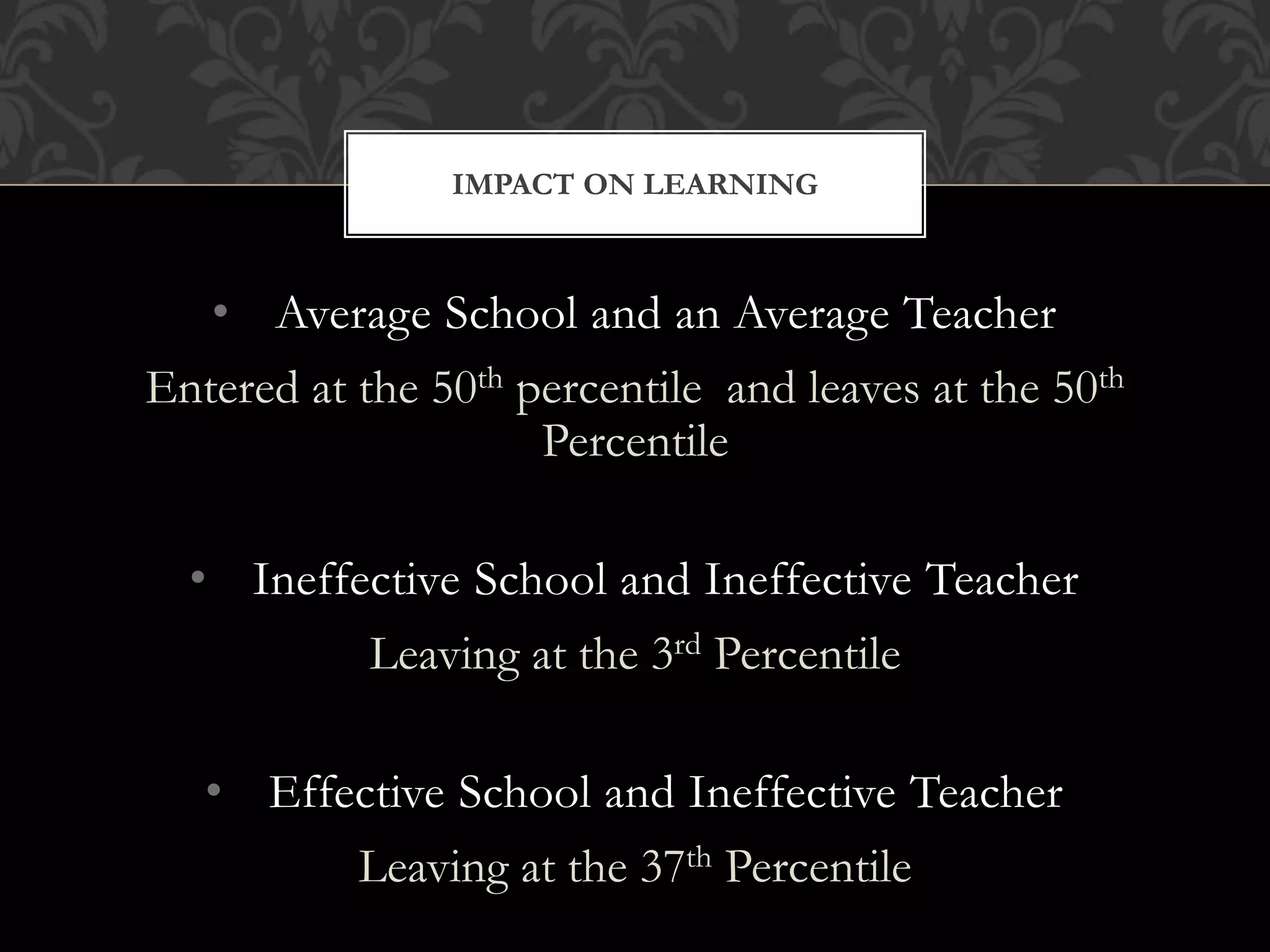
• Average School and an Average Teacher
Entered at the 50th percentile and leaves at the 50th
Percentile
• Ineffective School and Ineffective Teacher
Leaving at the 3rd Percentile
• Effective School and Ineffective Teacher
Leaving at the 37th Percentile
IMPACT ON LEARNING
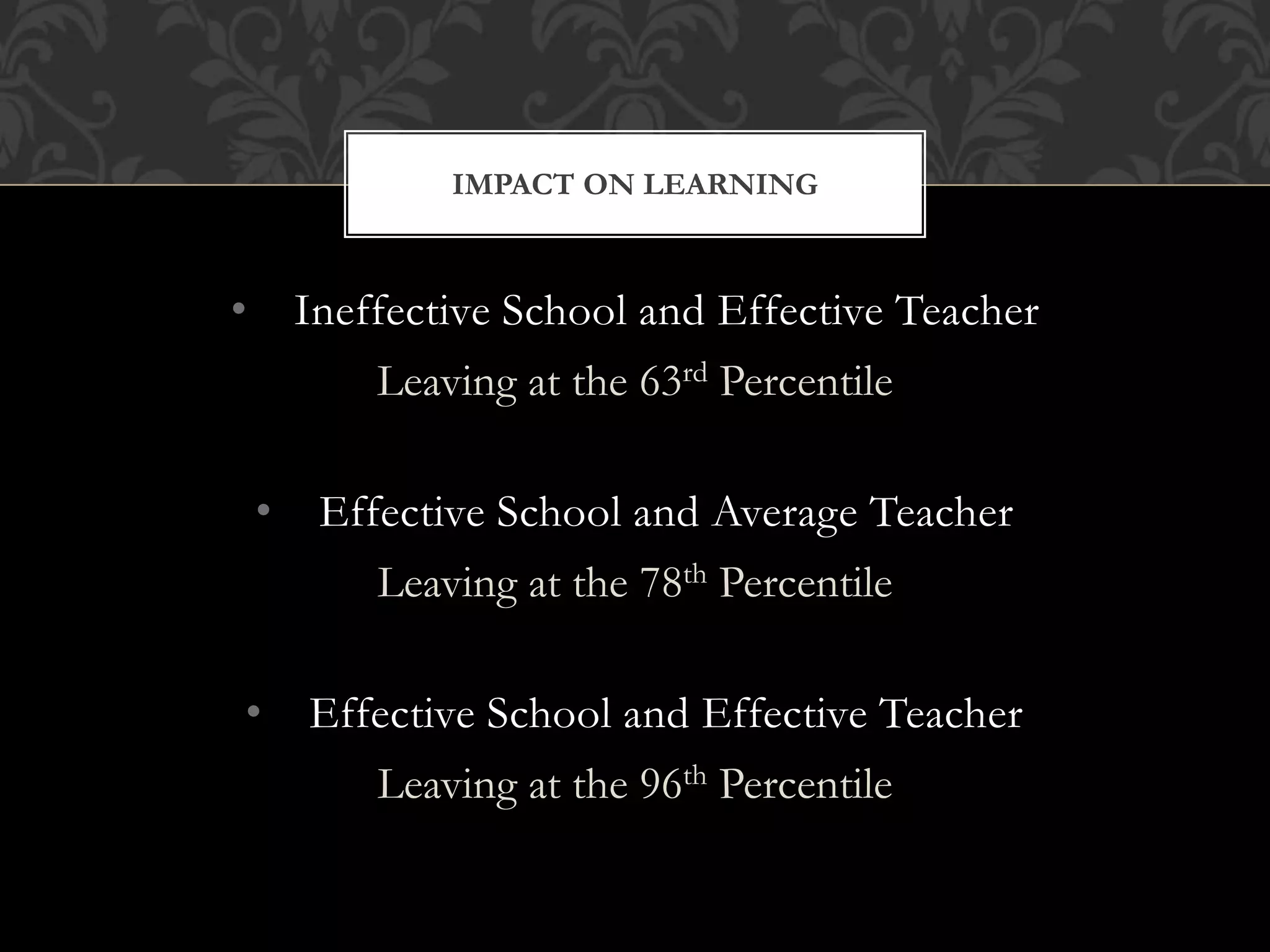
• Ineffective School and Effective Teacher
Leaving at the 63rd Percentile
• Effective School and Average Teacher
Leaving at the 78th Percentile
• Effective School and Effective Teacher
Leaving at the 96th Percentile
IMPACT ON LEARNING
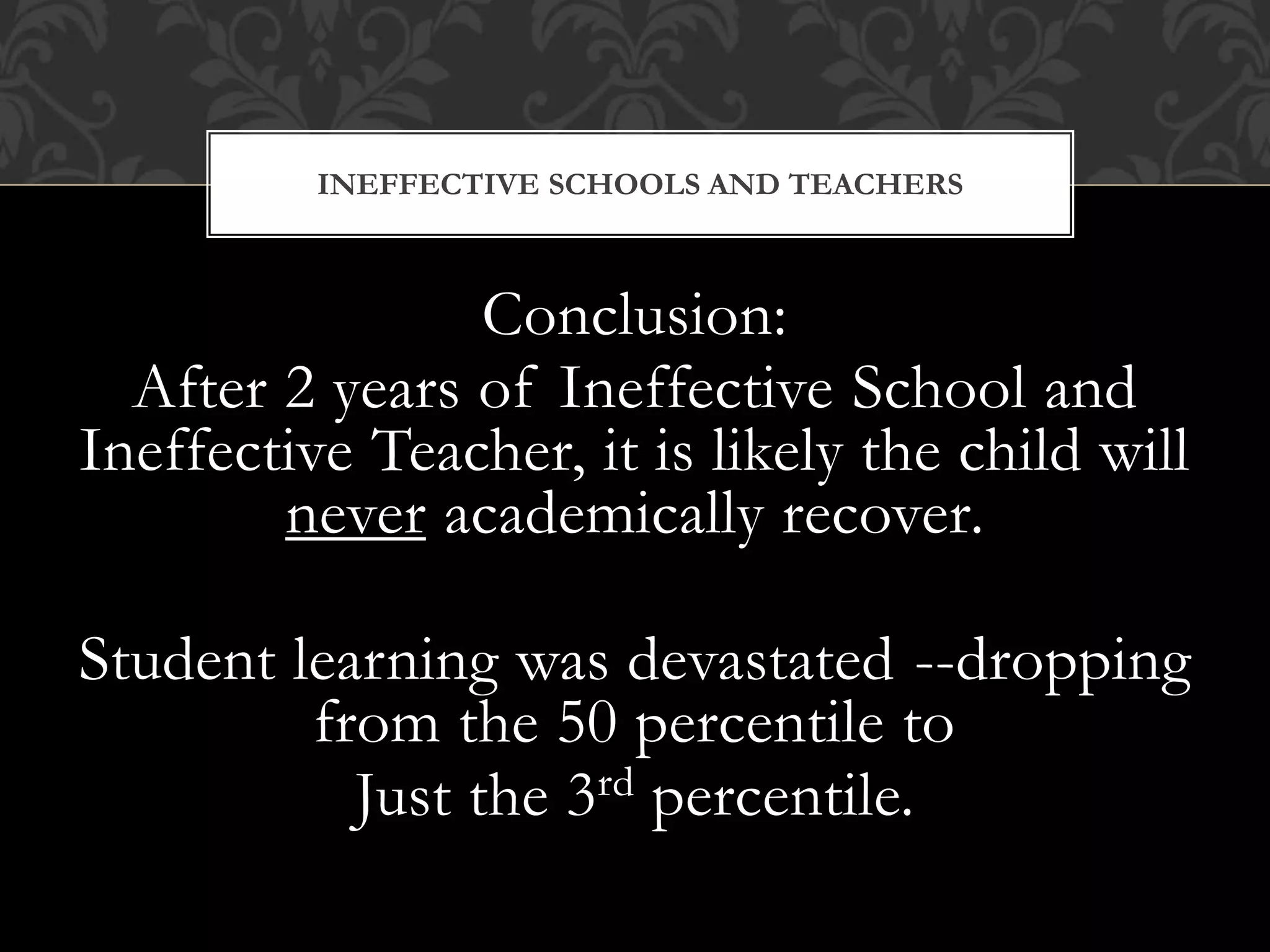
Conclusion:
After 2 years of Ineffective School and
Ineffective Teacher, it is likely the child will
never academically recover.
Student learning was devastated --dropping
from the 50 percentile to
Just the 3rd percentile.
INEFFECTIVE SCHOOLS AND TEACHERS
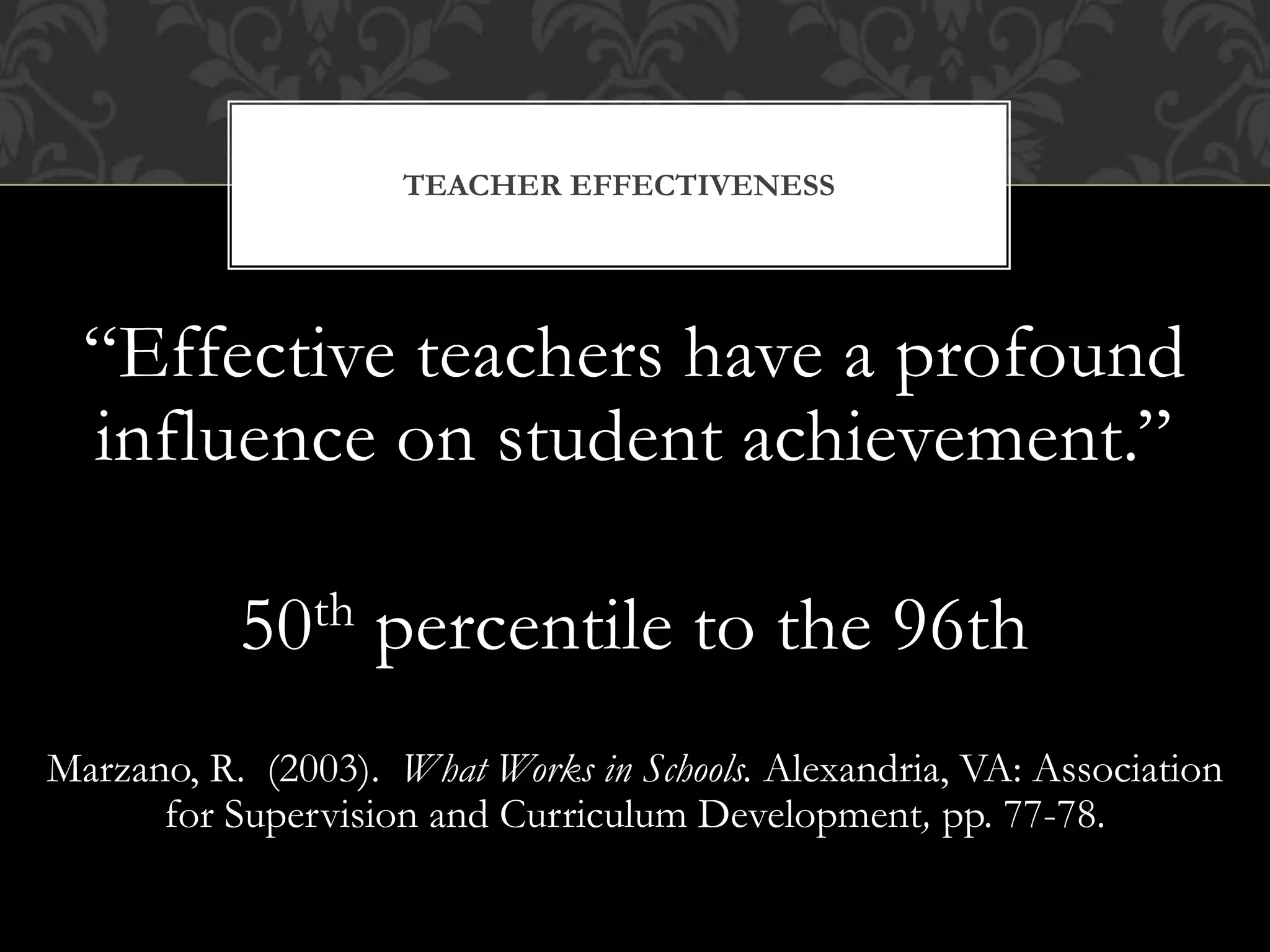
“Effective teachers have a profound
influence on student achievement.”
50th percentile to the 96th
Marzano, R. (2003). What Works in Schools. Alexandria, VA: Association
for Supervision and Curriculum Development, pp. 77-78.
TEACHER EFFECTIVENESS
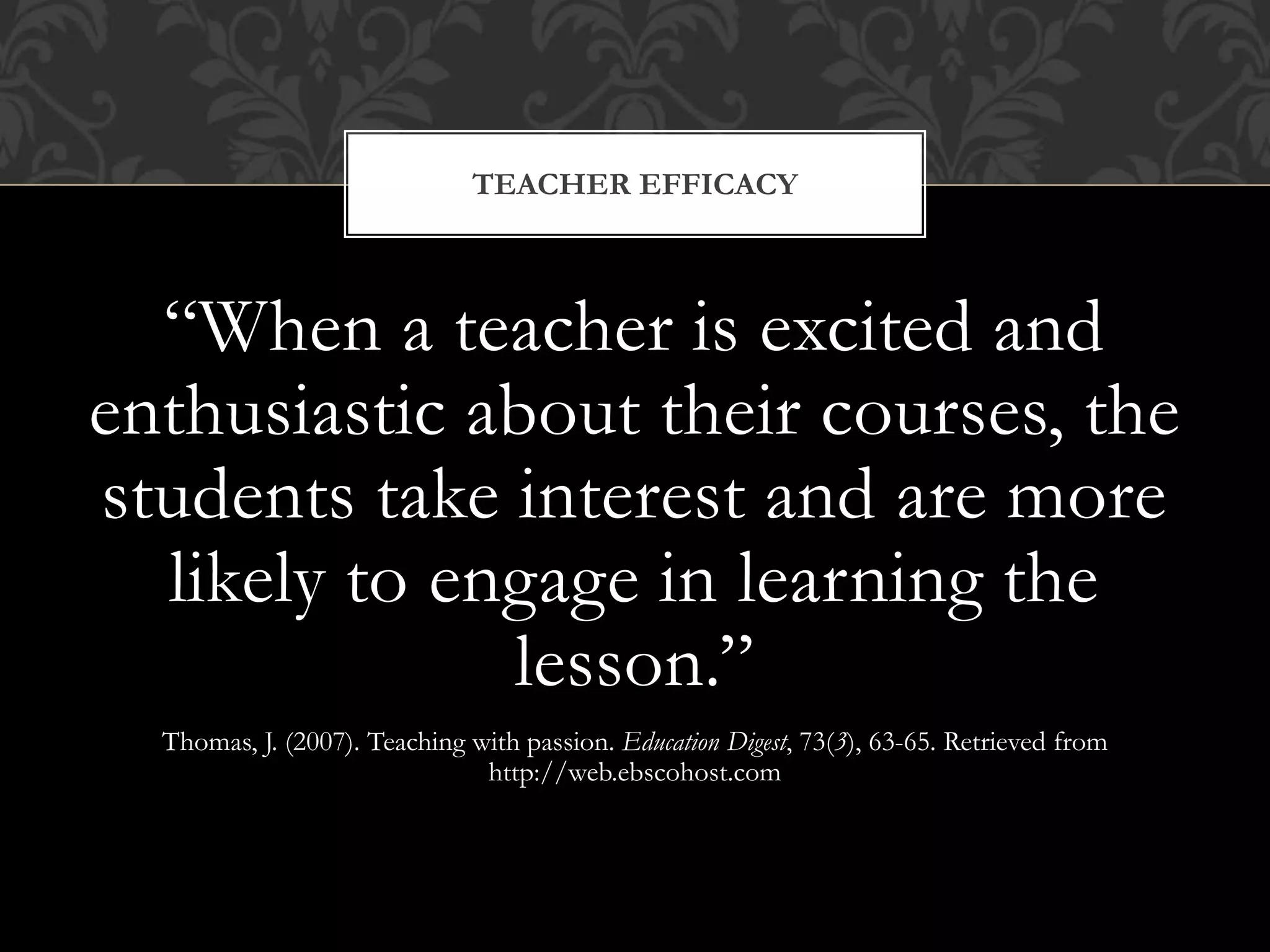
“When a teacher is excited and
enthusiastic about their courses, the
students take interest and are more
likely to engage in learning the
lesson.”
Thomas, J. (2007). Teaching with passion. Education Digest, 73(3), 63-65. Retrieved from
http://web.ebscohost.com
TEACHER EFFICACY
Schools must become focused on
teacher-directed instruction and
professional collaboration to
improve student learning.
OBJECTIVE
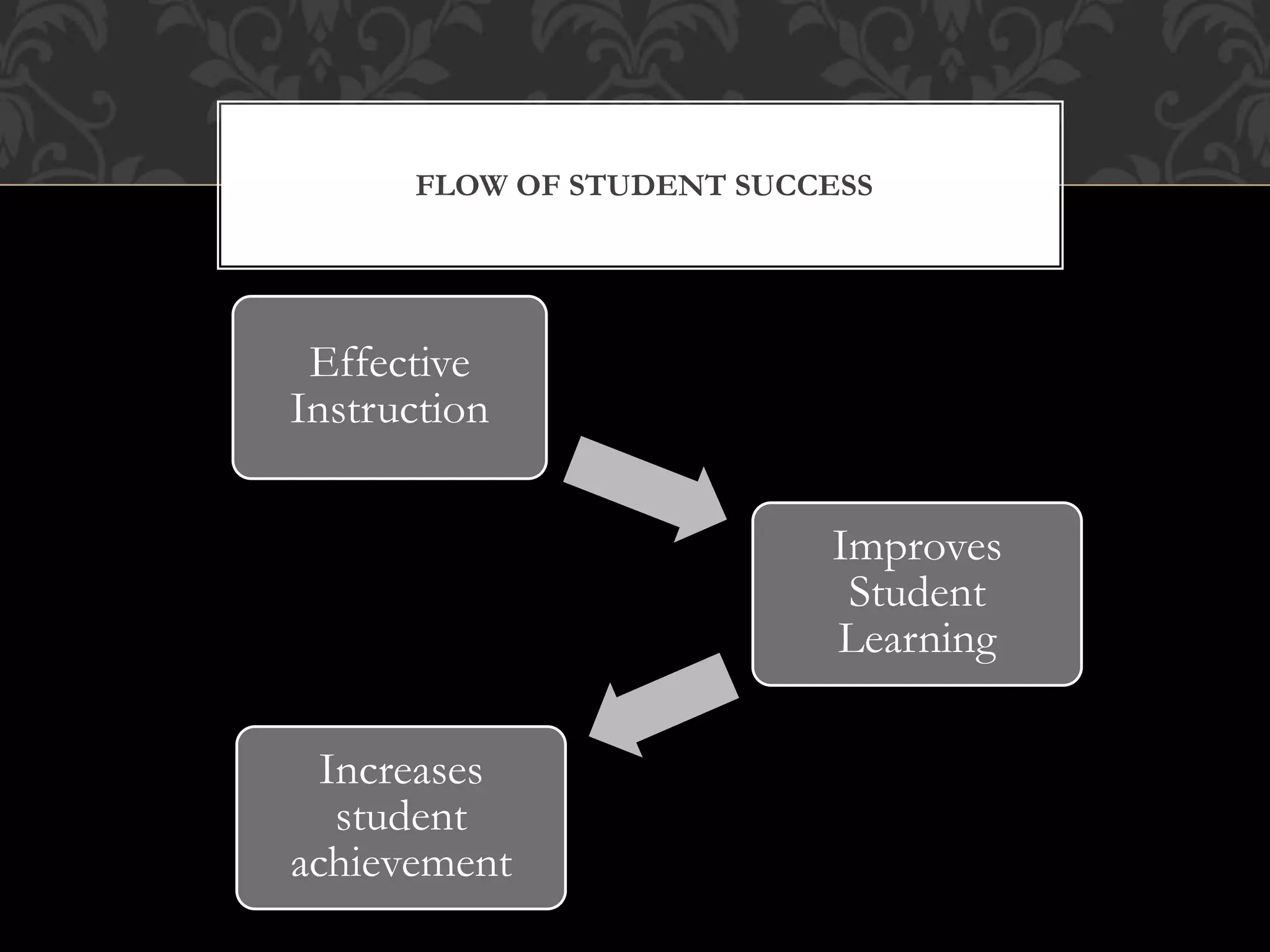
Effective
Instruction
Improves
Student
Learning
Increases
student
achievement
FLOW OF STUDENT SUCCESS
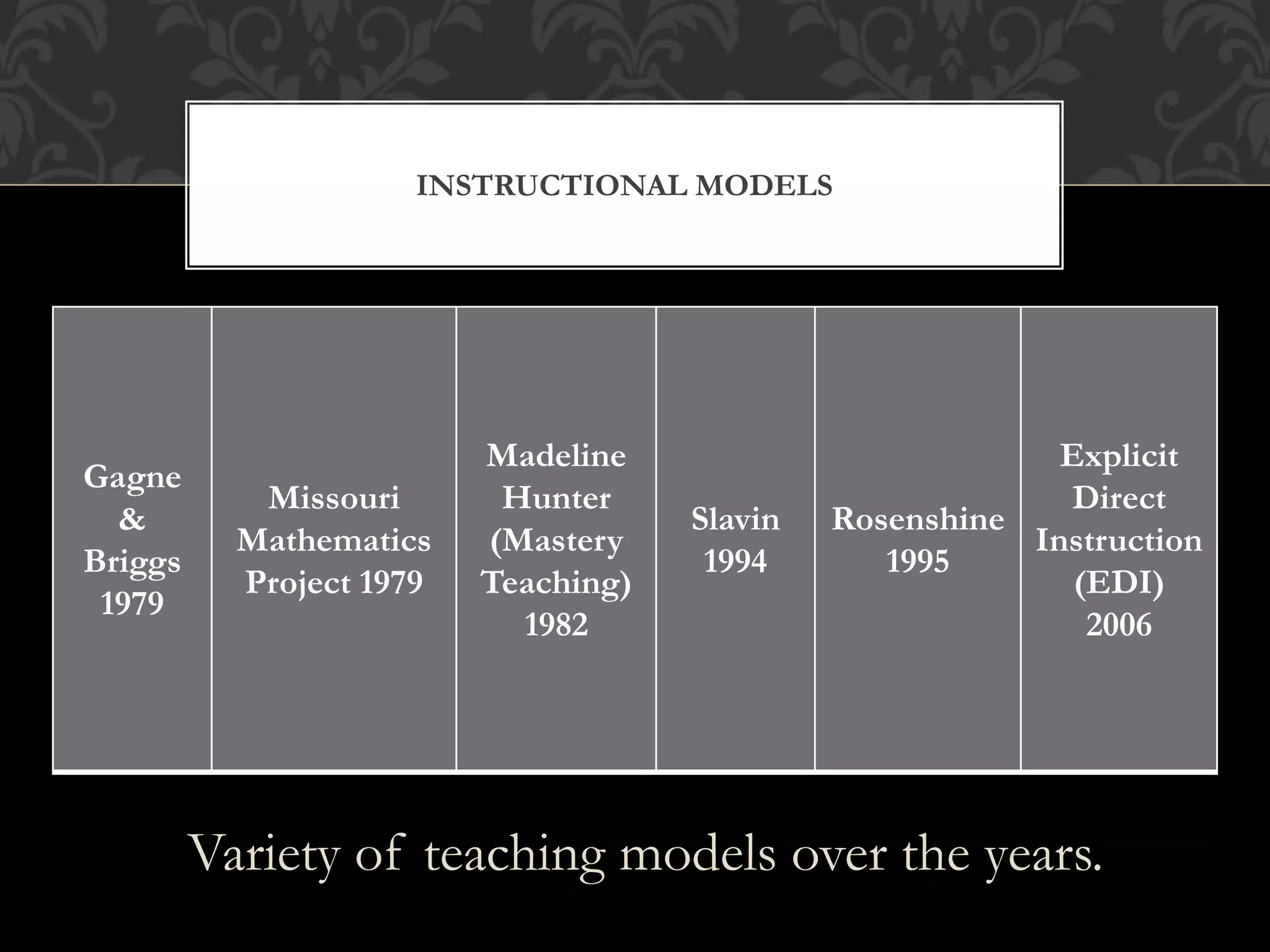
Gagne
&
Briggs
1979
Missouri
Mathematics
Project 1979
Madeline
Hunter
(Mastery
Teaching)
1982
Slavin
1994
Rosenshine
1995
Explicit
Direct
Instruction
(EDI)
2006
INSTRUCTIONAL MODELS
Variety of teaching models over the years.
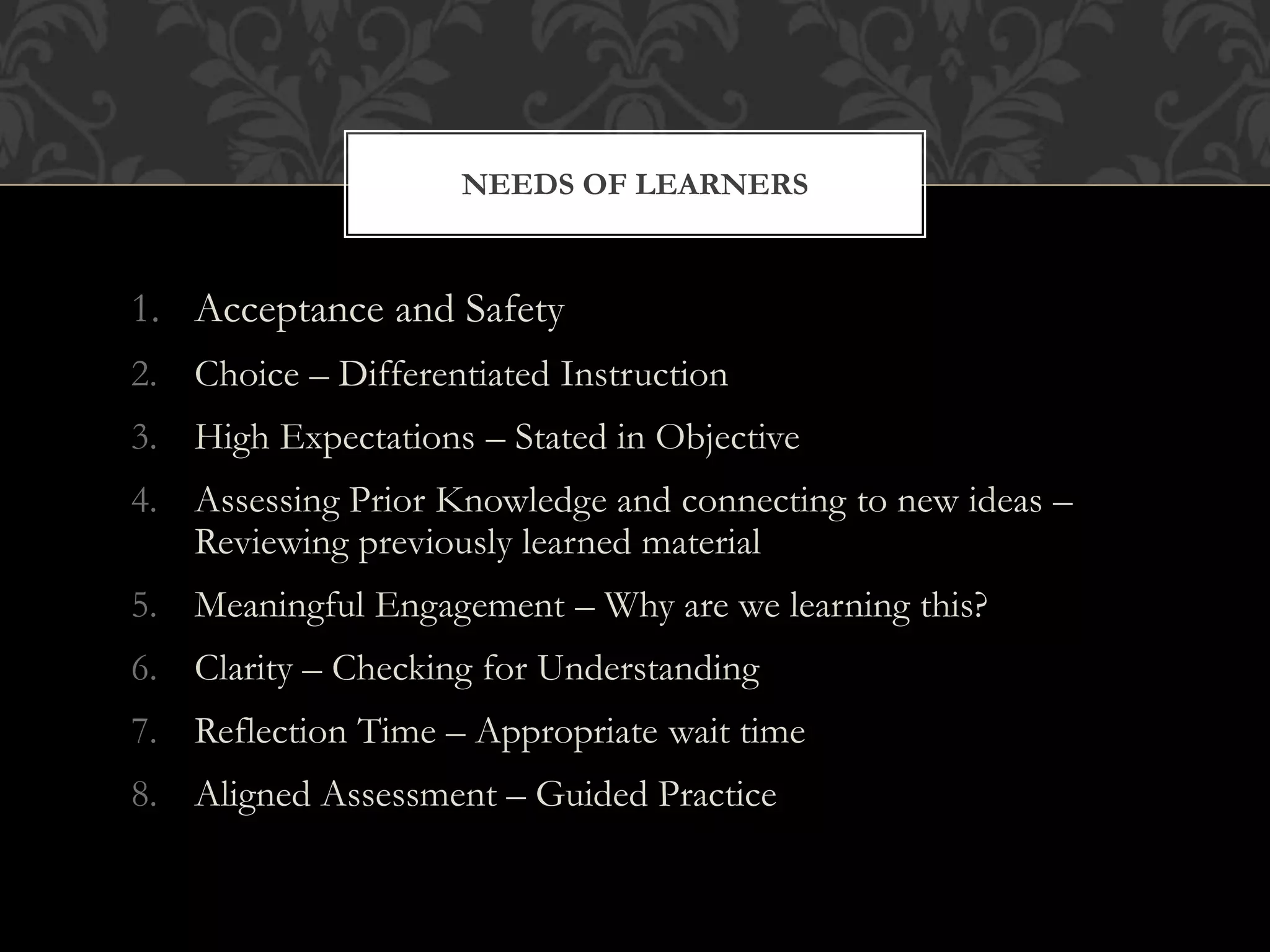
1. Acceptance and Safety
2. Choice – Differentiated Instruction
3. High Expectations – Stated in Objective
4. Assessing Prior Knowledge and connecting to new ideas –
Reviewing previously learned material
5. Meaningful Engagement – Why are we learning this?
6. Clarity – Checking for Understanding
7. Reflection Time – Appropriate wait time
8. Aligned Assessment – Guided Practice
NEEDS OF LEARNERS
Learning Objectives: A statement describing what
students will be able to do by the end of the lesson. It
must match the Independent Practice and be clearly stated
to the students and frequently revisited.
Activate Prior Knowledge: Purposefully moving
something connected to the new lesson from students’ long
term memories into their working memories so they can
build upon existing knowledge.
Concept/Skill Development: Teaching students the
concepts contained in the Learning Objective or the skills
necessary to execute the Learning Objective. Teach the
students how to do it.
INSTRUCTIONAL STRATEGIES
Guided Practice: Working problems with students at the same
time, step by step, while checking for understanding that they
are executing each step correctly.
Lesson Closure: Having Students work problems or answer
questions to prove that they have learned the concepts and skills
in the Learning Objective before they are given independent
practice.
Independent Practice: Having students successfully practice
what they were just taught.
Note Taking: Engages students in lesson, organization, and
reference material (e.g. Cornell Notes).
INSTRUCTIONAL STRATEGIES CONT.
1. Review previously learned material
2. State and re-state objective frequently throughout the
lesson
3. Present new material
4. Provide guided practice, assess performance, and give
corrective feedback
5. Assign independent practice, assess performance, and
give corrective feedback
6. Review previously learned material – provide
corrective feedback
DIRECT INSTRUCTIONAL MODEL
Teach First
Ask a Question
Pause
Pick a Non-Volunteer
Listen to the Response
Effective Feedback (Echo, Elaborate, Explain)
T.A.P.P.L.E.
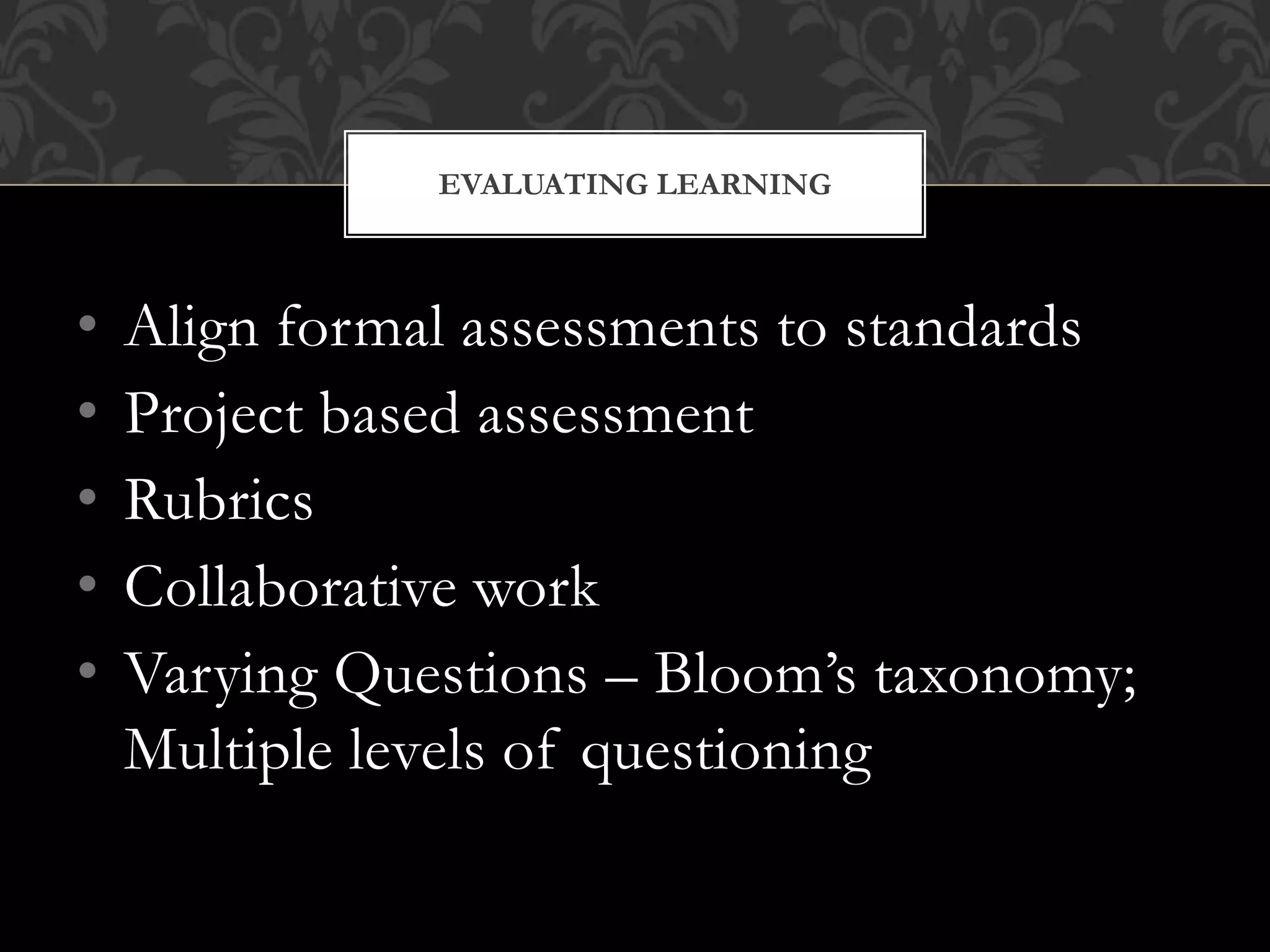
• Align formal assessments to standards
• Project based assessment
• Rubrics
• Collaborative work
• Varying Questions – Bloom’s taxonomy;
Multiple levels of questioning
EVALUATING LEARNING
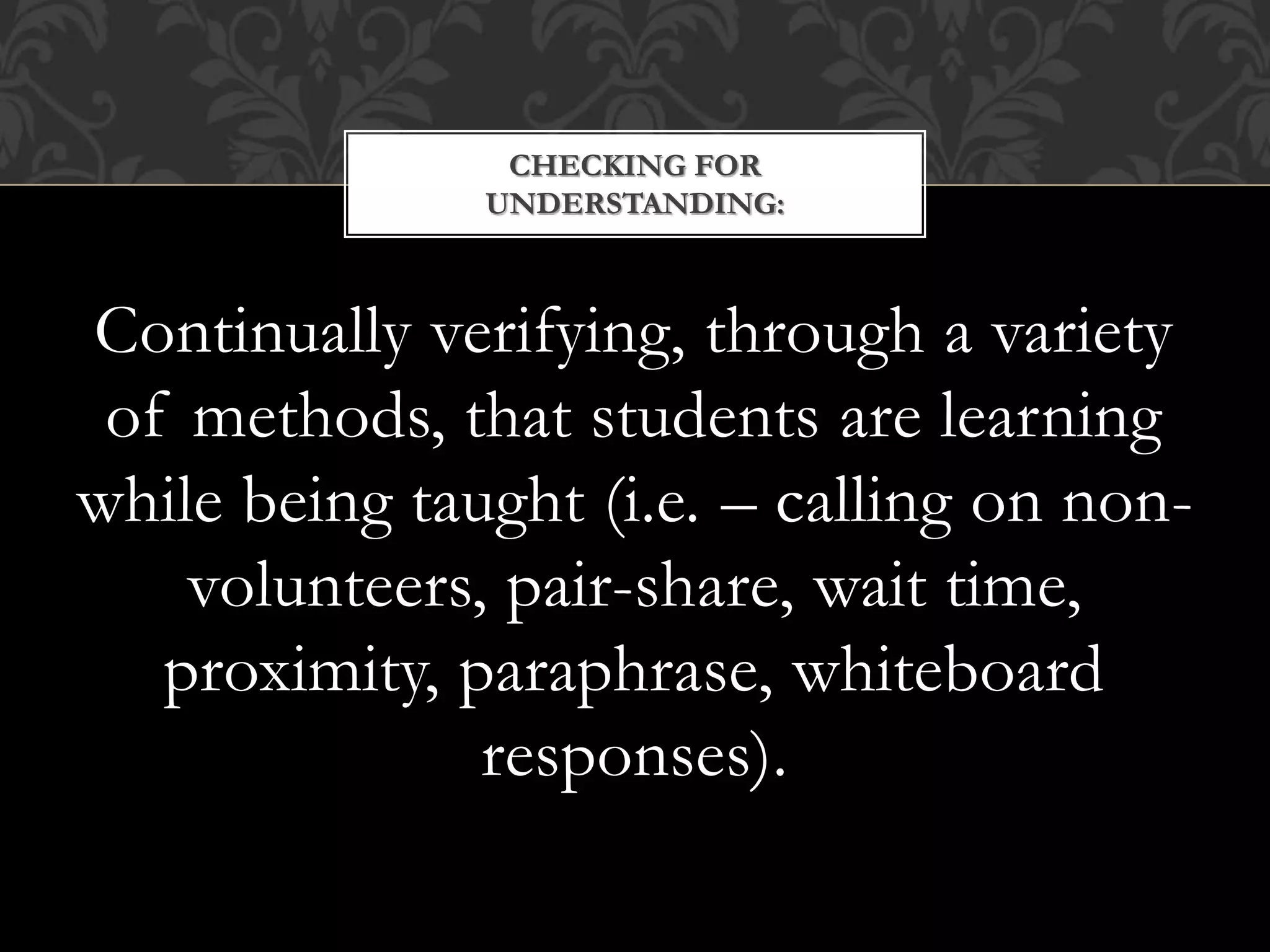
Continually verifying, through a variety
of methods, that students are learning
while being taught (i.e. – calling on non-
volunteers, pair-share, wait time,
proximity, paraphrase, whiteboard
responses).
CHECKING FOR
UNDERSTANDING:
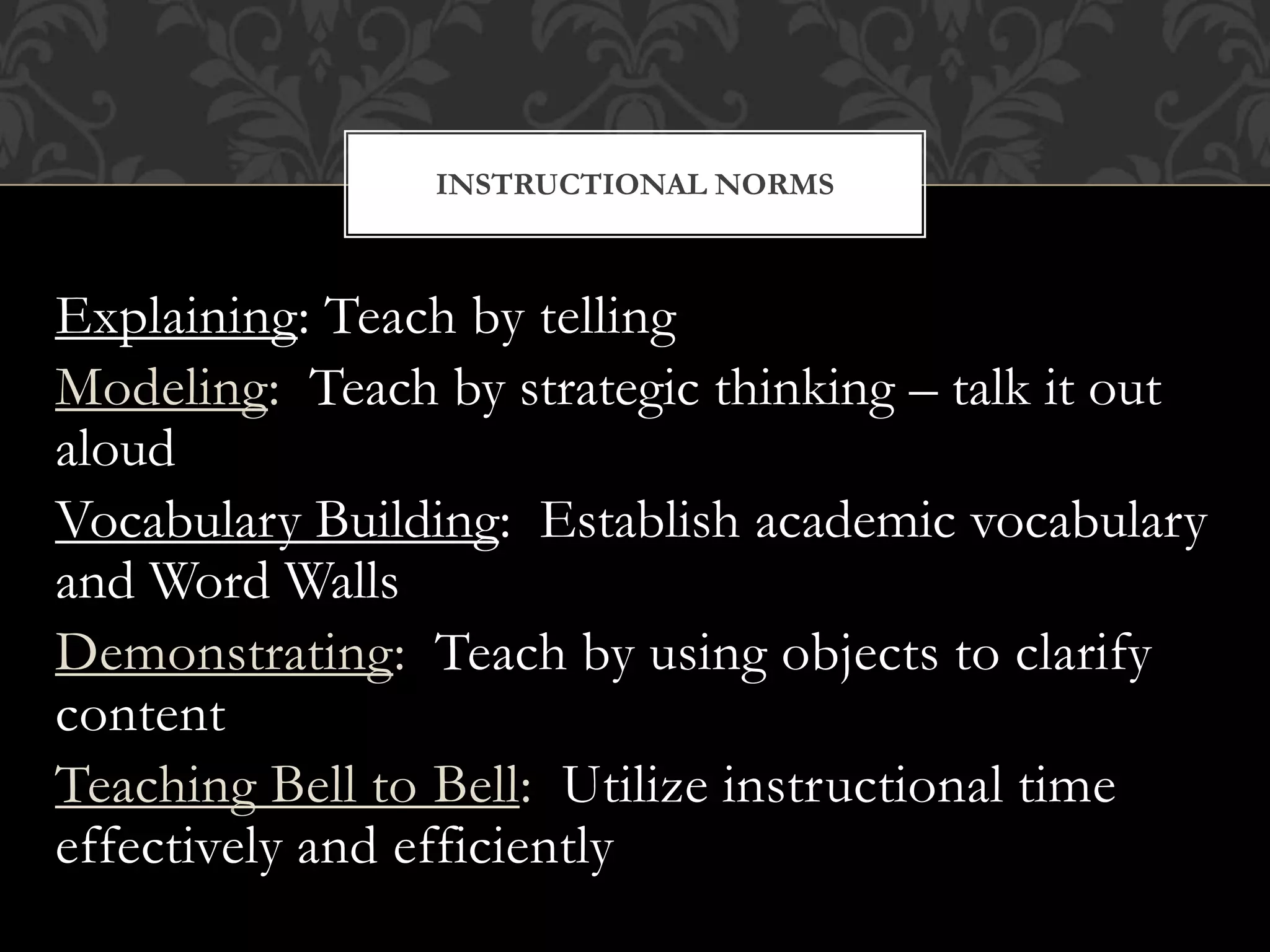
Explaining: Teach by telling
Modeling: Teach by strategic thinking – talk it out
aloud
Vocabulary Building: Establish academic vocabulary
and Word Walls
Demonstrating: Teach by using objects to clarify
content
Teaching Bell to Bell: Utilize instructional time
effectively and efficiently
INSTRUCTIONAL NORMS
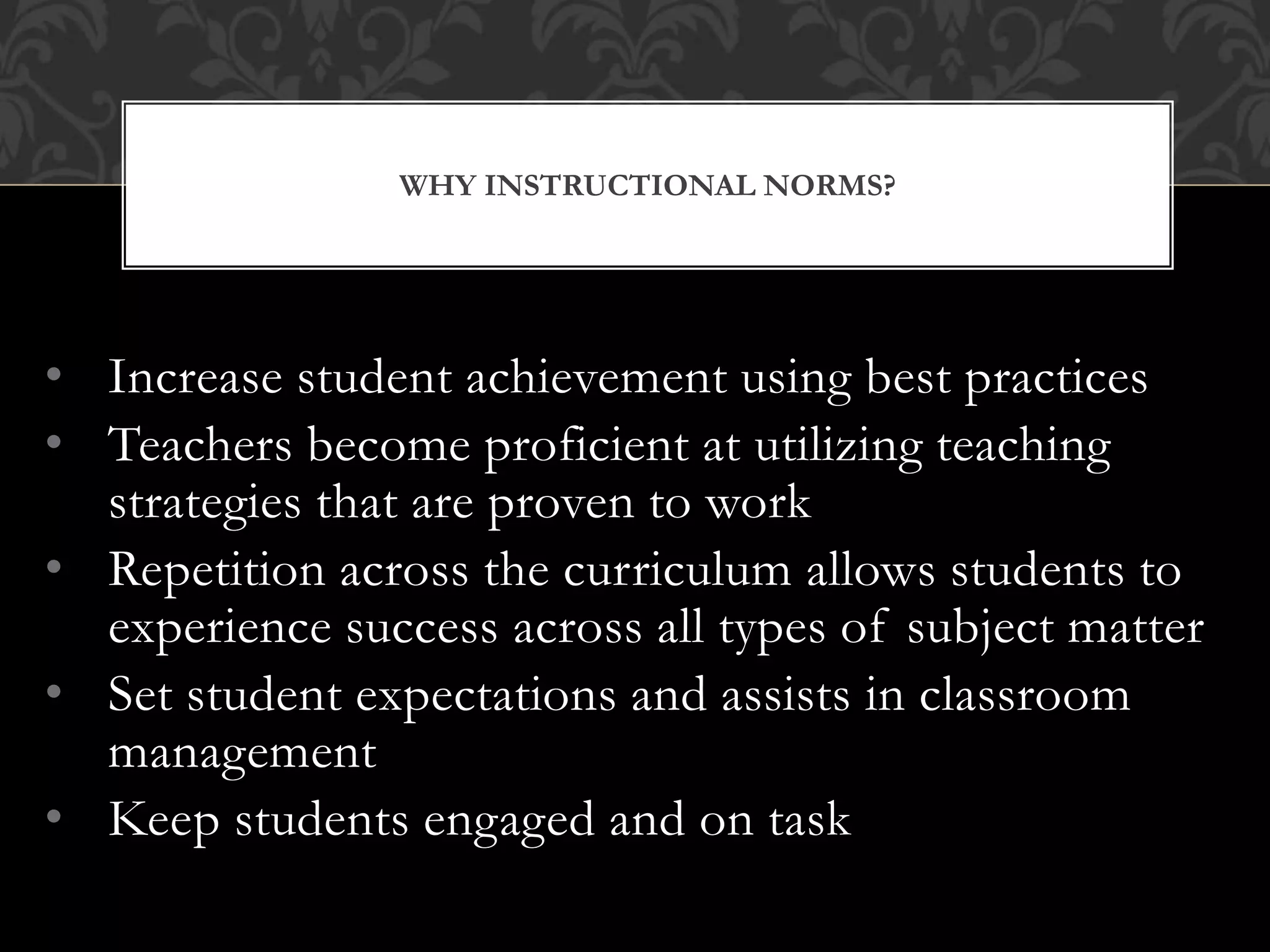
• Increase student achievement using best practices
• Teachers become proficient at utilizing teaching
strategies that are proven to work
• Repetition across the curriculum allows students to
experience success across all types of subject matter
• Set student expectations and assists in classroom
management
• Keep students engaged and on task
WHY INSTRUCTIONAL NORMS?
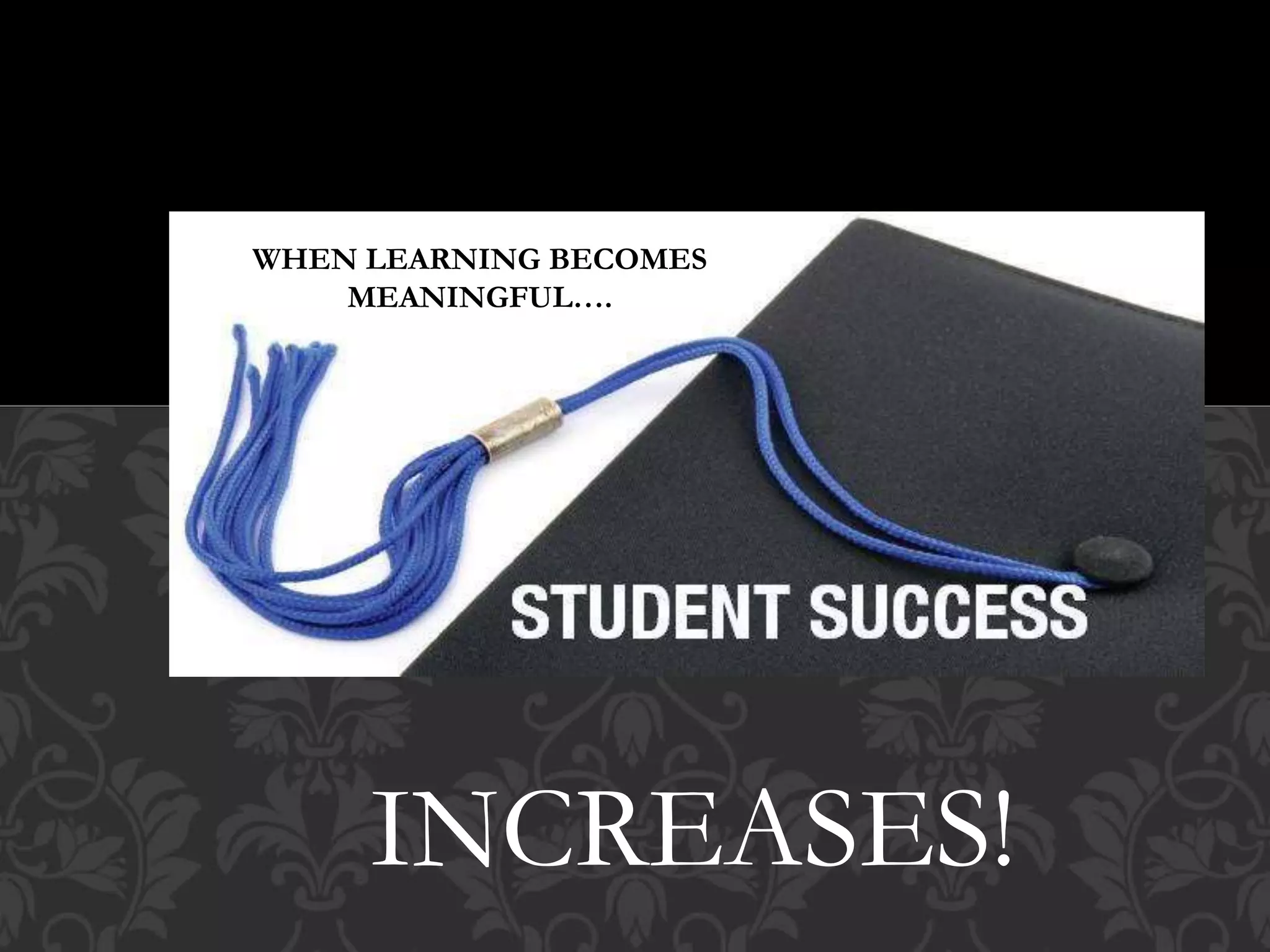
WHEN LEARNING BECOMES
MEANINGFUL….
INCREASES!
Recruitment & Retention of School Leaders: A critical need. Association of California
School Administrators, June 2001.
California School Business (Summer, 2007). California Association of School Business
Officials.
EdSource (November, 2007). Superintendents and Principals: Charting the Paths to
School Improvement.
Glass, T. E. & Franceschini, L. A. (2007). The State of the American School
Superintendency. AASA Center for System Leadership, Rowman and Littlefield Education,
Lanham, Maryland.
Marzano, R. (2003). What works in schools. Association for Supervision and Curiculum
Development, Alexandria, VA
Marzano, Waters & McNulty (2005). School leadership that works. Association for
Supervision and Curriculum Development, Alexandria, VA
RAND Research Brief (2003). Are schools facing a shortage of qualified administrators?
Wickham, D. (2007) Female Superintendents: Perceived Barriers and Successful Strategies
Used to Attain the Superintendency in CA. Dissertation, University of the Pacific.
REFERENCES
We are as different from one another on the
inside of our heads as we are from one another
on the outside of our heads.
There is no best way to teach, but there are
practices of teaching that are proven, over time,
to improve student learning.
TEACHING AND LEARNING
The best way to provide an exceptional learning
environment for students is to give them
outstanding teachers. Great principals focus on
students by focusing on teachers.
Todd Whitaker
Motivational Speaker and Educator
TEACHERS
No matter how interesting or relevant the content may
be or how enthusiastic the teacher is about their subject
matter, students must be willing and able to learn the
content and skills.
TEACHING PROFESSIONALS MUST:
ENSURE THEY MEET THE NEEDS OF
STUDENTS SO THAT THEY ARE WILLING TO
LEARN.
LEARNING
It is better to be prepared for an
opportunity and not have one than to have
an opportunity and not be prepared.
Whitney Young Jr.
American Civil Rights Leader

Impact on Student Learning and Instruction

  • 1.
    Staff Development by James Lake IMPACTSON LEARNING AND INSTRUCTION
  • 3.
    1. Credentials ofthe teacher 2. Class size 3. Leadership 4. Teacher quality 5. Curriculum 6. Parent involvement WHICH OF THESE HAS THE GREATEST IMPACT ON LEARNING?
  • 4.
    K-12 Study over2 years Synthesis of 35 years of high profile research studies Looked at students entering at the 50th percentile and spending 2 years in different types of schools with different types of teachers. ROBERT MARZANO’S RESEARCH (2003)
  • 5.
    Impact on StudentLearning Percentile Entering Percentile Leaving Average School and Average Teacher 50 Ineffective School and Ineffective Teacher 50 Effective School and Ineffective Teacher 50 Ineffective School and Effective Teacher 50 Effective School and Average Teacher 50 Effective School and Effective Teacher 50 50 3 37 78 96 63
  • 6.
    • Average Schooland an Average Teacher Entered at the 50th percentile and leaves at the 50th Percentile • Ineffective School and Ineffective Teacher Leaving at the 3rd Percentile • Effective School and Ineffective Teacher Leaving at the 37th Percentile IMPACT ON LEARNING
  • 7.
    • Ineffective Schooland Effective Teacher Leaving at the 63rd Percentile • Effective School and Average Teacher Leaving at the 78th Percentile • Effective School and Effective Teacher Leaving at the 96th Percentile IMPACT ON LEARNING
  • 8.
    Conclusion: After 2 yearsof Ineffective School and Ineffective Teacher, it is likely the child will never academically recover. Student learning was devastated --dropping from the 50 percentile to Just the 3rd percentile. INEFFECTIVE SCHOOLS AND TEACHERS
  • 9.
    “Effective teachers havea profound influence on student achievement.” 50th percentile to the 96th Marzano, R. (2003). What Works in Schools. Alexandria, VA: Association for Supervision and Curriculum Development, pp. 77-78. TEACHER EFFECTIVENESS
  • 10.
    “When a teacheris excited and enthusiastic about their courses, the students take interest and are more likely to engage in learning the lesson.” Thomas, J. (2007). Teaching with passion. Education Digest, 73(3), 63-65. Retrieved from http://web.ebscohost.com TEACHER EFFICACY
  • 11.
    Schools must becomefocused on teacher-directed instruction and professional collaboration to improve student learning. OBJECTIVE
  • 12.
  • 13.
  • 14.
    1. Acceptance andSafety 2. Choice – Differentiated Instruction 3. High Expectations – Stated in Objective 4. Assessing Prior Knowledge and connecting to new ideas – Reviewing previously learned material 5. Meaningful Engagement – Why are we learning this? 6. Clarity – Checking for Understanding 7. Reflection Time – Appropriate wait time 8. Aligned Assessment – Guided Practice NEEDS OF LEARNERS
  • 15.
    Learning Objectives: Astatement describing what students will be able to do by the end of the lesson. It must match the Independent Practice and be clearly stated to the students and frequently revisited. Activate Prior Knowledge: Purposefully moving something connected to the new lesson from students’ long term memories into their working memories so they can build upon existing knowledge. Concept/Skill Development: Teaching students the concepts contained in the Learning Objective or the skills necessary to execute the Learning Objective. Teach the students how to do it. INSTRUCTIONAL STRATEGIES
  • 16.
    Guided Practice: Workingproblems with students at the same time, step by step, while checking for understanding that they are executing each step correctly. Lesson Closure: Having Students work problems or answer questions to prove that they have learned the concepts and skills in the Learning Objective before they are given independent practice. Independent Practice: Having students successfully practice what they were just taught. Note Taking: Engages students in lesson, organization, and reference material (e.g. Cornell Notes). INSTRUCTIONAL STRATEGIES CONT.
  • 17.
    1. Review previouslylearned material 2. State and re-state objective frequently throughout the lesson 3. Present new material 4. Provide guided practice, assess performance, and give corrective feedback 5. Assign independent practice, assess performance, and give corrective feedback 6. Review previously learned material – provide corrective feedback DIRECT INSTRUCTIONAL MODEL
  • 18.
    Teach First Ask aQuestion Pause Pick a Non-Volunteer Listen to the Response Effective Feedback (Echo, Elaborate, Explain) T.A.P.P.L.E.
  • 19.
    • Align formalassessments to standards • Project based assessment • Rubrics • Collaborative work • Varying Questions – Bloom’s taxonomy; Multiple levels of questioning EVALUATING LEARNING
  • 20.
    Continually verifying, througha variety of methods, that students are learning while being taught (i.e. – calling on non- volunteers, pair-share, wait time, proximity, paraphrase, whiteboard responses). CHECKING FOR UNDERSTANDING:
  • 21.
    Explaining: Teach bytelling Modeling: Teach by strategic thinking – talk it out aloud Vocabulary Building: Establish academic vocabulary and Word Walls Demonstrating: Teach by using objects to clarify content Teaching Bell to Bell: Utilize instructional time effectively and efficiently INSTRUCTIONAL NORMS
  • 22.
    • Increase studentachievement using best practices • Teachers become proficient at utilizing teaching strategies that are proven to work • Repetition across the curriculum allows students to experience success across all types of subject matter • Set student expectations and assists in classroom management • Keep students engaged and on task WHY INSTRUCTIONAL NORMS?
  • 23.
  • 24.
    Recruitment & Retentionof School Leaders: A critical need. Association of California School Administrators, June 2001. California School Business (Summer, 2007). California Association of School Business Officials. EdSource (November, 2007). Superintendents and Principals: Charting the Paths to School Improvement. Glass, T. E. & Franceschini, L. A. (2007). The State of the American School Superintendency. AASA Center for System Leadership, Rowman and Littlefield Education, Lanham, Maryland. Marzano, R. (2003). What works in schools. Association for Supervision and Curiculum Development, Alexandria, VA Marzano, Waters & McNulty (2005). School leadership that works. Association for Supervision and Curriculum Development, Alexandria, VA RAND Research Brief (2003). Are schools facing a shortage of qualified administrators? Wickham, D. (2007) Female Superintendents: Perceived Barriers and Successful Strategies Used to Attain the Superintendency in CA. Dissertation, University of the Pacific. REFERENCES
  • 25.
    We are asdifferent from one another on the inside of our heads as we are from one another on the outside of our heads. There is no best way to teach, but there are practices of teaching that are proven, over time, to improve student learning. TEACHING AND LEARNING
  • 26.
    The best wayto provide an exceptional learning environment for students is to give them outstanding teachers. Great principals focus on students by focusing on teachers. Todd Whitaker Motivational Speaker and Educator TEACHERS
  • 27.
    No matter howinteresting or relevant the content may be or how enthusiastic the teacher is about their subject matter, students must be willing and able to learn the content and skills. TEACHING PROFESSIONALS MUST: ENSURE THEY MEET THE NEEDS OF STUDENTS SO THAT THEY ARE WILLING TO LEARN. LEARNING
  • 28.
    It is betterto be prepared for an opportunity and not have one than to have an opportunity and not be prepared. Whitney Young Jr. American Civil Rights Leader