












































November 6, 2012
What Educators can Learn from
the Video Game Industry
Bryan Fendley
Director of Academic Computing
University of Arkansas at Monticello
                                       November 6, 2012
A short bio
Today’s mission
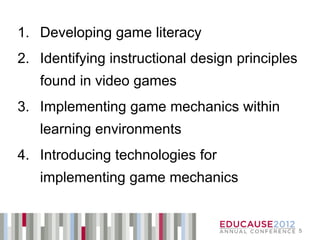
1. Developing game literacy
2. Identifying instructional design principles
   found in video games
3. Implementing game mechanics within
   learning environments
4. Introducing technologies for
   implementing game mechanics


                                                 5
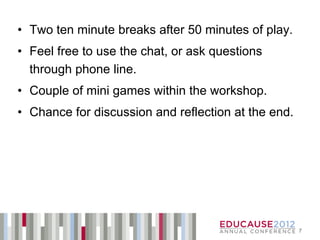
Rules of play for this workshop
• Two ten minute breaks after 50 minutes of play.
• Feel free to use the chat, or ask questions
  through phone line.
• Couple of mini games within the workshop.
• Chance for discussion and reflection at the end.


                                                     7
Identify the gamified element


         Game Element


                                8
Game Element


   Where does this story begin?
Game Element


       My quest was started.
Game Element


         Then, I leveled up.
Sharing what I have learned during
           my quest.
• Defining games
• Gamification
• Games and learning
• Gaming the classroom
• Gamified syllabus
• Technology supporting educational gaming
• The future of gaming
• Where my quest will be taking me next


                                             13
Game Element


               Ice - breaker
What’s your player type?


                           15
Bartle’s player types

  – Achievers
  – Explorers
  – Socializers
  – Killers


                        16
Generation “G”
“Games are the norm for people born after
  1971”.


                         http://en.wikipedia.org/wiki/Bing_Gordon
Game Element
                   Poll
 • What percent of youth play games?
 • What percent of gamers are women?
 • How old is the average game player?
Game Stats
• 97% youth play games
• 40% gamers are women
• Average game player is 35 years old and
  has been playing for 12 years


               Entertainment Software Association’s annual study of game players
               http://www.theesa.com/facts/gameplayer.asp
What are games really about?
• Problem solving
• Engagement
• More and more also involve a social
  component
Defining traits of a game
•   Goal
•   Rules
•   Feedback system
•   Voluntary participation


                  Jane McGonigal, Reality Is Broken: Why Games Make Us Better and How
                  They Can Change the World
Goals
• In instructional design we call this
  “objectives”.


                                         22
Rules
• All classes have rules – syllabus.


                                       23
Feedback system
• We have many feedback systems.
• In video games feedback is instant.


                                        24
Voluntary participation
• Technically students are in classes
  voluntarily, but the reality is they might
  rather be somewhere else.


                                               25
Let’s not forget “Fun”
• Games are fun, although the word fun is
  subjective.


                                            26
Types of games
•   Text based games
•   Alternate Reality Games (ARG)
•   Mobile games
•   Virtual worlds
•   Single player
•   Massively Multiplayer Online (MMO)
•   Epistemic
•   Serious
                                         27
What is gamification?
• The application of game mechanics; term
  is mostly used in marketing, but also
  applicable to education.
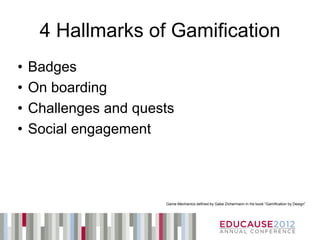
4 Hallmarks of Gamification
•   Badges
•   On boarding
•   Challenges and quests
•   Social engagement


                       Game Mechanics defined by Gabe Zichermann in his book “Gamification by Design”
Digital Badges for Learning

“Badges can help speed the shift from credentials that
  simply measure seat time, to ones that more
  accurately measure competency.”

              Secretary Duncan, U.S. Department of Education
         http://www.ed.gov/news/speeches/digital-badges-learning
On boarding
Challenges and quests
Social engagement
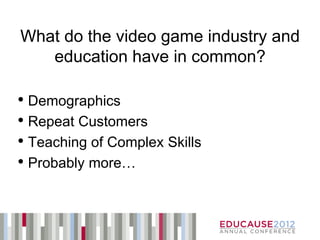
What do the video game industry and
   education have in common?

• Demographics
• Repeat Customers
• Teaching of Complex Skills
• Probably more…
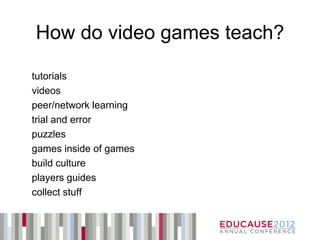
How do video games teach?

tutorials
videos
peer/network learning
trial and error
puzzles
games inside of games
build culture
players guides
collect stuff
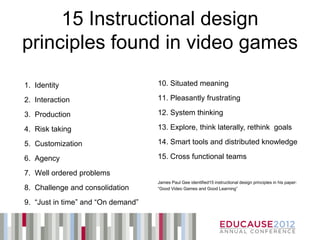
15 Instructional design
principles found in video games
1. Identity                         10. Situated meaning

2. Interaction                      11. Pleasantly frustrating

3. Production                       12. System thinking

4. Risk taking                      13. Explore, think laterally, rethink goals

5. Customization                    14. Smart tools and distributed knowledge

6. Agency                           15. Cross functional teams

7. Well ordered problems
                                    James Paul Gee identified15 instructional design principles in his paper:
8. Challenge and consolidation      “Good Video Games and Good Learning”


9. “Just in time” and “On demand”
Identity


     James Paul Gee identified15 instructional design principles in his paper:
                                   “Good Video Games and Good Learning”
Interaction


      James Paul Gee identified15 instructional design principles in his paper:
                                    “Good Video Games and Good Learning”
Production


       James Paul Gee identified15 instructional design principles in his paper:
                                     “Good Video Games and Good Learning”
Risk taking


      James Paul Gee identified15 instructional design principles in his paper:
                                    “Good Video Games and Good Learning”
Customization


        James Paul Gee identified15 instructional design principles in his paper:
                                      “Good Video Games and Good Learning”
Agency


    James Paul Gee identified15 instructional design principles in his paper:
                                  “Good Video Games and Good Learning”
Well ordered problems


           James Paul Gee identified15 instructional design principles in his paper:
                                         “Good Video Games and Good Learning”
Challenge and consolidation


              James Paul Gee identified15 instructional design principles in his paper:
                                            “Good Video Games and Good Learning”
“Just in Time” and “On Demand”


                 James Paul Gee identified15 instructional design principles in his paper:
                                               “Good Video Games and Good Learning”
Situated meanings


         James Paul Gee identified15 instructional design principles in his paper:
                                       “Good Video Games and Good Learning”
Pleasantly frustrating


            James Paul Gee identified15 instructional design principles in his paper:
                                          “Good Video Games and Good Learning”
System thinking


        James Paul Gee identified15 instructional design principles in his paper:
                                      “Good Video Games and Good Learning”
Explore, think laterally, rethink goals


                     James Paul Gee identified15 instructional design principles in his paper:
                                                   “Good Video Games and Good Learning”
Smart tools and distributed
        knowledge


               James Paul Gee identified15 instructional design principles in his paper:
                                             “Good Video Games and Good Learning”
Cross functional teams


            James Paul Gee identified15 instructional design principles in his paper:
                                          “Good Video Games and Good Learning”
Performance before competence


               James Paul Gee identified15 instructional design principles in his paper:
                                             “Good Video Games and Good Learning”
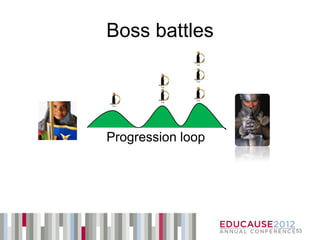
Boss battles


Progression loop


                   53
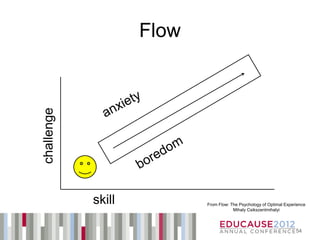
Flow
challenge


            skill          From Flow: The Psychology of Optimal Experience
                                       Mihaly Csikszentmihalyi


                                                                     54
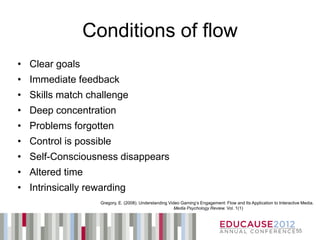
Conditions of flow
• Clear goals
• Immediate feedback
• Skills match challenge
• Deep concentration
• Problems forgotten
• Control is possible
• Self-Consciousness disappears
• Altered time
• Intrinsically rewarding
                   Gregory, E. (2008). Understanding Video Gaming’s Engagement: Flow and Its Application to Interactive Media.
                                                        Media Psychology Review. Vol. 1(1)


                                                                                                                     55
Technologies for implementing
game mechanics
• LMS
• Game development platforms


                                56
Syllabus for a gamed classroom Spring
                   2012

The Multiplayer Classroom, Designing
Coursework as a Game
By Lee Sheldon
From my syllabus
     Grading Policy

     This course will function like a role playing game, where you work for WeevilTech
     Game Studio. I will be your boss. Your grades will be assigned like experience
     points, you level up to get a better grade. Everybody starts with zero points. Your
     goal should be to become a full time employee for WeevilTech Game Studio, by
     successfully completing all projects and attending and participating in all virtual
     project meetings.
     We have roughly 15 weeks for this course. We will cover the first eight chapters of
     the book. There will be a test and assignment for each chapter. We will have
     meetings twice a week called “SCRUM” meetings. Discussion boards will be used
     for the meeting. You will be graded for your participation in these meetings. There
     will be a final project in this class, and a short 1000 word essay.


     END OF COURSE TEAM PROJECT

            1.   The teams will be selected randomly
            2.   We will develop a game with a UAM theme
            3.   The required format and delivery of the project materials will be determined
            5.   The grade will be given on a 100 point scale
From my syllabus
           Scoring System for Class
           Grades
           Level           Xp points              Letter Grade

           Employee         2640-3300             A

           Intern           1980-2639             B

           Rookie           1320-1979             C

           n00b             660-1319              D
           Nublet           0-559                 F


          Point Distribution
          8 exams                      100 pts each               800
          8 weekly assignments         100 pts each               800
          15 pre sprint meetings       50 pts each                750
          15 post sprint meetings      50 pts each                750
          Final Project                100 pts each               100
          Final Paper                  100 pts each               100

          Total Points                                           3300
SAMR by Puentedura

Technologies at this two
levels fall into the
transformation category


Technologies at this two
levels fall into the
enhancement category


                           http://hippasus.com/resources/tte/


                                                           60
It’s not all roses
• Some educators worry that teachers
  haven’t been sufficiently trained to
  integrate video games into schools.

http://www.huffingtonpost.com/2012/09/25/education-nation-why-educ_n_1912506.html
Developing your own games


                            62
Institutional concerns


                         63
The future of gaming


                       64
Identify the gamified element


                                65
Each time you see one of these “Game
Element” symbols, take note.
               Game Element


At the end of the workshop, we will see how
many game elements used during the workshop
that we can identify.


                                        66
Game Element


   Where does this story begin?
Game Element


       My quest was started
Game Element


         Then, I leveled up
Game Element


               Ice - breaker
Where will my quest taking me
            next?
Thank you for participating!
• GamedLearning.com
• Twitter: @GamedLearning

What Educators Can Learn From the Video Game Industry

  • 1.
  • 2.
    What Educators canLearn from the Video Game Industry Bryan Fendley Director of Academic Computing University of Arkansas at Monticello November 6, 2012
  • 3.
  • 4.
  • 5.
    1. Developing gameliteracy 2. Identifying instructional design principles found in video games 3. Implementing game mechanics within learning environments 4. Introducing technologies for implementing game mechanics 5
  • 6.
    Rules of playfor this workshop
  • 7.
    • Two tenminute breaks after 50 minutes of play. • Feel free to use the chat, or ask questions through phone line. • Couple of mini games within the workshop. • Chance for discussion and reflection at the end. 7
  • 8.
    Identify the gamifiedelement Game Element 8
  • 9.
    Game Element Where does this story begin?
  • 10.
    Game Element My quest was started.
  • 11.
    Game Element Then, I leveled up.
  • 12.
    Sharing what Ihave learned during my quest.
  • 13.
    • Defining games •Gamification • Games and learning • Gaming the classroom • Gamified syllabus • Technology supporting educational gaming • The future of gaming • Where my quest will be taking me next 13
  • 14.
    Game Element Ice - breaker
  • 15.
  • 16.
    Bartle’s player types – Achievers – Explorers – Socializers – Killers 16
  • 17.
    Generation “G” “Games arethe norm for people born after 1971”. http://en.wikipedia.org/wiki/Bing_Gordon
  • 18.
    Game Element Poll • What percent of youth play games? • What percent of gamers are women? • How old is the average game player?
  • 19.
    Game Stats • 97%youth play games • 40% gamers are women • Average game player is 35 years old and has been playing for 12 years Entertainment Software Association’s annual study of game players http://www.theesa.com/facts/gameplayer.asp
  • 20.
    What are gamesreally about? • Problem solving • Engagement • More and more also involve a social component
  • 21.
    Defining traits ofa game • Goal • Rules • Feedback system • Voluntary participation Jane McGonigal, Reality Is Broken: Why Games Make Us Better and How They Can Change the World
  • 22.
    Goals • In instructionaldesign we call this “objectives”. 22
  • 23.
    Rules • All classeshave rules – syllabus. 23
  • 24.
    Feedback system • Wehave many feedback systems. • In video games feedback is instant. 24
  • 25.
    Voluntary participation • Technicallystudents are in classes voluntarily, but the reality is they might rather be somewhere else. 25
  • 26.
    Let’s not forget“Fun” • Games are fun, although the word fun is subjective. 26
  • 27.
    Types of games • Text based games • Alternate Reality Games (ARG) • Mobile games • Virtual worlds • Single player • Massively Multiplayer Online (MMO) • Epistemic • Serious 27
  • 28.
    What is gamification? •The application of game mechanics; term is mostly used in marketing, but also applicable to education.
  • 29.
    4 Hallmarks ofGamification • Badges • On boarding • Challenges and quests • Social engagement Game Mechanics defined by Gabe Zichermann in his book “Gamification by Design”
  • 30.
    Digital Badges forLearning “Badges can help speed the shift from credentials that simply measure seat time, to ones that more accurately measure competency.” Secretary Duncan, U.S. Department of Education http://www.ed.gov/news/speeches/digital-badges-learning
  • 31.
  • 32.
  • 33.
  • 34.
    What do thevideo game industry and education have in common? • Demographics • Repeat Customers • Teaching of Complex Skills • Probably more…
  • 35.
    How do videogames teach? tutorials videos peer/network learning trial and error puzzles games inside of games build culture players guides collect stuff
  • 36.
    15 Instructional design principlesfound in video games 1. Identity 10. Situated meaning 2. Interaction 11. Pleasantly frustrating 3. Production 12. System thinking 4. Risk taking 13. Explore, think laterally, rethink goals 5. Customization 14. Smart tools and distributed knowledge 6. Agency 15. Cross functional teams 7. Well ordered problems James Paul Gee identified15 instructional design principles in his paper: 8. Challenge and consolidation “Good Video Games and Good Learning” 9. “Just in time” and “On demand”
  • 37.
    Identity James Paul Gee identified15 instructional design principles in his paper: “Good Video Games and Good Learning”
  • 38.
    Interaction James Paul Gee identified15 instructional design principles in his paper: “Good Video Games and Good Learning”
  • 39.
    Production James Paul Gee identified15 instructional design principles in his paper: “Good Video Games and Good Learning”
  • 40.
    Risk taking James Paul Gee identified15 instructional design principles in his paper: “Good Video Games and Good Learning”
  • 41.
    Customization James Paul Gee identified15 instructional design principles in his paper: “Good Video Games and Good Learning”
  • 42.
    Agency James Paul Gee identified15 instructional design principles in his paper: “Good Video Games and Good Learning”
  • 43.
    Well ordered problems James Paul Gee identified15 instructional design principles in his paper: “Good Video Games and Good Learning”
  • 44.
    Challenge and consolidation James Paul Gee identified15 instructional design principles in his paper: “Good Video Games and Good Learning”
  • 45.
    “Just in Time”and “On Demand” James Paul Gee identified15 instructional design principles in his paper: “Good Video Games and Good Learning”
  • 46.
    Situated meanings James Paul Gee identified15 instructional design principles in his paper: “Good Video Games and Good Learning”
  • 47.
    Pleasantly frustrating James Paul Gee identified15 instructional design principles in his paper: “Good Video Games and Good Learning”
  • 48.
    System thinking James Paul Gee identified15 instructional design principles in his paper: “Good Video Games and Good Learning”
  • 49.
    Explore, think laterally,rethink goals James Paul Gee identified15 instructional design principles in his paper: “Good Video Games and Good Learning”
  • 50.
    Smart tools anddistributed knowledge James Paul Gee identified15 instructional design principles in his paper: “Good Video Games and Good Learning”
  • 51.
    Cross functional teams James Paul Gee identified15 instructional design principles in his paper: “Good Video Games and Good Learning”
  • 52.
    Performance before competence James Paul Gee identified15 instructional design principles in his paper: “Good Video Games and Good Learning”
  • 53.
  • 54.
    Flow challenge skill From Flow: The Psychology of Optimal Experience Mihaly Csikszentmihalyi 54
  • 55.
    Conditions of flow •Clear goals • Immediate feedback • Skills match challenge • Deep concentration • Problems forgotten • Control is possible • Self-Consciousness disappears • Altered time • Intrinsically rewarding Gregory, E. (2008). Understanding Video Gaming’s Engagement: Flow and Its Application to Interactive Media. Media Psychology Review. Vol. 1(1) 55
  • 56.
    Technologies for implementing gamemechanics • LMS • Game development platforms 56
  • 57.
    Syllabus for agamed classroom Spring 2012 The Multiplayer Classroom, Designing Coursework as a Game By Lee Sheldon
  • 58.
    From my syllabus Grading Policy This course will function like a role playing game, where you work for WeevilTech Game Studio. I will be your boss. Your grades will be assigned like experience points, you level up to get a better grade. Everybody starts with zero points. Your goal should be to become a full time employee for WeevilTech Game Studio, by successfully completing all projects and attending and participating in all virtual project meetings. We have roughly 15 weeks for this course. We will cover the first eight chapters of the book. There will be a test and assignment for each chapter. We will have meetings twice a week called “SCRUM” meetings. Discussion boards will be used for the meeting. You will be graded for your participation in these meetings. There will be a final project in this class, and a short 1000 word essay. END OF COURSE TEAM PROJECT 1. The teams will be selected randomly 2. We will develop a game with a UAM theme 3. The required format and delivery of the project materials will be determined 5. The grade will be given on a 100 point scale
  • 59.
    From my syllabus Scoring System for Class Grades Level Xp points Letter Grade Employee 2640-3300 A Intern 1980-2639 B Rookie 1320-1979 C n00b 660-1319 D Nublet 0-559 F Point Distribution 8 exams 100 pts each 800 8 weekly assignments 100 pts each 800 15 pre sprint meetings 50 pts each 750 15 post sprint meetings 50 pts each 750 Final Project 100 pts each 100 Final Paper 100 pts each 100 Total Points 3300
  • 60.
    SAMR by Puentedura Technologiesat this two levels fall into the transformation category Technologies at this two levels fall into the enhancement category http://hippasus.com/resources/tte/ 60
  • 61.
    It’s not allroses • Some educators worry that teachers haven’t been sufficiently trained to integrate video games into schools. http://www.huffingtonpost.com/2012/09/25/education-nation-why-educ_n_1912506.html
  • 62.
  • 63.
  • 64.
    The future ofgaming 64
  • 65.
  • 66.
    Each time yousee one of these “Game Element” symbols, take note. Game Element At the end of the workshop, we will see how many game elements used during the workshop that we can identify. 66
  • 67.
    Game Element Where does this story begin?
  • 68.
    Game Element My quest was started
  • 69.
    Game Element Then, I leveled up
  • 70.
    Game Element Ice - breaker
  • 71.
    Where will myquest taking me next?
  • 72.
    Thank you forparticipating! • GamedLearning.com • Twitter: @GamedLearning