Staff Development
Presentation
Learning Styles & Differentiation in
Instruction
J. Walsh-Davis M.Ed.
Learning begins with attention:
That’s what the experts say. Let’s
see if we agree with them.
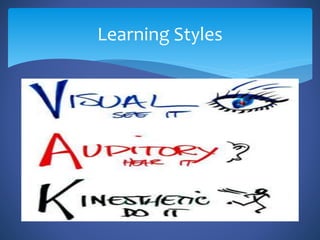
Learning Styles
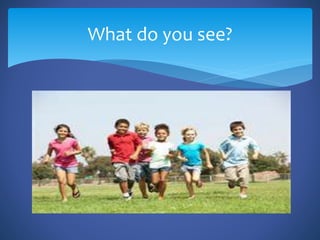
What do you see?
 What did you see?
 What did you pay most attention to?
 Did anyone use their imagination to extend
the picture?
 Did the picture spark some kind of emotion
inside you?
Sharing
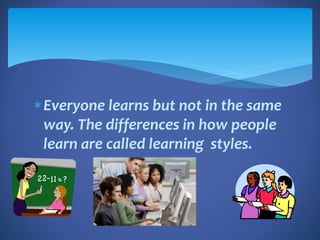
Everyone learns but not in the same
way. The differences in how people
learn are called learning styles.
Learning Styles
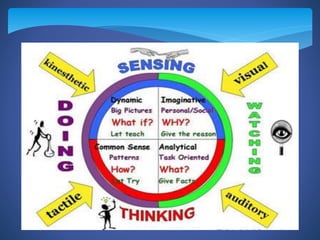
Realistic, practical and matter-of-fact.
They are efficient, results-oriented,
prefers actions to words, and are hands-on
learners.
They tend to be neat, precise and require
immediate feed-back to an assignment.
Mastery Learner
(sensing & thinking)
 Theoretical, Intellectual and knowledge-oriented.
 They are curious about ideas, loves to solve complex
problems and are highly tolerant of theory.
 These learners plan ahead before beginning an
assignment and need little feedback while they
work.
 Understanding learners are avid readers, and loves
using technology, formulas and abstract symbols.
Understanding Learner
(Intuition & thinking)
 Curious, insightful and imaginative
 Self-expressive learners are
dreamers and are always searching
for new ways to express themselves.
 They are turned-off by rote learning
and look more for open-ended
questions such as ‘What would
happen if….?’
Self-Expressive Learner
(intuition & feeling)
 Social, experiential and community-
oriented.
 Inter-personal learners take a personal
approach to their learning. They love
activities that involve real-world
situations, personal interactions or
solving others problems.
Interpersonal Learners
(sensing & feeling)
 Used at the beginning of a class; excellent for
feedback for presenting new concepts.
 - as an anticipatory set – to find out how much the
students know.
 - as a behavior management tool asking questions
such as ‘what did I do wrong?’ ‘ How may I correct it?’
 It may also be used to explain graphics at the
beginning of a lesson.
Differentiated Strategies
Admit Slip
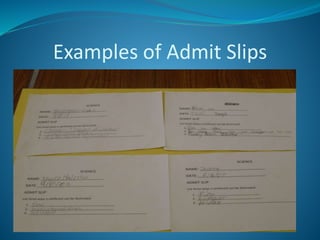
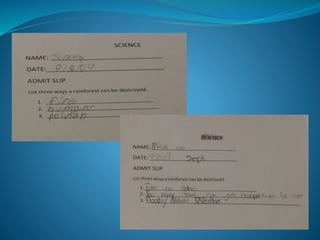
Examples of Admit Slips
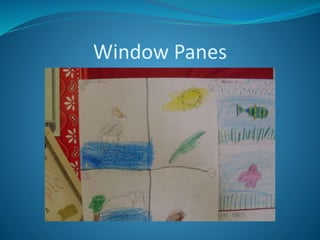
Strategy: Window Panes
 Description:
 This strategy uses a lot of color which is brain
compatible and lends interest to the student.
 It has at least 4 cells with each cell containing a picture
or icon and very few words.
 Window panes assists students to bring clarity to their
thoughts through the use of visuals. It is a respectful,
challenging task that engages ALL students as active
participants.
Window Panes
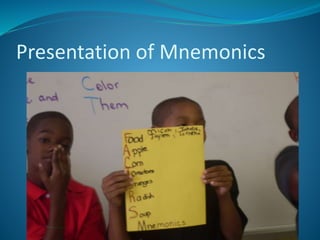
Mnemonics
Mnemonics is a strategy that is
incooperated into differentiated
instructions. The most common use of
this strategy is acronyms. This allows
for quick and easy memorization of
information and is excellent for use
with Blooms’ Taxonomy at the lower
level – recall; remember.
Presentation of Mnemonics
Think – Pair - Share
 Introducing concepts, students think about concept,
pair up with another student and share their
understanding of concept with each other.
 Concept may be modified to Think – Write – Share.
Pupils write their thoughts on the concept assigned
and then share information with class instead of with a
partner.
 Pupils volunteering to share information with whole
class.
JIGSAW
 May use leading questions to begin strategy. It begins
with a home-group numbered 1 – 4. They split into
expert groups to talk about their area of learning. They
then return to home group and each numbered person
share their concept ; forming the ‘big picture’ as all
home-group members will now have covered the
content.
 A product may be created at the end of the discussion
such as a flip-book or flow-chart to show
understanding.
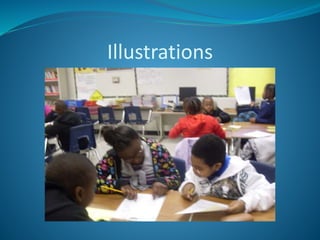
Illustrations
TASK ROTATION
 Is an assessment strategy to show mastery of the
intelligences. The activities involved caters to
individual students strengths and weaknesses as they
get the opportunity to work on a style of learning in
which they are strong
 The areas are: Mastery, Interpersonal, Understanding
and Self-Expressive.
Results of Task Rotation
 Students will see it as a different way of
learning and each intelligence was catered
to. It allows the students a chance to excel in
their strongest intelligence and provide
them with a sense of achievement .
 They can work on several tasks at once and
it can prove very productive for both teacher
and students.
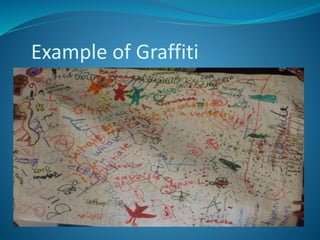
GRAFFITTI
 This is a strategy that involves the creativity
of students. It may be used to explore
concepts in a creative way using words and
pictures.
 How Does it Work?
 Students use words and pictures to convey
their understanding of the concept. Graffiti
is the hand-made version of ‘wordle’ using
graphics as well as words.
Example of Graffiti
EXIT SLIPS
 Exit slips may be used as final product or
closure for a class. They may be a statement
to be written, a question to be answered
based on a concept taught in lesson.
Students leave the class upon presentation
of this information. This is a good way of
checking for understanding.
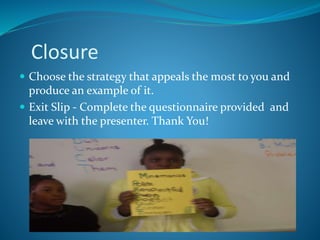
Closure
 Choose the strategy that appeals the most to you and
produce an example of it.
 Exit Slip - Complete the questionnaire provided and
leave with the presenter. Thank You!

Learning styles & differentiation in instruction

  • 1.
    Staff Development Presentation Learning Styles& Differentiation in Instruction J. Walsh-Davis M.Ed.
  • 2.
    Learning begins withattention: That’s what the experts say. Let’s see if we agree with them. Learning Styles
  • 3.
  • 4.
     What didyou see?  What did you pay most attention to?  Did anyone use their imagination to extend the picture?  Did the picture spark some kind of emotion inside you? Sharing
  • 5.
    Everyone learns butnot in the same way. The differences in how people learn are called learning styles.
  • 6.
  • 8.
    Realistic, practical andmatter-of-fact. They are efficient, results-oriented, prefers actions to words, and are hands-on learners. They tend to be neat, precise and require immediate feed-back to an assignment. Mastery Learner (sensing & thinking)
  • 9.
     Theoretical, Intellectualand knowledge-oriented.  They are curious about ideas, loves to solve complex problems and are highly tolerant of theory.  These learners plan ahead before beginning an assignment and need little feedback while they work.  Understanding learners are avid readers, and loves using technology, formulas and abstract symbols. Understanding Learner (Intuition & thinking)
  • 10.
     Curious, insightfuland imaginative  Self-expressive learners are dreamers and are always searching for new ways to express themselves.  They are turned-off by rote learning and look more for open-ended questions such as ‘What would happen if….?’ Self-Expressive Learner (intuition & feeling)
  • 11.
     Social, experientialand community- oriented.  Inter-personal learners take a personal approach to their learning. They love activities that involve real-world situations, personal interactions or solving others problems. Interpersonal Learners (sensing & feeling)
  • 12.
     Used atthe beginning of a class; excellent for feedback for presenting new concepts.  - as an anticipatory set – to find out how much the students know.  - as a behavior management tool asking questions such as ‘what did I do wrong?’ ‘ How may I correct it?’  It may also be used to explain graphics at the beginning of a lesson. Differentiated Strategies Admit Slip
  • 13.
  • 15.
    Strategy: Window Panes Description:  This strategy uses a lot of color which is brain compatible and lends interest to the student.  It has at least 4 cells with each cell containing a picture or icon and very few words.  Window panes assists students to bring clarity to their thoughts through the use of visuals. It is a respectful, challenging task that engages ALL students as active participants.
  • 16.
  • 17.
    Mnemonics Mnemonics is astrategy that is incooperated into differentiated instructions. The most common use of this strategy is acronyms. This allows for quick and easy memorization of information and is excellent for use with Blooms’ Taxonomy at the lower level – recall; remember.
  • 18.
  • 19.
    Think – Pair- Share  Introducing concepts, students think about concept, pair up with another student and share their understanding of concept with each other.  Concept may be modified to Think – Write – Share. Pupils write their thoughts on the concept assigned and then share information with class instead of with a partner.  Pupils volunteering to share information with whole class.
  • 20.
    JIGSAW  May useleading questions to begin strategy. It begins with a home-group numbered 1 – 4. They split into expert groups to talk about their area of learning. They then return to home group and each numbered person share their concept ; forming the ‘big picture’ as all home-group members will now have covered the content.  A product may be created at the end of the discussion such as a flip-book or flow-chart to show understanding.
  • 21.
  • 22.
    TASK ROTATION  Isan assessment strategy to show mastery of the intelligences. The activities involved caters to individual students strengths and weaknesses as they get the opportunity to work on a style of learning in which they are strong  The areas are: Mastery, Interpersonal, Understanding and Self-Expressive.
  • 23.
    Results of TaskRotation  Students will see it as a different way of learning and each intelligence was catered to. It allows the students a chance to excel in their strongest intelligence and provide them with a sense of achievement .  They can work on several tasks at once and it can prove very productive for both teacher and students.
  • 24.
    GRAFFITTI  This isa strategy that involves the creativity of students. It may be used to explore concepts in a creative way using words and pictures.  How Does it Work?  Students use words and pictures to convey their understanding of the concept. Graffiti is the hand-made version of ‘wordle’ using graphics as well as words.
  • 25.
  • 26.
    EXIT SLIPS  Exitslips may be used as final product or closure for a class. They may be a statement to be written, a question to be answered based on a concept taught in lesson. Students leave the class upon presentation of this information. This is a good way of checking for understanding.
  • 27.
    Closure  Choose thestrategy that appeals the most to you and produce an example of it.  Exit Slip - Complete the questionnaire provided and leave with the presenter. Thank You!