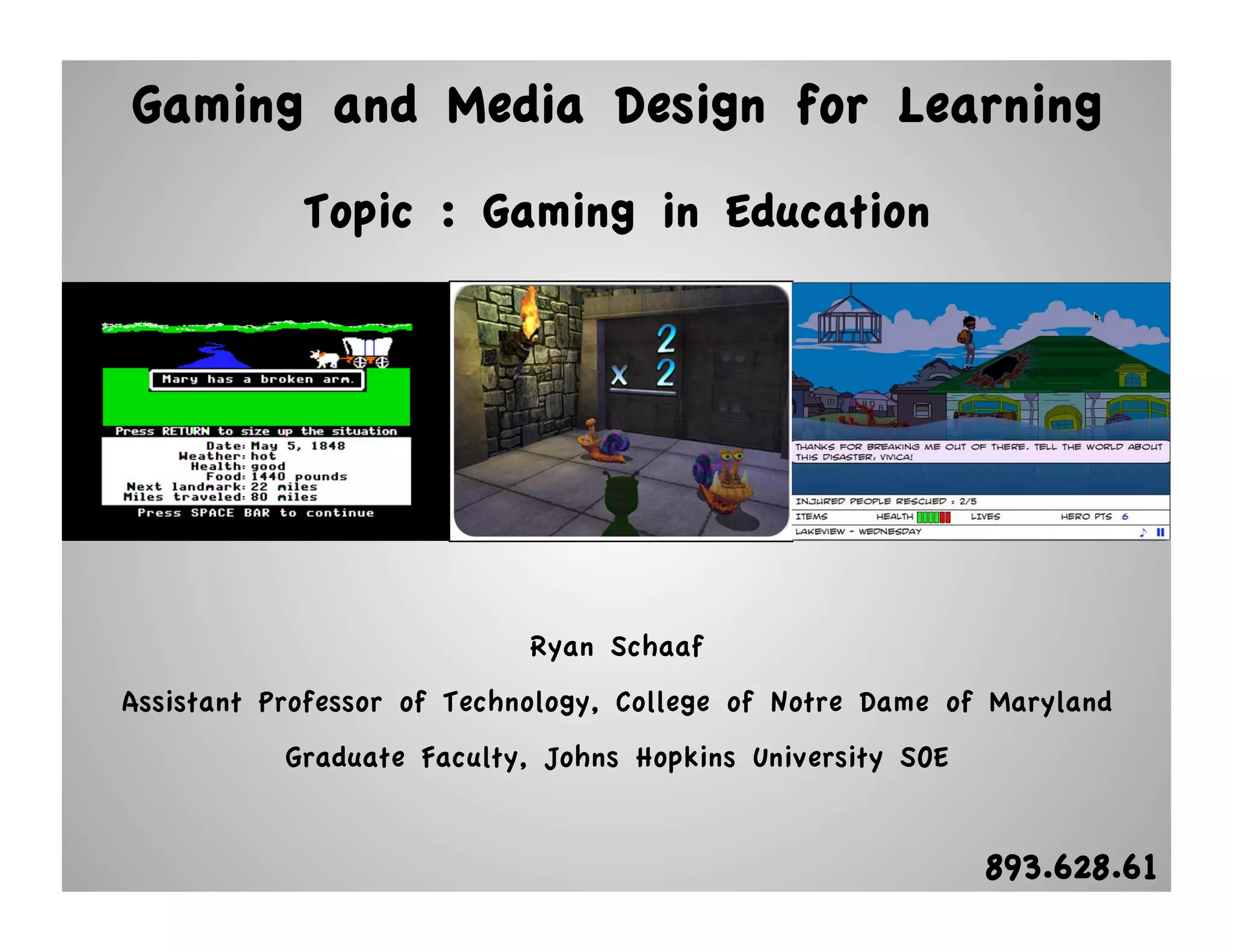



Gaming and Media Design for Learning
            Topic : Gaming in Education


                            Ryan Schaaf
Assistant Professor of Technology, College of Notre Dame of Maryland
           Graduate Faculty, Johns Hopkins University SOE


                                                            893.628.61
What is Digital Game-Based Learning?

Digital game-based learning (DGBL) is
an instructional method that
incorporates educational content or
learning principles into video games
with the goal of engaging learners.
Applications of digital game-based
learning draw upon the constructivist
theory of education.
 http://www.learnnc.org/lp/pages/4970
Discussion Questions
What would be the benefits of incorporating digital
games into the classroom?

First, think as a student. Why would it be cool?

Next, think as a teacher. Why would it be an
effective learning strategy?

Finally, if you were a teacher, how would you defend
its use with parents and/or administrators?
The Attraction of DGBL
•  mirrors how humans think and how the mind
   works
•  popularity
•  motivating and fun
•  21st century learners prefer 21st century methods
   of learning
•  independence
•  game design utilizes multiple intelligences
•  versatile platform for learning
•  collateral learning in a media rich society
•  safe alternative to reality
•  collaboration and problem-solving
Gaming and the Mind
Computer-based games present information in a
manner more consistent with how the human
brain learns

“Computer-based games provide simulations that
often mirror cognitive functions in the brain.
Humans think and learn through experiences they
have had and via simulations they run in their
heads based on those experiences, much as if they
were playing video games in their head” (Gee
2007).
Gaming and the Mind
 Pleasure and Motivation
 •  people enjoy learning new information
 •  hard work and deep fun


“Good video games give people pleasure. These
pleasures are connected to control, agency,
and meaningfulness. Good games are problem-
solving spaces that create deep
learning.” (Gee 2007)
Incorporating Digital Game-Based
        Learning into Instruction

•  Motivation
•  Instructional strategy
•  Closure
•  Assessment
•  Review, Reteach
Gaming in Education Misconceptions


              •  Students will miss the point
              •  Video games are too violent
              •  Video games do not synch
                 up to my curriculum
              •  Video games are a waste of
                 time
              •  Video games cost too much
                 money
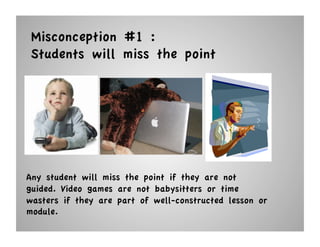
Misconception #1 :
 Students will miss the point


Any student will miss the point if they are not
guided. Video games are not babysitters or time
wasters if they are part of well-constructed lesson or
module.
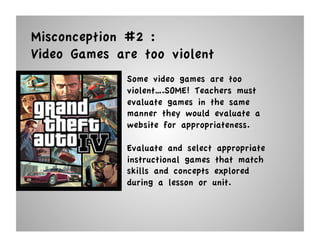
Misconception #2 :
Video Games are too violent
              Some video games are too
              violent….SOME! Teachers must
              evaluate games in the same
              manner they would evaluate a
              website for appropriateness.

              Evaluate and select appropriate
              instructional games that match
              skills and concepts explored
              during a lesson or unit.
Misconception #3 :
Video games are a waste of time
             Some video games are a waste
             of time….SOME!

             Teachers must approach new
             learning strategies with an
             open-mind

             The military and big business
             have embraced this approach to
             training. Why not education?
Misconceptions #4 & 5 :

Video games do not synch up to my
curriculum

Video games cost too much money


Browser-based instructional games are a web
search away!!
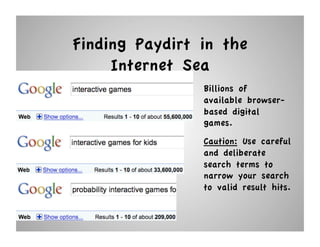
Finding Paydirt in the
     Internet Sea
                Billions of
                available browser-
                based digital
                games.
                Caution: Use careful
                and deliberate
                search terms to
                narrow your search
                to valid result hits.
Interactive Activity
Select a general concept and perform a Google
   or other web engine search. Find a digital
   game that fits your concept and play it. While
   you are playing the game:
•  What does the game teach?
•  What is the objective of the game?
•  What are the pros and cons of the game?
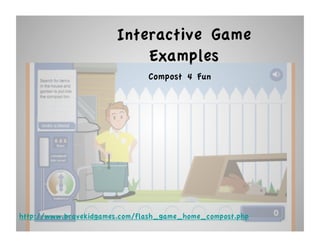
Interactive Game
                           Examples
                               Compost 4 Fun


http://www.bravekidgames.com/flash_game_home_compost.php
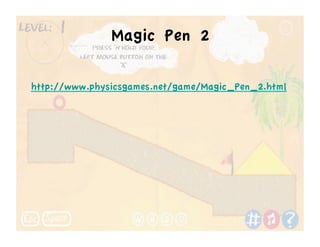
Magic Pen 2

http://www.physicsgames.net/game/Magic_Pen_2.html
http://labyrinth.thinkport.org/www/index.php
http://www.darfurisdying.com/
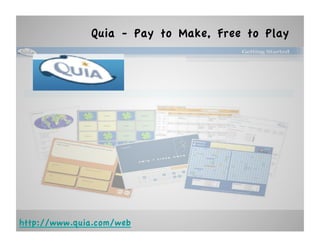
Quia - Pay to Make, Free to Play


http://www.quia.com/web
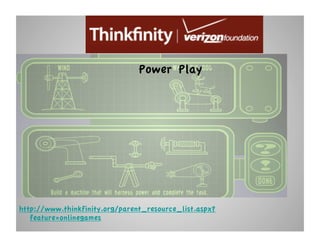
Power Play


http://www.thinkfinity.org/parent_resource_list.aspx?
   feature=onlinegames
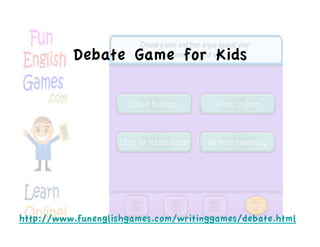
Debate Game for Kids


http://www.funenglishgames.com/writinggames/debate.html
Game Sharing
•  Web title
•  Summarize game play
•  What does it teach?
•  Did you enjoy the game? Do you
   predict your students will enjoy the
   game?
Class #1 Closing Questions
•  What are the course assignments,
   expectations, and logistics?
•  Why are games so beneficial to an
   educational setting?
•  What does the current research
   support with digital games in the
   classroom?
Discussion #1
   (Located in ELC Discussion Tab)
 Gaming in Education > Searching for
Digital Games to incorporate into your
              Curriculum

In class, you learned several strategies for finding
browser-based digital games to incorporate into
instruction. In this discussion board, identify three to
five games you previewed with web links included.
How was the game play? Will the game be useful
for instruction? How would you utilize it in a lesson?
Bibliography
Armstrong, T. (2003). You’re Smarter than You Think: A Kid’s Guide to Multiple
     Intelligences. Minneapolis, MN: Free Spirit Publishing Inc.

Campbell, L. & Campbell, B. (1999) Multiple Intelligences and Student
    Achievement: Success Stories from Six Schools. Alexandria, VA: ASCD

Demski, J. (2009). The WoW factor. T.H.E. Journal, 36(10), 30-35.

Gee, J.P. (2007). Good video games + good learning: Collected essays on video
      games, learning, and literacy. New York, NY: Peter Lang.

Harris, K. (1986) Self-Motivating of Attentional Behavior Versus Self-Monitoring
      of Productivity: Effects on On-Task Behavior and Academic Response Rate
      Among Learning Disabled Children. College Park, MD, Journal of Applied
      Behavior Analysis

Johnson, L., Levine, A., Smith, R., and Smythe, T. (2009). The 2009 Horizon
      Report: K-12 Edition. Austin, Texas: The New Media Consortium

Prensky, M (2001). Digital Game-Based Learning. St. Paul, Minnesota: Paragon
      House.

Shaffer, D.W. (2006). How computer games help children learn. New York, NY:
      Palgrave Macmillian

Skurzynski, G. (1991) Almost the Real Thing. New York, NY: Maxwell
      MacMillan International

Gaming in education

  • 1.
    Gaming and MediaDesign for Learning Topic : Gaming in Education Ryan Schaaf Assistant Professor of Technology, College of Notre Dame of Maryland Graduate Faculty, Johns Hopkins University SOE 893.628.61
  • 2.
    What is DigitalGame-Based Learning? Digital game-based learning (DGBL) is an instructional method that incorporates educational content or learning principles into video games with the goal of engaging learners. Applications of digital game-based learning draw upon the constructivist theory of education. http://www.learnnc.org/lp/pages/4970
  • 3.
    Discussion Questions What wouldbe the benefits of incorporating digital games into the classroom? First, think as a student. Why would it be cool? Next, think as a teacher. Why would it be an effective learning strategy? Finally, if you were a teacher, how would you defend its use with parents and/or administrators?
  • 4.
    The Attraction ofDGBL •  mirrors how humans think and how the mind works •  popularity •  motivating and fun •  21st century learners prefer 21st century methods of learning •  independence •  game design utilizes multiple intelligences •  versatile platform for learning •  collateral learning in a media rich society •  safe alternative to reality •  collaboration and problem-solving
  • 5.
    Gaming and theMind Computer-based games present information in a manner more consistent with how the human brain learns “Computer-based games provide simulations that often mirror cognitive functions in the brain. Humans think and learn through experiences they have had and via simulations they run in their heads based on those experiences, much as if they were playing video games in their head” (Gee 2007).
  • 6.
    Gaming and theMind Pleasure and Motivation •  people enjoy learning new information •  hard work and deep fun “Good video games give people pleasure. These pleasures are connected to control, agency, and meaningfulness. Good games are problem- solving spaces that create deep learning.” (Gee 2007)
  • 7.
    Incorporating Digital Game-Based Learning into Instruction •  Motivation •  Instructional strategy •  Closure •  Assessment •  Review, Reteach
  • 8.
    Gaming in EducationMisconceptions •  Students will miss the point •  Video games are too violent •  Video games do not synch up to my curriculum •  Video games are a waste of time •  Video games cost too much money
  • 9.
    Misconception #1 : Students will miss the point Any student will miss the point if they are not guided. Video games are not babysitters or time wasters if they are part of well-constructed lesson or module.
  • 10.
    Misconception #2 : VideoGames are too violent Some video games are too violent….SOME! Teachers must evaluate games in the same manner they would evaluate a website for appropriateness. Evaluate and select appropriate instructional games that match skills and concepts explored during a lesson or unit.
  • 11.
    Misconception #3 : Videogames are a waste of time Some video games are a waste of time….SOME! Teachers must approach new learning strategies with an open-mind The military and big business have embraced this approach to training. Why not education?
  • 12.
    Misconceptions #4 &5 : Video games do not synch up to my curriculum Video games cost too much money Browser-based instructional games are a web search away!!
  • 13.
    Finding Paydirt inthe Internet Sea Billions of available browser- based digital games. Caution: Use careful and deliberate search terms to narrow your search to valid result hits.
  • 14.
    Interactive Activity Select ageneral concept and perform a Google or other web engine search. Find a digital game that fits your concept and play it. While you are playing the game: •  What does the game teach? •  What is the objective of the game? •  What are the pros and cons of the game?
  • 15.
    Interactive Game Examples Compost 4 Fun http://www.bravekidgames.com/flash_game_home_compost.php
  • 16.
  • 17.
  • 18.
  • 19.
    Quia - Payto Make, Free to Play http://www.quia.com/web
  • 20.
  • 21.
    Debate Game forKids http://www.funenglishgames.com/writinggames/debate.html
  • 22.
    Game Sharing •  Webtitle •  Summarize game play •  What does it teach? •  Did you enjoy the game? Do you predict your students will enjoy the game?
  • 23.
    Class #1 ClosingQuestions •  What are the course assignments, expectations, and logistics? •  Why are games so beneficial to an educational setting? •  What does the current research support with digital games in the classroom?
  • 24.
    Discussion #1 (Located in ELC Discussion Tab) Gaming in Education > Searching for Digital Games to incorporate into your Curriculum In class, you learned several strategies for finding browser-based digital games to incorporate into instruction. In this discussion board, identify three to five games you previewed with web links included. How was the game play? Will the game be useful for instruction? How would you utilize it in a lesson?
  • 25.
    Bibliography Armstrong, T. (2003).You’re Smarter than You Think: A Kid’s Guide to Multiple Intelligences. Minneapolis, MN: Free Spirit Publishing Inc. Campbell, L. & Campbell, B. (1999) Multiple Intelligences and Student Achievement: Success Stories from Six Schools. Alexandria, VA: ASCD Demski, J. (2009). The WoW factor. T.H.E. Journal, 36(10), 30-35. Gee, J.P. (2007). Good video games + good learning: Collected essays on video games, learning, and literacy. New York, NY: Peter Lang. Harris, K. (1986) Self-Motivating of Attentional Behavior Versus Self-Monitoring of Productivity: Effects on On-Task Behavior and Academic Response Rate Among Learning Disabled Children. College Park, MD, Journal of Applied Behavior Analysis Johnson, L., Levine, A., Smith, R., and Smythe, T. (2009). The 2009 Horizon Report: K-12 Edition. Austin, Texas: The New Media Consortium Prensky, M (2001). Digital Game-Based Learning. St. Paul, Minnesota: Paragon House. Shaffer, D.W. (2006). How computer games help children learn. New York, NY: Palgrave Macmillian Skurzynski, G. (1991) Almost the Real Thing. New York, NY: Maxwell MacMillan International