Financial and Managerial Accounting
–MBA
Chapter –II
Understanding of financial
statements
What is
Book - keeping & AccountingBook - keeping & Accounting ?
♦ Book keeping
– Recording the
transactions
of an organization
♦ Accounting
– Analysis of the
performance
of an organization
What is Book keepingBook keeping 1 ?
♦ You have £10.
♦ Your mother/father/aunt
gives you £100 because
today is your birthday.
♦ You go with your friends
to celebrate your birthday.
♦ You have £15 left after the
celebration.
♦ How much money did you
spend?
♦ In businesses, all of this
would be recorded !
‘Books’ would be kept
of all your (financial)
activities !!
What is BookkeepingBookkeeping 2 ?
♦ Record important, useful information.
♦ The information must be recorded
accurately
♦ It is routine
♦ It is recording
♦ It is ‘accounting for’ business
transactions
♦ Examples of transactions:
♦ sale/purchase of goods/services,
every sale, etc., is shown in money.
Accounts are kept of all
the (financial) activities
Book-keeping is
often known as
‘Double entry’
What is Accounting 1Accounting 1?
♦ Providing financial
information in an
organization
– objectively
– consistently
– professionally
– conservatively valued
♦ to enable management to
perform three functions
– recording
– analysis
– control
What is Accounting 2Accounting 2?
♦ Using financial information to analyse
the performance of management
of (and inside ) an
organization
– objectively
– consistently
– professionally
– with reliable techniques for
internal management
control
– and comparing overall performance
of the organisation
– with (for example) other
What is
Book keepingBook keeping andand AccountingAccounting?
♦ We cannot keep Accounting records
– without documents (proof of transactions)
– sales, purchases, banking (payment and receipts)
documents
♦ these are source documents
♦ this documentary evidence:
– tells/shows us the actual transaction
– shows what has happened
♦ Accounting records:
– show the impact of these transactions on a business
– show what these transactions mean to a business
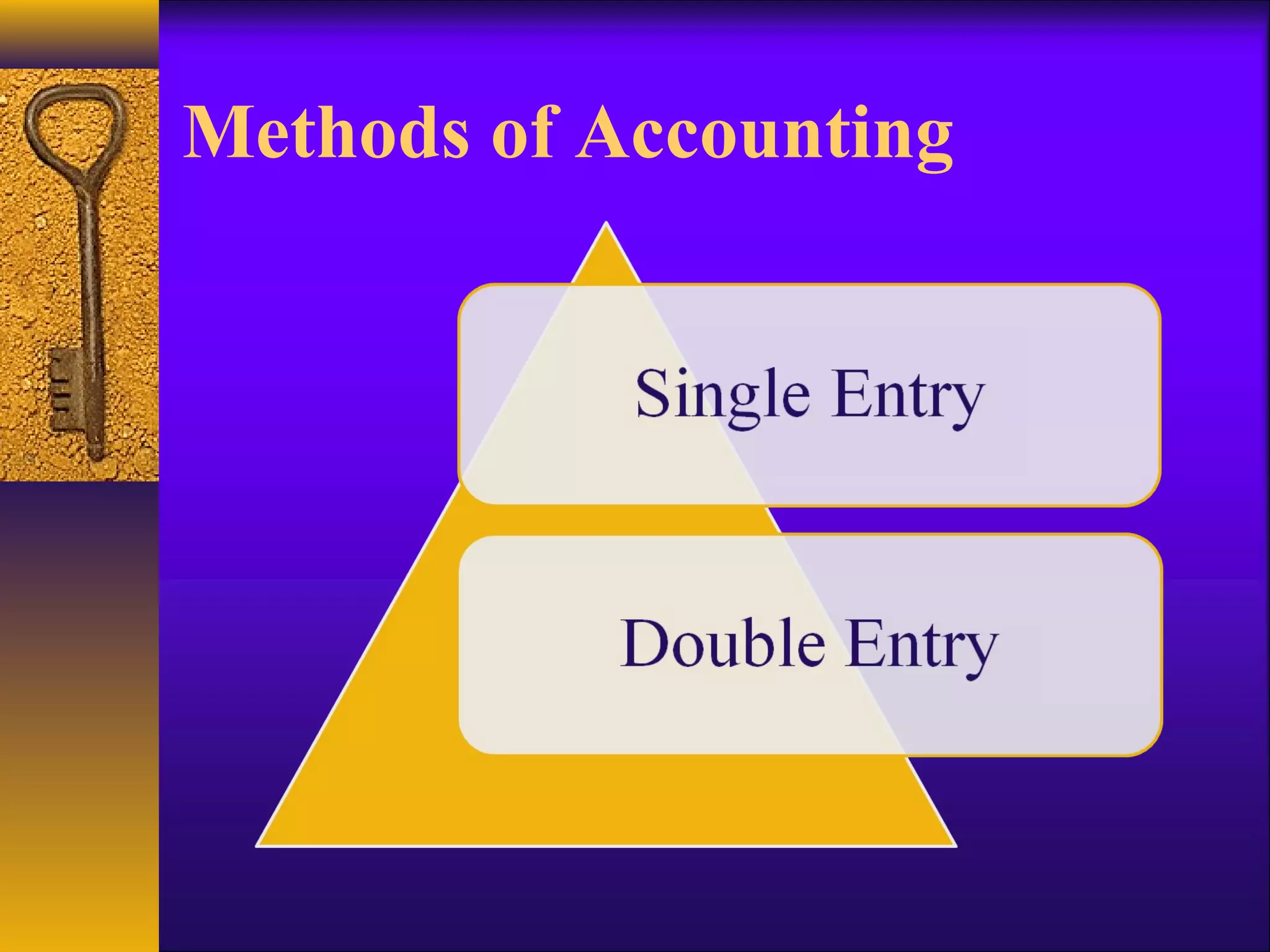
Methods of Accounting
Single Entry:
♦ It is incomplete system of recording
business transactions.
♦ The business organization maintains only
cash book and personal accounts of debtors
and creditors.
♦ So the complete recording of transactions
cannot be made and trail balance cannot be
prepared.
Double Entry:
♦ It this system every business transaction is
having a two fold effect of benefits giving
and benefit receiving aspects.
♦ The recording is made on the basis of both
these aspects.
♦ Double Entry is an accounting system that
records the effects of transactions and other
events in at least two accounts with equal
debits and credits.
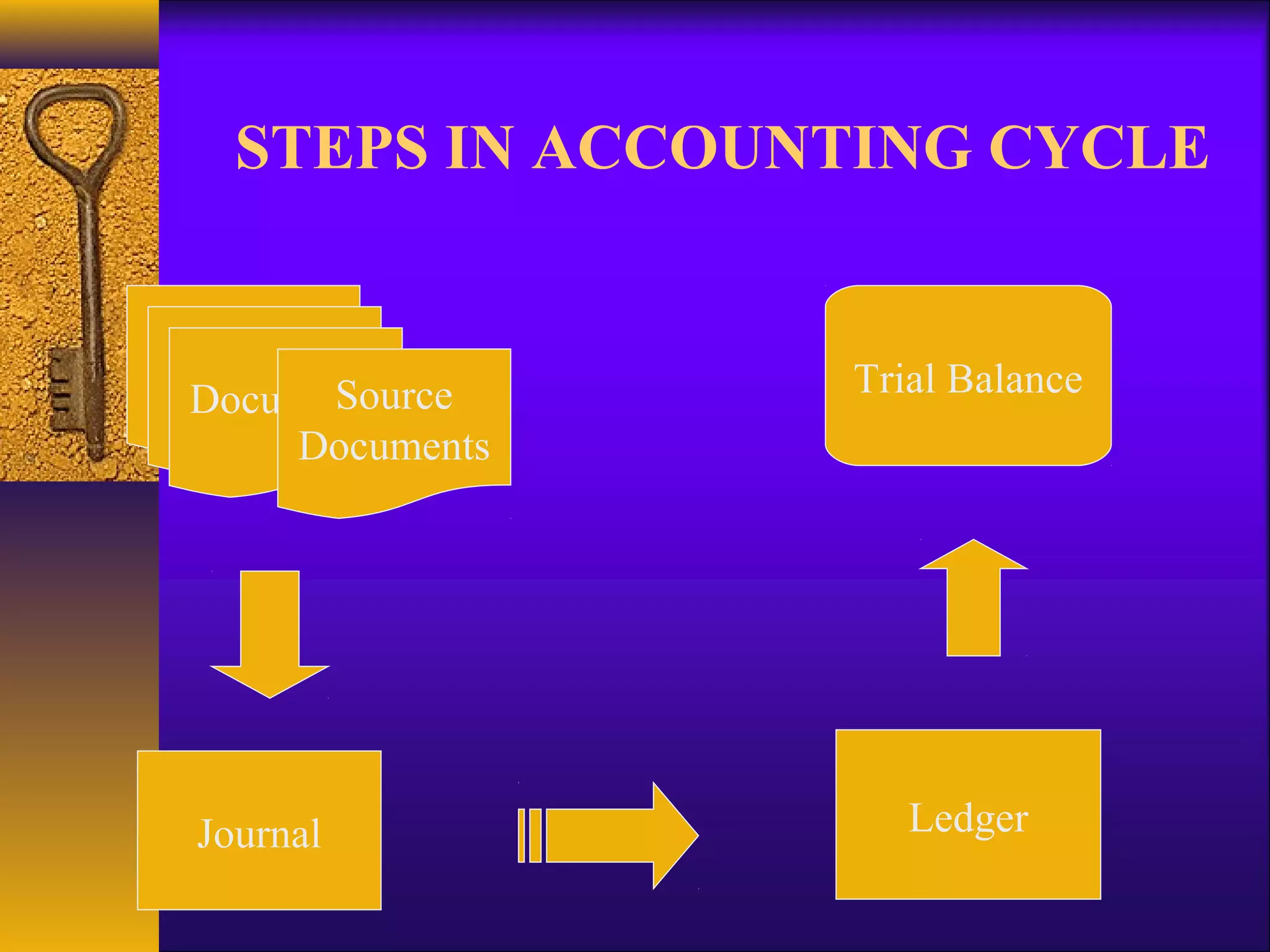
STEPS IN ACCOUNTING CYCLE
Documents
Documents
DocumentsSource
Documents
Journal Ledger
Trial Balance
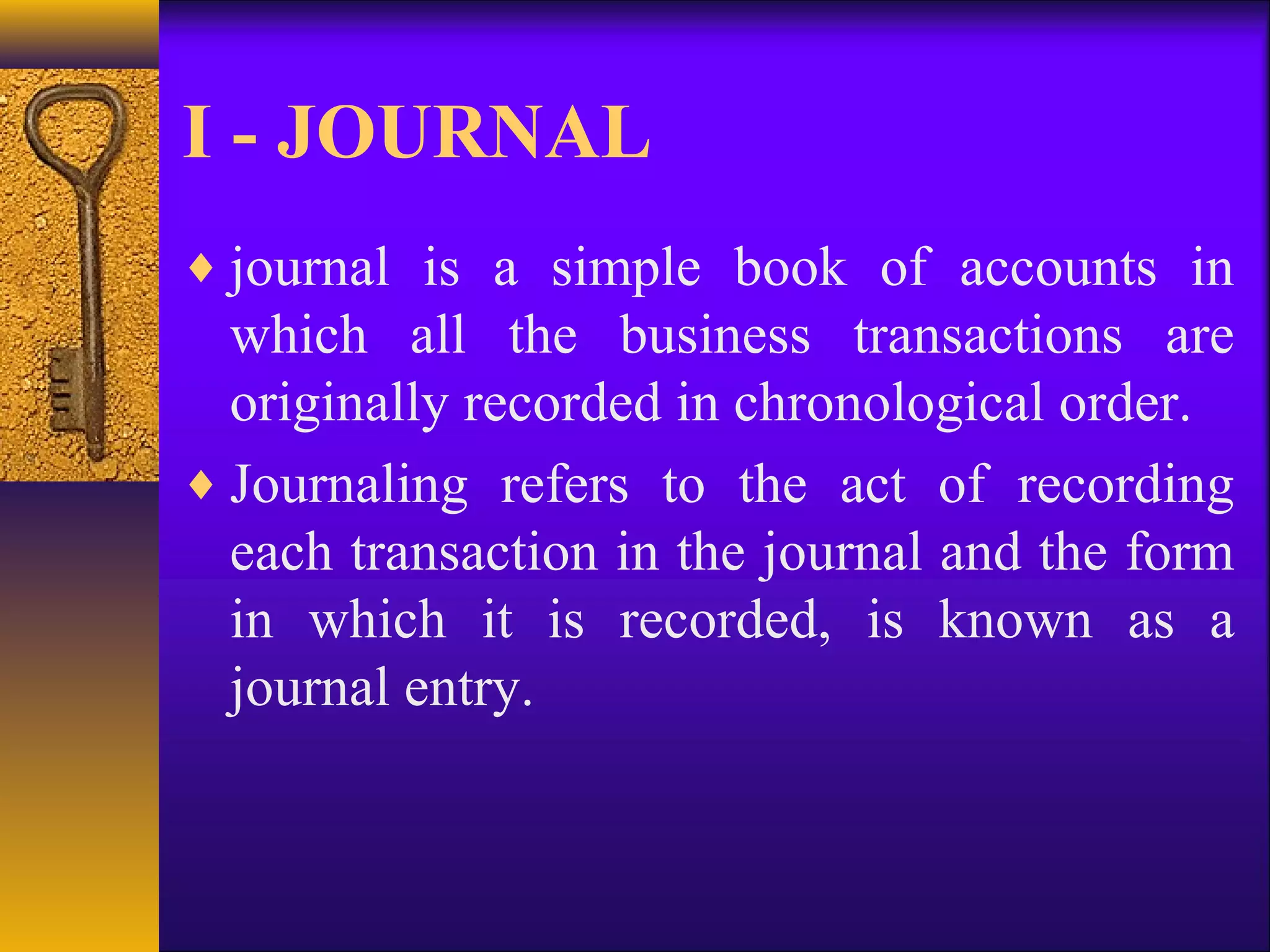
I - JOURNAL
♦ journal is a simple book of accounts in
which all the business transactions are
originally recorded in chronological order.
♦ Journaling refers to the act of recording
each transaction in the journal and the form
in which it is recorded, is known as a
journal entry.
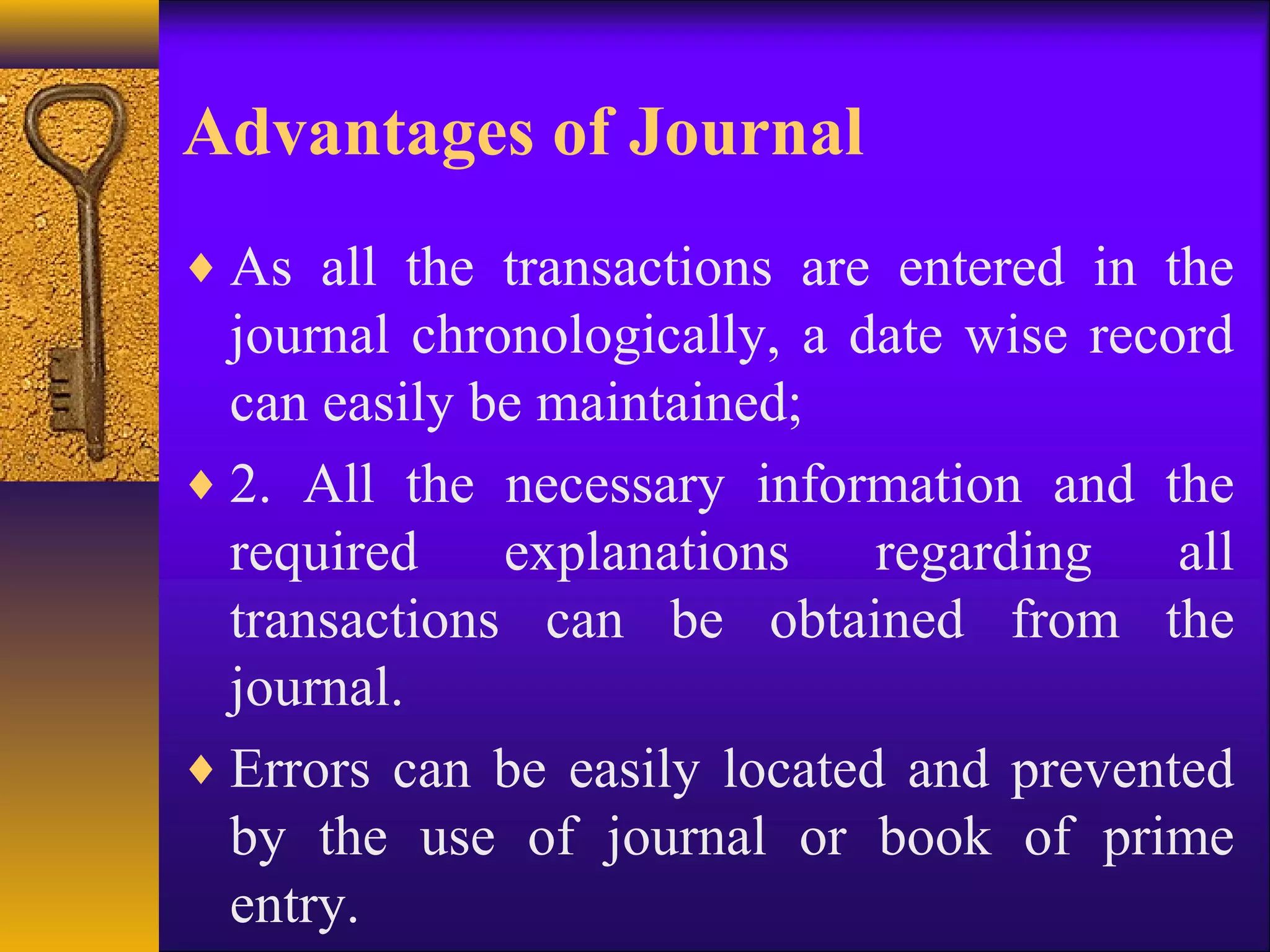
Advantages of Journal
♦ As all the transactions are entered in the
journal chronologically, a date wise record
can easily be maintained;
♦ 2. All the necessary information and the
required explanations regarding all
transactions can be obtained from the
journal.
♦ Errors can be easily located and prevented
by the use of journal or book of prime
entry.
Journal Performa
Name of the journal
Date Particular L. Folio Debit Credit
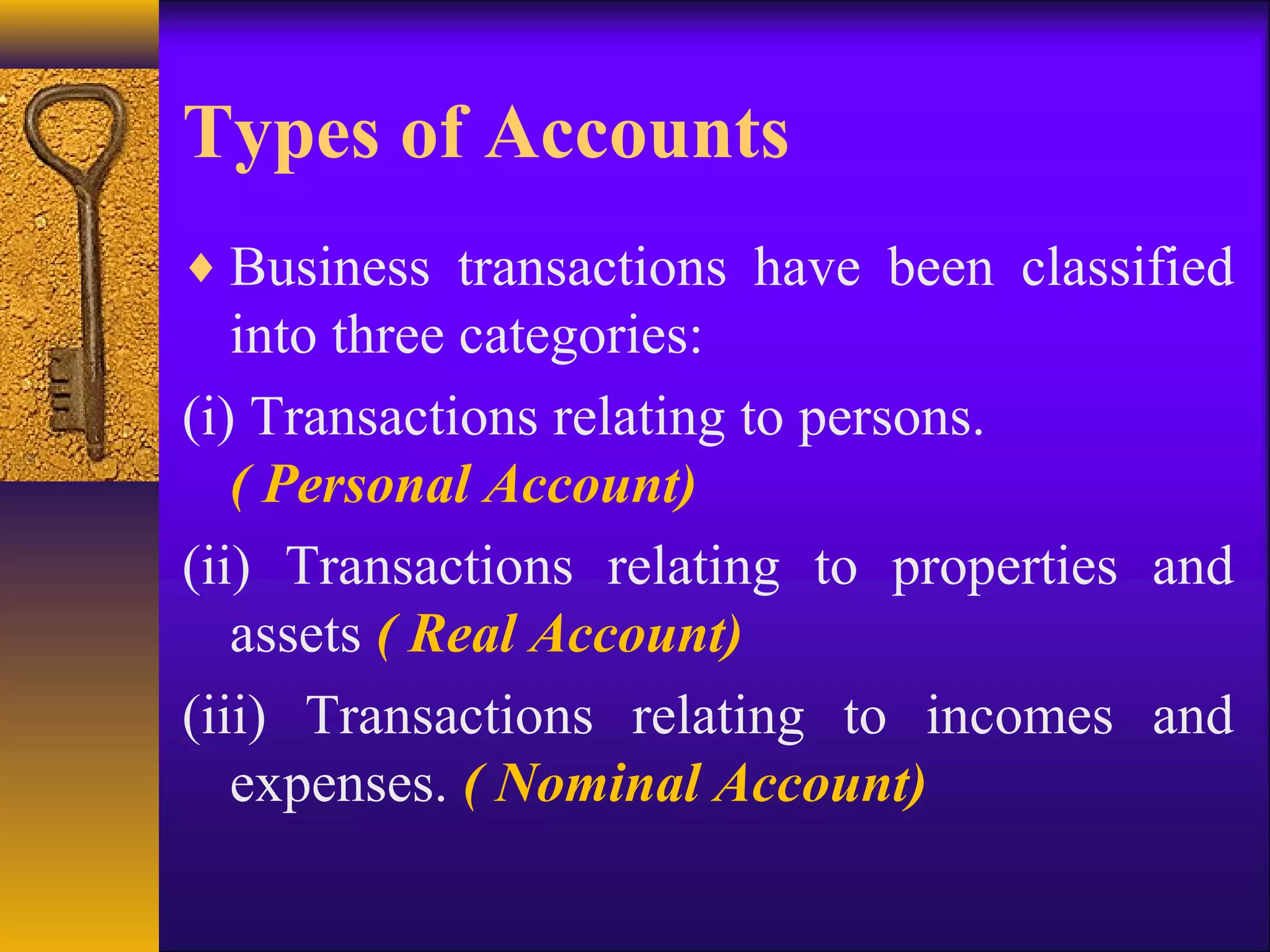
Types of Accounts
♦ Business transactions have been classified
into three categories:
(i) Transactions relating to persons.
( Personal Account)
(ii) Transactions relating to properties and
assets ( Real Account)
(iii) Transactions relating to incomes and
expenses. ( Nominal Account)
Personal Accounts:
♦ Accounts recording transactions with a
person or group of persons.
♦ These accounts are necessary, in particular,
to record credit transactions.
♦ The rule for personal accounts is:
• Debit the receiver
• Credit the giver
Real Accounts
♦ Accounts relating to properties or assets
♦ A separate account is maintained for each
asset e.g., Cash Machinery, Building, etc.,
♦ The rule for Real accounts is:
• Debit what comes in
• Credit what goes out
Nominal Accounts
♦ It is relating to income, revenue, gain
expenses and losses.
♦ A separate account is maintained for each
expense or loss and gain or income.
♦ Ex:-Wages account, Rent account
Commission account, Interest received
account etc.,
♦ The rule for Nominal accounts is:
• Debit all expenses and losses
• Credit all incomes and gains
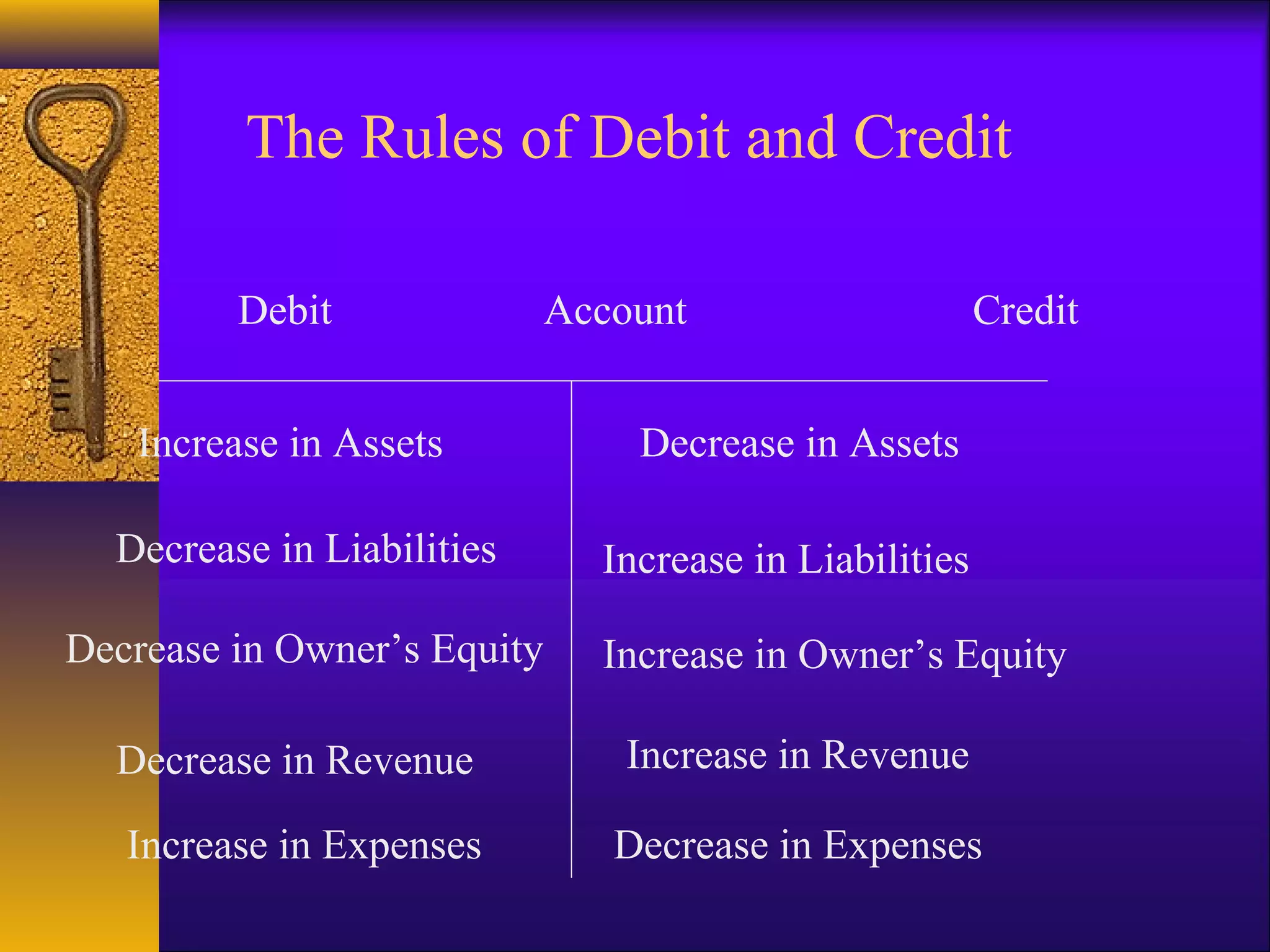
The Rules of Debit and Credit
Debit Account Credit
Increase in Assets Decrease in Assets
Decrease in Liabilities Increase in Liabilities
Decrease in Owner’s Equity Increase in Owner’s Equity
Decrease in Revenue Increase in Revenue
Increase in Expenses Decrease in Expenses
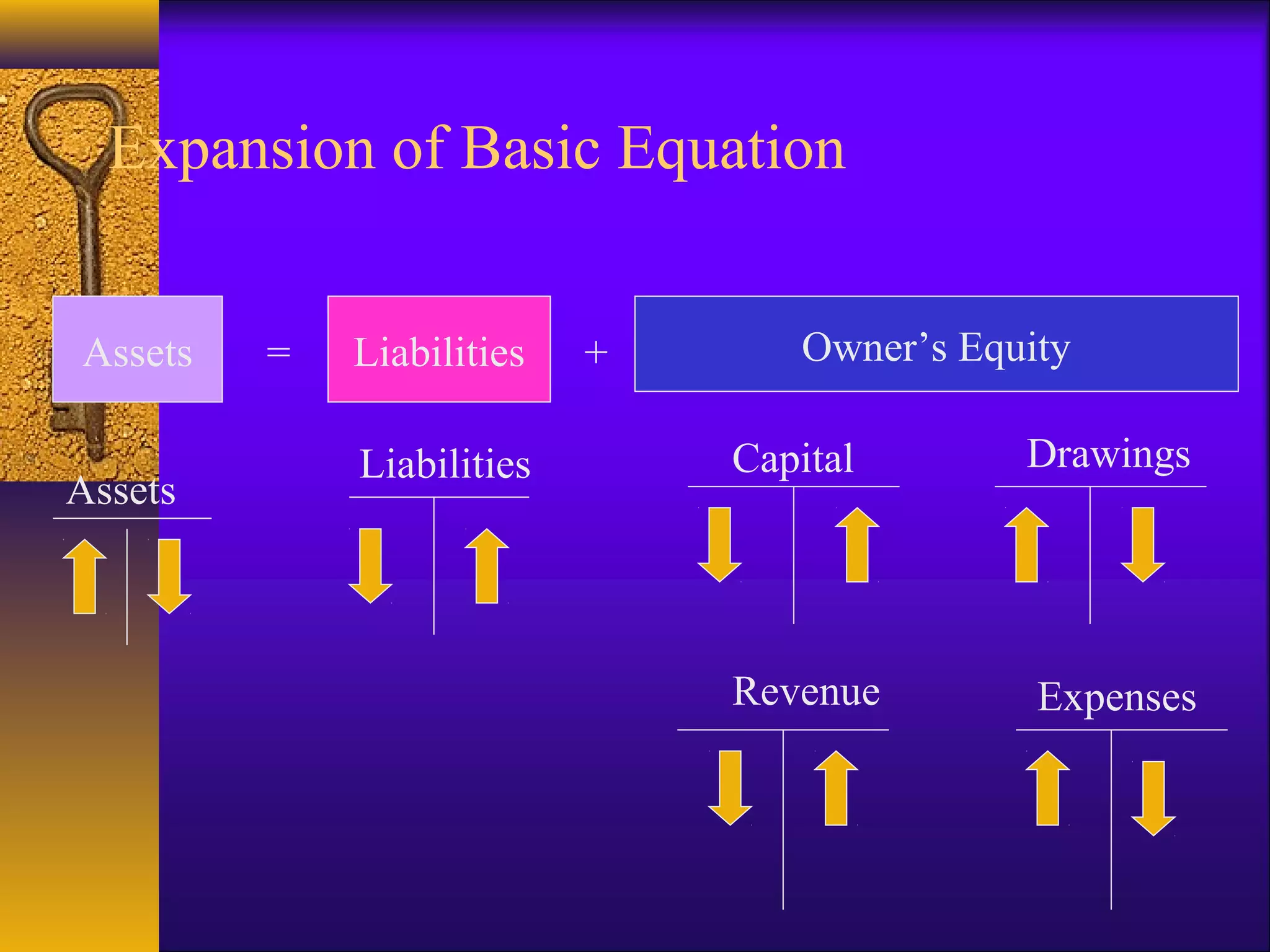
Expansion of Basic Equation
Assets = Liabilities + Owner’s Equity
Assets
Liabilities Capital Drawings
Revenue Expenses
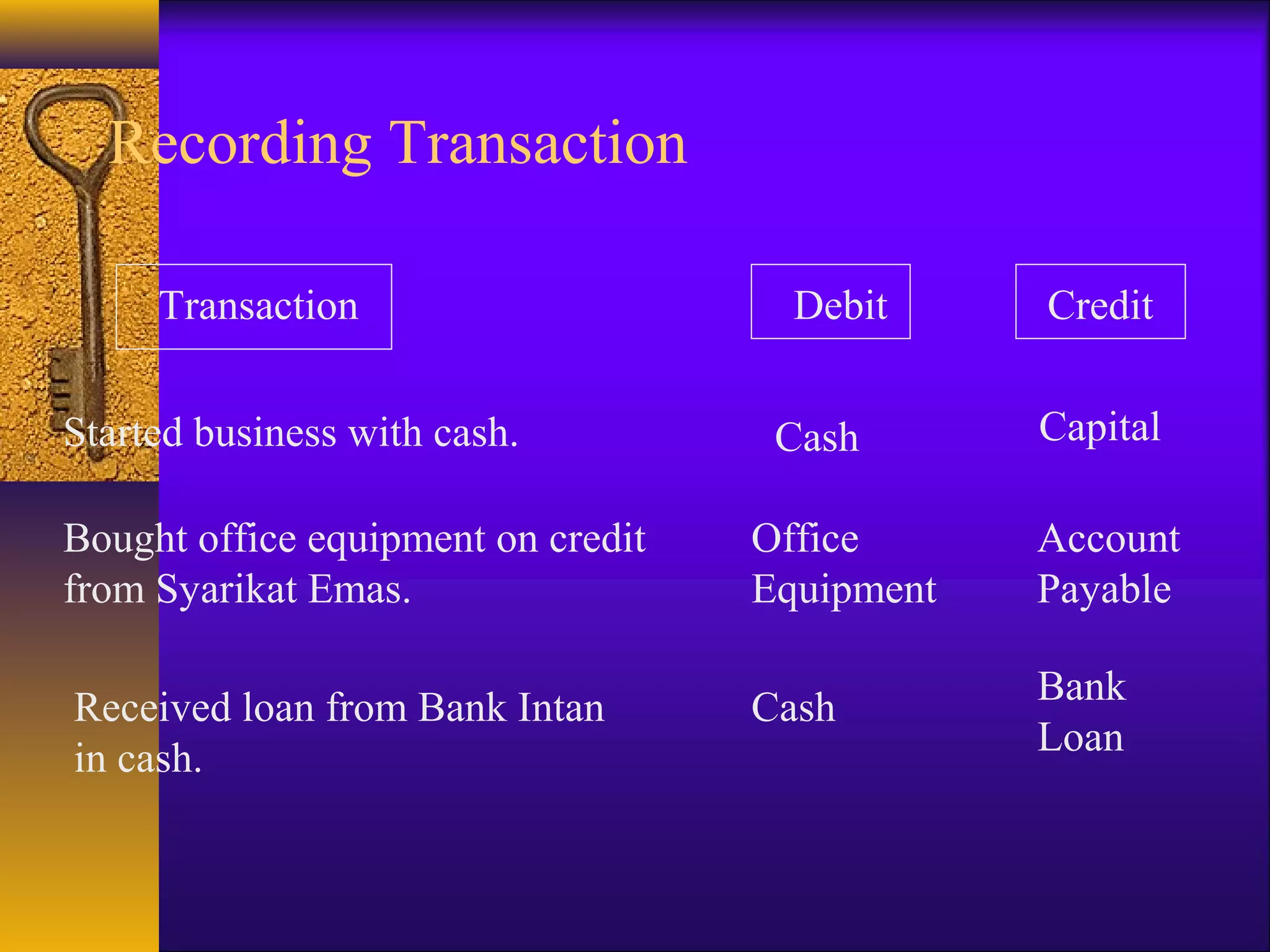
Recording Transaction
Transaction Debit Credit
Started business with cash. CapitalCash
Bought office equipment on credit
from Syarikat Emas.
Office
Equipment
Account
Payable
Received loan from Bank Intan
in cash.
Cash
Bank
Loan
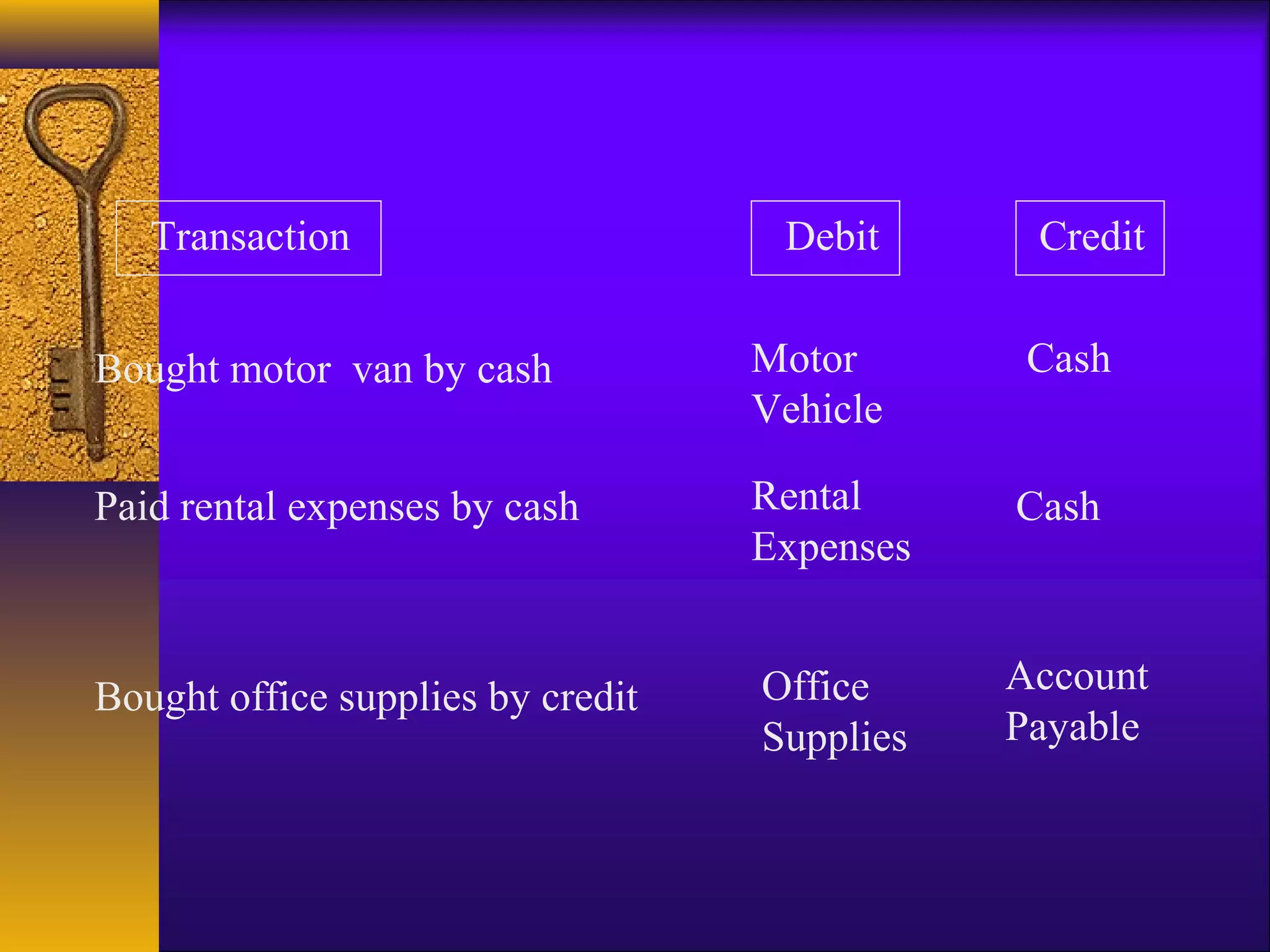
Transaction Debit Credit
Bought motor van by cash Motor
Vehicle
Cash
Paid rental expenses by cash Rental
Expenses
Cash
Bought office supplies by credit Office
Supplies
Account
Payable
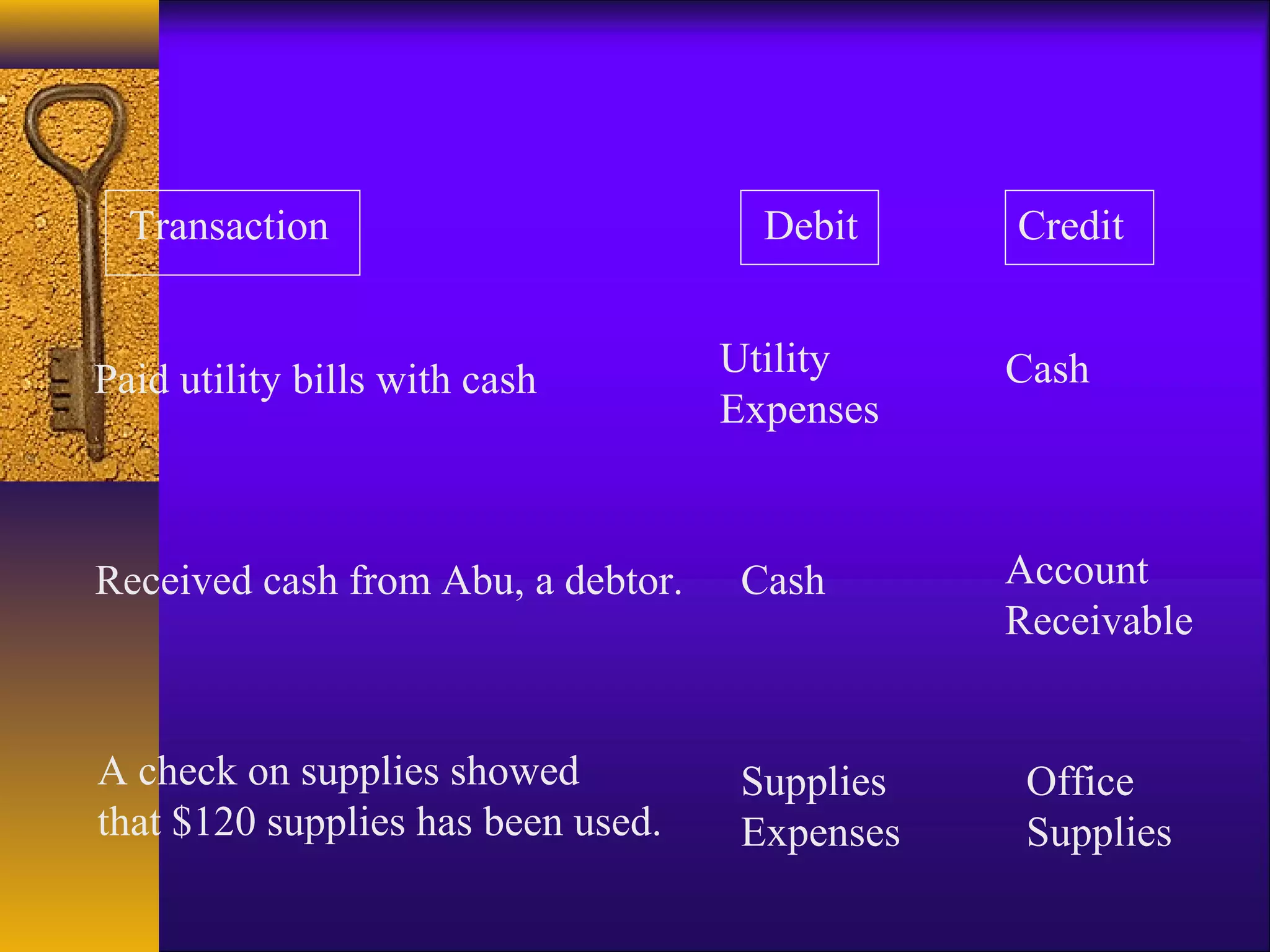
Transaction Debit Credit
Paid utility bills with cash
Utility
Expenses
Cash
Received cash from Abu, a debtor. Cash Account
Receivable
A check on supplies showed
that $120 supplies has been used.
Supplies
Expenses
Office
Supplies
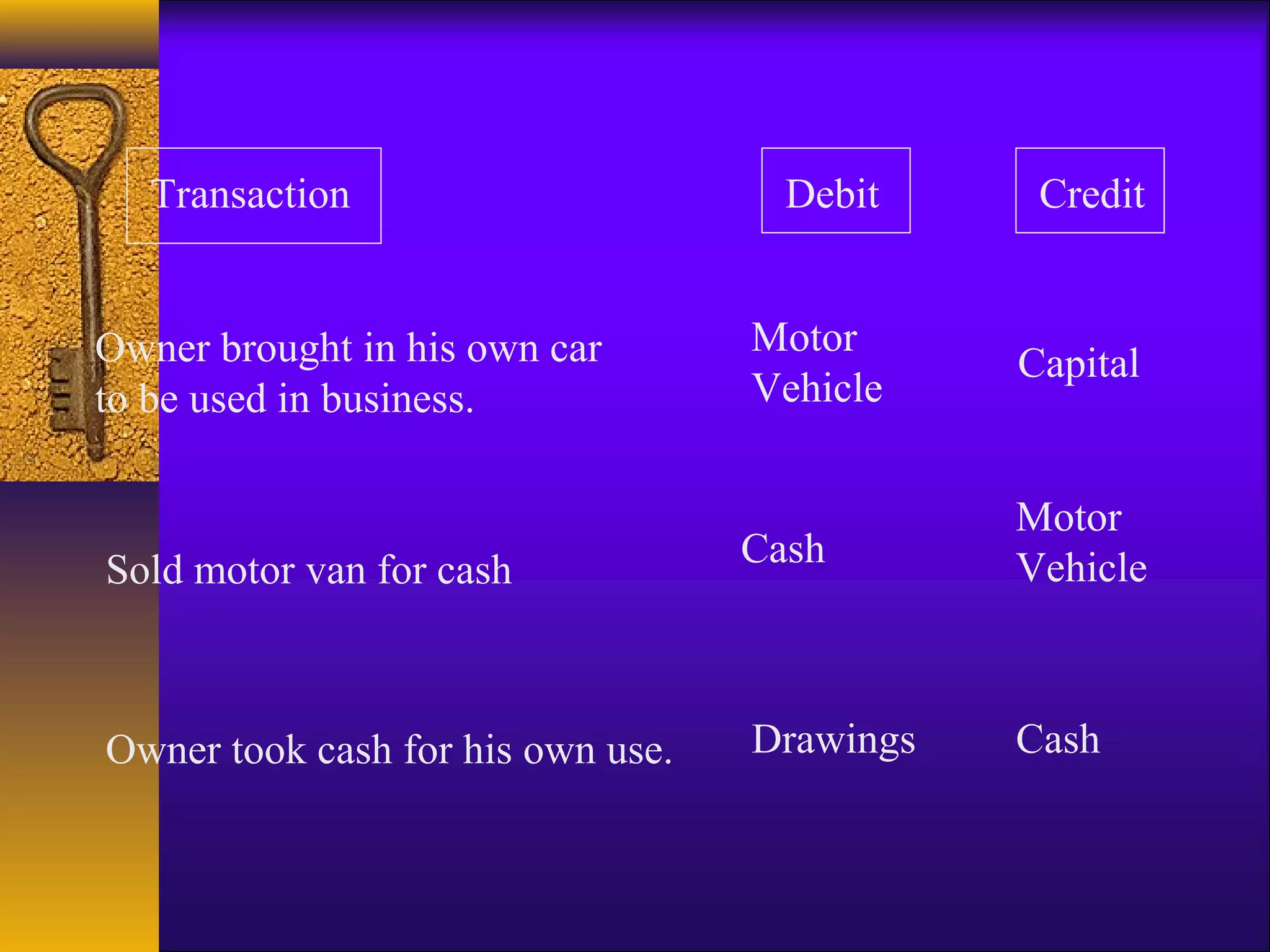
Transaction Debit Credit
Owner brought in his own car
to be used in business.
Motor
Vehicle
Capital
Sold motor van for cash
Cash
Motor
Vehicle
Owner took cash for his own use. Drawings Cash
Journal Entries
Siti Malaysia, the owner of Tadika Malaysia started her business
on 1 January 2002 with cash M25,000. The followings are
transactions related to the business for the month of January:
Illustration : Tadika Malaysia
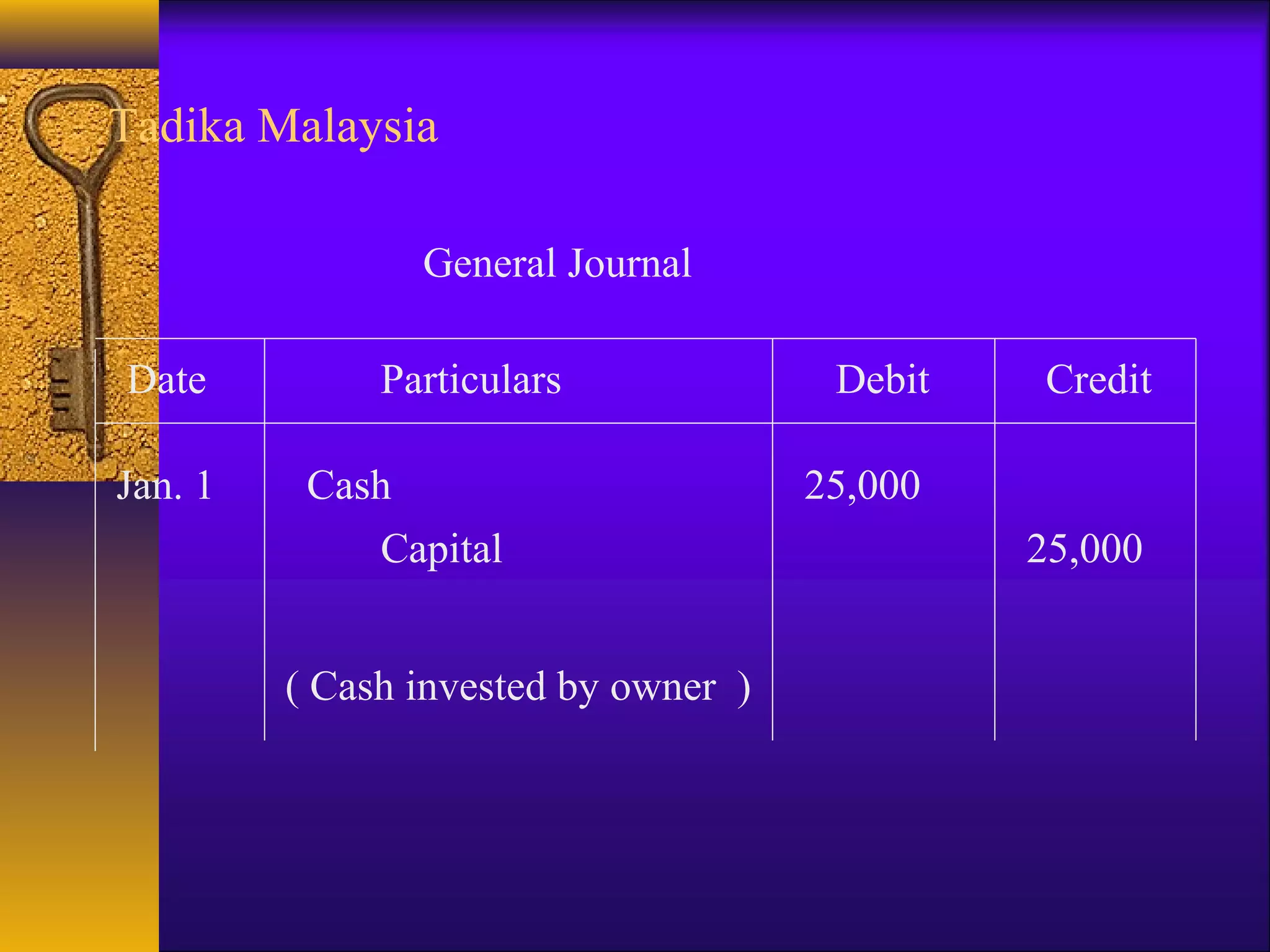
Tadika Malaysia
General Journal
Date Particulars Debit Credit
Jan. 1 Cash 25,000
Capital 25,000
( Cash invested by owner )
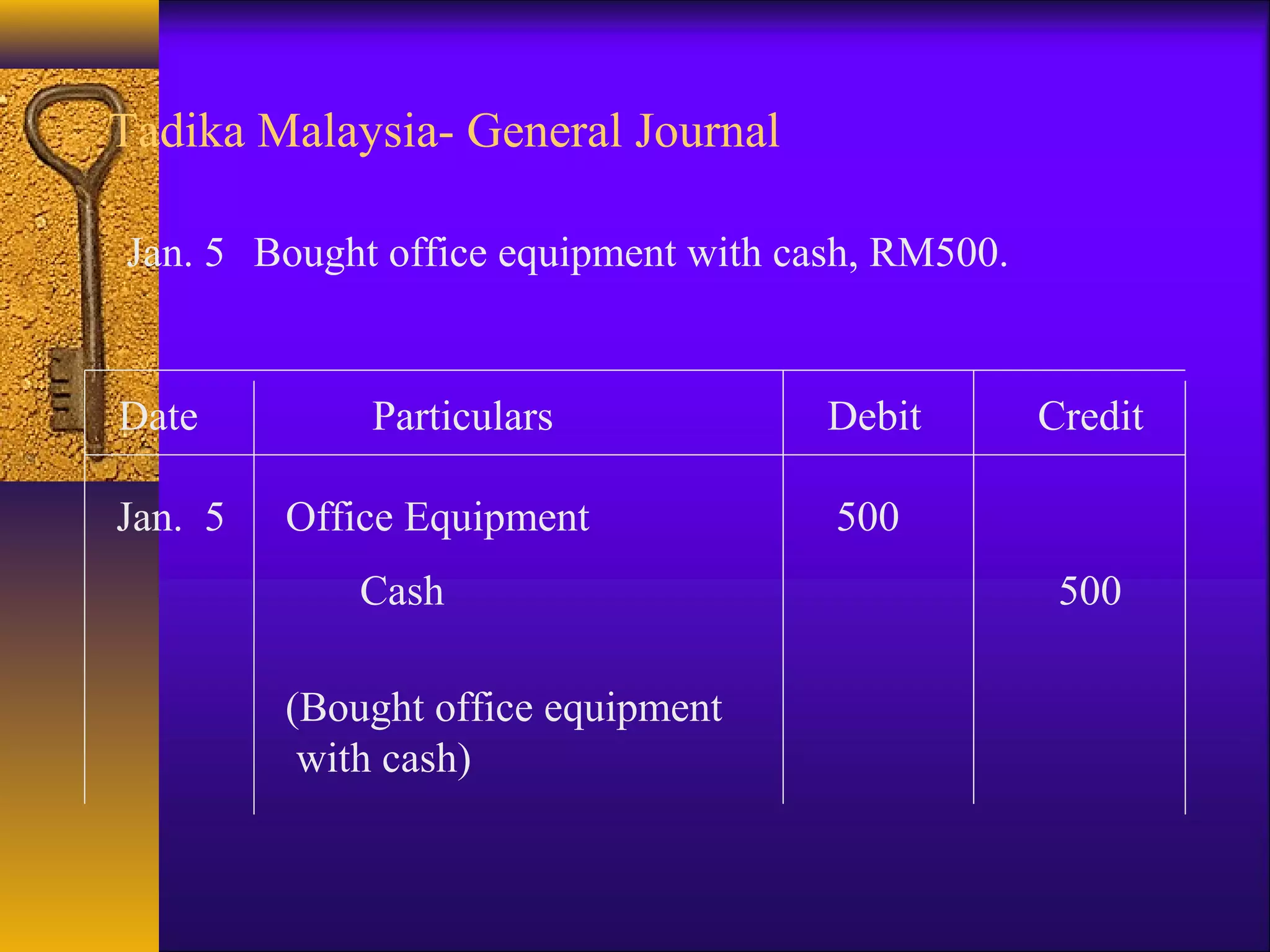
Tadika Malaysia- General Journal
Jan. 5 Bought office equipment with cash, RM500.
Jan. 5 Office Equipment 500
Cash 500
(Bought office equipment
with cash)
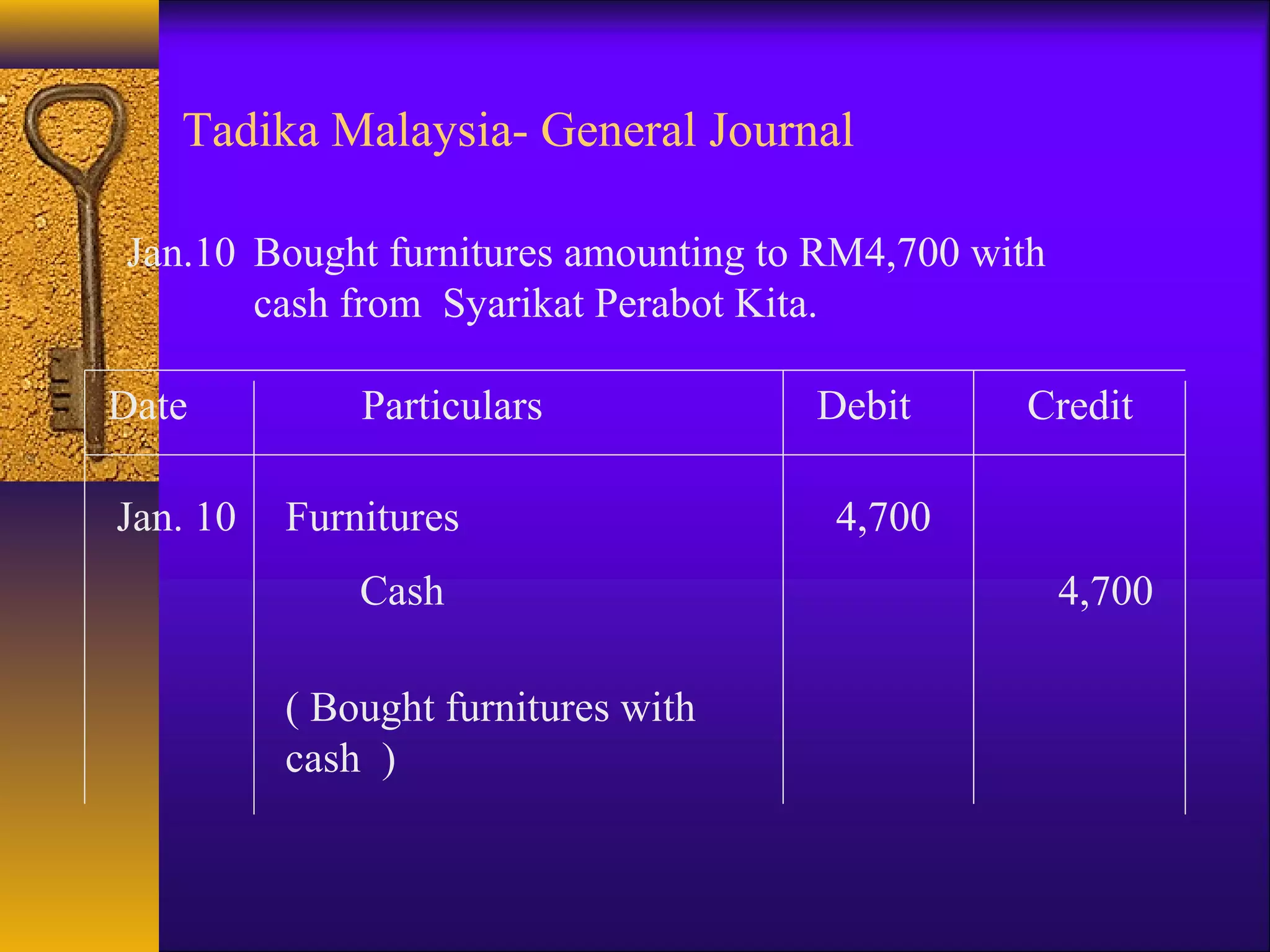
Date Particulars Debit Credit
Jan.10 Bought furnitures amounting to RM4,700 with
cash from Syarikat Perabot Kita.
Jan. 10 Furnitures 4,700
Cash 4,700
( Bought furnitures with
cash )
Date Particulars Debit Credit
Tadika Malaysia- General Journal
Jan. 11 35,000
35,000
Date Particulars Debit Credit
Tadika Malaysia- General Journal
Jan.11 Bought motor van for business use by credit
from Syarikat Kenderaan amounting to RM35,000.
Motor vehicles
Account Payable
( bought motor van by credit )
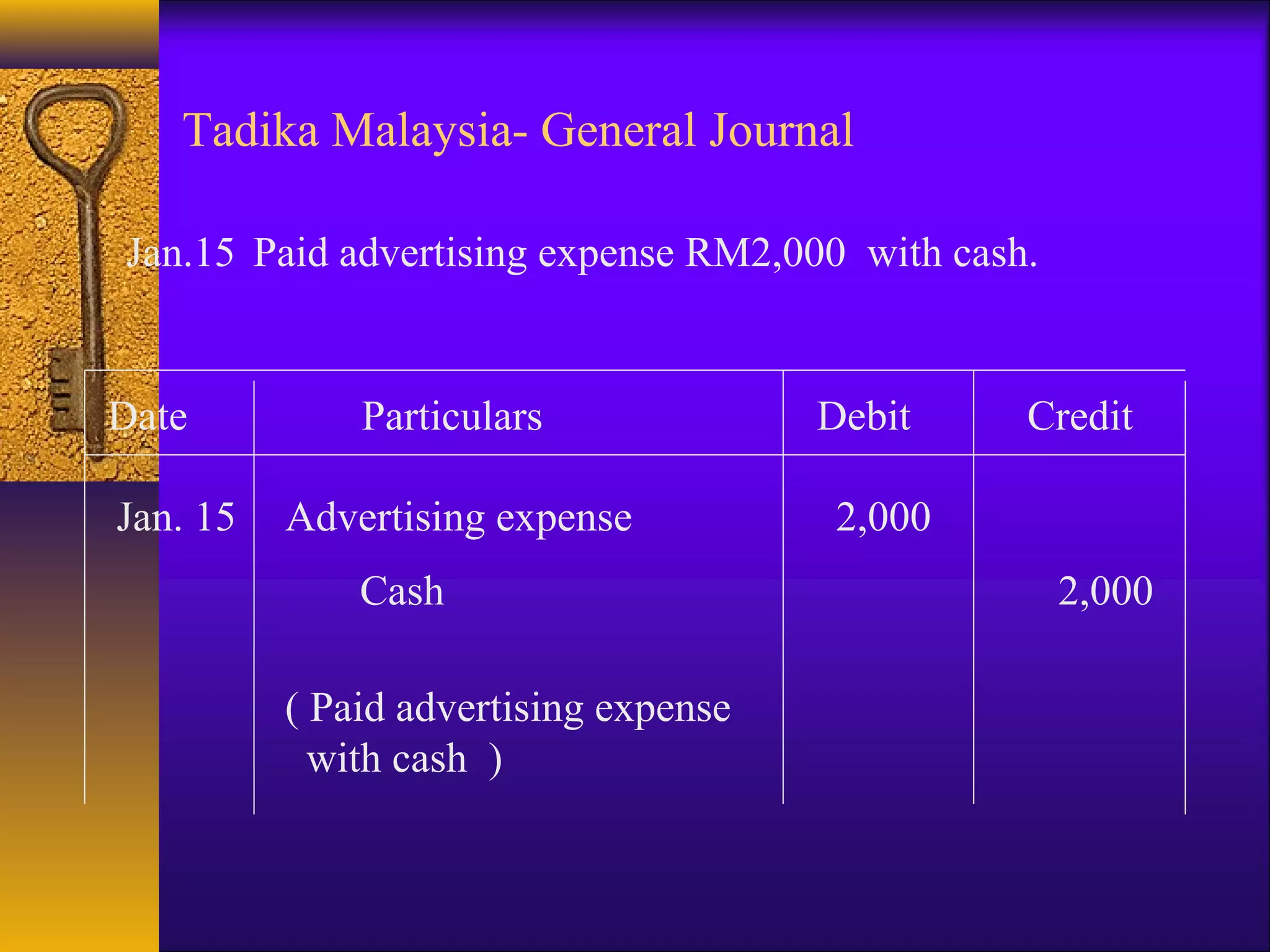
Jan.15 Paid advertising expense RM2,000 with cash.
Jan. 15 Advertising expense 2,000
Cash 2,000
( Paid advertising expense
with cash )
Date Particulars Debit Credit
Tadika Malaysia- General Journal
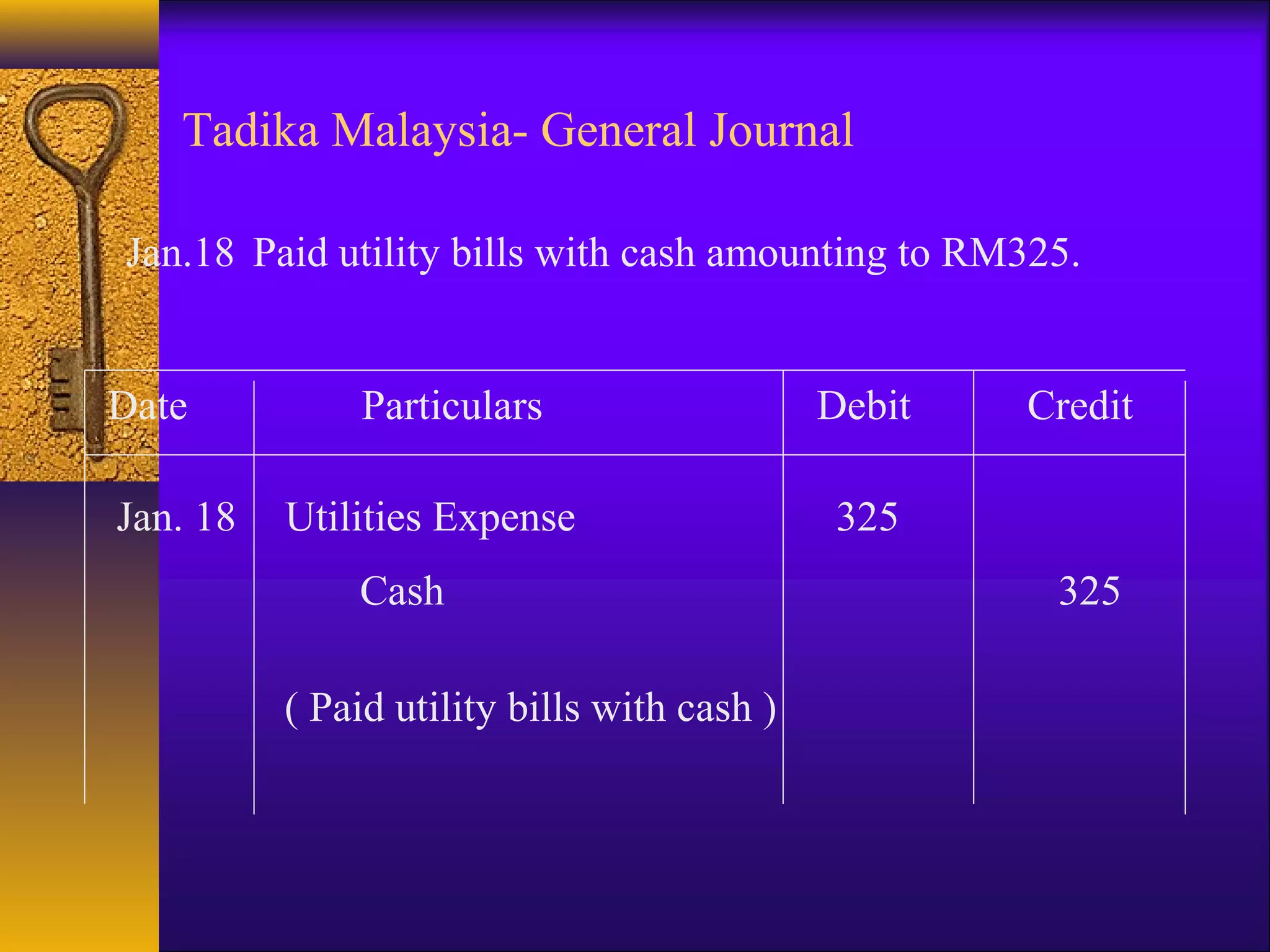
Jan.18 Paid utility bills with cash amounting to RM325.
Jan. 18 Utilities Expense 325
Cash 325
( Paid utility bills with cash )
Date Particulars Debit Credit
Tadika Malaysia- General Journal
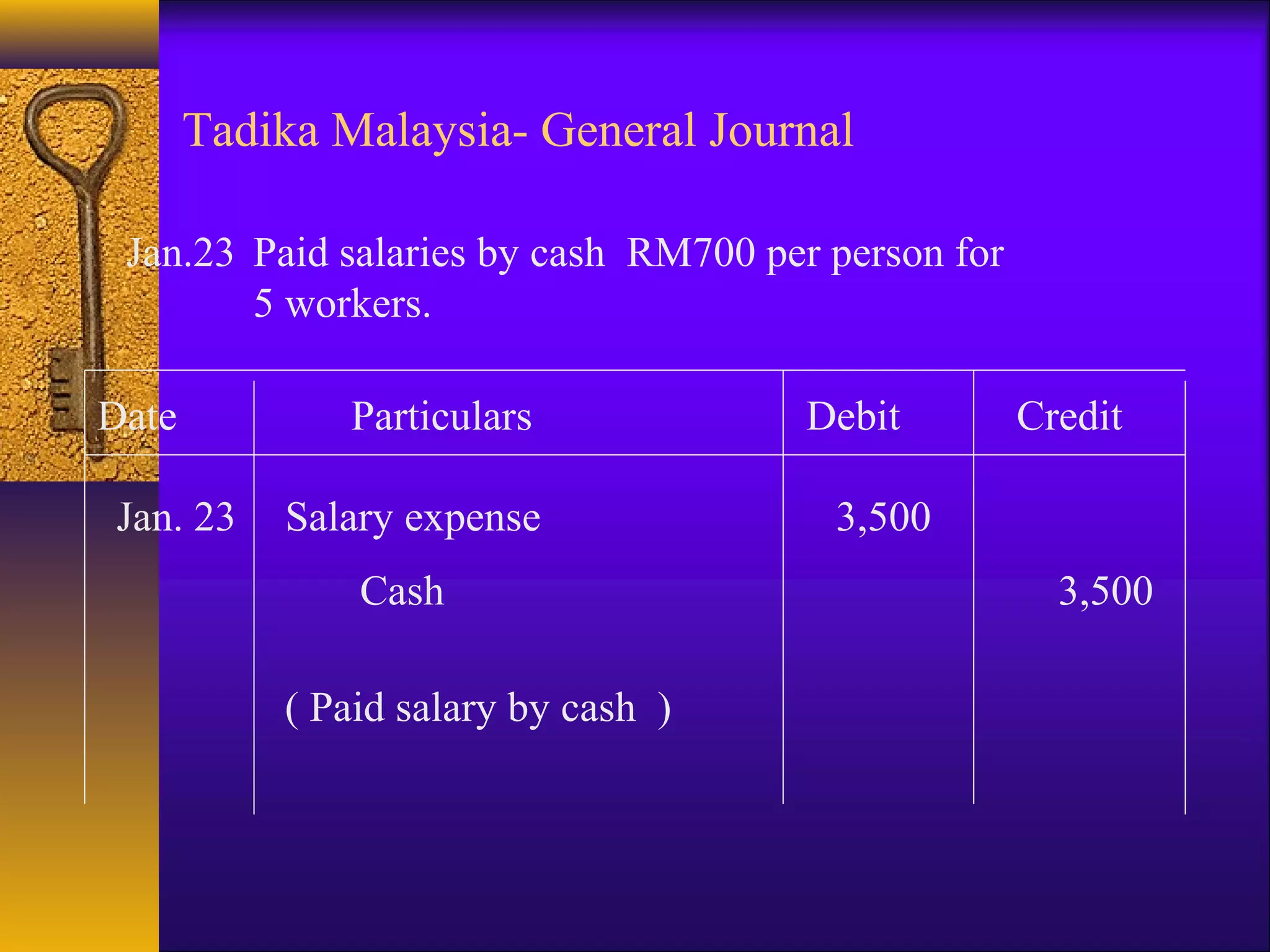
Jan.23 Paid salaries by cash RM700 per person for
5 workers.
Jan. 23 Salary expense 3,500
Cash 3,500
( Paid salary by cash )
Date Particulars Debit Credit
Tadika Malaysia- General Journal
Jan 24 Received cash RM7,500 for the fees of the month.
Jan. 24 Cash 7,500
Revenue : Fees 7,500
( received fees or the month )
Date Particulars Debit Credit
Tadika Malaysia- General Journal
Jan.27 Bought two units of computers on credit , amounting
to RM4,000 per unit.
Jan. 27 Office Equipment 8,000
Account Payables 8,000
( Bought computers on credit )
Date Particulars Debit Credit
Tadika Malaysia- General Journal
Jan.30 Siti Malaysia took cash RM1,200 for her own use.
Jan. 30 Drawings 1,200
Cash 1,200
( Cash withdrawals by the owner )
Date Particulars Debit Credit
Tadika Malaysia- General Journal
II - LEDGER
♦ In journal, as all the business transactions are recorded
chronologically, it is very difficult to obtain all the
transactions pertaining to one head of account together at
one place.
♦ But, the preparation of different ledger accounts helps to
get a consolidated picture of the transactions pertaining to
one ledger account at a time.
♦ Thus, a ledger account may be defined as a summary
statement of all the transactions relating to a person, asset,
expense, or income or gain or loss which have taken place
during a specified period and shows their net effect
ultimately.
Posting from journal to ledger
Journal Ledger
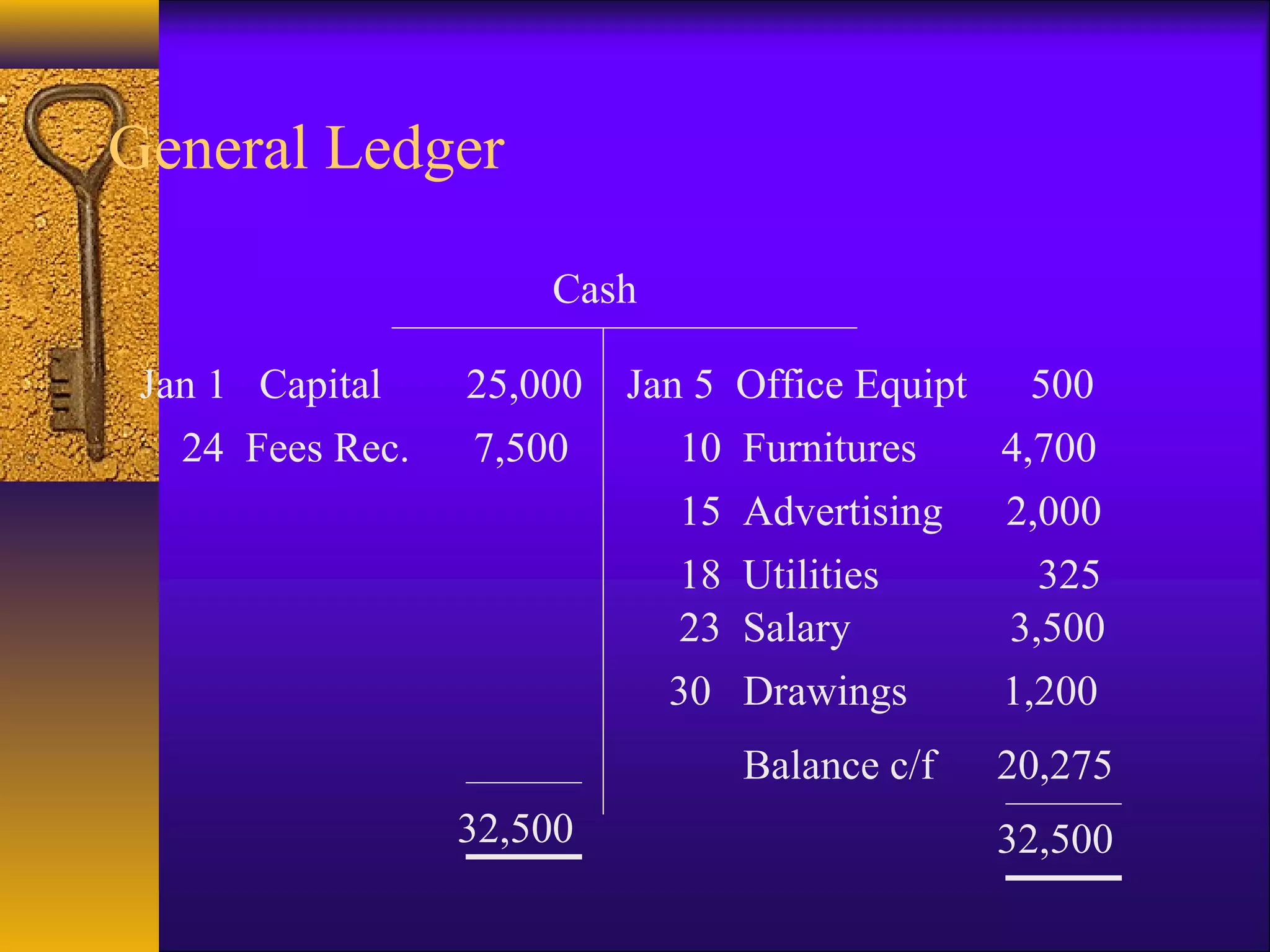
General Ledger
Cash
Jan 1 Capital 25,000 Jan 5 Office Equipt 500
24 Fees Rec. 7,500 10 Furnitures 4,700
18 Utilities 325
15 Advertising 2,000
30 Drawings 1,200
23 Salary 3,500
Balance c/f
32,500 32,500
20,275
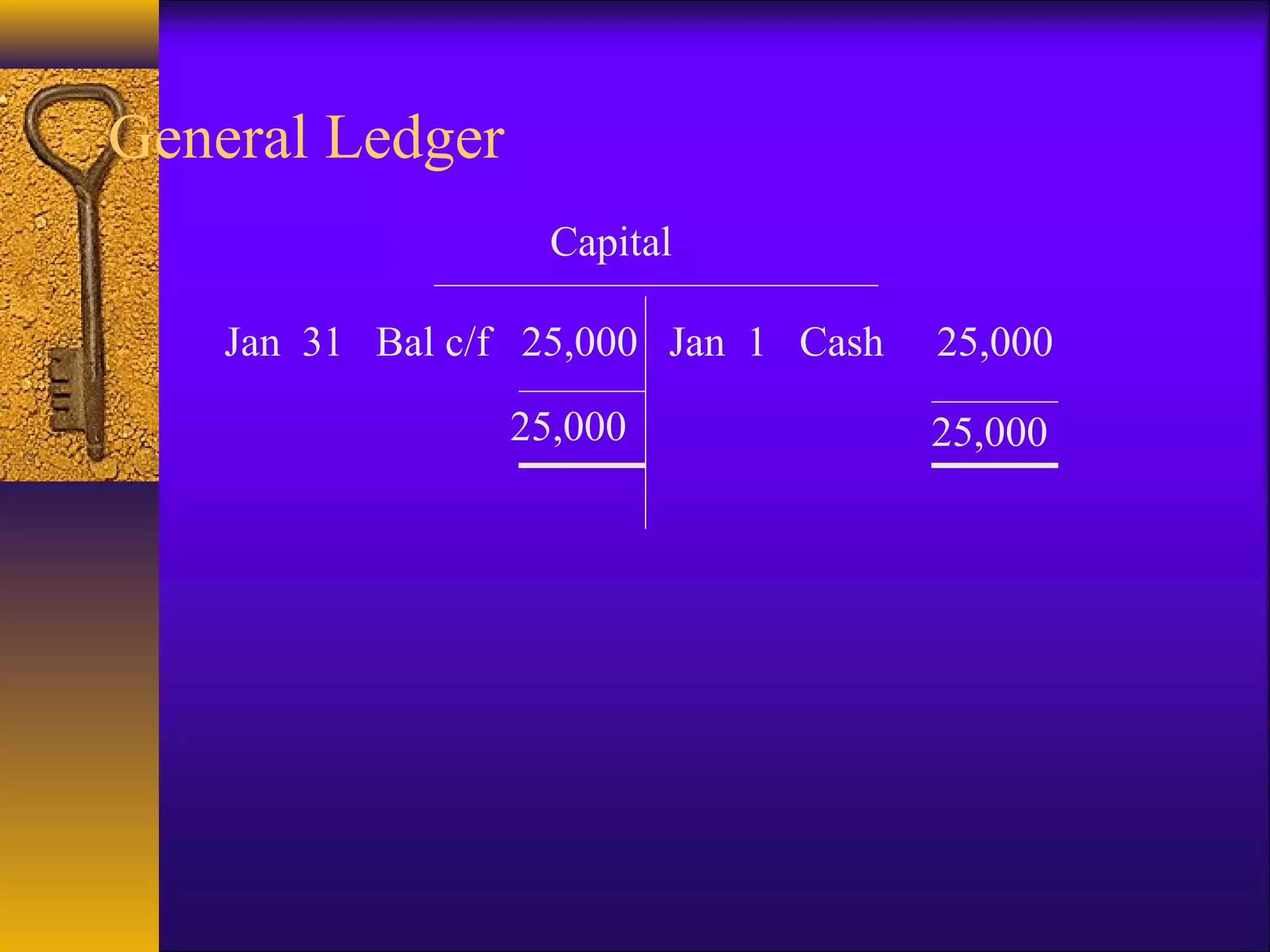
General Ledger
Capital
Jan 1 Cash 25,000
25,00025,000
Jan 31 Bal c/f 25,000
General Ledger
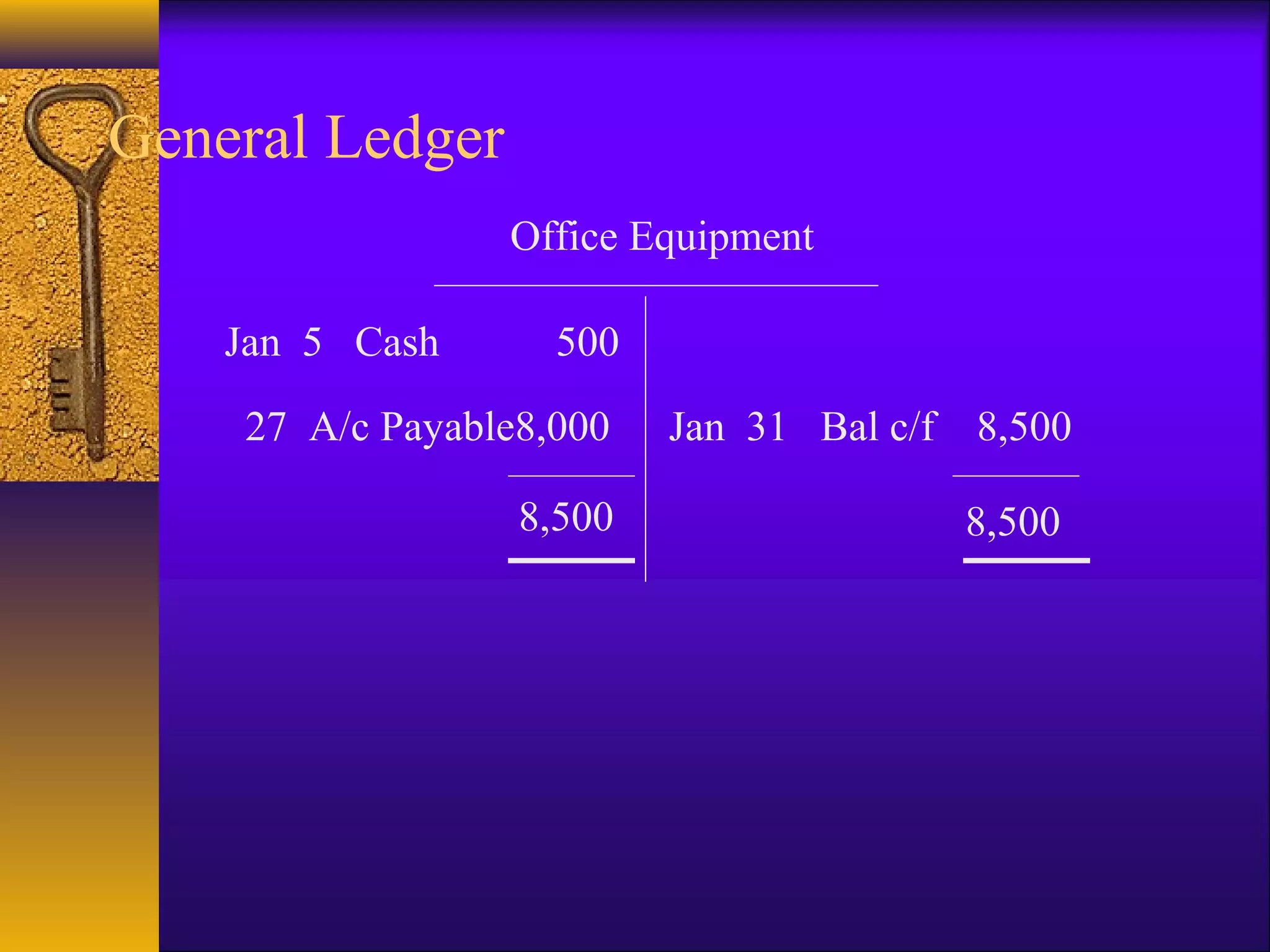
Office Equipment
Jan 31 Bal c/f 8,500
Jan 5 Cash 500
27 A/c Payable8,000
8,500 8,500
General Ledger
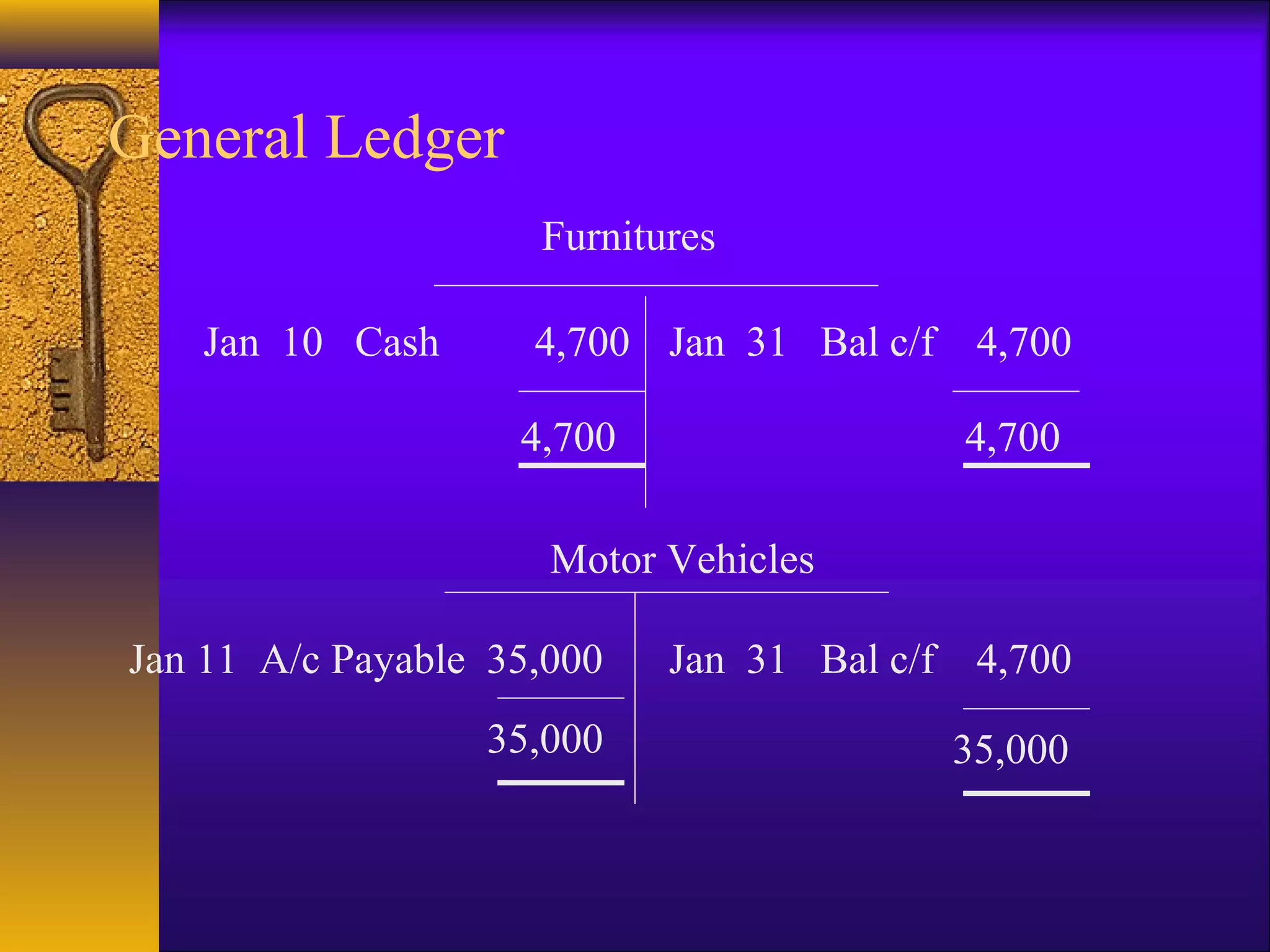
Furnitures
Jan 31 Bal c/f 4,700Jan 10 Cash 4,700
4,700 4,700
Motor Vehicles
Jan 11 A/c Payable 35,000 Jan 31 Bal c/f 4,700
35,000 35,000
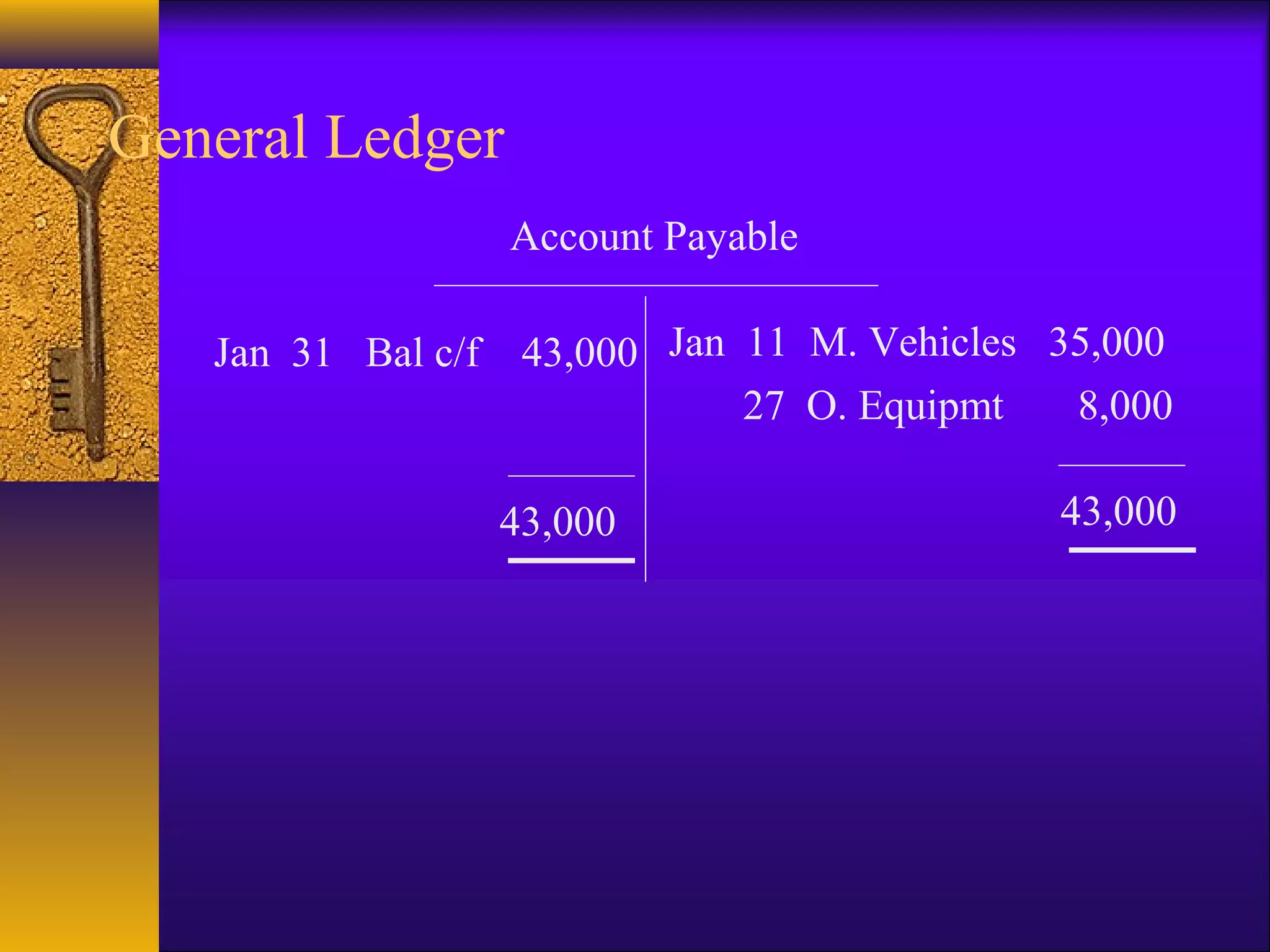
General Ledger
Account Payable
Jan 31 Bal c/f 43,000 Jan 11 M. Vehicles 35,000
27 O. Equipmt 8,000
43,000 43,000
General Ledger
Advertising
Jan 31 Bal c/f 2,000Jan 15 Cash 2,000
2,000 2,000
Utility
Jan 18 Cash 325 Jan 31 Bal c/f 325
325 325
General Ledger
Salaries
Jan 31 Bal c/f 3,500Jan 23 Cash 3,500
3,500 3,500
Fees Received
Jan 24 Cash 7,500Jan 31 Bal c/f 7,500
7,500 7,500
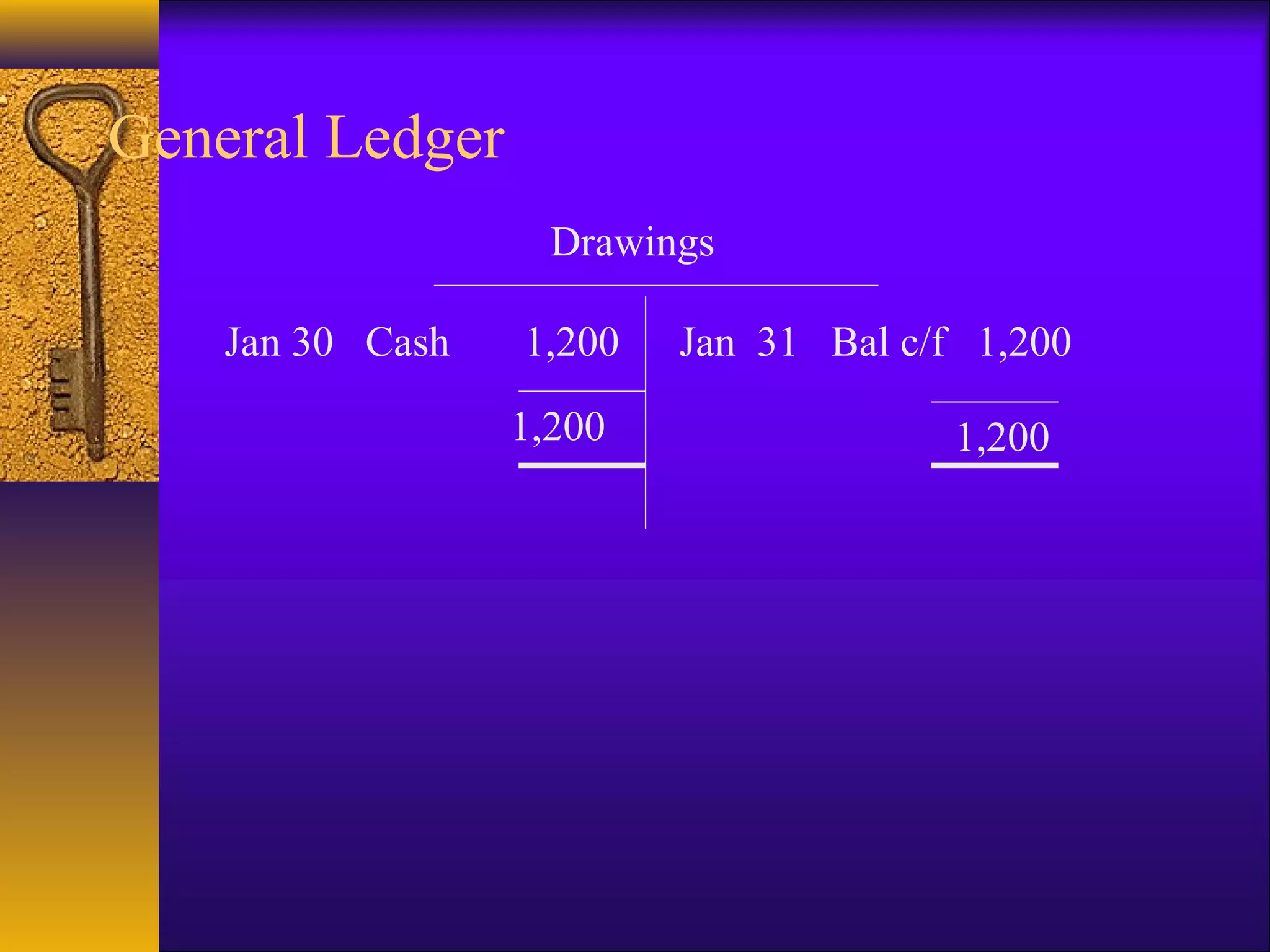
General Ledger
Drawings
Jan 30 Cash 1,200
1,2001,200
Jan 31 Bal c/f 1,200
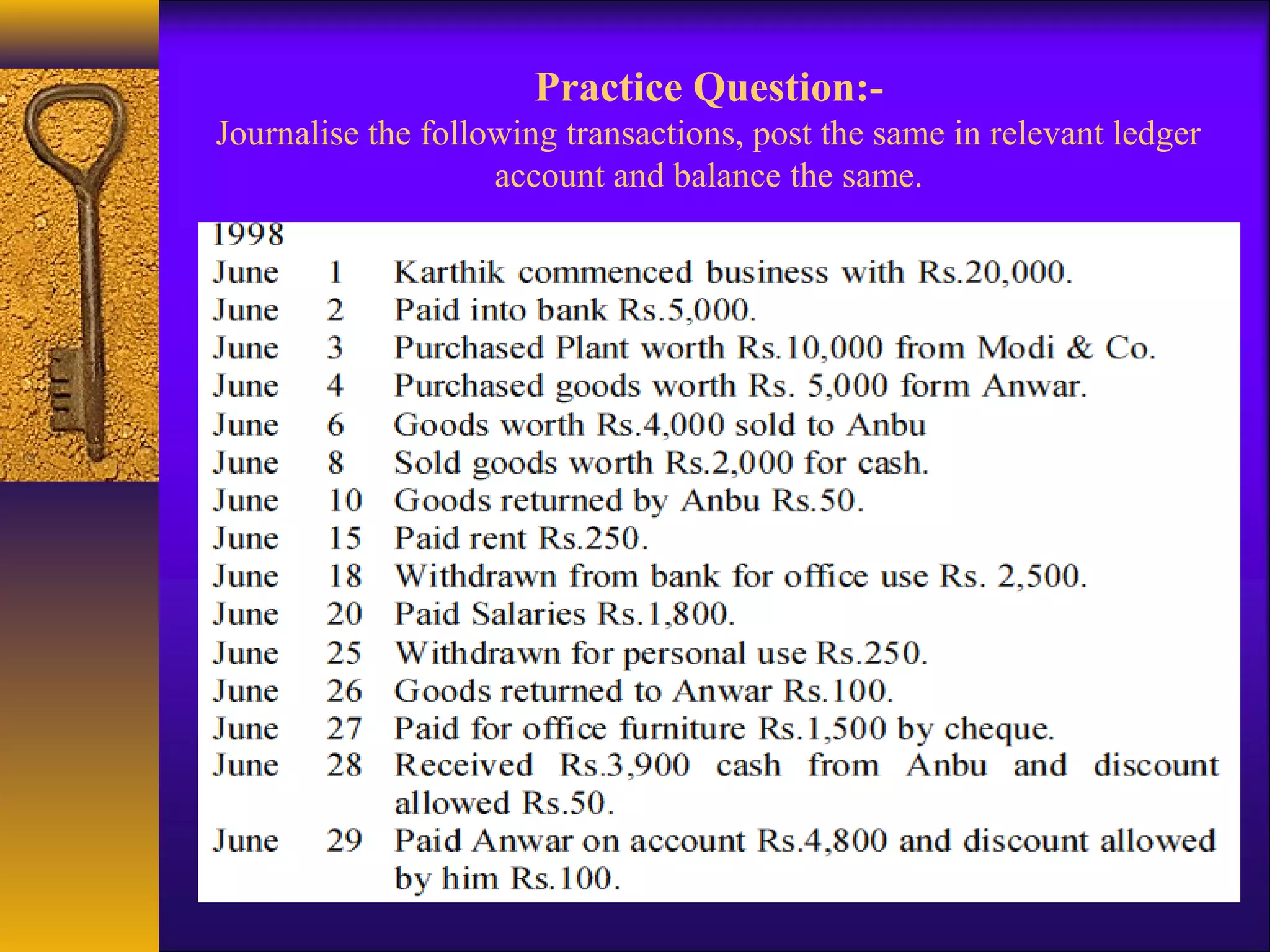
Practice Question:-
Journalise the following transactions, post the same in relevant ledger
account and balance the same.
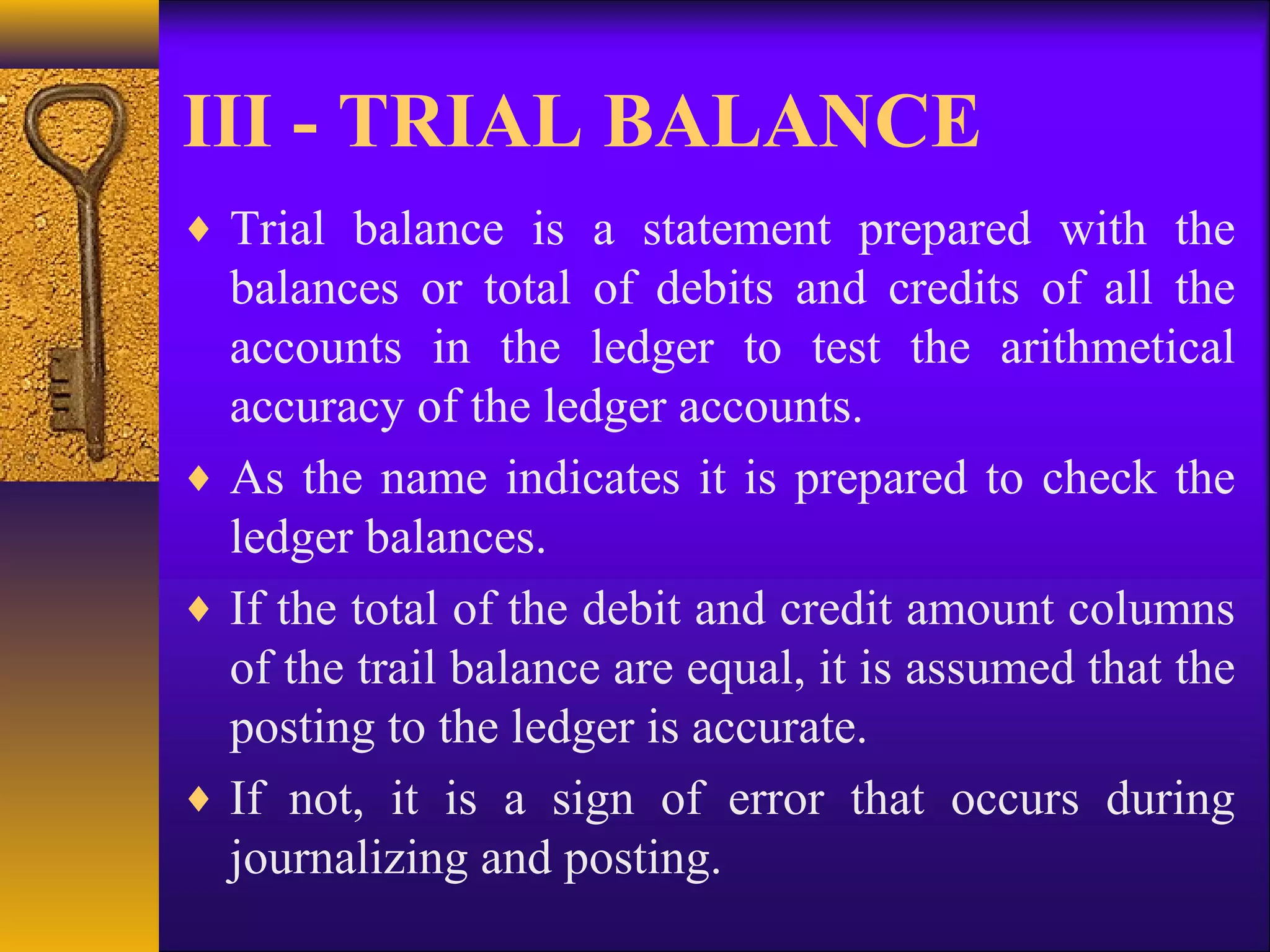
III - TRIAL BALANCE
♦ Trial balance is a statement prepared with the
balances or total of debits and credits of all the
accounts in the ledger to test the arithmetical
accuracy of the ledger accounts.
♦ As the name indicates it is prepared to check the
ledger balances.
♦ If the total of the debit and credit amount columns
of the trail balance are equal, it is assumed that the
posting to the ledger is accurate.
♦ If not, it is a sign of error that occurs during
journalizing and posting.
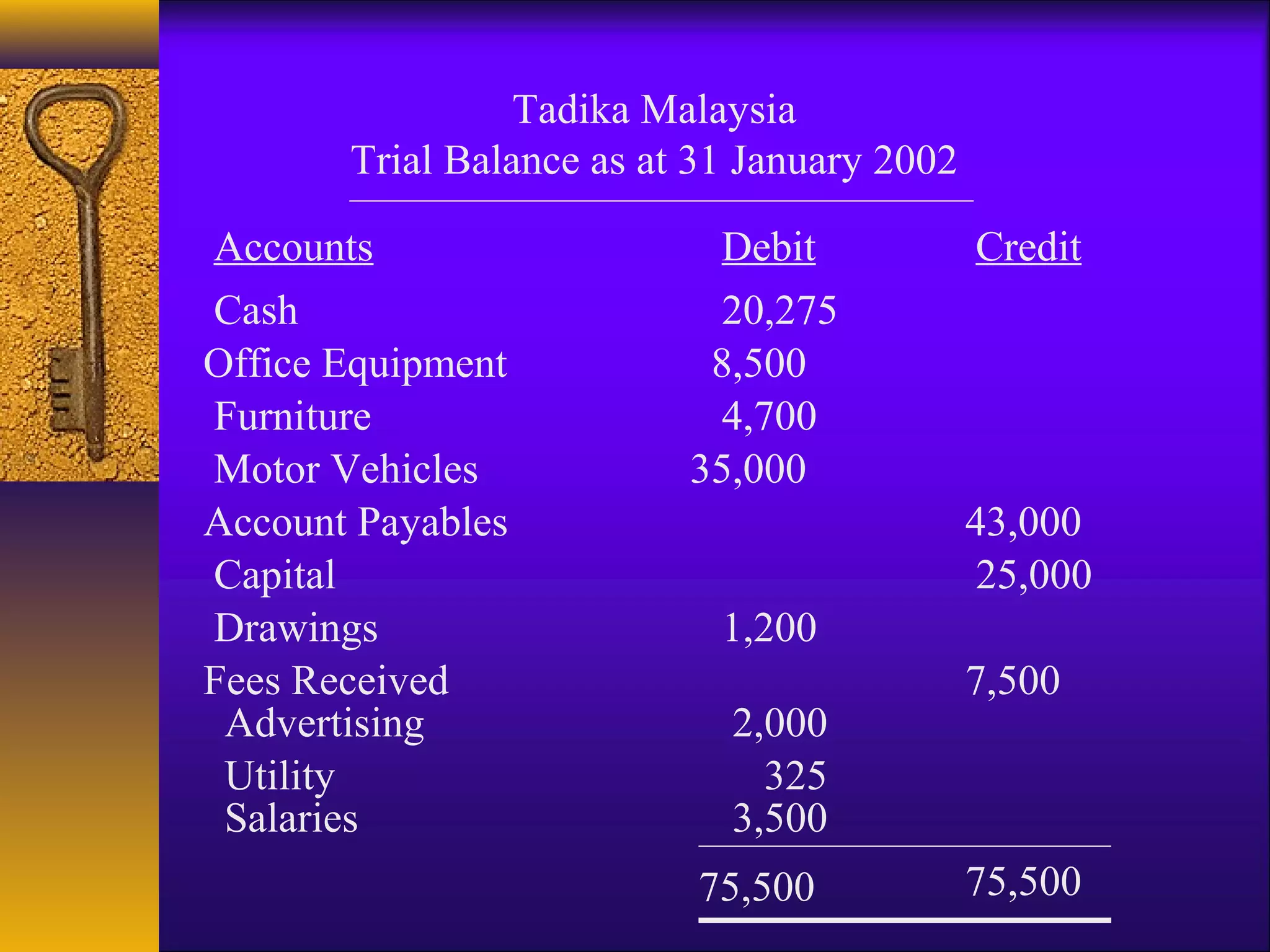
Tadika Malaysia
Trial Balance as at 31 January 2002
Accounts Debit Credit
Cash 20,275
Capital 25,000
Office Equipment 8,500
Furniture 4,700
Motor Vehicles 35,000
Account Payables 43,000
Advertising 2,000
Utility 325
Salaries 3,500
Fees Received 7,500
Drawings 1,200
75,500 75,500
IV – FINANCIAL STATEMENTS
(FINAL ACCOUNTS)
♦ A. Trading Account
♦ B. Profit and Loss Account
♦ C. Balance Sheet
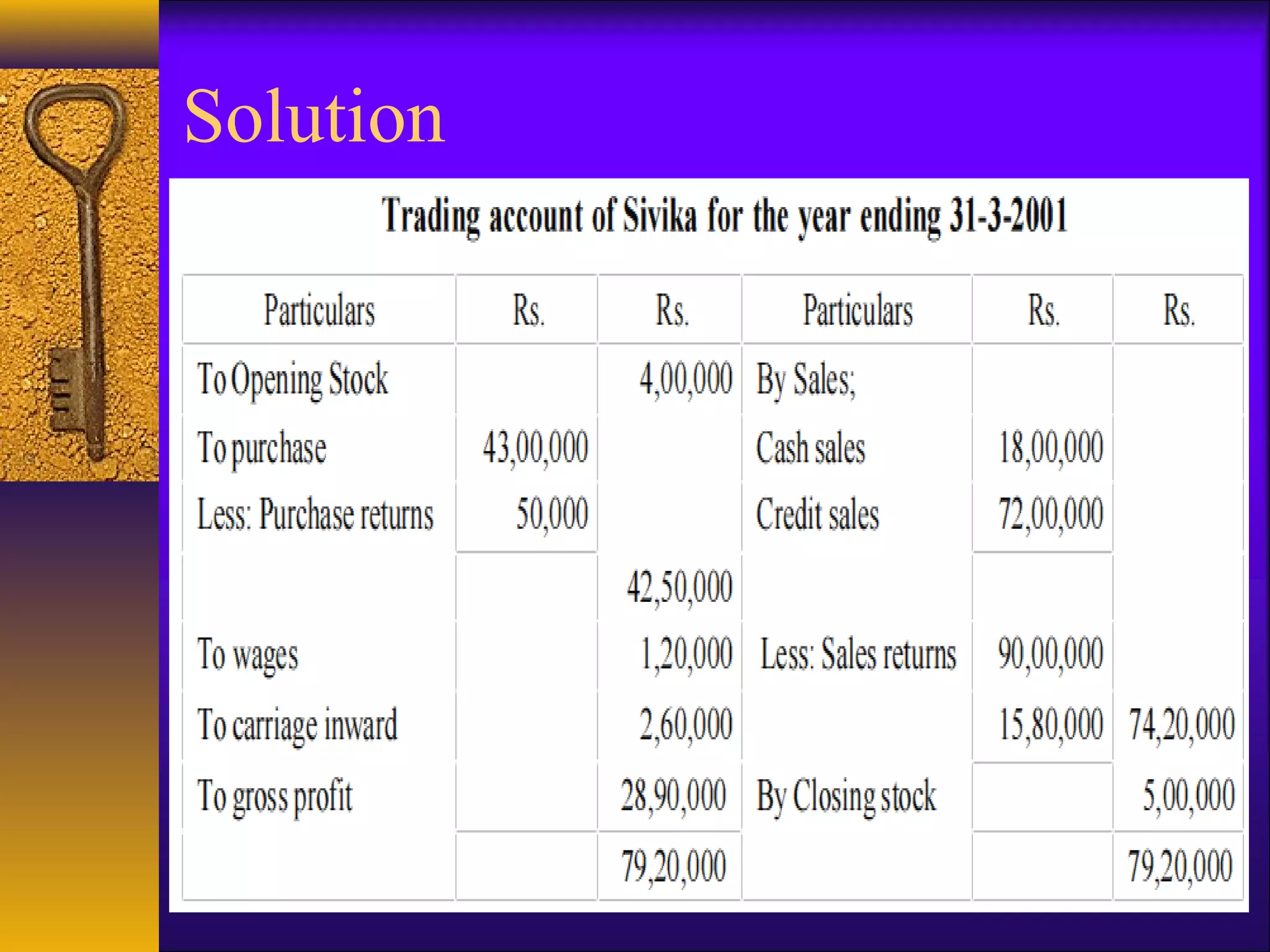
A. Trading Account
♦ Trading account is prepared for an accounting period to
find the trading results i.e., the amount of gross profit/loss
of the concern.
♦ It has made from buying and selling during the accounting
period.
♦ The difference between the sales and cost of sales is gross
profit.
♦ For the purpose of computing cost of sales, value of
opening stock, purchases, direct expenses on purchasing
and manufacturing are added up and closing stock of
finished goods is reduced.
♦ The balance of this account shows gross profit or loss
which is transferred to the profit and loss account.
Example:-
Solution
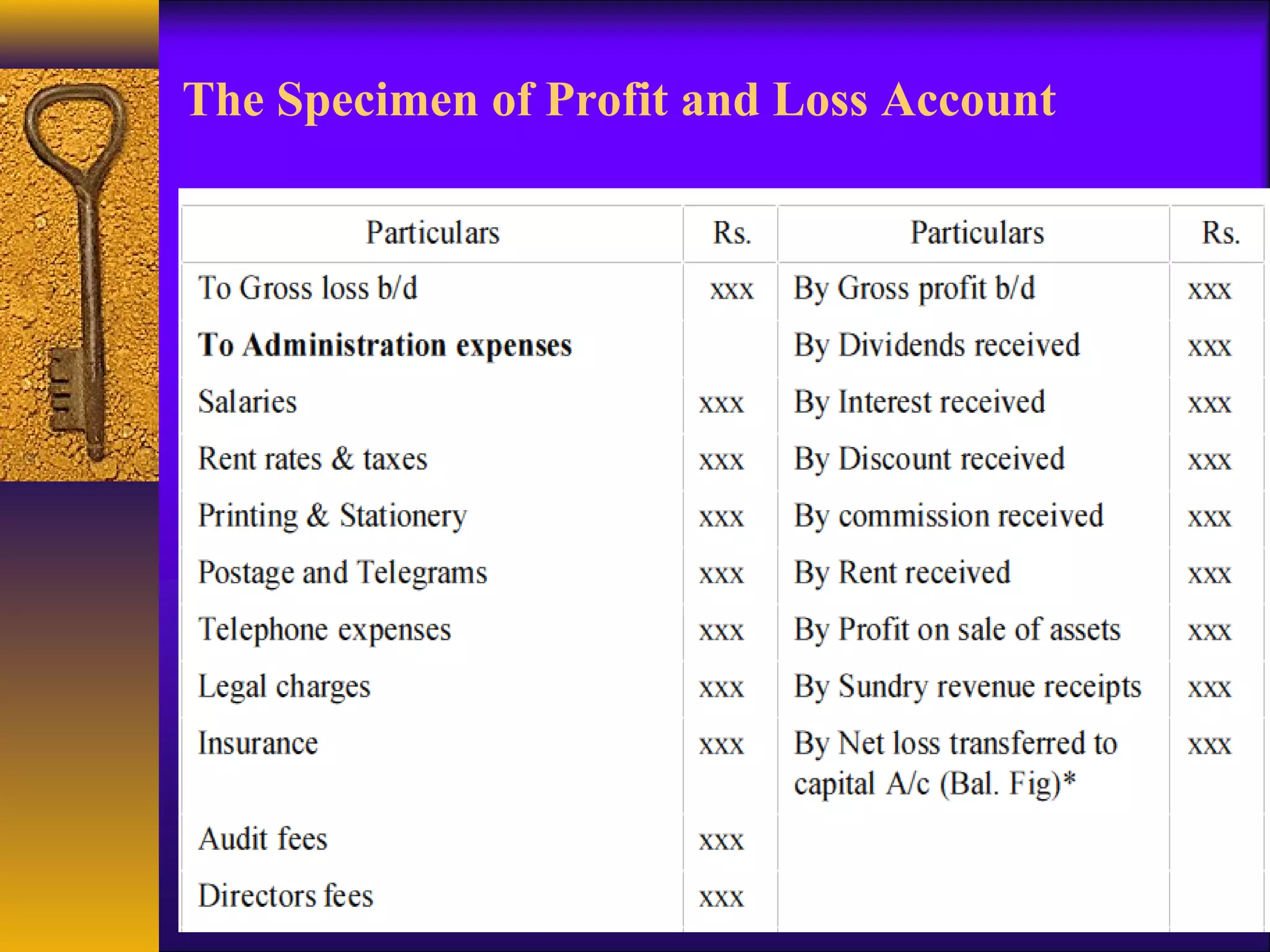
B. Profit And Loss Account
♦ Profit and loss account starts with gross profit brought
down from trading account on the credit side. (If gross
loss, on the debit side).
♦ All the indirect expenses are debited and all the revenue
incomes are credited to the profit and loss account
♦ If incomes or credit is more, than the expenses or debit, the
difference is net profit.
♦ On the other hand if the expenses or debit side is more, the
difference is net loss.
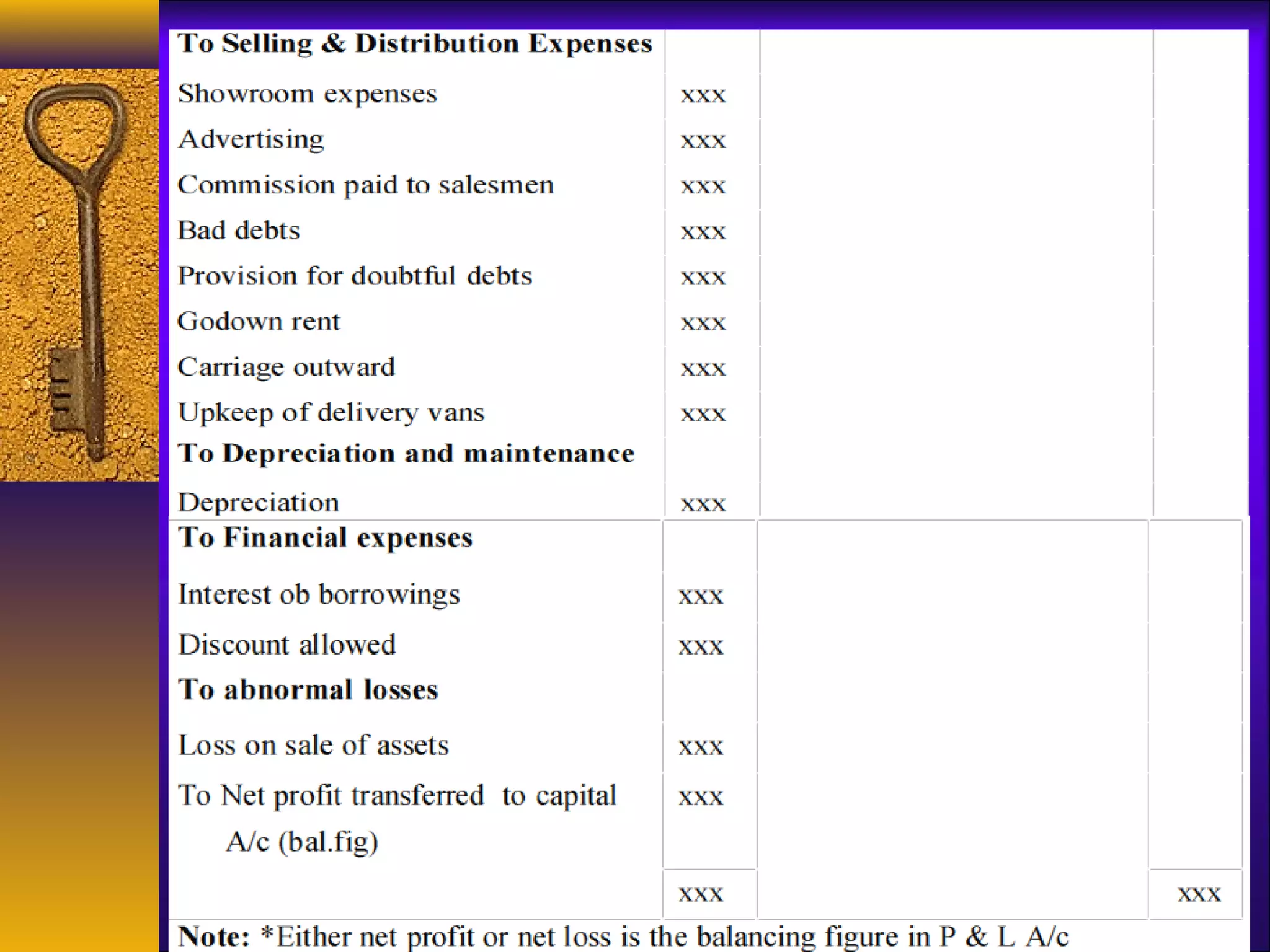
The Specimen of Profit and Loss Account
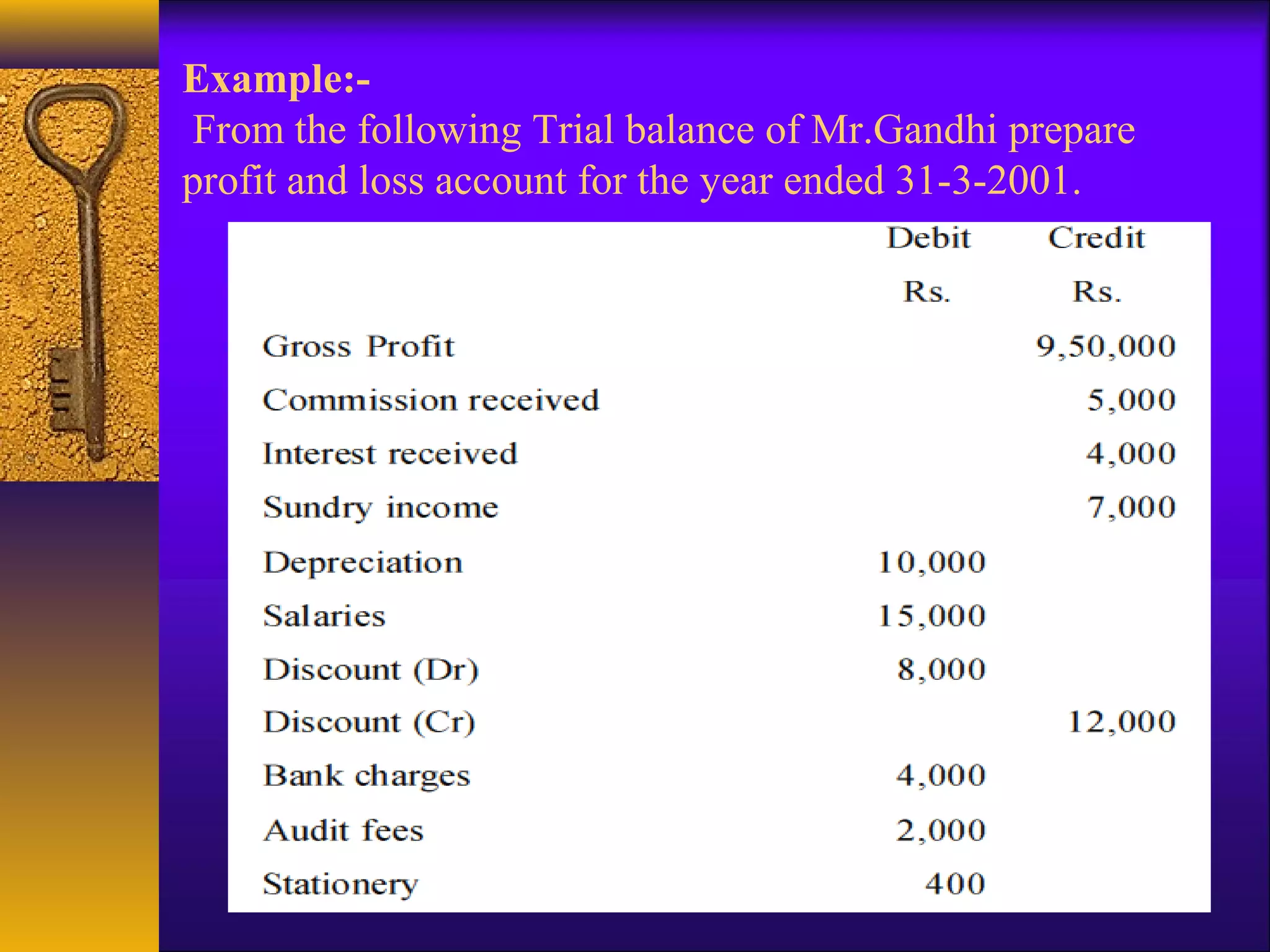
Example:-
From the following Trial balance of Mr.Gandhi prepare
profit and loss account for the year ended 31-3-2001.
Solution
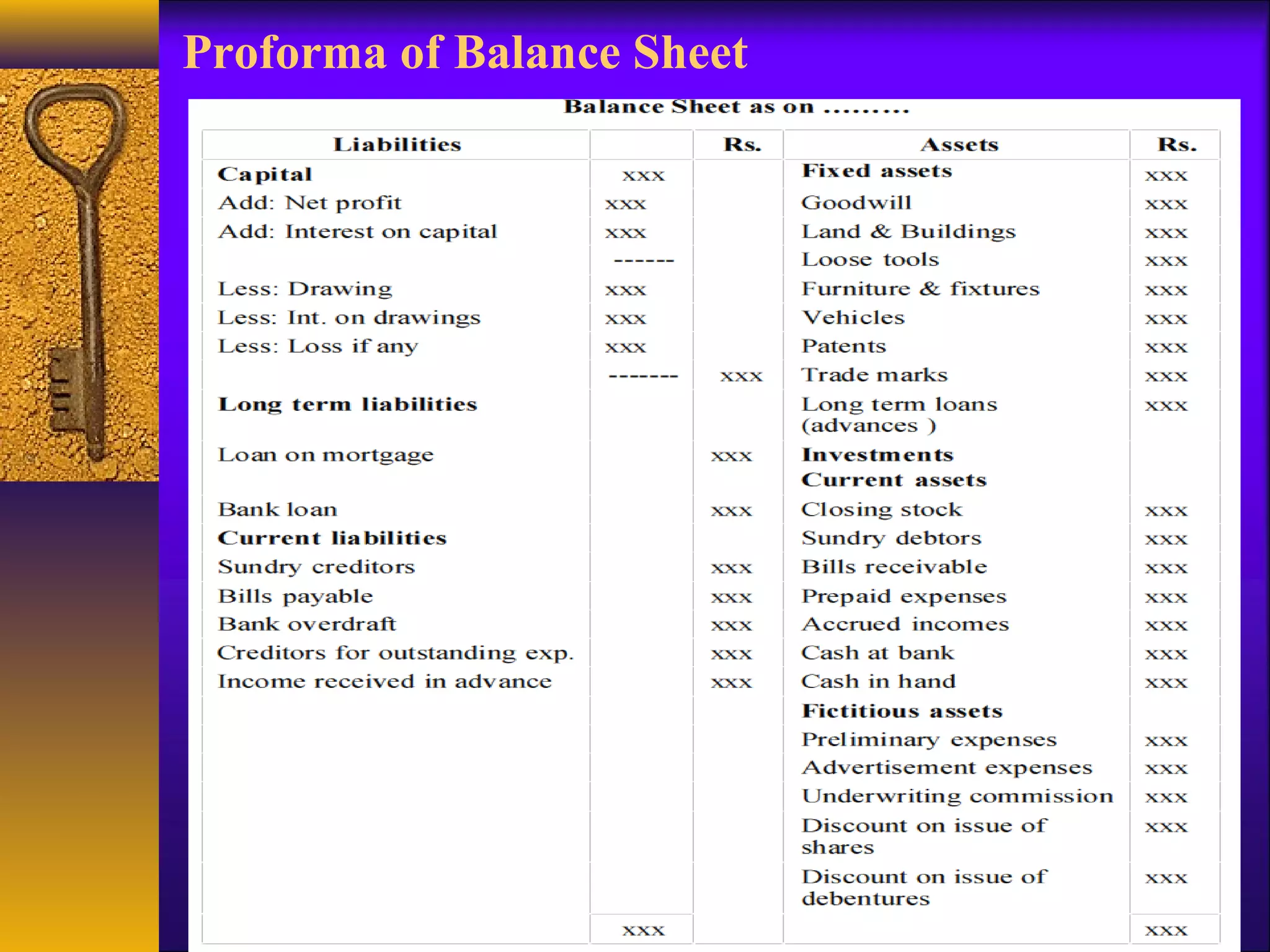
C. Balance Sheet
♦ “Balance sheet is a screen picture of the financial position of a going
business concern at a certain moment” - Francis.
♦ It comprises of lists of assets, liabilities and capital fund on a given
date.
♦ It presents the financial position of a concern as revealed by the
accounting records.
♦ It reflects the assets owned by the concern and the sources of funds
used in the acquisition of those assets.
♦ In simple language it is prepared in such a way that true financial
position is revealed in a form easily readable and more rapidly
understood.
Proforma of Balance Sheet
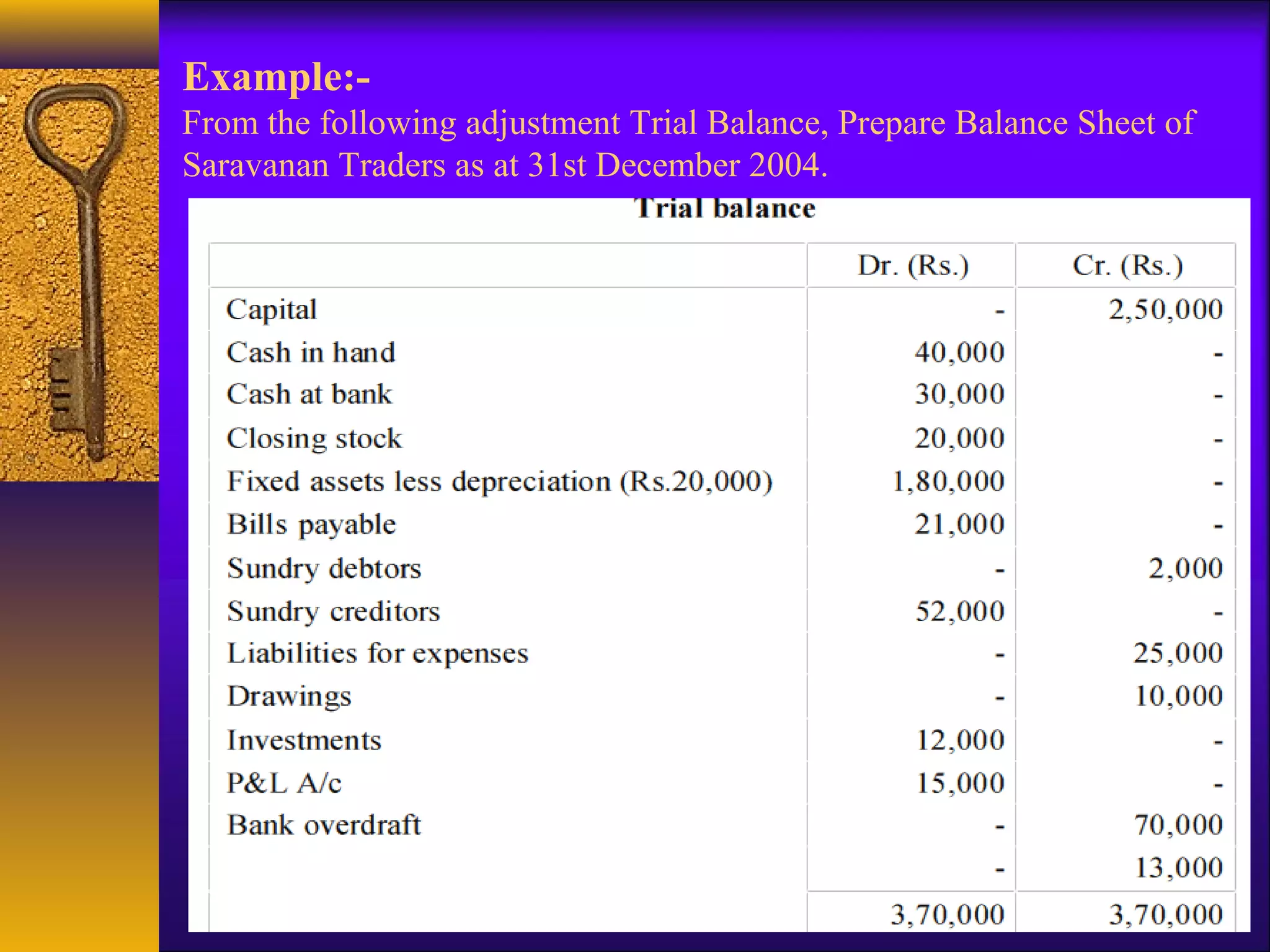
Example:-
From the following adjustment Trial Balance, Prepare Balance Sheet of
Saravanan Traders as at 31st December 2004.
Solution
Individual Assignment
From the following data, prepare a profit and loss a/c and a balance sheet
as on 31-3-1996.
Any QuestionsQuestions ?
By
Dr. Suresh Vadde
Associate Professor
Department of Management
Samara University, Ethiopia.

Accounting cycle

  • 1.
    Financial and ManagerialAccounting –MBA Chapter –II Understanding of financial statements
  • 2.
    What is Book -keeping & AccountingBook - keeping & Accounting ? ♦ Book keeping – Recording the transactions of an organization ♦ Accounting – Analysis of the performance of an organization
  • 3.
    What is BookkeepingBook keeping 1 ? ♦ You have £10. ♦ Your mother/father/aunt gives you £100 because today is your birthday. ♦ You go with your friends to celebrate your birthday. ♦ You have £15 left after the celebration. ♦ How much money did you spend? ♦ In businesses, all of this would be recorded ! ‘Books’ would be kept of all your (financial) activities !!
  • 4.
    What is BookkeepingBookkeeping2 ? ♦ Record important, useful information. ♦ The information must be recorded accurately ♦ It is routine ♦ It is recording ♦ It is ‘accounting for’ business transactions ♦ Examples of transactions: ♦ sale/purchase of goods/services, every sale, etc., is shown in money. Accounts are kept of all the (financial) activities Book-keeping is often known as ‘Double entry’
  • 5.
    What is Accounting1Accounting 1? ♦ Providing financial information in an organization – objectively – consistently – professionally – conservatively valued ♦ to enable management to perform three functions – recording – analysis – control
  • 6.
    What is Accounting2Accounting 2? ♦ Using financial information to analyse the performance of management of (and inside ) an organization – objectively – consistently – professionally – with reliable techniques for internal management control – and comparing overall performance of the organisation – with (for example) other
  • 7.
    What is Book keepingBookkeeping andand AccountingAccounting? ♦ We cannot keep Accounting records – without documents (proof of transactions) – sales, purchases, banking (payment and receipts) documents ♦ these are source documents ♦ this documentary evidence: – tells/shows us the actual transaction – shows what has happened ♦ Accounting records: – show the impact of these transactions on a business – show what these transactions mean to a business
  • 8.
  • 9.
    Single Entry: ♦ Itis incomplete system of recording business transactions. ♦ The business organization maintains only cash book and personal accounts of debtors and creditors. ♦ So the complete recording of transactions cannot be made and trail balance cannot be prepared.
  • 10.
    Double Entry: ♦ Itthis system every business transaction is having a two fold effect of benefits giving and benefit receiving aspects. ♦ The recording is made on the basis of both these aspects. ♦ Double Entry is an accounting system that records the effects of transactions and other events in at least two accounts with equal debits and credits.
  • 11.
    STEPS IN ACCOUNTINGCYCLE Documents Documents DocumentsSource Documents Journal Ledger Trial Balance
  • 12.
    I - JOURNAL ♦journal is a simple book of accounts in which all the business transactions are originally recorded in chronological order. ♦ Journaling refers to the act of recording each transaction in the journal and the form in which it is recorded, is known as a journal entry.
  • 13.
    Advantages of Journal ♦As all the transactions are entered in the journal chronologically, a date wise record can easily be maintained; ♦ 2. All the necessary information and the required explanations regarding all transactions can be obtained from the journal. ♦ Errors can be easily located and prevented by the use of journal or book of prime entry.
  • 14.
    Journal Performa Name ofthe journal Date Particular L. Folio Debit Credit
  • 15.
    Types of Accounts ♦Business transactions have been classified into three categories: (i) Transactions relating to persons. ( Personal Account) (ii) Transactions relating to properties and assets ( Real Account) (iii) Transactions relating to incomes and expenses. ( Nominal Account)
  • 16.
    Personal Accounts: ♦ Accountsrecording transactions with a person or group of persons. ♦ These accounts are necessary, in particular, to record credit transactions. ♦ The rule for personal accounts is: • Debit the receiver • Credit the giver
  • 17.
    Real Accounts ♦ Accountsrelating to properties or assets ♦ A separate account is maintained for each asset e.g., Cash Machinery, Building, etc., ♦ The rule for Real accounts is: • Debit what comes in • Credit what goes out
  • 18.
    Nominal Accounts ♦ Itis relating to income, revenue, gain expenses and losses. ♦ A separate account is maintained for each expense or loss and gain or income. ♦ Ex:-Wages account, Rent account Commission account, Interest received account etc., ♦ The rule for Nominal accounts is: • Debit all expenses and losses • Credit all incomes and gains
  • 19.
    The Rules ofDebit and Credit Debit Account Credit Increase in Assets Decrease in Assets Decrease in Liabilities Increase in Liabilities Decrease in Owner’s Equity Increase in Owner’s Equity Decrease in Revenue Increase in Revenue Increase in Expenses Decrease in Expenses
  • 20.
    Expansion of BasicEquation Assets = Liabilities + Owner’s Equity Assets Liabilities Capital Drawings Revenue Expenses
  • 21.
    Recording Transaction Transaction DebitCredit Started business with cash. CapitalCash Bought office equipment on credit from Syarikat Emas. Office Equipment Account Payable Received loan from Bank Intan in cash. Cash Bank Loan
  • 22.
    Transaction Debit Credit Boughtmotor van by cash Motor Vehicle Cash Paid rental expenses by cash Rental Expenses Cash Bought office supplies by credit Office Supplies Account Payable
  • 23.
    Transaction Debit Credit Paidutility bills with cash Utility Expenses Cash Received cash from Abu, a debtor. Cash Account Receivable A check on supplies showed that $120 supplies has been used. Supplies Expenses Office Supplies
  • 24.
    Transaction Debit Credit Ownerbrought in his own car to be used in business. Motor Vehicle Capital Sold motor van for cash Cash Motor Vehicle Owner took cash for his own use. Drawings Cash
  • 25.
    Journal Entries Siti Malaysia,the owner of Tadika Malaysia started her business on 1 January 2002 with cash M25,000. The followings are transactions related to the business for the month of January: Illustration : Tadika Malaysia
  • 26.
    Tadika Malaysia General Journal DateParticulars Debit Credit Jan. 1 Cash 25,000 Capital 25,000 ( Cash invested by owner )
  • 27.
    Tadika Malaysia- GeneralJournal Jan. 5 Bought office equipment with cash, RM500. Jan. 5 Office Equipment 500 Cash 500 (Bought office equipment with cash) Date Particulars Debit Credit
  • 28.
    Jan.10 Bought furnituresamounting to RM4,700 with cash from Syarikat Perabot Kita. Jan. 10 Furnitures 4,700 Cash 4,700 ( Bought furnitures with cash ) Date Particulars Debit Credit Tadika Malaysia- General Journal
  • 29.
    Jan. 11 35,000 35,000 DateParticulars Debit Credit Tadika Malaysia- General Journal Jan.11 Bought motor van for business use by credit from Syarikat Kenderaan amounting to RM35,000. Motor vehicles Account Payable ( bought motor van by credit )
  • 30.
    Jan.15 Paid advertisingexpense RM2,000 with cash. Jan. 15 Advertising expense 2,000 Cash 2,000 ( Paid advertising expense with cash ) Date Particulars Debit Credit Tadika Malaysia- General Journal
  • 31.
    Jan.18 Paid utilitybills with cash amounting to RM325. Jan. 18 Utilities Expense 325 Cash 325 ( Paid utility bills with cash ) Date Particulars Debit Credit Tadika Malaysia- General Journal
  • 32.
    Jan.23 Paid salariesby cash RM700 per person for 5 workers. Jan. 23 Salary expense 3,500 Cash 3,500 ( Paid salary by cash ) Date Particulars Debit Credit Tadika Malaysia- General Journal
  • 33.
    Jan 24 Receivedcash RM7,500 for the fees of the month. Jan. 24 Cash 7,500 Revenue : Fees 7,500 ( received fees or the month ) Date Particulars Debit Credit Tadika Malaysia- General Journal
  • 34.
    Jan.27 Bought twounits of computers on credit , amounting to RM4,000 per unit. Jan. 27 Office Equipment 8,000 Account Payables 8,000 ( Bought computers on credit ) Date Particulars Debit Credit Tadika Malaysia- General Journal
  • 35.
    Jan.30 Siti Malaysiatook cash RM1,200 for her own use. Jan. 30 Drawings 1,200 Cash 1,200 ( Cash withdrawals by the owner ) Date Particulars Debit Credit Tadika Malaysia- General Journal
  • 36.
    II - LEDGER ♦In journal, as all the business transactions are recorded chronologically, it is very difficult to obtain all the transactions pertaining to one head of account together at one place. ♦ But, the preparation of different ledger accounts helps to get a consolidated picture of the transactions pertaining to one ledger account at a time. ♦ Thus, a ledger account may be defined as a summary statement of all the transactions relating to a person, asset, expense, or income or gain or loss which have taken place during a specified period and shows their net effect ultimately.
  • 37.
    Posting from journalto ledger Journal Ledger
  • 38.
    General Ledger Cash Jan 1Capital 25,000 Jan 5 Office Equipt 500 24 Fees Rec. 7,500 10 Furnitures 4,700 18 Utilities 325 15 Advertising 2,000 30 Drawings 1,200 23 Salary 3,500 Balance c/f 32,500 32,500 20,275
  • 39.
    General Ledger Capital Jan 1Cash 25,000 25,00025,000 Jan 31 Bal c/f 25,000
  • 40.
    General Ledger Office Equipment Jan31 Bal c/f 8,500 Jan 5 Cash 500 27 A/c Payable8,000 8,500 8,500
  • 41.
    General Ledger Furnitures Jan 31Bal c/f 4,700Jan 10 Cash 4,700 4,700 4,700 Motor Vehicles Jan 11 A/c Payable 35,000 Jan 31 Bal c/f 4,700 35,000 35,000
  • 42.
    General Ledger Account Payable Jan31 Bal c/f 43,000 Jan 11 M. Vehicles 35,000 27 O. Equipmt 8,000 43,000 43,000
  • 43.
    General Ledger Advertising Jan 31Bal c/f 2,000Jan 15 Cash 2,000 2,000 2,000 Utility Jan 18 Cash 325 Jan 31 Bal c/f 325 325 325
  • 44.
    General Ledger Salaries Jan 31Bal c/f 3,500Jan 23 Cash 3,500 3,500 3,500 Fees Received Jan 24 Cash 7,500Jan 31 Bal c/f 7,500 7,500 7,500
  • 45.
    General Ledger Drawings Jan 30Cash 1,200 1,2001,200 Jan 31 Bal c/f 1,200
  • 46.
    Practice Question:- Journalise thefollowing transactions, post the same in relevant ledger account and balance the same.
  • 47.
    III - TRIALBALANCE ♦ Trial balance is a statement prepared with the balances or total of debits and credits of all the accounts in the ledger to test the arithmetical accuracy of the ledger accounts. ♦ As the name indicates it is prepared to check the ledger balances. ♦ If the total of the debit and credit amount columns of the trail balance are equal, it is assumed that the posting to the ledger is accurate. ♦ If not, it is a sign of error that occurs during journalizing and posting.
  • 48.
    Tadika Malaysia Trial Balanceas at 31 January 2002 Accounts Debit Credit Cash 20,275 Capital 25,000 Office Equipment 8,500 Furniture 4,700 Motor Vehicles 35,000 Account Payables 43,000 Advertising 2,000 Utility 325 Salaries 3,500 Fees Received 7,500 Drawings 1,200 75,500 75,500
  • 49.
    IV – FINANCIALSTATEMENTS (FINAL ACCOUNTS) ♦ A. Trading Account ♦ B. Profit and Loss Account ♦ C. Balance Sheet
  • 50.
    A. Trading Account ♦Trading account is prepared for an accounting period to find the trading results i.e., the amount of gross profit/loss of the concern. ♦ It has made from buying and selling during the accounting period. ♦ The difference between the sales and cost of sales is gross profit. ♦ For the purpose of computing cost of sales, value of opening stock, purchases, direct expenses on purchasing and manufacturing are added up and closing stock of finished goods is reduced. ♦ The balance of this account shows gross profit or loss which is transferred to the profit and loss account.
  • 52.
  • 53.
  • 54.
    B. Profit AndLoss Account ♦ Profit and loss account starts with gross profit brought down from trading account on the credit side. (If gross loss, on the debit side). ♦ All the indirect expenses are debited and all the revenue incomes are credited to the profit and loss account ♦ If incomes or credit is more, than the expenses or debit, the difference is net profit. ♦ On the other hand if the expenses or debit side is more, the difference is net loss.
  • 55.
    The Specimen ofProfit and Loss Account
  • 57.
    Example:- From the followingTrial balance of Mr.Gandhi prepare profit and loss account for the year ended 31-3-2001.
  • 58.
  • 59.
    C. Balance Sheet ♦“Balance sheet is a screen picture of the financial position of a going business concern at a certain moment” - Francis. ♦ It comprises of lists of assets, liabilities and capital fund on a given date. ♦ It presents the financial position of a concern as revealed by the accounting records. ♦ It reflects the assets owned by the concern and the sources of funds used in the acquisition of those assets. ♦ In simple language it is prepared in such a way that true financial position is revealed in a form easily readable and more rapidly understood.
  • 60.
  • 61.
    Example:- From the followingadjustment Trial Balance, Prepare Balance Sheet of Saravanan Traders as at 31st December 2004.
  • 62.
  • 63.
    Individual Assignment From thefollowing data, prepare a profit and loss a/c and a balance sheet as on 31-3-1996.
  • 64.
    Any QuestionsQuestions ? By Dr.Suresh Vadde Associate Professor Department of Management Samara University, Ethiopia.