PROCEDURE FOR PREPARING A
FUNDS FLOW STATEMENT &
Statement of changes in working capital
MANAGEMENT ACCOUNTING, FUND FLOW STATEMENT 1
Mr. LIBEESH P C
Assistant Professor in Commerce
B Com, Bed, M Com, UGC NET
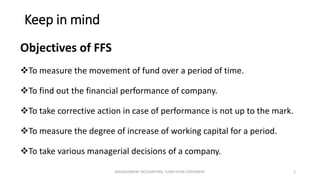
Keep in mind
Objectives of FFS
To measure the movement of fund over a period of time.
To find out the financial performance of company.
To take corrective action in case of performance is not up to the mark.
To measure the degree of increase of working capital for a period.
To take various managerial decisions of a company.
MANAGEMENT ACCOUNTING, FUND FLOW STATEMENT 2
Importance of current and fixed item in the fund
Increase or decrease of working capital shows that
the extent of fund utilized.
The utilization or movement funds is due to the
effect of changes in the fixed item.
So both current and fixed item are considered as
important in the fund flow analysis.
MANAGEMENT ACCOUNTING, FUND FLOW STATEMENT 3
Causes of changes in working capital
An increase in current assets increases the working capital
The decrease in current assets decreases the working capital
An increase in current liabilities decreases the working capital
A decrease in current liabilities increases working capital
MANAGEMENT ACCOUNTING, FUND FLOW STATEMENT 4
Current items
Current liabilities
Sundry creditors
Bank overdraft
Bills payable
Outstanding expenses
Income received in advance
Provision for tax
Proposed dividend
Current assets
Stock
Sundry debtors
Cash
Bank balance
Bills receivables
Outstanding income
Expenses paid in advance
MANAGEMENT ACCOUNTING, FUND FLOW STATEMENT 5
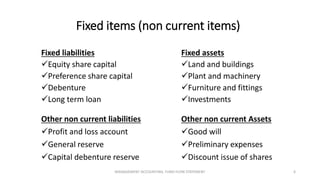
Fixed items (non current items)
Fixed liabilities
Equity share capital
Preference share capital
Debenture
Long term loan
Fixed assets
Land and buildings
Plant and machinery
Furniture and fittings
Investments
Other non current Assets
Good will
Preliminary expenses
Discount issue of shares
Other non current liabilities
Profit and loss account
General reserve
Capital debenture reserve
MANAGEMENT ACCOUNTING, FUND FLOW STATEMENT 6
preparation of FFS consists of three parts
1. Statement or schedule of changes in working capital
2. Preparation of adjusted profit and loss account
3. Statement of sources and application of funds
MANAGEMENT ACCOUNTING, FUND FLOW STATEMENT 7
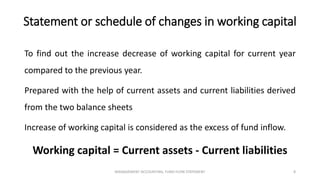
Statement or schedule of changes in working capital
To find out the increase decrease of working capital for current year
compared to the previous year.
Prepared with the help of current assets and current liabilities derived
from the two balance sheets
Increase of working capital is considered as the excess of fund inflow.
Working capital = Current assets - Current liabilities
MANAGEMENT ACCOUNTING, FUND FLOW STATEMENT 8
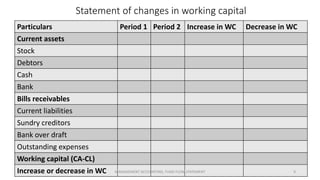
Statement of changes in working capital
Particulars Period 1 Period 2 Increase in WC Decrease in WC
Current assets
Stock
Debtors
Cash
Bank
Bills receivables
Current liabilities
Sundry creditors
Bank over draft
Outstanding expenses
Working capital (CA-CL)
Increase or decrease in WC MANAGEMENT ACCOUNTING, FUND FLOW STATEMENT 9
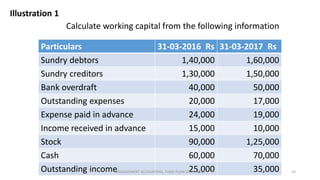
Calculate working capital from the following information
Particulars 31-03-2016 Rs 31-03-2017 Rs
Sundry debtors 1,40,000 1,60,000
Sundry creditors 1,30,000 1,50,000
Bank overdraft 40,000 50,000
Outstanding expenses 20,000 17,000
Expense paid in advance 24,000 19,000
Income received in advance 15,000 10,000
Stock 90,000 1,25,000
Cash 60,000 70,000
Outstanding income 25,000 35,000
Illustration 1
MANAGEMENT ACCOUNTING, FUND FLOW STATEMENT 10
Particulars 31-03-2016 Rs 31-03-2017 Rs
Current Assets
Sundry debtors 1,40,000 1,60,000
Stock 90,000 1,25,000
Cash 60,000 70,000
Outstanding income 25,000 35,000
Expense paid in advance 24,000 19,000
Total Current Assets 3,39,000 4,09,000
Current Liabilities
Sundry creditors 1,30,000 1,50,000
Bank overdraft 40,000 50,000
Outstanding expenses 20,000 17,000
Income received in advance 15,000 10,000
Total Current Liabilities 2,05,000 2,27,000
Working Capital = CA-CL 1,34,000 1,82,000
Solution 1 Calculation of working capital
MANAGEMENT ACCOUNTING, FUND FLOW STATEMENT 11
Illustration 2
MANAGEMENT ACCOUNTING, FUND FLOW STATEMENT 12
Statement of changes in working capital
Particulars Period 1 Period 2 Increase in WC Decrease in WC
Current assets
Stock 1,50,000 2,25,000 75,000
Accounts receivables 70,000 1,40,000 70,000
Cash 30,000 10,000 20,000
Work in progress 80,000 90,000 10,000
Total assets 3,30,000 4,65,000 1,55,000 20,000
Solution 2
MANAGEMENT ACCOUNTING, FUND FLOW STATEMENT 13
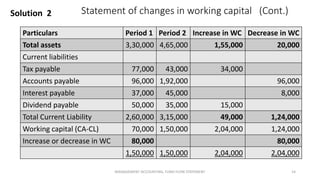
Statement of changes in working capital (Cont.)
Particulars Period 1 Period 2 Increase in WC Decrease in WC
Total assets 3,30,000 4,65,000 1,55,000 20,000
Current liabilities
Tax payable 77,000 43,000 34,000
Accounts payable 96,000 1,92,000 96,000
Interest payable 37,000 45,000 8,000
Dividend payable 50,000 35,000 15,000
Total Current Liability 2,60,000 3,15,000 49,000 1,24,000
Working capital (CA-CL) 70,000 1,50,000 2,04,000 1,24,000
Increase or decrease in WC 80,000 80,000
1,50,000 1,50,000 2,04,000 2,04,000
Solution 2
MANAGEMENT ACCOUNTING, FUND FLOW STATEMENT 14
1. ……………..means excess of current assets over current liabilities.
(a)Working capital
(b) Gross working capital
(c) Net working capital
(d) All of these
Ans: Net working capital
MANAGEMENT ACCOUNTING, FUND FLOW STATEMENT 15
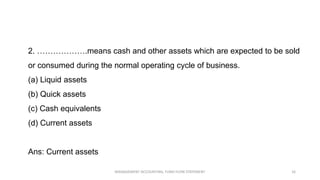
2. ……………….means cash and other assets which are expected to be sold
or consumed during the normal operating cycle of business.
(a) Liquid assets
(b) Quick assets
(c) Cash equivalents
(d) Current assets
Ans: Current assets
MANAGEMENT ACCOUNTING, FUND FLOW STATEMENT 16
3. Which among the following asset is excluded from current assets ?
(a) Loose tools
(b) Accounts receivable
(c) Short term investments with bank
(d) Finished goods
Ans: Loose tools
MANAGEMENT ACCOUNTING, FUND FLOW STATEMENT 17
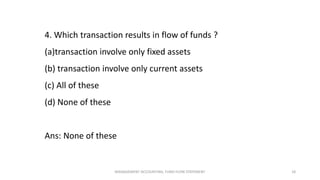
4. Which transaction results in flow of funds ?
(a)transaction involve only fixed assets
(b) transaction involve only current assets
(c) All of these
(d) None of these
Ans: None of these
MANAGEMENT ACCOUNTING, FUND FLOW STATEMENT 18
5. There will be flow of funds, if a transaction involves………………
(a) Current assets and fixed assets
(b) Current assets and capital
(c) Current assets and fixed liabilities
(d) All of these
Ans: All of these
MANAGEMENT ACCOUNTING, FUND FLOW STATEMENT 19
Mr. LIBEESH P C
Assistant Professor in Commerce
B Com, Bed, M Com, UGC NET

Fund flow statement

  • 1.
    PROCEDURE FOR PREPARINGA FUNDS FLOW STATEMENT & Statement of changes in working capital MANAGEMENT ACCOUNTING, FUND FLOW STATEMENT 1 Mr. LIBEESH P C Assistant Professor in Commerce B Com, Bed, M Com, UGC NET
  • 2.
    Keep in mind Objectivesof FFS To measure the movement of fund over a period of time. To find out the financial performance of company. To take corrective action in case of performance is not up to the mark. To measure the degree of increase of working capital for a period. To take various managerial decisions of a company. MANAGEMENT ACCOUNTING, FUND FLOW STATEMENT 2
  • 3.
    Importance of currentand fixed item in the fund Increase or decrease of working capital shows that the extent of fund utilized. The utilization or movement funds is due to the effect of changes in the fixed item. So both current and fixed item are considered as important in the fund flow analysis. MANAGEMENT ACCOUNTING, FUND FLOW STATEMENT 3
  • 4.
    Causes of changesin working capital An increase in current assets increases the working capital The decrease in current assets decreases the working capital An increase in current liabilities decreases the working capital A decrease in current liabilities increases working capital MANAGEMENT ACCOUNTING, FUND FLOW STATEMENT 4
  • 5.
    Current items Current liabilities Sundrycreditors Bank overdraft Bills payable Outstanding expenses Income received in advance Provision for tax Proposed dividend Current assets Stock Sundry debtors Cash Bank balance Bills receivables Outstanding income Expenses paid in advance MANAGEMENT ACCOUNTING, FUND FLOW STATEMENT 5
  • 6.
    Fixed items (noncurrent items) Fixed liabilities Equity share capital Preference share capital Debenture Long term loan Fixed assets Land and buildings Plant and machinery Furniture and fittings Investments Other non current Assets Good will Preliminary expenses Discount issue of shares Other non current liabilities Profit and loss account General reserve Capital debenture reserve MANAGEMENT ACCOUNTING, FUND FLOW STATEMENT 6
  • 7.
    preparation of FFSconsists of three parts 1. Statement or schedule of changes in working capital 2. Preparation of adjusted profit and loss account 3. Statement of sources and application of funds MANAGEMENT ACCOUNTING, FUND FLOW STATEMENT 7
  • 8.
    Statement or scheduleof changes in working capital To find out the increase decrease of working capital for current year compared to the previous year. Prepared with the help of current assets and current liabilities derived from the two balance sheets Increase of working capital is considered as the excess of fund inflow. Working capital = Current assets - Current liabilities MANAGEMENT ACCOUNTING, FUND FLOW STATEMENT 8
  • 9.
    Statement of changesin working capital Particulars Period 1 Period 2 Increase in WC Decrease in WC Current assets Stock Debtors Cash Bank Bills receivables Current liabilities Sundry creditors Bank over draft Outstanding expenses Working capital (CA-CL) Increase or decrease in WC MANAGEMENT ACCOUNTING, FUND FLOW STATEMENT 9
  • 10.
    Calculate working capitalfrom the following information Particulars 31-03-2016 Rs 31-03-2017 Rs Sundry debtors 1,40,000 1,60,000 Sundry creditors 1,30,000 1,50,000 Bank overdraft 40,000 50,000 Outstanding expenses 20,000 17,000 Expense paid in advance 24,000 19,000 Income received in advance 15,000 10,000 Stock 90,000 1,25,000 Cash 60,000 70,000 Outstanding income 25,000 35,000 Illustration 1 MANAGEMENT ACCOUNTING, FUND FLOW STATEMENT 10
  • 11.
    Particulars 31-03-2016 Rs31-03-2017 Rs Current Assets Sundry debtors 1,40,000 1,60,000 Stock 90,000 1,25,000 Cash 60,000 70,000 Outstanding income 25,000 35,000 Expense paid in advance 24,000 19,000 Total Current Assets 3,39,000 4,09,000 Current Liabilities Sundry creditors 1,30,000 1,50,000 Bank overdraft 40,000 50,000 Outstanding expenses 20,000 17,000 Income received in advance 15,000 10,000 Total Current Liabilities 2,05,000 2,27,000 Working Capital = CA-CL 1,34,000 1,82,000 Solution 1 Calculation of working capital MANAGEMENT ACCOUNTING, FUND FLOW STATEMENT 11
  • 12.
  • 13.
    Statement of changesin working capital Particulars Period 1 Period 2 Increase in WC Decrease in WC Current assets Stock 1,50,000 2,25,000 75,000 Accounts receivables 70,000 1,40,000 70,000 Cash 30,000 10,000 20,000 Work in progress 80,000 90,000 10,000 Total assets 3,30,000 4,65,000 1,55,000 20,000 Solution 2 MANAGEMENT ACCOUNTING, FUND FLOW STATEMENT 13
  • 14.
    Statement of changesin working capital (Cont.) Particulars Period 1 Period 2 Increase in WC Decrease in WC Total assets 3,30,000 4,65,000 1,55,000 20,000 Current liabilities Tax payable 77,000 43,000 34,000 Accounts payable 96,000 1,92,000 96,000 Interest payable 37,000 45,000 8,000 Dividend payable 50,000 35,000 15,000 Total Current Liability 2,60,000 3,15,000 49,000 1,24,000 Working capital (CA-CL) 70,000 1,50,000 2,04,000 1,24,000 Increase or decrease in WC 80,000 80,000 1,50,000 1,50,000 2,04,000 2,04,000 Solution 2 MANAGEMENT ACCOUNTING, FUND FLOW STATEMENT 14
  • 15.
    1. ……………..means excessof current assets over current liabilities. (a)Working capital (b) Gross working capital (c) Net working capital (d) All of these Ans: Net working capital MANAGEMENT ACCOUNTING, FUND FLOW STATEMENT 15
  • 16.
    2. ……………….means cashand other assets which are expected to be sold or consumed during the normal operating cycle of business. (a) Liquid assets (b) Quick assets (c) Cash equivalents (d) Current assets Ans: Current assets MANAGEMENT ACCOUNTING, FUND FLOW STATEMENT 16
  • 17.
    3. Which amongthe following asset is excluded from current assets ? (a) Loose tools (b) Accounts receivable (c) Short term investments with bank (d) Finished goods Ans: Loose tools MANAGEMENT ACCOUNTING, FUND FLOW STATEMENT 17
  • 18.
    4. Which transactionresults in flow of funds ? (a)transaction involve only fixed assets (b) transaction involve only current assets (c) All of these (d) None of these Ans: None of these MANAGEMENT ACCOUNTING, FUND FLOW STATEMENT 18
  • 19.
    5. There willbe flow of funds, if a transaction involves……………… (a) Current assets and fixed assets (b) Current assets and capital (c) Current assets and fixed liabilities (d) All of these Ans: All of these MANAGEMENT ACCOUNTING, FUND FLOW STATEMENT 19 Mr. LIBEESH P C Assistant Professor in Commerce B Com, Bed, M Com, UGC NET