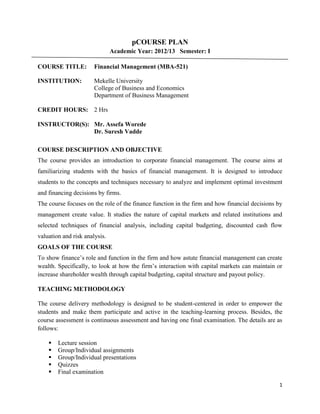
pCOURSE PLAN
                               Academic Year: 2012/13 Semester: I

COURSE TITLE:          Financial Management (MBA-521)

INSTITUTION:           Mekelle University
                       College of Business and Economics
                       Department of Business Management

CREDIT HOURS: 2 Hrs

INSTRUCTOR(S): Mr. Assefa Worede
               Dr. Suresh Vadde

COURSE DESCRIPTION AND OBJECTIVE
The course provides an introduction to corporate financial management. The course aims at
familiarizing students with the basics of financial management. It is designed to introduce
students to the concepts and techniques necessary to analyze and implement optimal investment
and financing decisions by firms.
The course focuses on the role of the finance function in the firm and how financial decisions by
management create value. It studies the nature of capital markets and related institutions and
selected techniques of financial analysis, including capital budgeting, discounted cash flow
valuation and risk analysis.
GOALS OF THE COURSE
To show finance’s role and function in the firm and how astute financial management can create
wealth. Specifically, to look at how the firm’s interaction with capital markets can maintain or
increase shareholder wealth through capital budgeting, capital structure and payout policy.

TEACHING METHODOLOGY

The course delivery methodology is designed to be student-centered in order to empower the
students and make them participate and active in the teaching-learning process. Besides, the
course assessment is continuous assessment and having one final examination. The details are as
follows:

       Lecture session
       Group/Individual assignments
       Group/Individual presentations
       Quizzes
       Final examination

                                                                                               1
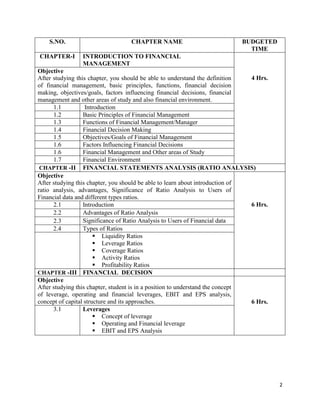
S.NO.                          CHAPTER NAME                             BUDGETED
                                                                              TIME
CHAPTER-I       INTRODUCTION TO FINANCIAL
                MANAGEMENT
Objective
After studying this chapter, you should be able to understand the definition    4 Hrs.
of financial management, basic principles, functions, financial decision
making, objectives/goals, factors influencing financial decisions, financial
management and other areas of study and also financial environment.
      1.1          Introduction
      1.2         Basic Principles of Financial Management
      1.3         Functions of Financial Management/Manager
      1.4         Financial Decision Making
      1.5         Objectives/Goals of Financial Management
      1.6         Factors Influencing Financial Decisions
      1.6         Financial Management and Other areas of Study
      1.7         Financial Environment
 CHAPTER -II FINANCIAL STATEMENTS ANALYSIS (RATIO ANALYSIS)
Objective
After studying this chapter, you should be able to learn about introduction of
ratio analysis, advantages, Significance of Ratio Analysis to Users of
Financial data and different types ratios.
      2.1         Introduction                                                  6 Hrs.
      2.2         Advantages of Ratio Analysis
      2.3         Significance of Ratio Analysis to Users of Financial data
      2.4         Types of Ratios
                        Liquidity Ratios
                        Leverage Ratios
                        Coverage Ratios
                        Activity Ratios
                        Profitability Ratios
CHAPTER -III FINANCIAL DECISION
Objective
After studying this chapter, student is in a position to understand the concept
of leverage, operating and financial leverages, EBIT and EPS analysis,
concept of capital structure and its approaches.                                6 Hrs.
      3.1         Leverages
                        Concept of leverage
                        Operating and Financial leverage
                        EBIT and EPS Analysis


                                                                                         2
3.2          Form of Capital structure
                        Concept of Capital Structure
                        Capital Structure Determinants
                        Net Income Approach
                        Net Operating Income Approach
                        Modigliani and Miller Approach
CHAPTER -IV INVESTMENT DECISION
Objective
After studying this chapter, you should be able to understand the
introduction of capital budgeting, capital budgeting process, kinds of capital
budgeting decisions and different methods of capital budgeting.                  6 Hrs.
       4.1         Introduction to Capital Budgeting
       4.2         Capital Budgeting Process
       4.3         Kinds of Capital Budgeting Decisions
       4.4         Methods of Capital budgeting
      4.4.1        Traditional Methods
                        Pay-back Period Method (PB)
                        Average Rate of Return (ARR)
      4.4.2        Time Adjusted or Discounted Cash Flow
                        Net Present Value Method (NPV)
                        Internal Rate of Return Method (IRR)
                        Profitability Index Method (PI)
 CHAPTER -V WORKING CAPITAL DECISION
Objective
After studying this chapter, you should be able to learn the concepts of
working capital, types and components working capital, factors determining       4 Hrs.
the working capital requirements and forecasting the working capital
requirements.
       5.1         Concepts of Working capital
       5.2         Types of Working Capital
       5.3         Components of Working Capital
       5.4         Factors Determining the Working Capital Requirements
       5.5         Forecasting Working Capital Requirements
CHAPTER -VI DIVIDEND DECISION
Objective
After studying this chapter, you should be able to know dividend and
valuation of the firm, relevance and irrelevance dividend policies.
       6.1         Introduction
       6.2         Dividend and Valuation of the Firm                            6 Hrs.
       6.3         Relevance of Dividend Policy
                        Walter’s Model
                        Gordon’s Model
       6.4         Irrelevance of Dividend Policy
                        Residual Theory
                        Modigliani- Miller Approach


                                                                                          3
ASSESSMENT
Group/Individual Assignment ………………………………                       10%
Group/Individual Presentations ……………………………..                   10%
Quizzes ……………………………….……………………..                                30%
Final Examination …………………………………………..                           50%
Total …………………………………………                                         100%

SCALE
A  [85–100]                 C    [50 – 60]
B+ [75 – 84]                D+   [40 – 49]
B [65 – 74]                 D    [30 – 39]
C+ [61 – 64]                F    [0 – 30]

COURSE POLICY
   According to the MU legislation, you must attend at least 80% of the 32 hours (i.e., at
    least 26 hours) and score at least 50% result from the continuous assessment; otherwise
    you can’t sit for the final examination.
   You must submit group assignments at least within a given dead line.
   You must attend group assignments and group presentations regularly.

SUGGESTED READINGS:

      Brigham, E.F., and Ehrhardt, M.C., 2003, “Financial Management: Theory and Practice”,
       South Western Publishing, USA, 12th Ed.
      I.M. Pandy, 2005, “Financial Management”, Vikas Publishing House Pvt. Ltd., New
       Delhi, 9th Ed.
      Myers, S.C., and Brealey, R.A., 2003, “Principles of Corporate Finance”, McGraw-
       Hill/Irwin, USA, 7th Ed.
      M Y Khan and P K Jain, 2004, “Financial Management Text, Problems and Cases”, Tata
       McGraw Hill.
      Prasanna Chandra, 2001, “Financial Management – Theory and Practice”, Tata McGraw
       Hill, 2nd ed.
      Preethi Singh, 2009, “Fundamentals of Financial Management”, Ane Books Pvt. Ltd.,
       New Delhi, 2nd Ed.
      Any Book, journal, or article on Financial Management or Corporate Finance.


                                                                                          4

Fm mba course plan

  • 1.
    pCOURSE PLAN Academic Year: 2012/13 Semester: I COURSE TITLE: Financial Management (MBA-521) INSTITUTION: Mekelle University College of Business and Economics Department of Business Management CREDIT HOURS: 2 Hrs INSTRUCTOR(S): Mr. Assefa Worede Dr. Suresh Vadde COURSE DESCRIPTION AND OBJECTIVE The course provides an introduction to corporate financial management. The course aims at familiarizing students with the basics of financial management. It is designed to introduce students to the concepts and techniques necessary to analyze and implement optimal investment and financing decisions by firms. The course focuses on the role of the finance function in the firm and how financial decisions by management create value. It studies the nature of capital markets and related institutions and selected techniques of financial analysis, including capital budgeting, discounted cash flow valuation and risk analysis. GOALS OF THE COURSE To show finance’s role and function in the firm and how astute financial management can create wealth. Specifically, to look at how the firm’s interaction with capital markets can maintain or increase shareholder wealth through capital budgeting, capital structure and payout policy. TEACHING METHODOLOGY The course delivery methodology is designed to be student-centered in order to empower the students and make them participate and active in the teaching-learning process. Besides, the course assessment is continuous assessment and having one final examination. The details are as follows:  Lecture session  Group/Individual assignments  Group/Individual presentations  Quizzes  Final examination 1
  • 2.
    S.NO. CHAPTER NAME BUDGETED TIME CHAPTER-I INTRODUCTION TO FINANCIAL MANAGEMENT Objective After studying this chapter, you should be able to understand the definition 4 Hrs. of financial management, basic principles, functions, financial decision making, objectives/goals, factors influencing financial decisions, financial management and other areas of study and also financial environment. 1.1 Introduction 1.2 Basic Principles of Financial Management 1.3 Functions of Financial Management/Manager 1.4 Financial Decision Making 1.5 Objectives/Goals of Financial Management 1.6 Factors Influencing Financial Decisions 1.6 Financial Management and Other areas of Study 1.7 Financial Environment CHAPTER -II FINANCIAL STATEMENTS ANALYSIS (RATIO ANALYSIS) Objective After studying this chapter, you should be able to learn about introduction of ratio analysis, advantages, Significance of Ratio Analysis to Users of Financial data and different types ratios. 2.1 Introduction 6 Hrs. 2.2 Advantages of Ratio Analysis 2.3 Significance of Ratio Analysis to Users of Financial data 2.4 Types of Ratios  Liquidity Ratios  Leverage Ratios  Coverage Ratios  Activity Ratios  Profitability Ratios CHAPTER -III FINANCIAL DECISION Objective After studying this chapter, student is in a position to understand the concept of leverage, operating and financial leverages, EBIT and EPS analysis, concept of capital structure and its approaches. 6 Hrs. 3.1 Leverages  Concept of leverage  Operating and Financial leverage  EBIT and EPS Analysis 2
  • 3.
    3.2 Form of Capital structure  Concept of Capital Structure  Capital Structure Determinants  Net Income Approach  Net Operating Income Approach  Modigliani and Miller Approach CHAPTER -IV INVESTMENT DECISION Objective After studying this chapter, you should be able to understand the introduction of capital budgeting, capital budgeting process, kinds of capital budgeting decisions and different methods of capital budgeting. 6 Hrs. 4.1 Introduction to Capital Budgeting 4.2 Capital Budgeting Process 4.3 Kinds of Capital Budgeting Decisions 4.4 Methods of Capital budgeting 4.4.1 Traditional Methods  Pay-back Period Method (PB)  Average Rate of Return (ARR) 4.4.2 Time Adjusted or Discounted Cash Flow  Net Present Value Method (NPV)  Internal Rate of Return Method (IRR)  Profitability Index Method (PI) CHAPTER -V WORKING CAPITAL DECISION Objective After studying this chapter, you should be able to learn the concepts of working capital, types and components working capital, factors determining 4 Hrs. the working capital requirements and forecasting the working capital requirements. 5.1 Concepts of Working capital 5.2 Types of Working Capital 5.3 Components of Working Capital 5.4 Factors Determining the Working Capital Requirements 5.5 Forecasting Working Capital Requirements CHAPTER -VI DIVIDEND DECISION Objective After studying this chapter, you should be able to know dividend and valuation of the firm, relevance and irrelevance dividend policies. 6.1 Introduction 6.2 Dividend and Valuation of the Firm 6 Hrs. 6.3 Relevance of Dividend Policy  Walter’s Model  Gordon’s Model 6.4 Irrelevance of Dividend Policy  Residual Theory  Modigliani- Miller Approach 3
  • 4.
    ASSESSMENT Group/Individual Assignment ……………………………… 10% Group/Individual Presentations …………………………….. 10% Quizzes ……………………………….…………………….. 30% Final Examination ………………………………………….. 50% Total ………………………………………… 100% SCALE A [85–100] C [50 – 60] B+ [75 – 84] D+ [40 – 49] B [65 – 74] D [30 – 39] C+ [61 – 64] F [0 – 30] COURSE POLICY  According to the MU legislation, you must attend at least 80% of the 32 hours (i.e., at least 26 hours) and score at least 50% result from the continuous assessment; otherwise you can’t sit for the final examination.  You must submit group assignments at least within a given dead line.  You must attend group assignments and group presentations regularly. SUGGESTED READINGS:  Brigham, E.F., and Ehrhardt, M.C., 2003, “Financial Management: Theory and Practice”, South Western Publishing, USA, 12th Ed.  I.M. Pandy, 2005, “Financial Management”, Vikas Publishing House Pvt. Ltd., New Delhi, 9th Ed.  Myers, S.C., and Brealey, R.A., 2003, “Principles of Corporate Finance”, McGraw- Hill/Irwin, USA, 7th Ed.  M Y Khan and P K Jain, 2004, “Financial Management Text, Problems and Cases”, Tata McGraw Hill.  Prasanna Chandra, 2001, “Financial Management – Theory and Practice”, Tata McGraw Hill, 2nd ed.  Preethi Singh, 2009, “Fundamentals of Financial Management”, Ane Books Pvt. Ltd., New Delhi, 2nd Ed.  Any Book, journal, or article on Financial Management or Corporate Finance. 4