PROJECT
ORGANIZATION
DR. RICHA SINGHAL
ASSOCIATE PROFESSOR
DEPARTMENT OF EAFM
S.S.JAIN SUBODH PG COLLEGE (AUTONOMOUS)
Mr. SAMEER KATARIA
B.COM (HONS) EAFM
S.S.JAIN SUBODH PG COLLEGE (AUTONOMOUS
PRESENTATION OUTLINE
 PROJECT ORGANIZATION INTRODUCTION
 ORGANIZATION STRUCTURE AND RESPONSIBILITIES
 LINE STRUCTURE
 FUNCTIONAL STRUCTURE
 LINE AND STAFF STRUCTURE
 DIVISONAL STRUCTURE
 MATRIX STRUCTURE
 RESPONSIBILITY MATRIX.
DR. RICHA SINGHAL 2
INTRODUCTION
Project organization is a temporary setup formed for specific projects. It's also called “projectized
organizational structure.” The project manager assigned for the project is the head of this structure.
Once the project is complete, you may choose to dismantle this setup or move it to form a new project. In the
case of a new project, the project manager might have to reshuffle the staff to fit the new plan. You’ll hire
resources or specialists from different functional departments.
A TEMPORARY ORGANIZATION DESIGNED TO ACHIVE SPECIFIC RESULTS BY USING A
TEAM OF SPECIALISTS FROM DIFFERENT FUNCTIONAL AREAS IN THE FIRM IS CALLED
A PROJECT ORGANIZATION.
■ UNITY OF COMMAND
■ INTER-RELATED TASKS
■ CLEAR-CUT AUTHORITY LINES
■ WELL-DEFINED RESPONSIBILITY
DR. RICHA SINGHAL 3
■ Advantages
• Easy to communicate, hence can stay up to date
• The team can have a strong sense of identity as
all are working together to achieve a common
goal
• Manage resources efficiently and effectively
■ Disadvantages
• No clear growth path for the team once the
project gets completed
• It's expensive because the organization dedicates
all the specialists for one single project.
DR. RICHA SINGHAL 4
PROJECT ORGANIZATION STRUCTURE
THE PROJECT ORGANIZATION STRUCTURE IDENTIFIES THE RELATIONSHIP BETWEEN THE
PROJECT PARTICIPANTS, TOGETHER WITH DEFINING THEIR DUTIES, RESPONSIBILITIES
ANDAUTHORITY.
■ LINEAND STAFF ORGANIZATION
■ FUNCTIONAL ORGANIZATION
■ MATRIX ORGANIZATION
DR. RICHA SINGHAL 5
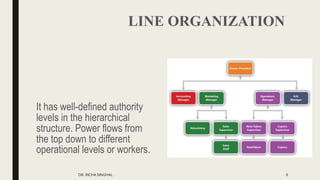
It has well-defined authority
levels in the hierarchical
structure. Power flows from
the top down to different
operational levels or workers.
DR. RICHA SINGHAL 6
LINE ORGANIZATION
FUNCTIONAL ORGANIZATION
The Functional Organization groups workers
based on their area of specialization. This
structure is an extension of the Line
Organization. The functional manager leads
the team and manages all the operations or
businesses.
DR. RICHA SINGHAL 7
LINE AND STAFF ORGANIZATION
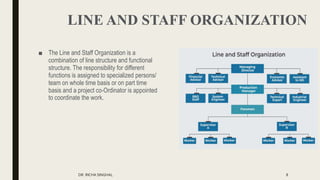
■ The Line and Staff Organization is a
combination of line structure and functional
structure. The responsibility for different
functions is assigned to specialized persons/
team on whole time basis or on part time
basis and a project co-Ordinator is appointed
to coordinate the work.
DR. RICHA SINGHAL 8
ADVANTAGES
 The line and staff organization provides the benefits of planned specialization.
 Staff can make quality decisions as they get right information and support from
specialists at the right time so they can get better decisions and enjoy better
coordination.
 Get training to enhance skills, get an opportunity to work in research &
development.
 Unity of command is maintained.
 There is a clear flow of authority and responsibility among line officers.
 There is a greater scope for growth and expansion by adding general and
specialist staff for new activity without disturbing the basic structure.
DR. RICHA SINGHAL 9
DISADVANTAGES
 Increased confusion and conflicts among the staff. Jealousies
and friction between line and staff reduce operational efficiency
of the enterprise.
 Higher costs on hiring specialist
 A tendency to develop personal image within the group. Staff
men may not perform their job well because they are not
accountable for the results.
DR. RICHA SINGHAL 10
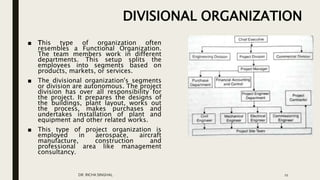
DIVISIONAL ORGANIZATION
DR. RICHA SINGHAL 11
■ This type of organization often
resembles a Functional Organization.
The team members work in different
departments. This setup splits the
employees into segments based on
products, markets, or services.
■ The divisional organization's segments
or division are autonomous. The project
division has over all responsibility for
the project. It prepares the designs of
the buildings, plant layout, works out
the process, makes purchases and
undertakes installation of plant and
equipment and other related works.
■ This type of project organization is
employed in aerospace, aircraft
manufacture, construction and
professional area like management
consultancy.
ADVANTAGE
S
 The project manager has full authority and control over the division.
 Project management allows maximum use of specialised knowledge which
can be transferred from one project to another.
 Project organization has been found to fit a number of widely varying
situations, from building contractors and advertising agencies to
accounting and consulting firms.
 The timely completion of a project without disturbing the normal routine of
rest of the organisation.
DR. RICHA SINGHAL 12
DISADVANTAGE
S
 The autonomous nature often results in duplication of functions and resources.
 Segmentation creates boundaries among divisions and may lead to poor inter-unit
coordination.
 There may be role conflicts, poor loyalty and under utilization of resources due to the fear of
being forgotten at the time of promotion.
 A project manager is responsible for project outcomes but the ongoing conventional
organization does not give him unlimited authority.
DR. RICHA SINGHAL 13
MATRIX ORGANIZATION STRUCTURE
DR. RICHA SINGHAL 14
• It is a two dimensional structure, a
combination of divisional structure
and traditional functional structure.
A permanent organization designed to
achieve specific results by using teams
of specialists from different functional
areas in the organization is a matrix
organization or grid organization.
• Functional departments create a
vertical chain of command while the
project teams form the horizontal
chain.
ADVANTAGES
1. This structure facilitates the proper sharing and utilization of highly specialized staff, equipment
and resources. Each project or product unit can share the specialized resource with other units,
rather than duplicating it to provide independent service for each.
2. The matrix organization provides the professional identification of specialists and professionals
based on their specialization and efficiency. Talented specialists can be utilized more efficiently
under this structure.
3. Matrix structure fosters flexibility throughout the organization. Various skills can be brought
together in this type of organization.
4. Effective Control: The main responsibility of the project manager is to maintain coordination among
interrelated factors of a particular project. He has to communicate both with the horizontal and
vertical authorities so that the project work can be run smoothly. Similarly, functional managers are
responsible for providing technical and administrative guidance to projects. This leads to a better
and more effective control over regular operation.
5. Technical Excellence: Matrix structure ensures the maintenance of high technical standards. They
facilitate high quality and innovative solutions to technical problems.
6. Motivation: Matrix structure motivates to the project staff as they can focus directly on the
completion of a particular project. Lower level get an opportunity to participate in important
decisions faster higher levels of motivation and commitment.
DR. RICHA SINGHAL 15
DISADVANTAGES
1. Costly: This structure increases administrative cost. In this structure, specialists from the project
as well as functional authorities involve in project works. It increases paperwork and other
information costs. Besides, it is essential to pay lump-sum remuneration to functional and project
specialists. Hence, this structure is costly to implement and maintain.
2. Power Struggle: One of the main problems with the matrix structure is that the project manager
and functional manager may not agree on priorities or resource allocations, leading to conflict and
power struggle.
3. Difficulties: In matrix structure the project manager controls the administrative decisions, while
the functional managers control the technical decisions. Due to this division of power and
responsibility management control and co-ordination is difficult in a matrix structure.
4. Slowness in Decisions: Functional and project specialists can shift responsibility for decision
making. This delays decisions. Likewise, all decisions may become group decisions, leading to gross
inefficiency.
5. Complex Organization Structure: The matrix structure is complex and more difficult for the
participants to understand than the functional or pure project organization.
6. Unity of Command: In matrix structure, subordinates have to follow instructions from more than
one superior. Generally, they receive orders from functional managers as well as from project
managers. In some cases, subordinates may receive instructions from both the superiors at a time.
This structure violates the principle of unity of command.
DR. RICHA SINGHAL 16
RESPONSIBILITY MATRIX
The project manager has total
responsibility and accountability for
project success. The functional
departments on the other hand have
functional responsibility of the project.
The kind of responsibility defined for
each organisational position or work
package intersection should be
determined by mutual agreement of the
workers assigned and their managers.
This intersection of the Work Break-
down Structure (WBS) and the
organisational structure represented by a
chart is called responsibility matrix.
DR. RICHA SINGHAL 17
This Photo by Unknown Author is licensed under CC BY
THANKS
DR. RICHA SINGHAL 18

PROJECT ORGANIZATION

  • 1.
    PROJECT ORGANIZATION DR. RICHA SINGHAL ASSOCIATEPROFESSOR DEPARTMENT OF EAFM S.S.JAIN SUBODH PG COLLEGE (AUTONOMOUS) Mr. SAMEER KATARIA B.COM (HONS) EAFM S.S.JAIN SUBODH PG COLLEGE (AUTONOMOUS
  • 2.
    PRESENTATION OUTLINE  PROJECTORGANIZATION INTRODUCTION  ORGANIZATION STRUCTURE AND RESPONSIBILITIES  LINE STRUCTURE  FUNCTIONAL STRUCTURE  LINE AND STAFF STRUCTURE  DIVISONAL STRUCTURE  MATRIX STRUCTURE  RESPONSIBILITY MATRIX. DR. RICHA SINGHAL 2
  • 3.
    INTRODUCTION Project organization isa temporary setup formed for specific projects. It's also called “projectized organizational structure.” The project manager assigned for the project is the head of this structure. Once the project is complete, you may choose to dismantle this setup or move it to form a new project. In the case of a new project, the project manager might have to reshuffle the staff to fit the new plan. You’ll hire resources or specialists from different functional departments. A TEMPORARY ORGANIZATION DESIGNED TO ACHIVE SPECIFIC RESULTS BY USING A TEAM OF SPECIALISTS FROM DIFFERENT FUNCTIONAL AREAS IN THE FIRM IS CALLED A PROJECT ORGANIZATION. ■ UNITY OF COMMAND ■ INTER-RELATED TASKS ■ CLEAR-CUT AUTHORITY LINES ■ WELL-DEFINED RESPONSIBILITY DR. RICHA SINGHAL 3
  • 4.
    ■ Advantages • Easyto communicate, hence can stay up to date • The team can have a strong sense of identity as all are working together to achieve a common goal • Manage resources efficiently and effectively ■ Disadvantages • No clear growth path for the team once the project gets completed • It's expensive because the organization dedicates all the specialists for one single project. DR. RICHA SINGHAL 4
  • 5.
    PROJECT ORGANIZATION STRUCTURE THEPROJECT ORGANIZATION STRUCTURE IDENTIFIES THE RELATIONSHIP BETWEEN THE PROJECT PARTICIPANTS, TOGETHER WITH DEFINING THEIR DUTIES, RESPONSIBILITIES ANDAUTHORITY. ■ LINEAND STAFF ORGANIZATION ■ FUNCTIONAL ORGANIZATION ■ MATRIX ORGANIZATION DR. RICHA SINGHAL 5
  • 6.
    It has well-definedauthority levels in the hierarchical structure. Power flows from the top down to different operational levels or workers. DR. RICHA SINGHAL 6 LINE ORGANIZATION
  • 7.
    FUNCTIONAL ORGANIZATION The FunctionalOrganization groups workers based on their area of specialization. This structure is an extension of the Line Organization. The functional manager leads the team and manages all the operations or businesses. DR. RICHA SINGHAL 7
  • 8.
    LINE AND STAFFORGANIZATION ■ The Line and Staff Organization is a combination of line structure and functional structure. The responsibility for different functions is assigned to specialized persons/ team on whole time basis or on part time basis and a project co-Ordinator is appointed to coordinate the work. DR. RICHA SINGHAL 8
  • 9.
    ADVANTAGES  The lineand staff organization provides the benefits of planned specialization.  Staff can make quality decisions as they get right information and support from specialists at the right time so they can get better decisions and enjoy better coordination.  Get training to enhance skills, get an opportunity to work in research & development.  Unity of command is maintained.  There is a clear flow of authority and responsibility among line officers.  There is a greater scope for growth and expansion by adding general and specialist staff for new activity without disturbing the basic structure. DR. RICHA SINGHAL 9
  • 10.
    DISADVANTAGES  Increased confusionand conflicts among the staff. Jealousies and friction between line and staff reduce operational efficiency of the enterprise.  Higher costs on hiring specialist  A tendency to develop personal image within the group. Staff men may not perform their job well because they are not accountable for the results. DR. RICHA SINGHAL 10
  • 11.
    DIVISIONAL ORGANIZATION DR. RICHASINGHAL 11 ■ This type of organization often resembles a Functional Organization. The team members work in different departments. This setup splits the employees into segments based on products, markets, or services. ■ The divisional organization's segments or division are autonomous. The project division has over all responsibility for the project. It prepares the designs of the buildings, plant layout, works out the process, makes purchases and undertakes installation of plant and equipment and other related works. ■ This type of project organization is employed in aerospace, aircraft manufacture, construction and professional area like management consultancy.
  • 12.
    ADVANTAGE S  The projectmanager has full authority and control over the division.  Project management allows maximum use of specialised knowledge which can be transferred from one project to another.  Project organization has been found to fit a number of widely varying situations, from building contractors and advertising agencies to accounting and consulting firms.  The timely completion of a project without disturbing the normal routine of rest of the organisation. DR. RICHA SINGHAL 12
  • 13.
    DISADVANTAGE S  The autonomousnature often results in duplication of functions and resources.  Segmentation creates boundaries among divisions and may lead to poor inter-unit coordination.  There may be role conflicts, poor loyalty and under utilization of resources due to the fear of being forgotten at the time of promotion.  A project manager is responsible for project outcomes but the ongoing conventional organization does not give him unlimited authority. DR. RICHA SINGHAL 13
  • 14.
    MATRIX ORGANIZATION STRUCTURE DR.RICHA SINGHAL 14 • It is a two dimensional structure, a combination of divisional structure and traditional functional structure. A permanent organization designed to achieve specific results by using teams of specialists from different functional areas in the organization is a matrix organization or grid organization. • Functional departments create a vertical chain of command while the project teams form the horizontal chain.
  • 15.
    ADVANTAGES 1. This structurefacilitates the proper sharing and utilization of highly specialized staff, equipment and resources. Each project or product unit can share the specialized resource with other units, rather than duplicating it to provide independent service for each. 2. The matrix organization provides the professional identification of specialists and professionals based on their specialization and efficiency. Talented specialists can be utilized more efficiently under this structure. 3. Matrix structure fosters flexibility throughout the organization. Various skills can be brought together in this type of organization. 4. Effective Control: The main responsibility of the project manager is to maintain coordination among interrelated factors of a particular project. He has to communicate both with the horizontal and vertical authorities so that the project work can be run smoothly. Similarly, functional managers are responsible for providing technical and administrative guidance to projects. This leads to a better and more effective control over regular operation. 5. Technical Excellence: Matrix structure ensures the maintenance of high technical standards. They facilitate high quality and innovative solutions to technical problems. 6. Motivation: Matrix structure motivates to the project staff as they can focus directly on the completion of a particular project. Lower level get an opportunity to participate in important decisions faster higher levels of motivation and commitment. DR. RICHA SINGHAL 15
  • 16.
    DISADVANTAGES 1. Costly: Thisstructure increases administrative cost. In this structure, specialists from the project as well as functional authorities involve in project works. It increases paperwork and other information costs. Besides, it is essential to pay lump-sum remuneration to functional and project specialists. Hence, this structure is costly to implement and maintain. 2. Power Struggle: One of the main problems with the matrix structure is that the project manager and functional manager may not agree on priorities or resource allocations, leading to conflict and power struggle. 3. Difficulties: In matrix structure the project manager controls the administrative decisions, while the functional managers control the technical decisions. Due to this division of power and responsibility management control and co-ordination is difficult in a matrix structure. 4. Slowness in Decisions: Functional and project specialists can shift responsibility for decision making. This delays decisions. Likewise, all decisions may become group decisions, leading to gross inefficiency. 5. Complex Organization Structure: The matrix structure is complex and more difficult for the participants to understand than the functional or pure project organization. 6. Unity of Command: In matrix structure, subordinates have to follow instructions from more than one superior. Generally, they receive orders from functional managers as well as from project managers. In some cases, subordinates may receive instructions from both the superiors at a time. This structure violates the principle of unity of command. DR. RICHA SINGHAL 16
  • 17.
    RESPONSIBILITY MATRIX The projectmanager has total responsibility and accountability for project success. The functional departments on the other hand have functional responsibility of the project. The kind of responsibility defined for each organisational position or work package intersection should be determined by mutual agreement of the workers assigned and their managers. This intersection of the Work Break- down Structure (WBS) and the organisational structure represented by a chart is called responsibility matrix. DR. RICHA SINGHAL 17 This Photo by Unknown Author is licensed under CC BY
  • 18.