Dr. Richa Singhal
Associate Professor,EAFM
S.S. Jain Subodh P.G.College, jaipur
1
CONTENT
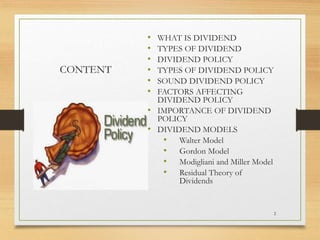
• WHAT IS DIVIDEND
• TYPES OF DIVIDEND
• DIVIDEND POLICY
• TYPES OF DIVIDEND POLICY
• SOUND DIVIDEND POLICY
• FACTORS AFFECTING
DIVIDEND POLICY
• IMPORTANCE OF DIVIDEND
POLICY
• DIVIDEND MODELS
• Walter Model
• Gordon Model
• Modigliani and Miller Model
• Residual Theory of
Dividends
2
3
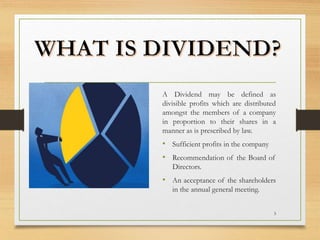
A Dividend may be defined as
divisible profits which are distributed
amongst the members of a company
in proportion to their shares in a
manner as is prescribed by law.
• Sufficient profits in the company
• Recommendation of the Board of
Directors.
• An acceptance of the shareholders
in the annual general meeting.
4
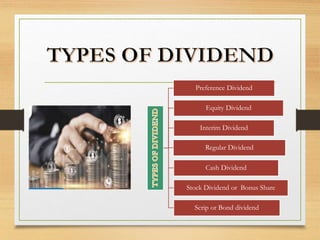
Preference Dividend
Equity Dividend
Interim Dividend
Regular Dividend
Cash Dividend
Stock Dividend or Bonus Share
Scrip or Bond dividend
Dividend Policy can be
defined as the plan of action
adopted by its directors
whenever the dividend
decision is to be made.
It determines the division of
earnings between payout to
shareholders and retained
earnings.
5
6
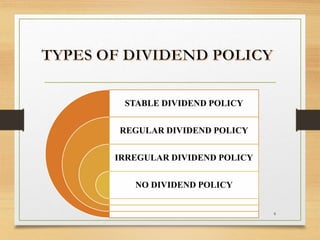
STABLE DIVIDEND POLICY
REGULAR DIVIDEND POLICY
IRREGULAR DIVIDEND POLICY
NO DIVIDEND POLICY
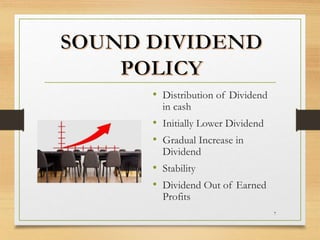
• Distribution of Dividend
in cash
• Initially Lower Dividend
• Gradual Increase in
Dividend
• Stability
• Dividend Out of Earned
Profits
7
8
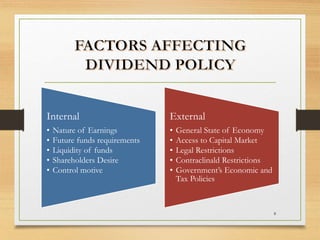
Internal
• Nature of Earnings
• Future funds requirements
• Liquidity of funds
• Shareholders Desire
• Control motive
External
• General State of Economy
• Access to Capital Market
• Legal Restrictions
• Contraclinald Restrictions
• Government’s Economic and
Tax Policies
9
DEVELOP SHAREHOLDER’S TRUST
INFLUENCE INSTITUTIONAL INVETORS
FUTURE PROSPECTS
EQUITY EVAUATION
MARKET VALUE STATBILITY OF SHARES
MARKET FOR PREFERENCE SHARES AND DEBENTURES
DEGREE OF CONTROL
RAISING OF SURPLUS FUNDS
TAX ADVANTAGE
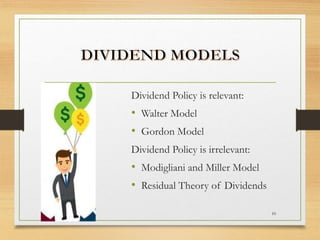
Dividend Policy is relevant:
• Walter Model
• Gordon Model
Dividend Policy is irrelevant:
• Modigliani and Miller Model
• Residual Theory of Dividends
10
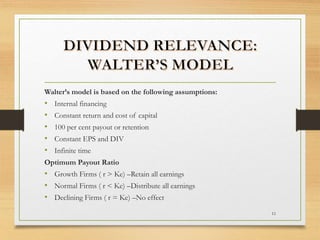
Walter’s model is based on the following assumptions:
• Internal financing
• Constant return and cost of capital
• 100 per cent payout or retention
• Constant EPS and DIV
• Infinite time
Optimum Payout Ratio
• Growth Firms ( r > Ke) –Retain all earnings
• Normal Firms ( r < Ke) –Distribute all earnings
• Declining Firms ( r = Ke) –No effect
11
12
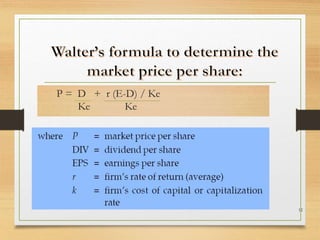
P = D + r (E-D) / Ke
Ke Ke
13
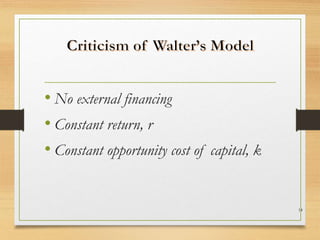
• No external financing
• Constant return, r
• Constant opportunity cost of capital, k
14
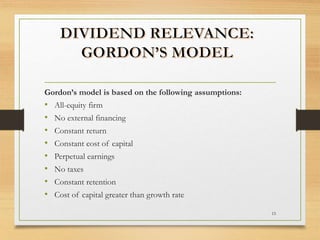
Gordon’s model is based on the following assumptions:
• All-equity firm
• No external financing
• Constant return
• Constant cost of capital
• Perpetual earnings
• No taxes
• Constant retention
• Cost of capital greater than growth rate
15
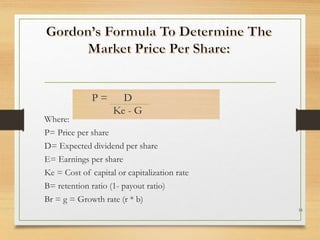
Where:
P= Price per share
D= Expected dividend per share
E= Earnings per share
Ke = Cost of capital or capitalization rate
B= retention ratio (1- payout ratio)
Br = g = Growth rate (r * b)
16
P = D
Ke - G
17
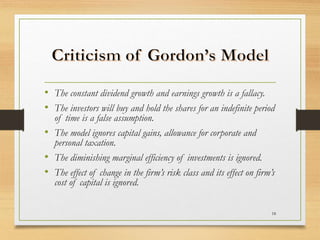
• The constant dividend growth and earnings growth is a fallacy.
• The investors will buy and hold the shares for an indefinite period
of time is a false assumption.
• The model ignores capital gains, allowance for corporate and
personal taxation.
• The diminishing marginal efficiency of investments is ignored.
• The effect of change in the firm’s risk class and its effect on firm’s
cost of capital is ignored.
18
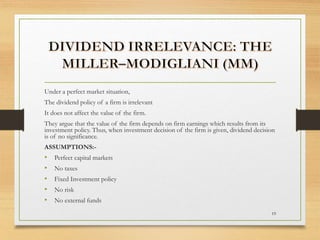
Under a perfect market situation,
The dividend policy of a firm is irrelevant
It does not affect the value of the firm.
They argue that the value of the firm depends on firm earnings which results from its
investment policy. Thus, when investment decision of the firm is given, dividend decision
is of no significance.
ASSUMPTIONS:-
• Perfect capital markets
• No taxes
• Fixed Investment policy
• No risk
• No external funds
19
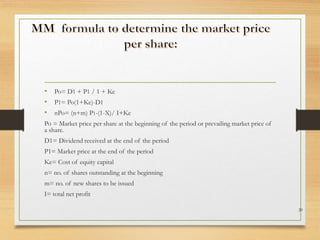
• Po= D1 + P1 / 1 + Ke
• P1= Po(1+Ke)-D1
• nPo= (n+m) P1-(1-X)/ I+Ke
Po = Market price per share at the beginning of the period or prevailing market price of
a share.
D1= Dividend received at the end of the period
P1= Market price at the end of the period
Ke= Cost of equity capital
n= no. of shares outstanding at the beginning
m= no. of new shares to be issued
I= total net profit
20
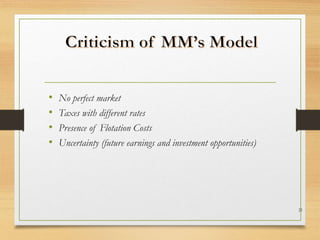
• No perfect market
• Taxes with different rates
• Presence of Flotation Costs
• Uncertainty (future earnings and investment opportunities)
21
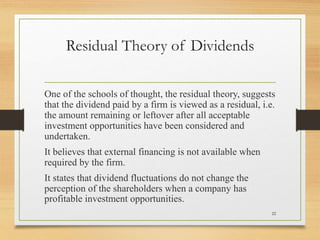
Residual Theory of Dividends
One of the schools of thought, the residual theory, suggests
that the dividend paid by a firm is viewed as a residual, i.e.
the amount remaining or leftover after all acceptable
investment opportunities have been considered and
undertaken.
It believes that external financing is not available when
required by the firm.
It states that dividend fluctuations do not change the
perception of the shareholders when a company has
profitable investment opportunities.
22
THANK
YOU
23

DIVIDEND POLICY

  • 1.
    Dr. Richa Singhal AssociateProfessor,EAFM S.S. Jain Subodh P.G.College, jaipur 1
  • 2.
    CONTENT • WHAT ISDIVIDEND • TYPES OF DIVIDEND • DIVIDEND POLICY • TYPES OF DIVIDEND POLICY • SOUND DIVIDEND POLICY • FACTORS AFFECTING DIVIDEND POLICY • IMPORTANCE OF DIVIDEND POLICY • DIVIDEND MODELS • Walter Model • Gordon Model • Modigliani and Miller Model • Residual Theory of Dividends 2
  • 3.
    3 A Dividend maybe defined as divisible profits which are distributed amongst the members of a company in proportion to their shares in a manner as is prescribed by law. • Sufficient profits in the company • Recommendation of the Board of Directors. • An acceptance of the shareholders in the annual general meeting.
  • 4.
    4 Preference Dividend Equity Dividend InterimDividend Regular Dividend Cash Dividend Stock Dividend or Bonus Share Scrip or Bond dividend
  • 5.
    Dividend Policy canbe defined as the plan of action adopted by its directors whenever the dividend decision is to be made. It determines the division of earnings between payout to shareholders and retained earnings. 5
  • 6.
    6 STABLE DIVIDEND POLICY REGULARDIVIDEND POLICY IRREGULAR DIVIDEND POLICY NO DIVIDEND POLICY
  • 7.
    • Distribution ofDividend in cash • Initially Lower Dividend • Gradual Increase in Dividend • Stability • Dividend Out of Earned Profits 7
  • 8.
    8 Internal • Nature ofEarnings • Future funds requirements • Liquidity of funds • Shareholders Desire • Control motive External • General State of Economy • Access to Capital Market • Legal Restrictions • Contraclinald Restrictions • Government’s Economic and Tax Policies
  • 9.
    9 DEVELOP SHAREHOLDER’S TRUST INFLUENCEINSTITUTIONAL INVETORS FUTURE PROSPECTS EQUITY EVAUATION MARKET VALUE STATBILITY OF SHARES MARKET FOR PREFERENCE SHARES AND DEBENTURES DEGREE OF CONTROL RAISING OF SURPLUS FUNDS TAX ADVANTAGE
  • 10.
    Dividend Policy isrelevant: • Walter Model • Gordon Model Dividend Policy is irrelevant: • Modigliani and Miller Model • Residual Theory of Dividends 10
  • 11.
    Walter’s model isbased on the following assumptions: • Internal financing • Constant return and cost of capital • 100 per cent payout or retention • Constant EPS and DIV • Infinite time Optimum Payout Ratio • Growth Firms ( r > Ke) –Retain all earnings • Normal Firms ( r < Ke) –Distribute all earnings • Declining Firms ( r = Ke) –No effect 11
  • 12.
    12 P = D+ r (E-D) / Ke Ke Ke
  • 13.
  • 14.
    • No externalfinancing • Constant return, r • Constant opportunity cost of capital, k 14
  • 15.
    Gordon’s model isbased on the following assumptions: • All-equity firm • No external financing • Constant return • Constant cost of capital • Perpetual earnings • No taxes • Constant retention • Cost of capital greater than growth rate 15
  • 16.
    Where: P= Price pershare D= Expected dividend per share E= Earnings per share Ke = Cost of capital or capitalization rate B= retention ratio (1- payout ratio) Br = g = Growth rate (r * b) 16 P = D Ke - G
  • 17.
  • 18.
    • The constantdividend growth and earnings growth is a fallacy. • The investors will buy and hold the shares for an indefinite period of time is a false assumption. • The model ignores capital gains, allowance for corporate and personal taxation. • The diminishing marginal efficiency of investments is ignored. • The effect of change in the firm’s risk class and its effect on firm’s cost of capital is ignored. 18
  • 19.
    Under a perfectmarket situation, The dividend policy of a firm is irrelevant It does not affect the value of the firm. They argue that the value of the firm depends on firm earnings which results from its investment policy. Thus, when investment decision of the firm is given, dividend decision is of no significance. ASSUMPTIONS:- • Perfect capital markets • No taxes • Fixed Investment policy • No risk • No external funds 19
  • 20.
    • Po= D1+ P1 / 1 + Ke • P1= Po(1+Ke)-D1 • nPo= (n+m) P1-(1-X)/ I+Ke Po = Market price per share at the beginning of the period or prevailing market price of a share. D1= Dividend received at the end of the period P1= Market price at the end of the period Ke= Cost of equity capital n= no. of shares outstanding at the beginning m= no. of new shares to be issued I= total net profit 20
  • 21.
    • No perfectmarket • Taxes with different rates • Presence of Flotation Costs • Uncertainty (future earnings and investment opportunities) 21
  • 22.
    Residual Theory ofDividends One of the schools of thought, the residual theory, suggests that the dividend paid by a firm is viewed as a residual, i.e. the amount remaining or leftover after all acceptable investment opportunities have been considered and undertaken. It believes that external financing is not available when required by the firm. It states that dividend fluctuations do not change the perception of the shareholders when a company has profitable investment opportunities. 22
  • 23.