
Guided by:-
Prof. K. V. Kiran Kumar
Presented by TEAM 7
Angad Soni
Sushovit Rout
Maninder Singh
Anshul Chawla
Dileep Nandamuri
Rajat Kare
 Accounting Standards : Introduction
Accounting Standards: Overview
Scope of Accounting Standards
Advantages of AS
Disadvantages of AS
 AS 6 Valuation of Inventory & AS 7
Depreciation
 IFRS
Set of uniform guidelines for presenting
financial statements fairly and
consistently in order to depict the
financial performance of an organization
Accounting standards are viewed as
policy documents used for recognition,
measurement, and disclosure of
information relating to the transactions
of a business
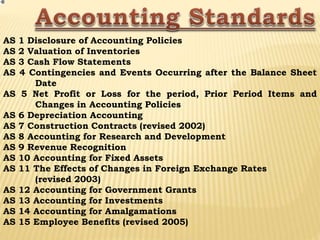
AS 1 Disclosure of Accounting Policies
AS 2 Valuation of Inventories
AS 3 Cash Flow Statements
AS 4 Contingencies and Events Occurring after the Balance Sheet
Date
AS 5 Net Profit or Loss for the period, Prior Period Items and
Changes in Accounting Policies
AS 6 Depreciation Accounting
AS 7 Construction Contracts (revised 2002)
AS 8 Accounting for Research and Development
AS 9 Revenue Recognition
AS 10 Accounting for Fixed Assets
AS 11 The Effects of Changes in Foreign Exchange Rates
(revised 2003)
AS 12 Accounting for Government Grants
AS 13 Accounting for Investments
AS 14 Accounting for Amalgamations
AS 15 Employee Benefits (revised 2005)
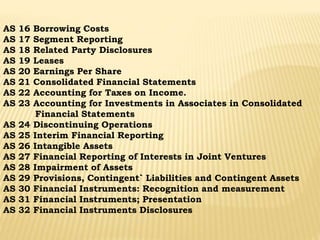
AS 16 Borrowing Costs
AS 17 Segment Reporting
AS 18 Related Party Disclosures
AS 19 Leases
AS 20 Earnings Per Share
AS 21 Consolidated Financial Statements
AS 22 Accounting for Taxes on Income.
AS 23 Accounting for Investments in Associates in Consolidated
Financial Statements
AS 24 Discontinuing Operations
AS 25 Interim Financial Reporting
AS 26 Intangible Assets
AS 27 Financial Reporting of Interests in Joint Ventures
AS 28 Impairment of Assets
AS 29 Provisions, Contingent` Liabilities and Contingent Assets
AS 30 Financial Instruments: Recognition and measurement
AS 31 Financial Instruments; Presentation
AS 32 Financial Instruments Disclosures
Applicability
 Principle Based
 Conformity with laws
Harmonized policies and practices
Reliable accounting information
Improved presentation of accounts
Curbs Initiative
Adaptation to special circumstances
Frequent Changes in business environment
 Inventory should be valued at the lower of cost and
net realizable value
 The total amount to be depreciated from the value of
a depreciable asset should be spread over its useful life
on a systematic basis
 The method selected for charging depreciation should
be consistently followed:
 Straight Line method
Written Down value method
 Accountants worldwide felt that having one
set of standards for financial reporting is a
more efficient and convenient option for all
enterprises, regardless of their location. This
led to the emergence of IFRS.
Purpose  Provide a global framework and
guidance for the preparation of financial
statements and disclosure of financial
information so that the language used by the
company in such reports conforms to
terminology prescribed by IFRS.
Accounting standards and IFRS

Accounting standards and IFRS

  • 1.
    Guided by:- Prof. K.V. Kiran Kumar Presented by TEAM 7 Angad Soni Sushovit Rout Maninder Singh Anshul Chawla Dileep Nandamuri Rajat Kare
  • 2.
     Accounting Standards: Introduction Accounting Standards: Overview Scope of Accounting Standards Advantages of AS Disadvantages of AS  AS 6 Valuation of Inventory & AS 7 Depreciation  IFRS
  • 3.
    Set of uniformguidelines for presenting financial statements fairly and consistently in order to depict the financial performance of an organization Accounting standards are viewed as policy documents used for recognition, measurement, and disclosure of information relating to the transactions of a business
  • 4.
    AS 1 Disclosureof Accounting Policies AS 2 Valuation of Inventories AS 3 Cash Flow Statements AS 4 Contingencies and Events Occurring after the Balance Sheet Date AS 5 Net Profit or Loss for the period, Prior Period Items and Changes in Accounting Policies AS 6 Depreciation Accounting AS 7 Construction Contracts (revised 2002) AS 8 Accounting for Research and Development AS 9 Revenue Recognition AS 10 Accounting for Fixed Assets AS 11 The Effects of Changes in Foreign Exchange Rates (revised 2003) AS 12 Accounting for Government Grants AS 13 Accounting for Investments AS 14 Accounting for Amalgamations AS 15 Employee Benefits (revised 2005)
  • 5.
    AS 16 BorrowingCosts AS 17 Segment Reporting AS 18 Related Party Disclosures AS 19 Leases AS 20 Earnings Per Share AS 21 Consolidated Financial Statements AS 22 Accounting for Taxes on Income. AS 23 Accounting for Investments in Associates in Consolidated Financial Statements AS 24 Discontinuing Operations AS 25 Interim Financial Reporting AS 26 Intangible Assets AS 27 Financial Reporting of Interests in Joint Ventures AS 28 Impairment of Assets AS 29 Provisions, Contingent` Liabilities and Contingent Assets AS 30 Financial Instruments: Recognition and measurement AS 31 Financial Instruments; Presentation AS 32 Financial Instruments Disclosures
  • 6.
  • 7.
    Harmonized policies andpractices Reliable accounting information Improved presentation of accounts
  • 8.
    Curbs Initiative Adaptation tospecial circumstances Frequent Changes in business environment
  • 9.
     Inventory shouldbe valued at the lower of cost and net realizable value  The total amount to be depreciated from the value of a depreciable asset should be spread over its useful life on a systematic basis  The method selected for charging depreciation should be consistently followed:  Straight Line method Written Down value method
  • 10.
     Accountants worldwidefelt that having one set of standards for financial reporting is a more efficient and convenient option for all enterprises, regardless of their location. This led to the emergence of IFRS. Purpose  Provide a global framework and guidance for the preparation of financial statements and disclosure of financial information so that the language used by the company in such reports conforms to terminology prescribed by IFRS.