PROJECT CONTRACTING
DR. RICHA SINGHAL
ASSOCIATE PROFESSOR
S.S.JAIN SUBODH P.G. COLLEGE
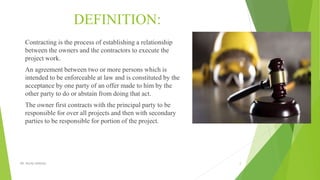
DEFINITION:
Contracting is the process of establishing a relationship
between the owners and the contractors to execute the
project work.
An agreement between two or more persons which is
intended to be enforceable at law and is constituted by the
acceptance by one party of an offer made to him by the
other party to do or abstain from doing that act.
The owner first contracts with the principal party to be
responsible for over all projects and then with secondary
parties to be responsible for portion of the project.
DR. RICHA SINGHAL 2
PROCESS OF FORMING A PROJECT
CONTRACT
 Registration of projects to be constructed
 Publishing bidding notice
 Invitation for bidding
 Pre-assessment of the qualifications of the tenderers
 Releasing of bidding documents
 Selecting experts to form assessment team
 Tender opening
 Assessment of tender documents.
 Declaring the winner
 Signing the contract
DR. RICHA SINGHAL 3
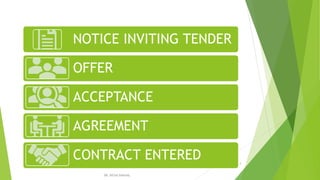
NOTICE INVITING TENDER
OFFER
ACCEPTANCE
AGREEMENT
CONTRACT ENTERED
DR. RICHA SINGHAL
4
TYPES OF CONTRACTS
A- FIXED PRICE CONTRACTS-
The price remains fixed as long as there are no changes to the scope of work or
provisions of agreement.
The basic feasibility of the project must be established and agreed by both the
parties.
The end product must be capable of being defined in sufficient detail so that no
doubt exist with any of the party.
This contract passes much of the responsibilities of the project manager to the
contractor.
Alternative forms of this contract are as follows:
FIXED PRICE WITH REDETERMINATION
FIXED PRICE INCENTIVES
DR. RICHA SINGHAL
5
B- COST PLUS OR COST REIMBURSABLE PLUS CONTRACTS-
COST PLUS FEE-
Agreed fee is paid to the contractor on the basis of the costs incurred.
COST PLUS AWARD FEE-
Awarded on the basis of some agreed measure of project performance.
COST PLUS INCENTIVE FEE-
Awarded on the basis of achieving parameters of cost, schedule and
performance.
DR. RICHA SINGHAL 6
C- TURNKEY CONTRACTING-
A turnkey contract may be defined as a contract in which a single
contractor acquires and sets up all necessary premises, equipment, and
supplies operating personnel to bring a project to a state of operational
readiness.
Technical package
Financial package
Lump Sum Turnkey Contract
Engineering Procurement Construction
DR. RICHA SINGHAL 7
D- CONCESSIONAL CONTRACTS
A private contractor develop a project at its own cost to recover initial
investment of the project.
Build- Operate- Transfer
Build- Own- Operate- Transfer
Lease- Rehabilitate- Operate- Transfer
Build- Operate- Lease- Transfer
Build- Own- Operate
Build- Own- Operate- sell
DR. RICHA SINGHAL 8
NEGOTIATION
Negotiation is a communication process between the parties
incidental to making of a contract to arrive at a common
understanding on the essentials of the contract in the area of
project management.
During negotiation, terms related to specifications, schedules
and price are converted into legal contractual agreements.
Cost, terms and conditions of the original contract
Variations in quality
Basis for price redetermination
Continued supply of spares
Buyback arrangements of initially dumped unwanted spares
Technology upgradation after initial supply of equipment's on a
continuous basis
DR. RICHA SINGHAL 9
CONTRACT ADMINISTRATION
To ensure that the project meets commitments
of both the owner and contractor as specified in
the project contract is called contract
administration.
Authorisation
Monitoring Project work
Controlling Changes
Receiving Payments
DR. RICHA SINGHAL 10
DR. RICHA SINGHAL 11

PROJECT CONTRACTING

  • 1.
    PROJECT CONTRACTING DR. RICHASINGHAL ASSOCIATE PROFESSOR S.S.JAIN SUBODH P.G. COLLEGE
  • 2.
    DEFINITION: Contracting is theprocess of establishing a relationship between the owners and the contractors to execute the project work. An agreement between two or more persons which is intended to be enforceable at law and is constituted by the acceptance by one party of an offer made to him by the other party to do or abstain from doing that act. The owner first contracts with the principal party to be responsible for over all projects and then with secondary parties to be responsible for portion of the project. DR. RICHA SINGHAL 2
  • 3.
    PROCESS OF FORMINGA PROJECT CONTRACT  Registration of projects to be constructed  Publishing bidding notice  Invitation for bidding  Pre-assessment of the qualifications of the tenderers  Releasing of bidding documents  Selecting experts to form assessment team  Tender opening  Assessment of tender documents.  Declaring the winner  Signing the contract DR. RICHA SINGHAL 3
  • 4.
  • 5.
    TYPES OF CONTRACTS A-FIXED PRICE CONTRACTS- The price remains fixed as long as there are no changes to the scope of work or provisions of agreement. The basic feasibility of the project must be established and agreed by both the parties. The end product must be capable of being defined in sufficient detail so that no doubt exist with any of the party. This contract passes much of the responsibilities of the project manager to the contractor. Alternative forms of this contract are as follows: FIXED PRICE WITH REDETERMINATION FIXED PRICE INCENTIVES DR. RICHA SINGHAL 5
  • 6.
    B- COST PLUSOR COST REIMBURSABLE PLUS CONTRACTS- COST PLUS FEE- Agreed fee is paid to the contractor on the basis of the costs incurred. COST PLUS AWARD FEE- Awarded on the basis of some agreed measure of project performance. COST PLUS INCENTIVE FEE- Awarded on the basis of achieving parameters of cost, schedule and performance. DR. RICHA SINGHAL 6
  • 7.
    C- TURNKEY CONTRACTING- Aturnkey contract may be defined as a contract in which a single contractor acquires and sets up all necessary premises, equipment, and supplies operating personnel to bring a project to a state of operational readiness. Technical package Financial package Lump Sum Turnkey Contract Engineering Procurement Construction DR. RICHA SINGHAL 7
  • 8.
    D- CONCESSIONAL CONTRACTS Aprivate contractor develop a project at its own cost to recover initial investment of the project. Build- Operate- Transfer Build- Own- Operate- Transfer Lease- Rehabilitate- Operate- Transfer Build- Operate- Lease- Transfer Build- Own- Operate Build- Own- Operate- sell DR. RICHA SINGHAL 8
  • 9.
    NEGOTIATION Negotiation is acommunication process between the parties incidental to making of a contract to arrive at a common understanding on the essentials of the contract in the area of project management. During negotiation, terms related to specifications, schedules and price are converted into legal contractual agreements. Cost, terms and conditions of the original contract Variations in quality Basis for price redetermination Continued supply of spares Buyback arrangements of initially dumped unwanted spares Technology upgradation after initial supply of equipment's on a continuous basis DR. RICHA SINGHAL 9
  • 10.
    CONTRACT ADMINISTRATION To ensurethat the project meets commitments of both the owner and contractor as specified in the project contract is called contract administration. Authorisation Monitoring Project work Controlling Changes Receiving Payments DR. RICHA SINGHAL 10
  • 11.