PROJECT
PLANNING
DR. RICHA SINGHAL
ASSOCIATE PROFESSOR
DEPTT. OF EAFM
S.S.JAIN SUBODH PG COLLEGE, JAIPUR (RAJ.)
PRESENTATION
OUTLINE
 PROJECT PLANNING: INTRODUCTION
STEPS OF DEVELOPING A PROJECT PLAN
 PLANNING FUNDAMENTALS
 PROJECT MASTER PLAN
 IMPORTANCE OF MASTER PLAN
 TECHNIQUES OF PROJECT PLANNING
 WORK BREAK DOWN STRUCTURE
 WORK PACKAGES
 PROJECT SCHEDULING
 BAR CHARTS
 RAT AND CAT SCHEDULE
 NETWORK SCHEDULE (PERT/CPM)
 LINE OF BALANCE.
Planning is a systematic way of deciding about doing things in a purposeful manner. when
this approach is applied exclusively for project, it is termed as project planning. it is the
process of deciding in advance about the future course of actions to be taken.
Project planning is part of project management, which relates to the use of schedules such
as Gantt charts to plan and subsequently report progress within the project environment.
Project planning can be done manually or by the use of project management software.
Project planning is a discipline for stating how to complete a project within a certain
timeframe, usually with defined stages, and with designated resources.
INTRODUCTION
STEPS OF DEVELOPING A PROJECT PLAN
DEVELOPMENT OF PROJECT PLAN OBJECTIVES
PROGRAMMING OFACTION
SCHEDULING OF RESOURCES AND TIME
ORGANISING OF A PROJECT TEAM, INFRASTRUCTURE AND WORKING METHODS
BUDGETING
DESIGNING A CONTROLLING SYSTEM
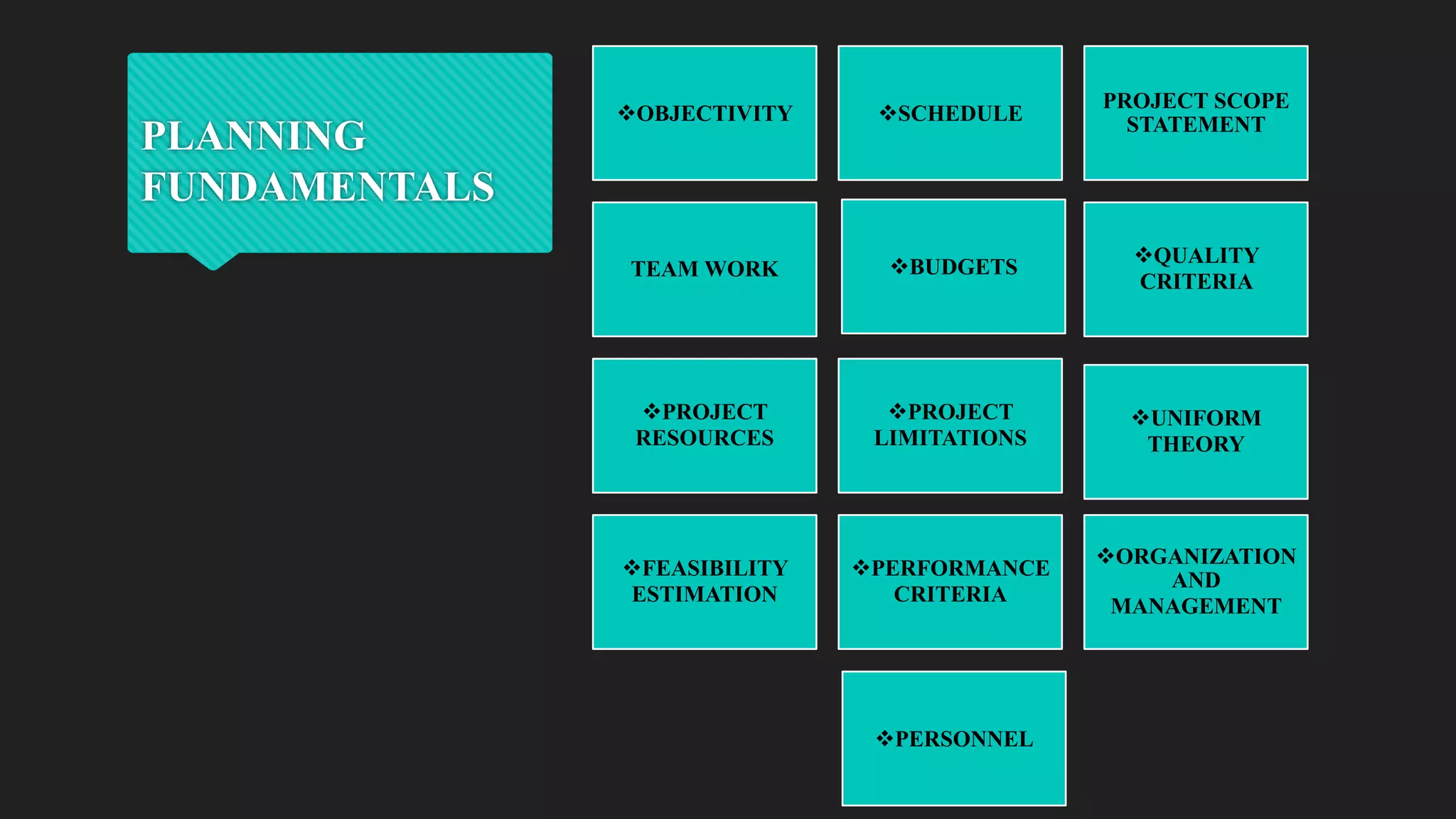
PLANNING
FUNDAMENTALS
OBJECTIVITY SCHEDULE
PROJECT SCOPE
STATEMENT
TEAM WORK BUDGETS
QUALITY
CRITERIA
PROJECT
RESOURCES
PROJECT
LIMITATIONS
UNIFORM
THEORY
FEASIBILITY
ESTIMATION
PERFORMANCE
CRITERIA
ORGANIZATION
AND
MANAGEMENT
PERSONNEL
IMPORTANCE OF PROJECT PLANNING
 Direction means to give proper information, accurate instructions and useful guidance to the
subordinates. It is impossible without planning. It is because planning tells us what to do, how to do it
and when to do it. Therefore, planning helps to give the right direction.
 With control, the actual performance of an employee is compared with the plans, and deviations (if any)
are found out and corrected. It is impossible to achieve such control without the right planning.
Therefore, planning becomes necessary to keep good control.
 Every organization has certain objectives or targets. It keeps working hard to fulfill these goals.
Planning helps an organization to achieve these aims, but with some ease and promptness. Planning
also helps an organization to avoid doing some random ( done by chance) activities.
 A good plan provides various financial and non-financial incentives to both managers and employees.
These incentives motivate them to work hard and achieve the objectives of the organization. Thus,
planning through various incentives helps to motivate the personnel of an organization.
 Planning helps managers to express their creativity and innovation. It brings satisfaction to the
managers and eventually a success to the organization.
Cont…..
 A manager makes many different plans. Then the manager selects or chooses the best of all available strategies. Making a
selection or choosing something means to take a decision. So, decision-making is facilitated by planning.
 Planning makes optimum utilization of all available resources. This entails a cost-benefit analysis for each project task so that
planners don’t waste valuable resources and avoids their duplication. It aims to give the highest returns at the lowest possible
cost. It thus increases the overall efficiency
 Often, the plans of all departments of an organization are well coordinated with each other. Similarly, the short-term,
medium-term and long-term plans of an organization are also coordinated with each other. Such proper coordination is
possible only because of efficient planning.
 Organizing means to bring together all available resources, i.e. 6 Ms. Organizing is not possible without planning. It is
so, since, planning tells us the number of resources required and when are they needed. It means that planning aids in
organizing in an efficient way.
 A project plan takes into consideration the team’s communication needs and pinpoints the most effective channels to keep collaborators connected
— such as email, chat, virtual meetings, shared documents, and more.
 Involving employees in project planning encourages them to contribute their perspective and skill, rather than simply telling them what they need to do.
This ensures more effective execution and makes team members feel like a valued part of the company which improves employee retention in
company.
 There are many risks involved in any modern business. Planning helps to forecast these business-related risks. It also helps to take the necessary
precautions to avoid these risks and prepare for future uncertainties in advance. Thus, it reduces business risks.
PROJECT MASTER PLAN
All the functional areas of the organization attached to the project
should be involved in the planning process. Although each area
develops its own plan but all such plans becomes a part of a single
overall plan. This overall plan is referred to as the project master plan
or project summary plan.
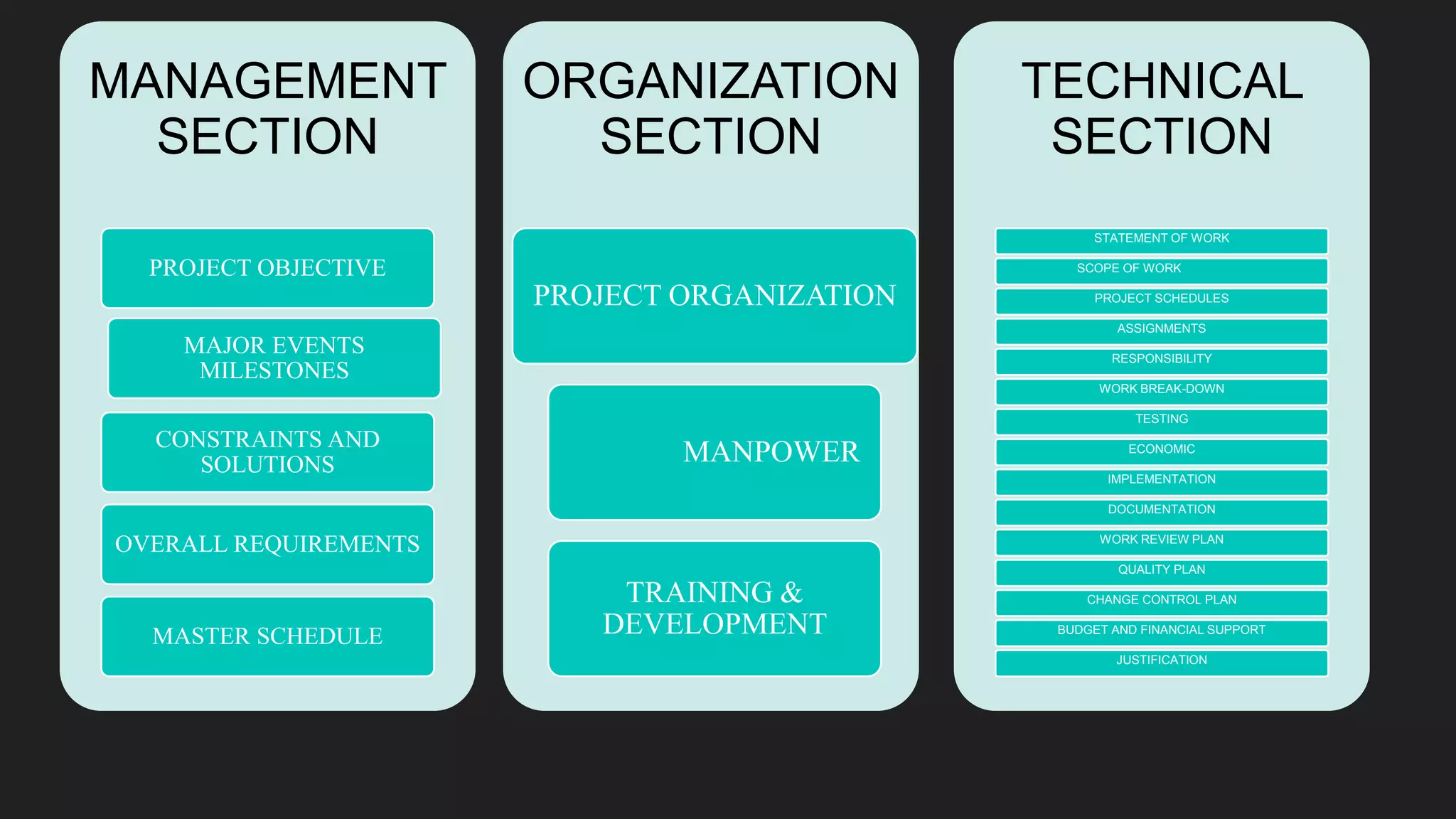
After assessing the feasibility of a project, creating a Master Project
Plan defines the scope of development both in the architectural
sense as well as it provides milestones that ensure that the
construction is executed in the pre-defined timeframe.
The contents of master plans vary depending on the size, complexity
and nature of the project. The master plan has three sections:-
IMPORTANCE OF MASTER PLAN
• The master planning provides a road map for all future project development decisions.
• The master plan, even if seen by some as an additional cost, can eventually lead to savings in the long
run.
• The master plan allows the involvement of all parties concerned in advance and sets out
expectations on how the various activities and tasks will be developed.
• A master plan approval creates “buy-ins” by the main stakeholders in a project. If everyone gives their
“blessing” at the outset, there will be much less chance to ask questions or step back later.
• A master plan allows you to estimate costs before the actual work begins. This also allows you to
raise funds for a longer period of time to fund your project.
• General planning can create visibility and credibility for a project. If a project’s vision can be
presented to its potential users, it often generates excitement about its potential and this often drives a
project and helps it to happen sooner.
• Projects that have a planned master plan generally have a higher completion rate than unplanned
projects.
MANAGEMENT
SECTION
PROJECT OBJECTIVE
MAJOR EVENTS
MILESTONES
CONSTRAINTS AND
SOLUTIONS
OVERALL REQUIREMENTS
MASTER SCHEDULE
ORGANIZATION
SECTION
PROJECT ORGANIZATION
MANPOWER
TRAINING &
DEVELOPMENT
TECHNICAL
SECTION
STATEMENT OF WORK
SCOPE OF WORK
PROJECT SCHEDULES
ASSIGNMENTS
RESPONSIBILITY
WORK BREAK-DOWN
TESTING
ECONOMIC
IMPLEMENTATION
DOCUMENTATION
WORK REVIEW PLAN
QUALITY PLAN
CHANGE CONTROL PLAN
BUDGET AND FINANCIAL SUPPORT
JUSTIFICATION
TECHNIQUES OF PROJECT PLANNING
 WORK BREAK DOWN STRUCTURE
 WORK PACKAGES
 PROJECT SCHEDULING
 BAR CHARTS
 RAT AND CAT SCHEDULE
 NETWORK SCHEDULE (PERT/CPM)
 LINE OF BALANCE
WORK BREAK DOWN STRUCTURE
 THE PROCEDURE FOR DEVIDING THE
OVERALL PROJECT INTO SUB-ELEMENTS
OR SMALL PIECES (WORKPACKAGES) TO
BE WELL UNDERSTOOD, PLANNED AND
CONTROLLED IS KNOWN AS WBS.
 EXECUTED BY THE PROJECT TEAM TO
ACCOMPLISH THE PROJECT OJJECTIVES
AND CREATE THE REQUIRED
DELIVERABLES.
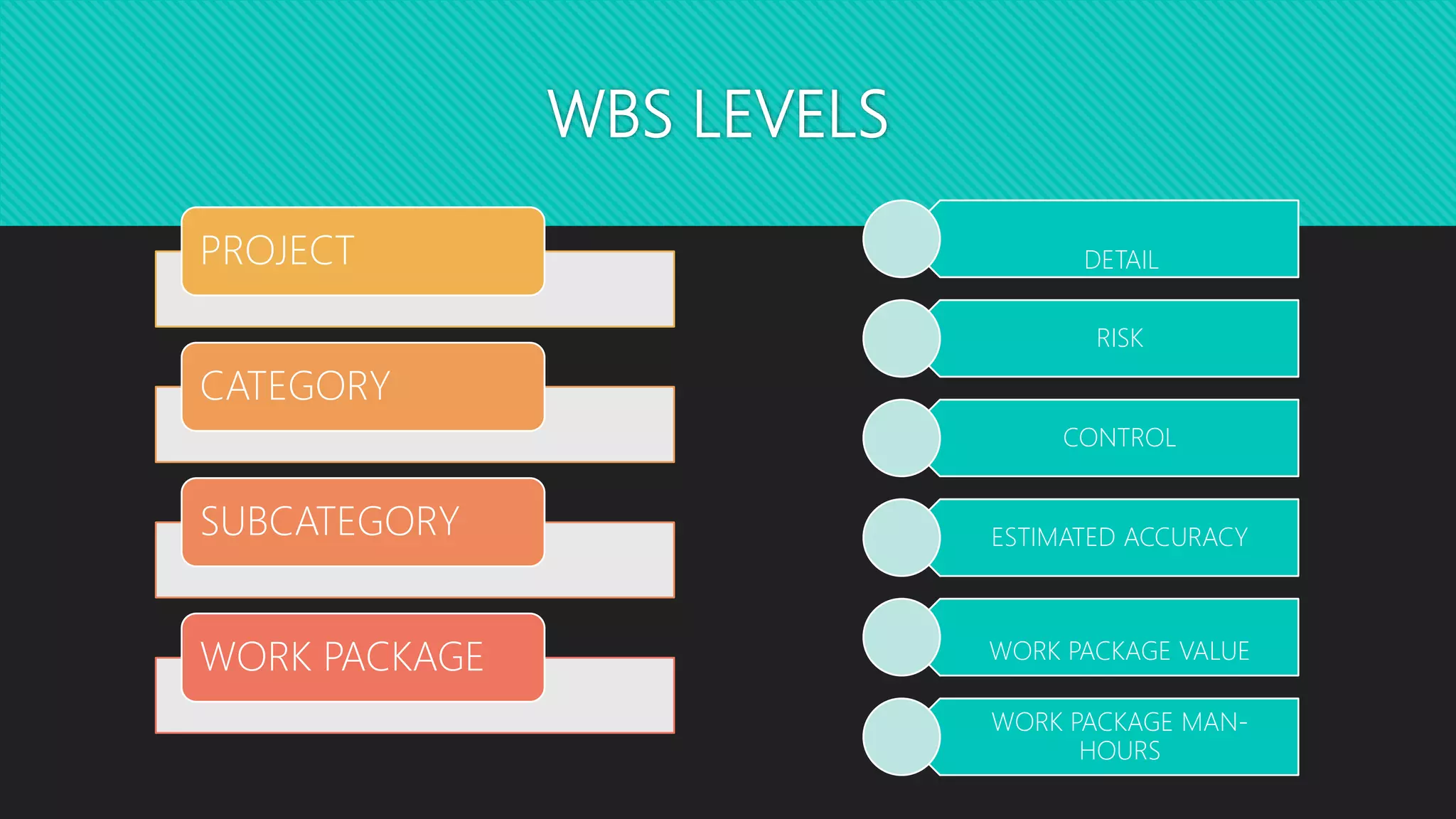
WBS LEVELS
DETAIL
RISK
CONTROL
ESTIMATED ACCURACY
WORK PACKAGE VALUE
WORK PACKAGE MAN-
HOURS
PROJECT
CATEGORY
SUBCATEGORY
WORK PACKAGE
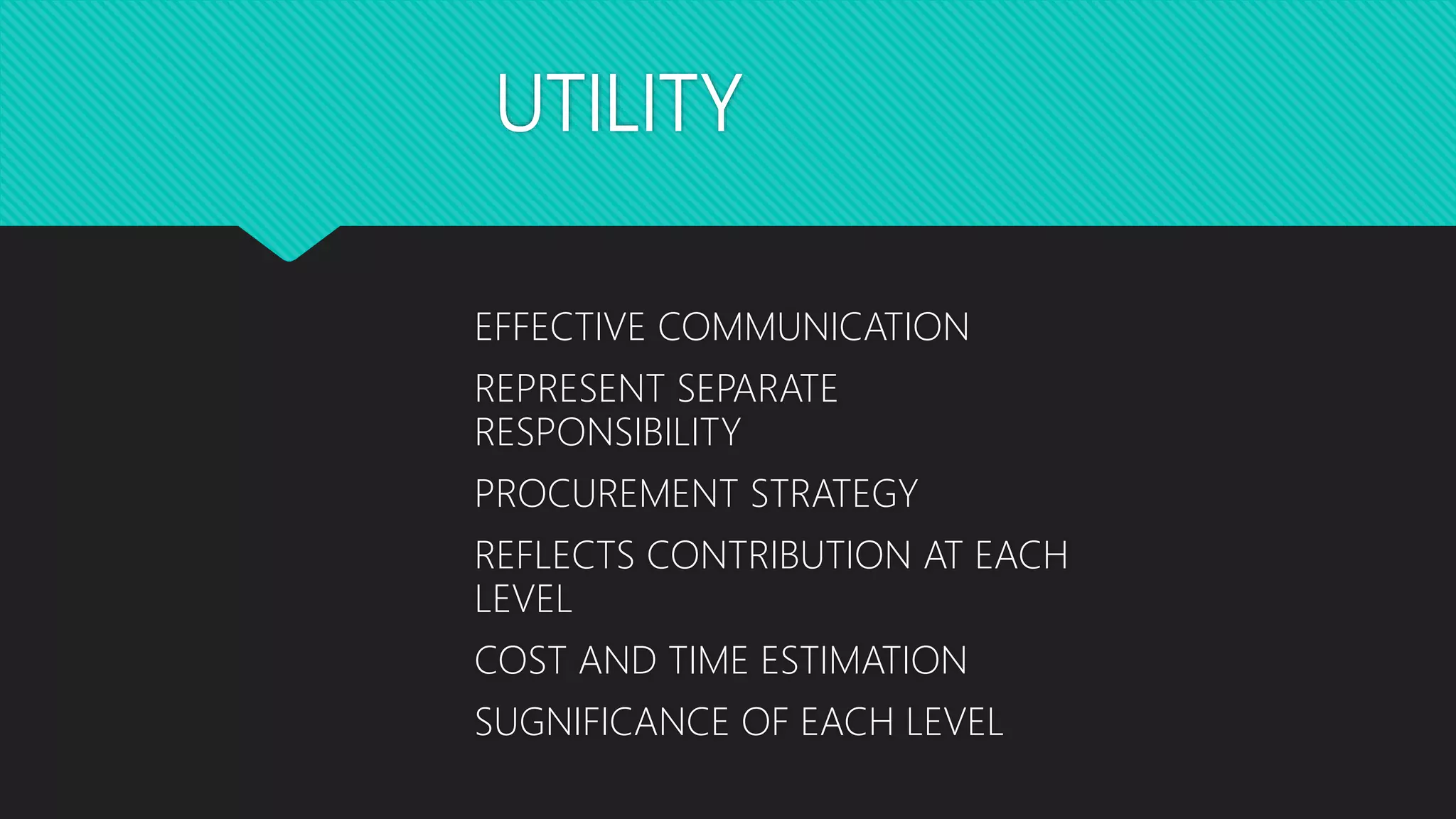
UTILITY
EFFECTIVE COMMUNICATION
REPRESENT SEPARATE
RESPONSIBILITY
PROCUREMENT STRATEGY
REFLECTS CONTRIBUTION AT EACH
LEVEL
COST AND TIME ESTIMATION
SUGNIFICANCE OF EACH LEVEL
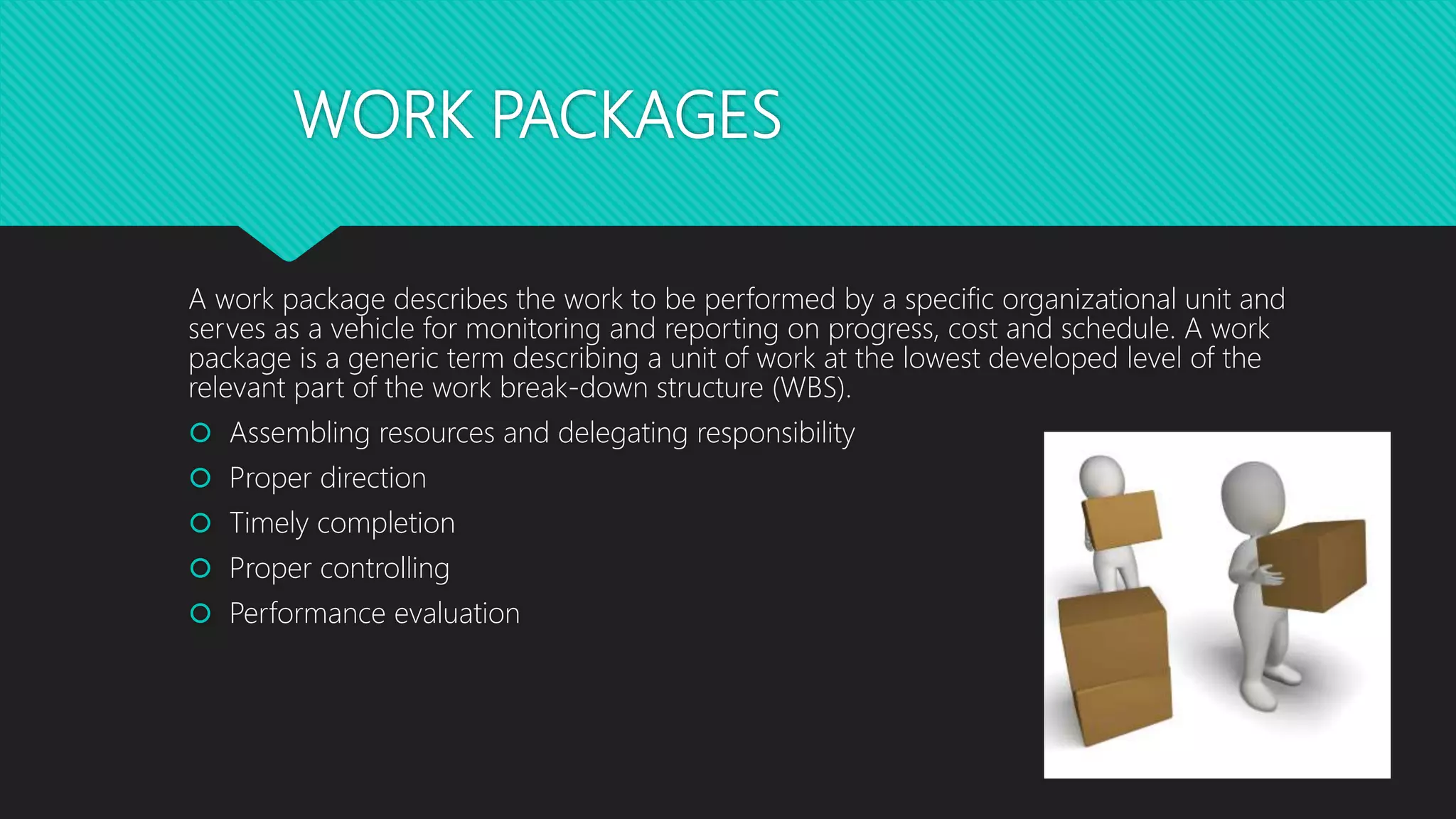
WORK PACKAGES
A work package describes the work to be performed by a specific organizational unit and
serves as a vehicle for monitoring and reporting on progress, cost and schedule. A work
package is a generic term describing a unit of work at the lowest developed level of the
relevant part of the work break-down structure (WBS).
 Assembling resources and delegating responsibility
 Proper direction
 Timely completion
 Proper controlling
 Performance evaluation
PROJECT SCHEDULING
SCHEDULE IS THE CONVERSION OF A PROJECT ACTION
PLAN INTO AN OPERATING TIMETABLE. PROJECT
SCHEDULING IS THE PROCESS OF LISTING DOWN STEP-
BY-STEP IN SEQUENTIAL ORDER THE TASKS OR ACTIVITIES
INVOLVED IN THE IMPLEMENTATION OF PROJECTS.
 FRAMEWORK FOR PLANNING, SCHEDULING,MONITORING
AND CONTROLLING THE PROJECT.
 INTERDEPENDENCE OF TASKS.
 TIME SCHEDULE
 PROPER COMMUNICATION
 DEFINES CRITICAL ACTIVITIES
PROJECT SCHEDULING TECHNIQUES
BAR CHARTS (GANTT CHARTS)
RAT AND CAT SCHEDULES
NETWORK SCHEDULES
LINE OF BALANCE
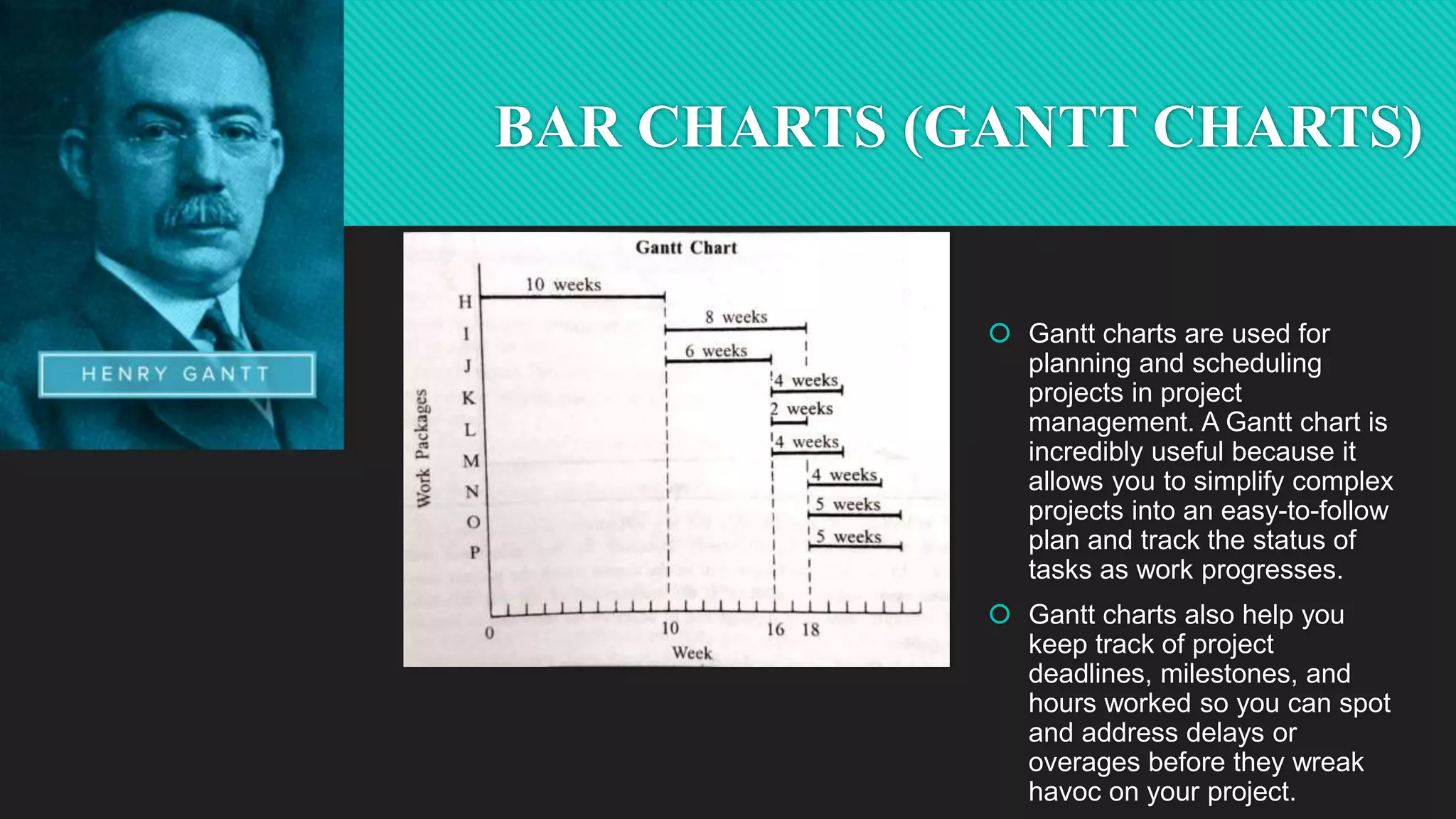
BAR CHARTS (GANTT CHARTS)
 Gantt charts are used for
planning and scheduling
projects in project
management. A Gantt chart is
incredibly useful because it
allows you to simplify complex
projects into an easy-to-follow
plan and track the status of
tasks as work progresses.
 Gantt charts also help you
keep track of project
deadlines, milestones, and
hours worked so you can spot
and address delays or
overages before they wreak
havoc on your project.
COMPONENTS OF GANTT CHART
• Task list: Runs vertically down the left of the gantt chart to describe project work and may be
organized into groups and subgroups
• Timeline: Runs horizontally across the top of the gantt chart and shows months, weeks, days, and
years
• Dateline: A vertical line that highlights the current date on the gantt chart
• Bars: Horizontal markers on the right side of the gantt chart that represent tasks and show
progress, duration, and start and end dates
• Milestones: Yellow diamonds that call out major events, dates, decisions, and deliverables
• Dependencies: Light gray lines that connect tasks that need to happen in a certain order
• Progress: Shows how far along work is and may be indicated by percent complete and/or bar
shading
• Resource assigned: Indicates the person or team responsible for completing a task
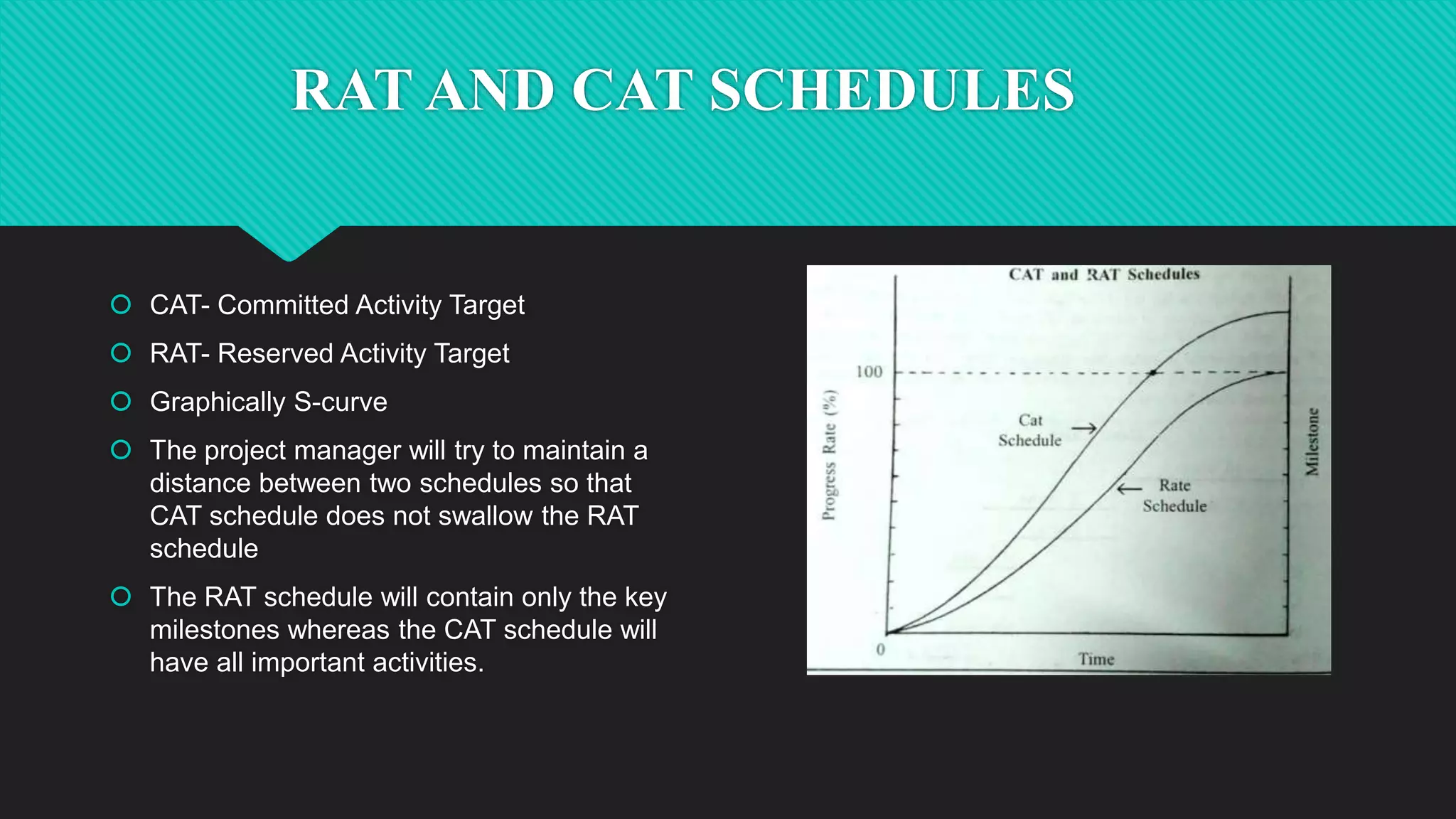
RAT AND CAT SCHEDULES
 CAT- Committed Activity Target
 RAT- Reserved Activity Target
 Graphically S-curve
 The project manager will try to maintain a
distance between two schedules so that
CAT schedule does not swallow the RAT
schedule
 The RAT schedule will contain only the key
milestones whereas the CAT schedule will
have all important activities.
NETWORK SCHEDULE & LINE OF BALANCE
NETWORK SCHEDULES- This technique is
based on drawing the logical relationships
between construction operations and
establishing and funding the operation which
has the most crucial effect on the project
duration. This is performed through PERT and
CPM techniques.
LINE OF BALANCE- It is an extension of Gantt
Chart which collects, measures and presents
information relating to time, cost and
accomplishment of the project phases. It shows
the progress status.
REVIEW QUESTIONS
Q- WAS THE CONCEPT OF WORK PACKAGES USED? IF SO, WHAT WAS INCLUDED IN WORK
PACKAGE?
Q- “GANTT CHART IS EVERYONE’S FAVORITE.” EXPLAIN THE STATEMENT.
Q- DESCRIBE THE PROJECT MASTER PLAN FOR PROJECT WHICH YOU KNOW. WHAT ARE ITS
CONTENTS? SHOW A TYPICAL MASTER PLAN.
Q- WRITE SHORT NOTES:
(i) NETWORK TECHNIQUE
(ii) RAT AND CAT SCHEDULE
(iii) LINE OF BALANCE
THANKS

PROJECT PLANNING

  • 1.
    PROJECT PLANNING DR. RICHA SINGHAL ASSOCIATEPROFESSOR DEPTT. OF EAFM S.S.JAIN SUBODH PG COLLEGE, JAIPUR (RAJ.)
  • 2.
    PRESENTATION OUTLINE  PROJECT PLANNING:INTRODUCTION STEPS OF DEVELOPING A PROJECT PLAN  PLANNING FUNDAMENTALS  PROJECT MASTER PLAN  IMPORTANCE OF MASTER PLAN  TECHNIQUES OF PROJECT PLANNING  WORK BREAK DOWN STRUCTURE  WORK PACKAGES  PROJECT SCHEDULING  BAR CHARTS  RAT AND CAT SCHEDULE  NETWORK SCHEDULE (PERT/CPM)  LINE OF BALANCE.
  • 3.
    Planning is asystematic way of deciding about doing things in a purposeful manner. when this approach is applied exclusively for project, it is termed as project planning. it is the process of deciding in advance about the future course of actions to be taken. Project planning is part of project management, which relates to the use of schedules such as Gantt charts to plan and subsequently report progress within the project environment. Project planning can be done manually or by the use of project management software. Project planning is a discipline for stating how to complete a project within a certain timeframe, usually with defined stages, and with designated resources. INTRODUCTION
  • 4.
    STEPS OF DEVELOPINGA PROJECT PLAN DEVELOPMENT OF PROJECT PLAN OBJECTIVES PROGRAMMING OFACTION SCHEDULING OF RESOURCES AND TIME ORGANISING OF A PROJECT TEAM, INFRASTRUCTURE AND WORKING METHODS BUDGETING DESIGNING A CONTROLLING SYSTEM
  • 5.
    PLANNING FUNDAMENTALS OBJECTIVITY SCHEDULE PROJECT SCOPE STATEMENT TEAMWORK BUDGETS QUALITY CRITERIA PROJECT RESOURCES PROJECT LIMITATIONS UNIFORM THEORY FEASIBILITY ESTIMATION PERFORMANCE CRITERIA ORGANIZATION AND MANAGEMENT PERSONNEL
  • 6.
    IMPORTANCE OF PROJECTPLANNING  Direction means to give proper information, accurate instructions and useful guidance to the subordinates. It is impossible without planning. It is because planning tells us what to do, how to do it and when to do it. Therefore, planning helps to give the right direction.  With control, the actual performance of an employee is compared with the plans, and deviations (if any) are found out and corrected. It is impossible to achieve such control without the right planning. Therefore, planning becomes necessary to keep good control.  Every organization has certain objectives or targets. It keeps working hard to fulfill these goals. Planning helps an organization to achieve these aims, but with some ease and promptness. Planning also helps an organization to avoid doing some random ( done by chance) activities.  A good plan provides various financial and non-financial incentives to both managers and employees. These incentives motivate them to work hard and achieve the objectives of the organization. Thus, planning through various incentives helps to motivate the personnel of an organization.  Planning helps managers to express their creativity and innovation. It brings satisfaction to the managers and eventually a success to the organization.
  • 7.
    Cont…..  A managermakes many different plans. Then the manager selects or chooses the best of all available strategies. Making a selection or choosing something means to take a decision. So, decision-making is facilitated by planning.  Planning makes optimum utilization of all available resources. This entails a cost-benefit analysis for each project task so that planners don’t waste valuable resources and avoids their duplication. It aims to give the highest returns at the lowest possible cost. It thus increases the overall efficiency  Often, the plans of all departments of an organization are well coordinated with each other. Similarly, the short-term, medium-term and long-term plans of an organization are also coordinated with each other. Such proper coordination is possible only because of efficient planning.  Organizing means to bring together all available resources, i.e. 6 Ms. Organizing is not possible without planning. It is so, since, planning tells us the number of resources required and when are they needed. It means that planning aids in organizing in an efficient way.  A project plan takes into consideration the team’s communication needs and pinpoints the most effective channels to keep collaborators connected — such as email, chat, virtual meetings, shared documents, and more.  Involving employees in project planning encourages them to contribute their perspective and skill, rather than simply telling them what they need to do. This ensures more effective execution and makes team members feel like a valued part of the company which improves employee retention in company.  There are many risks involved in any modern business. Planning helps to forecast these business-related risks. It also helps to take the necessary precautions to avoid these risks and prepare for future uncertainties in advance. Thus, it reduces business risks.
  • 8.
    PROJECT MASTER PLAN Allthe functional areas of the organization attached to the project should be involved in the planning process. Although each area develops its own plan but all such plans becomes a part of a single overall plan. This overall plan is referred to as the project master plan or project summary plan. After assessing the feasibility of a project, creating a Master Project Plan defines the scope of development both in the architectural sense as well as it provides milestones that ensure that the construction is executed in the pre-defined timeframe. The contents of master plans vary depending on the size, complexity and nature of the project. The master plan has three sections:-
  • 9.
    IMPORTANCE OF MASTERPLAN • The master planning provides a road map for all future project development decisions. • The master plan, even if seen by some as an additional cost, can eventually lead to savings in the long run. • The master plan allows the involvement of all parties concerned in advance and sets out expectations on how the various activities and tasks will be developed. • A master plan approval creates “buy-ins” by the main stakeholders in a project. If everyone gives their “blessing” at the outset, there will be much less chance to ask questions or step back later. • A master plan allows you to estimate costs before the actual work begins. This also allows you to raise funds for a longer period of time to fund your project. • General planning can create visibility and credibility for a project. If a project’s vision can be presented to its potential users, it often generates excitement about its potential and this often drives a project and helps it to happen sooner. • Projects that have a planned master plan generally have a higher completion rate than unplanned projects.
  • 10.
    MANAGEMENT SECTION PROJECT OBJECTIVE MAJOR EVENTS MILESTONES CONSTRAINTSAND SOLUTIONS OVERALL REQUIREMENTS MASTER SCHEDULE ORGANIZATION SECTION PROJECT ORGANIZATION MANPOWER TRAINING & DEVELOPMENT TECHNICAL SECTION STATEMENT OF WORK SCOPE OF WORK PROJECT SCHEDULES ASSIGNMENTS RESPONSIBILITY WORK BREAK-DOWN TESTING ECONOMIC IMPLEMENTATION DOCUMENTATION WORK REVIEW PLAN QUALITY PLAN CHANGE CONTROL PLAN BUDGET AND FINANCIAL SUPPORT JUSTIFICATION
  • 11.
    TECHNIQUES OF PROJECTPLANNING  WORK BREAK DOWN STRUCTURE  WORK PACKAGES  PROJECT SCHEDULING  BAR CHARTS  RAT AND CAT SCHEDULE  NETWORK SCHEDULE (PERT/CPM)  LINE OF BALANCE
  • 12.
    WORK BREAK DOWNSTRUCTURE  THE PROCEDURE FOR DEVIDING THE OVERALL PROJECT INTO SUB-ELEMENTS OR SMALL PIECES (WORKPACKAGES) TO BE WELL UNDERSTOOD, PLANNED AND CONTROLLED IS KNOWN AS WBS.  EXECUTED BY THE PROJECT TEAM TO ACCOMPLISH THE PROJECT OJJECTIVES AND CREATE THE REQUIRED DELIVERABLES.
  • 13.
    WBS LEVELS DETAIL RISK CONTROL ESTIMATED ACCURACY WORKPACKAGE VALUE WORK PACKAGE MAN- HOURS PROJECT CATEGORY SUBCATEGORY WORK PACKAGE
  • 14.
    UTILITY EFFECTIVE COMMUNICATION REPRESENT SEPARATE RESPONSIBILITY PROCUREMENTSTRATEGY REFLECTS CONTRIBUTION AT EACH LEVEL COST AND TIME ESTIMATION SUGNIFICANCE OF EACH LEVEL
  • 15.
    WORK PACKAGES A workpackage describes the work to be performed by a specific organizational unit and serves as a vehicle for monitoring and reporting on progress, cost and schedule. A work package is a generic term describing a unit of work at the lowest developed level of the relevant part of the work break-down structure (WBS).  Assembling resources and delegating responsibility  Proper direction  Timely completion  Proper controlling  Performance evaluation
  • 16.
    PROJECT SCHEDULING SCHEDULE ISTHE CONVERSION OF A PROJECT ACTION PLAN INTO AN OPERATING TIMETABLE. PROJECT SCHEDULING IS THE PROCESS OF LISTING DOWN STEP- BY-STEP IN SEQUENTIAL ORDER THE TASKS OR ACTIVITIES INVOLVED IN THE IMPLEMENTATION OF PROJECTS.  FRAMEWORK FOR PLANNING, SCHEDULING,MONITORING AND CONTROLLING THE PROJECT.  INTERDEPENDENCE OF TASKS.  TIME SCHEDULE  PROPER COMMUNICATION  DEFINES CRITICAL ACTIVITIES
  • 17.
    PROJECT SCHEDULING TECHNIQUES BARCHARTS (GANTT CHARTS) RAT AND CAT SCHEDULES NETWORK SCHEDULES LINE OF BALANCE
  • 18.
    BAR CHARTS (GANTTCHARTS)  Gantt charts are used for planning and scheduling projects in project management. A Gantt chart is incredibly useful because it allows you to simplify complex projects into an easy-to-follow plan and track the status of tasks as work progresses.  Gantt charts also help you keep track of project deadlines, milestones, and hours worked so you can spot and address delays or overages before they wreak havoc on your project.
  • 19.
    COMPONENTS OF GANTTCHART • Task list: Runs vertically down the left of the gantt chart to describe project work and may be organized into groups and subgroups • Timeline: Runs horizontally across the top of the gantt chart and shows months, weeks, days, and years • Dateline: A vertical line that highlights the current date on the gantt chart • Bars: Horizontal markers on the right side of the gantt chart that represent tasks and show progress, duration, and start and end dates • Milestones: Yellow diamonds that call out major events, dates, decisions, and deliverables • Dependencies: Light gray lines that connect tasks that need to happen in a certain order • Progress: Shows how far along work is and may be indicated by percent complete and/or bar shading • Resource assigned: Indicates the person or team responsible for completing a task
  • 20.
    RAT AND CATSCHEDULES  CAT- Committed Activity Target  RAT- Reserved Activity Target  Graphically S-curve  The project manager will try to maintain a distance between two schedules so that CAT schedule does not swallow the RAT schedule  The RAT schedule will contain only the key milestones whereas the CAT schedule will have all important activities.
  • 21.
    NETWORK SCHEDULE &LINE OF BALANCE NETWORK SCHEDULES- This technique is based on drawing the logical relationships between construction operations and establishing and funding the operation which has the most crucial effect on the project duration. This is performed through PERT and CPM techniques. LINE OF BALANCE- It is an extension of Gantt Chart which collects, measures and presents information relating to time, cost and accomplishment of the project phases. It shows the progress status.
  • 22.
    REVIEW QUESTIONS Q- WASTHE CONCEPT OF WORK PACKAGES USED? IF SO, WHAT WAS INCLUDED IN WORK PACKAGE? Q- “GANTT CHART IS EVERYONE’S FAVORITE.” EXPLAIN THE STATEMENT. Q- DESCRIBE THE PROJECT MASTER PLAN FOR PROJECT WHICH YOU KNOW. WHAT ARE ITS CONTENTS? SHOW A TYPICAL MASTER PLAN. Q- WRITE SHORT NOTES: (i) NETWORK TECHNIQUE (ii) RAT AND CAT SCHEDULE (iii) LINE OF BALANCE
  • 23.