Concepts Used
Functions of Several Variables
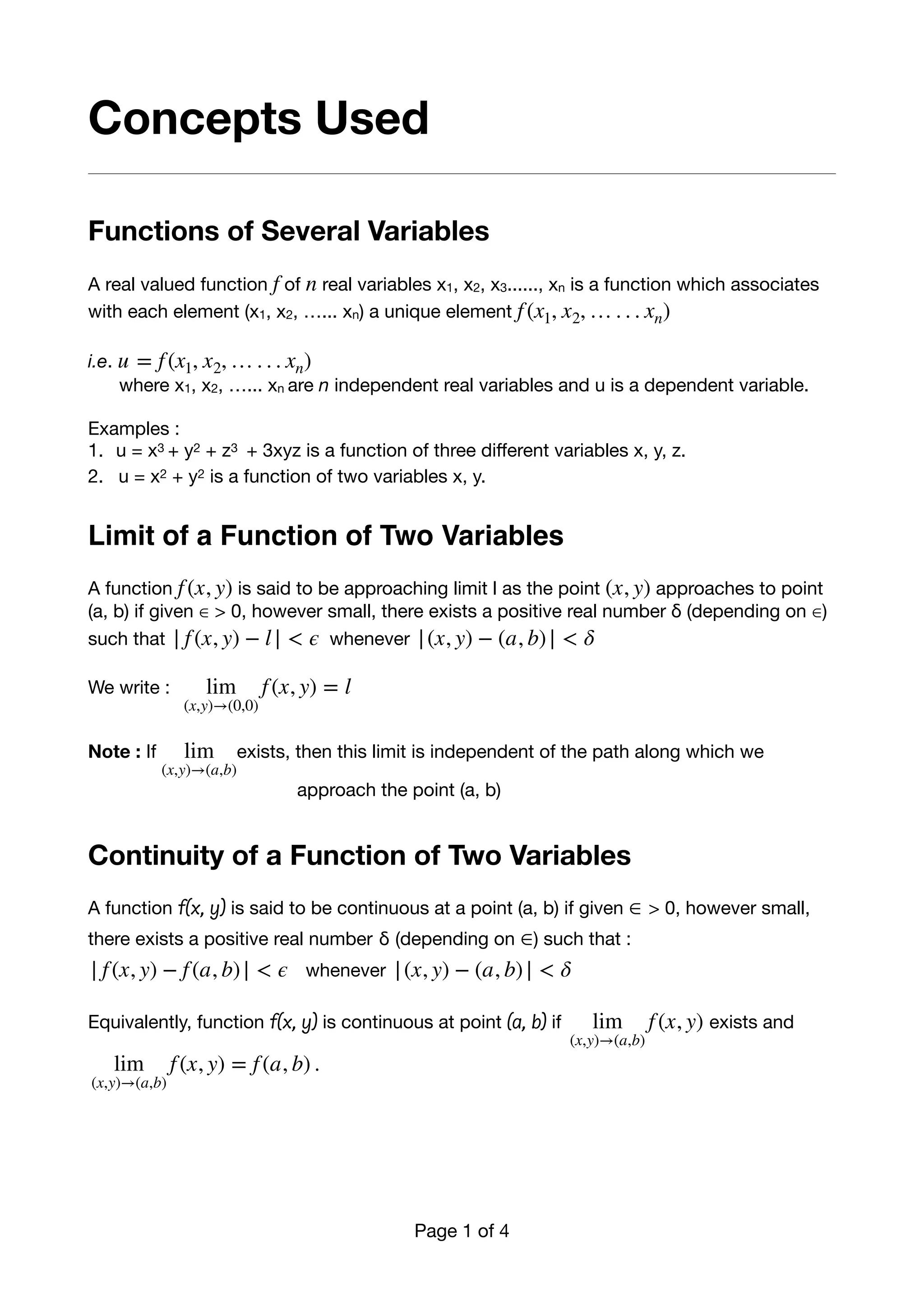
A real valued function of real variables x1, x2, x3......, xn is a function which associates
with each element (x1, x2, …... xn) a unique element 

i.e. 

where x1, x2, …... xn are n independent real variables and u is a dependent variable. 

Examples :  


1. u = x3 + y2 + z3  + 3xyz is a function of three di
ff
erent variables x, y, z.

2. u = x2 + y2 is a function of two variables x, y.

Limit of a Function of Two Variable
s

A function  is said to be approaching limit l as the point approaches to point
(a, b) if given ∈ > 0, however small, there exists a positive real number δ (depending on ∈)
such that    whenever  

We write : 

Note : If exists, then this limit is independent of the path along which we 	 	 

	 	 	 approach the point (a, b)


Continuity of a Function of Two Variables
A function f(x, y) is said to be continuous at a point (a, b) if given ∈ > 0, however small,
there exists a positive real number δ (depending on ∈) such that :

  whenever 

Equivalently, function f(x, y) is continuous at point (a, b) if exists and


f n
f(x1, x2, … . . . xn)
u = f(x1, x2, … . . . xn)
f(x, y) (x, y)
| f(x, y) − l| < ϵ |(x, y) − (a, b)| < δ
lim
(x,y)→(0,0)
f(x, y) = l
lim
(x,y)→(a,b)
| f(x, y) − f(a, b)| < ϵ |(x, y) − (a, b)| < δ
lim
(x,y)→(a,b)
f(x, y)
lim
(x,y)→(a,b)
f(x, y) = f(a, b) .
Page of1 4
Examples
1. If a function is de
fi
ned by = , (x, y) (0,0)

Show that the two iterated limits : and exist but
the simultaneous limit does not exist.


Sol. = = = 1


= = = -1


The two iterated limits exist.


Let along the line , then


= = 

= 


which is not unique as it takes di
ff
erent values for di
ff
erent values of m.


The simultaneous limit does not exist.


f f(x, y)
x2
− y2
x2 + y2
≠
lim
x→0
[lim
y→0
f(x, y)] lim
y→0
[lim
x→0
f(x, y)]
lim
(x,y)→(0,0)
f(x, y)
lim
x→0
[lim
y→0
f(x, y)] lim
x→0
[lim
y→0
x2
− y2
x2 + y2
] lim
x→0
x2
x2
lim
y→0
[lim
x→0
f(x, y)] lim
y→0
[lim
x→0
x2
− y2
x2 + y2
] lim
y→0
−y2
y2
∴
(x, y) → (0,0) y = mx
lim
(x,y)→(0,0)
f(x, y) lim
(x,y)→(0,0)
x2
− y2
x2 + y2
lim
x→0
x2
− m2
x2
x2 + m2x2
lim
x→0
1 − m2
1 + m2
∴ lim
(x,y)→(0,0)
x2
− y2
x2 + y2
Page of2 4
2. Show that = 0

Sol. = Put , 

= 

= 

= 

= 

= 


lim
(x,y)→(0,0)
x4
− y4
x2 + y2
|
x4 − y4
x2 + y2
− 0| |x2
− y2
| x = r cosθ y = r sinθ
|r2
cos2
θ − r2
sin2
θ|
|r2
(cos2
θ − sin2
θ)|
|r2
(cos2θ)|
r2
|(cos2θ)| ≤ r2
[ ∵ |cos2θ| ≤ 1]
x2
+ y2
< ϵ if x2
<
ϵ
2
and y2
<
ϵ
2
, where ϵ > 0
∴ |
x4
− y4
x2 + y2
− 0| < ϵ if |x|2
<
ϵ
2
and |y|2
<
ϵ
2
or |
x4
− y4
x2 + y2
− 0| < ϵ if |x| <
ϵ
2
and |y| <
ϵ
2
or |
x4
− y4
x2 + y2
− 0| <  ϵ if |x| < δ and |y| < δ where δ =
ϵ
2
or |
x4
− y4
x2 + y2
− 0| <  ϵ if |x − 0| < δ and |y − 0| < δ
∴ lim
(x,y)→(0,0)
x4
− y4
x2 + y2
= 0
Page of3 4


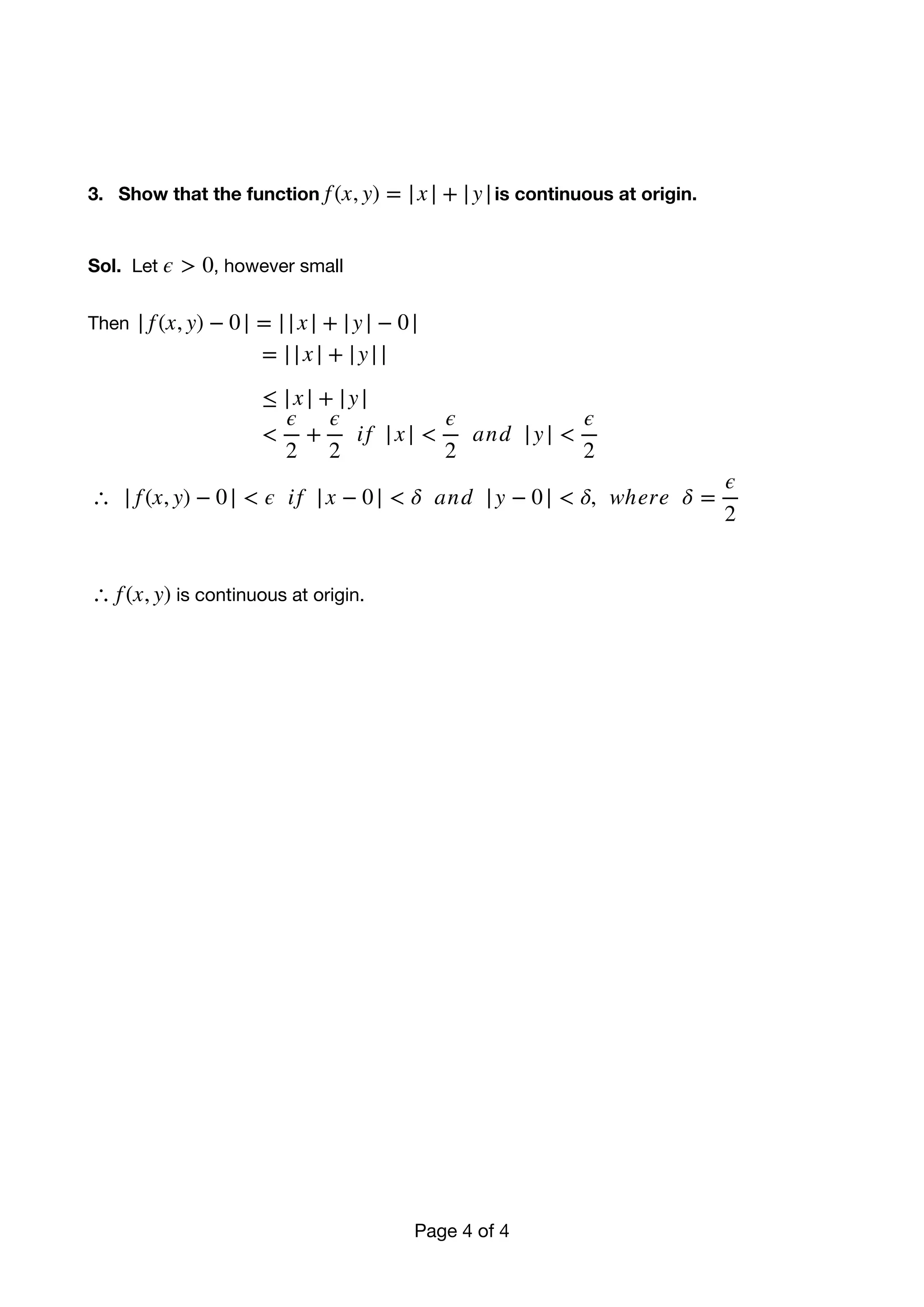
3. Show that the function is continuous at origin.


Sol. Let , however small


Then 


is continuous at origin.
f(x, y) = |x| + |y|
ϵ > 0
| f(x, y) − 0| = ||x| + |y| − 0|
= ||x| + |y||
≤ |x| + |y|
<
ϵ
2
+
ϵ
2
if |x| <
ϵ
2
and |y| <
ϵ
2
∴ | f(x, y) − 0| < ϵ if |x − 0| < δ and |y − 0| < δ, where δ =
ϵ
2
∴ f(x, y)
Page of4 4

Functions of several variables

  • 1.
    Concepts Used Functions ofSeveral Variables A real valued function of real variables x1, x2, x3......, xn is a function which associates with each element (x1, x2, …... xn) a unique element i.e. where x1, x2, …... xn are n independent real variables and u is a dependent variable.  Examples :   1. u = x3 + y2 + z3  + 3xyz is a function of three di ff erent variables x, y, z. 2. u = x2 + y2 is a function of two variables x, y. Limit of a Function of Two Variable s A function  is said to be approaching limit l as the point approaches to point (a, b) if given ∈ > 0, however small, there exists a positive real number δ (depending on ∈) such that    whenever   We write : Note : If exists, then this limit is independent of the path along which we 
 approach the point (a, b) Continuity of a Function of Two Variables A function f(x, y) is said to be continuous at a point (a, b) if given ∈ > 0, however small, there exists a positive real number δ (depending on ∈) such that :   whenever Equivalently, function f(x, y) is continuous at point (a, b) if exists and f n f(x1, x2, … . . . xn) u = f(x1, x2, … . . . xn) f(x, y) (x, y) | f(x, y) − l| < ϵ |(x, y) − (a, b)| < δ lim (x,y)→(0,0) f(x, y) = l lim (x,y)→(a,b) | f(x, y) − f(a, b)| < ϵ |(x, y) − (a, b)| < δ lim (x,y)→(a,b) f(x, y) lim (x,y)→(a,b) f(x, y) = f(a, b) . Page of1 4
  • 2.
    Examples 1. If afunction is de fi ned by = , (x, y) (0,0)
 Show that the two iterated limits : and exist but the simultaneous limit does not exist.
 
 Sol. = = = 1
 
 = = = -1
 
 The two iterated limits exist.
 
 Let along the line , then
 
 = = 
 = 
 
 which is not unique as it takes di ff erent values for di ff erent values of m.
 
 The simultaneous limit does not exist.


 f f(x, y) x2 − y2 x2 + y2 ≠ lim x→0 [lim y→0 f(x, y)] lim y→0 [lim x→0 f(x, y)] lim (x,y)→(0,0) f(x, y) lim x→0 [lim y→0 f(x, y)] lim x→0 [lim y→0 x2 − y2 x2 + y2 ] lim x→0 x2 x2 lim y→0 [lim x→0 f(x, y)] lim y→0 [lim x→0 x2 − y2 x2 + y2 ] lim y→0 −y2 y2 ∴ (x, y) → (0,0) y = mx lim (x,y)→(0,0) f(x, y) lim (x,y)→(0,0) x2 − y2 x2 + y2 lim x→0 x2 − m2 x2 x2 + m2x2 lim x→0 1 − m2 1 + m2 ∴ lim (x,y)→(0,0) x2 − y2 x2 + y2 Page of2 4
  • 3.
    2. Show that= 0
 Sol. = Put , 
 = 
 = 
 = 
 = 
 = 


 lim (x,y)→(0,0) x4 − y4 x2 + y2 | x4 − y4 x2 + y2 − 0| |x2 − y2 | x = r cosθ y = r sinθ |r2 cos2 θ − r2 sin2 θ| |r2 (cos2 θ − sin2 θ)| |r2 (cos2θ)| r2 |(cos2θ)| ≤ r2 [ ∵ |cos2θ| ≤ 1] x2 + y2 < ϵ if x2 < ϵ 2 and y2 < ϵ 2 , where ϵ > 0 ∴ | x4 − y4 x2 + y2 − 0| < ϵ if |x|2 < ϵ 2 and |y|2 < ϵ 2 or | x4 − y4 x2 + y2 − 0| < ϵ if |x| < ϵ 2 and |y| < ϵ 2 or | x4 − y4 x2 + y2 − 0| <  ϵ if |x| < δ and |y| < δ where δ = ϵ 2 or | x4 − y4 x2 + y2 − 0| <  ϵ if |x − 0| < δ and |y − 0| < δ ∴ lim (x,y)→(0,0) x4 − y4 x2 + y2 = 0 Page of3 4
  • 4.
    
 
 3. Show thatthe function is continuous at origin. 
 Sol. Let , however small
 
 Then 
 
 is continuous at origin. f(x, y) = |x| + |y| ϵ > 0 | f(x, y) − 0| = ||x| + |y| − 0| = ||x| + |y|| ≤ |x| + |y| < ϵ 2 + ϵ 2 if |x| < ϵ 2 and |y| < ϵ 2 ∴ | f(x, y) − 0| < ϵ if |x − 0| < δ and |y − 0| < δ, where δ = ϵ 2 ∴ f(x, y) Page of4 4