Fun With
Magnets
Bhavya Mohindru
Magnets
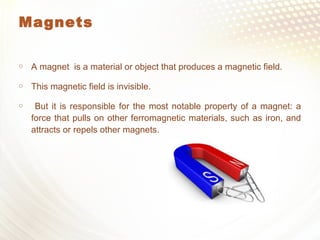
 A magnet is a material or object that produces a magnetic field.
 This magnetic field is invisible.
 But it is responsible for the most notable property of a magnet: a
force that pulls on other ferromagnetic materials, such as iron, and
attracts or repels other magnets.
Discovery
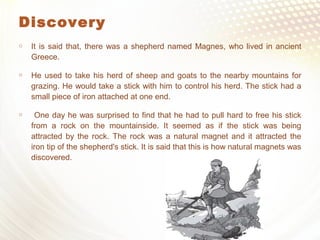
 It is said that, there was a shepherd named Magnes, who lived in ancient
Greece.
 He used to take his herd of sheep and goats to the nearby mountains for
grazing. He would take a stick with him to control his herd. The stick had a
small piece of iron attached at one end.
 One day he was surprised to find that he had to pull hard to free his stick
from a rock on the mountainside. It seemed as if the stick was being
attracted by the rock. The rock was a natural magnet and it attracted the
iron tip of the shepherd's stick. It is said that this is how natural magnets was
discovered.
Magnetite/ Lodestone
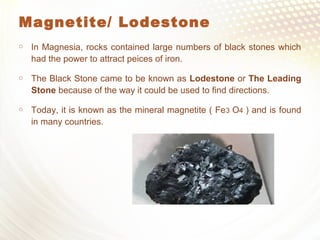
 In Magnesia, rocks contained large numbers of black stones which
had the power to attract peices of iron.
 The Black Stone came to be known as Lodestone or The Leading
Stone because of the way it could be used to find directions.
 Today, it is known as the mineral magnetite ( Fe3 O4 ) and is found
in many countries.
Magnetic & Non - Magnetic
Substances
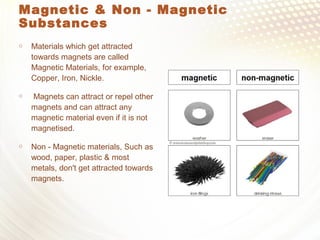
 Materials which get attracted
towards magnets are called
Magnetic Materials, for example,
Copper, Iron, Nickle.
 Magnets can attract or repel other
magnets and can attract any
magnetic material even if it is not
magnetised.
 Non - Magnetic materials, Such as
wood, paper, plastic & most
metals, don't get attracted towards
magnets.
Test For Magnetism : Compass
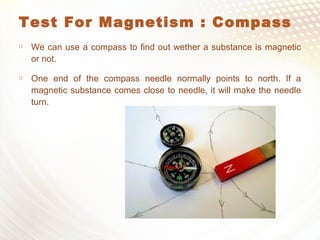
 We can use a compass to find out wether a substance is magnetic
or not.
 One end of the compass needle normally points to north. If a
magnetic substance comes close to needle, it will make the needle
turn.
Test For Magnetism : Repulsion
 Take a metal & a known magnet.
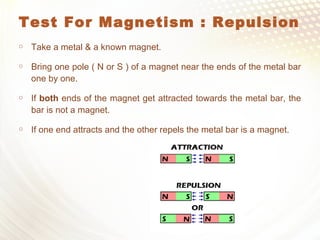
 Bring one pole ( N or S ) of a magnet near the ends of the metal bar
one by one.
 If both ends of the magnet get attracted towards the metal bar, the
bar is not a magnet.
 If one end attracts and the other repels the metal bar is a magnet.
Magnetic Compass
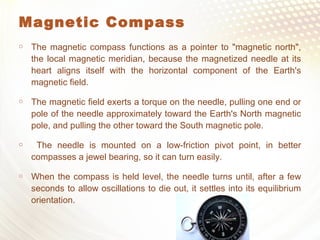
 The magnetic compass functions as a pointer to "magnetic north",
the local magnetic meridian, because the magnetized needle at its
heart aligns itself with the horizontal component of the Earth's
magnetic field.
 The magnetic field exerts a torque on the needle, pulling one end or
pole of the needle approximately toward the Earth's North magnetic
pole, and pulling the other toward the South magnetic pole.
 The needle is mounted on a low-friction pivot point, in better
compasses a jewel bearing, so it can turn easily.
 When the compass is held level, the needle turns until, after a few
seconds to allow oscillations to die out, it settles into its equilibrium
orientation.
Attraction & Replusion
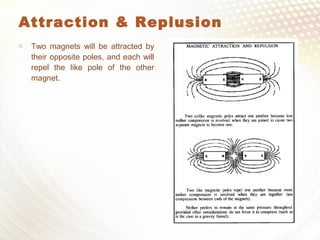
 Two magnets will be attracted by
their opposite poles, and each will
repel the like pole of the other
magnet.
An Isolated Magnetic Pole Does'nt
Exist
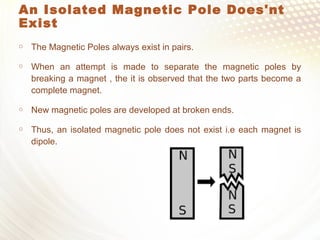
 The Magnetic Poles always exist in pairs.
 When an attempt is made to separate the magnetic poles by
breaking a magnet , the it is observed that the two parts become a
complete magnet.
 New magnetic poles are developed at broken ends.
 Thus, an isolated magnetic pole does not exist i.e each magnet is
dipole.
Uses Of Magnets
 It is used in a Compass to find directions
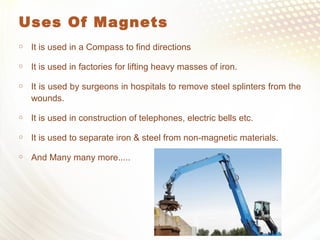
 It is used in factories for lifting heavy masses of iron.
 It is used by surgeons in hospitals to remove steel splinters from the
wounds.
 It is used in construction of telephones, electric bells etc.
 It is used to separate iron & steel from non-magnetic materials.
 And Many many more.....
Fun With Magnets

Fun With Magnets

  • 1.
  • 2.
    Magnets  A magnetis a material or object that produces a magnetic field.  This magnetic field is invisible.  But it is responsible for the most notable property of a magnet: a force that pulls on other ferromagnetic materials, such as iron, and attracts or repels other magnets.
  • 3.
    Discovery  It issaid that, there was a shepherd named Magnes, who lived in ancient Greece.  He used to take his herd of sheep and goats to the nearby mountains for grazing. He would take a stick with him to control his herd. The stick had a small piece of iron attached at one end.  One day he was surprised to find that he had to pull hard to free his stick from a rock on the mountainside. It seemed as if the stick was being attracted by the rock. The rock was a natural magnet and it attracted the iron tip of the shepherd's stick. It is said that this is how natural magnets was discovered.
  • 4.
    Magnetite/ Lodestone  InMagnesia, rocks contained large numbers of black stones which had the power to attract peices of iron.  The Black Stone came to be known as Lodestone or The Leading Stone because of the way it could be used to find directions.  Today, it is known as the mineral magnetite ( Fe3 O4 ) and is found in many countries.
  • 5.
    Magnetic & Non- Magnetic Substances  Materials which get attracted towards magnets are called Magnetic Materials, for example, Copper, Iron, Nickle.  Magnets can attract or repel other magnets and can attract any magnetic material even if it is not magnetised.  Non - Magnetic materials, Such as wood, paper, plastic & most metals, don't get attracted towards magnets.
  • 6.
    Test For Magnetism: Compass  We can use a compass to find out wether a substance is magnetic or not.  One end of the compass needle normally points to north. If a magnetic substance comes close to needle, it will make the needle turn.
  • 7.
    Test For Magnetism: Repulsion  Take a metal & a known magnet.  Bring one pole ( N or S ) of a magnet near the ends of the metal bar one by one.  If both ends of the magnet get attracted towards the metal bar, the bar is not a magnet.  If one end attracts and the other repels the metal bar is a magnet.
  • 8.
    Magnetic Compass  Themagnetic compass functions as a pointer to "magnetic north", the local magnetic meridian, because the magnetized needle at its heart aligns itself with the horizontal component of the Earth's magnetic field.  The magnetic field exerts a torque on the needle, pulling one end or pole of the needle approximately toward the Earth's North magnetic pole, and pulling the other toward the South magnetic pole.  The needle is mounted on a low-friction pivot point, in better compasses a jewel bearing, so it can turn easily.  When the compass is held level, the needle turns until, after a few seconds to allow oscillations to die out, it settles into its equilibrium orientation.
  • 9.
    Attraction & Replusion Two magnets will be attracted by their opposite poles, and each will repel the like pole of the other magnet.
  • 10.
    An Isolated MagneticPole Does'nt Exist  The Magnetic Poles always exist in pairs.  When an attempt is made to separate the magnetic poles by breaking a magnet , the it is observed that the two parts become a complete magnet.  New magnetic poles are developed at broken ends.  Thus, an isolated magnetic pole does not exist i.e each magnet is dipole.
  • 11.
    Uses Of Magnets It is used in a Compass to find directions  It is used in factories for lifting heavy masses of iron.  It is used by surgeons in hospitals to remove steel splinters from the wounds.  It is used in construction of telephones, electric bells etc.  It is used to separate iron & steel from non-magnetic materials.  And Many many more.....