Cyber Safety
Keeping Our Computers Safe
Overview
Computer Protection
 Key Terms:
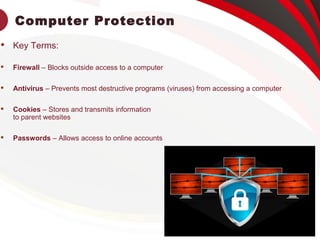
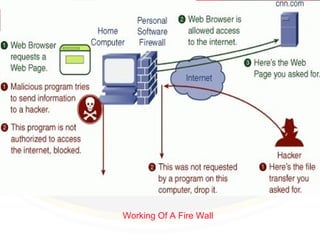
 Firewall – Blocks outside access to a computer
 Antivirus – Prevents most destructive programs (viruses) from accessing a computer
 Cookies – Stores and transmits information
to parent websites
 Passwords – Allows access to online accounts
Working Of A Fire Wall
Computer Protection
 Online:
 Connected to the Internet
 Disconnect when not in use
 Firewall:
 Limits the information sent to and from your computer
 Barrier from the internet
 Examples of firewall programs:
• Zonealarm
• Comodo
• Norton
Computer Protection
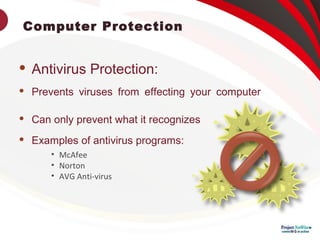
 Antivirus Protection:
 Prevents viruses from effecting your computer
 Can only prevent what it recognizes
 Examples of antivirus programs:
• McAfee
• Norton
• AVG Anti-virus
Computer Protection
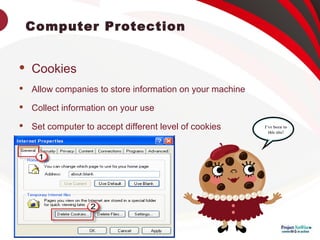
 Cookies
 Allow companies to store information on your machine
 Collect information on your use
 Set computer to accept different level of cookies I’ve been to
this site!
Computer Protection
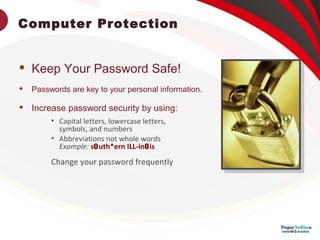
 Keep Your Password Safe!
 Passwords are key to your personal information.
 Increase password security by using:
• Capital letters, lowercase letters,
symbols, and numbers
• Abbreviations not whole words
Example: s0uth*ern ILL-in0is
Change your password frequently
Identity Theft
 Key Terms:
 Email – Messages sent
via the internet
 Websites - Locations on
the Internet
Identity Theft
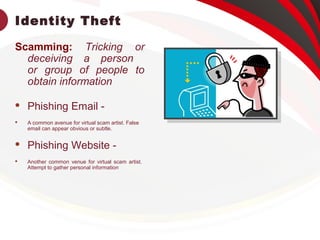
Scamming: Tricking or
deceiving a person
or group of people to
obtain information
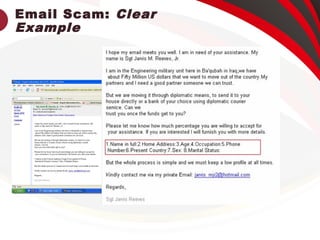
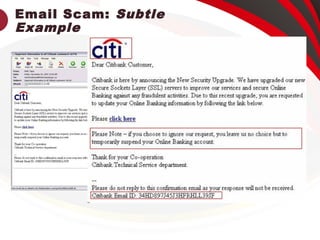
 Phishing Email -
 A common avenue for virtual scam artist. False
email can appear obvious or subtle.
 Phishing Website -
 Another common venue for virtual scam artist.
Attempt to gather personal information
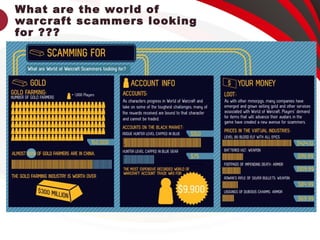
What are the world of
warcraft scammers looking
for ???
Email Scam: Clear
Example
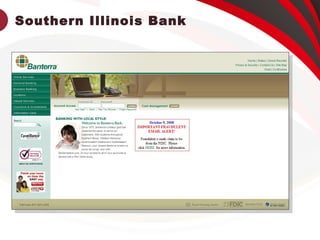
Email Scam: Subtle
Example
Southern Illinois Bank
Email
 Follow these guidelines
when using email:
 Sent messages are
uncontrollable.
 Do not open emails
from email addresses
you do not recognize!
 Treat online situations
the same way you would
personal situations.
Identity Theft: Websites
 Check out the legitimacy of a
website
 Key icons and web addresses
 Well-known site
 Check for misspellings
 Do not give out personal
information
 Set information to private if possible
 If you are unsure just remember
to:
Stop… Look… Call!
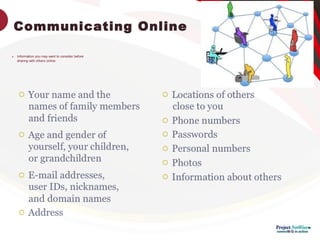
Communicating Online

Information you may want to consider before
sharing with others online:
Spending And Saving Online

Consider the following before buying anything online:

Do you know the store from the brick mortar world?

What is the site’s reputation?

Is the website secure?

Is the offer too good to be true?

Does the merchant collect more information than is needed to
complete the sale?

Use a payment service or credit card for payment.

Review the company's shipping method.
Spending and Saving Online

Protect yourself when banking or paying bills online:
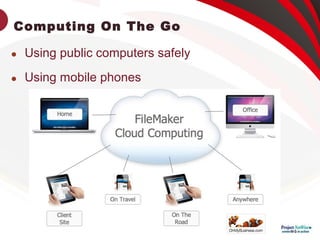
Computing On The Go

Using public computers safely

Using mobile phones
Bullying On Line

What to do if you are “cyber-bullied.”

Safety tips to avoid or deal with online bullying.

Keep personal information private.

Use technology tools to block inappropriate or threatening behavior.

Do not answer phone calls or read messages, e-mails or comments
from “cyber-bullies.” Set them aside in case they are needed by
authorities for evidence.
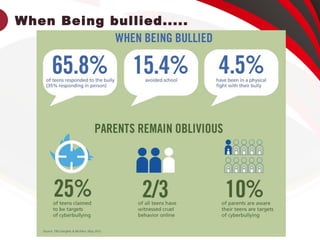
When Being bullied.....
Buying Prescriptions On Line

Know your source to make sure it’s safe

Make sure a website is a state-licensed pharmacy located in the
United States.

Find a list at http://www.nabp.net and http://www.vipps.info.

Look for websites with practices that protect you.

Be sure your privacy is protected.

If you are suspicious or have complaints about a service or
transaction, report the website!
Electronic Medical Records

The advantages of Electronic Medical Records

Recommended online storage services for
Electronic Medical Records.
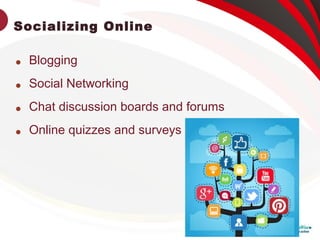
Socializing Online

Blogging

Social Networking

Chat discussion boards and forums

Online quizzes and surveys
Sharing Photos, Images & Video

Sharing Photos Safely

Image copyright infringement

Sharing videos online

Using webcams
Defensive Computing

Browsing and searching

Ads on search engines and sponsored search results.

Identifying secure/trusted websites

Understand the risks in sharing information.

Browser settings and filtering software.
Safe Practices
 Remember these helpful tips when using a computer for
“web surfing” or online transactions:
 Treat your computer
like your home.
 Never give out
personal information!
 Talk to your kids about
Internet safety.
 If it sounds too good
to be true… it usually is!
The First Question
When I’m on line I should never give out:
A. My last name
B. The names of my pets
C. The names of my favorite book or TV shows
Answer 1
 Option A - My last name
Question 2
 Before I buy something online or access a site
requiring payment I should:
A. First make sure I really want it
B. Check with my parents
C. Check out store prices first.
Answer 2
 Option B - Check with my parents
Question 3
 You are in a very high post in a company. You have to
complete a project with your Senior. As you are going
on a vacation your senior asks your Email ID and
Password so that he can access files. It is an
important work. Should you give it ??
A. Give your password as it is important
B. Do not give your password as you do not care about
the work.
C. Do not give him and request your boss for some
more time
Answer 3
 Option C - Do not give him and request your
boss for some more time
Question 4
 If someone I meet online gives me his phone
number I should:
A. Call him as he is your friend and has given his
number too
B. Give him your number and request him to call
after sometime
C. Ask your Parents and check the number
Answer 4
 Option C - Ask your Parents and check the
number
Question 5
 What is Netiquette?
A. Treat others as badly as they treat you.
B. Be polite online and others will do the same
C. Call people names when they do something
you don't like.
D. Repeat messages over an over so others
don't get a chance to talk.
E. No Answer
Answer 5
 Option B - Be polite online and others will do
the same
Question 6
 Which is these is a good way to keep from being
bullied?
A.Delete messages from people you don't know, or from
those people who seem angry or mean.
B.When something doesn't seem right, stay in the site,
chat anyway and give out personal information.
C.Post all your school pictures online along with your
address, email, and phone number.
D.Send messages when you are angry and haven't had
time to think about the situation.
Answer 6
 Option A - Delete messages from people you don't
know, or from those people who seem angry or mean.
Question 7
As I travel through "Cyberspace," I should
never..
A.Take a break and have a snack.
B.Use the Internet to help me with my
homework.
C.Agree to meet someone in person who I have
met online.
Answer 7
 Option C - Agree to meet someone in person
who I have met online.
Question 8
 If someone I meet online asks me to keep a
secret from my parents I should....
A.Keep the secret because they are my "cyber
friend."
B.Tell all of my friends, because it's hard for me
to keep a secret.
C.Tell my parents, because no one should ever
ask me to keep secrets from my parents.
Answer 8
 Option C - Tell my parents, because no one
should ever ask me to keep secrets from my
parents.
Question 9
 Which of these is NOT a good way to keep from
being bullied?
A.Get back at the bullies by doing the same things they
did to you.
B.Don't give out private information .
C.Don't exchange pictures or give out email addresses to
people you meet on the Internet.
D.Don't send a message when you are angry.
Answer 9
 Option A - Get back at the bullies by doing the
same things they did to you.
Question 10
 Someone is on my E-mail "buddy list," "friend
list," or "contact list" and I only know that
person online, he or she is
A. My friend and someone I can trust
B. The Person he or she claims to be
C. Someone I should be cautious about,
because I don't know him or her well.
Answer 10
 Option C - Someone I should be cautious
about, because I don't know him or her well.
Internet safety

Internet safety

  • 1.
  • 2.
  • 3.
    Computer Protection  KeyTerms:  Firewall – Blocks outside access to a computer  Antivirus – Prevents most destructive programs (viruses) from accessing a computer  Cookies – Stores and transmits information to parent websites  Passwords – Allows access to online accounts
  • 4.
    Working Of AFire Wall
  • 5.
    Computer Protection  Online: Connected to the Internet  Disconnect when not in use  Firewall:  Limits the information sent to and from your computer  Barrier from the internet  Examples of firewall programs: • Zonealarm • Comodo • Norton
  • 6.
    Computer Protection  AntivirusProtection:  Prevents viruses from effecting your computer  Can only prevent what it recognizes  Examples of antivirus programs: • McAfee • Norton • AVG Anti-virus
  • 7.
    Computer Protection  Cookies Allow companies to store information on your machine  Collect information on your use  Set computer to accept different level of cookies I’ve been to this site!
  • 8.
    Computer Protection  KeepYour Password Safe!  Passwords are key to your personal information.  Increase password security by using: • Capital letters, lowercase letters, symbols, and numbers • Abbreviations not whole words Example: s0uth*ern ILL-in0is Change your password frequently
  • 9.
    Identity Theft  KeyTerms:  Email – Messages sent via the internet  Websites - Locations on the Internet
  • 10.
    Identity Theft Scamming: Trickingor deceiving a person or group of people to obtain information  Phishing Email -  A common avenue for virtual scam artist. False email can appear obvious or subtle.  Phishing Website -  Another common venue for virtual scam artist. Attempt to gather personal information
  • 11.
    What are theworld of warcraft scammers looking for ???
  • 12.
  • 13.
  • 14.
  • 15.
    Email  Follow theseguidelines when using email:  Sent messages are uncontrollable.  Do not open emails from email addresses you do not recognize!  Treat online situations the same way you would personal situations.
  • 16.
    Identity Theft: Websites Check out the legitimacy of a website  Key icons and web addresses  Well-known site  Check for misspellings  Do not give out personal information  Set information to private if possible  If you are unsure just remember to: Stop… Look… Call!
  • 17.
    Communicating Online  Information youmay want to consider before sharing with others online:
  • 18.
    Spending And SavingOnline  Consider the following before buying anything online:  Do you know the store from the brick mortar world?  What is the site’s reputation?  Is the website secure?  Is the offer too good to be true?  Does the merchant collect more information than is needed to complete the sale?  Use a payment service or credit card for payment.  Review the company's shipping method.
  • 19.
    Spending and SavingOnline  Protect yourself when banking or paying bills online:
  • 20.
    Computing On TheGo  Using public computers safely  Using mobile phones
  • 21.
    Bullying On Line  Whatto do if you are “cyber-bullied.”  Safety tips to avoid or deal with online bullying.  Keep personal information private.  Use technology tools to block inappropriate or threatening behavior.  Do not answer phone calls or read messages, e-mails or comments from “cyber-bullies.” Set them aside in case they are needed by authorities for evidence.
  • 22.
  • 23.
    Buying Prescriptions OnLine  Know your source to make sure it’s safe  Make sure a website is a state-licensed pharmacy located in the United States.  Find a list at http://www.nabp.net and http://www.vipps.info.  Look for websites with practices that protect you.  Be sure your privacy is protected.  If you are suspicious or have complaints about a service or transaction, report the website!
  • 24.
    Electronic Medical Records  Theadvantages of Electronic Medical Records  Recommended online storage services for Electronic Medical Records.
  • 25.
    Socializing Online  Blogging  Social Networking  Chatdiscussion boards and forums  Online quizzes and surveys
  • 26.
    Sharing Photos, Images& Video  Sharing Photos Safely  Image copyright infringement  Sharing videos online  Using webcams
  • 27.
    Defensive Computing  Browsing andsearching  Ads on search engines and sponsored search results.  Identifying secure/trusted websites  Understand the risks in sharing information.  Browser settings and filtering software.
  • 28.
    Safe Practices  Rememberthese helpful tips when using a computer for “web surfing” or online transactions:  Treat your computer like your home.  Never give out personal information!  Talk to your kids about Internet safety.  If it sounds too good to be true… it usually is!
  • 30.
    The First Question WhenI’m on line I should never give out: A. My last name B. The names of my pets C. The names of my favorite book or TV shows
  • 31.
    Answer 1  OptionA - My last name
  • 32.
    Question 2  BeforeI buy something online or access a site requiring payment I should: A. First make sure I really want it B. Check with my parents C. Check out store prices first.
  • 33.
    Answer 2  OptionB - Check with my parents
  • 34.
    Question 3  Youare in a very high post in a company. You have to complete a project with your Senior. As you are going on a vacation your senior asks your Email ID and Password so that he can access files. It is an important work. Should you give it ?? A. Give your password as it is important B. Do not give your password as you do not care about the work. C. Do not give him and request your boss for some more time
  • 35.
    Answer 3  OptionC - Do not give him and request your boss for some more time
  • 36.
    Question 4  Ifsomeone I meet online gives me his phone number I should: A. Call him as he is your friend and has given his number too B. Give him your number and request him to call after sometime C. Ask your Parents and check the number
  • 37.
    Answer 4  OptionC - Ask your Parents and check the number
  • 38.
    Question 5  Whatis Netiquette? A. Treat others as badly as they treat you. B. Be polite online and others will do the same C. Call people names when they do something you don't like. D. Repeat messages over an over so others don't get a chance to talk. E. No Answer
  • 39.
    Answer 5  OptionB - Be polite online and others will do the same
  • 40.
    Question 6  Whichis these is a good way to keep from being bullied? A.Delete messages from people you don't know, or from those people who seem angry or mean. B.When something doesn't seem right, stay in the site, chat anyway and give out personal information. C.Post all your school pictures online along with your address, email, and phone number. D.Send messages when you are angry and haven't had time to think about the situation.
  • 41.
    Answer 6  OptionA - Delete messages from people you don't know, or from those people who seem angry or mean.
  • 42.
    Question 7 As Itravel through "Cyberspace," I should never.. A.Take a break and have a snack. B.Use the Internet to help me with my homework. C.Agree to meet someone in person who I have met online.
  • 43.
    Answer 7  OptionC - Agree to meet someone in person who I have met online.
  • 44.
    Question 8  Ifsomeone I meet online asks me to keep a secret from my parents I should.... A.Keep the secret because they are my "cyber friend." B.Tell all of my friends, because it's hard for me to keep a secret. C.Tell my parents, because no one should ever ask me to keep secrets from my parents.
  • 45.
    Answer 8  OptionC - Tell my parents, because no one should ever ask me to keep secrets from my parents.
  • 46.
    Question 9  Whichof these is NOT a good way to keep from being bullied? A.Get back at the bullies by doing the same things they did to you. B.Don't give out private information . C.Don't exchange pictures or give out email addresses to people you meet on the Internet. D.Don't send a message when you are angry.
  • 47.
    Answer 9  OptionA - Get back at the bullies by doing the same things they did to you.
  • 48.
    Question 10  Someoneis on my E-mail "buddy list," "friend list," or "contact list" and I only know that person online, he or she is A. My friend and someone I can trust B. The Person he or she claims to be C. Someone I should be cautious about, because I don't know him or her well.
  • 49.
    Answer 10  OptionC - Someone I should be cautious about, because I don't know him or her well.