CLASS 8
LS 16 LIGHT
Deepa Unnikrishnan 1
Deepa Unnikrishnan 2
Mirror & Reflection of light
• A mirror is a glass having a shiny or polished surface.
• When light falls on a mirror it is reflected back.
• Mirror changes the direction of light that falls upon it.
3
REFLECTION
• Reflection- The process of bouncing back of light from a smooth and
polished surface.
NORMAL- THE POINT OF INCIDENCE
Deepa Unnikrishnan 4
Incident ray - The ray of light that falls on the
surface.
Reflected ray - The ray of the light that gets
reflected back from the surface.
• Normal - It is an imaginary line that is drawn
perpendicular to the reflecting surface at the point
where the incident ray strikes the surface.
(The point of incidence.)
• The angle of incidence - The angle that the incident ray makes with
the normal.
• The angle of reflection - The angle that the reflected ray makes with
the normal.
Deepa Unnikrishnan
5
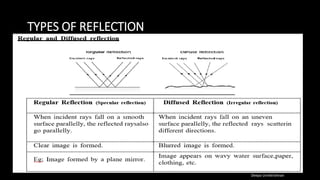
TYPES OF REFLECTION
Deepa Unnikrishnan
6
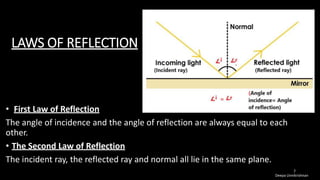
LAWS OF REFLECTION
• First Law of Reflection
The angle of incidence and the angle of reflection are always equal to each
other.
• The Second Law of Reflection
The incident ray, the reflected ray and normal all lie in the same plane.
Deepa Unnikrishnan
7
What could happen if I threw the light on the
mirror along the normal?
• If light is incident on the mirror
along the normal, then the angle of
reflection and angle of incidence will
be same, and they will be equal to
zero degree.
• The angle of incidence is incident
normal to the plane, so light is
reflected along the same
path.
Deepa Unnikrishnan
8
Deepa Unnikrishnan
9
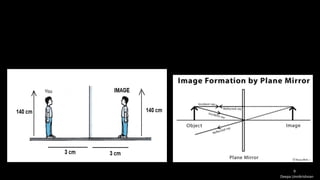
Characteristics of the image by a plane
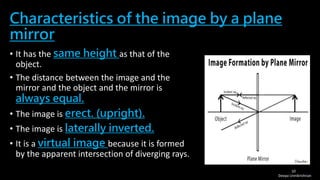
mirror
• It has the same height as that of the
object.
• The distance between the image and the
mirror and the object and the mirror is
always equal.
• The image is erect. (upright).
• The image is laterally inverted.
• It is a virtual image because it is formed
by the apparent intersection of diverging rays.
Deepa Unnikrishnan
10
LATERAL INVERSION
• When an image is formed in a mirror the, the left side of the object
appears at the right side of the image and vice versa. This is called a
lateral inversion.
Deepa Unnikrishnan
11
LUMINOUS & ILLUMINATED OBJECTS
• Illuminated objects - Objects that do not produce light on their own
but reflect light.
• Luminous objects - Objects which can produce light on their own.
Deepa Unnikrishnan
12
MULTIPLE REFLECTION
• If more than one mirrors are placed at certain angles to each other,
reflection of light happens multiple times between the reflecting
surfaces and produce many images.
Deepa Unnikrishnan
13
Applications of Multiple reflections in daily- life
PERISCOPE KALEIDOSCOPE
Deepa Unnikrishnan
14
PERISCOPE-
• A Periscope is an instrument that is
used to look at objects that are not in
the line of sight of the observer. It
works on the phenomena of multiple
reflection. There are two mirrors that
are inclined at an angle 450. It is used
in submarines, tanks and bunkers by
the soldiers
Deepa Unnikrishnan 15
Kaleidoscope-
• It is a device that works on the phenomena
of multiple reflections with the help of three
plane mirrors inside it. We can look into the
Kaleidoscope from one end and the light
enters into the Kaleidoscope from the other
end. When the light falls upon these objects
in the Kaleidoscope, multiple reflections of
these objects are created in the three
Mirrors. This results in the formation of
beautiful and colourful patterns.
Deepa Unnikrishnan
16
DISPERSION OF LIGHT
• The sunlight is white in colour however
this white light
• The white light consists of seven colours
namely VIBGYOR (violet, indigo, blue,
green, yellow, orange and red).
• This arrangement of seven colours of a
white light is called as Spectrum.
• However, due to the reflection of light,
the seven colours can split and be seen as
separate colours rather than a single
white light.
• This phenomenon of the splitting of light
into its constituents is called Dispersion of
light.
Deepa Unnikrishnan
17
Examples of dispersion of light:
• Formation of rainbow due to the
dispersion of white light through the water
droplets.
• Passing of Sunlight through a prism
• Dispersion of light through the soap
Bubbles
• Dispersion of light on the CDs
Deepa Unnikrishnan
18
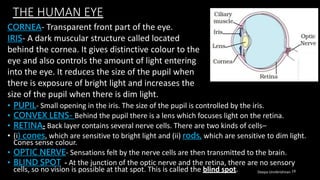
THE HUMAN EYE
• PUPIL- Small opening in the iris. The size of the pupil is controlled by the iris.
• CONVEX LENS- Behind the pupil there is a lens which focuses light on the retina.
• RETINA- Back layer contains several nerve cells. There are two kinds of cells–
• (i) cones, which are sensitive to bright light and (ii) rods, which are sensitive to dim light.
Cones sense colour.
• OPTIC NERVE- Sensations felt by the nerve cells are then transmitted to the brain.
• BLIND SPOT - At the junction of the optic nerve and the retina, there are no sensory
cells, so no vision is possible at that spot. This is called the blind spot.
CORNEA- Transparent front part of the eye.
IRIS- A dark muscular structure called located
behind the cornea. It gives distinctive colour to the
eye and also controls the amount of light entering
into the eye. It reduces the size of the pupil when
there is exposure of bright light and increases the
size of the pupil when there is dim light.
Deepa Unnikrishnan 19